Sep 182025
 

Abstract expressionist artist Mark di Suvero‘s sculpture Declaration (pictured above) is located on the Venice Beach Boardwalk in Los Angeles. It was installed in 2001 to commemorate the Venice Art Walk’s 22nd year and in support of the Venice Family Clinic, a local organization that provides quality health care to those in need. Di Suvero turned 92 today, 9/18.

Although he is well known for his large sculptures, he is also a painter. Some of these works were shown in 2019 at L.A. Louver in Los Angeles along with some of his smaller sculptures (pictured below).

From the L.A. Louver press release about the paintings-

A selection of brilliant abstract paintings by the artist accompanies the sculptures. Like the sculptures, his paintings are never still. Created with dazzling colors in dense layers of linear and freeform gestures, they project a swirling sensation akin to the twirling movement in his three-dimensional works. Accented with phosphorescent paints, the works luminesce and reverberate even in the absence of light (and are especially dazzling when activated by black lights installed throughout the gallery space). “The heart of art is the search for form that is electrifying, that gives life to our vision,” explains di Suvero. “This is the language of emotion. Anesthetic is to kill feeling. Aesthetic is the opposite, aesthetic is feeling. The thing that is most important is the dream, the vision for what doesn’t exist that could exist.”

It was recently announced that L.A. Louver will be closing their Venice Beach space, but in happier news they will be donating the gallery’s complete archive and library to The Huntington in San Marino, California.

Apr 242025
 

“I Like How the Left Side Modulates Up”, 1989, acrylic on canvas (from the “Hitchcock” series)

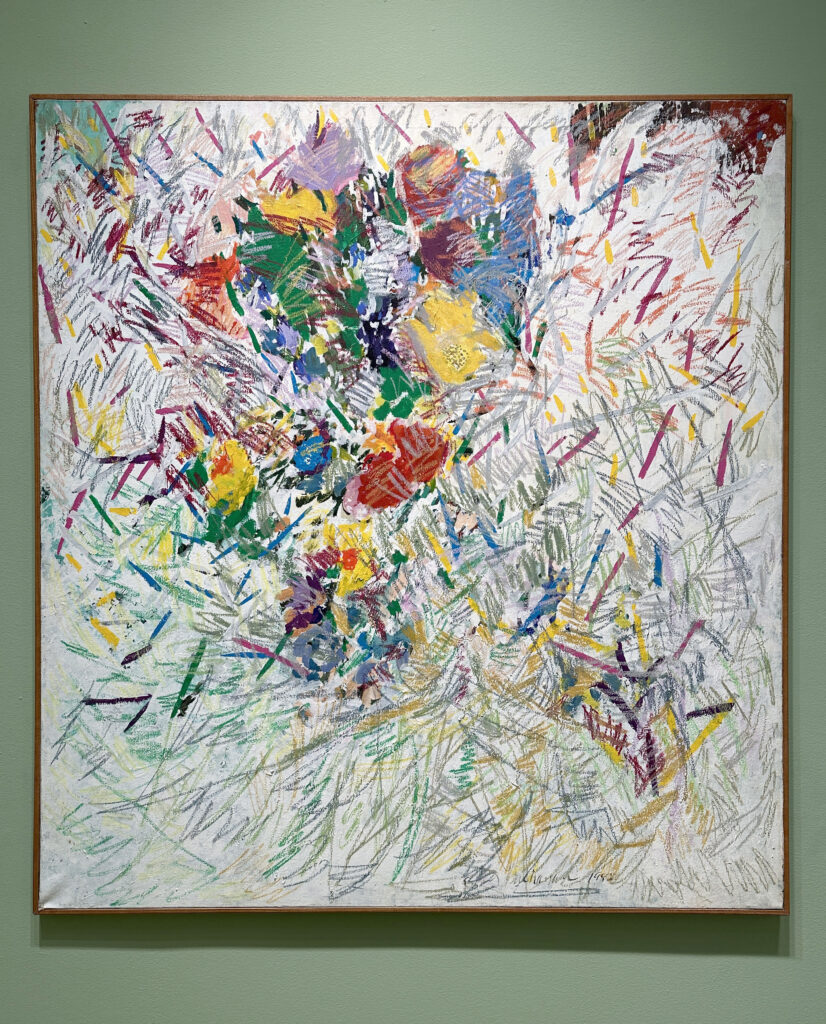
“Apollo, 617”, 1982, acrylic on canvas

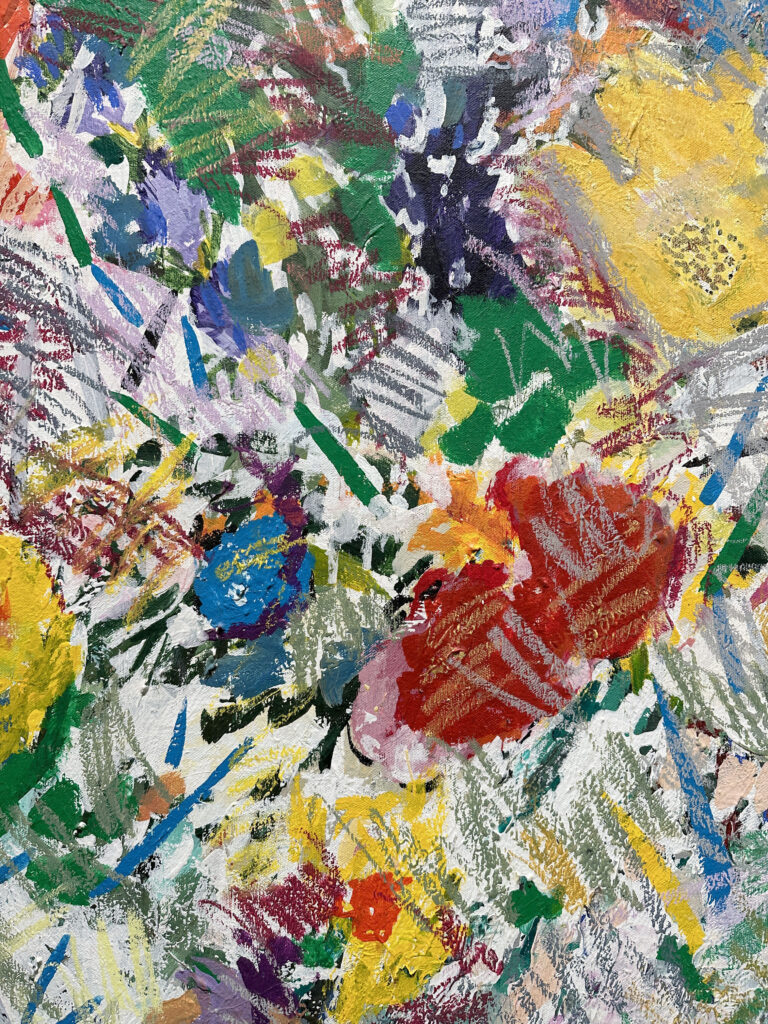
Sundaram Tagore Gallery is currently showing the paintings of the late Robert Natkin for the exhibition A Better Place. The colorful abstract works are from the several series he produced during his lifetime.

Natkin used his artwork to explore different concepts and influences, many of which are listed in the press release below and in the information provided alongside several of the artworks.

“The Beloved (Field Mouse)”, 1969, acrylic on linen

Here, for example, is the information provided for the painting above, from his Field Mouse series-

Natkin explored motile, fragmentary shapes from 1967 onward in the “Field Mouse” series, a reference to a poem by Ezra Pound about the passage of time. These visualizations of fleeting life-experience, with which Natkin sought to form a new emotional vocabulary, often resemble microscopic views of teeming organisms. For him, they were complex emotional landscapes, reflecting a romantic turn when the Natkin family moved from New York to the quiet of rural Connecticut in 1970.

And the Days Are Not Full Enough

And the days are not full enough
And the nights are not full enough
And life slips by like a field mouse
Not shaking the grass
Ezra Pound

More from the gallery’s press release-

Robert Natkin is internationally recognized as an unsurpassed colorist and for the beauty of his large-scale abstract canvases. He was represented by blue-chip New York gallerists Elinor Poindexter in the 1960s and André Emmerich in the 1970s. Today, his work is in the collections of New York’s Metropolitan Museum of Art, Museum of Modern Art, Guggenheim Museum and Whitney Museum of American Art, among others.

Born to a poor and unhappy Russian-Jewish family in Chicago during the Great Depression, Natkin would transcend his traumatic upbringing, often finding refuge in the color and splendor of the movies, charting an industrious course through public art education and briefly co-founding a gallery, to become one of the foremost American abstract colorist painters of the 1960s, ’70s and ’80s. His paintings are life-affirming, sensual celebrations of visual delight, of glorious Hollywood Technicolor, of fascinating surface effects, enticing layers, and sunny outlooks.

Natkin’s painterly journey can be seen through its distinct and loosely phased series as he accumulated years of psychotherapy and read and looked voraciously. They reveal his drive for redemption not just through introspection, but by consistently forging new stylistic syntheses.

FEATURED SERIES

The vigorous, gestural brushwork of Natkin’s early abstractions reflects the seismic impact of the Abstract Expressionists, including Willem de Kooning, and Jackson Pollock, whose work he encountered in an article about Abstract Expressionism in Life magazine in 1949. Natkin also found inspiration in French artists Matisse and Bonnard, among others in the collections of the Art Institute of Chicago where he studied from 1948–1952.

In 1957, Natkin married the painter Judith Dolnick and together they founded the Wells Street Gallery in downtown Chicago, exhibiting cooperatively with a group of young contemporaries who similarly explored free-form abstraction, including the sculptor John Chamberlain, Ann Mattingly, Gerald van de Wiele and friend Ernest Dieringer. Wells Street Gallery made its cultural mark but was commercially unsuccessful, closing two years later, whereupon Natkin and Dolnick moved to New York.

In New York, Natkin’s vigorously abstract paintings took on more rectilinear qualities, decisively so with his Apollo series, characterized by loose vertical bands of color. The series began in the early 1960s under the inspiration of Rilke’s poem Archaic Torso of Apollo, based on a sculptural fragment in the Louvre, with its final imperative: “You have to change your life.” Named after the Greek god of the sun, the arts and healing, the Apollos established for Natkin the purpose of his art as a means of transformation for self and society.

The Apollo series was long-lived, spanning the 1960s and revived in the mid-1970s. The later instances incorporated Natkin’s distinctive technique of applying acrylic paint with a sponge covered in cloths of various textures, which he discovered in 1971. At his Dolnick’s suggestion, Natkin made a painting on a dishcloth because she had seen him make little paintings on handkerchiefs to give to friends, and then came up with the idea of effectively printing from it. The technique increased his productivity and transformed his aesthetic.

The pointillistic, gauzy effect of this technique came into its own in the more muted, diaphanous visions of the Bath series, so named for the English city where Natkin was to have an exhibition. The subtle, atmospheric nature of the Bath paintings are akin to his earlier Intimate Lighting series, which ran through much of the 1970s, and were described by British art critic Peter Fuller as possessing hints of portraiture in their central focus and inspired by Cubism in the clearly applied blocks of sponge-and-cloth-painting.

Natkin’s Straight Edge and Step paintings emerged from a period in the mid-1960s when he was preparing to teach a course on color at Pratt Institute in Brooklyn and read Josef Albers’ theories on its interaction. They also channel the modernist architecture of his native Chicago, his love of jazz singers Billie Holiday and Nina Simone, and the dynamic grid-pattern streets of New York.

He explored motile, fragmentary shapes from 1967 onward in the Field Mouse series, a reference to a poem by Ezra Pound about the passage of time. These visualizations of fleeting life-experience, by which Natkin sought to form a new emotional vocabulary, often resembled microscopic views of teeming organisms and organelles. For him, they were also complex emotional landscapes, reflecting a more romantic turn when the Natkin family moved from New York to the quiet of rural Connecticut in 1970.

In 1977, Natkin produced the Bern series, named for the Swiss capital where the Klee Foundation is located and where Natkin spent many hours among Paul Klee’s works. In this series, he uses more sharply delineated shapes against expansive fields of intense color. Perhaps the boldest colors and shapes appear in the 1980s in the Hitchcock series, an homage to the great director and the movie-theater origins of his artistic journey. Hitchcock’s interest in psychoanalytic themes where dark secrets often drive the narrative, and his charging of the carefully crafted scenery and props with menacing symbolism appealed to Natkin.

Robert Natkin died in 2010 after several years of declining health. Over the course of his career, he demonstrated a remarkable capability of spanning beauty and ugliness in his art, though he dedicated his prime to the struggle of the former over the latter, to the Apollonian ascendancy of light over darkness.

In Somewhere Over the Rainbow, a 1982 documentary by award-winning filmmaker Mike Dibb, Natkin says, “In one sense, I want to be superhuman, but in another sense, I feel I’m barely an animal. And it’s a practice that I think if I don’t always maintain, juggle both these kinds of reality, I could then very easily be done in by the very kind of reparation that I use to make myself and that I hope will help the rest of the world to become a better place. I want to become a better place! Not a person: I want to become a better place, because as a person, I’m going to be gone in—I don’t know—ten minutes or ten years, but I want to become a better place.”

This exhibition closes 4/26/25.


Apr 112025
 

“King Alfred’s Country”, 2006. Acrylic on linen

“Rock Cod Story Place – Freshwater”, 2005. Acrylic on canvas

“Dibirdibi Country”, 2006. Acrylic on canvas

“Dibirdibi Country”, 2010. Acrylic on linen

The expressive paintings pictured above, currently on view at Karma, are by the late Aboriginal Australian artist Mirdidingkingathi Juwarnda Sally Gabori who began painting in 2005, at eighty-one years old. Learning that her paintings are focused on the land she was forcibly relocated from adds an extra layer of poignancy to the work.

From the gallery-

The Kaiadilt artist’s original, nonrepresentational iconography, based on interlocking shapes, passages of pure color, and visible brushstrokes, depicts her primary subject, Bentinck Island, in Australia’s Gulf of Carpentaria, using the language of abstraction. Gestural marks trace the path of rivers; milky white forms indicate the incursion of cyclones; diagrammatic structures map the patterns left on the ocean floor by dugong grazing on seagrass. Rendered from memories of a home she was forced to leave, Gabori’s paintings are, in her words, “about a story place way out to sea.”

Gabori began painting in 2005 around the age of eighty-one. While she started small, working horizontally on a tabletop, the artist soon began using wall-mounted surfaces as large as nineteen-feet wide, moving her body across her compositions as she applied acrylic straight out of the tube and mixed wet on wet directly on her canvases. The resulting paintings, which she made in the last decade of her life, often focused on six significant locations, or Countries, as the Kaiadilt refer to them, on Bentinck: Mirdidingki, Dibirdibi, Dingkari, Makarrki, Thundi, and Nyinyilki. To make these works, Gabori drew on recollections of the island’s topography: its saltpans, reefs, and mangrove swamps; the freshwater pond where she collected waterlilies; the various rivers that run alongside where she, her father, and her husband were born. In 1948, Gabori and the rest of Bentinck’s population were forcibly relocated by Christian missionaries to the nearby Mornington Island. There, parents were separated from their children and the Kaiadilt people were forbidden from speaking their language. Gabori spent the rest of her life on Mornington, only able to visit Bentinck temporarily after the passage of Australian laws that restored Kaiadilt access to the land in 1994.

Rock Cod Story Place – Freshwater (2005), one of the earliest works in this exhibition, visualizes Dibirdibi Country, the area of Bentinck associated with her husband Pat through the Kaiadilt system of naming people after places, as well as the Rock Cod, a being that, according to Kaiadilt cosmology, created the island. Concentric, ovoid rings of unmixed color radiate out from a central mass like the ripples of freshwater that flow into the island’s estuaries. The nearly neon Dingkarri (2006) associatively maps the contours of an islet that was an important fishing ground for the Kaiadilt community. Rather than a literal depiction of the Country’s appearance, Dingkarri is instead a pictorial manifestation of tides in flux: by mixing acrylics on the canvas itself, Gabori created morphing color fields that suggest movement.

Though developed autonomously from Western art history, Gabori’s painterly syntax nonetheless evokes the oeuvres of the American Abstract Expressionists. Evidence of Gabori’s hand is everywhere in My Country (2009), which celebrates Mirdidingki, her birthplace. Working rapidly, she brushed together magenta and white to create a variegated field that morphs as it stretches across the vertical canvas. Close looking reveals a subterranean wash of yellow acrylic peeking through from behind Gabori’s urgent brushstrokes, complicating what at first appears duochromatic. Her jagged, brushy edges and embrace of unadulterated black call to mind Clyfford Still; her arcing, interlocking forms provoke comparison with Amy Sillman. The gestural Didirbidi Country (2010) reads as an exploration of the relations between shapes that abut each other, creating craggy borderlands at their intersections. Beyond its formalism, the work is a recollection of the stone fishing trap walls maintained by Kaiadilt women that branch off of Bentinck’s coastline. In addition to specific cultural meanings and associations encoded in paint, the works convey an affective charge that transcends geography, temporality, and identity.  Refracted through memory and mediated by dispossession, Gabori’s paintings are a living archive of a homeland.

This exhibition closes 4/12/25.


May 142024
 

“Swirl of Sounds- The Ghost in the Banyan Tree”, 1976, Oil on canvas

“Flotilla”, 1962, Oil on linen

“The Blue Drum Path to the Open Coast”, 1977, Oil on canvas

The paintings in Alice Baber: Reverse Infinity at Berry Campbell are alive with color. The delightful paintings were created using thinned-down oils and acrylics to give the work a watercolor effect.

On one wall, the gallery has included the quote below in which Baber described her process-

“When I first conceive of a painting‭, ‬I must feel it‭, ‬I hear it‭, ‬I taste it‭, ‬and I want to eat it‭. ‬I start from the driving force‭ ‬of color‭ (‬color hunger‭); ‬then comes a second color to provide light‭, ‬luminous light‭. ‬It will be the glow to reinforce the first color‭. ‬I then discover the need of one‭, ‬two‭, ‬three‭, ‬or more colors which will indicate and make movement‭, ‬establish the psychodynamic balance in midair‭, ‬allow freedom to take place‭, ‬add weight at the top and bottom of painting‭, ‬and create mythical whirlpools between larger forms‭.”

Alice Baber‭, ‬Color‭, ‬1972‭

This exhibition closes 5/18/24.

May 112023


Andrew Edlin Gallery is currently showing a collection of rarely seen works by artist Beverly Buchanan. It covers her years as an abstract expressionist painter in NYC and her later work inspired by the rural South.

The gallery’s press release gives a really good history of this wonderful artist-

The first section of the show features the artist’s abstract paintings and works on paper from the 1970s, alongside post-minimalist sculpture from the late 1970s and early 1980s. The second section introduces a later, more personal side of Buchanan’s oeuvre, her colorful depictions of flowers and small folk-inspired assemblages created during the same period as her well-known “shacks.” A number of the works in the show, many of which were part of the artist’s private collection, have never been shown.

Though Buchanan wrote about her love of “making things” from an early age, it wasn’t until 1971, when she began taking evening classes taught by African-American painter Norman Lewis (1909-1979) at the Art Students League in New York, that her career as an artist took off. Abstract still-lifes that she made in Lewis’s class in 1972 are displayed here for the first time. That same year, her paintings were included in a group show at Cinque Gallery, a nonprofit space co-founded by Lewis and Romare Bearden (1911-1988), which showcased the art of emerging minority artists.

Having witnessed demolition sites in Harlem and SoHo, Buchanan evoked the visual erosion of architectural facades through what she dubbed her “Wall” paintings. In 1976 she presented a selection that she called “Torn Walls” in a two-person show titled City Walls at the Montclair Art Museum in New Jersey. In his New York Times review, David Shirey described the show as “indisputably a tinderbox of a display that will cause sparks to fly” and “the kind …one sees more regularly at the Whitney Museum and at some of New York’s avantgarde galleries.” Three of these paintings are being shown for the first time since that exhibition, forty-seven years ago. The show also includes a monotype, small studies, and a large painting from a series she titled “Black Walls.” The latter was originally featured in Shackworks, a seminal exhibition that opened at the Montclair Art Museum in 1994 and traveled to nine other institutions from 1994-1996.

By the late 1970s, Buchanan was further exploring the aesthetics of architectural decay through sculpture, i.e., cast concrete assemblages, made from pieces of stone, brick debris, clay, and cement mixtures. She arranged these works in clusters on the floor, documenting them with photographs, and exhibited them, notably at Truman Gallery in New York in 1978, and at the feminist artist cooperative A.I.R. Gallery in 1980 in its groundbreaking show Dialectics of Isolation, curated by Ana Mendieta. Some of the small black terracotta works on display may be considered as studies for these larger assemblages.

After moving to Georgia in 1977, Buchanan became increasingly interested in making what she referred to as “environmental sculpture,” artworks that mimicked exterior surfaces and were also site-specific installations that were allowed to decay over time and become part of the surroundings. Most notably, in 1979 she completed Ruins and Rituals (also the title of the Brooklyn Museum retrospective from 2016-2017), and in 1980 Marsh Ruins, with funding from a Guggenheim Fellowship. To construct the three mounds that comprise Marsh Ruins, Buchanan produced her own tabby cement. Composed of the lime from burned oyster shells mixed with sand, water, ash, and other shells, tabby is what colonial settlers used to build structures in coastal Georgia, the location of Marsh Ruins. In her zine “Making Tabby for Brick Sculptures,” Buchanan documented the labor-intensive process of making tabby, a task that in the eighteenth century was typically delegated to enslaved workers. Two smaller iterations of these structures, with bits of oyster shell showing in the concrete, are laid out in the show alongside four other examples of her cast concrete assemblages. Though little is known about their exhibition history, we do know that the artist placed these cast concrete works in her garden in Athens, Georgia. They retain stripes of the green, blue, black and earth-toned paint with which Buchanan initially covered them. The faint outline of her signature “B.B.” is also visible.

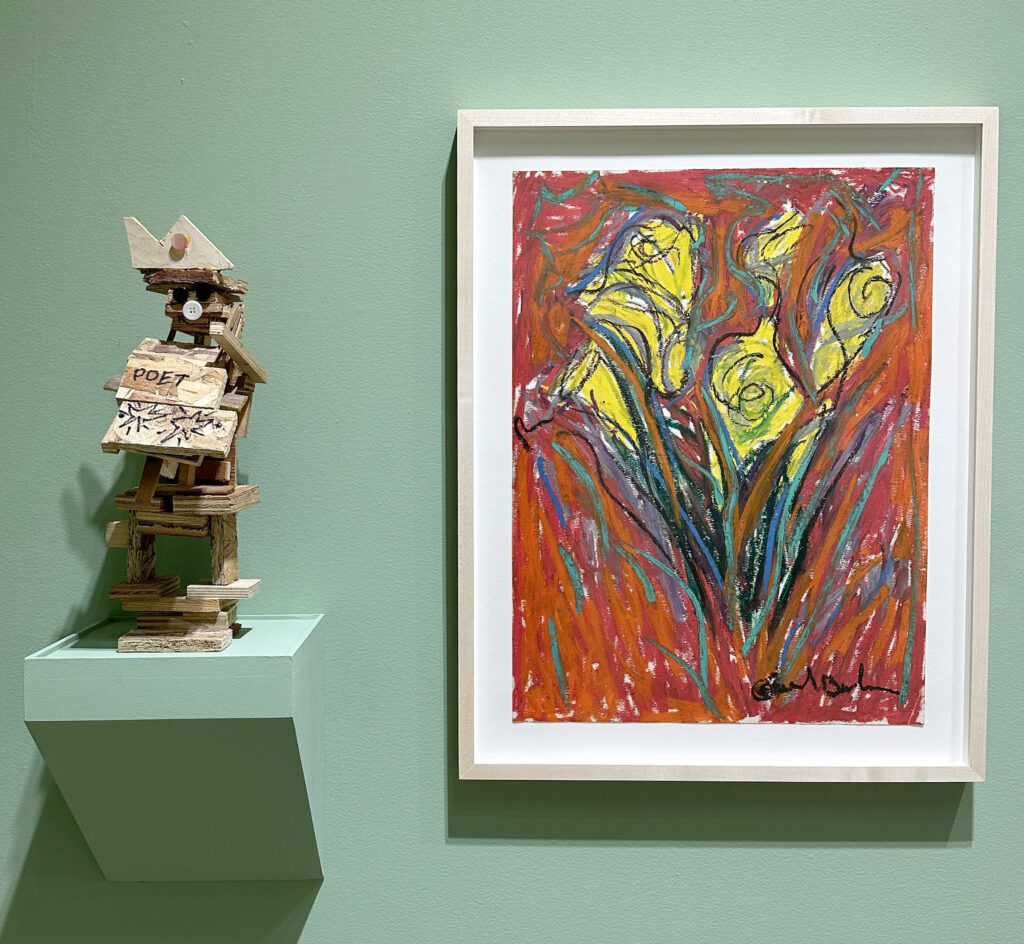
Buchanan’s later work is intimately linked to her natural surroundings and folk art. As a native Southerner, she drew on memories from her childhood as well as the lush Georgian landscape and yard art of local self-taught artists. A passionate gardener, Buchanan produced vivid oil pastel flower drawings and small assemblage works. She loved to rummage through thrift stores collecting marbles, wedding toppers, and beads, to create what she referred to as her “Christmas trees,” and “spirit jars,” her take on memory jugs, a prized Southern Folk Art form. Buchanan was particularly moved by a visit to folk artist Nellie Mae Rowe’s home in Fayette County, Georgia, and reminisced: “Being at Nellie Mae Rowe’s home was like being engulfed in a magic forest of her work because every surface had a mark from her hand and the simple chewing gum works made you never take gum as just chewing gum again.” A distinctive chewing gum jug and pin are also included in the show.

This exhibition closes 5/13/23.