Dec 182025
 

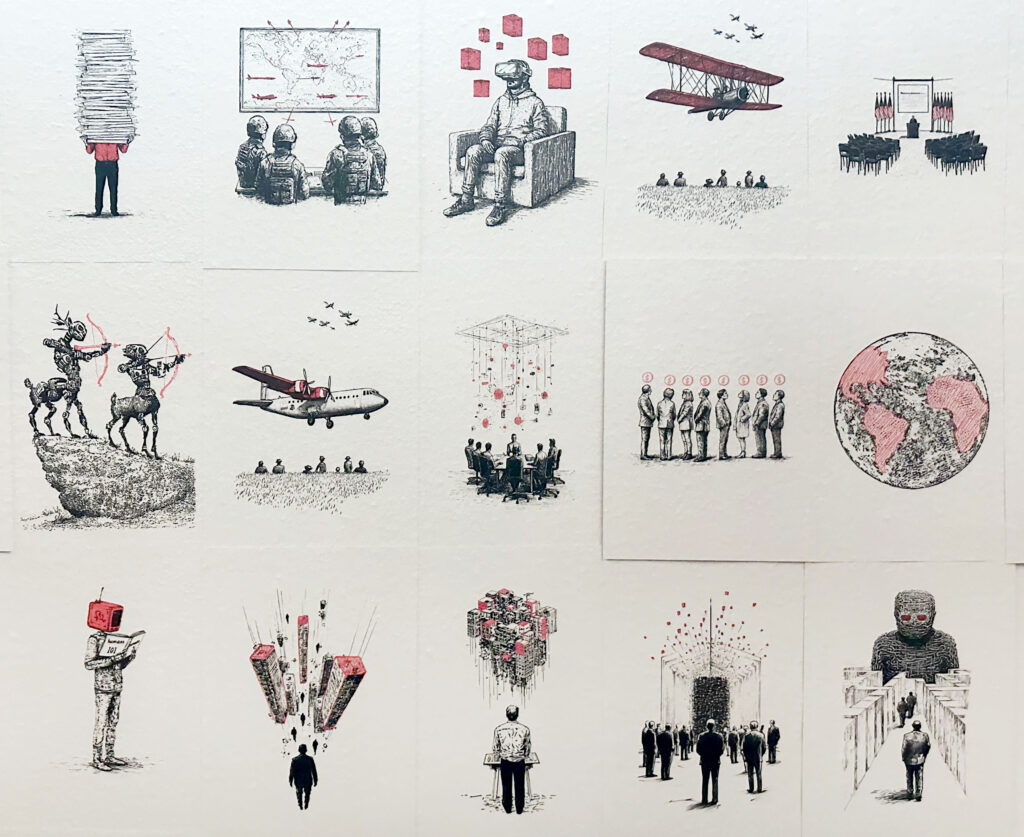
Portraits by Carrie Ann Baade

Reclaim | Reframe: Datasets and Cultural Visibility, is one of three exhibitions that make up The Delaware Contemporary’s 2025 Biennial- Art + AI. The timely show features work by Carrie Ann Baade, Tyanna Buie, Blažo Kovačević, and Tara Youngborg.

From the museum

Through AI and computational technologies, artists Carrie Ann Baade, Tyanna Buie, Blažo Kovačević, and Tara Youngborg construct layered narratives that reclaim overlooked and marginalized histories. In doing so, these artists unsettle dominant cultural and media frameworks that have long erased, distorted, or commodified lived experience. Exploring themes of identity, ancestry, and displacement, they use generative tools as critical instruments to question, expose, and reconfigure the archival and institutional biases embedded in history, culture, and the environment. From ancestral reclamation and speculative futures to immersive storytelling and data-driven environmental translations, their work advances a reimagining of social justice through the lens of artificial intelligence.

Together, these artists offer a complex portrait of making in the age of AI, revealing how tools shaped by those in power can both perpetuate bias and enable resistance. Their work asks: Who shapes the cultural record? When an AI model “remembers,” whose truth is it repeating? How can we reclaim agency within these systems (built on our collective labor)?

The images at the beginning of this post are from Carrie Anne Baade’s series, Birthplace. Her mixed media portraits of her ancestors, created with the help of AI, present a fascinating look at the stories of several women from early in American history.

From Baade’s statement about the work-

Birthplace is a visual exploration of personal ancestry, delving into the lives of women from colonial Louisiana between 1690 and 1750. Through oil painting, collage, and Al-generated imagery, I reconstruct the presence of these women-figures shaped by French colonial rule, Indigenous displacement, and Romani migration-whose stories have been largely absent from recorded history. Employing a methodology that blends archival research with imaginative storytelling, I create portraits that serve as visual hypotheses-acts of artistic and ancestral repair. The compositions incorporate antique lace, colonial maps, domestic fabrics, and found objects, mirroring the intertwined textures of lineage, migration, and identity. Al-generated image blending aids in synthesizing historically plausible references, speculating on the appearance and presence of women who were never visually recorded.

This project is not about one family, but a shared American inheritance. It reveals the complexity of identity in a land shaped by colonization, migration, and erasure. In rematriating these women to history, Birthplace offers viewers a visual counter-history-one rooted in survival, interconnection, and the enduring power of maternal lineage.

Pictured below are works from the other artists in the exhibition along with information provided by the museum.

Tara Youngborg examines how institutional data and machine learning shape our understanding of land and environment. Using field research, environmental archives, and US Geological Survey datasets, her datastream translates waterflow data and topographic maps into immersive video installations that highlight the limitations of digital representation. By transforming statistics into layered, shifting media, Youngborg portrays landscapes as dynamic terrains of knowledge. Glitches and ruptures in the work expose gaps between digital abstraction and lived experience, prompting questions about algorithmic authority and what is lost when place is reduced to data.

Tara Youngborg’s installation

Tara Youngborg’s installation (detail)

In AR (Argumentative Reality) and Truck for Three Illegal Passengers, Blažo Kovačević uses augmented reality, 3D modeling, and game engine software to confront invasive state surveillance and the dehumanization of migrants. Using digitally enhanced X-ray images from European Border Patrol inspections, he reconstructs a 2015 tragedy in Serbia where 54 undocumented passengers died in a van crash. His works shift between detached aerial views and intimate interior scans, altering typical media frames into ethical engagement. Kovačević warns how AI-driven technologies can perpetuate oppression through automated surveillance, data collection, and erasure, urging reflection on the politics of visibility and mediated violence.

A still from Blažo Kovačević’s video

Tyanna Buie reconstructs erased family histories and reimagines Black identity through speculative Afro-Futurist frameworks. Using ChatGPT and DeepFake technology, she remixes images, sound, and text to create narratives where absence becomes presence. In The Guardians of Nyala, Buie overlays her own likeness onto eighteenth-century Dutch dignitary portraits, then collaborates with AI to imagine a family history untouched by colonization. Rooted in personal narrative and Black popular culture, her counter-archive elevates erased lives and transforms AI from a tool of replication into one of radical self-authorship.

Two of the portraits from Tyanna Buie’s “The Guardians of Nyala”

This exhibition closes 12/28/25.

May 162025
 

“Radiating Kindness (Oil)”, 2023, Oil on linen

“Bold Glamour”, 2023, Digital print on linen

For AI Paintings, Matthew Stone‘s 2023 exhibition at The Hole’s Lower East Side location, he explored new ways of using the latest technology while expanding on techniques used in his previous digital creations.

Details from The Hole about this exhibition-

Two LED screens form the center of this show, displaying an unedited stream of novel AI outputs; a new painting every ten seconds. Corresponding in scale to the surrounding works on linen and functioning like smart canvases, these AI paintings transform endlessly and if you’re alone in the gallery, you will be the only person to ever see that version of the artwork.

Stone’s AI paintings—both the tangible on linen and the fleeting screenic pieces—are created through his training of a custom AI model on top of Stable Diffusion’s open source, deep learning, text-to-image model. By feeding it only his past artworks, Stone has created a self-reflexive new series of AI works that disintegrates the hegemony of the singular static masterpiece and problematizes the idea of ownership, or even what “the artwork” itself entails.

AI has become part of contemporary culture, used to solve real world problems and also create TikTok filters. It’s a tool and like a paintbrush it can be used skillfully or not. At the moment AI is throwing the art world into upheaval as artists explore its potential, galleries contend with its disruption of technique and presentation and collectors and museums feel the dissolution of authorship and ownership.

A second type of work makes its debut here, Radiating Kindness (Oil), a 3D printed, machine-assisted oil painting made in collaboration with ARTMATR labs in Red Hook, where MIT artists and engineers have come together to make innovative tools and tech. By leveraging AI, robotics, computer vision and painting scripts, their robot has created a traditional oil painting in three dimensions. You can see on the surface how the interplay between analog and digital mark making is eye-boggling.

The show also includes examples of Stone’s “traditional” technique, which is anything but: on the 13-foot wide linen painting, Irradiance, four nude figures dance over piles of strewn AI paintings. The figures in the foreground, reminiscent in choreography of Henri Matisse’s Dance (La Dance), 1910, are bodacious, athletic women, heavy and sexy like a Michelangelo marble while at the same time futuristic, weightless and splendid in impossible glass and metallic brush marks. Here Stone’s circular and sensitive approach is laid bare for the viewer, the references to art history, technology, culture, access and the pursuit for the intangible is almost overwhelming to grasp.

Stone’s approach points to the deeply interwoven nature of our offline and online lives today. He sees artists’ use of new technologies as necessary, with creatives deploying these tools in a manner that’s not motivated by big tech or financial gains, disrupting the algorithm by creating their own and exploring this new frontier without data-driven deliverables. Creating new context and room for human subjectivities and emotion in the shift from analog to digital that arguably has already occurred.

Below, in an interview for The Standard, he discusses using AI for this work further-

When working with AI, do you sometimes feel overwhelmed or do you always feel in control?

I have never felt fully in control while making art and I’ve always been back and forth between wanting to be and understanding the transformative and creative power of just letting go. The most exciting moments in my creative process have often been unexpected mistakes. Those happy mistakes have revealed something that can then be consciously amplified. Using AI creates lots of unexpected outcomes very fast. So as someone who likes accidents in this context of image making, it’s a good way to become accident-prone.

Do you consider AI as just another digital tool? Or does it feel more like a collaboration? In other words, do you sometimes feel AI might develop its own taste, point of view, conscience?

It’s a digital tool and I try to resist the urge to anthropomorphize it. But it’s difficult because it feels like such a paradigm shift and also sometimes like dreaming. I think that culturally speaking, we are moving in a direction that assigns these qualities of perceived sentience to AI even when more mundane actions are at play. It’s not clear to me how we will tell if AI has achieved general intelligence, but I think most people will assume it to be the case long before it actually happens, assuming that it does.

May 032025
 

Currently at The Art Spot in Asbury Park are the incredible cardboard creations of multi-disciplinary artists Michael La Vallee (aka Porkchop) and Bradley Hoffer for Anti AI: A 2025 Cardboard Odyssey. Along with the exhibitions, the gallery also serves as a studio for La Vallee and a shop selling items by him and others, including a large section of modified clothing items.

Outside of the gallery are two large murals, pictured below. The first is by Porkchop and Hoffer and the second is by artists Joe Iurato and Logan Hicks.

Mural by Porkchop and Bradley Hofffer

Mural by Joe Iurato and Logan Hicks (with Bradley Hoffer section from the previous mural)

This show is on view until May 8th, 2025.

Feb 132025
 

The contemporary artists and designers in Seeing the Unseeable: Data, Design, Art at Art Center College of Design, each use different types of data as the basis for work that is both imaginative and informative. This exhibition is part of The Getty’s PST ART: Art and Science Collide programming.

From the gallery-

Seeing the Unseeable: Data, Design, Art explores selected works by contemporary artist and designers responding to data’s impact on daily life. The exhibition premise rises from the dawn of Big Data in the early 1990s, which brought with it advancements in the field of data visualization: the practice of representing vast quantities of information to make it understandable and engaging to the public.
In its early forms, data visualization was most often used in map-making and creating statistical graphics, viewed largely as a tool to convey information in the sciences and support analytic reasoning. In recent years the field has become an influential force in contemporary culture, transforming visual literacy in the global cultural landscape.

Seeing the Unseeable considers data in the recent past and present, addressing issues related to data mining and invisible data, data humanism, and data’s relationship to our varied environments. Exploring a critical cultural moment in our relationship with the magnitudes of information that routinely bombard us, works in the exhibition draw attention to issues ranging from the vastness and capabilities of data technologies to the personal, social and humanitarian consequences of data collection and data systems.

Hyojung Seo, “Singapore Weather Data Drawing Series (Wind Direction, Tem-perature, Windspeed) 2022

About the video work by Hyojung Seo

Singapore Weather Data Drawing Series reconsiders data visualization as it develops beyond mere representation to aestheticization. As the title of the work suggests, this series of data are drawings aimed to build a visual narrative beyond the original scope of the data itself. The weather data drawings generally represent information about Singapore’s weather patterns, while also standing as abstract digital artworks. This visual loosening of data into a series of patterns and movements presents weather statistics thorough a visual sensation rather than a more conventional data visualization design. The essential link is the descriptive title. While the work may abstract Singapore’s weather patterns, the movement and shapes designed by Seo also expand the meaning of the information as a kind of living, organic form.


About the above work by Linnéa Gabriella Spransy

Described by Spransy as “procedural abstractions,” the paintings shown present an alternative to what may be considered data-driven art. While terms such as “data” and “generative art” are often used to describe digital-based imagery, the artist’s painting method lies at the heart of data and data visualization: number patterns. The Prime Mover paintings demonstrate the intimate working relationship between the artist and pure data. Spransy begins by constructing linear patterns using prime number sequences onto the prepared canvas. From this accumulated form, she then selects areas to pour paint over. After the paint dries, she initiates another pattern that grows around the existing intrusions. This push and pull of structure and chaos creates a field of balance and counterbalance, an ebb and flow between the artist, the numbers, and the seemingly shifting, multiple layers and dimensions of her paintings.

Iñigo Manglano-Ovalle, “Lu, Jack and Carrie (from The Garden of Delights)”, 1998, Archival pigment prints

About the above work by Iñigo Manglano-Ovalle and Storm Prototype: Cloud Prototype No. 2 and 4, 2006 (the hanging titanium sculptures in the first photo)-

Iñigo Manglano-Ovalle is recognized for a wide-ranging, multifaceted practice resulting in sculpture, large-scale instal-lations, photography, and video. Ranging in scale from modest to monumental, his works are the result of years of research and achieved working in collaboration with creatives, inventors, and technicians in a vast range of fields, from the physical and life sciences to earth sciences. Lu, Jack and Carrie (from The Garden of Delights) (1998) is comprised of three colorful digital prints: a series of abstractions based on images of DNA samples taken from imaging technologies utilized in genomic mapping and depicting “families” of friends selected in sequence. Storm Prototype: Cloud Prototype Nos. 2 and 4 2006) are hovering spectral forms manifested in three dimensions from the analysis and compilation of real weather data. Additionally, the works are inspired by the artist’s consideration of global migration patterns. These works represent the compulsory flow of nature, whether revealed in the sky, ocean, or over land, impervious to international boundaries.

Giorgia Lupi and Ehren Shorday, “Incroci (Crossings)”, 2022, Black paint on raw canvas

About the above work by Giorgia Lupi and Ehren Shorday

Described by the artists as data portraits, this collaborative project emerged from Lupi’s observation that “each person’s life may be unique and different, but when seen together, these distinct paths begin to form patterns.” For Incroci, a dataset was created by asking strangers, and their social media circles, to share five dates (day/month/year) representing significant life moments, from the day of their birth up to the year 2022. The project was conducted during the Covid-19 pandemic, which gave weight to the question of what could be considered a significant life moment. Incroci exemplifies the ways in which data visualization design is evolving to a level beyond merely providing an aesthetic framework for data to realizing subtext within the datasets. As Lupi states: “The more ubiquitous data becomes, the more we need to experiment with how to make it unique, contextual, intimate. The way we visualize is crucial because it is the key to translating numbers into concepts we can relate to.”

About the work above by Semiconductor

Ruth Jarman and Joe Gerhardt, aka Semiconductor, have been collaborating for over 25 years working in sound, video, installation and sculpture. Referring to their work as technological sublime, they explore ways of experiencing nature mediated through the languages of science and technology. Spectral Constellations is a series of generative animations, driven by scientific data of young stars. This data, collected by scientists using a method called Spectroscopy, creates an understanding of structures around distant young stars, where gas and dust come together to form planets. Semiconductor have employed this spectral data as a physical material, translating it into rings of light which resemble gradiated discs of planetary and stellar formations. As the data ebbs and flows it introduces a sense of form and motion. Waveforms merge and interfere revealing patterns and rhythms, engaging our human tendency towards pattern recognition. The fragmented LED mosaics provide partial windows from which the spectral data shifts and shimmers.

Fernanda Bertini Viégas and Martin Wattenberg, “Wind Map”, 2012, Interactive software, dimensions variable

About Fernanda Bertini Viégas and Martin Wattenberg‘s Wind Map-

Fernanda Viégas, a computational designer, and Martin Wattenberg, a mathematician and journalist, are known as pioneers in the field of data visualization. Their research has helped define visualization as a discipline and practice, creating interactive and open-source tools for examining a wide range of scientific, social, and artistic questions. Conceived as a personal art project, their iconic work Wind Map culls information from the National Digital Forecast Database, which is maintained by the National Weather Service and available to the public. Continually gathering these forecasts, which are time-stamped and revised each hour, the artists have created a “living portrait” of the wind landscape over the United States. To emphasize the beauty and distinction of this influential work, exhibition curators commissioned a special iteration of Wind Map without the city locations and names. The standard version of this piece remains in the public domain on their website: http://hint.fm/wind/

Laurie Frick, “Moodjam Intense”, 2024 and “Moodjam Mild”, 2024, Abet Laminati samples on ACM panel

About Laurie Frick’s Moodjam Intense and Moodjam Mild-

In her exploration to humanize data, Frick creatively mines information from her own functional and behavioral patterns as part of her art practice. Inspired initially by the daily activity tracking of computer programmer Ben Lipkowitz, Frick began tracking her own sleep with an electroencephalogram headband, expanding it to her husband’s sleep patterns and then others. Initially mapping her moods with color swatches through Mood-jam.com, Frick expanded to track her temperament every few seconds using a combination of heart rate (HRV), facial recognition and galvanic skin response (GSR), assessing her stress, nervousness, and general mood every few seconds. The work shown is an interpretation of this compiled data, using boxes of countertop laminate samples that she sourced during an artist residency at the Headlands Art Center near San Francisco. Moodjam Intense and Moodjam Mild are the resulting gridded works.

Peggy Weil, “77 Cores”, 2024, White Mylar Digital print

About Peggy Weil’s 77 Cores

Peggy Weil has long been engaged in exploring ways of seeing. Today she continues to inquire the realms of perception, investigating how we see, what we see, and how we can see beyond. When she heard about the Greenland Ice Sheets project which stores 2-mile-long poles of ice samples in meter long cylinders, she was compelled to document them. The ice cores-paleo thermometers holding ash from volcanic eruptions, pollen and environmental gasses-are, to Weil, “deep space holding very deep time.” As such they speak to the notion of the extended landscape: stretched out beyond what we perceive and see, hidden in the atmosphere or the earth underneath our feet. In 77 Cores, images of seventy-seven glacier ice-sheet cores are printed and laid out over twenty-four feet. allowing the viewer to mark time by walking its length.

Sarah Morris “Property Must Be Seen [Sound Graph]”, 2020; “Deviancy is the Essence of Culture [Sound Graph]”, 2020; “You Cannot Keep Love [Sound Graph]”, 2020, Household gloss paint on canvas

About Sarah Morris and the Sound Graph paintings above-

Sarah Morris creates films, paintings, and sculptures based on a wide range of sources, including graphic logos, architectural space, transportation systems and maps, GPS technology, and the movement of people in urban locations. She has said, “I want to map what is going on, these situations we find ourselves in-both physically and philosophically.” The Sound Graph paintings are derived from fragments of conversations and sounds recorded by the artist and translated into hard-edged geometric shapes in vibrant patterns that seem to visually fluctuate. Her interest in incorporating sound into her paintings began when she conceived the film Finite and Infinite Games (2017), titled after the cult philosophy and numbers theory novel by James P. Carse. Morris sees her paintings as being part of a larger self-generating system, always remaining open and allowing for interpretation, motion and change.

Mimi Ọnụọha, “The Library of Missing Data Sets”, 2016; “The Library of Missing Data Sets v2.0”, 2018; “The Library of Missing Data Sets v3.0”, 2022, Mixed Media Installation

Mimi Ọnụọha, “In Absentia”, 2019, 6 risograph prints on paper

About the works above by Mimi Ọnụọha

The Library of Missing Datasets comprises three filing cabinets filled with folders the reveal unseen biases within the system of data collecting. According to the artist, this work is “a physical repository of those things that have been excluded in a society where so much is collected.” While data-collecting algorithms claim to provide comprehensive information, their vastness hides data-driven forms of inequity: what Ọnụọha considers “algorithmic violence.” Revealing the conditions surrounding invisible data, she “aims] to trouble assumptions baked into the beliefs and technologies that mediate our existences.” In Absentia (2019) presents six risograph prints in the style of twentieth-century African American sociologist W. E. B. Du Bois’ infographics presented at Exposition Universelle, the Paris World’s Fair, in 1900. Ọnụọha visually quotes from Du Bois to acknowledge his work’s significance and the injustice it has since suffered: the US Department of Labor and Statistics halted publishing of his sociological research on Black rural life in Alabama, claiming it to be too controversial.

Finally, the image above is of work from Refik Anadol’s AI data painting series– California Landscapes.

Refik Anadol is an artist, designer, and leader in the aesthetics of data and machine intelligence. Utilizing advanced technologies including Al, machine algorithms, and quantum computing, he has become known for large scale, immersive installations that render massive amounts of data into highly dynamic abstractions. The artist’s California Landscape series employs images of California’s national parks. Spawned from a dataset of over 153 million images, the largest dataset of this kind ever to be used for an artwork, the Generative Study works feature images that are recognizable. Yet as these majestic landscapes constantly morph, so does the matter that we conventionally identify as earth and sky. A series of interconnected lines imbue the images with additional references, in this case the algorithm driving this perpetual visual flux. In its varying juxtapositions of nature and technology, this work reminds us of how distinctive our perceptions of each may be.

This exhibition closes 2/15/25.

Jan 032025
 

Michael Joo, “Noospheres (Composition OG:CR)”, 2024

Cannupa Hanska Luger, “Sovereign”, 2024

Yoshitomo Nara, “A Sinking Island Floating in a Sea Called Space 1 and 2”, 2024

For the group exhibition Breath(e): Toward Climate and Social Justice, Hammer Museum has gathered artists from around the world to present work that addresses environmental and social issues. The exhibition is part of the PST ART: Art and Science Collide programming taking place throughout Southern California.

From the museum about the exhibition-

The confluence of cataclysmic events that marked the year 2020-among them the global COVID-19 pandemic and ensuing economic crisis, the rise in anti-Asian hate crimes, and the murder of George Floyd, which gave powerful momentum to Black Lives Matter and other social justice movements-created a rupture. For many, it felt like the end of the world that they had known. Under circumstances of physical and psychological lockdown, the very notion of taking a single breath-an act vital to multispecies existence since time immemorial-took on renewed significance. Breathing as an act of resistance and survival in the face of racial inequity and a global health crisis calls attention to the inextricable link between social and environmental injustice. The often imperceptible but ever growing burden of climate-related tragedies-the thawing cryosphere, extreme heat, flooding, deforestation, radioactive aftermaths of wars, and ocean acidification-has played a direct role in the deterioration of economic conditions and the displacement of populations.

Breath(e) assembles artists from around the world who share concerns about threats to their communities and environments. The exhibition foregrounds an ethical stance that critiques the privileging of the human being as the most significant among all entities and instead values interdependence. Some of the works reassess philosophical assumptions regarding what constitutes the “human,” while others question who speaks on behalf of the rights of nature and how we adjudicate the agency of the earth, trees, air, and oceans. The exhibition also highlights artistic practices that have transformed the cultural tropes of the climate crisis into narratives of resilience, transformation, renewal, and coexistence. These narratives are explored through various means: restoring balance and belonging to the land through speculative models for future survival; exploring the regenerative capacities of waste through structural transformations in life cycles; making visible the impact of anthropogenic violence on our bodies over time; the passing down of living knowledge that promotes biodiversity through multiple generations; giving voice to youth and empowering them with food sovereignty; and the radical presence of multispecies survival amid capitalist exploitation. Each of these strategies points to systemic shifts, reminding us of the power of each breath and of how the ethical principles of justice can be advanced amid life as well as on the path to extinction.

Below are a few selections and some additional information from the museum.

Xin Liu, “The Mothership”

About the work above-

Identifying as both a scientist and an artist, Xin Liu uses the language of technological development to explore our desire to preserve and artificially extend biological life. In 2023, inspired by scientific innovations in cryonics and egg freezing, Liu developed Cry:0, a series of mixed-media sculptures that includes The Mothership, a science fiction-like panel equipped with a cooling mechanism that pulls water directly from the air, causing thin layers of frost to gradually develop on the surface of the central bronze mouth, which the artist cast from her own body. With its spectral, biomorphic form and evocative title, The Mothership reflects on technologies designed to manipulate time as well as the central role played by the female body in perpetuating the human species.

Installations by Korean art collective ikkibawiKrrr and Garnett Puett (structure in the back on the right)

About the ikkibawiKrrr multimedia installation and video-

The Korean collective ikkibawiKrr’s expanded approach to art making encompasses performance, workshops, and events. The neologism ikkibawiKrrr consists of the Korean words ikki, meaning “moss”; bawl, meaning “rock”; and krrr, an onomato poetic word that implies a rolling motion. Through its work the group aspires to be “moss-like,” an organism constantly adapting in response to its surroundings. It has focused its recent work on the culture and ecology of the tropical Jeju Island, located off the southern coast of Korea.

A popular tourist destination known for its pristine ecosystem, Jeju Island is home to a community of haenyeo (female divers, or “women of the sea’), who are venerated for their ability to hold their breath for long periods of time while underwater. Upon rising to the surface, the haenyeo make a distinctive whistling sound as they rapidly exhale carbon dioxide and inhale fresh oxygen, a breathing technique called sumbisori, or “breath sound.” A matriarchal community committed to environmentalism, the haenyeo have been sustainably harvesting seafood for centuries. Given their symbiotic relationship with nature, their already arduous work has been greatly impacted by climate change, particularly rising water temperatures, which have harmed algae and changed the migratory patterns of predatory fish. Additionally, Jeju Island is not as clean as it once was, and the haenyeo now risk being trapped by discarded fishing nets and spend their time collecting plastics from the ocean.

In the video that forms part of ikkibawiKrr’s multimedia installation Seaweed Story (2022), a haenyeo choir stands on the cliffs of Hado, a fishing village on Jeju Island, singing a regional variation on “Arrang,” an ancient folk song with strong ties to Korean nationalism. During Japan’s imperialist era (1910-45), the fishing industry exploited the haenyeo and overfished their waters, leading the women to organize local cooperatives and public demonstrations, many of which took place in Hado. Through their performance, the haenyeo reinforce their connection to both the ocean and historical resistance movements. The installation also includes a sandbox containing miniature replicas of the small houses where these women convene, rest, and change in and out of their wetsuits.

Below is Garnett Puett’s sculpture, located inside the enclosed structure pictured above, where bees help create the work.

From the museum-

A sculptor and fourth-generation beekeeper based in Hawaii, Garnett Puett collaborates with bees to create what he terms “apisculptures” (api is the Latin word for “bee”). Combining ancestral knowledge with his passion for art, Puett conceived of this signature method in 1983, when he was a graduate student at Pratt Institute in New York City. As demonstrated by the newly commissioned work on view, Puett emphasizes the creative process over any particular outcome. To initiate Untitled (Paradoxical Garden Downstream) (2024), he conceived a figurative armature for the sculpture, coated it in thick layers of beeswax using a rotating table of his own design, and enclosed it in a habitat for bees. He then introduced a locally sourced queen along with her hive, thousands of worker bees (female honeybees), who made the work their home. Over the course of its brief lifespan, approximately six weeks, the colony will gather nectar and pollen to sustain the queen while elaborating the structure with honeycomb. Working symbiotically, Puett and the bees will eventually arrive at a final apisculpture. Three previously realized works are on view in the same gallery.

Garnett Puett, “Untitled (Paradoxical Garden Downstream)”,2024

Roxy Paine, “Chart”, 2024

Roxy Paine, “Chart”, 2024 (detail)

From the museum about Roxy Paine and the work above-

Since the 1990s, Roxy Paine has made thousands of scientifically accurate reproductions of mushrooms, underscoring the important role played by fungi in balancing our ecosystems. As agents of decomposition, fungi drive the global carbon cycle-the process by which carbon moves between the soil, living organisms, and the atmosphere. Belonging to a category of artworks that Paine calls “replicants,” his synthetic fungi colonies convincing y mimic the ways organic mushrooms spread in concentrated areas, sprouting directly from the floor or from wall-hung supports. Paine has researched and replicated the three major types of mushrooms: parasitic fungi, which attack living matter, thus regulating the populations of their hosts; saprophytic fungi, which consume and recycle dead matter; and symbiotic or mycorrhizal fungi, which flourish synergistically with the roots of plants and trees, supporting forests as they absorb carbon. Also known as “climate change warriors,” mycorrhizal fungi have the capacity to delay the effects of global warming, but rising temperatures could be putting them at risk of decline.

Chart (2024), a multivariant field, presents lesser-known examples of parasitic, saprophytic, and symbiotic fungi, including Geastrum striatum, or earthstars; the coral-like Clathrus ruber, or cage fungus, a type of stinkhorn that attracts insects by smelling of rotten meat; the scaly, globular Scleroderma citrinum, or pigskin poison puffball; Sarcoscypha coccinea, or scarlet cup, composed of small, open ellipsoids, reminiscent of bodily orifices, that gather in moist moss or on the forest floor; and Lycogola epidendrum, creamsicle-colored pustules that, when naturally occurring, ooze pink slime when pressed. Paine also simulates the neon-bright nets of plasmodium slime mold, a saprophytic organism resembling fungi that consumes mushrooms, bacteria, and other rotting matter. While these species would not be found cohabitating in the wild, they unite in their effort to erode a Turkish rug patterned with abstract representations of flora and fauna. This syncretic rug, a product of merging cultures, stands in for the invisible, carpet-like mycelium, the network of threads that form the rootlike structure of a fungus.

Paintings from Mel Chin’s series of paintings for “Interpretation of Vision (or IOV, pronounced “eye of”)”

About Mel Chin’s work from the museum-

Commissioned for this exhibition, Interpretation of Vision (or IOV, pronounced “eye of”) consists of thirty-two paintings realized through personal connections with individuals whose lives were altered by phenomenological experiences. Chin believes that the first step in the collective undertaking to fight persistent social and climate injustice is to dismantle division and promote empathy toward others. Opposed to proselytizing, he feels obligated to take the first step.

Like the artist Frida Kahlo, Chin drew inspiration from retablos and ex votos, small-scale devotional paintings, typically on wood or metal, that serve as votive offerings. During the nineteenth century any life-changing event could warrant the making of an ex-voto as an offering of gratitude. Typically produced by anonymous artisans on behalf of a patron, these paintings represent the tragic circumstances, such as accidents and near-fatal Illnesses, that precipitated their commission, showing saints or martyrs intervening to save the life of the afflicted. IOV is a multistage commission that began with a public call for stories from people whose lives were altered by natural, spiritual, or supernatural phenomena. Inspired by the unnamed ex-voto artisans, Chin collaborated with each respondent to honor and elevate their stories. Each dialogue resulted in a diptych, a two-part painting, presented on an artist-designed, seismically sensitive plinth. In each work the rendering of reality is embedded into an aperture on the right, while its corollary, the depiction of the transformational experience, is mounted on the surface. The wall fluidly accommodates any shifts between perception and knowing.

Ron Finley created the large scale garden installation, Grounded for the exhibition, pictured below. Also included in his section of the exhibition are several of the shovels created by his artist friends for Urban Weaponry Project, Weapons of Mass Creation, located in a separate room.

From the museum-

Finley, also known as the Gangsta Gardener, empowers people to grow their own food and advocates for communities to have access to fresh, nutrient-dense, organically grown food. Through the Ron Finley Project, he has cultivated gardens in urban food deserts, places where access to healthy food and fresh produce is limited or nonexistent. In 2009 he began planting vegetables, fruit trees, and other greenery along parkways, the stretches of land between the sidewalk and the street, in South Central Los Angeles. “I wanted butterflies and hummingbirds. I wanted something pretty, like amaryllis and agapanthus, and I wanted it to smell like jasmine, juniper, mint, and orange blossoms,” he recalls. “So that’s what I did.” After receiving a citation from the city for gardening without a permit, he fought back, and the City of Los Angeles changed its ordinance regulating gardening on public land.

With the commissioned work Grounded, Finley brings his urban gardening practice to the Hammer, creating a green, nourishing respite on the museum’s terrace in emulation of his own extraordinary garden. Both sites include vegetables and fruit trees growing alongside artworks and repurposed objects and contain communal spaces intended to rejuvenate audiences while fostering dialogues about food access, empowerment, and freedom. Inside, Finley presents selected works from his ongoing Urban Weaponry Project, Weapons of Mass Creation (2018-), a project that underscores his deep-rooted devotion to art, design, gardening, and grassroots organizing. Seven years ago he noticed that many of his artist friends were working in isolation. In an effort to connect them, he began inviting each one to transform a common, mass-produced gardening shovel into a distinctive work of art. A testament to Finley’s strength in community building, the present installation represents only a small fraction of his expansive collection. “A tool of mass creation,” as he frequently calls it, the shovel becomes a twin symbol of artistic production and food cultivation.

Lan Tuazon also created a large installation outside of the main galleries (pictured below).

From the museum-

Part of a generation of artists invested in criticizing institutionalized systems, Lan Tuazon proposes methods for recirculating organic and human-made materials to sustainably extend the lifespan of our things. In a linear economy, most consumer products begin as natural resources extracted from the landscape only to conclude as waste in a landfill. Commissioned for this exhibition, Over Your Head & Under the Weather (2024) stages a circular economy by demonstrating techniques of material recovery. Single-use plastics have been industrially shredded and pressed into panels, surplus newspapers are densified into newspaper wood, and other organic materials like coconut fibers are reconfigured into papercrete. Tuazon also makes use of innovative industrial products. The entire structure is constructed from multifunctional WaterBricks, interlocking, modular storage containers originally designed to preserve food and water for emergency and disaster relief purposes, and the floor is lined with Biomason’s carbon-reducing/sequestering Biolith tiles, made with recycled aggregates and bacterium-cultivated cement.

Designed to resemble a functionalized minimal sculpture, Over Your Head & Under the Weather wraps around the building to form two primary architectural bays. One side houses an industrial shredder and a plastic-collection station. Visitors are invited to contribute to the work’s circular economy by donating their #2 and #5 plastics, which will later be processed and shredded. The windows on the other side of the structure contain sculptural reliefs from Tuazon’s Assorted Drive series. Drawing on the language of data storage, the Assorted Drives ironically preserve physical evidence of human production and consumption: found materials, plastic beverage rings, bread ties, caps, and confetti made from previously shredded plastics. Part of an ongoing series, the towering sculpture Future Fossil-made from mass-produced containers, cut and nested like Russian dolls-uses the metaphor of geological petrification to allude to the tremendous scale and indeterminate lifespan of consumer and industrial waste.

Tiffany Chung’s stored in a jar: moonsoon, drowning fish, color of water, and the floating world, 2010-11, pictured below, references Vietnam and its vulnerability to flooding and the rising sea level.

Through meticulous archival and mapping practices, Tiffany Chung commemorates the experiences of local communities facing sociopolitical and climate-related trauma, placing those experiences within a global context. Born in Vietnam during the Vietnam War, Chung was forced to relocate following the fall of Saigon in 1975 to one of the government’s New Economic Zones (NEZ) as part of a population redistribution program aimed at restructuring Vietnam’s economy and southern society. Chung moved with her family to the Mekong Delta, the southwestern region of Vietnam where the Mekong River meets the South China Sea. In 1978 she witnessed a historic riverine flood in the area that killed seventy-four, left seventy-nine thousand homeless, and impacted more than four hundred thousand people. Eventually Chung migrated to the United States, taking part in the massive exodus of refugees precipitated by the NEZ program. Today Vietnam is among the countries that are most vulnerable to sea-level rise. According to recent projections, by the year 2050 almost all the land in southern Vietnam could be engulfed, displacing twenty million people, or nearly one quarter of the country’s population.

In several works, Chung explores extreme flooding — a natural phenomenon that in Vietnam is exacerbated both by the construction of hydroelectric dams in the Mekong River Basin and by human-driven climate change-and proposes solutions. In 2010 she constructed stored in a jar: monsoon, drowning fish, color water, and the floating world, a large-scale model for a floating village. To create this utopian world, Chung drew a formal language from vernacular architecture throughout Asia and structured a city in emulation of actual floating communities: vessels and houseboats tethered together in Ha Long Bay in Vietnam; floating communities on Tonle Sap Lake in Cambodia; a makeshift system of interconnected house-rafts on the Song Kalia River in Sangkhlaburi, Thailand; and camps of floating palaces on a network of rivers in Srinagar, India.

Tiffany Chung, “stored in a jar: moonsoon, drowning fish, color of water, and the floating world”, 2010-11

Sarah Rosalena, “Exit Point”, 2019

About Sarah Rosalena’s work pictured above-

To make Exit Point, Rosalena trained a neural network to combine the Blue Marble photo and the M87 black hole image and output the results to a mechanical loom, which materialized each pixel as a thread in a Jacquard textile. As the Jacquard loom is considered a predecessor to the modern computer, her textiles also challenge linear accounts of technological progress. Through the use of artificial intelligence, Rosalena creates coiling, looping, and spiraling temporalities that function as tools for examining our past and present.

About Bently Spang‘s War Shirt #6- Waterways, pictured above-

The Northern Cheyenne artist Bently Spang creates multidisciplinary artworks inspired by the utilitarian and artistic practices of his ancestors, the Tsitsistas/Suhtaio people. One of Spang’s first such projects was War Shirt #1 (1998), which he made by stitching together family photographs and film negatives, using the negatives as fringe. Spang notes that ancestral war shirts are “reciprocal garments” created by the community to shelter warriors as they battle to protect that community. In 2017 Mountain Time Arts in Bozeman, Montana, commissioned Spang to create a work that would explore the influence of climate change on water resources and raise awareness of the issue in the region. The result was War Shirt #6-Waterways (2017), a multimedia sculptural installation that takes the form of a Plains-style war shirt.

The body of War Shirt #6-Waterways is made up of twenty-one monitors and fringed with six digital still photographs. With the help of a local support team, Spang welded the steel armature and programmed the monitors to present a synchronous, multichannel video, which he filmed while walking from the Tongue River, a tributary of the Yellowstone River that traverses Montana and Wyoming, to a local spring on the Northern Cheyenne Indian Reservation; the digital fringe presents images from a preserved plant press book collected by a tribal historian and ethnobotanist. “I’m telling the viewer to know your water, know where it comes from and how it gets to you, and then you can protect it,” says Spang. “We should all have a relationship with that water, with these places that the water manifests.”

Sandy Rodriguez, “YOU ARE HERE/ Tovaangar / El Pueblo de Nuestra Señora la Reina de los Angeles de Porciúncula / Los Angeles”(2021)

About the Sandy Rodriguez work above-

Made during the first year of the COVID-19 pandemic, the multilingual map of the greater Los Angeles area YOU ARE HERE / Tovaangar / El Pueblo de Nuestra Señora la Reina de los Angeles de Porciúncula / Los Angeles (2021) draws inspiration from the region’s history. It includes depictions of the trial of Toypurina, an Indigenous woman who led a rebellion against the Mission San Gabriel in 1785, as well as sixteenth-century primary source materials, including the Florentine Codex (ca. 1529-69), an encyclopedic ethnographic study of central Mexico. YOU ARE HERE includes images of plants and animals used by Native peoples, which represent geographic locations and serve as indicators of the cardinal directions. Place-names are hand painted in English, Spanish, and Tongva to reference renaming in the region over time as a colonial act of aggression. Rodriguez wants visitors to encounter this painting as they might a way-finding map and to use it to reorient themselves in space and time. She studies, documents, and processes native botanical specimens that have healing properties to create pigments, inks, and watercolors, applying these handmade materials to amate paper made from the bark of trees in Puebla, Mexico. A symbol of Indigenous culture, this sacred pre-Columbian material was prohibited by the Spanish during the colonial period.

Pictured below is one of Yangkura’s “waste monsters”, Tongsinsa, and his film depicting the monster in public (him in the costume).

From the museum-

Working on the west coast of South Korea, Yangkura is a performance and installation artist who uses ordinary trash to represent the dynamics of foreign relations in northeast Asia. Provoked by the 2007 MT Hebei Spirit Oil Spill (HSOS), in which 10,900 tons of crude oil spilled into the sea and contaminated the Korean coastline, Yangkura has focused his practice on the effects of anthropogenic marine pollution. In 2013 he began collecting and categorizing the waste from North Korea, China, and Japan that washed ashore on the coast of South Korea. By tracing tidal movements, he established the migratory pattens for marine debris moving among these countries, discovering that Korea’s trash frequently makes its way to Tsushima Island in Japan. He suspects that this island’s unique geographic formation makes it behave like a vacuum for international garbage, allowing the waters east of Korea to stay relatively clean. As Yangkura’s research suggests, the litter collecting in our oceans does not recognize geopolitical boundaries.

In 2015 Yangkura began constructing “waste monsters” —whimsical, colossal trash costumes, each with its own fictive identity. Yangkura wears these costumes while stilt-walking in performances intended to draw public awareness to the grotesqueness of our collective marine pollution problem. While he recognizes other environmental activists attempting to shock the public into change, he does not believe this approach is sustainable. Instead, he prefers to broach the topic of anthropogenic pollution through storytelling, weaving fantastic, subliminal narratives to engage and educate. In 2017 Yangkura began working with Tsushima CAPPA, a Japanese environmental organization focused on promoting awareness of marine pollution and on cleaning Tsushima Island. He used this collaboration to create a new “monster,” a character he hoped would deftly underscore selfishness as a fundamental human problem. Forgotten Tongsinsa or Forgotten Messenger (2017-) is constructed from trash originating in Korea, China, and Japan recovered from the coast of Tsushima Island (the word tongsinsa refers to a messenger with a diplomatic purpose, and it was originally applied to envoys sent to Japan on goodwill missions during the Joseon era). Yangkura describes Forgotten Tongsinsa as a good monster who dearly misses home and is simply trying to find his way back again.

This exhibition closes 1/5/25.

Jun 092023
 

Tempus Volta, one of Tempus Projects’ spaces in the Ybor Kress building in Tampa, is currently showing Gigi Lage’s solo exhibition, Exposure Garden.

From the gallery’s website-

Lage uses generative AI as a tool to construct still frames from the artist’s own text input. Lage examines how AI processes its learning patterns from existing data and how its output defines the image, its deranged textures, and the story found within the frame. This work explores themes surrounding the implication of replication, the complexities of a single image, and a machine’s relationship to our natural world.

Exposure Garden uncovers the disturbances between AI-generated realities and our human experiences through the exploration of human life in natural elements as processed by machines. Lage explores the simulation of human connection as re-imagined video stills & film negatives. These extractions of images romanticize a version of our world in a dream-like state; through another type of mind that may or may not be our own.

This show will be up until 6/15/23.

Jun 052023
 

Currently at Jenny Carey’s Gratus Gallery in Ybor City are photographs by Johanna Keefe.

Keefe is a talented ceramicist as well as photographer. For this series she created the objects, photographed them, and than used a specific AI filter to obtain her final results.

This exhibition will be on view until 6/15/23.

Oct 202017
 

                                                            Fanon (Even the Dead Are Not Safe) 2017 (image via Metro Pictures)

Artificial intelligence is a growing field with numerous implications for the future, some more sinister than others. Trevor Paglen’s current exhibition at Metro Pictures gives some insight into this evolving technology.

From the Metro Pictures press release-

Trevor Paglen’s A Study of Invisible Images is the first exhibition of works to emerge from his ongoing research into computer vision, artificial intelligence (AI) and the changing status of images. This body of work has formed over years of collaboration with software developers and computer scientists and as an artist-in-residence at Stanford University. The resulting prints and moving images reveal a proliferating and otherwise imperceptible category of “invisible images” characteristic of computer vision.

Paglen’s exhibition focuses on three distinct kinds of invisible images: training libraries, machine-readable landscapes, and images made by computers for themselves. For Machine-Readable Hito, for example, Paglen took hundreds of images of artist Hito Steyerl and subjected them to various facial recognition algorithms. This portrait of Steyerl presents the images alongside metadata indicating the age, gender, emotional state and other signifiers that the algorithms have interpreted from the images. In another portrait in the show, Paglen trained facial recognition software to read the face of philosopher Frantz Fanon. A ghostly image of Fanon shows the facial signature–the unique qualities of a face as determined by biometric recognition software–used by computer vision to identify an individual.

To make the prints in Adversarially Evolved Hallucinations, Paglen trained an AI to recognize images associated with taxonomies such as omens and portents, monsters, and dreams. A second AI worked in tandem with the first to generate the eerie, beautiful images that speak to the exuberant promises and dark undercurrents characterizing our increasingly automated world.

The video installation Behold These Glorious Times! brings together hundreds of thousands of training images routinely used for standardized computer vision experiments and pairs them with visual representations of an AI learning to recognize the objects, faces, expressions and actions. A loose narrative begins to emerge about the collapsing distinctions between humans, machines and nature. Electronic musician Holly Herndon composed a soundtrack using libraries of voices created to teach AI networks how to recognize speech and other acoustic phenomena.

The image below is one of the prints from Adversarially Evolved Hallucinations. A series of these images, presented all in one room in the back gallery, are particularly unsettling as they have elements that seem familiar while remaining distorted. As artworks, they are captivating in their strangeness as well as their beauty.

                                                                Porn (Corpus: The Humans) 2017 (image via Metro Pictures)

The exhibition also has a printout with more detail about the creation of the work that goes beyond the press release, located at the front of the gallery. Make sure to leave time to take in this fascinating show. A Study of Invisible Images closes 10/21/17.