Aug 132026
 

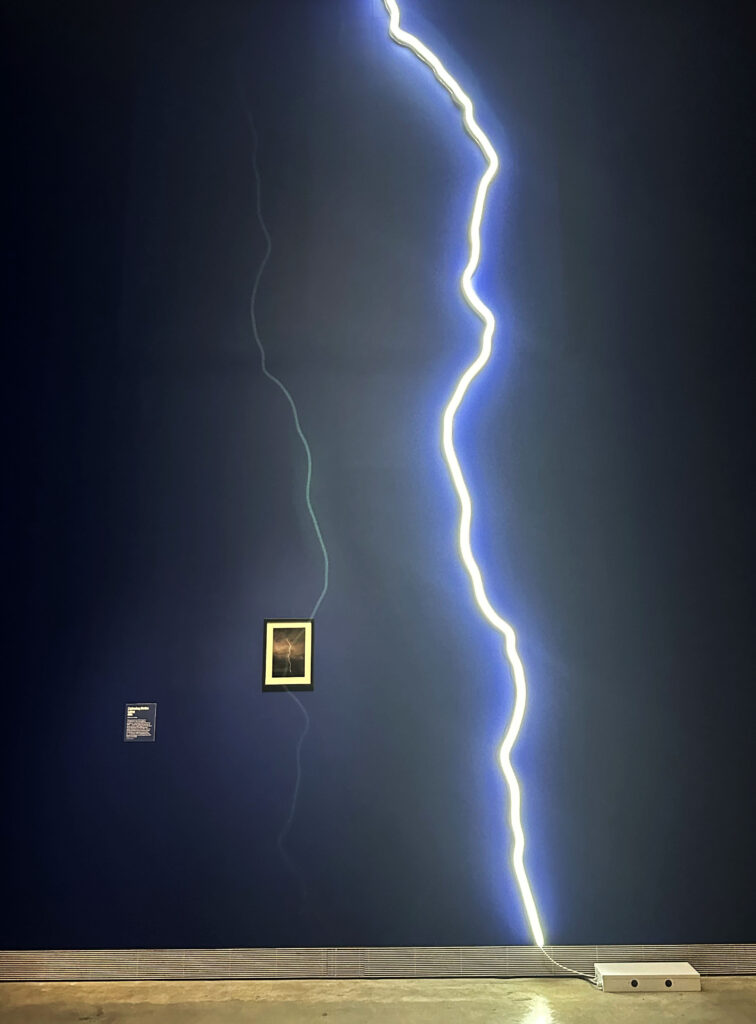
“Lightning Strike Lamp”, 2025
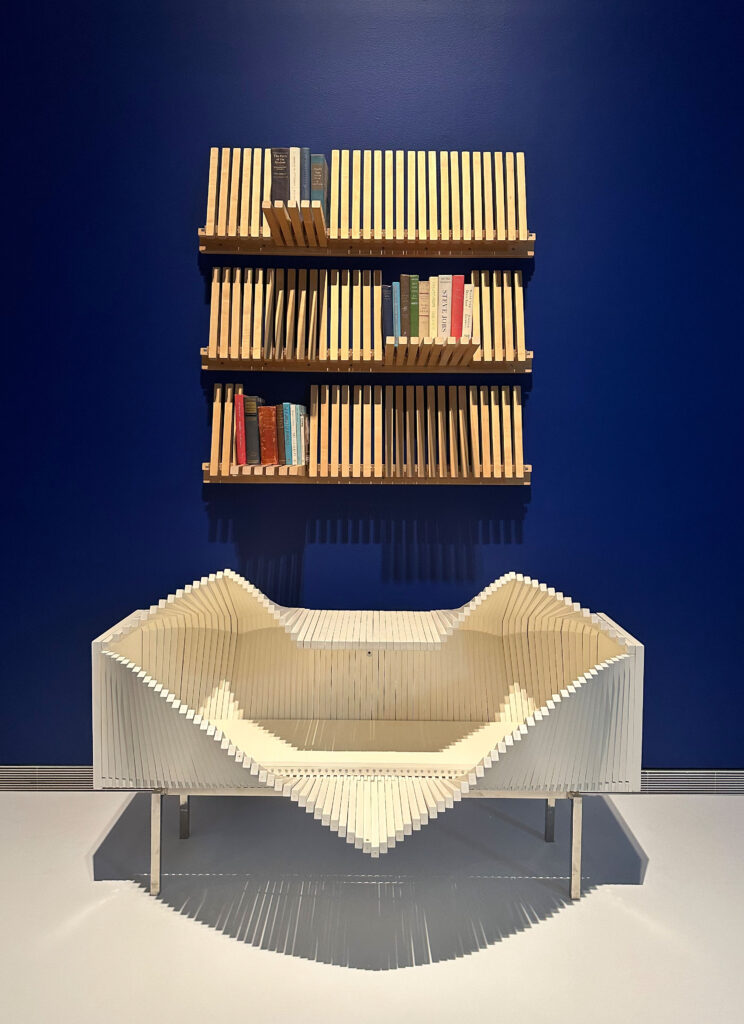
Top: “Piano Shelf”, 2014, Lacquered mahogony, steel ; Bottom: “Wave Cabinet”, Lacquered Baltic birch, steel, glass
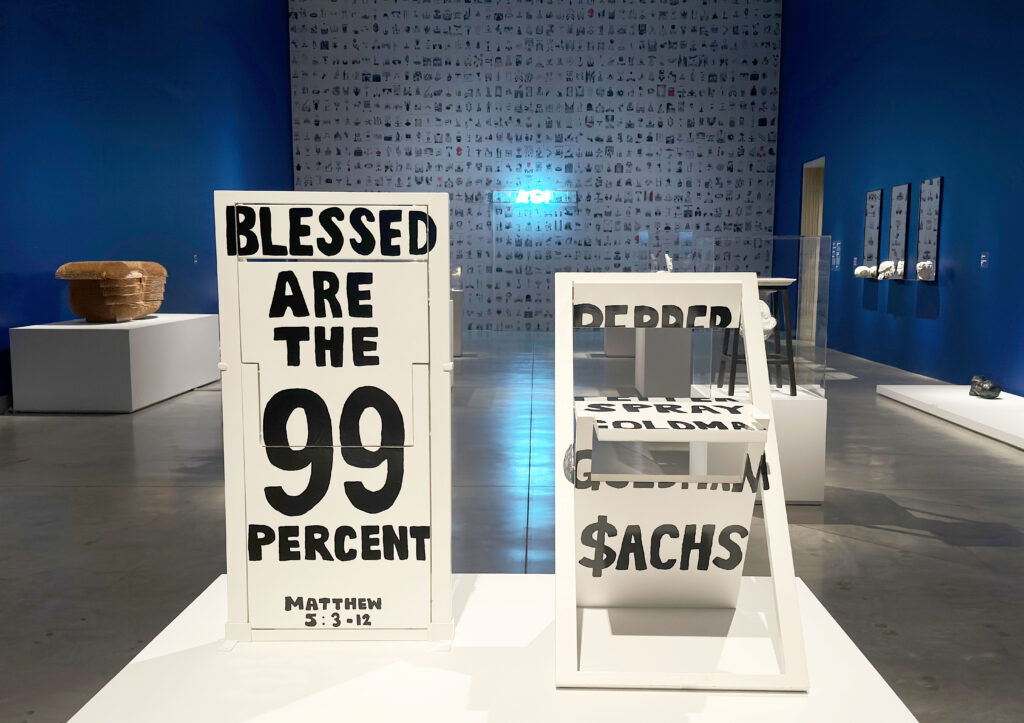
“Occupy Chair”, 2012
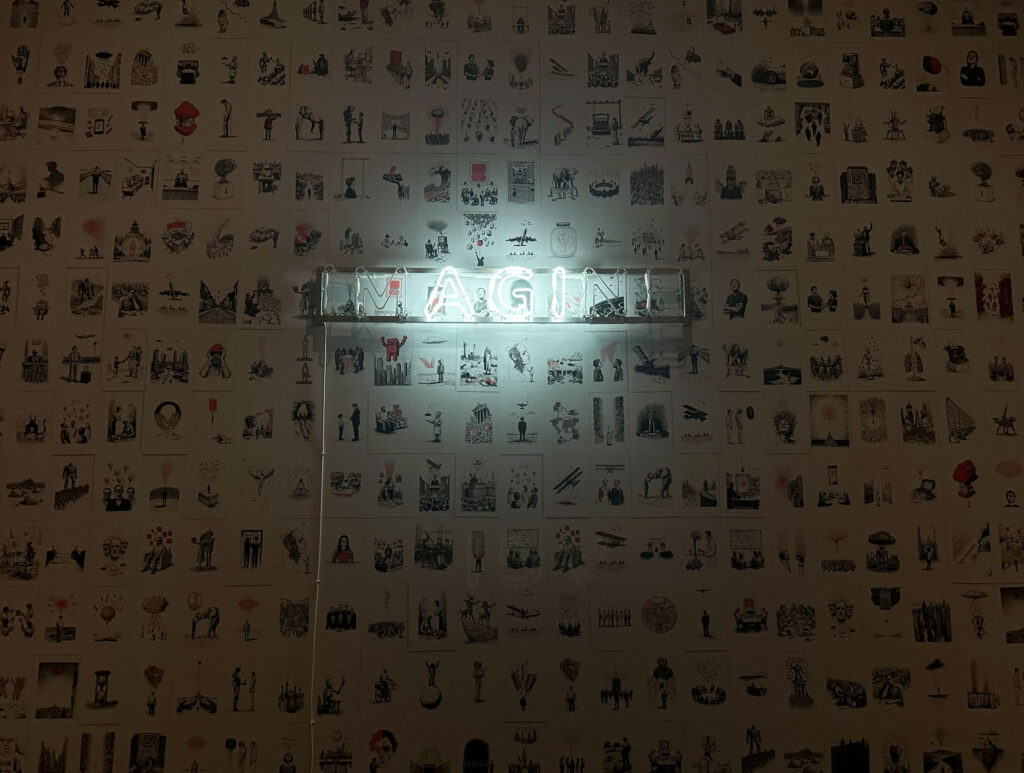
“IMAGINE Neon”, 2025, Neon tubing
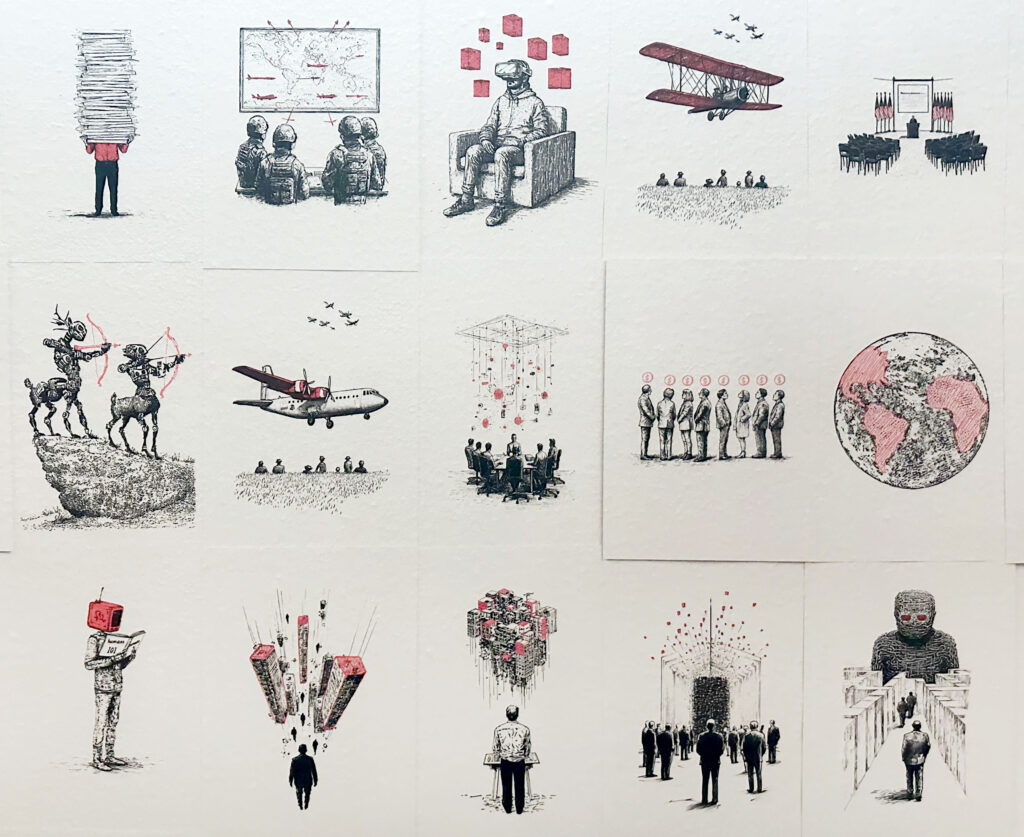
Detail from wall of AI generated drawings behind “IMAGINE Neon”

Mixing art, design, and politics, Sebastian Errazuriz‘s exhibition Double Take at the Philadelphia Museum of Art is a lot of fun. On one side of the room a neon bolt of lightning repeatedly flashes against the wall, while on another neon letters alternate between “IMAGINE” and “AGI” (Artificial General Intelligence) illuminating AI-generated drawings based on his original sketches. There’s also uniquely designed furniture, lamps made using taxidermy chickens, chairs referencing the Occupy Movement, objects incorporating Greco-Roman statue head reproductions, and more, all encouraging visitors to think about nature, technology, and the world around them.

From the museum:

Sebastian Errazuriz (Chilean, born 1977) twists our typical expectations and experiences of using furniture, lighting, and everyday objects. Embracing humor and appropriation, his limited edition and one-of-a-kind pieces often have a subtext that goes beyond form or function, offering personal narrative, a political message, or cultural commentary. This mid-career survey presents over twenty years of a multi-hyphenate practice that gives design a conceptual, Surrealist slant.

Works featured in the exhibition span art, craft, design, and technology. His “kinetic” furniture, constructed from the early 2010s, is characterized by moveable parts – doors, drawers, and shelves that are repositionable, creating new configurations. Other works take nature as a source of inspiration or make new and surprising use of found objects, including vintage watches and taxidermy fowl. Also on display are furniture, mirrors, and other objects that the designer creates by scanning original Greco-Roman antiquities that are then digitally-manipulated and recast in poured marble. A newly commissioned fluorescent light explores Errazuriz’s fascination with, and apprehension about, the potential impact of Artificial General Intelligence on artists, designers, and culture more broadly.

The diverse works on view convey imagination and wit, while also bewildering those who encounter them. The pieces are meant to be lived with, but, at the same time, are provocations with an air of mystery around their function and meaning. Attesting to Errazuriz’s expansive definition of design, the works in this exhibition suggest alternate ways of seeing, thinking, and living.

The show is on view until 8/16/26.


Apr 042025
 

Create Magic Studios, made up of husband and wife team Todd and Allison Purse, has recently taken over local book store Huxley & Hiro‘s future home with a pop-up shop and gallery. The space is filled with artwork from local artists and Todd’s bright, colorful murals.

Along with making artwork and comics, Todd Purse also designs artwork for Brandywine Coffee Roasters, including their hand printed bags. In one of the rooms in the gallery several of them are on display.

Tonight, 4/4/25, is one of the last times to see the space and will be open from 5-8pm with live music from Danny and the Darlings.

It is also ArtLoop Wilmington, a monthly First Friday art walk with several venues around the city staying open late.

Dec 192024
 

“Fire in the Fishtank (Synchronized Dance)”, 2022, oil on birch, white oak, cherry, walnut

“Blue Like Jazz”, 2022, oil on birch, oak, and “Who more Sci-Fi than us?”, 2023, acrylic on mdf, walnut

“Blue Like Jazz”, 2022, oil on birch, oak, and “Who more Sci-Fi than us?”, 2023, acrylic on mdf, walnut (detail)

“Even Keel”, 2019, various wood, and “Yellow Butter, Purple Jelly, Red Jam, Black Bread”, 2023, acrylic on mdf, cherry

“Even Keel”, 2019, various wood

“Crowd IV”, 2016, woodcut print on BFK Rives cream

Multidisciplinary artist Nate Harris’s work for Arrangement, his solo exhibition at The Delaware Contemporary, highlights his ability to use his training in graphic design to create unique work using a variety of materials.

From the museum-

Design begins with the fundamentals; lines, shapes, and colors create compositional variety. No matter how complex the resulting product is, it can be broken down into these foundational elements. A keystone of design is “arrangement”. It defines whether the composition is representational or abstract, if it is a pattern and showcases repetition, or highlights key moments of visual interest. Multidisciplinary artist, Nate Harris, understands the critical nature of arrangement and by examining several mediums, showcases his expansive power of this knowledge base.

Based in New York City, Nate Harris is a formally trained graphic designer, who utilizes these fundamental elements as a launching point to direct variable bodies of work. While Harris produces with an array of mediums and in a range of scale, wood is a central throughline in much of his work. In his practice, wood can be utilized as an incised tool to create graphic prints or carved as an added sculptural element. Inspired by experimentation, Harris does not discard materials, opting to hold onto wood shards and other spare pieces. These leftovers are saved, sometimes for years, as shapes destined for unknown, future works. Harris navigates this “library of materials” as an iterative resource and a welcome limitation; the path into his experimentation that is also influenced by spatial constraints within his studio.

With a deep understanding of graphic elements, Harris can combine this education with his innate comfortability with wood as a medium. As a young man, Harris liked to work with his hands; fixing his bike and building skate ramps with friends, and this foundation has allowed Harris to transcend the medium within his practice. Through shape, color, and line, Harris consistently redefines his aesthetic. His woodblock prints can depict geometric figures animated with movement, while others may showcase abstract and clean duplication, ultimately becoming patterns themselves. Harris will expand from the surface itself, layering wood in conjunction with other materials, or will use numerous types of wood to create a free-standing sculpture.

Harris’s approach is based on fundamentals, uniquely propelled through material, and grounded in experimental vigor. These works showcase his keen sensibility as a designer, while simultaneously blurring this concept with fine woodworking. Harris is in dialogue with these two constructs continuously to create a style that expands definitions of design and fine art together.

This exhibition closes 12/29/24.
Aug 142024
 

Frey House I (1940) as pictured in House & Garden magazine, January 1948

More images of Frey House I

Palm Springs is famous for its mid-century modern architecture and architect Albert Frey played a large part in creating that legacy. Palm Springs Art Museum’s Architecture and Design Center’s Albert Frey: Inventive Modernist celebrates his career with a creatively curated show filled with an extensive collection of historical photographs.

From the museum-

Albert Frey (American, born Switzerland, 1903-1998) helped to establish Palm Springs as a world-recognized center for modern architecture and design. He was the first architect to design a modern International Style structure for Palm Springs and paved the way for modern architecture and the architects that followed.

Steeped in early European modernism, Frey’s adroit handling of low-cost and low-maintenance industrial materials, sublime desert color combinations, and appealing geometric compositions give him a unique and permanent place in the idiom of “desert modernism” and succinctly expressed his two greatest loves—nature and architecture.

His mark on Palm Springs is indelible and includes such recognized icons as the Palm Springs City Hall, Fire Station #1, The Palm Springs Visitors Center, The Palm Springs Aerial Tramway Valley Station, The Loewy House, and his final home, known as Frey House II, as well as hundreds of other notable projects.

“….the sun, the pure air and the simple forms of the desert create perfect conditions for architecture.”

Albert Frey in a letter to Le Corbusier, 1935 about Palm Springs

More selections from the exhibition below-

In 1937, Frey left California to join the staff of Philip Goodwin who was commissioned to design the new Museum of Modern Art in New York. The museum has included documentation, photos and a model of the building- pictured above.

Above are stills taken from North Shore Yacht Club (1958), a promotional video for the structure that Frey built when the Salton Sea was a thriving resort destination. The refurbished building is now used for community events in Mecca, California.

The Tramway Gas Station, pictured above, is now the location of the Official Palm Springs Visitor Information Center.

From the museum-

At the same location where some 23 years earlier Clark & Frey had designed the graceful stone entry gates to Palm Springs, Frey created another welcoming structure-the Tramway Gas Station, a bold and assertive monument. Architecturally speaking, its roof offers a hyperbolic paraboloid design. Its cantilever suggests a spectacular soaring bird and indicates that visitors were entering a decidedly mid-century modern, forward-thinking city. About its genesis Frey said, “When you think about what nature produces in fantastic forms, in birds and animals-that’s where creativity comes in.”

In 1996 the building was approved by the city for demolition, sparking the beginning of the mid-century preservation movement in Palm Springs. The building was saved by those who bravely stood up for and championed its daring artistry, its physical representation of a moment in time and place, and the legacy of Albert Frey.

This exhibition closes 8/18/24.

If you are a modernism fan, every year Palm Springs celebrates Modernism Week- this year with a four day event in October and next year a week long event in February.


Feb 202023
 

Pictured L to R: Peter Cotroneo, Alexander Nixon (foot), and Joshua Haddad

Pictured: Molly Evans (sketches installation) and Kendra Frorup

Pictured L to R: Chris Valle; Emma Quintana and Rick Hanberry; Joseph Scarce

This is the last week to check out the Art+Design Faculty Exhibition at University of Tampa’s art gallery, Scarfone Hartley. It’s a wonderful chance to check out the talent that is teaching at the school as well as some impressive work.

Artists included: Jaime Aelavanthara, Peter Cotroneo, Molly Evans, Kendra Frorup, Corey George, Jennifer Guest, Joshua Haddad, Ry McCullough, Samantha Modder, Alexander Nixon, Eric Ondina, Angelina Parrino, Emma Quintana, Joseph Scarce, and Chris Valle.

Below are more selections from the exhibition-