Apr 212026
 

Todd Gray, “The Song Remains (assumptions about the nature of time)”, 2024, Two UV pigment prints on Dibond, artist’s frames

In LA-based artist Todd Gray’s The Song Remains (assumptions about the nature of time), two images, one of Iggy Pop and the other of a statue in Italy, merge both visually and conceptually. It was on view as part of While Angels Gaze, his exhibition at Lehmann Maupin in NYC in 2025.

About the work from the gallery-

In The Song Remains (assumptions about the nature of time) (2024)—one of the exhibition’s smallest works, composed of just two panels—Gray depicts Iggy Pop in black and white, his image overlaid against a statue from Villa Torlonia of a figure holding a pan flute. The gesture of the statue’s outstretched arm on the left is mirrored in Iggy’s raised hand on the right, connecting the two figures across time as if by an invisible thread. The image suggests an enduring human archetype, different and yet unchanged over the course of many centuries, and invites wider questions about the essence of human nature.

Gray’s latest solo exhibition, Portals, is currently on view in Perrotin‘s new Los Angeles gallery through until 5/30/26. His commissioned piece, Octavia’s Gaze, was installed last year at LACMA in the new David Geffen Galleries, which are opening to the general public in May (they are currently open to members only).

Mar 282025
 

“Blood Orange Moon”, 2024, Oil on linen

“Daydream of a Nocturne”, 2023, Acrylic and oil on linen

The two paintings above are from In My Mind, Out My Mind, Shyama Golden’s exhibition at Harper’s last year. Golden, along with Narsiso Martinez was recently selected by LACMA to be the Art Here and Now (AHAN) Studio Artists of 2024.

From the Harper’s press release for Golden’s 2024 exhibition-

Across the paintings that comprise In My Mind, Out My Mind, Golden depicts universal cycles of rebirth as told through her personal biography and cultural memory. The artist derives inspiration from her neighboring Los Angeles landscapes and the figure of the yakka in Sri Lankan folklore, a demon or trickster spirit. Plummeting into the belly of the beast, Golden unravels her subconscious turmoil and is then reborn. In the biomythographical series, the artist transcends binaries of good and evil while meditating on the psychic, social, and ideological fissures that inform cyclical transformation.

Like a cinematic storyboard, each painting presents a different scene in Golden’s speculative odyssey. The narrative begins in the cemetery: eerie green hues resound, invoking the unsettling terrain where the living greet the dead. From there, Golden’s protagonist travels through gopher holes and subconscious highways where she collides with an imagined yakka and plunges into its wound. Golden’s avatar concludes her expedition at the Los Angeles River. Here, she emerges from a tree reborn, mirroring the river’s regenerative journey.

Repeatedly, Golden faces troubled interiority directly within this visual retelling of internal affliction. In works like Daydream of a Nocturne, which marks the beginning of the series, the artist’s fictional self sits beside a yakka alter ego among a ring of graves. On a padura, or traditional reed mat, Golden’s avatar presents an offering to the hybrid creature who bears a toothy grin: fish, served on a banana leaf, a clay oil lamp, and an all-American corn dog. These miscellaneous treats appease the yakka while gesturing towards diasporic hybridity.

In Blood Orange Moon, Golden represents herself after she’s ejected from a tree trunk following her expedition through psychological space. As if Alice, emerging from the rabbit hole that leads to Wonderland, Golden’s protagonist shimmies out from the world of her inner demons and happens upon an optimistic landscape. This surreal work, like the rest that comprise In My Mind, Out My Mind, beckons a curiosity for the unfamiliar—a desire that dwells at the pith of the exhibition. Across these scenes, Golden invites the onlooker to be gentler with all that is flawed and foreign. It is these perplexing yet dynamic differences, within ourselves and among others, that make us human.

 

Mar 292024
 

Richard Serra passed away on Tuesday, 3/26/24. In the video above, as part of PBS News Hour, Serra takes an interviewer on a tour of his 2007 MoMA exhibition, Richard Serra: 40 Years.

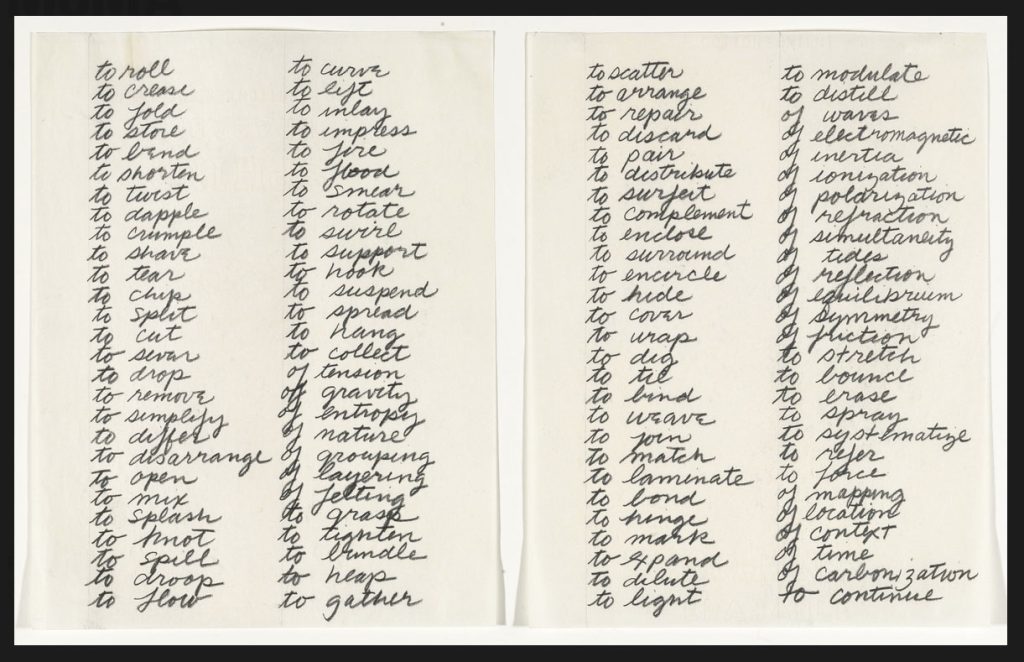
The program also provides some background on his history and discusses a bit of his creative process. One technique was to use a list of verb actions. He would choose one from the list and apply that to different materials. He explains in the video how he used “to lift” for a rubber sculpture in the exhibition.

Richard Serra, “Verb List”, 1967 (image via MoMA)

If you are in Los Angeles, one of his most famous sculptures, Band (2006), is currently on view at LACMA. In NYC you can see Equal (2015), which consists of eight forged steel boxes stacked in pairs, at the Museum of Modern Art.

Jan 192024
 

Pictured above is Drossos P. Skyllas‘ painting, Wisconsin Ice Cave, 1950, part of LACMA’s 2018 exhibition, Outliers and American Vanguard Art.

About the artist from the National Gallery of Art in Washington D.C. where the exhibition was also on view-

Drossos Skyllas achieved the exquisitely detailed, jewel-like surfaces of his paintings with tiny brushes he fashioned himself. He applied miniscule dabs of luminous oil paint in a pointillist manner, which gave his subjects a petrified yet shimmering quality. His refined technique and adherence to the academic genres of still life, landscape, portraiture, and mythological scenes demonstrate his knowledge of art history. And inspired by the old masters, he perfected the difficult depiction of reflective surfaces, including gems, mirrors, water, and ice. At the same time, his uniform clarity of detail, imposed symmetry, and sense of frozen time create a dreamlike mysteriousness reminiscent of magic realism. In addition to high art sources, Skyllas likely drew upon commercial illustration and photography. Untitled (Roses) resembles both traditional floral still lifes and midcentury advertisements for jewelry and flowers. Wisconsin Ice Cave relates as much to northern Renaissance landscape painting as to mass-produced picture postcards.

Born in Greece, Skyllas worked in his father’s tobacco business before emigrating to the US shortly after World War II. He settled in Chicago and devoted himself to becoming a professional artist, though he had no formal artistic training. Supported financially by his wife, Skyllas produced thirty-eight paintings from the late 1940s until his death in 1973. Some of these he submitted to the annual juried exhibition at the Art Institute of Chicago, Chicago and Vicinity, which featured his work in 1955, 1967, 1969, and 1973. He also sought commissions to paint portraits, but with asking prices as high as $30,000, he never found any patrons.

Skyllas’s work was discovered after his death by Chicago gallerist Phyllis Kind, who added him to her roster of self-taught artists in 1974. He was likely known to artists Jim Nutt and Gladys Nilsson before this, as they had exhibited alongside him in the 1967 Chicago and Vicinity exhibition and are enthusiastic collectors of self-taught artists (Wisconsin Ice Cave is in their collection). The meticulous finish of Skyllas’s paintings, which simultaneously evokes advertising art and Renaissance illusionism, appealed to Nutt, Nilsson, and fellow Chicago imagist Roger Brown, whose art collection also included the self-taught Greek master.


Jun 232023


Closing tomorrow, 6/24, is Cross Communication, an exhibition of Chris Burden’s relics, films, video works, and other materials that document his early performances at Gagosian’s 75th and Park location in NYC.

Walking into the gallery and hearing one of his TV commercials in which he reads off the names of famous artists followed by his own name (Chris Burden Promo (1976)), is a humorous introduction to Burden’s often audacious work. Poem for LA from 1975, which follows with the messages- “SCIENCE HAS FAILED”, “HEAT IS LIFE” and “TIME KILLS” still resonates today.

Check out the video below to see the commercials and hear Burden discuss the work.

Other videos included have him crawling across glass; lying between two sheets of glass that are on set on fire (Icarus); and one of his most infamous- being shot in the arm (Shoot, 1971). The less outrageous works are great too, including Disappearing (1971), pictured above.

For more on the artist, the excellent documentary Burden, by Richard Dewey and Timothy Marrinan, follows his career from these earlier works to the large scale sculptures like Metropolis II and Urban Light that came later. Both of these installations are on view in Los Angeles at LACMA.

Jul 302020
 

Happy Birthday to Betye Saar who turned 94 today! This work Still Ticking, (2005), was part of LACMA’s exhibition Betye Saar: Call and Response which opened at the museum in September of 2019.

From the wall description of the work-

Made shortly before Saar’s seventy-eighth birthday, the assemblage includes years and astrological glyphs on the inner left side that correlate to various important dates in her life. The work’s title wittily refers both to the timepieces in the sculpture- which, of course, are not ticking; indeed they are either frozen in time or missing their hands- and to the artist herself, who is alive and well, still ticking, now at age ninety-three.

Jul 062020
 

Today, July 6th, is the four year anniversary of the fatal shooting of Philando Castile by a police officer during a traffic stop in Minnesota. Castile was shot five times while his girlfriend and her four year old daughter were in the car.

Mark Bradford’s 150 Portrait Tone, 2017, currently at LACMA, is a devastating large scale work that uses excerpts from Philando Castile’s girlfriend Diamond Reynolds’s dialogue from the video she live streamed on Facebook from the incident.

From LACMA’s wall description of the work-

Bradford notes that he was moved by the multiple subjects Reynolds simultaneously addressed and the different spaces they occupied: her boyfriend, Castile, next to her (“stay with me”); the officer outside the car (“please, officer, don’t tell me that you just did this”); God (“Lord, please Jesus, don’t tell me that he’s gone”); as well as the unknown receiver on the other side of her lifestream (“please don’t tell me he just went like that”).

Like many of Bradford’s works, the mural-size composition contains elements of both abstraction and realism. In places, layers of manipulated paint render the text almost illegible. The dark form in the background, however, evokes all-too-real associations with the horrific shooting, such as Castile’s twisted arm and the dark-red bloodstain spread across his white shirt, both visible in the live stream feed.

The title, “150 Portrait Tone”, refers to the name and color code of the pink acrylic used throughout the painting (most conspicuous in a large patch at the work’s bottom edge). Like the now-obsolete “flesh” crayon in the Crayola 64 box (the color was renamed “peach” in 1962), the color “portrait tone” carries inherent assumptions about who, exactly, is being depicted. In the context of Bradford’s painting, the title presents a sobering commentary on power and representation.

May 102020
 

Swiss artist Cuno Amiet’s Mutter und Kind im Garten (Mother and Child in Garden), circa 1903, part of LACMA’s 2014 exhibition Expressionism in Germany and France: From Van Gogh to Kandinsky.

Jan 042020
 

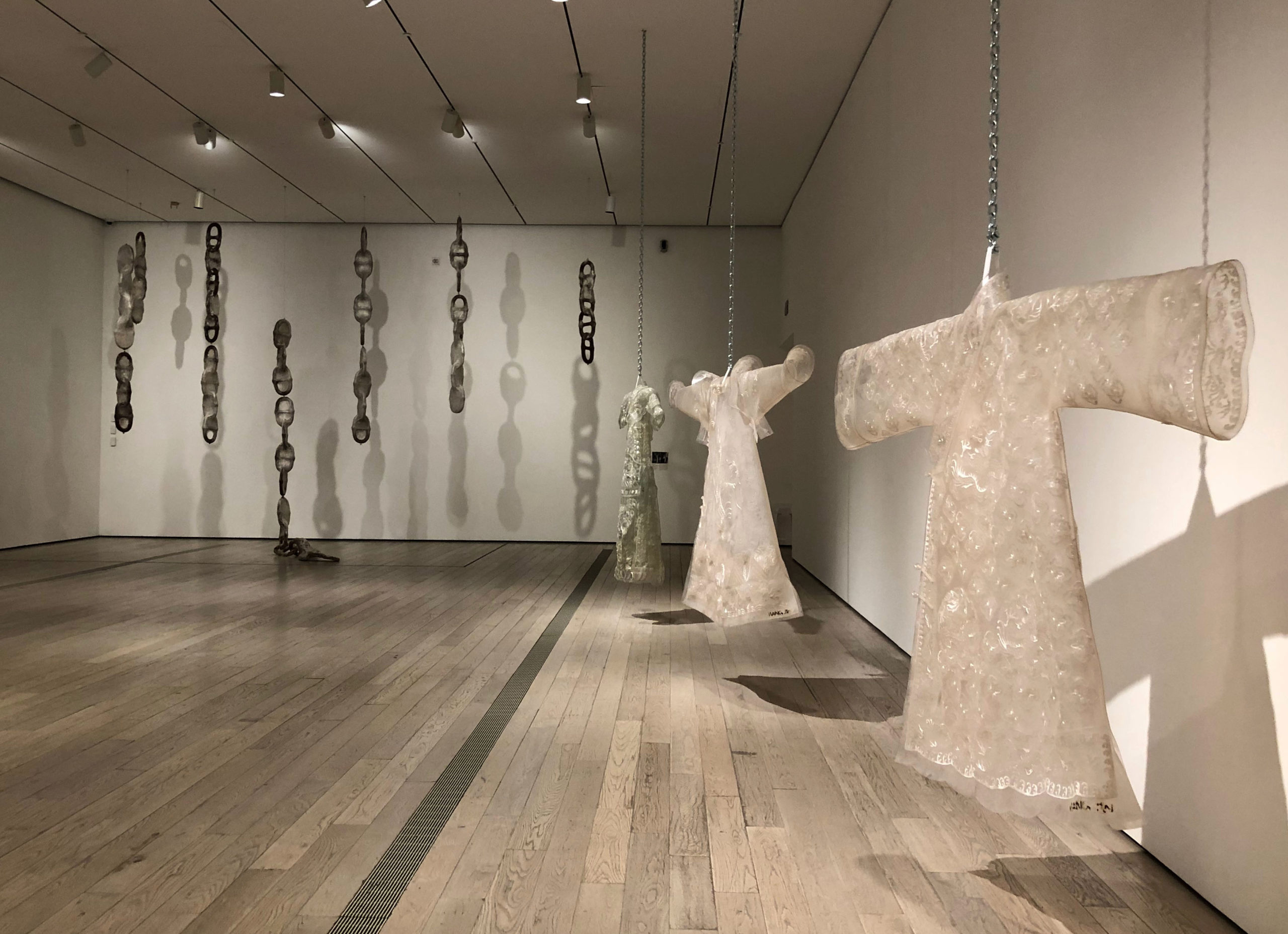
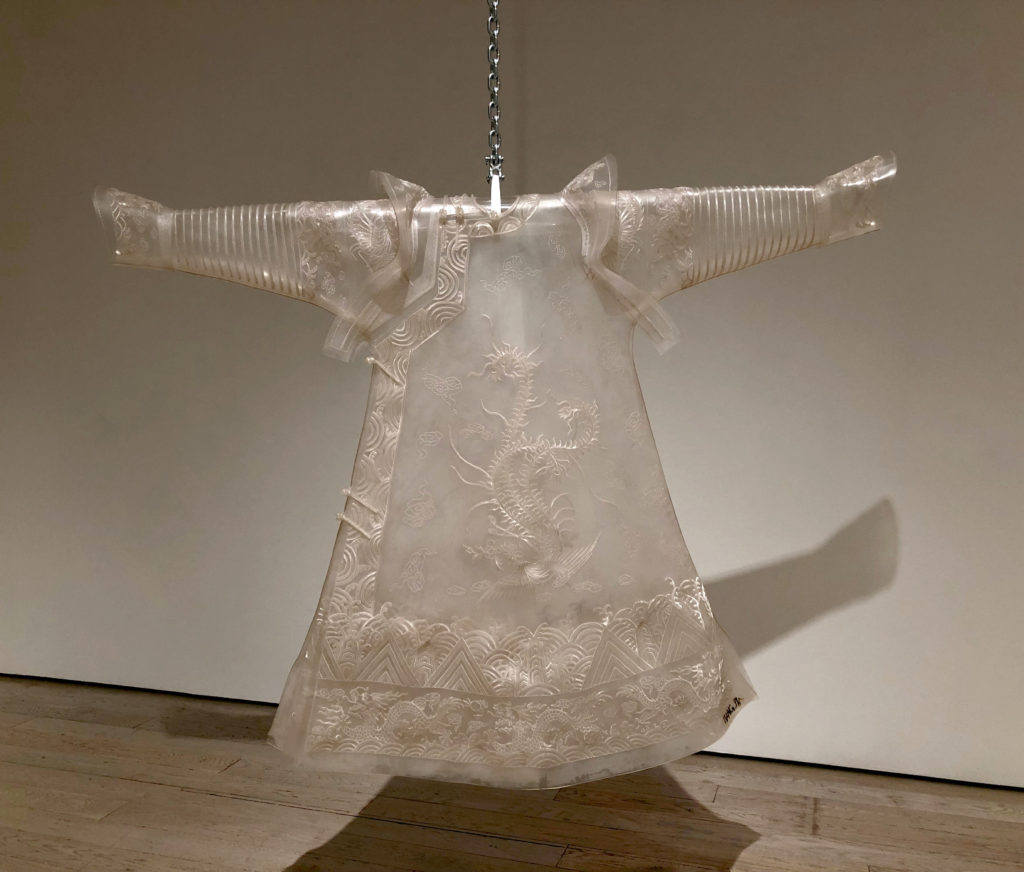
A Chinese Dream by Wang Jin

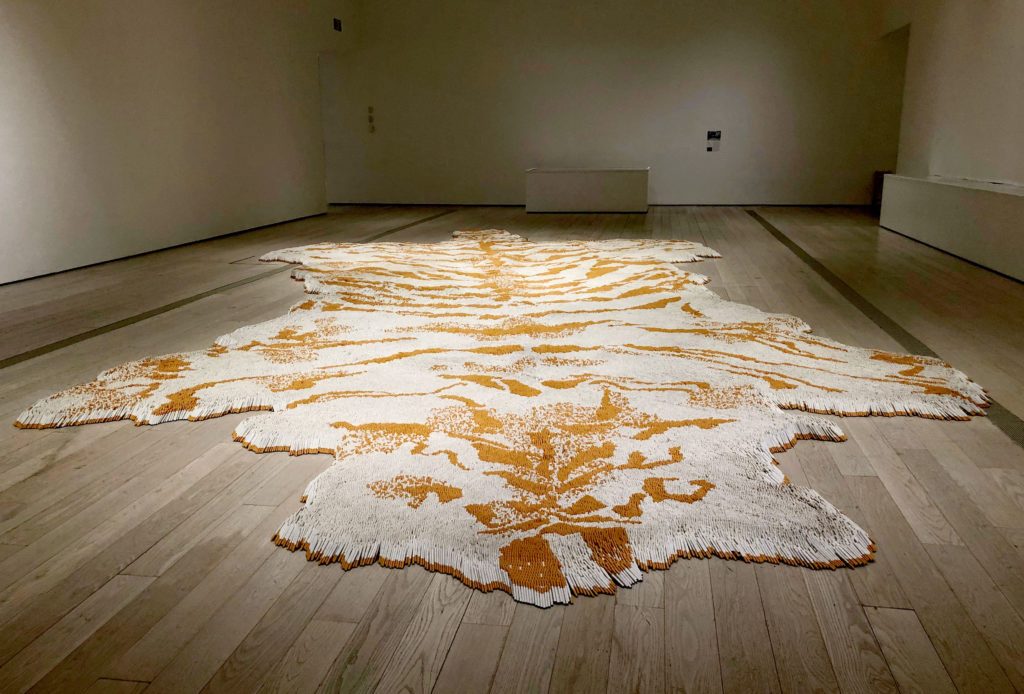
First Class by Xu Bing

First Class (detail)

Closing 1/5/20 is The Allure of Matter: Material Art from China at LACMA.

From their website-

Since the 1980s, Chinese contemporary artists have cultivated intimate relationships with their materials, establishing a framework of interpretation revolving around materiality. Their media range from the commonplace to the unconventional, the natural to the synthetic, the elemental to the composite: from plastic, water, and wood, to hair, tobacco, and Coca-Cola. Artists continue to explore and develop this creative mode, with some devoting decades of their practice to experiments with a single material. The Allure of Matter: Material Art from China brings together works from the past four decades in which conscious material choice has become a symbol of the artists’ expression, representing this unique trend throughout recent history. Some of the most influential Chinese contemporary artists today are featured in this exhibition, including Xu Bing, Cai Guo-Qiang, Lin Tianmiao, and Ai Weiwei.

There are a lot of impressive pieces in the show, including Xu Bing’s First Class, pictured above. Inspired by a photograph of a tiger-skin rug in a colonial home in Shanghai, it was created using cigarettes, also considered a luxury item by many. 

Also pictured are Wang Jin’s imperial robes/theatrical costumes that were created using PVC and fishing wire- replacing the traditional silk material. According to the wall description, the title Chinese Dream “alludes to the commercialization of tradition”. Held up by thick metal chains, they are also much heavier than the originals they copy.

Dec 062019
 

Closing 12/8/19 at LACMA is Every Living Thing: Animals in Japanese Art. It’s a really fun of exhibition with a good selection of art from different time periods, including Yayoi Kusama’s dog sculptures from Megu-chan (2014), two of which are pictured above.

From LACMA’s website-

Every Living Thing: Animals in Japanese Art celebrates one of the most distinctive and compelling aspects of Japanese art: the depiction of animals. Underpinned by Japan’s unique spiritual heritage of Shintō and Buddhism, the Japanese reverence for nature—and the place of animals within that realm—is expressed in sculpture, painting, lacquer-work, ceramics, metalwork, cloisonné, and woodblock prints.

Lions, dogs, horses, oxen, cats, fish, insects, birds, dragons, phoenixes—animals warm and cold-blooded, real and imaginary—are meticulously and beautifully rendered in myriad works from ancient 6th-century clay sculpture to contemporary art. Arranged in themes such as Zodiac Animals, Animals from Nature, Religion, Myth and Folklore, and Leisure, the exhibition draws heavily from LACMA’s permanent collection and includes masterpieces from Japanese and American public and private collections, some of which are on view for the first time.