Jul 272026
 

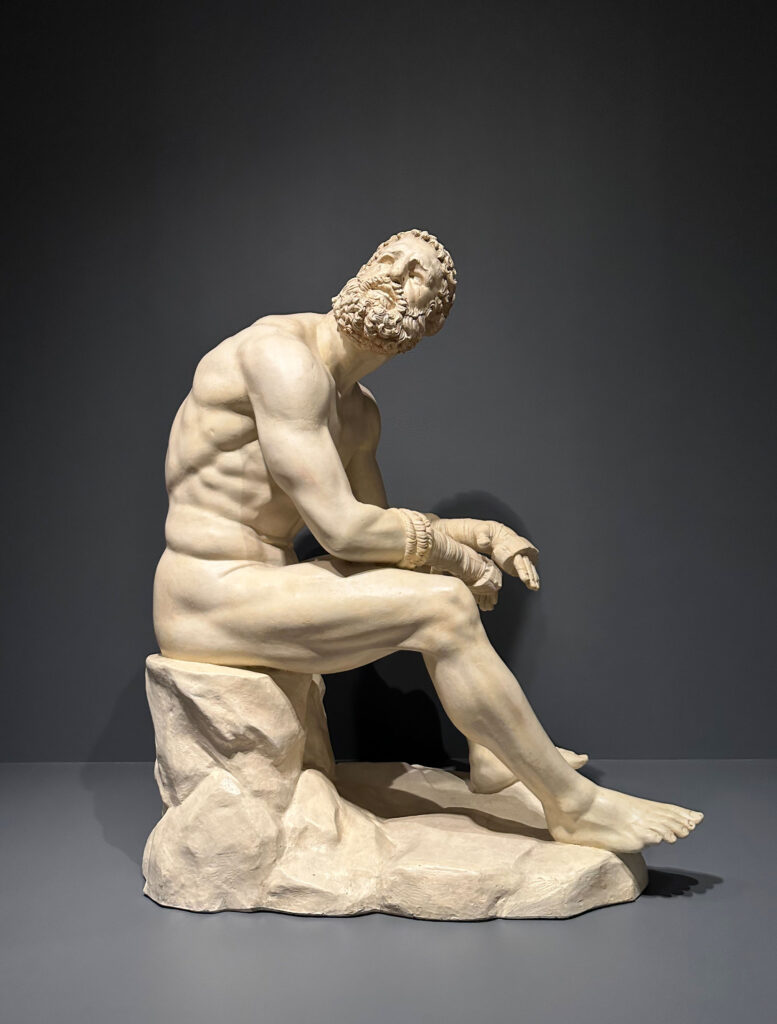
Caproni Brothers, “The Boxer at Rest”, 19th century Painted plaster cast from the original bronze which was produced between the late fourth and second centuries BCE

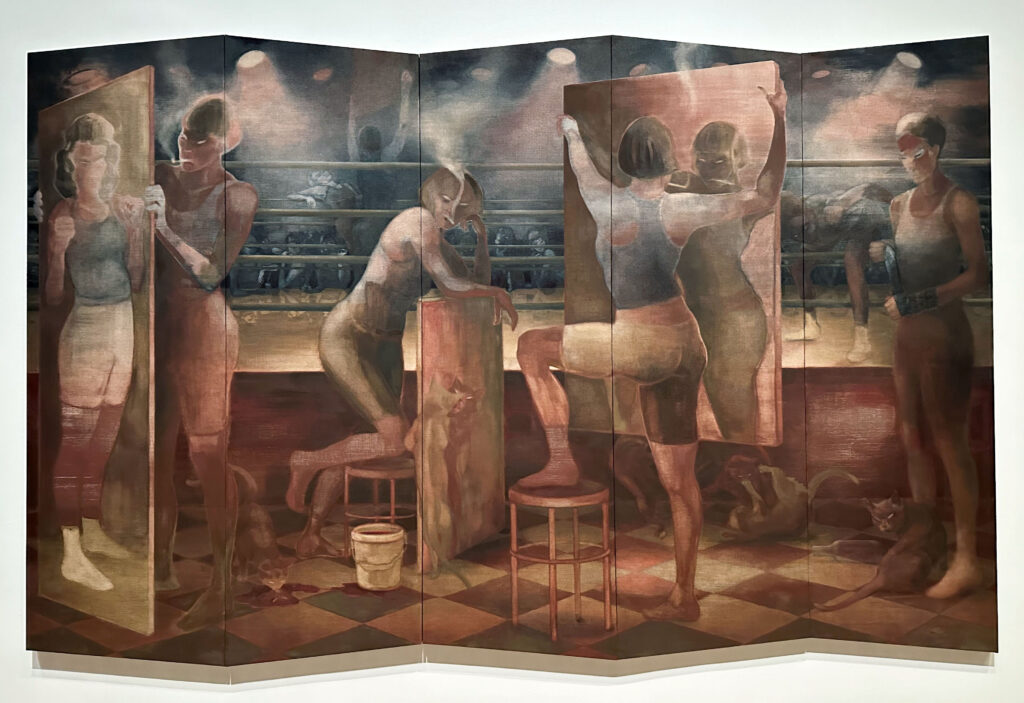
Lisa Brice “Untitled”, 2025 Pigment and natural water-soluble binders on linen

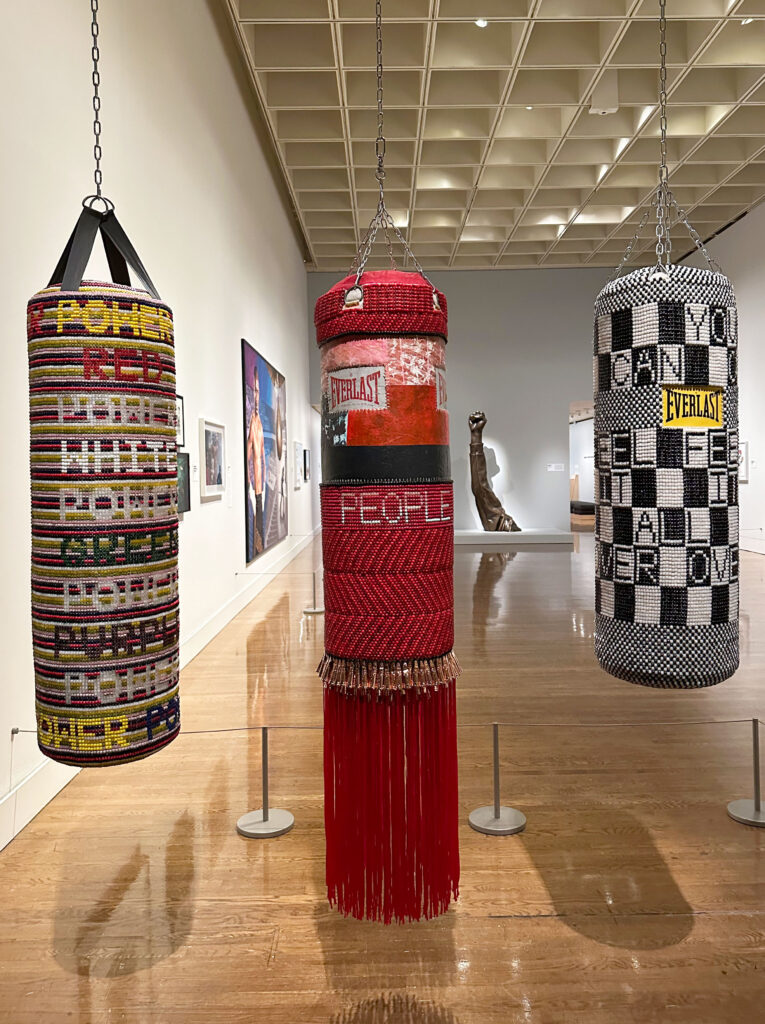
Jeffrey Gibson, (l to r) “Power, Power, Power”, 2017, “People Like Us”, 2014, and “You Can Feel It All Over”, 2015, Repurposed punching bags, glass beads, artificial sinew

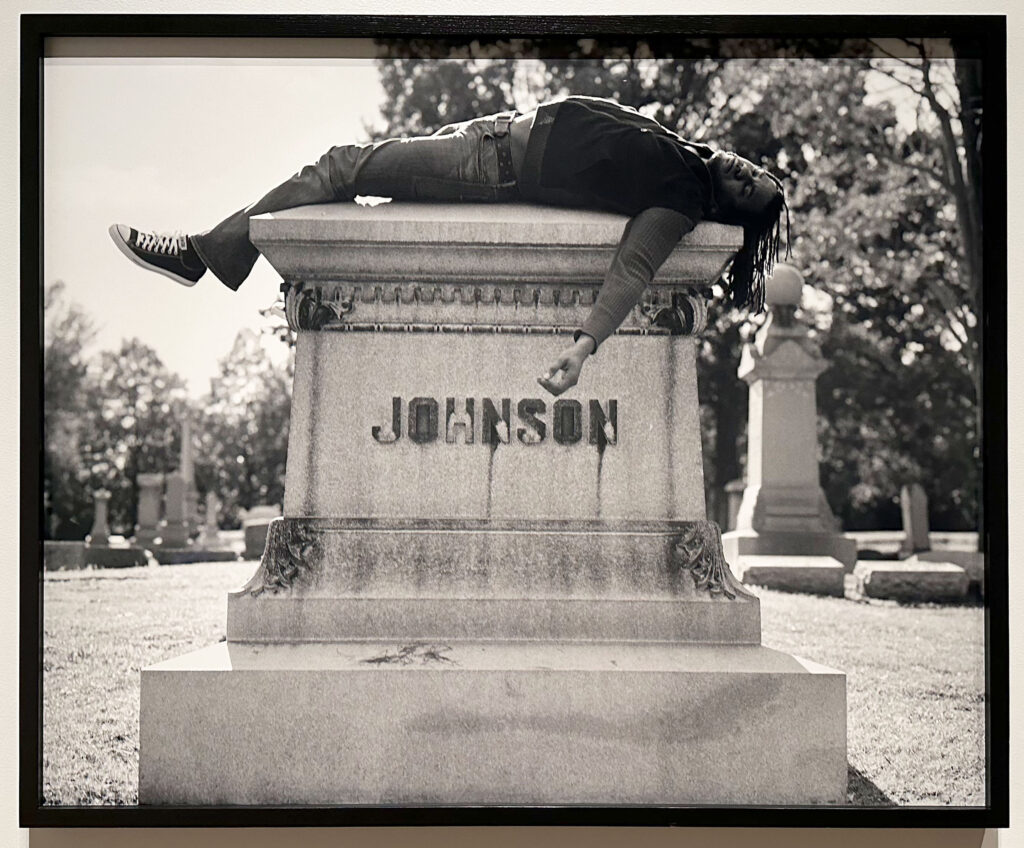
Rashid Johnson, “Self-Portrait Laying on Jack Johnson‘s Grave”, 2006, Durst Lambda print mounted on panel

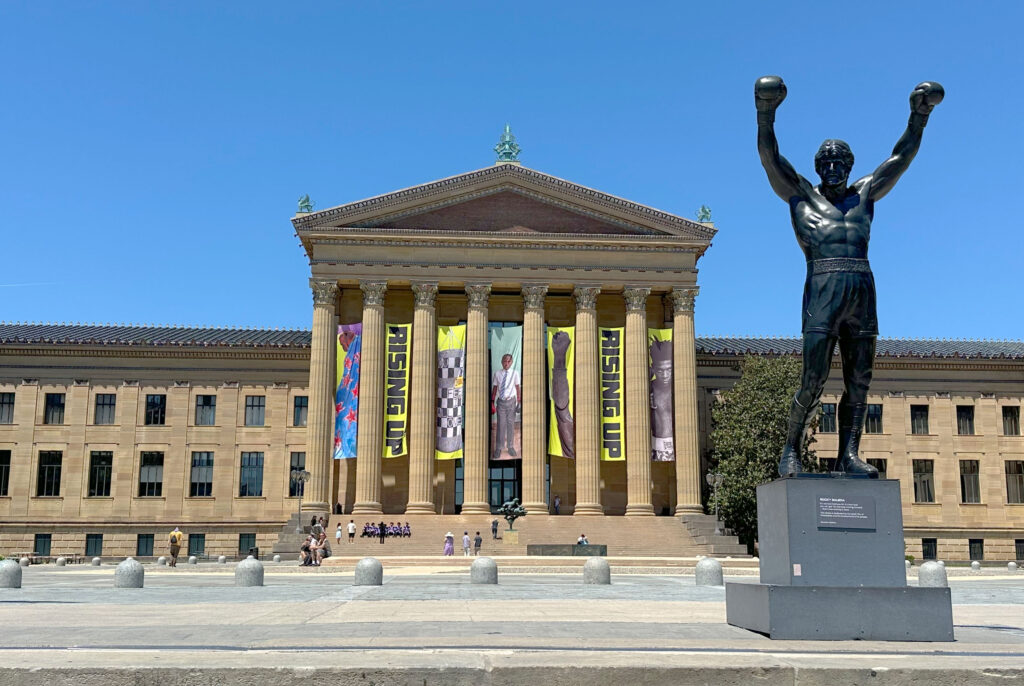
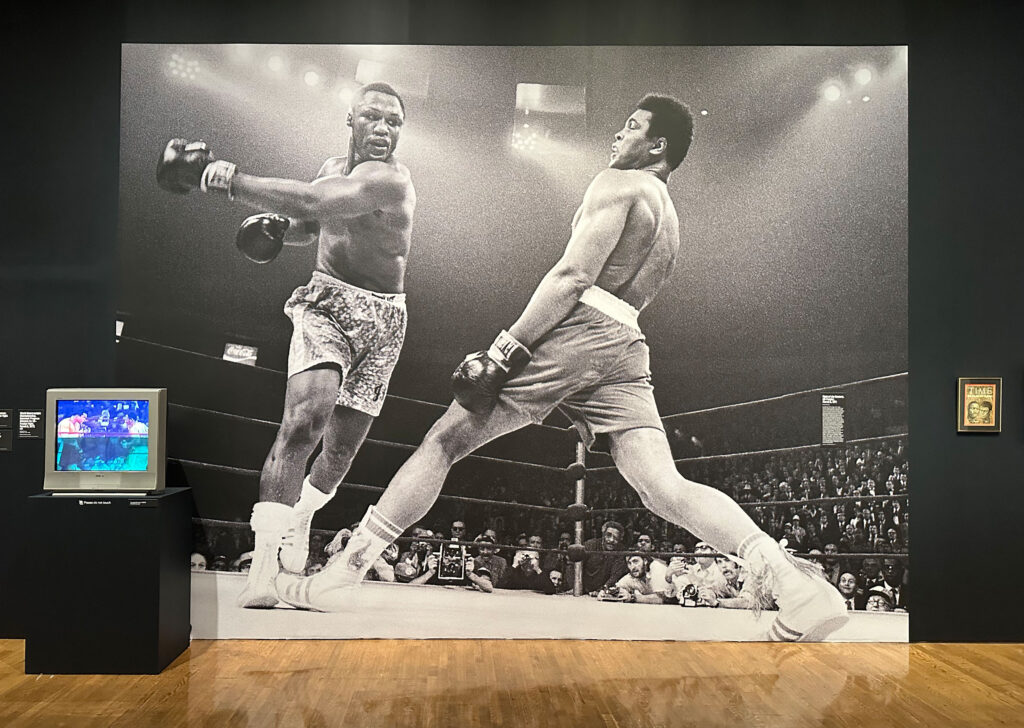
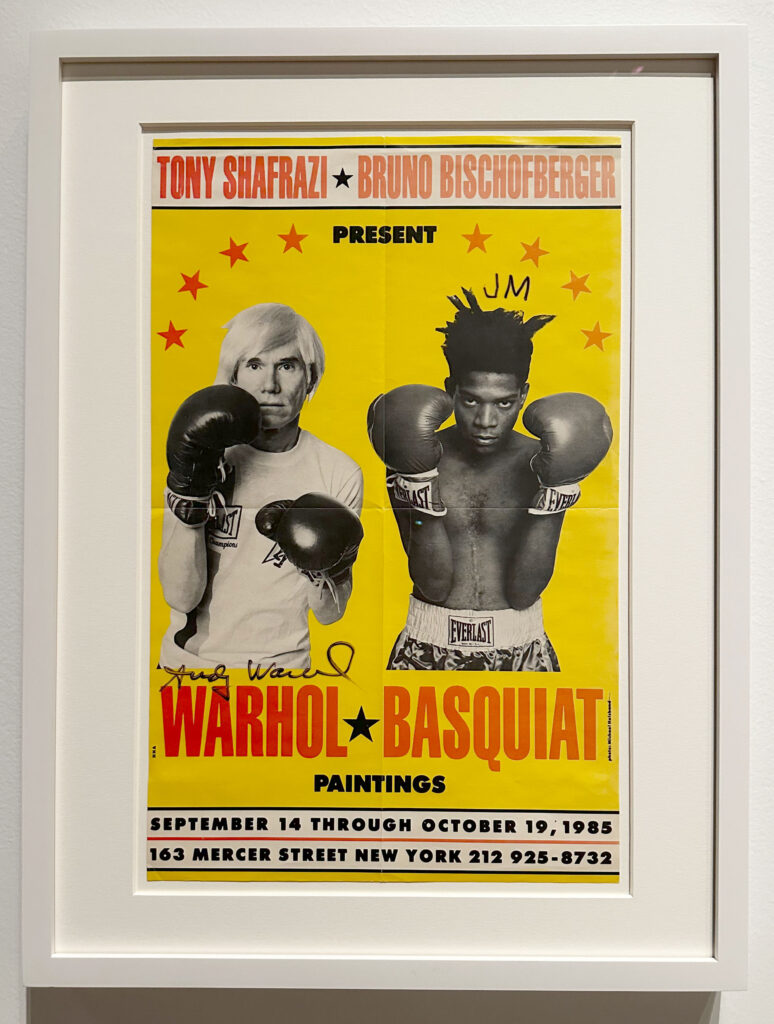
Approaching the front steps of the Philadelphia Museum of Art, you will find people of all ages and backgrounds taking photos with the statue of Rocky out front, often imitating his famous pose. Through a variety of works from antiquity to the present day, Rising Up looks at the history of this statue, the meanings attached to monuments, and the allure of boxers and boxing culture.

From the museum about the exhibition:

Blending the worlds of art, sports, and popular culture, Rising Up takes on the life of monuments by exploring the meanings and mythologies of the Rocky statue. The exhibition looks to the statue of the most famous Philadelphian who never lived as a way to better understand our complex and vital relationships to our public monuments.

The statue first appeared on-screen in the Oscar-winning Rocky film series. The third installment, Rocky III (1982), featured the dedication of a monument that celebrated the boxer as both an underdog and a hero. The movie-made statue was placed outside the actual museum during filming, a dynamic blurring of art and life that continues to this day. Since that introduction, and through the statue’s departure and prolonged absence from the museum grounds to its prodigal return to the steps, the statue has sparked debate over its aesthetic value and its role in the city. Today, the power of the Rocky statue as a monument stems from its ability to summon public participation.

From antiquity to modernity, Hollywood to contemporary art, Rising Up spotlights both popular narratives and undertold stories surrounding the Rocky statue. Each gallery offers a response to the exhibition’s central question — why do millions of people visit the Rocky statue at the steps of the Philadelphia Museum of Art each year? — and further explores the relationship between art, boxing, and civic identity. It offers a renewed context to consider the statue through works and artifacts that reflect on the deep legacies of boxing monuments across time.

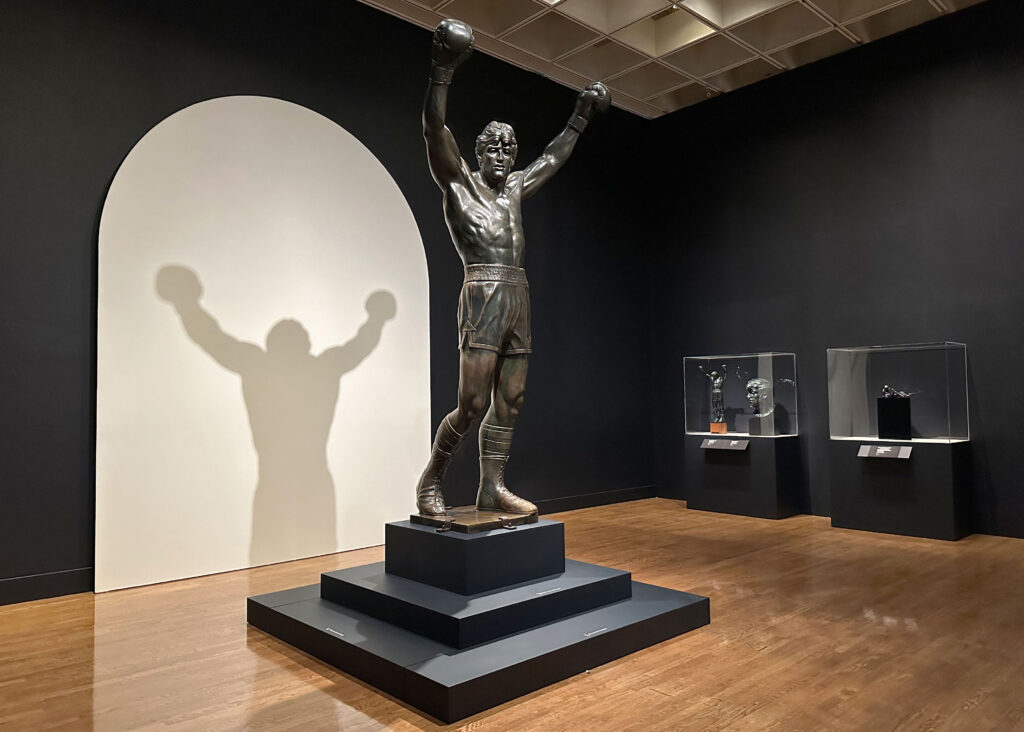
Rising Up marks the first time that the Rocky statue has been displayed inside the museum, explored alongside Philadelphia’s landmark boxing culture and multigenerational artists’ interpretations of sport and society. At its core, the exhibition looks at how monuments are made — by artists and by us — through the lens of the Rocky statue and the ways people engage, debate, and gather around this site of memory.

This exhibition closes on 8/2/26.

Jul 092025
 

In Alfred Hitchcock’s Vertigo, his thriller starring Jimmy Stewart and Kim Novak, issues of power, control, obsession, and identity loom large over the mysterious plot.  Stewart plays Scottie, a former San Francisco detective who retired when a traumatic incident left him with a debilitating fear of heights and vertigo. He is hired as a private investigator to follow an acquaintance’s wife, Madeline, played by Kim Novak, who has recently been acting strangely.

Shot in Technicolor, Hitchcock uses the vivid colors to represent the characters. Below, a hotel sign fills the room with an eerie green light, and Scottie’s head floats in red within a dream sequence that includes colorful animation.

There are also several recurring motifs throughout the film. One of the strongest is the various spirals present throughout the film- the tree rings, Madeline’s hair and the hair of the woman in the painting, and the staircase in the mission.  Of course, spirals can be dizzying, and when someone is feeling overwhelmed by their thoughts it is often referred to as “spiraling”- which Scottie is doing as the film progresses. They can also represent the cyclical nature of time.

Madeline and Scottie among the Redwood trees in Muir Woods

Madeline points to two lines marking her life.

Northern California is the backdrop and the scenes in and around San Francisco in the 1950s are stunning.

Vertigo received mixed reviews at the time of its release, but is now considered one of the best films ever made. Through his unique personal vision, Hitchcock created a world to get lost in, with new things to notice on each revisit. The film can also serve as a reminder to struggling artists to stay true to their own ideas- sometimes it takes time for a work to gain appreciation.

Feb 172025
 

Wim Wenders‘ 2023 film Perfect Days, stars Kōji Yakusho as Hirayama, a toilet cleaner in Tokyo who leads a solitary but seemingly contented life. He spends his time outside of work reading, listening to music on cassette tapes, taking care of his plants, and taking analog photos of trees. This simple life begins to change as smaller and larger moments with others expand his world and alter his routines.

The quiet film focuses on a few of these people- including his coworker and later the surprise arrival of his niece. Watching them together as they spend his previously solitary days mirroring each other unconsciously, is especially lovely. After her departure there is another interaction that leaves the viewer to wonder if Hirayama will continue to live this simple life or embrace potential changes to his “perfect days”.

The pictures of the trees throughout the film capture the Japanese word “komorebi”. The word is defined at the end of the film, after the credits, as “the shimmering of light and shadows that is created by leaves swaying in the wind”. These images continue in Hirayama’s black and white dreams, created by Wenders’ wife Donata.

Wim Wenders is currently showing two bodies of work at Howard Greenberg Gallery in NYC- Written in the West, from his roadtrip to the American West in 1983 and Once, a series of works from his travels and encounters with Hollywood. This exhibition will be on view until 3/15/25.


Dec 052024
 

Chris Marker’s 1983 poetic travelogue Sans Soleil brings something new with every rewatch. The film consists of footage, some stock and some of Marker’s own work, taken around the world, with a focus primarily on Japan and Guinea-Bissau. Along with these images, a narrator (Alexandra Stewart in the English version) reads from the letters she received from the fictitious cameraman. Within these letters are his thoughts on memory, history, culture, and life itself.

On this viewing it was his mention of Sei Shonagon, a lady in waiting to Princess Sadako in Japan at the beginning of the 11th century, and her lists, that stood out for me.

He says:

“Do we ever know where history is really made? Rulers ruled and used complicated strategies to fight one another. Real power was in the hands of a family of hereditary regents; the emperor’s court had become nothing more than a place of intrigues and intellectual games. But by learning to draw a sort of melancholy comfort from the contemplation of the tiniest things this small group of idlers left a mark on Japanese sensibility much deeper than the mediocre thundering of the politicians. Shonagon had a passion for lists: the list of ‘elegant things,’ ‘distressing things,’ or even of ‘things not worth doing.’ One day she got the idea of drawing up a list of ‘things that quicken the heart.’ Not a bad criterion I realize when I’m filming…”

Finding things, however small, that “quicken the heart” is a lovely criterion for life in general and this film is certainly on the list.

After watching Sans Soleil, and researching Marker, I watched one of his earlier works, the science fiction featurette  La Jetée. Constructed using still images, it contains only one brief shot made with a movie camera.

Using voice over narration, the short film takes place after World War III and tells the story of a prisoner in a post-apocalyptic Paris forces to time travel to the past and future in the hopes of saving the present. The man has a vivid memory from his childhood before the war of a woman he had seen at the airport, just before witnessing a man’s death. Through his time travel he is able to meet and develop a relationship with her as an adult. Time and memory, themes also present in Sans Soleil, were subjects Marker retained an interest in exploring in many of his films throughout the years.

La Jetée would go on to influence many artists, musicians, and filmmakers over the years. One of the most famous examples is Terry Gilliam’s movie 12 Monkeys which uses several of the film’s concepts of time travel.

Criterion Collection has released both movies together along with Marker’s six minute film Junktopia, and other extras. For more information on his filmography, Catherine Lupton has written a very informative essay on their website.


Sep 152024


This weekend I revisited 2011’s The Tree of Life, directed by Terence Malick. The film unfolds like a visual poem and the cinematography is breathtaking. It’s a beautiful meditation on all aspects of life including family, love, death, suffering, grace, nature, and God.

It received mixed reviews at the time, and the narrative may not come together for everyone, but the performances and ambition of the film make it worth a watch.


Aug 182024
 

Famous French actor Alain Delon passed away on Sunday, 8/18.

The stills above are from his film Le Samourai from 1967, directed by Jean-Pierre Melville.  The beautifully shot film follows a mostly silent Delon as an assassin trying to discover who is trying to kill him. It also stars his then wife Nathalie Delon.

Jul 072023
 

Richard Linklater’s 1990 film Slacker, is a wonderful trip back in time to the pre-Internet days and a celebration of American eccentricity. If you haven’t seen it, the film follows various different Austin locals in brief scenes and conversations, all within a 24 hour period in 1989.

The film opens on a monologue from Linklater himself describing his dream to a taxi driver and then moves on to a man who hits his mother with a car. The scenes flow from one character or group to a new one almost seamlessly. Conspiracy theorists, coffee shop philosophers, a man who collects televisions and disaster footage, a group of housemates reading a story on postcards from a former housemate left behind, and on and on as the day turns to night and then back to day again.

Linklater wrote these interactions and many of them are based on stories or projects from the people seen in the film. In his director’s commentary he gives the background for many of the involved participants. He also explains how he directed them not to treat any of the people speaking as if they are strange or odd. It’s another aspect of the film that makes it special, and a reminder of the way we should try to treat people.

Sadly Teresa Taylor (pictured in the above two photos center), aka Teresa Nervosa, one time drummer for the Butthole Surfers, died last month. Her image was used for the movie poster and promotional materials. Her scene in Slacker is one of the most memorable as well. She tells a story of a highway suicide and then attempts to sell what she claims is singer Madonna’s pap smear.


Sep 162022
 

Started above a Detroit record store in 1969, CREEM magazine would go on to cover the music scene until 1989. Now, 33 years later, it’s back. The first new issue of “America’s Only Rock ‘n’ Roll Magazine” is now in print and online- with a cover by artist Raymond Pettibon.

CREEM magazine gained a loyal following for both its unique writing and format. It also covered the punk, new wave, and heavy metal scenes in a time still dominated primarily by pop and rock music. Lester Bangs, who became more widely known after his portrayal by Philip Seymour Hoffman in Almost Famous, was editor of the magazine for five years. Cameron Crowe, who wrote and directed that film, also contributed articles for CREEM.

The premiere issue of the magazine has something for every music fan, while keeping the feel of the original. Special Interest, Mac DeMarco, Amyl and the Sniffers, Warthog, and KeiyaA are among the current artists covered. There’s an article on an album by The Osmonds and an excerpt from an unreleased book on The Who. Features from the original magazine like “Stars Cars” and their letters section also make a return.

This Wednesday (9/21/22) at The Grammy Museum, there will be a screening of the 2020 documentary  CREEM: America’s Only Rock ‘n’ Roll Magazine. The film will be followed by a conversation with JJ Kramer (CREEM Chairman and son of CREEM founder Barry Kramer), Jaan Uhelszki (Editor at the original CREEM and Editor Emeritus today), and Dave Carnie (CREEM Editorial Director), moderated by journalist Scott Sterling.

CREEM also just released a special David Bowie edition of the magazine. It includes articles from past issues, as well as an interview with Brett Morgen, director of Moonage Daydream, the new Bowie documentary which opens in theaters today, 9/16/22.

There are digital and print subscription options for the quarterly magazine and all subscriptions give you access to the digital archives- all 224 of the past issues.


Sep 152022
 

Above are scenes from Jean-Luc Godard’s 1960 film, Breathless, starring Jean Seberg and Jean-Paul Belmondo.

The first two pictures are from a press conference scene where Seberg’s character asks an author (played by influential director Jean-Pierre Melville) for his “greatest ambition in life” He replies- “To become immortal, and then die”.

Although it was sad to hear of Godard’s passing, he has certainly achieved immortality through his beautiful work.

Jan 212016
 

David Bowie- Playing Himself on Extras

David Bowie’s work as an actor varied throughout his career, from playing a vampire with Catherine Deneuve and Susan Sarandon in The Hunger, to a goblin king in Jim Henson’s Labyrinth. But he also had a great sense of humor which can be seen in his cameo in Zoolander and this moment playing himself in Ricky Gervais’s Extras.