
This painting, Dream Spiral Kitten, 2022, by Haley Josephs was part of the 2023 group exhibition Oh, What a World at Jack Barrett gallery in NYC.

This painting, Dream Spiral Kitten, 2022, by Haley Josephs was part of the 2023 group exhibition Oh, What a World at Jack Barrett gallery in NYC.

“Along the Army Corps Floodwall in Ardsley in Autumn”, 2023-4, Oil on linen

“Along the Army Corps Floodwall in Ardsley in Autumn” (closer)

“NYSC by the Saw Mill River in Winter”, 2024 Oil on linen

“Setting Sun with Entopitc Phenomena During the Canadian Wildfires in Sean’s Subaru”, 2023-4, Oil on colored linen

“LA Fitness in Ridge Hill by the Sprain Brooke in Summer”, 2023-4, Oil on linen

“LA Fitness in Ridge Hill by the Sprain Brooke in Summer” (closer)
Depicting various locations during different seasons, Dylan Vandenhoeck’s paintings for Right Under the Nose at Jack Barrett Gallery, explore the way selective vision creates and distorts our memories of moments and places.
From the press release by Jonathan Crary-
One of the important features of the Western European modern world that begins to emerge in the decades around the year 1500 is a reorganization of the human senses. Taking place over several hundred years is a relentless prioritization of vision and its isolation from the other senses. What some theorists have called “ocularcentrism” is this privileging of the eye and its alignment with rationalized forms of knowledge that distance a human observer from the physical world and estrange them from the multi-sensory immediacy of perception. Since the Renaissance, the arts have been shaped by practices and techniques that have posed the fiction that our vision is a faithful mirroring of an objective external reality. This model has been a crucial underpinning for the rationalized forms of knowledge and utilitarian, extractive priorities of Western modernity. But there have long been artists whose counter-practices have challenged this dominant framework, including, for instance, Hans Holbein and his Ambassadors, William Blake, J M W Turner, Roberto Matta and Stan Brakhage.
Dylan Vandenhoeck is part of this lineage for the ways in which his work foregrounds the embodied, or subjective nature of our vision. One of many examples of embodied vision is the fact that our optical impressions are shaped by the actual curvature of our spherical eyeballs. Yet the most pervasive systems of visual representation, such as linear perspective, have “corrected” this phenomenon by imposing rectilinear organizations onto perceptual experience. Another feature of lived vision to which Vandenhoeck is attentive are afterimages, the response of our eyes (as part of our nervous system) to strong stimulation of various kinds, but notably sunlight. Afterimages are vivid evidence of how our vision is a composite of sensations produced by our body and of the diverse effects of the luminous environment in which we are situated. His paintings present this hybridity as a heterogenous field of divergent events with different temporalities, but which nonetheless coalesce into the dynamic world of immediate experience. Using the terms of Deleuze and Guattari, Vandenhoeck creates a smooth space as opposed to a striated one, that is, non-metric, de-centered and open to metamorphoses.
Around the Mound, for example, manifests some of these qualities in its disturbance of conventional spatial cues, such as altering our reading of what is near and far. It affirms an aggregate field of vision composed of perceptual fragments that don’t cohere into a unified whole. But notably, while Vandenhoeck has crafted a landscape shaped by these disjunctions, he has also interwoven into the work swirling and pulsating flows that engage the viewer kinesthetically. Part of his project is to challenge the ways in which our attentiveness has been regulated and impoverished by the digital milieus in which we are perpetually immersed. The monotonous omnipresence of electroluminescent color and powerful forms of perceptual control, such as eye tracking, have routinized and diminished our visual capacities. Vandenhoeck conveys intimations of the sensory and libidinal gratifications of a heightened bodily response to the vibrant plurality of a living world. In this sense, there is at least a limited utopian underpinning to the images in this show. Yet if one dimension of his work poses the possibility of revivifying our perception, he makes clear that this can only occur within the broken actualities of the early twenty-first century. His revelatory images are all grounded in the prosaic periphery of New York City, marked by highways, shopping malls, and cell phone towers. Thus, one of Vandenhoeck’s remarkable achievements is the reclaiming of an expanded, transfigured vision amid the familiar terrain of the everyday.
This exhibition closes 6/22/24.

“As the Crow Flies”, 2022

“As the Crow Flies”, 2022 (detail)

“As the Crow Flies”, 2022 (detail)

“As the Crow Flies”, 2022 (detail)

“Skunk Hour”, 2022

“Dogwood”, 2022

“Dogwood”, 2022 (detail)
There’s more to Nikki Maloof’s paintings than meets the eye in her exhibition Skunk Hour at Perrotin. The more you look, the more details- often dark- begin to emerge.
From the press release-
For Nikki Maloof, painting is a way to convey the experience of existing in the world—the light, the dark, and all the shadows in between. Her language is figuration: she started out with portraits of individual animals, progressing onto still lifes and, most recently, domestic interiors and landscapes populated with a mix of creatures—human and non-human; alive, dead, and inanimate. These subjects, on one level, have an everyday familiarity. Indeed, they are in many instances collected from Maloof’s immediate environment: for the past few years, her house and studio in rural Massachusetts. But the resulting depictions, however vivid, never feel quite real. The colors are bright, the shapes cartoonish, the compositions often implausible. Everything is emotionally charged. The eyes of dead fish seem to brim with sadness, the oversized blade of a knife glints with menace. A woman who shares Maloof’s physical features stands at a window with a glum expression, her face only just visible behind a tree dense with apples. Looking at these canvases is like looking at a series of dreams, governed by a mysterious logic, their characters and events freighted with ambiguous symbolism.
Of course, unlike in a dream, Maloof chooses what to paint: hers is a conscious artistry. We see evidence of this in her equally accomplished graphite works on paper, in which images are carefully worked out before she embarks on the larger oils on linen. (It’s fun to play spot the difference between the versions in pencil and paint: notice how a glass of wine materializes on a countertop; how a cat relocates from the landing to the stairs.) Perhaps her work is more akin to confessional poetry, intensely personal yet meticulously crafted. The title of this exhibition, “Skunk Hour,” is borrowed from a well-known poem by Robert Lowell, published in 1959, which begins as a light-hearted description of a seaside town in Maine and culminates in a self-portrait of a mind in turmoil. “I myself am hell,” wrote Lowell, “nobody’s here— / only skunks, that search / in the moonlight for a bite to eat.” Similarly, Maloof describes the scenes she constructs as “vessels,” giving tangible form to psychological states or particular thoughts and feelings.
The idea for this new series of paintings hatched last spring, when one morning the artist stumbled upon the birth of a fawn near her home, and later that day witnessed the body of a recently deceased neighbor being removed from his home. She decided that she wanted to capture the weight of being made simultaneously aware of the beginning and the end of life, as well as the tension between the mundane and extraordinary. There are no laboring deer or body bags here: instead, we get paintings like Life Cycles (2022), in which five plates are arranged in a circle, showing the progression of fishes’ lives from small orange roe on crackers to clean-picked bones. Or Burning Bush (2022), in which an empty bird’s nest rests inches away from a hawk dismembering its prey on a branch of the same tree. Whether taking the form of conventional still lifes or more expansive house-and-garden scenes, Maloof’s coded pictures make clear reference to the conventions of Western religious vanitas painting, with its representations of physical objects—flowers, food, skulls—to symbolize the transience of earthly pleasures.
If this sounds unremittingly heavy, it’s not. Maloof’s paintings also offer up many of their own pleasures, both intellectual and sensuous. It would be remiss, for instance, to ignore the slapstick wit in the detail of a rolled joint on a kitchen shelf in the work entitled Skunk Hour (2022): skunk here signifying not the foul-odored mammal but the just-as-pungent strain of cannabis. Life, as Maloof understands, is nearly always funny, even when things are pretty bad. And if you’re not in the mood to laugh, well, just try to resist the delights of the paintings themselves—their profusions of color, pattern, and texture. Extending the culinary theme, we might describe her work as a feast for the eyes. See how the coiling smoke from the lit joint rhymes with the squiggles of steam rising above a pair of artichokes in a colander; notice the thick scraped impasto of the howling cat’s bristling fur. Maloof is unabashedly maximalist in her approach to her canvases, layering both imagery and brushstrokes, at times threatening to overwhelm her subjects through an abundance of painterly gesture. This makes perfect sense. In such moments it becomes clear that, despite the universality of their themes, Maloof’s paintings are a vision of the world as seen through the eyes of a singular artist.
This exhibition will close 4/15/23.
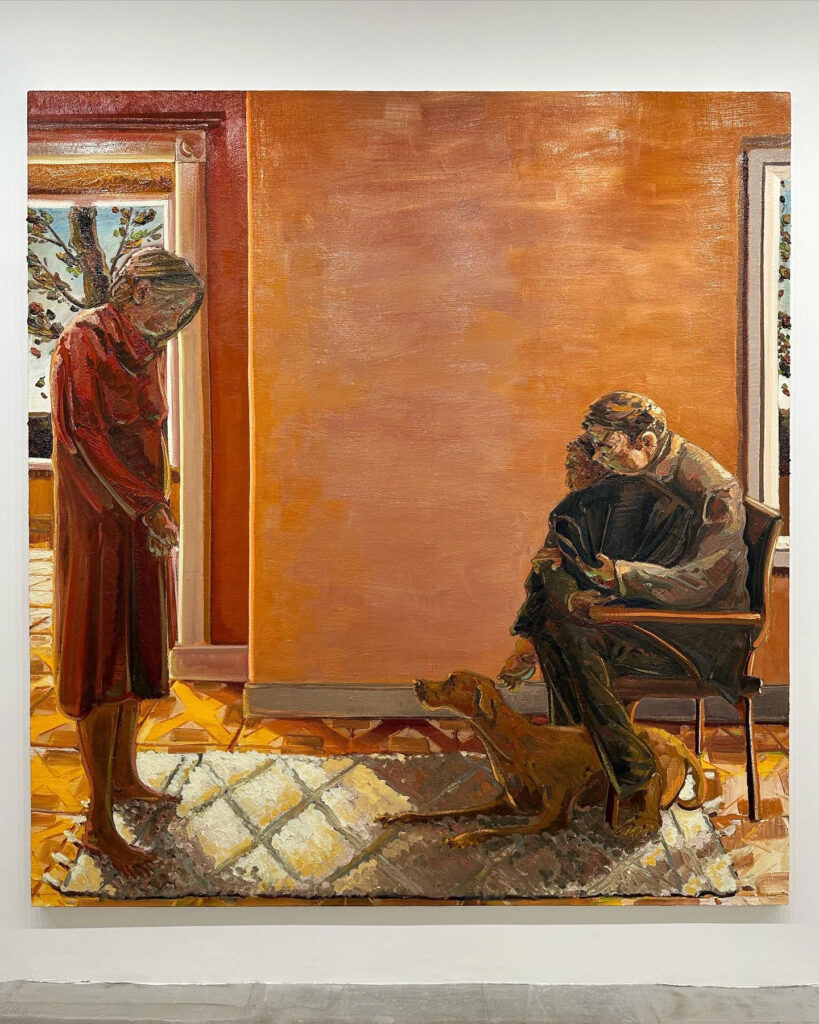
“Apologia, Apology”, 2023
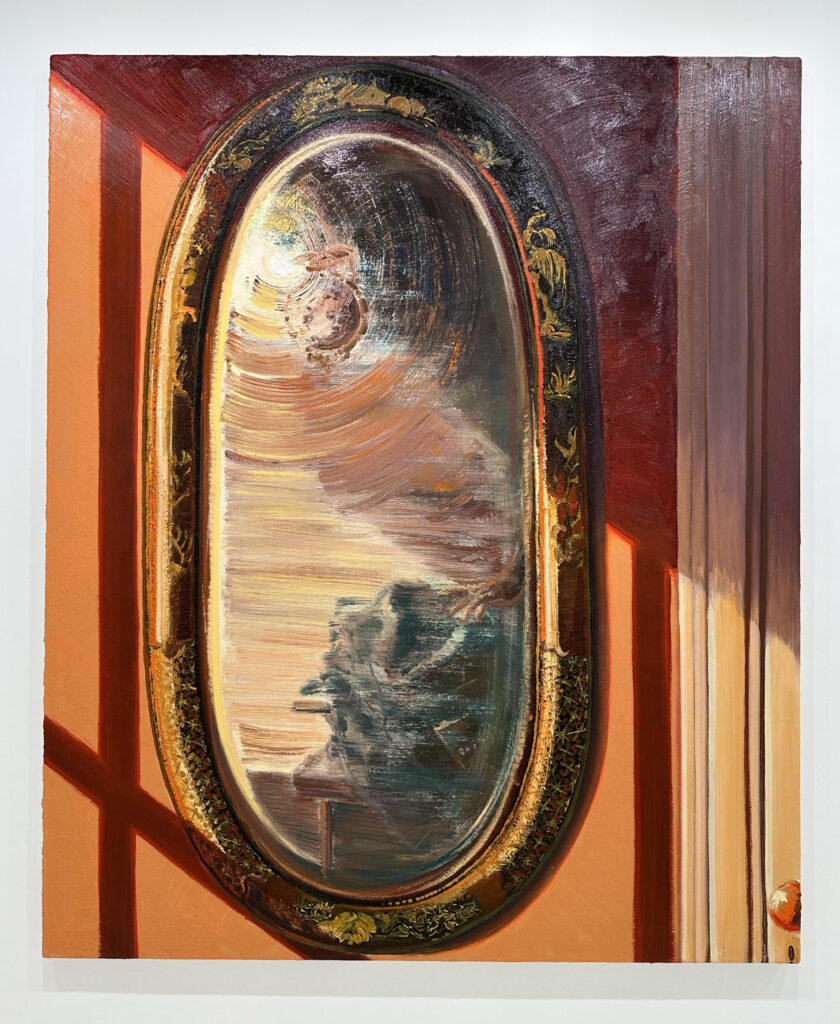
“To Contain More…or Less”, 2023

“The Air Was Heavy”, 2023
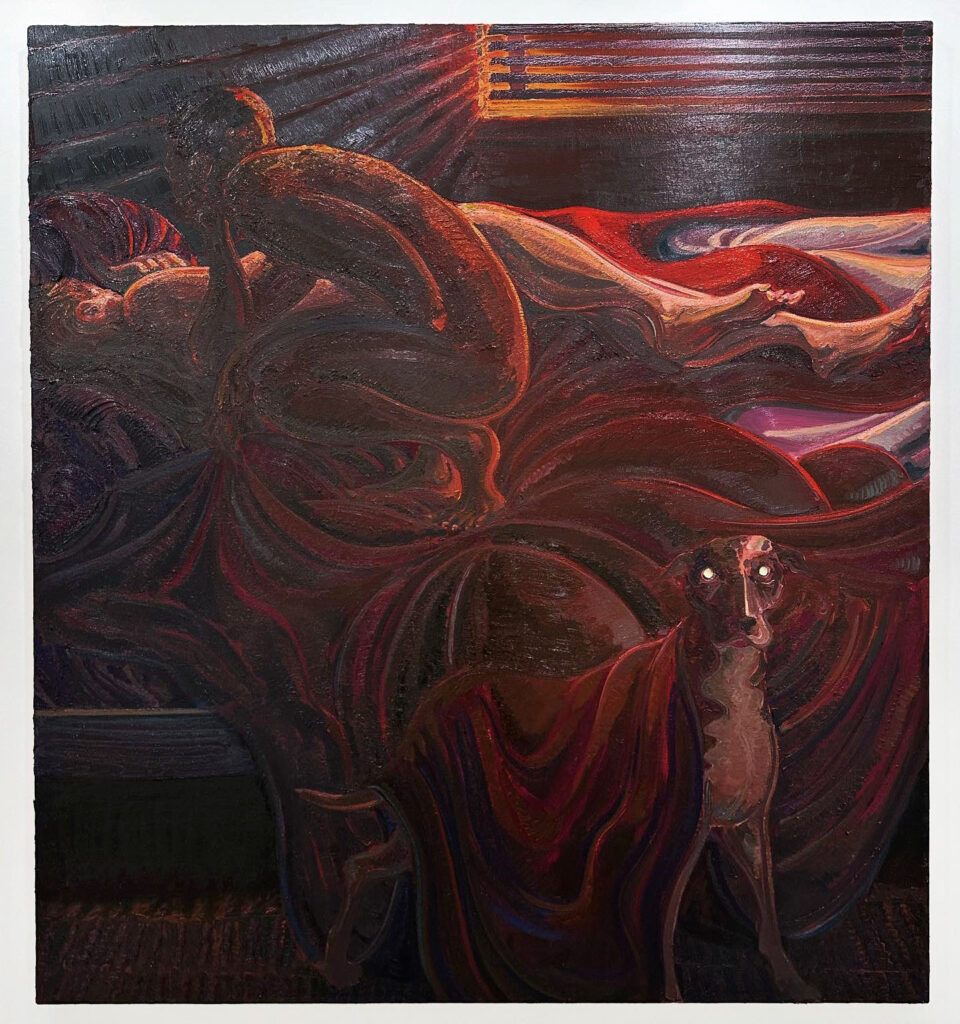
“4:33 AM”, 2023
If a picture is worth a thousand words, Timothy Lai’s paintings for Double Wall at Jack Barrett may be worth a few more. Everything feels tense and uncertain in the work, leaving the viewer with questions that they must answer with their own stories.
From the press release-
“Memory is a choice. You said that once, with your back to me, the way a god would say it.”
– Ocean Vuong
In Timothy Lai’s exhibition Double Wall, things left unsaid reside in waiting. Silence crouches as an omnipresent figure living within the familial unit, unleashed sometimes as performative protection, and at other times, leashed as a placeholder against emotions that cannot or will not be articulated. Amid this verbal lack, Lai’s work materially bristles.
The works in Double Wall reflect their domestic setting, showing vignettes of encounters between family members. These encounters are pushed compositionally, almost theatrically, to the foreground, pulling the viewer to witness these skirmishes. The works in Double Wall teeter on the precipice between conflict and resolution. In Apologia, Apology, the figures reside in the margins, in a non-confrontational stasis of pause. The air vibrates with the “dot dot dot” of feelings inarticulable. This tension Lai builds up in heavy impasto; the architectural negative space becomes an actor within the dynamic.
If Lai’s previous body of work centered around the misrecognition between father and son, Double Wall reads the effect these patriarchal structures have on the parental figure, and how inevitably, they are the heirlooms that make up the next generation’s inheritance. In Coronation, a person stands atop a stool with their back to us, arms hanging limp at their side as a shadowy figure in the background configures the suit jacket around their body. The suit, a uniform to gain social currency, and a mantle of white-Western authority, trickles down patriarchal economics to bestow the role of family leader on a new individual. The sharp geometric lines of the suit trap the fleshiness of the central figure. The transference uncovers the mutable masculine roles of father and son. Inherent in this piece is a subtle formal nod to the Crucifixion; Lai deftly gestures towards how the embodiment of these patriarchal roles can be similarly sacrificial, trading individuality to conform to the family unit, to become martyr.
In the other works, silence also sires assimilation. Mirrors appear often. In the work, To Contain Less… or More? a figure, bound up in the suit jacket, is caught between a chinoiserie and a colonial eagle mirror. Lai explores the triangulation of these three elements as a space that reflects the nuanced ontology of existing as a person of color in the United States. The figure departs the composition, leaving suit behind, alluding to the difficulty of choosing to engage, assimilate with and perform into these predetermined frameworks.
The uncertain site between the binaries of stasis and movement, silence and conflict are a running theme throughout the show. Depictions of a window-framed outside world are too small to envision moving through. A hand held mirror resting on an armchair reflects a closed door. Double Wall makes this tension visible, and Lai offers us no clear resolution. We are forced to sit within the pauses, breath held and on the cusp of speech.
This exhibition closes 4/15/23.