May 032025
 

Bradley Hoffer’s works in the foreground, Michael McLoughlin’s photos on the wall behind

Images to the left and right by photographer Mike McLoughlin

Asbury Park in New Jersey is most famous for its music scene, but recently murals and other artworks are adding another reason to visit this seaside town. Many of these pieces would not exist without the hard work of local Jenn Hampton, who started the Wooden Walls Project in 2015. The collaborative arts initiative has worked on numerous projects in the area with local artists and others from farther afield.

One of these projects is New Jersey photographer Mike McLoughlin‘s Art Lives Here- a series of portraits of local arts community members. Each portrait is based on a famous work of art. All of them can be found here.

Below are a few of the murals and works created in collaboration with Wooden Walls. They are located around Asbury Park Boardwalk‘s Historic Steam Plant building and the Carousel Casino Complex. They include works by Porkchop and Bradley Hoffer who currently have a joint exhibition on view at The Art Spot.

Hearts by Amberella, work by Tina Schwarz and mural by Keya Tama

Mural by Keya Tama

Work by ONEQ (@negiyakisoba)

Work by Joe Iurato (left) and Beau Stanton (right)

Ray Geary “St. Shadi and the Madd Doggs” Pigmented resin on board

Work by Pau Quintanajornet (@artofpau)- “Yemaya and her Sea Birds”

Mural is by Porkchop and Bradley Hoffer

Mural by Porkchop of Yemaya

Oct 082019
 

The Museum of Broken Windows is a free pop-up experience in New York City, a project by the NYCLU currently located Cooper Union.

From the Museum of Broken Windows/ NYCLU websites-

The broken windows theory is an academic theory proposed by social scientists James Q. Wilson and George Kelling in 1982. The academic theory, which first appeared in The Atlantic Monthly, states that signs of disorder in a neighborhood, like a broken window, encourages petty crimes and leads to more serious crimes. This postulation was adopted by the New York City Police Department and has led to the criminalization of poverty and the over-policing of Black and Brown communities at disproportionate rates. The theory has never been proven to be effective at reducing crime.

The Museum showcases the ineffectiveness of broken windows policing, which criminalizes our most vulnerable communities. The strategy of broken windows policing is outdated and has never been proven to be effective at reducing crime. For decades, communities of color have been disproportionately impacted by broken windows policing.

It is time for a change. New Yorkers are coming together for important conversations on policing and what it means to feel and be safe. Using art and creativity, the Museum of Broken Windows will provide a powerful and emotional experience that critically looks at the system of policing in New York.


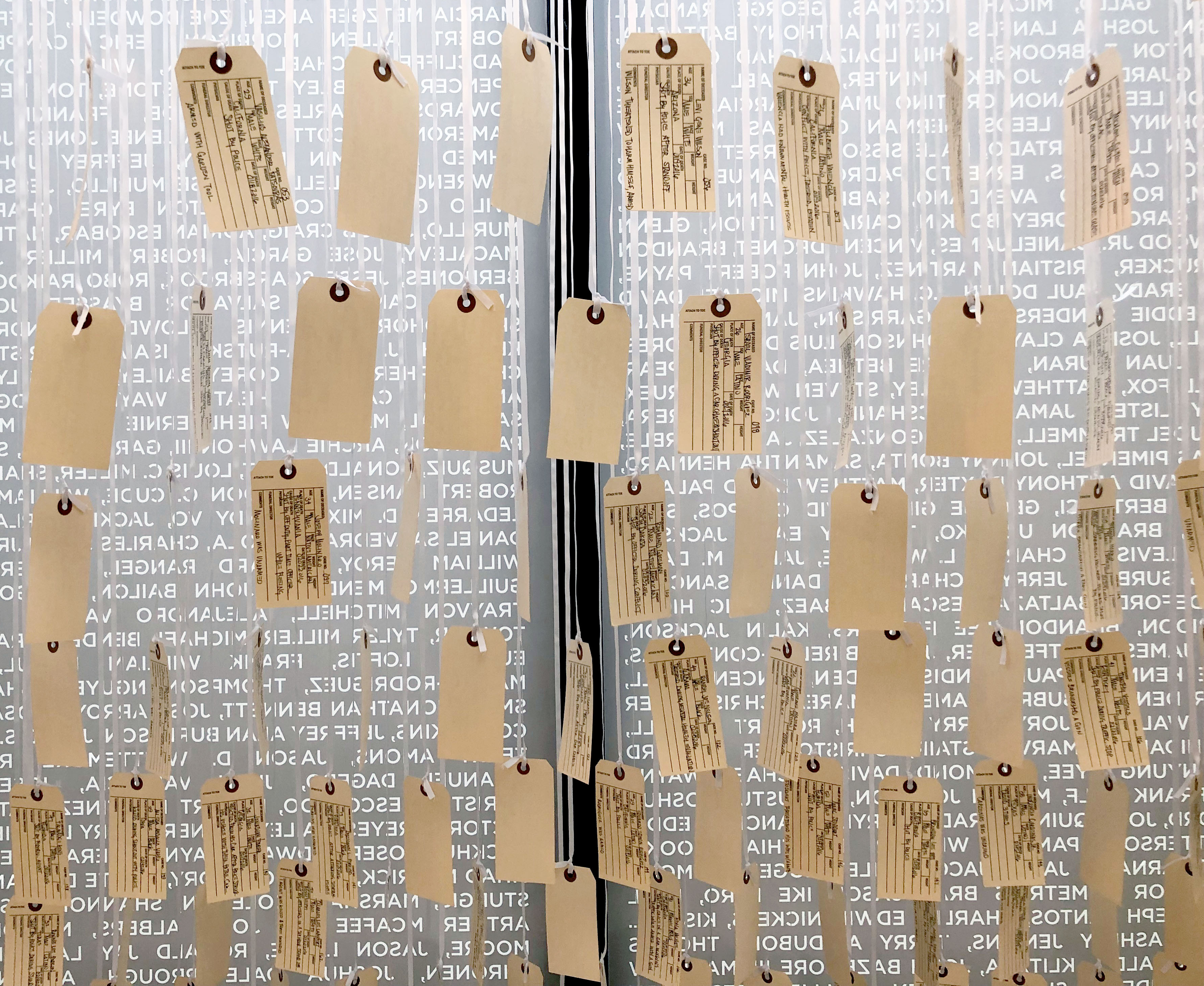
Pictured above are “…and counting” by Ann Lewis (each tag is filled out with the name of a person killed by police) and one of the group of portraits by Tracy Hetzel of women who have lost loved ones because of broken window policing. The one pictured is of Gwen Carr who is holding a picture of her son Eric Garner.

This show ends on 10/8/19.