
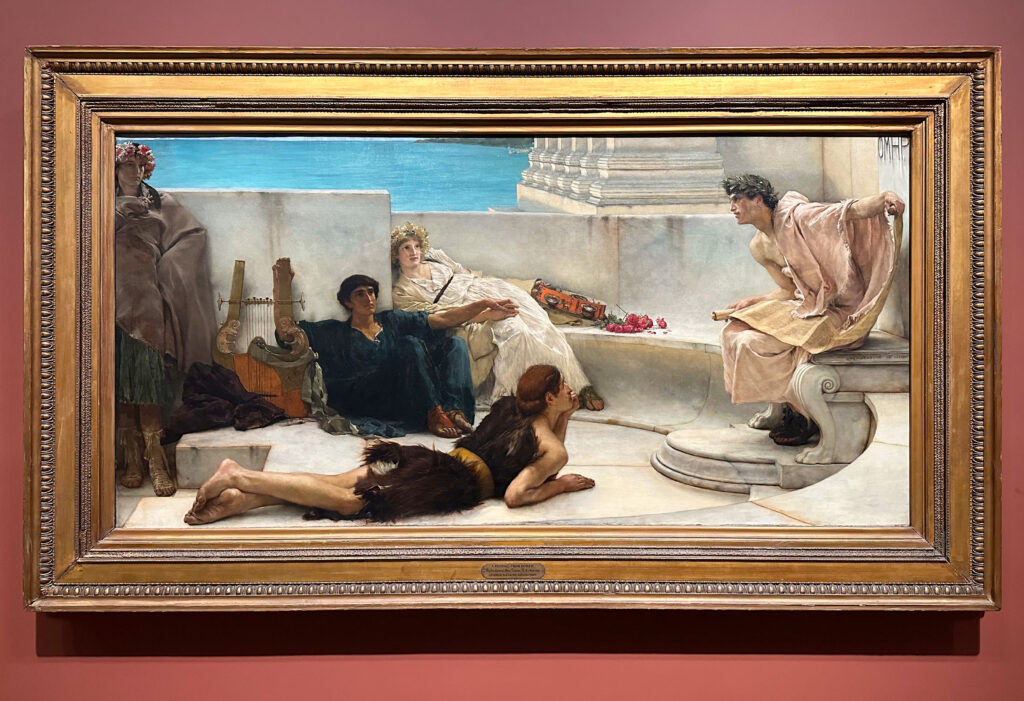
Sir Lawrence Alma-Tadema, “A Reading from Homer” (1885) at the Philadelphia Museum of Art
While interest in Homer’s epic poem the Odyssey grew this summer with the release of Christopher Nolan’s film version, it is also one of the oldest and most popular works of literature in the Western canon. Over the years it has been referenced by many artists in painting, film, and works of literature. In addition, according to Merriam-Webster, there are even a few words in the English language that can trace their origins back to the Odyssey.
Currently on view at the Philadelphia Museum of Art, is Sir Lawrence Alma-Tadema‘s painting A Reading from Homer (1885).
From the museum about the work:
Here, a young poet crowned with a laurel wreath reads from Homer to an audience dressed for a festival. The setting is probably Greece toward the end of the seventh century BCE. The Greek letters in the upper right indicate that the place is dedicated to the poet.
Through attention to details such as architecture and dress, Alma-Tadema evokes scenes of everyday life in ancient Greece and Rome. However, his pictures are rarely entirely archaeologically accurate. For example, while he accurately rendered the ancient musical instrument on the left, a cithara, he also included a type of rose that did not exist before the nineteenth century.
Live readings of Homer’s works continue to this day. At the end of October, for example, the National Hellenic Museum in Chicago is hosting a marathon reading of the Odyssey taking place over two days.
