Jan 232026
 

“Berthe Morisot with a Muff”, c. 1871–72, Oil on canvas

Last week was Berthe Morisot‘s birthday and today it is her friend, brother-in-law, and fellow Impressionist, Édouard Manet‘s birthday. He was born on January 23rd, in 1832, and painted the portrait of her pictured above. It is part of the Cleveland Museum of Art‘s permanent collection.

From the museum about this work

This painting depicts Impressionist painter Berthe Morisot, who met Édouard Manet at the Musée du Louvre in Paris in 1868. This portrait vibrates with vitality. Morisot wears a coat and stylish hat from which wisps of her dark hair escape. Manet’s wide brushstrokes and cross-hatchings evoke the sketchy quality of Morisot’s own paintings, likely Manet’s nod to his subject’s identity as an artist.

He made nine portraits of her in oil, watercolor, lithography, and etching during 1868–74. Initially artistic colleagues and friends, they became family in December 1874 when Morisot married Manet’s younger brother, Eugène.

The painting is currently on loan to San Francisco’s de Young museum for their current exhibition Manet & Morisot, on view until 3/1. Organized by Fine Arts Museums of San Francisco in collaboration with the Cleveland Museum of Art, the show will move to Cleveland on 3/29/26, and will run until July 5th.

About Manet & Morisot from the Cleveland Museum of Art

Manet & Morisot is the first ever major exhibition dedicated to the artistic exchange between Édouard Manet, often referred to as the father of modern painting, and Berthe Morisot, the only woman among the founding members of the Impressionist movement. Unfolding over a period of roughly 15 years, between 1868 and 1883, theirs was perhaps the closest relationship between any two members of the Impressionist circle. As friends and colleagues—by turns collaborative and competitive—they collected one another’s work. Morisot posed for some of Manet’s most compelling portraits, several of which will be on view in the first gallery of the exhibition. When she married Manet’s younger brother, their professional connection deepened into a familial bond.

Thirty-six paintings and six drawings and prints borrowed from museums and private collections in the United States and Europe reveal the evolution of a singular friendship between two groundbreaking artists. Visitors will see beach and garden scenes made en plein air (out-of-doors) that demonstrate how Manet borrowed individual motifs and compositional ideas directly from Morisot. Portraits of fashionable Parisian women of the 1880s by the two artists show their different perspectives; Manet’s paintings were inspired by admiration and erotic interest while Morisot’s were informed by lived experience. The exhibition closes with a self-portrait by Morisot painted when she was in her mid-40s, revealing her perception of herself as a professional artist.

Jan 142026
 

Impressionist painter Berthe Morisot was born today, January 14th, in 1841. She was part of a circle of artists that made up the Parisian avant-garde, including Edgar Degas, Pierre-Auguste Renoir, and Édouard Manet (she married his younger brother).

The oil painting pictured above, Reading (La Lecture), 1888, is on view at Museum of Fine Arts, St. Petersburg in Florida.

Jan 022024
 

Frank Weston Benson, “Natalie”, 1917, Oil on canvas

Childe Hassam, “Gathering Flowers in a French Garden”, 1888, Oil on canvas

Luther Emerson Van Gorder, “In the Park”, before 1894, Oil on canvas

Tampa Museum of Art’s current exhibition, Frontiers of Impressionism: Paintings from the Worcester Art Museum, features paintings by American and European impressionists and is a lovely reminder of the extraordinary works these artists created during this time period. The enduring popularity of the impressionists throughout the years makes sense when walking among these paintings. The use of color and brush work, as well as the details and beauty of the subject matter (not to mention the wealth and comfort often depicted)- make the viewer feel like they are being transported through time to the artist’s idyllic world.

From the museum-

In 2024, the term “impressionism” celebrates its 150th anniversary. Such a significant occasion inspires reflection on the profound impact that a relatively small group of artists in Paris made by positing a new mode of painting: one that favored painting outdoors over in a studio, immediacy over planning, the everyday over the grand, and the fleeting over the eternal. In doing so, the impressionists upended centuries of traditions in European art. This exhibition explores the radical impulses behind impressionism and its seemingly endless adaptability, as artists from around the world came to Paris to study and returned to their homelands, assimilating what they had absorbed and propelling the movement further.

The Worcester Art Museum pioneered new artistic horizons by embracing impressionism early in its history. The French and American impressionism collections at the Worcester Art Museum have long drawn visitors to the galleries. The first directors purchased works by Monet from his Parisian dealer, Durand-Ruel, as well as directly from American impressionists, making the Museum one of the first in the United States to collect impressionism actively as contemporary art. Over the past 125 years, this collection has grown, encapsulating the story of the movement’s roots and emergence in France and its subsequent expansion to the United States, Germany, Scandinavia, and beyond. Highlighting more than 30 artists, including Claude Monet, Pierre-Auguste Renoir, Camille Pissarro, Mary Cassatt, Childe Hassam, and Max Slevogt, this exhibition demonstrates impressionism’s international allure, captured in subjects as far-flung as Monet’s famed Giverny lily pond to the natural wonders of the Grand Canyon.

Below are a few more selections from the show.

Max Slevogt, “Selbstbildnis im Garten (A Self-Portrait in the Garden at Godgramstein), 1910, Oil on canvas

Max Slevogt, “Selbstbildnis im Garten (A Self-Portrait in the Garden at Godgramstein), 1910, Oil on canvas (detail)

Paul Signac, “Golfe Juan”, 1896, Oil on canvas

Thomas Cole, “View on the Arno, near Florence”, 1837, Oil on canvas

Lovis Corinth, “Vordem Spiegel (At the Mirror)”, 1912, Oil on canvas

John Singer Sargent, “Katherine Chase Pratt”, 1890, Oil on canvas

About the unfinished painting above (from the museum)-

A successful society portraitist, Sargent painted the elite from his international social circles. In June 1890, Sargent visited Worcester, Massachusetts, where he was inundated by requests for portraits. The sitter’s father, Frederick Pratt, a noted collector and eventual acting director of the Worcester Art Museum (1908 and 1917), became friends with the artist and invited him to return a few months later to paint his daughter, Katherine- although the idea for Katherine’s portrait originated in Sargent’s first trip to Worcester, when he had made a sketch of hydrangeas. Sargent’s vision of Katherine against a backdrop of flowers, however, proved less than satisfactory for his client and he abandoned the painting for another, more formal depiction. As an unfinished work, this painting reveals the immediacy of Sargent’s process, with careful attention to broad swaths of color and patterns in the brushwork to convey flower petals or folds of clothing.

This exhibition will be on view until 1/7/2024.

Feb 132023
 

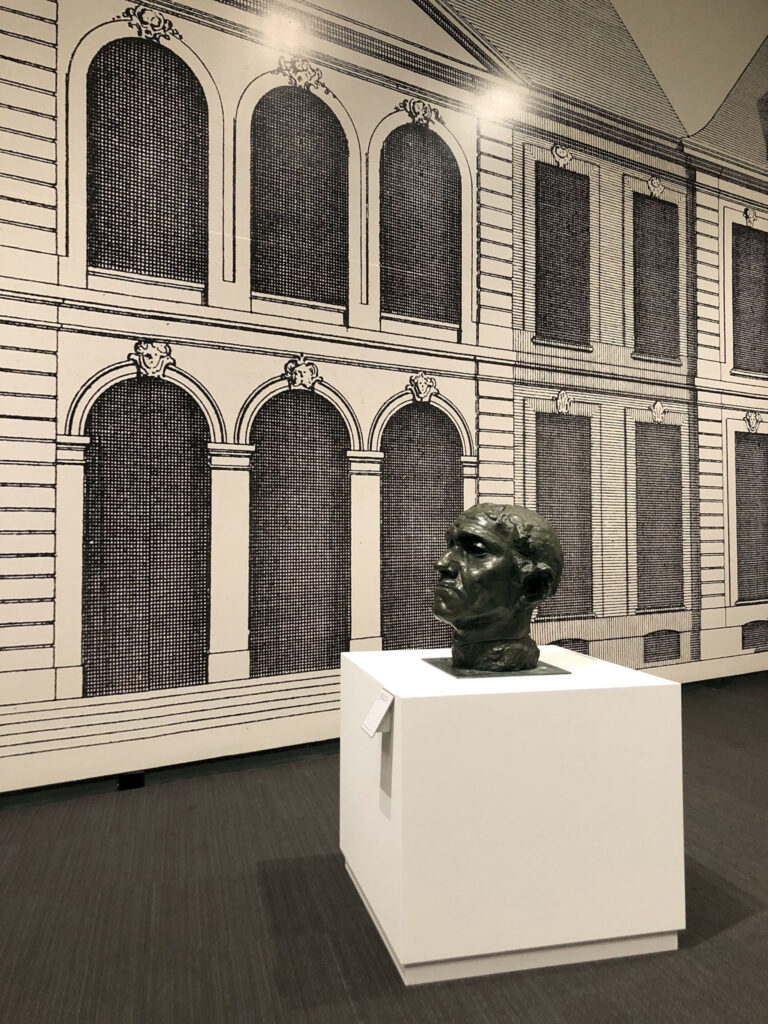
Auguste Rodin, “Monumental Head of Jean d’Aire”

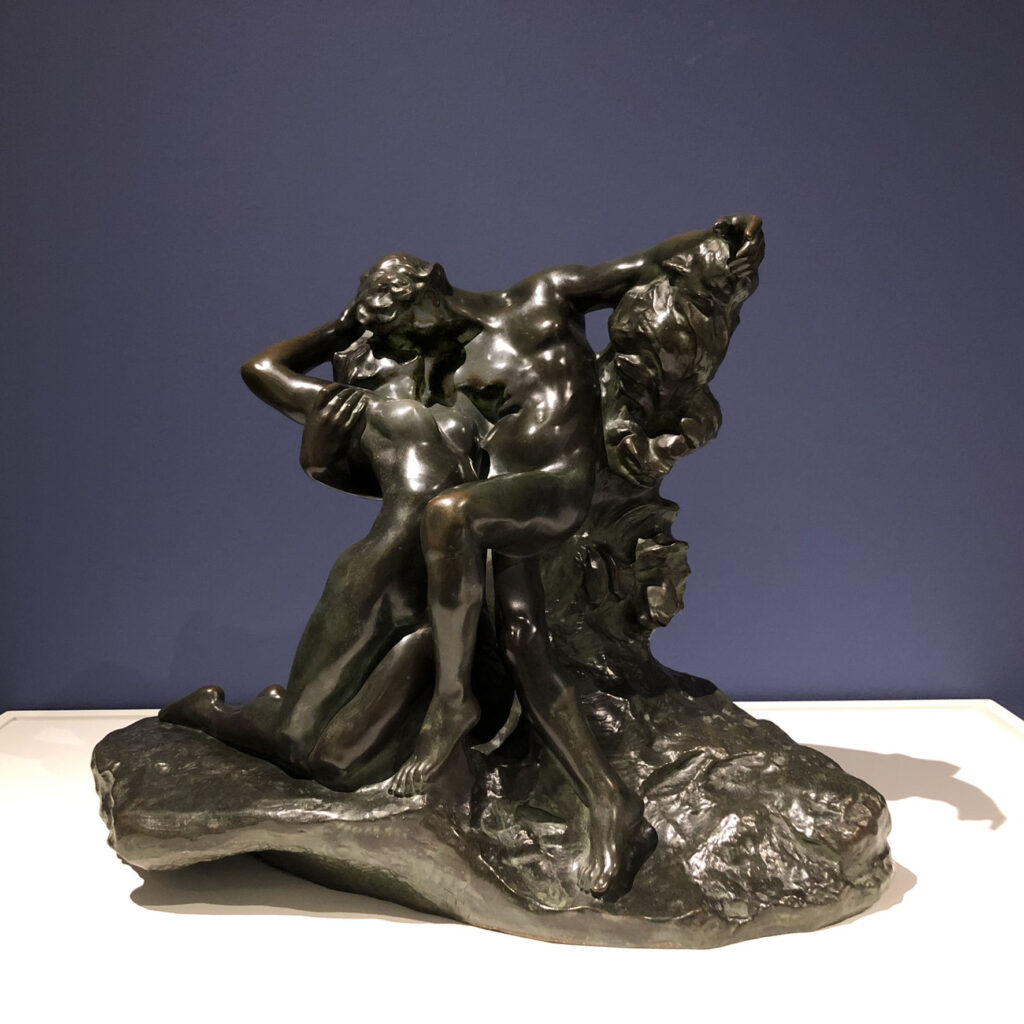
Eternal Spring

Currently at the Museum of Fine Arts St. Petersburg is True Nature: Rodin and the Age of Impressionism. The exhibition includes nearly 40 of his sculptures and presents them alongside Impressionist paintings by his contemporaries.

The curation of the show by Stanton Thomas really creates an exceptional experience for attendees. The large works, along with the paintings, are given plenty of space to be appreciated. While there is a power to seeing these larger than life works, the smaller ones, like Eternal Spring, pictured above, are also captivating.

In one room, on a single wall, is the facade of the building that would become the Musée Rodin. It is there to give both a sense of scale and to remind visitors that most of Rodin’s sculptures were intended for public spaces. Quotes by the Rodin, including one on beauty and character, along with film footage and photographs, add depth to the show as well.

This exhibition closes 3/26/23.