Aug 132026
 

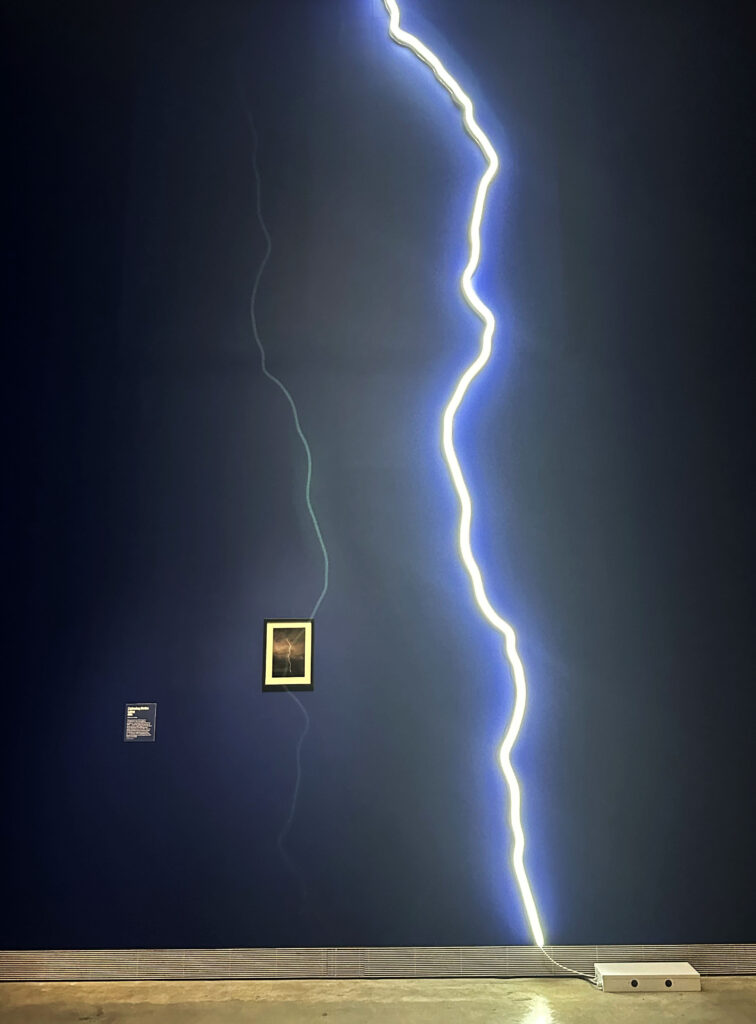
“Lightning Strike Lamp”, 2025

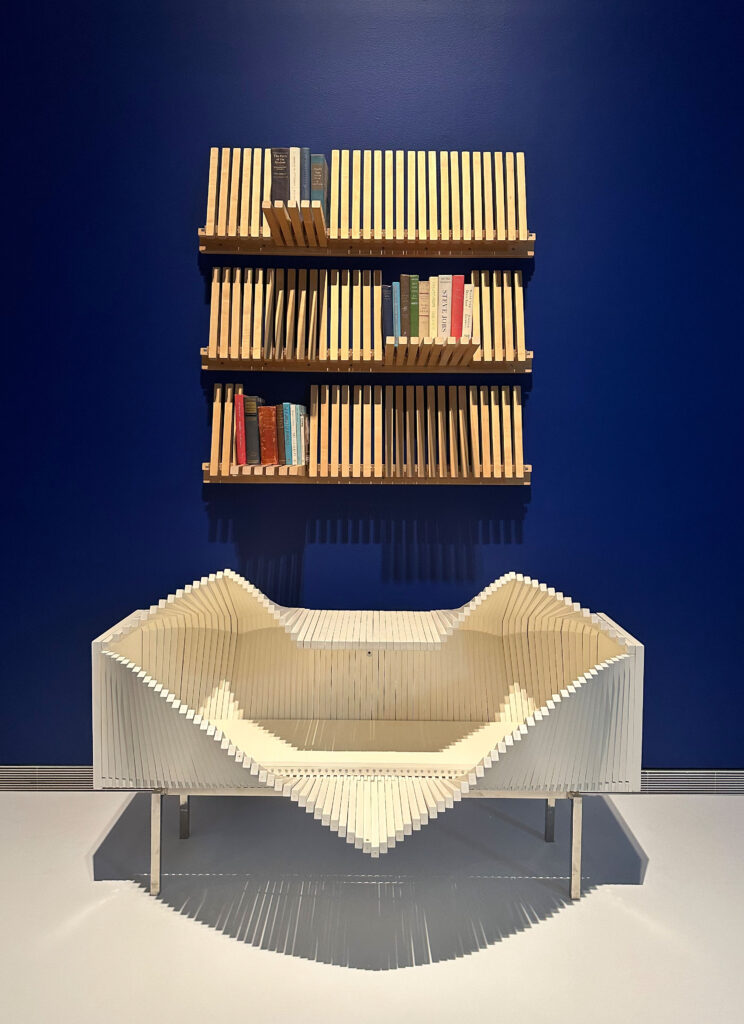
Top: “Piano Shelf”, 2014, Lacquered mahogony, steel ; Bottom: “Wave Cabinet”, Lacquered Baltic birch, steel, glass

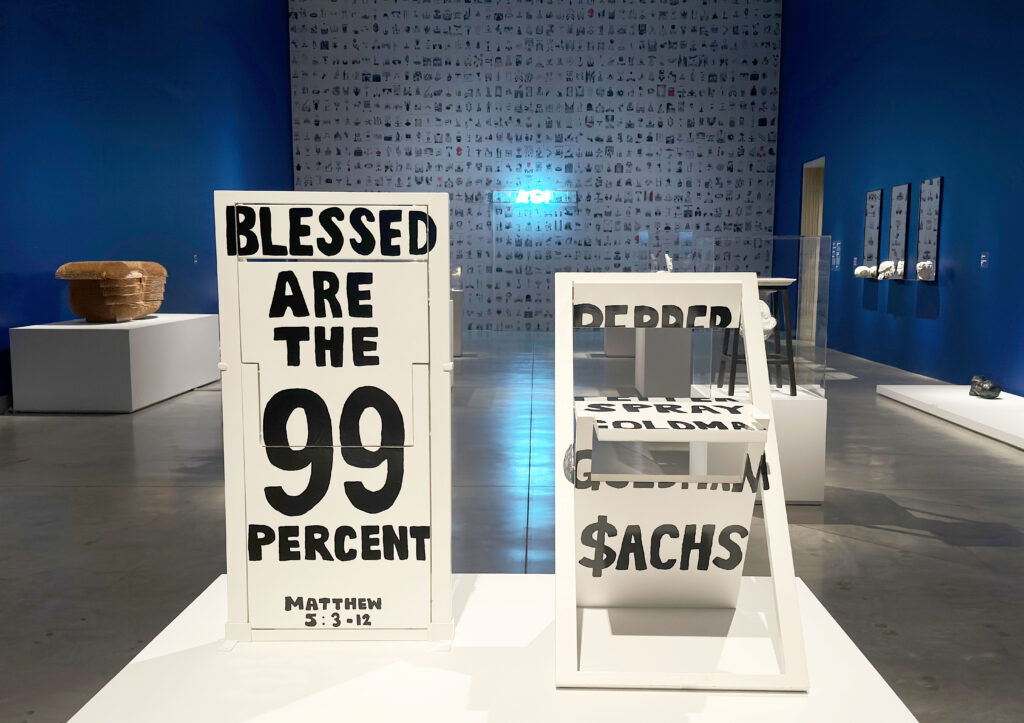
“Occupy Chair”, 2012

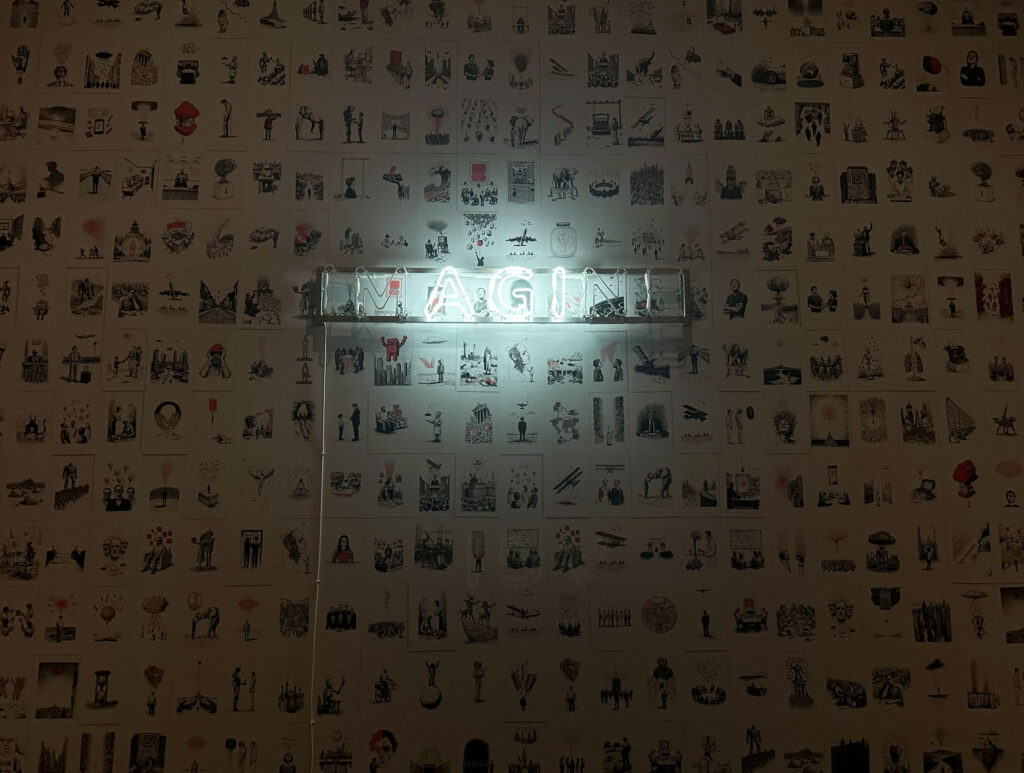
“IMAGINE Neon”, 2025, Neon tubing

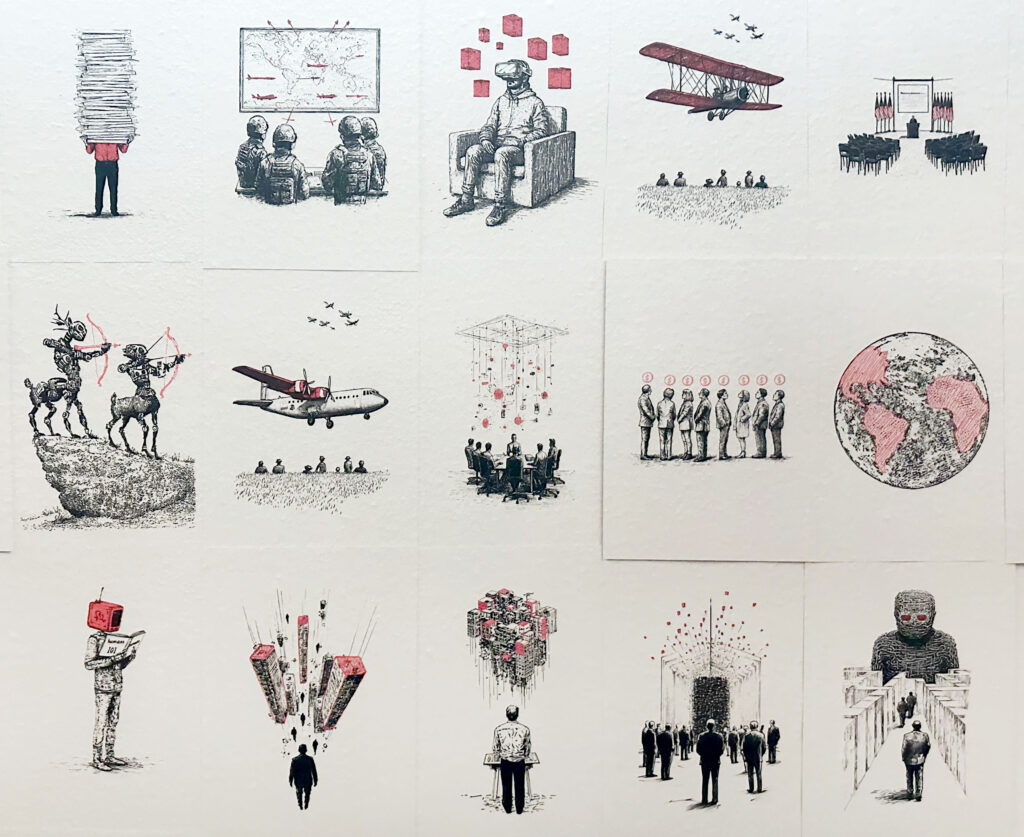
Detail from wall of AI generated drawings behind “IMAGINE Neon”

Mixing art, design, and politics, Sebastian Errazuriz‘s exhibition Double Take at the Philadelphia Museum of Art is a lot of fun. On one side of the room a neon bolt of lightning repeatedly flashes against the wall, while on another neon letters alternate between “IMAGINE” and “AGI” (Artificial General Intelligence) illuminating AI-generated drawings based on his original sketches. There’s also uniquely designed furniture, lamps made using taxidermy chickens, chairs referencing the Occupy Movement, objects incorporating Greco-Roman statue head reproductions, and more, all encouraging visitors to think about nature, technology, and the world around them.

From the museum:

Sebastian Errazuriz (Chilean, born 1977) twists our typical expectations and experiences of using furniture, lighting, and everyday objects. Embracing humor and appropriation, his limited edition and one-of-a-kind pieces often have a subtext that goes beyond form or function, offering personal narrative, a political message, or cultural commentary. This mid-career survey presents over twenty years of a multi-hyphenate practice that gives design a conceptual, Surrealist slant.

Works featured in the exhibition span art, craft, design, and technology. His “kinetic” furniture, constructed from the early 2010s, is characterized by moveable parts – doors, drawers, and shelves that are repositionable, creating new configurations. Other works take nature as a source of inspiration or make new and surprising use of found objects, including vintage watches and taxidermy fowl. Also on display are furniture, mirrors, and other objects that the designer creates by scanning original Greco-Roman antiquities that are then digitally-manipulated and recast in poured marble. A newly commissioned fluorescent light explores Errazuriz’s fascination with, and apprehension about, the potential impact of Artificial General Intelligence on artists, designers, and culture more broadly.

The diverse works on view convey imagination and wit, while also bewildering those who encounter them. The pieces are meant to be lived with, but, at the same time, are provocations with an air of mystery around their function and meaning. Attesting to Errazuriz’s expansive definition of design, the works in this exhibition suggest alternate ways of seeing, thinking, and living.

The show is on view until 8/16/26.


Jul 272026
 

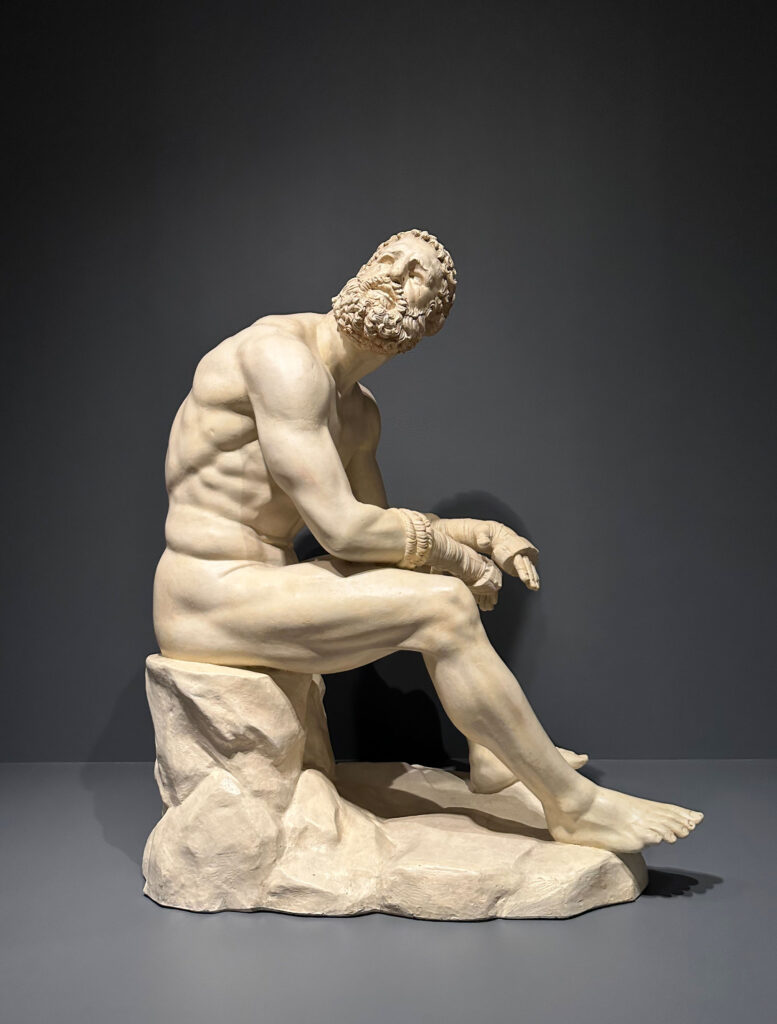
Caproni Brothers, “The Boxer at Rest”, 19th century Painted plaster cast from the original bronze which was produced between the late fourth and second centuries BCE

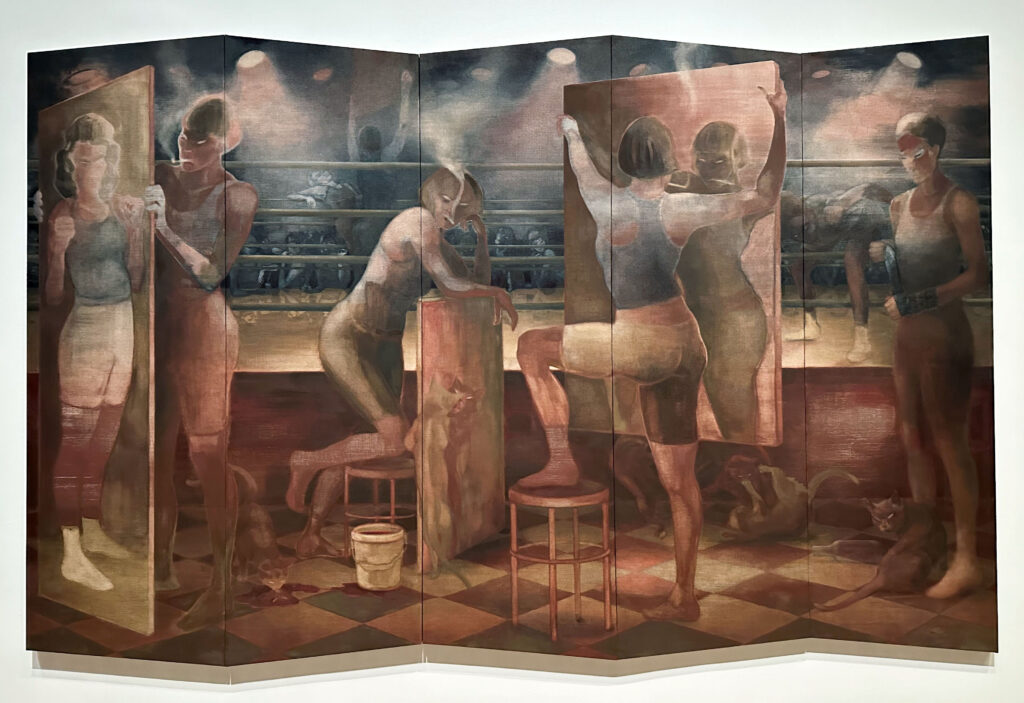
Lisa Brice “Untitled”, 2025 Pigment and natural water-soluble binders on linen

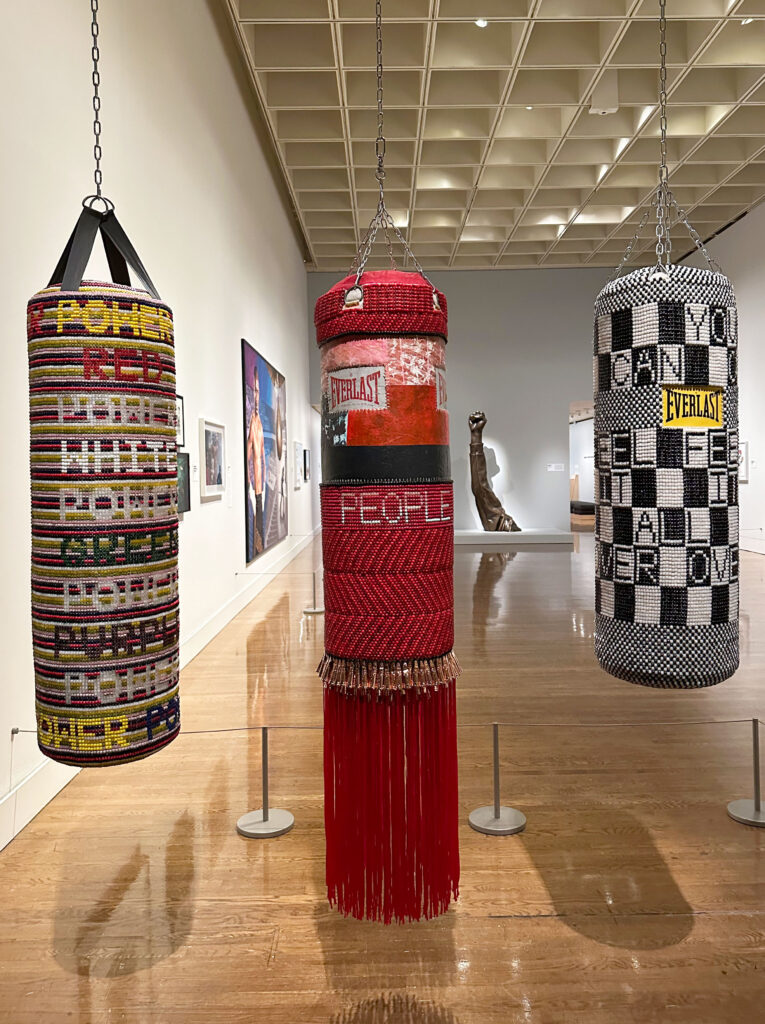
Jeffrey Gibson, (l to r) “Power, Power, Power”, 2017, “People Like Us”, 2014, and “You Can Feel It All Over”, 2015, Repurposed punching bags, glass beads, artificial sinew

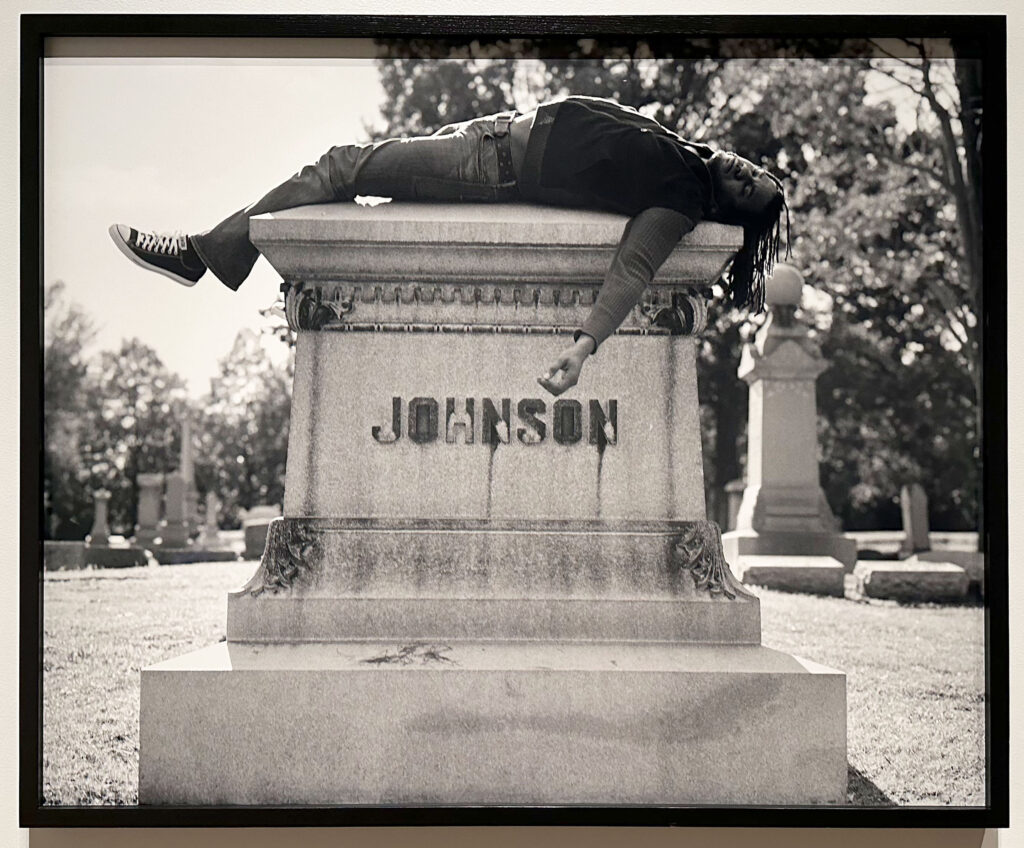
Rashid Johnson, “Self-Portrait Laying on Jack Johnson‘s Grave”, 2006, Durst Lambda print mounted on panel

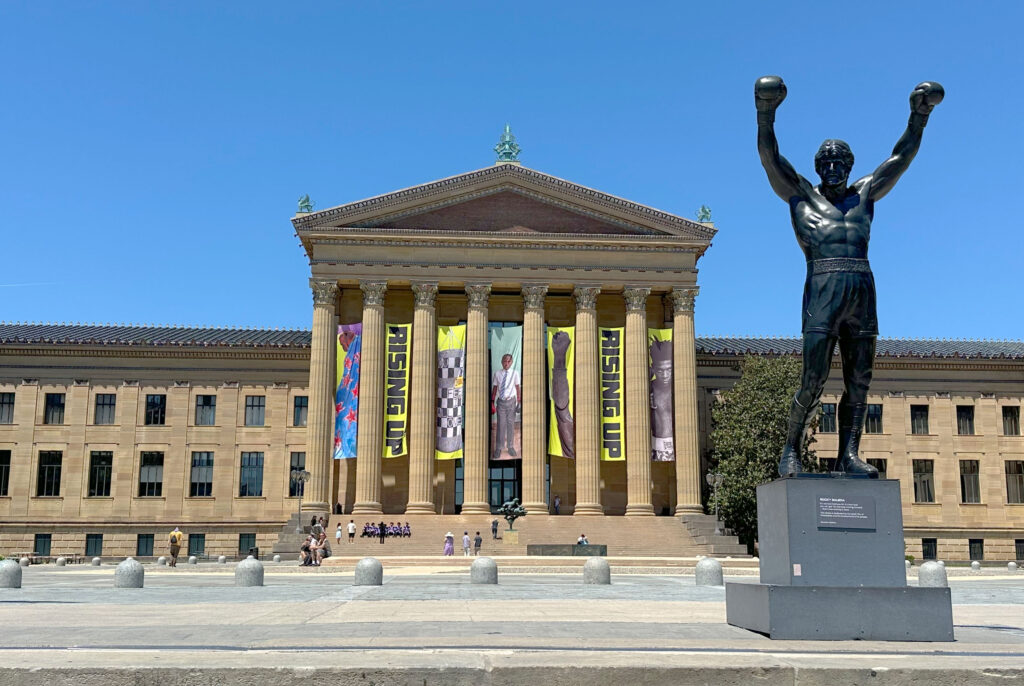
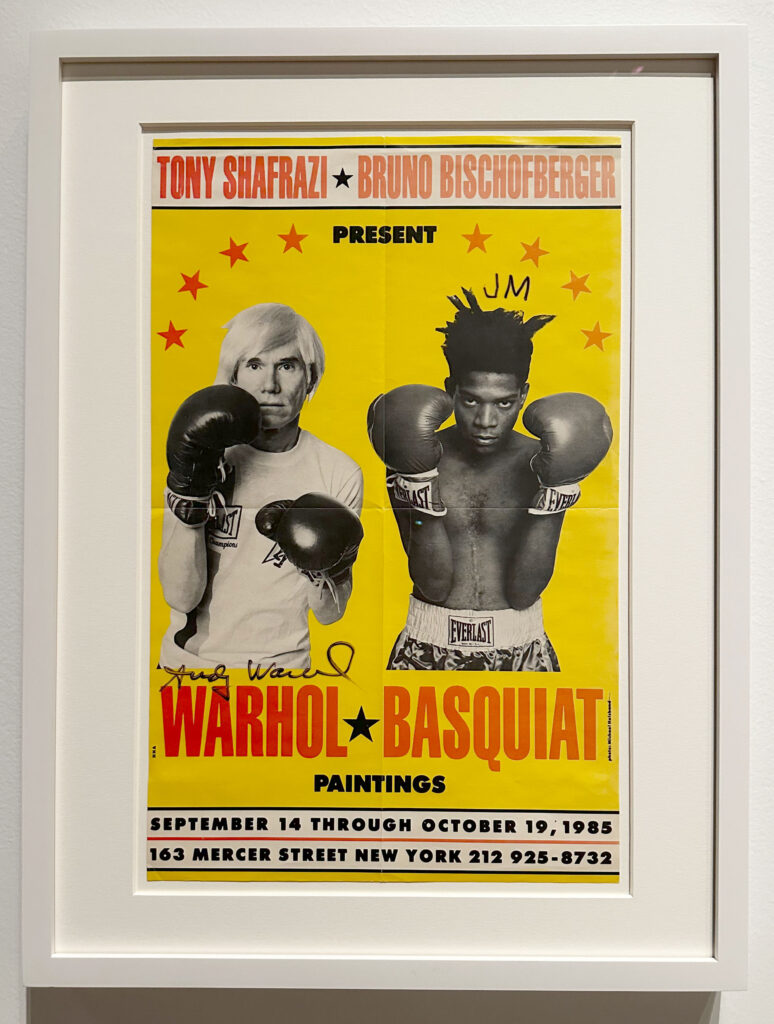
Approaching the front steps of the Philadelphia Museum of Art, you will find people of all ages and backgrounds taking photos with the statue of Rocky out front, often imitating his famous pose. Through a variety of works from antiquity to the present day, Rising Up looks at the history of this statue, the meanings attached to monuments, and the allure of boxers and boxing culture.

From the museum about the exhibition:

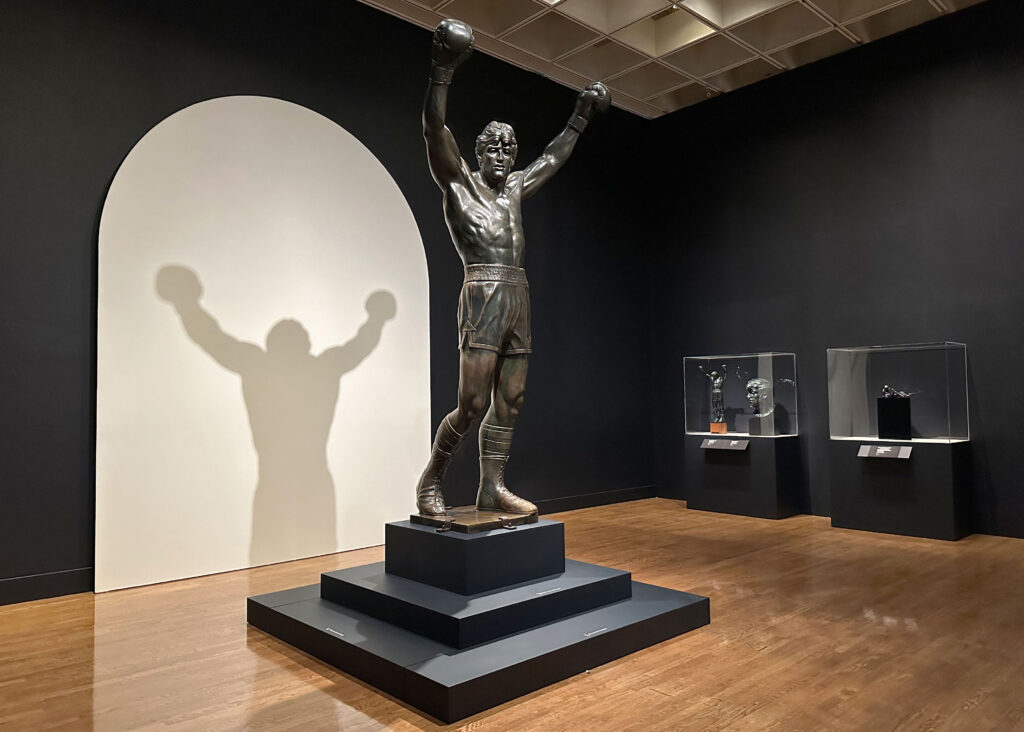
Blending the worlds of art, sports, and popular culture, Rising Up takes on the life of monuments by exploring the meanings and mythologies of the Rocky statue. The exhibition looks to the statue of the most famous Philadelphian who never lived as a way to better understand our complex and vital relationships to our public monuments.

The statue first appeared on-screen in the Oscar-winning Rocky film series. The third installment, Rocky III (1982), featured the dedication of a monument that celebrated the boxer as both an underdog and a hero. The movie-made statue was placed outside the actual museum during filming, a dynamic blurring of art and life that continues to this day. Since that introduction, and through the statue’s departure and prolonged absence from the museum grounds to its prodigal return to the steps, the statue has sparked debate over its aesthetic value and its role in the city. Today, the power of the Rocky statue as a monument stems from its ability to summon public participation.

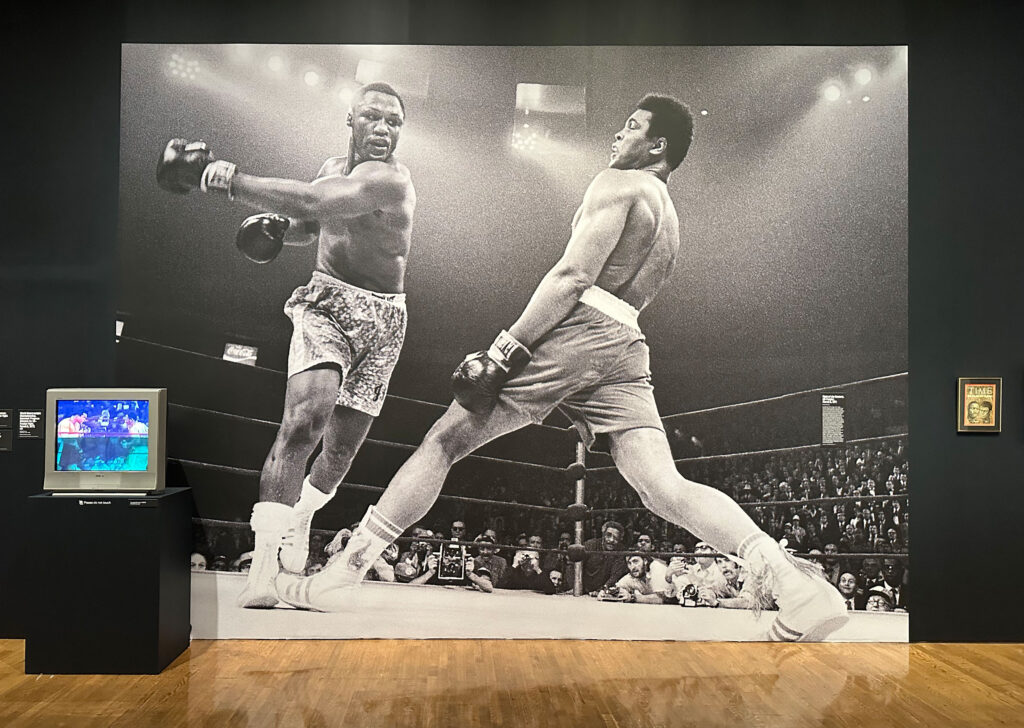
From antiquity to modernity, Hollywood to contemporary art, Rising Up spotlights both popular narratives and undertold stories surrounding the Rocky statue. Each gallery offers a response to the exhibition’s central question — why do millions of people visit the Rocky statue at the steps of the Philadelphia Museum of Art each year? — and further explores the relationship between art, boxing, and civic identity. It offers a renewed context to consider the statue through works and artifacts that reflect on the deep legacies of boxing monuments across time.

Rising Up marks the first time that the Rocky statue has been displayed inside the museum, explored alongside Philadelphia’s landmark boxing culture and multigenerational artists’ interpretations of sport and society. At its core, the exhibition looks at how monuments are made — by artists and by us — through the lens of the Rocky statue and the ways people engage, debate, and gather around this site of memory.

This exhibition closes on 8/2/26.

May 222026
 

Impressionist painter Mary Cassatt was born today, May 22nd, in 1844. The oil painting above, Woman with a Pearl Necklace in a Loge, 1879, can be seen at the Philadelphia Museum of Art as part of their permanent collection.

From the museum about the work:

Cassatt created a series of theater scenes in the late 1870s, displaying an interest in city nightlife shared by many of the Impressionists. This work, showing a woman (often said to be her sister Lydia) seated in front of a mirror with the balconies of the Paris Opéra House reflected behind her, demonstrates the influence of Cassatt’s friend Edgar Degas, particularly in the attention paid to the effects of artificial lighting on flesh tones. This painting was shown in Paris at the fourth Impressionist exhibition in 1879, where it was singled out for much praise.

May 112026
 

Spanish surrealist Salvador Dalí was born today, May 11th, in 1904. The painting above, Soft Construction with Boiled Beans (Premonition of Civil War), from 1936, is part of the Philadelphia Museum of Art‘s permanent collection. It was also included in their recent exhibition, Dreamworld: Surrealism at 100.

From the museum’s website about the work-

Salvador Dalí painted this allegory of self-inflicted carnage while living in Paris in early 1936, on the eve of the devastating civil war in his Spanish homeland between Francisco Franco’s right-wing nationalist forces and the elected Republic. The painting flaunts its flair for gruesome detail. A grimacing colossus towers over a sunbaked Spanish landscape and deliriously rips itself apart. Limbs are switched around and turned upside down, and the body’s trunk is missing entirely. A limp phallic shape draped over the truncated hip is a striking example of Dalí’s soft forms, implicitly referring to putrefaction and death. The scattered beans of the title exemplify the bizarre incongruities of scale to conjure the workings of an unconscious mind. Dalí interpreted the Spanish conflict in psychoanalytic terms, and he included an homage to Sigmund Freud, the initiator of psychoanalysis whose work inspired him to embrace such nightmarish visions, by including a tiny portrait of Freud inspecting the gnarled hand at lower left.


Apr 252026
 

Cy Twombly “Fifty Days at Iliam: Shield of Achilles”, 1978

Cy Twombly “Fifty Days at Iliam”, 1978, oil, oil crayon, and graphite on canvas

“Fifty Days at Iliam: Achaeans in Battle”, 1978

“Fifty Days at Iliam: The Fire that Consumes All before It”, 1978

“Fifty Days at Iliam: Shades of Achilles, Patroclus and Hector”, 1978

“Fifty Days at Iliam: Shades of Eternal Night”, 1978

Cy Twombly was born today, April 25th, in 1928. One of his most famous works is Fifty Days at Iliam, his visual interpretation of Homer’s poem the Iliad. This “painting in ten parts” is currently on view at the Philadelphia Museum of Art and images of each of the individual works can be found on the museum’s website.

About Fifty Days at lliam from the museum-

The pinnacle of Twombly’s lifelong preoccupation with Greek and Roman mythology, Fifty Days at lliam is the artist’s rendition of the last fifty days of the Trojan War. The monumental series fuses elements of Homer’s epic poem The lliad, probably written before 700 BCE, and Alexander Pope’s translation of that poem from the 1700s.

The artist purposefully misspells the name of the besieged Trojan city as lliam, instead of the Latin llium or the Greek Ilion. The letter “a” stands as a symbol for the Greek warrior Achilles, whose rage sparked by the death of his friend Patroclus propels the end of the decade-long conflict.

Partaking in a long artistic tradition of depicting war, Twombly addresses themes of heroism and aggression, comradeship and revenge, jubilant victory and the mourning of the dead. The ten canvases can be encountered sequentially or experienced as an all-encompassing panorama that gives the sensation of witnessing the battle firsthand.

Twombly’s signature style combines the poignant gestures of abstraction with poetic allusions to classicism. Relocating from the United States to Italy in the 1950s proved decisive for Twombly’s art, which uses raw mark-making to allude to the myths of antiquity.

For a look at Twombly’s life and career, the 2018 documentary Cy Dear, is well worth a watch. The film begins with a discussion of Fifty Days at lliam, which was on view as part of a 2017 retrospective at Centre Pompidou in Paris. It also includes interviews with several of his friends and colleagues– including former assistants, his son Alessandro, art dealer Larry Gagosian, and photographer Sally Mann.

Apr 172026
 

Today’s flashback is to Noah Davis‘s Imitation of Wealth installation which was shown in MOCA’s storefront space in 2015. Sadly, Davis passed away before it opened.

Some of these works are currently on view as part of his gorgeous retrospective at the Philadelphia Museum of Art.

From MOCA’s website about the installation-

One of the unique characteristics of the contemporary art scene in Los Angeles is the proliferation of artist-run spaces, many of which are located in storefronts across the city. MOCA was founded by artists and, due to its philosophy of placing artists at the center of its mission, has long been known as “the artist’s museum.” Storefront continues this tradition by inviting two artist-run organizations to take over MOCA’s Marcia Simon Weisman Works on Paper Study Center each year.

Founded in 2012, The Underground Museum is a storefront space developed by artist Noah Davis. Located at 3508 West Washington Avenue in Los Angeles’s Arlington Heights neighborhood, The Underground Museum has a gallery space, offices that serve as editing suites and a painting studio, and an outdoor garden which hosts parties, events, and film screenings. Davis wanted to bring what he called “museum-quality art” to a traditionally African American and Latino working-class neighborhood. However, when The Underground Museum first opened, no museums were willing to lend such works. Undaunted, Davis decided to recreate iconic artworks by famous artists such as Marcel Duchamp, On Kawara, and Jeff Koons. The title for his inaugural exhibition, Imitation of Wealth, alludes to Douglas Sirk’s classic film Imitation of Life (1959), a pre-civil rights era melodrama about passing. Just as the film’s protagonist pretends to be white in order to escape the fate of the second-class citizenship offered to African Americans, the works in the exhibition masquerade as famous works of art in an attempt to break down the traditional class and ethnic barriers to high culture. Irreverent and tongue-in-cheek, Imitation of Wealth stages many of art’s time-honored questions about the nature of truth and authenticity.

The Underground Museum, where this work was first shown, was a unique and special place that held many great exhibitions and events. After Davis’s death it was run by his wife, artist Karon Davis (who co-founded the space), and his brother filmmaker Kahlil Joseph. The museum closed in 2022.

Below are some images from a visit in 2019.

Front doors of the Underground Museum

Two views of the outdoor space at the museum-

Along with the galleries, bookstore, and outdoor spaces, you could even find artwork in the bathrooms. The unique wallpaper collage seen below was created by Genevieve Gaignard.

Objects in the bathroom at the Underground Museum

Wallpaper detail

Apr 162026
 

Noah Davis, “The Conductor”, 2014, Oil on canvas

A collection of photographs, notes, documents, and a video (not pictured) are located on a wall at the beginning of the exhibition

Currently at the Philadelphia Museum of Art, the retrospective Noah Davis presents a collection of works from the artist’s short but impressive career.

From the museum about the show-

Noah Davis (born in 1983) drew inspiration from every corner of life: photographs dug out of bins in flea markets, books on Egyptian mythology, daytime television, history paintings, early internet blogs. He used these sources to populate his work with a cast of anonymous figures who rest and play and dance and read and swim in scenes that tug between the fictional and the imaginary, the ordinary and the fantastical.

Even as a high school student, Davis had a painting studio, a space near his family home in Seattle that his parents had rented in the hope that he would kindly stop ruining the carpets. He studied film and conceptual art at Cooper Union in New York City before assembling his own motley education among fellow artists in Los Angeles. He slid fluidly between painting styles to present a breadth of Black life, feeling keenly a responsibility to represent the people around him. In 2012, Davis and his wife Karon cofounded the Underground Museum, in the historically Black and Latinx Los Angeles neighborhood of Arlington Heights. There they transformed three storefronts into a cultural center that was free and open to all.

This exhibition, the first museum retrospective of Davis’s work, highlights his relentless creativity from 2007 until his untimely death in 2015, and his devotion to all aspects of a person’s encounter with art. As he put it simply: “Painting does something to your soul that nothing else can. It is visceral and immediate.”

Below are a few selections-

“Isis”, 2009, Oil and acrylic on linen

Artist Karon Davis, Noah’s wife, discussed Isis on the audio tour provided for Hammer Museum’s version of the exhibition.

Below is an excerpt from the transcript-

…Isis is based on a photo Noah took the day I unfurled two large fans, each with cheesy images of an Egyptian king and queen printed on their surface, and painted them yellow with house paint. I threw on my sister’s Naja’s old gold dance leotard from the 80s with sequins lining the hems and tassels that hung off my butt and sparkled like tinsel.

Noah said, “Stand there. You are Isis.” Using the fans as wings, I raised my arms and opened them. He snapped the pic and quickly retreated to paint. Egypt has always held a special place in my heart. When Noah and I met, I was studying ancient myths and history. I had just left my production job in Hollywood and was exploring film projects. Black Wall Street, Black Cowboys, Stepin Fetchit, The Frogs, Egyptian mythology, and so on.

Noah joined me on these journeys through history, and our home became a portal where imaginations could run wild. We exchanged stories, dreams, and techniques of making art. He painted and we lost ourselves in the magical time.

You can see both of us in this painting. Noah’s reflection is behind me in the window of our home. This painting holds so much for me. It is our past, and it is my present, and future in both painting and in life. I am Isis, and Noah is Osiris.

In ancient Egyptian mythology, Isis assembles all the scattered parts of Osiris in order to cast a spell to make him whole again, so he can live forever as a god. Noah is my Osiris. He will live forever through his work. My assignment is gathering these parts of my love and protecting them..

“Pueblo del Rio: Arabesque”, 2014, Oil on canvas

From the museum about the paintings above-

These works were inspired by Pueblo del Rio, a housing project designed in part by Paul Williams in 1941 for Black defense workers in Los Angeles. The projects were built along the concept of a “garden city,” with shared lawns and outdoor spaces designed to promote community, but they quickly degenerated into one of the most impoverished and dangerous areas in the city. In quiet resistance to this reality, Davis reimagined Pueblo del Rio as a place of harmony and accord, where ballet dancers arabesque and a trumpeter plays.

The exhibition also includes Davis’s Imitation of Wealth, pictured below, where he recreated famous works of art.

“Imitation of Wealth” -Davis’s versions of sculptures by Dan Flavin and Marcel Duchamp along with a real On Kawara painting

From the museum-

Davis’s father left him a small inheritance, specifically for fostering community and joy. Davis and Karon rented three storefronts in the Arlington Heights section of Los Angeles, and started devoting themselves to what would become known as the Underground Museum (UM) – an art space, free and open to all — made possible by his father’s legacy. Davis’s paintings of this time reveal a man deeply invested in the question of what he felt had been missing all these years: spaces for “the people around me” to feel recognized and to congregate. The exhibition The Missing Link opened at Roberts & Tilton Gallery in Los Angeles in February 2013.

Davis persuaded his gallery to throw the opening dinner at the UM, which became the museum’s unofficial opening. He served frogs’ legs and champagne, and guests were able to enjoy new sculptures by Karon, as well as their first jointly curated show: Imitation of Wealth. When no museums would lend, Davis decided he would simply make do himself: “What if we just use what we have — like these ugly-ass lights.” The building’s LED strip lights were turned into an imitation Dan Flavin sculpture, while a $70 vacuum cleaner from Craigslist became a knockoff Jeff Koons. The exhibition became a kind of elegy to the bootleg, the title alluding to Douglas Sirk’s 1959 melodrama Imitation of Life, in which the young Black protagonist passes as white.

The museum included one work from their own collection, On Kawara‘s 3. JUNI 2001, in this recreation, with an interesting coincidence-

When he started bootlegging his own artworks, he made a fake On Kawara painting with the date of Oct. 7, 1957, to mark his father, Keven Davis’s, birthday. To honor his original spirit and ambition, we are lending this authentic On Kawara from our collection to join his “imitations” — it’s a special coincidence that the date is Noah Davis’s own birthday. The year 2001 was when he moved to New York to become an artist; a moment that led to everything else in this exhibition.

This exhibition closes 4/26/26.

Feb 062026
 

Giorgio de Chirico, “Portrait of Guillaume Apollinaire”,1914, Oil and charcoal on canvas

René Magritte, “The Secret Double”, 1927, Oil on Canvas

Dreamworld: Surrealism at 100 at the Philadelphia Museum of Art presents a large collection of works, in a variety of mediums, from the artistic movement. The show takes you through Surrealism’s history and is filled with many inventive and imaginative pieces- including several from lesser-known artists.

From the museum about the exhibition-

Surrealism burst onto the scene in Paris in 1924. French writer André Breton announced the aims of this revolutionary literary and artistic movement in his Manifesto of Surrealism. It started with a question: How, ideally, should we live? Breton observed that, at about twenty years of age, we make the error of trading our childlike imaginations for adult good sense and logic. Yet it’s the imagination that allows access to the innate state of freedom that we all possess. And maintaining freedom, Breton proposed, should always be the highest human aspiration.

Surrealism’s ambitions were broad and bold: its adherents wanted nothing less than a revolution in consciousness. To that end, they explored a method of experimental poetry called automatic writing, comparable to spoken free association, done spontaneously and, as far as possible, without conscious intent. Sigmund Freud’s theories about the role of the unconscious and the interpretation of dreams were an important inspiration. The Surrealists looked to access the unconscious mind to break free from the constraining rationality of the modern world.

Visual artists were part of the Surrealist movement from the start. They took up surprising and often challenging subject matter, imagery, and techniques across many mediums: painting, sculpture, drawing, printmaking, photography, book illustration and design, and film. In Dreamworld: Surrealism at 100, we explore how, from the movement’s 1920s beginnings through the 1950s, these trailblazing artists made good on Surrealism’s revolution in consciousness.

The exhibition is split into six categories- Waking Dream which features Surrealism’s beginnings in the 1920s, Natural History, focused on the influence of nature, Desire, Premonition of War, Exiles, and Magic Art, which focuses on the new type of esotericism that emerged within Surrealism in the aftermath of World War II.

Lee Miller’s photographs of natural rock formations

Salvador Dalí, “Aphrodisiac Telephone” 1938, Plastic, metal

From the museum about Aphrodisiac Telephone, one of the artworks in the Desire section

Salvador Dalí likened the Surrealist object, which uses found items, as a symbolic creation with improbable juxtapositions, comparable to poetry and sexual perversion. He applied this idea in Aphrodisiac Telephone. Its basis is the substitution of a lobster— a real lobster in the sculpture’s first iteration for display in 1938, a factitious lobster in white plastic for the editioned version —for a similarly shaped telephone handset. The title alludes to the lobster’s reputation as an aphrodisiac when eaten.

Max Ernst, “The Fireside Angel (The Triumph of Surrealism)”, 1937, Oil on canvas

From the museum about the Max Ernst painting above, from the Premonition of War section-

Ernst painted The Fireside Angel (The Triumph of Surrealism) to protest the atrocities of the Spanish Civil War as well as the defeat of the Republican side. But this depiction of a rampaging bird-headed beast also served as an allegorical reflection on the nature of evil. Ernst exhibited this painting as The Triumph of Surrealism — a despairingly ironic title given the situation in Europe — at the 1938 International Surrealist Exhibition in Paris.

During World War II many European artists escaped to New York City and Mexico. The Exiles section features works by these artists, as well as Mexican (like Roberto Montenegro pictured below) and American artists whose work could also be seen as part of the Surrealist movement.

Roberto Montenegro, “The Double”, 1938, Oil on panel

The last section of the exhibition Magic Art, focuses on the increase in post-war interest in supernatural themes. There was also a room devoted to the work of artist friends Leonora Carrington and Remedios Varo, who had moved to Mexico during the war.

Leonora Carrington, “And Then We Saw the Daughter of the Minotaur”, 1953, Oil on canvas

Remedios Varo, “Creation of the Birds”, 1957, Oil on Masonite

This exhibition is on view until 2/16/25.