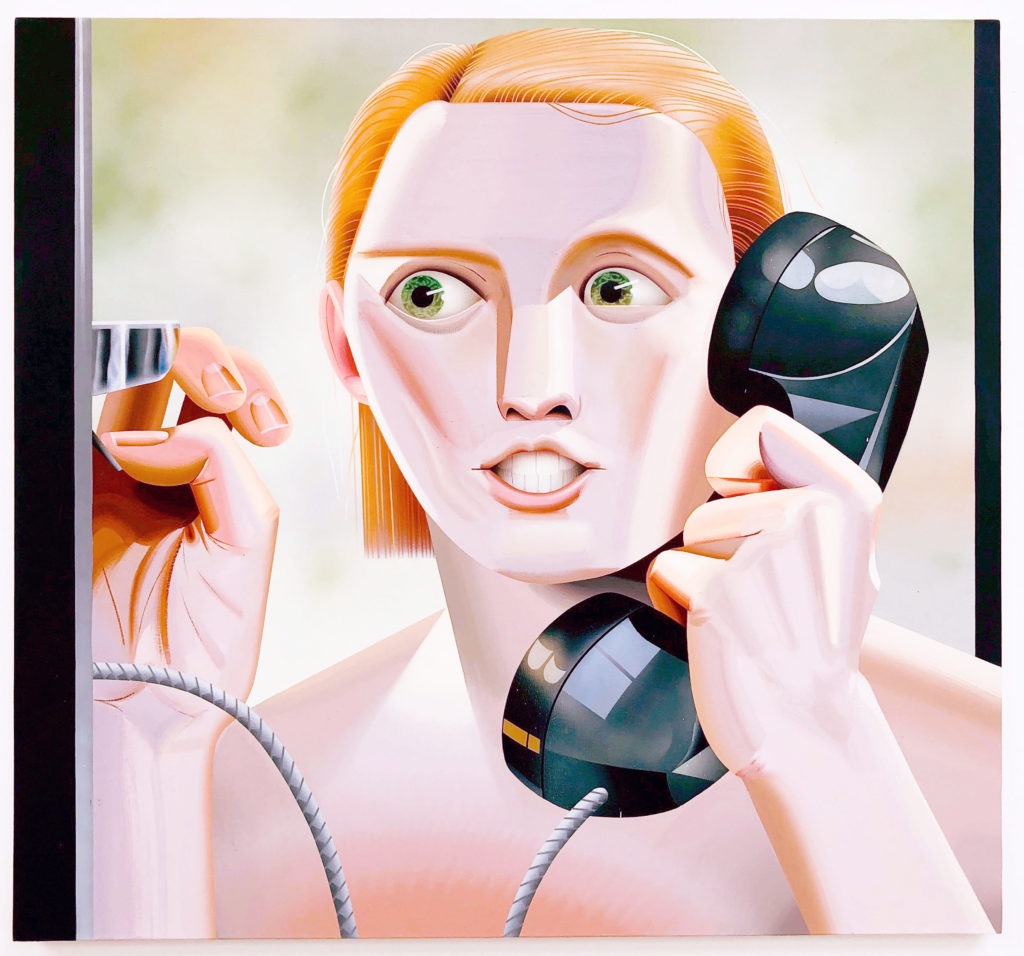
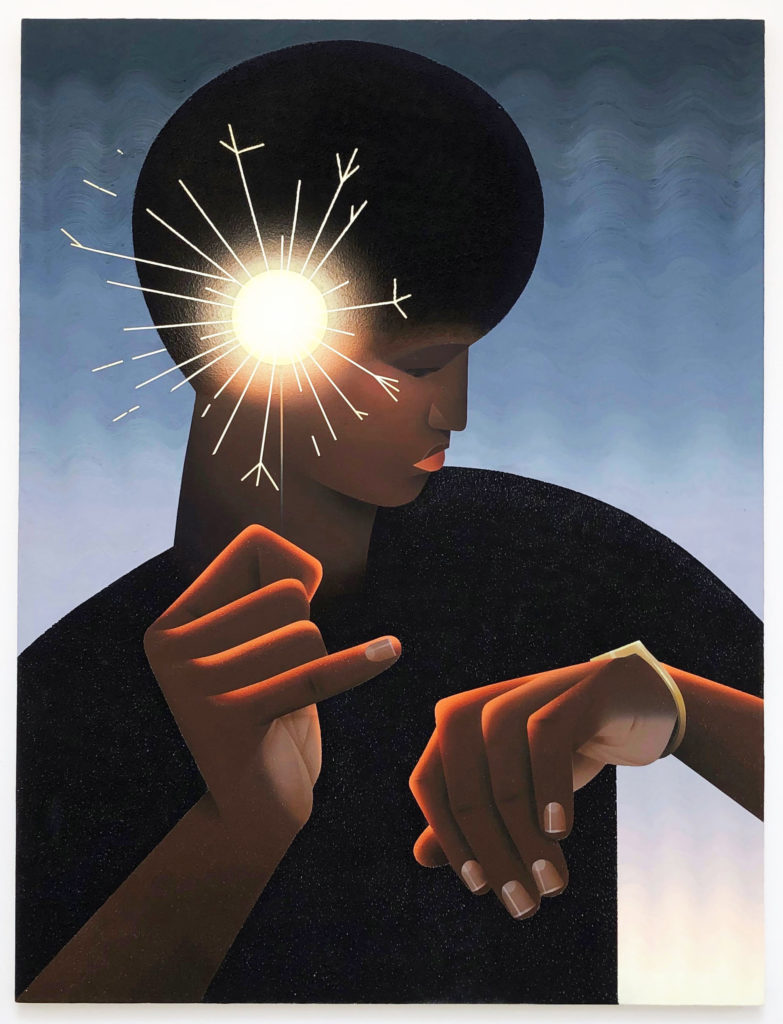
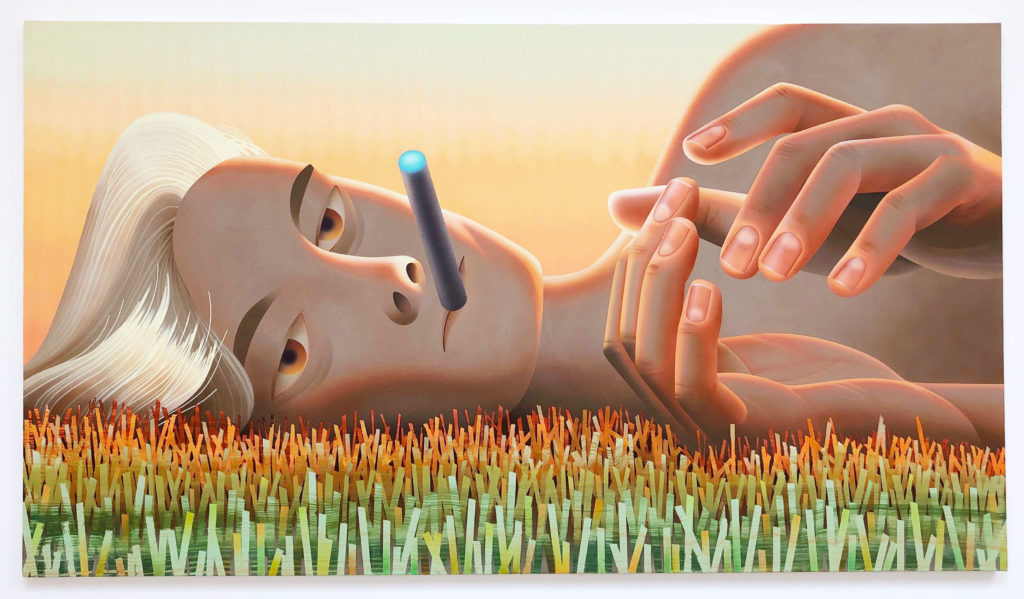
Otis Quaicoe, Black Feathers, 2019

Chloe Wise, Stuck between a hard rock and a café, 2019

Laura Sanders, Victorine, By Herself, 2019

Nona Garcia, After Elaine Navas, 2019

Robin F. Williams, Siri Defends Her Honor, 2019
Currently at Marianne Boesky Gallery in Chelsea is Xenia: Crossroads in Portrait Painting, an outstanding collection of paintings by 17 artists and spanning both of the gallery’s locations.
From the press release–
Marianne Boesky Gallery is pleased to present Xenia: Crossroads in Portrait Painting, an exhibition that explores the resurgence of portraiture as an incisive platform through which to consider the nature and meaning of identity. As our globalized society becomes increasingly marked by emigration, resettlement, and technological interconnectedness, so too have notions of the self become exponentially fractured and complex. Through the work of seventeen artists, Xenia: Crossroads in Portrait Painting captures the ways in which artists are leveraging the power of the portrait to express these intricacies, exposing the relationship between identity, place, and shifting social norms.
Xenia: Crossroads in Portrait Painting will feature new and recent works by a wide range of artists, including Polina Barskaya, Amoako Boafo, Cristina Canale, Somaya Critchlow, Ndidi Emefiele, Maria Farrar, Nona Garcia, Cindy Ji Hye Kim, Doron Langberg, Otis Quaicoe, Laura Sanders, Pamela Phatsimo Sunstrum, Rodel Tapaya, Salman Toor, Hannah van Bart, Robin F. Williams, and Chloe Wise. The group of artists were born and currently live across five continents and over twenty countries, many having relocated by choice or necessity.
Across their vivid and insightful portraits, the individual is depicted as both of singular and communal experience, and as reflecting multiple signifiers of acceptance, displacement, environment, consumerism, and cultural references. In instances, the figure is amputated, aggregated, and multi-acculturated; it is shown within empty expanses and amongst other bodies and objects. Yet despite the spectrum of perspectives and the various formal and conceptual approaches, the artists’ visions are united by a central sense of humanity.
This connection is also encapsulated in the exhibition title, which takes its name from the ancient Greek concept of “xenia” or “guest-friendship”. This notion is mentioned in Teju Cole and Fazal Sheiekh’s 2019 book, Human Archipelago, and refers to the extension of generosity to visitors from afar. Together, the artists’ work speaks to the multicity of factors that shape identity—thus highlighting that “otherness” is purely notional. And at the same time, the act of painting another being can be seen as an act of xenia itself.
“Throughout art history, portraits have served as indicators of social values and personal circumstances. The incredible reemergence of the genre speaks to its ongoing power to reflect our perceptions of ourselves and the world we occupy. I find particularly fascinating the depth and diversity of approaches contemporary artists are taking to portraiture, and the way that their work so aptly encapsulates the complexity of identifying who you are and where you’re from today. Xenia offers a sampling of some of the most exciting voices reshaping portraiture within contemporary practice and speaks to art’s incredible ability to connect with social and political dialogues,” said Marianne Boesky.
This exhibition closes 2/15/20.