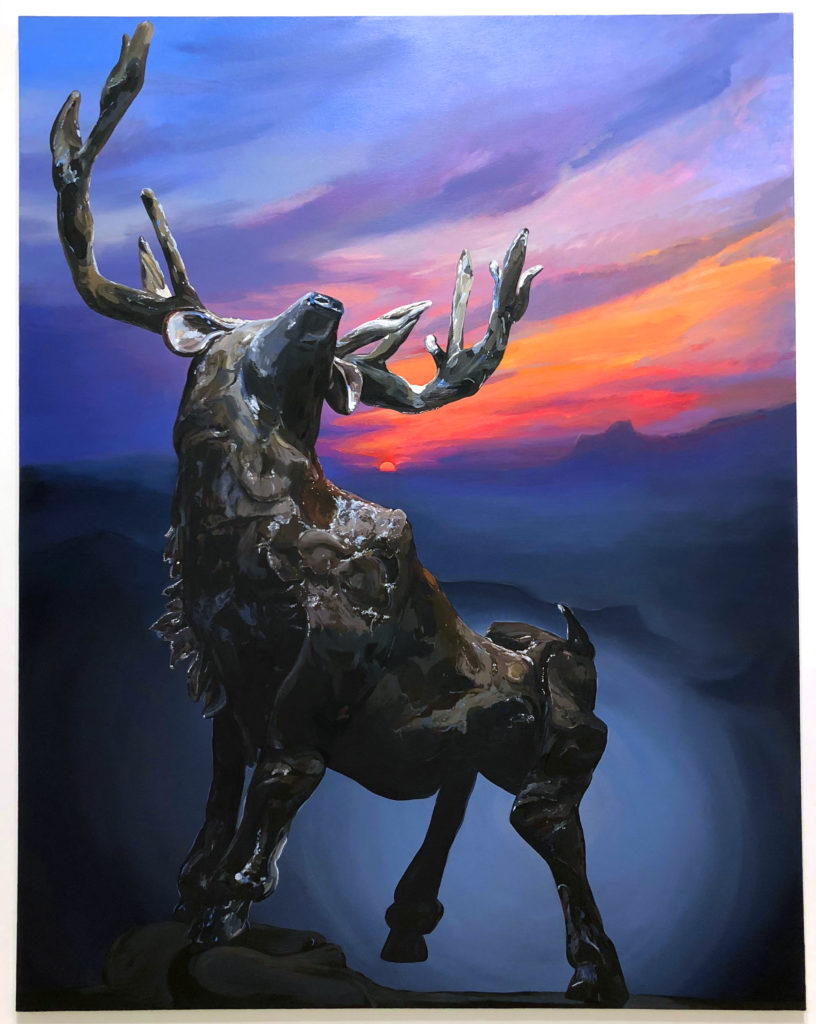
“Era of Eternity”, 2025, Oil on canvas

“Era of Eternity”, 2025, Oil on canvas (detail)

“The Material World”, 2025, Oil on canvas
Emma Webster‘s two large paintings for That Thought Might Think at Petzel present unsettling expressions of the anxiety inherent in living through uncertain ecological times.
From the gallery about the work and the artist’s process-
These new works are Webster’s largest to date, and depict expansive, revelatory vistas of genesis and apocalypse. Painted amid the Los Angeles fires, her two paintings offer a front row seat into dramatic, fantastical maquettes of rupturing landscapes. Morphing light, space, and scale, Webster speaks to the precarity of the natural world and the role of artifice.
The artist’s duet of paintings plays with a shifting sense of beginning, end, and causation. The Material World evokes a cool, Proterozoic majesty. Verdant with foliage beneath eclipsed sunlight, the viewer faces a front of cut-out trees, scraggly and bare-boughed. Meanwhile, Era of Eternity is a celestial rapture of a spiraling sunburst, with a flurry of geese cresting the canyon below. Webster casts tense atmospheres, placing her scenes in strange times of day, unclear if they represent daybreak or nightfall. Do these worlds unveil a beginning, a coming dawn, or the serene melancholy of twilight? And with it, an unraveling?
These two paintings are deeply rooted in the context of ecological crisis. Webster says: “It was surreal to make this work while just outside the studio; the orange, smoky sky was raining ash from the fires.” Yet, Webster celebrates the power and resilience of natural systems, both surreal and sophisticated, through her constructed environments. They are virtual plein-air paintings of supernatural landscapes that do not represent real-world places. However, they are places which absorb the viewer, familiar yet not, further illuminating the complex entanglements of the Anthropocene.
To create her paintings, Webster fuses VR technology, penned sketches, and scans of hand-made sculptures. She translates her digital dioramas to the painted plane, integrating inventive means to advance the genre of still life. With both digital and analog tools, Webster expands on the rich history of artists commandeering technologies, such as the Claude glass or camera obscura. By building an entire set in virtual reality, Webster expands the planes of her enveloping paintings. Her landscapes take on an immersive quality, like a proxy for reality, becoming avatars of the natural world. The unsettling panoramas in That Thought Might Think intertwine the material and the virtual, where the bounds of reality become increasingly elusive. In an era where seamless technologies chase the knife’s edge of sentience, Webster highlights the urgency of our relationship to the natural, the simulated, and the real.
This exhibition closes 4/12/25.