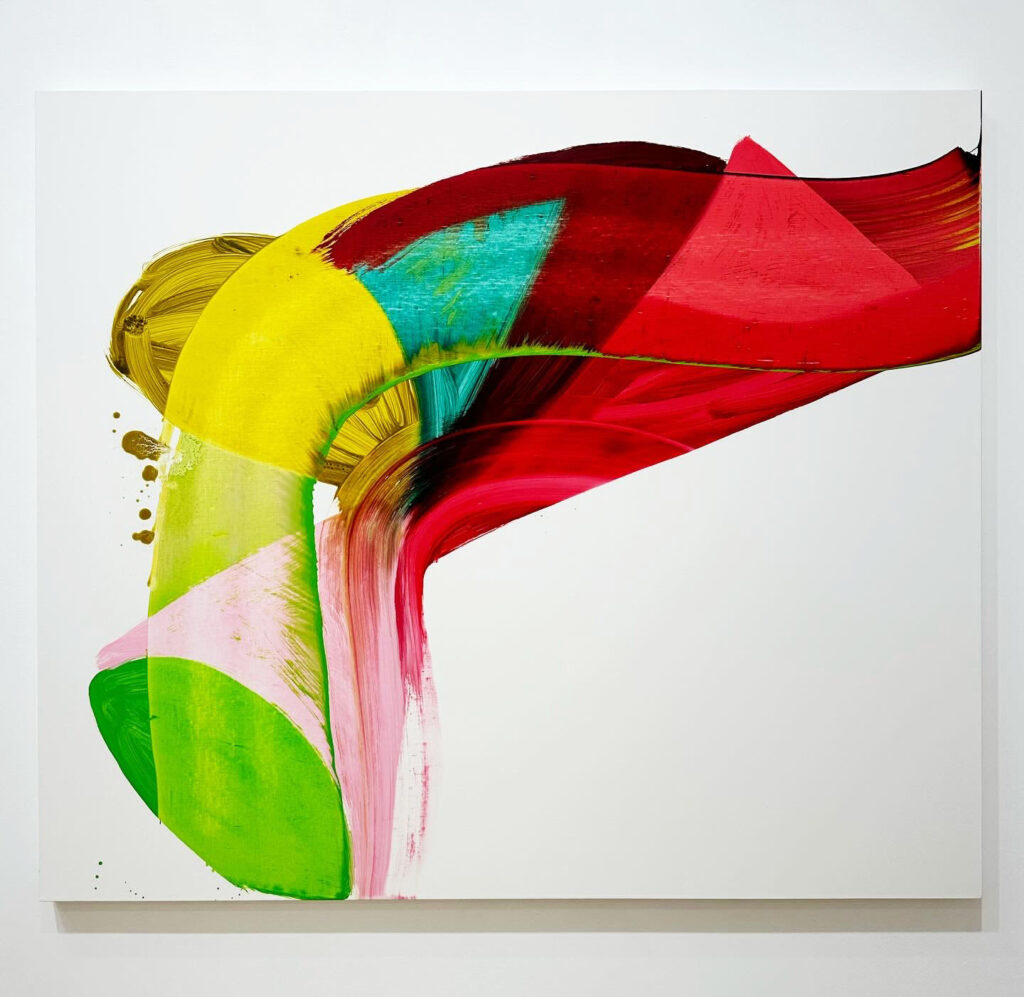
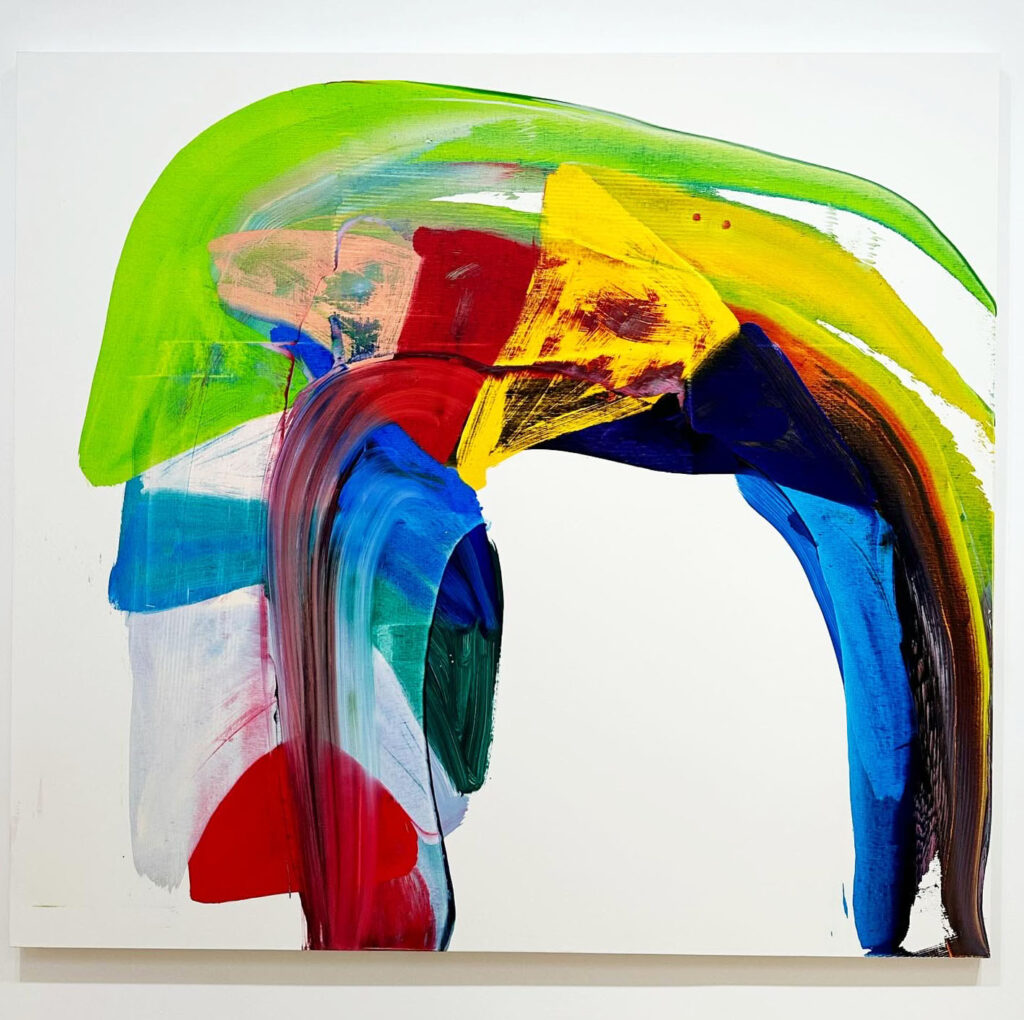
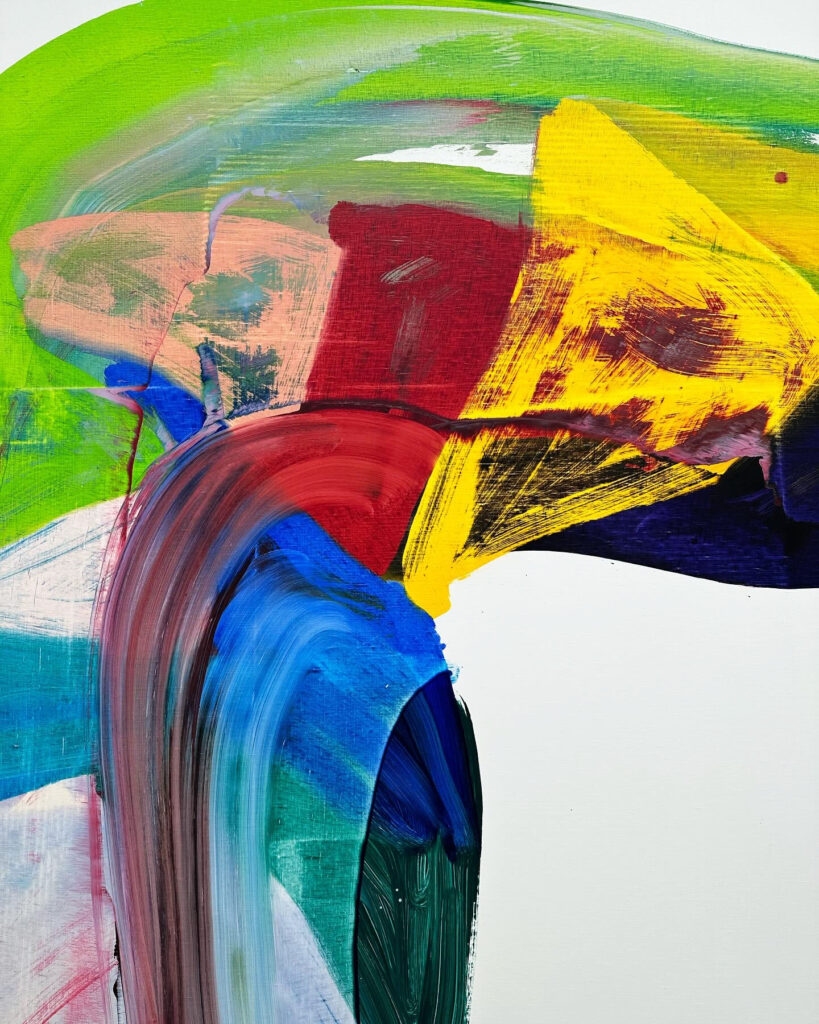
“Radiating Kindness (Oil)”, 2023, Oil on linen

“Bold Glamour”, 2023, Digital print on linen
For AI Paintings, Matthew Stone‘s 2023 exhibition at The Hole’s Lower East Side location, he explored new ways of using the latest technology while expanding on techniques used in his previous digital creations.
Details from The Hole about this exhibition-
Two LED screens form the center of this show, displaying an unedited stream of novel AI outputs; a new painting every ten seconds. Corresponding in scale to the surrounding works on linen and functioning like smart canvases, these AI paintings transform endlessly and if you’re alone in the gallery, you will be the only person to ever see that version of the artwork.
Stone’s AI paintings—both the tangible on linen and the fleeting screenic pieces—are created through his training of a custom AI model on top of Stable Diffusion’s open source, deep learning, text-to-image model. By feeding it only his past artworks, Stone has created a self-reflexive new series of AI works that disintegrates the hegemony of the singular static masterpiece and problematizes the idea of ownership, or even what “the artwork” itself entails.
AI has become part of contemporary culture, used to solve real world problems and also create TikTok filters. It’s a tool and like a paintbrush it can be used skillfully or not. At the moment AI is throwing the art world into upheaval as artists explore its potential, galleries contend with its disruption of technique and presentation and collectors and museums feel the dissolution of authorship and ownership.
A second type of work makes its debut here, Radiating Kindness (Oil), a 3D printed, machine-assisted oil painting made in collaboration with ARTMATR labs in Red Hook, where MIT artists and engineers have come together to make innovative tools and tech. By leveraging AI, robotics, computer vision and painting scripts, their robot has created a traditional oil painting in three dimensions. You can see on the surface how the interplay between analog and digital mark making is eye-boggling.
The show also includes examples of Stone’s “traditional” technique, which is anything but: on the 13-foot wide linen painting, Irradiance, four nude figures dance over piles of strewn AI paintings. The figures in the foreground, reminiscent in choreography of Henri Matisse’s Dance (La Dance), 1910, are bodacious, athletic women, heavy and sexy like a Michelangelo marble while at the same time futuristic, weightless and splendid in impossible glass and metallic brush marks. Here Stone’s circular and sensitive approach is laid bare for the viewer, the references to art history, technology, culture, access and the pursuit for the intangible is almost overwhelming to grasp.
Stone’s approach points to the deeply interwoven nature of our offline and online lives today. He sees artists’ use of new technologies as necessary, with creatives deploying these tools in a manner that’s not motivated by big tech or financial gains, disrupting the algorithm by creating their own and exploring this new frontier without data-driven deliverables. Creating new context and room for human subjectivities and emotion in the shift from analog to digital that arguably has already occurred.
Below, in an interview for The Standard, he discusses using AI for this work further-
When working with AI, do you sometimes feel overwhelmed or do you always feel in control?
I have never felt fully in control while making art and I’ve always been back and forth between wanting to be and understanding the transformative and creative power of just letting go. The most exciting moments in my creative process have often been unexpected mistakes. Those happy mistakes have revealed something that can then be consciously amplified. Using AI creates lots of unexpected outcomes very fast. So as someone who likes accidents in this context of image making, it’s a good way to become accident-prone.
Do you consider AI as just another digital tool? Or does it feel more like a collaboration? In other words, do you sometimes feel AI might develop its own taste, point of view, conscience?
It’s a digital tool and I try to resist the urge to anthropomorphize it. But it’s difficult because it feels like such a paradigm shift and also sometimes like dreaming. I think that culturally speaking, we are moving in a direction that assigns these qualities of perceived sentience to AI even when more mundane actions are at play. It’s not clear to me how we will tell if AI has achieved general intelligence, but I think most people will assume it to be the case long before it actually happens, assuming that it does.