Apr 252026
 

Cy Twombly “Fifty Days at Iliam: Shield of Achilles”, 1978

Cy Twombly “Fifty Days at Iliam”, 1978, oil, oil crayon, and graphite on canvas

“Fifty Days at Iliam: Achaeans in Battle”, 1978

“Fifty Days at Iliam: The Fire that Consumes All before It”, 1978

“Fifty Days at Iliam: Shades of Achilles, Patroclus and Hector”, 1978

“Fifty Days at Iliam: Shades of Eternal Night”, 1978

Cy Twombly was born today, April 25th, in 1928. One of his most famous works is Fifty Days at Iliam, his visual interpretation of Homer’s poem the Iliad. This “painting in ten parts” is currently on view at the Philadelphia Museum of Art and images of each of the individual works can be found on the museum’s website.

About Fifty Days at lliam from the museum-

The pinnacle of Twombly’s lifelong preoccupation with Greek and Roman mythology, Fifty Days at lliam is the artist’s rendition of the last fifty days of the Trojan War. The monumental series fuses elements of Homer’s epic poem The lliad, probably written before 700 BCE, and Alexander Pope’s translation of that poem from the 1700s.

The artist purposefully misspells the name of the besieged Trojan city as lliam, instead of the Latin llium or the Greek Ilion. The letter “a” stands as a symbol for the Greek warrior Achilles, whose rage sparked by the death of his friend Patroclus propels the end of the decade-long conflict.

Partaking in a long artistic tradition of depicting war, Twombly addresses themes of heroism and aggression, comradeship and revenge, jubilant victory and the mourning of the dead. The ten canvases can be encountered sequentially or experienced as an all-encompassing panorama that gives the sensation of witnessing the battle firsthand.

Twombly’s signature style combines the poignant gestures of abstraction with poetic allusions to classicism. Relocating from the United States to Italy in the 1950s proved decisive for Twombly’s art, which uses raw mark-making to allude to the myths of antiquity.

For a look at Twombly’s life and career, the 2018 documentary Cy Dear, is well worth a watch. The film begins with a discussion of Fifty Days at lliam, which was on view as part of a 2017 retrospective at Centre Pompidou in Paris. It also includes interviews with several of his friends and colleagues– including former assistants, his son Alessandro, art dealer Larry Gagosian, and photographer Sally Mann.
Mar 082024
 

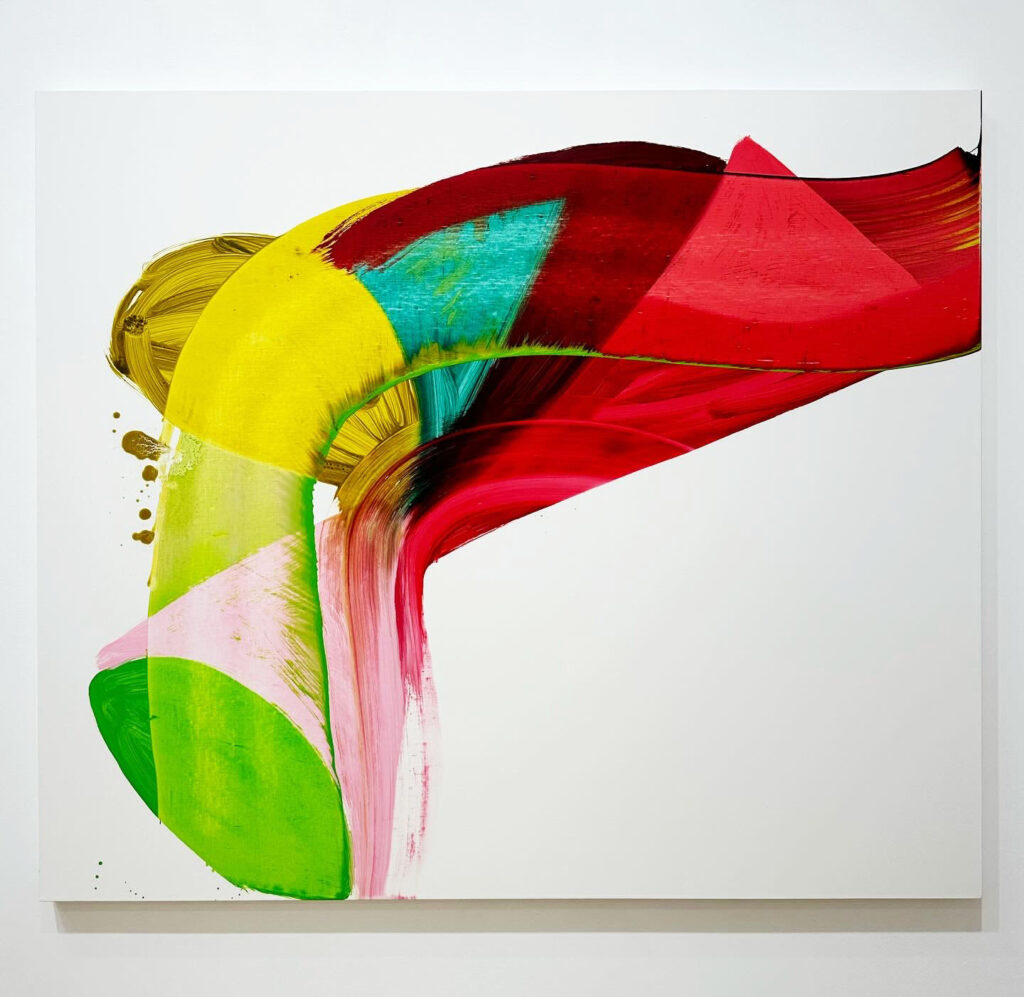
“Valentine”, 2022, oil on linen

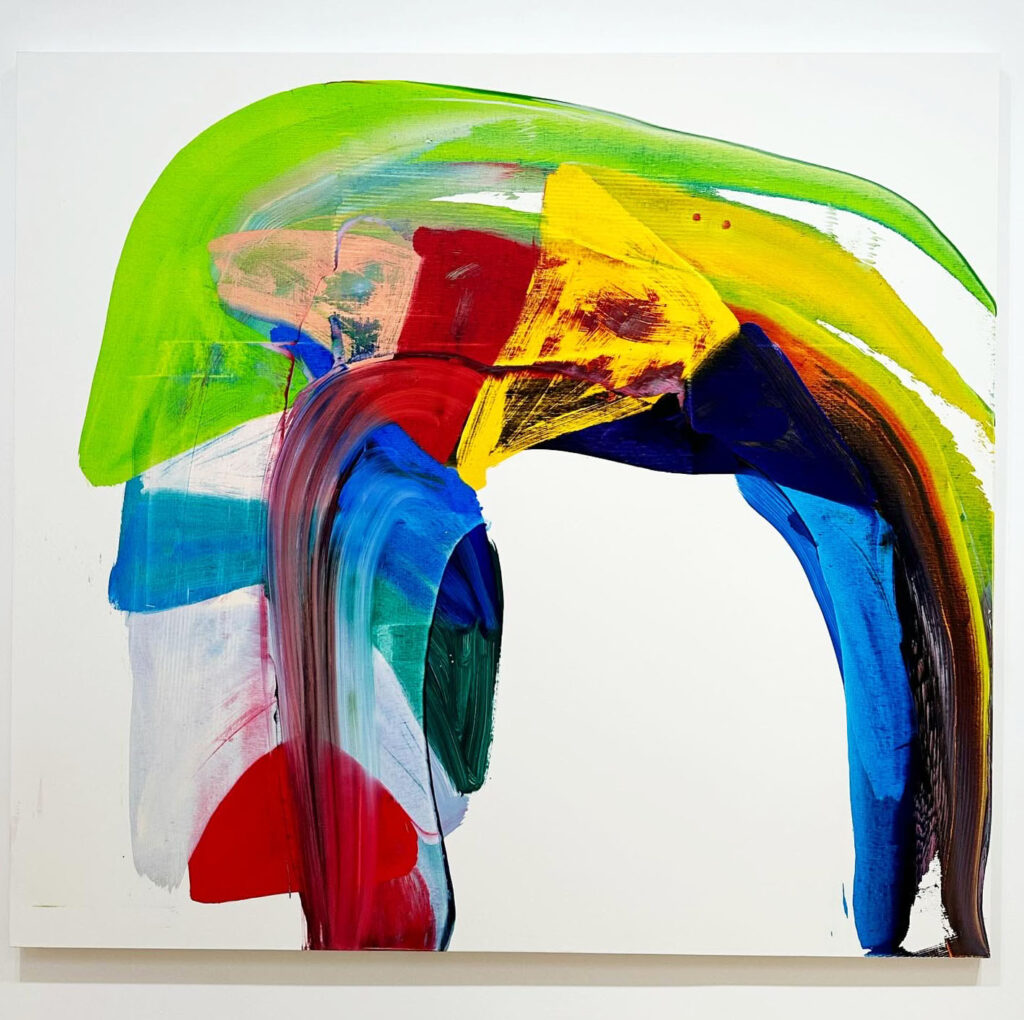
“Braid”, 2022, oil on linen

“Braid”, 2022, oil on linen (detail)

The two colorful paintings above are from Andrea Belag’s 2023 solo exhibition, Currents, at Bienvenu Steinberg & J in New York.

From the gallery’s press release-

Since the 1990s, Belag has constantly modified her approach to abstraction through various transitions and mutations. Her internal genealogy matters as much as her relationship to a tradition of abstraction. In the words of artist and critic Julian Kreimer: “it’s not hard to metaphorize those traces, lines left behind by larger swaths of paint that were wiped away, lines whose own shifting colors reveal how they are made by what they’ve touched and changed. But as with so many of Belag’s paintings, the point isn’t to nail down the metaphors (…) Belag’s work becomes an edge condition for painting without flirting with minimalist near-nothingness; it tests out where beauty can emerge, and what we can get to work. It opens up from a few wiped shapes into a sophisticated object able to transport one into a reverie about slippage, slipping away, the here and not hereness of life, death, and the varieties of love”.

Geometry and order have progressively given place to swirling swaths of color, solidity replaced by suspended motion. Painting is an all consuming action. She paints standing up, leaning over and often walking around the canvas placed horizontally. It starts with the arm and as she walks around the canvas her whole body gets involved. Transparent colors on the surface are not fixed and can create form or dissolve into light. She rubs, smudges, and scraps to create translucent, softly luminous surfaces where the brushwork is strikingly visible. “My paintings are contemporary because I paint in the here and now. It’s unavoidable. The artists I feel indebted to are Henri Matisse, Mary Heilmann, Joan Mitchell, Gerhard Richter, Bill Traylor, and Japanese Zen gardens. Style is a dead-end, but I have a point of view. I love transparency and the touch of materials, so I have created a way of painting where I make this possible. I use mostly transparent pigments and fine linen, and I paint wet into wet. The marks are on one layer of the painted surface with very little overlap or pentimento. Color makes space and light come through the paint and emotion comes through as well. There is fear and desire in painting, and that’s addictive. Haptics are the touchstones.” (Andrea Belag, 2023)

Her current solo exhibition, Twombly’s Green, opened this week at Steven Harvey Fine Art Projects.

From their press release-

This grouping of work is, as the title suggests, inspired by Belag’s recollection of Cy Twombly’s use of the color Hooker’s green in his “Pond Paintings.” She writes-

These paintings are inspired by my memory of Twombly’s green and white paintings that I first saw in the Menil Collection in Houston in 2015. I was stunned by his paint handling and his use of Hooker’s Green.

Since then, I learned he painted quickly and directly with his hands. Discovering the “Pond Paintings” was unexpected and I kept thinking about them. Hooker’s green is opaque and dark. But the dark value doesn’t overwhelm the hue. Instead, there is richness and depth without a trace of yellow.

When I identified the pigment and started to paint with it, I felt a vibration. There was a time when painting with green was taboo and now it is ubiquitous.

Is green in the zeitgeist?

All painted within the last twelve months, these works are a continuation of the artist’s practice of lush, energetic abstraction. Playing with circularity in an ongoing attempt to “get away from the grid,” Belag uses color as forms in space, bodies set in motion. Citing foundational inspirations in Matisse and Guston, who she later studied with at the New York Studio School, Belag’s work can also be related to vanguard practitioners of 80s abstraction such as Bill Jensen, David Reed and Mary Heilmann. Her immediate peers Christopher Wool and Joyce Pensato are also compass points in the stripped down dedication to raw painterly brio they share.

This exhibition is on view until 4/13/24.