Nov 252025
 

Artist, writer and professional wrestler Rosalyn Drexler, born on November 25, 1926, sadly passed away in September of this year. In addition to her famous artworks, she also wrote several novels and won Obie awards for her plays.

The painting above, Marilyn Pursued by Death, 1963, is currently on view at the Whitney Museum of American Art in New York.

From the museum about the work-

Rosalyn Drexler’s work often explores the dark backstories of postwar media culture and gender roles. She frequently clipped subjects from printed materials-here, a news photograph of Marilyn Monroe fleeing the paparazzi with her bodyguard in tow-enlarged and collaged them onto canvas, and then painted over the image. In the artist’s words, her source images were “hidden but present, like a disturbing memory.” On the day this source photograph was taken in 1956, Marilyn Monroe and Arthur Miller were to announce their upcoming marriage; in the frenzy to cover the event, a car carrying reporters crashed, killing at least one member of the press.

Aug 012024
 

Claes Oldenburg’s Soft Calendar for the Month of August, (Acrylic on canvas filled with foam rubber), pictured above, is currently on view at The Metropolitan Museum of Art.

From the museum about the work-

Contradiction animates Oldenburg’s sculptures of everyday objects. In works such as Soft Calendar, what is hard is made soft, what is small is made large, and what is flat is made three-dimensional. Stuffed fabric sculptures like this one originated in 1962 as props in Oldenburg’s art events, or Happenings, and evolved into independent works. The giant numbers here are sensuously rounded and pillow-like. Their overlapping arrangement asserts their volumetric nature. Each Sunday is called out in brilliant red, while the remaining days of the week are coated in white enamel.

Photographic documentation suggests that Soft Calendar was assembled and painted by Oldenburg and his partner, Patty Mucha, at Green Gallery in 1962.

Jun 252023
 

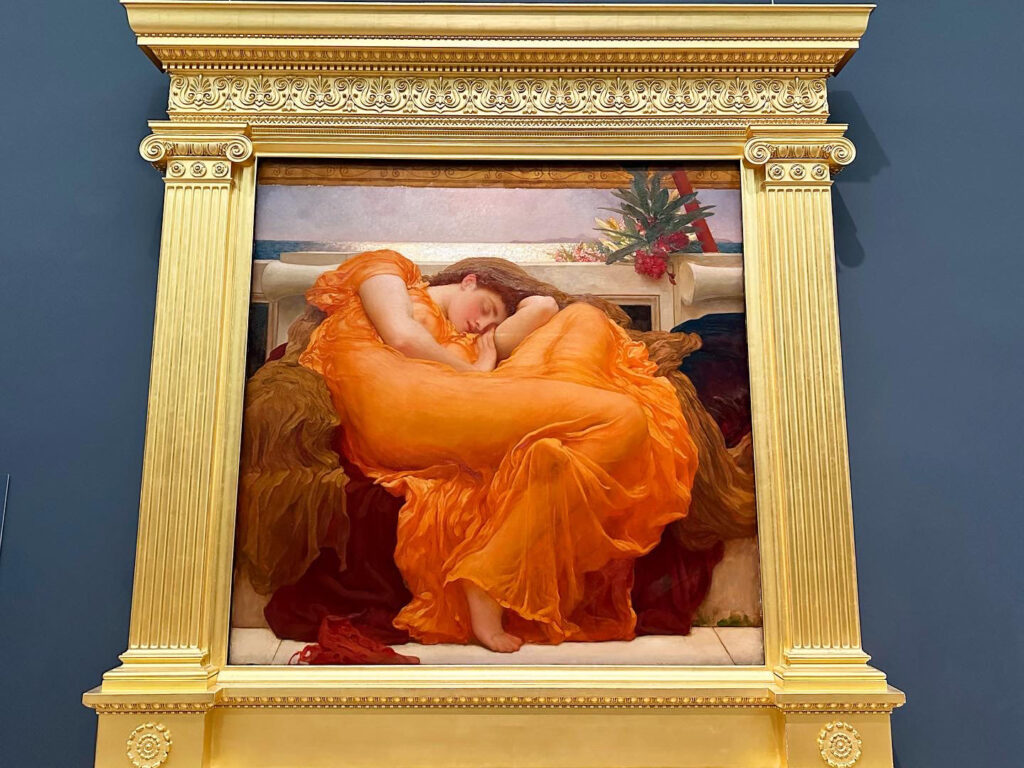
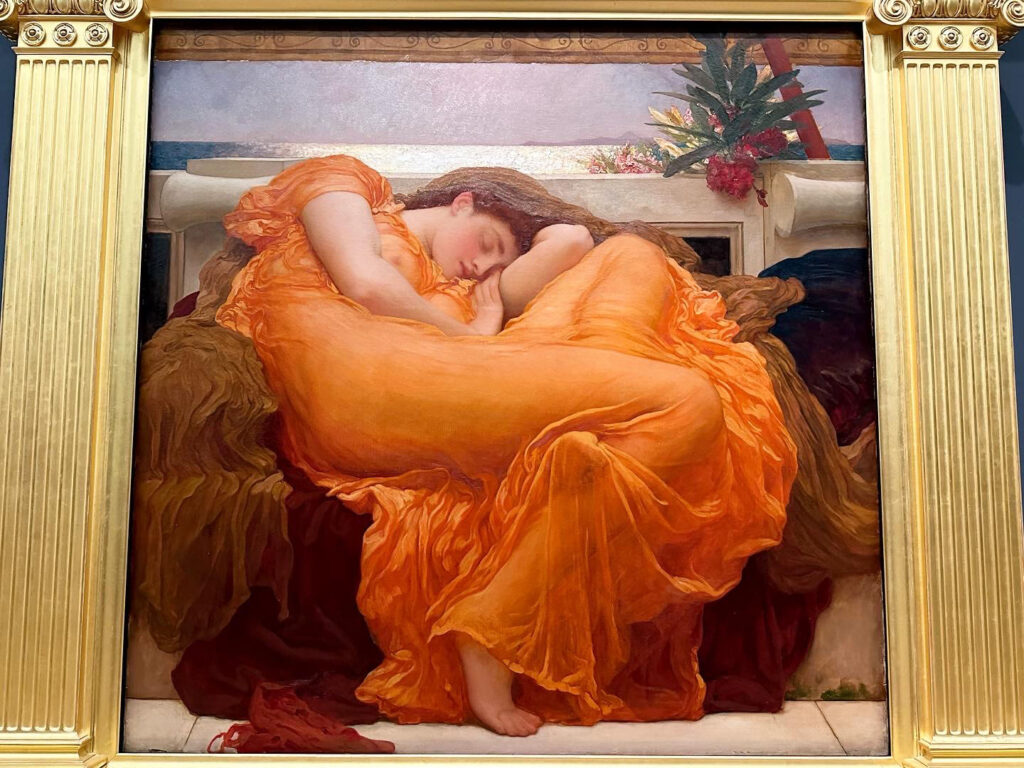
Frederic Leighton’s 1895 painting Flaming June is currently on view at The Metropolitan Museum of Art. It is on loan from Museo de Arte de Ponce in Puerto Rico, which is currently undergoing earthquake-related renovations.

From The Met’s website about the work-

According to Leighton, the composition was inspired by the posture of a tired model. He elaborated her sinuous pose and then added sheer orange draperies. Her skin flushed by the sun, she is transformed into a personification of summer heat. The image reflects Leighton’s allegiance to artistic ideals that emphasized harmonious color and form over narrative.

This and Lachrymae (hanging nearby) were the last great pair of paintings he exhibited at the Royal Academy in London, in 1895. Critics raved, but tastes soon changed; Flaming June did not regain its fame until the Museo de Arte de Ponce acquired it in the 196os. The frame is a reconstruction of the lost original designed by the artist.

This work will be on view until February of 2024.

Jan 302023
 

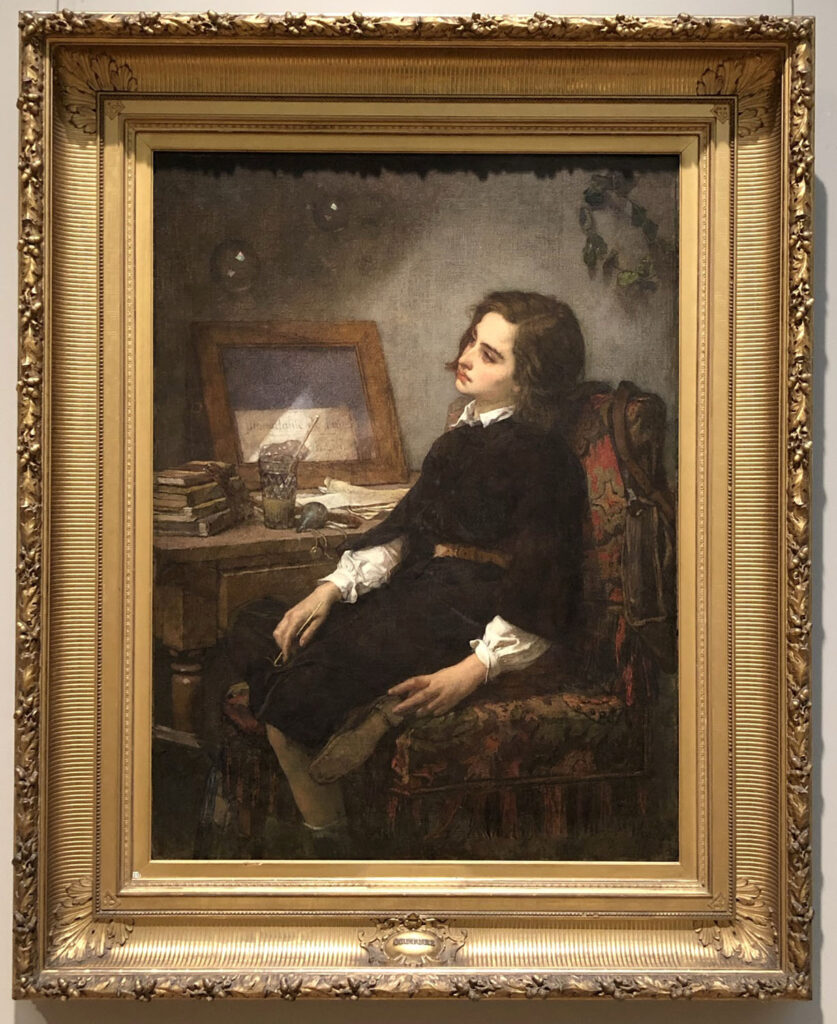
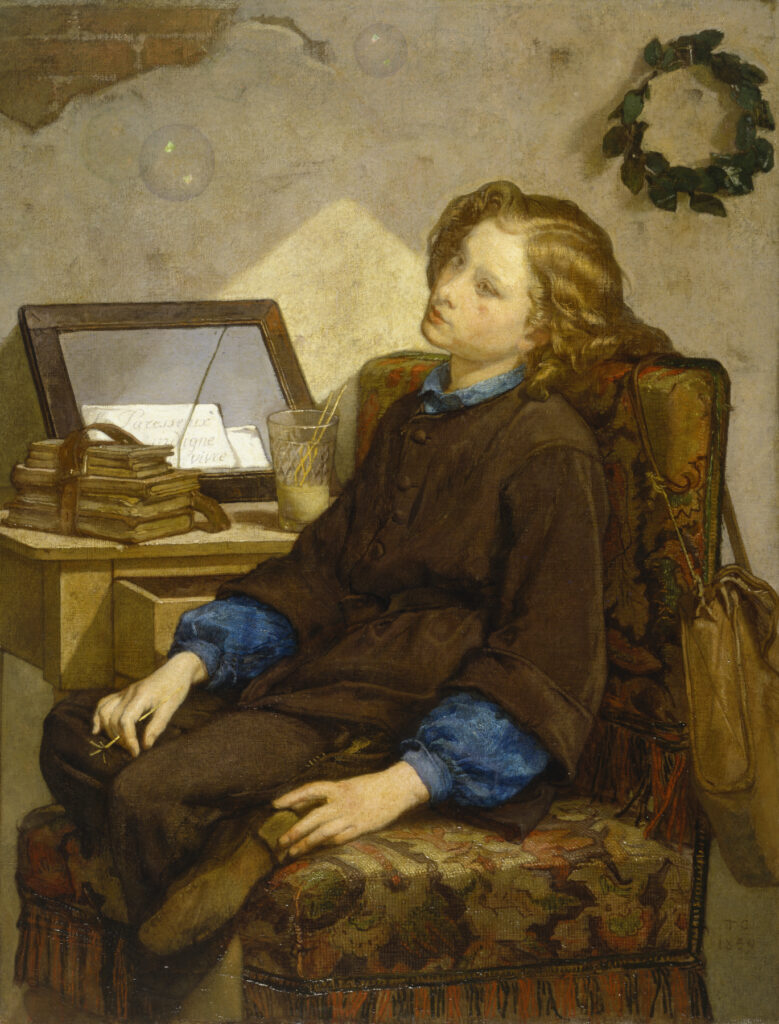
Thomas Couture’s Soap Bubbles, ca. 1859, on view at The Metropolitan Museum of Art.

From the museum’s website about the work-

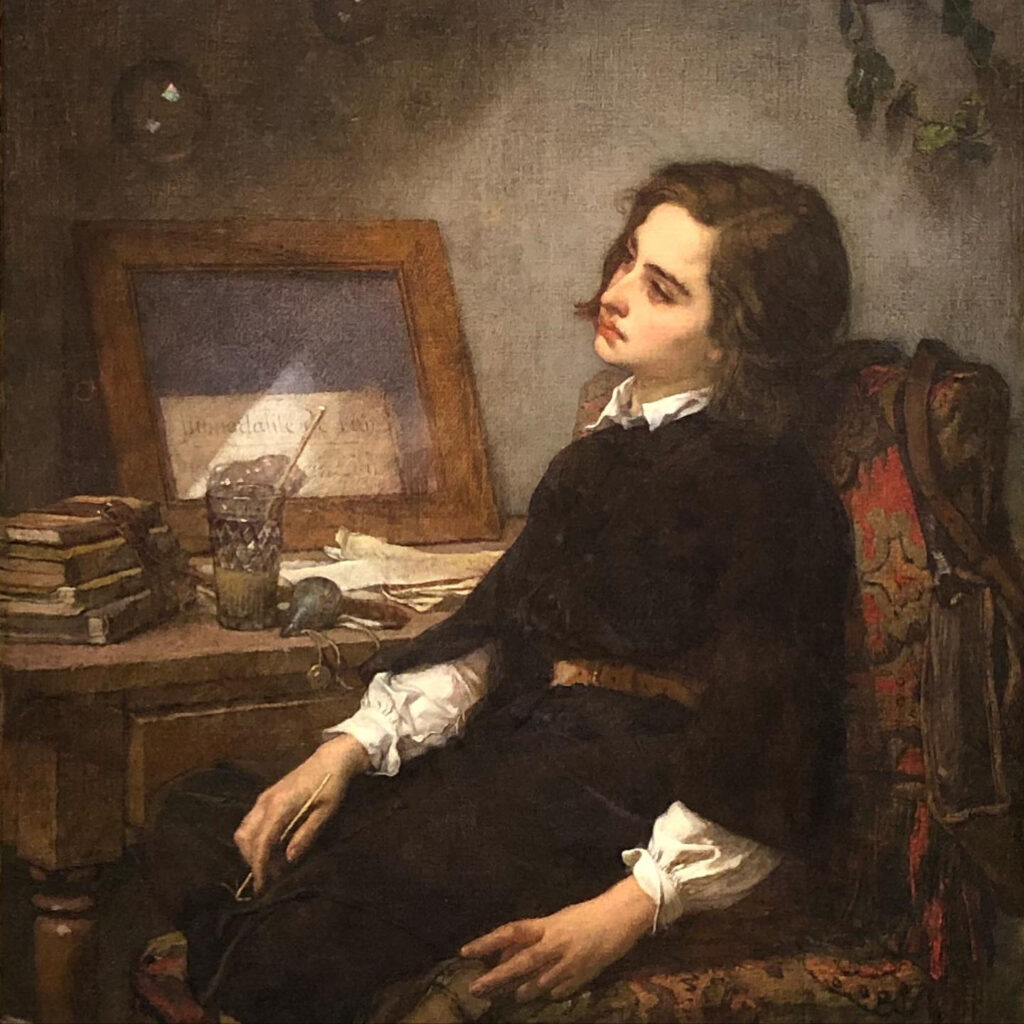
A schoolboy, identifiable by the books on the desk, contemplates soap bubbles, traditional symbols of the transience of life. A wilting laurel wreath on the wall behind him suggests the fleeting nature of praise and honors. The word “immortalité,” inscribed on the paper inserted in the mirror, reinforces the painting’s allegorical content.

Couture was an influential teacher known for his opposition to strict academic instruction. Among his pupils was Manet, who in 1867 painted his own, more naturalistic, version of this subject (Museu Calouste Gulbenkian, Lisbon).

Interestingly, there is a very similar painting to this one, Daydreams, 1859, also by Couture, that is on view at The Walters Art Museum in Baltimore, Maryland.

This time the writing on the paper in the mirror reads “Le Parasseux indigne de vivre”- the lazy one unworthy of living.

Jul 042022
 

Jasper Johns’ Three Flags, 1958, is currently on view at the Whitney Museum of American Art in NYC.

Information about the work from the Whitney’s website-

In 1954, Jasper Johns began painting what would become one of his signature emblems: the American flag. As an iconic image–comparable to the targets, maps, and letters that he also has depicted–Johns realized that the flag was “seen and not looked at, not examined.” The execution and composition of Three Flags elicit close inspection by the viewer. The painting draws attention to the process of its making through Johns’s use of encaustic, a mixture of pigment suspended in warm wax that congeals as each stroke is applied; the resulting accumulation of discrete marks creates a sensuous, almost sculptural surface. The work’s structural arrangement adds to its complexity. The trio of flags—each successively diminished in scale by about twenty-five percent—projects outward, contradicting classical perspective, in which objects appear to recede from the viewer’s vantage point. By shifting the visual emphasis from the flag’s emblematic meaning to the geometric patterns and variegated texture of the picture surface and the canvas structure, Johns explores the boundary between abstraction and representation. As he remarked, this painting allowed him to “go beyond the limits of the flag, and to have different canvas space.”