
Catherine Murphy‘s painting Blue Blanket, 1990, is on view at The Metropolitan Museum in NYC and is part of their permanent collection.

Catherine Murphy‘s painting Blue Blanket, 1990, is on view at The Metropolitan Museum in NYC and is part of their permanent collection.


“Apokaluptein 16389067” 2010-2013, Prison bed sheets, transferred newsprint, color pencil, graphite, and gouache

Apokaluptein: 16389067 by Jesse Krimes was part of the group exhibition Marking Time: Art in the Age of Mass Incarceration, on view at MoMA PS1 from 2020-2021. This work can currently be seen as part of his solo exhibition Corrections, on view at The Metropolitan Museum of Art until 7/13/25.
From MoMa PS1 about Krimes and Apokaluptein–
Jesse Krimes graduated from art school shortly before he was arrested and incarcerated. He spent his first year in prison in an isolation cell in North Carolina. After being transferred to Federal Correctional Institution, Fairton, in New Jersey, Krimes formed a multiracial art collective with Jared Owens and Gilberto Rivera, whose works also appear in this exhibition. During his time at Fairton, Krimes used penal matter to address questions of political theory, philosophy, aesthetics, and value.
Made over three years, Apokaluptein: 16389067 comprises thirty-nine prison bed sheets that depict a sweeping landscape representing heaven, earth, and hell. Using hair gel and a spoon, Krimes transferred images from print media to the bed sheets, drawing and painting around them to create an exploration of social value, state power, idealized beauty, and extractive capitalism. The work’s title combines the Greek word “apokaluptein,” meaning “to reveal” or “to uncover,” with Krimes’s prison number. The mass destruction Krimes depicts resonates with what he has described as his “loss of identity and stripping away of all societal markers and this destruction that happened on a very personal level….You lose your name; you become this number.” Imprisoned people are rendered state property and exploited to produce state goods: the bedsheets that compose Apokaluptein: 16389067 were made by imprisoned workers through a federal government-initiated program called UNICOR.
Krimes made each panel of this work individually, using the edge of his desk to measure the horizon on each sheet so that the panels would line up once joined. Assisted by incarcerated mailroom workers and sympathetic guards, the artist clandestinely transported finished panels out of prison before they could be confiscated. Upon his release in 2014, he assembled Apokaluptein: 16389067 and was finally able to see the work in its totality for the first time.
From The Met’s website about Corrections–
Photography has played a key role in structuring systems of power in society, including those related to crime and punishment. This exhibition presents immersive contemporary installations by the artist Jesse Krimes (American, b. 1982) alongside nineteenth-century photographs from The Met collection by the French criminologist Alphonse Bertillon, who developed the first modern system of criminal identification before the adoption of fingerprinting.
Krimes’s image-based installations, made over the course of his six-year incarceration, reflect the ingenuity of an artist working without access to traditional materials. Employing prison-issued soap, hair gel, playing cards, and newspaper he created works of art that seek to disrupt and recontextualize the circulation of photographs in the media. Displayed at The Met in dialogue with Bertillon, whose pioneering method paired anthropomorphic measurements with photographs to produce the present-day mug shot, Krimes’s work raises questions about the perceived neutrality of our systems of identification and the hierarchies of social imbalance they create and reinscribe. An artist for whom collaboration and activism are vital, Krimes founded the Center for Art and Advocacy to highlight the talent and creative potential among individuals who have experienced incarceration and to support and improve outcomes for formerly incarcerated artists.
One of his recent works on view in Corrections, Naxos, was created to pair with Apokaluptein.
About the work from curator Lisa Sutcliffe’s essay on The Met’s website–
The breadth of this interest in collaboration and advocacy can be seen in Naxos (2024), which features nearly ten thousand pebbles gathered from prison yards by incarcerated individuals around the country and shared with Krimes. Each hand-wrapped stone is suspended from a needle by a thread hand-printed with ink to match imagery from Apokaluptein. Installed across from each other, their pairing mirrors and deconstructs that earlier work, serving as a reflection of individuals caught up in the system of mass incarceration. The artist was inspired by the writings of psychologist Carl Jung, who warned of the danger of reducing individuals to statistics: Jung noted the impossibility of finding a river stone whose size matches the ideal average. With each distinctive yet anonymous pebble standing in for the mugshot, Krimes interweaves the complexity of individual experience with the broader social and political context in which mass incarceration exists.
Krimes’ Center for Art and Advocacy recently opened ts flagship location in the Bedford-Stuyvesant neighborhood of Brooklyn, New York. Its inaugural exhibition, Collective Gestures: Building Community through Practice, highlights “the transformative work of over 35 artists who have participated in The Center’s Right of Return Fellowship Program” and will be on view until 9/20/25.


Both Hammer Museum in Los Angeles and Palm Springs Art Museum are showing prints from Henri Matisse’s Jazz. It’s interesting to see the same work but in two different contexts based on the curation.
At Hammer Museum they are part of the group exhibition Sum of the Parts: Serial Imagery in Printmaking, 1500 to Now, on view until 11/24/24.
From the museum-
Printmaking’s capacity for serial imagery was recognized during the Renaissance in Europe and has continued to be explored by artists across centuries and geographies to creative, oftentimes experimental ends. Print publishers had a hand in issuing series, which could be conceived complete from the start, expanded from shorter sets, or even formed from existing bodies of related works. Diverse organizing principles have shaped the serial format, including pictorial narratives, iconographic groupings, formal innovations, thematic variations, and sequences measuring time and marking place, as well as structural, modular, and conceptual progressions. Importantly, the creative act itself is an open-ended serial pursuit, with each gesture, idea, and decision interacting with or informing the next.
While we can appreciate an individual print extracted from a series as a work in its own right, our visual perceptions, intellectual interpretations, and emotional responses shift when we view multiple images collectively: the whole becomes greater-or other-than the sum of its parts. New meanings surface as commonalities, patterns, or differences emerge. Selected from the collection of the Grunwald Center for the Graphic Arts, this exhibition presents prints conceived as sets or series and further considers artists’ informal serial procedures and approaches to printmaking across five centuries.
At Palm Springs Art Museum they are part of Art Foundations, which places different works together in from their collection into groups organized in different themes. Matisse is paired with Ellsworth Kelly in a section devoted to “artmaking through the angle of a given concept, with each wall dedicated to a single concept: pure color, automatic painting, text as a motif, or ready-made.”
From the museum about the exhibition-
Art Foundations explores how various art forms have been produced throughout the last two centuries. It presents a succession of artwork groupings across multiple media and disciplines, bringing together works not usually shown in the same space. Meant to be visited clockwise, each gallery provides a different angle on what we consider art, with each grouping questioning how art is made, why, where, and by whom.
This presentation shifts the lens through which we look at art, allowing us to explore gallery after gallery, the conception and the material of artmaking, and the spaces where it is created. Art Foundations brings together academically trained and untrained artists as well as visual arts, architecture, design, and glass, displaying the breadth and interconnectedness of the museum’s collection.
For more on Matisse’s Jazz, The Metropolitan Museum of Art provides detailed information on its website.


For Petrit Halilaj‘s installation Abatare at The Metropolitan Museum of Art, he used children’s doodles found on desks in his former school in Kosovo to create sculptures that bring these drawings to life around the outdoor garden. As a former refugee these drawings he found were personal to him and you can sense that in the way they are grouped together and his use of birds and flowers.
From the museum-
Halilaj was inspired by children’s doodles, drawings, and scribblings found on desks at the school he attended in Runik, Kosovo. For The Met commission, he expanded his research to other schools in Albania and countries from the former Yugoslavia, which are now undergoing significant cultural and sociopolitical change. Furtive drawings from kids’ desks have been enlarged into three-dimensional metal sculptures, each retaining the trace of the original. Together, they bring to public view the collective memory and imaginative power of generations of students whose lives were marked by traumatic conflicts and territorial divisions. Kosovo experienced the last of a series of wars in the Balkan region in the 1990s, during which many children were denied access to education on ideological grounds. Abetare borrows its title from the book the artist and his peers used to learn the alphabet at school, each letter linked to a lesson in pictures and text.
In Abetare, culturally specific references to different political ideologies, religions, and local heroes coexist with more universal symbols and playful nods to pop culture, art history, and sports. Spread around The Iris and B. Gerald Cantor Roof Garden, the “drawings in space” merge with the surrounding architecture and landscape to create a multivocal scenography with an open-ended narrative. A celebration of the shared impulse for personal expression and mark making, Abetare is an opportunity for discovery and an invitation to expand our capacity to imagine transformative futures.
In the video below from The Met, Halilaj discusses the work with curator Iria Candela, including the discovery of the desks, and shares some of his personal history.
This exhibition closes 10/27/24.
Trailer- “The First Monday in May”
The 2016 documentary The First Monday in May, follows chief curator of The Costume Institute at the Metropolitan Museum of Art Andrew Bolton as he prepares the 2015 exhibition China: Through the Looking Glass. The film also follows Anna Wintour as she prepares for the Met Gala party that accompanies the exhibition. Bolton’s work on the show with director Wong Kar Wai, as well as the negotiations and logistics behind creating it are fascinating.
The film is full of celebrities and fashion designers including Karl Lagerfeld, Jean Paul Gaultier, and John Galliano.
The Costume Institute’s latest exhibition, also curated by Andrew Bolton, Sleeping Beauties: Reawakening Fashion, closes on 9/2.

Bea Szenfeld, “Ammonite”, spring/summer 2014, White paper, white polyester thread, and white plastic pearls


“Undercover” (Japanese, founded 1990) Jun Takahashi, Dress, spring/summer 2024, White silk satin trimmed with pink rayon plain-weave roses and pink synthetic pleated organza and overlaid with white nylon tulle embroidered with black plastic sequins and crystal, bugle, and seed beads in the forms of spiders and trimmed with white silk satin

Gucci, Alessandro Michele, Cape, autumn/winter 2017-18, Seafoam silk satin embroidered with polychrome plastic sequins, plastic pearls, clear glass crystals, black glass bugle beads, and bronze glass seed beads in the pattern of a dove, a cloud and flowers
Pictured above are just a few of the many stunning works on view at The Metropolitan Museum of Art for the exhibition, Sleeping Beauties: Reawakening Fashion. In addition to the over 200 garments and accessories, the museum has added an additional sensory experience that includes scents that influenced the designers of certain time periods.
Curator Andrew Bolton discusses the show with Artnet here.
From the museum-
When an item of clothing enters The Costume Institute’s collection, its status is irrevocably changed. What was once a vital part of a person’s lived experience becomes a lifeless work of art that can no longer be worn, heard, touched, or smelled. Sleeping Beauties: Reawakening Fashion endeavors to resuscitate garments from the collection by reactivating their sensory qualities and reengaging
our sensorial perceptions. With its cross-sensory offerings, the exhibition aims to extend the interpretation of fashion within museums from the merely visual to the multisensory and participatory, encouraging personal connections.
The galleries unfold as a series of case studies united by the theme of nature. Motifs such as flowers and foliage, birds and insects, and fish and shells are organized into three groupings: earth, air, and water, respectively. In many ways, nature serves as the ultimate metaphor for fashion—its rebirth, renewal, and cyclicity as well as its transience, ephemerality, and evanescence. The latter qualities are evident in the “sleeping beauties,” garments that are self- destructing due to inherent weaknesses and the inevitable passage of time, which ground several of the case studies.
Sleep is an essential salve for a garment’s well-being and survival, but as in life, it requires a suspension of the senses that equivocates between life and death. The exhibition is a reminder that the featured fashions— despite being destined for an eternal slumber safely within the museum’s walls—do not forget their sensory histories. Indeed, these histories are embedded within the very fibers of their being, and simply require reactivation through the mind and body, heart and soul of those willing to dream and imagine.

Mary Katranzou’s “Digitalis” evening dress, spring/summer 2018, White synthetic faille digitally printed with lilies, daisies, dahlias, peonies, petunias, amaryllises, chrysanthemums, and foxgloves, embroidered with polychrome sequins, seed beads, bugle beads, and cannetille, and pieced with white neoprene trimmed with gray scuba knit and digitally printed with black lilies, daisies, dahlias, peonies, petunias, amaryllises, and chrysanthemums
About the dress above from the museum-
Mary Katrantzou‘s evening dress combines several elements of the three painted silk gowns opposite. Stylistically, the bold scale, color palette, and arrangement of the floral motifs resemble the 1740s robe à la frangaise, while the techniques of outlining the pattern in black and embroidering the flowers and leaves with beads recall the 1780g robe à l’anglaise and the 1870s Mme Martin Decalf gown, respectively. Katrantzou’s design inspiration, however, is decidedly contemporary: the children’s activity paint by number, which involves filling in numbered sections of a picture outlined in black with corresponding colored pigments.

Conner Ives, “Couture Girl” dress, autumn/winter 2021-22, White deadstock silk organza embroidered with polychrome deadstock plastic seed beads and polychrome recycled polyethylene terephthalate sequins of daisies, peonies, dahlias, and sunflowers
About the dress above-
Nature and artifice coalesce in Conner Ives’s “Couture Girl” dress from the designer’s 2020 graduate collection “The American Dream,” which was inspired by the women with whom he grew up in Bedford, New York. The garment’s bulblike shape parodies the pneumatic silhouettes of mid-twentieth-century fashion. The dress took five months to complete and is a testament to Ives’s commitment to sustainable practices: the silk organza is deadstock fabric donated by Carolina Herrera’s creative director, Wes Gordon, and the paillettes – made from recycled polyethylene terephthalate (PET) – were designed and produced in collaboration with Rachel Olowes of the Sustainable Sequin Company. Ives embroidered the more than ten thousand sequins by hand, basing the six shapes on his four favorite flowers – daisies, peonies, dahlias, and sunflowers.
The museum also included these rose-inspired garments.

Dolce & Gabbana, Domenico Dolce, Stefano Gabbana, Dress, 2024 Alta Moda, Red silk satin

Valentino, Pierpaolo Piccioli, Jacket, autumn/winter 2022-23 haute couture, Red silk taffeta appliqued with self-fabric roses
This exhibition closes 9/2/24.

Claes Oldenburg’s Soft Calendar for the Month of August, (Acrylic on canvas filled with foam rubber), pictured above, is currently on view at The Metropolitan Museum of Art.
From the museum about the work-
Contradiction animates Oldenburg’s sculptures of everyday objects. In works such as Soft Calendar, what is hard is made soft, what is small is made large, and what is flat is made three-dimensional. Stuffed fabric sculptures like this one originated in 1962 as props in Oldenburg’s art events, or Happenings, and evolved into independent works. The giant numbers here are sensuously rounded and pillow-like. Their overlapping arrangement asserts their volumetric nature. Each Sunday is called out in brilliant red, while the remaining days of the week are coated in white enamel.
Photographic documentation suggests that Soft Calendar was assembled and painted by Oldenburg and his partner, Patty Mucha, at Green Gallery in 1962.

Laura Wheeler Waring, “Girl with Pomegranate”, ca. 1940, oil on canvas

Winold Reiss, “Langston Hughes”, 1925, Pastel on illustration board

Winold Reiss, “Alain Leroy Locke”, 1925, Pastel on illustration board
The Harlem Renaissance and Transatlantic Modernism at The Metropolitan Museum of Art showcases some of the outstanding work created during this time period. The exhibition also provides some background on the artists, their peers in the art world, and their community.
From the museum-
The Harlem Renaissance emerged in the 1920s as one of the era’s most vibrant modes of artistic expression. The first African American-led movement of international modern art, it evolved over the next two decades into a transformative moment during which Black artists developed radically new modes of self-expression. They portrayed all aspects of the modern city life that took shape during the early decades of the Great Migration, when millions of African Americans left the segregated rural South in search of freedom and opportunity in Harlem and other expanding Black communities nationwide.
This exhibition explores how artists associated with the “New Negro” movement-as the Harlem Renaissance was originally known, after influential writings by the philosopher Alain Locke and others-visualized the modern Black subject. It reveals the extensive connections between these artists and the period’s preeminent writers, performers, and civic leaders. At the same time, it reconstructs cross-cultural affinities and exchanges among the New Negro artists and their modernist peers in Europe and across the Atlantic world, often established during international travel and expatriation.
This complex, multilayered story unfolds through portraits, scenes of city life, and powerful evocations of Black history and cultural philosophy. Highlights include seldom-seen works from historically Black colleges and universities and culturally specific collections. Across its broad sweep, opening with founding ideas and concluding with activist imagery made on the cusp of the civil rights era, it establishes the critical role of the Harlem Renaissance in the history of art as well as the period’s enduring cultural legacy.

Horace Pippin, “Self Portrait”, 1944, Oil on canvas, adhered to cardboard; and “The Artist’s Wife”, 1936, Oil on linen
The caption for the above paintings reads-
Contemporary artist Kerry James Marshall has described Pippin’s self-portrait as a “monumental statement of self-confidence.” In this small painting, tightly cropped at bust length, Pippin gazes confidently at the viewer, his firmly drawn likeness reflecting a well-disciplined hand. Pippin portrayed his wife, Jennie Ora Fetherstone Wade Giles, at three times the scale of his own image, but he unified the two paintings by using a similar palette. Jennie’s blue dress is echoed in the background of his portrait, while the background of her portrait is picked up in the artist’s tie and button-down shirt.
The portraits in the exhibition are not the only standouts. Below are a few more selections.

Suzanna Ogunjami, “Full Blown Magnolia”, 1935, oil on burlap

William H. Johnson, “Flowers”, 1939-40, oil on plywood

Aaron Douglas, “The Creation”, 1935, Oil on masonite

Aaron Douglas, “Aspiration”, 1936, Oil on masonite
From the museum about artist Aaron Douglas–
A core objective of the Harlem Renaissance was to portray the history and cultural philosophy that gave shape to a specifically African American identity and worldview. The artist Aaron Douglas, whose monumental murals earned him acclaim as the period’s foremost history painter, was also respected for his masterful use of biblical allegory to convey aspirations for freedom, equality, and opportunity.
Douglas first developed his signature silhouette figural compositions-derived in part from Cubism, Egyptian tomb reliefs, and American popular culture-for book and magazine cover illustrations in the late 1920s. He later elaborated this distinctive style in large-scale works for public projects and institutional commissions nationwide as well as at Fisk University in Nashville, where he established the art department and taught for thirty-eight years. Both Douglas and the sculptor Augusta Savage, founder of a Harlem community art school, created art inspired by the work of the author and composer James Weldon Johnson.

Laura Wheeler Waring, “Mother and Daughter”, 1927, Oil on canvas board
About Laura Wheeler Waring’s painting Mother and Daughter from the museum-
Mother and Daughter is perhaps the most direct engagement by a prominent Black artist of this era with the controversial topic of racially mixed families; its very existence was a disruption of the silence on the subject within certain segments of society. Waring experimented with some of the modernist pictorial devices favored by Alain Locke in her portrayal of a Black mother and her white-presenting daughter, rendering them not as specific individuals but as generic types emblematic of the omnipresence of racially mixed families. Flattening their near-identical facial features in profile, Waring established the true subject of the painting via the title and through the work’s most prominent element: the divergent skin tones that point to the subjects’ radically different paths through a social life defined by color lines.

Beauford Delaney, “Dark Rapture (James Baldwin)”, 1941, Oil on masonite
Finally, this portrait of James Baldwin by Beauford Delaney was also a highlight.
From the museum about the work-
Delaney met the writer and civil rights activist James Baldwin in 1940. Finding common ground on multiple fronts-intellectual, social, and artistic-the two gay men began a friendship that would last thirty-eight years. Dark Rapture, the first of Delaney’s several portrayals of Baldwin, presents the author in a thickly painted, expressive tonal study of reds, browns, and blues against a brightly hued landscape. Both introspective and joyous, Dark Rapture stands as a visual manifestation of queer camaraderie, identity, and the search for belonging in the modern world.
This exhibition closes 7/28/24.
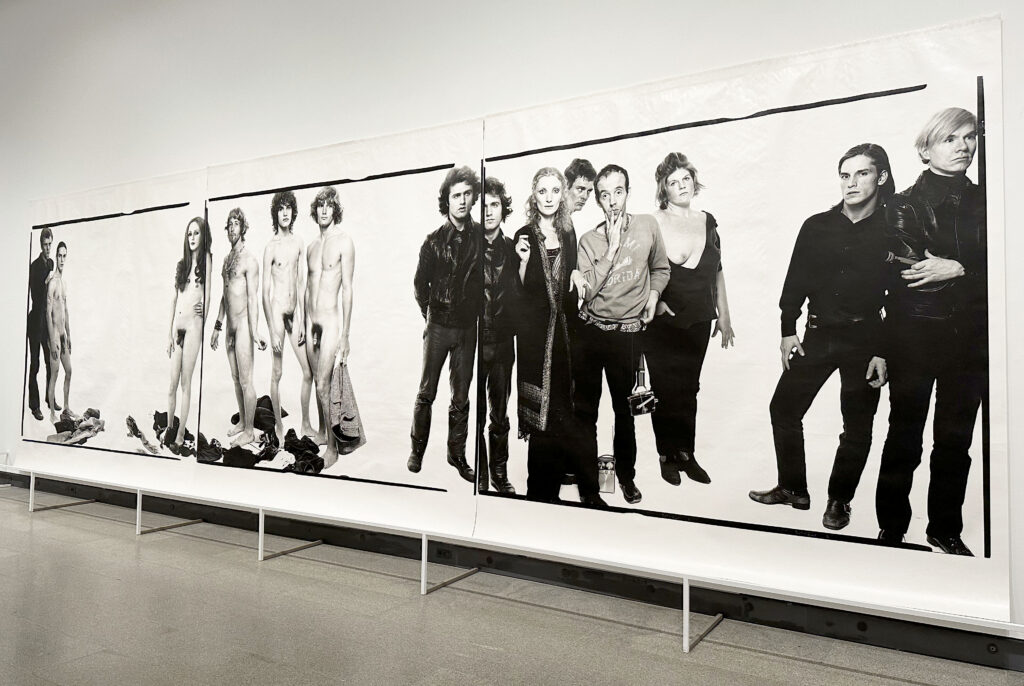
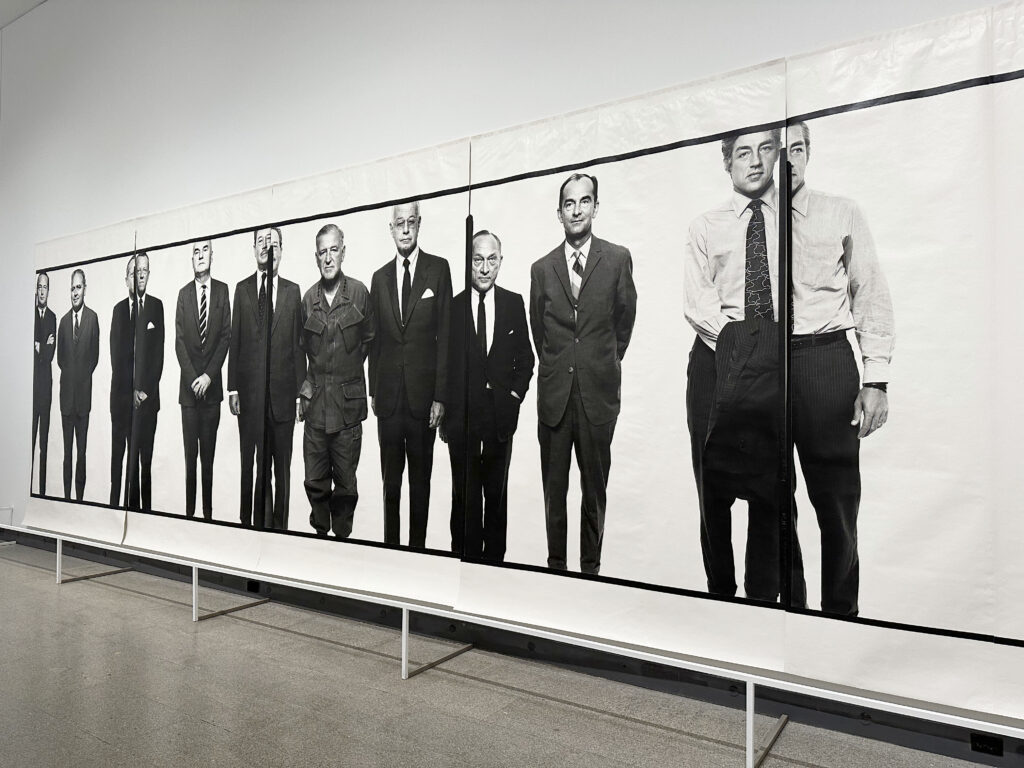
There are currently two exhibitions in New York celebrating Richard Avedon’s photography. At The Metropolitan Museum of Art is Richard Avedon: Murals. Pictured above are two of the large murals included. The first is of Andy Warhol and members of The Factory and the other is of members of the Mission Council in Saigon.
From The Met’s website about the show-
In 1969, Richard Avedon was at a crossroads. After a five-year hiatus, the photographer started making portraits again, this time with a new camera and a new sense of scale. Trading his handheld Rolleiflex for a larger, tripod-mounted device, he reinvented his studio dynamic. Instead of dancing around his subjects from behind a viewfinder, as he had in his lively fashion pictures, he could now stand beside a stationary camera and meet them head-on. Facing down groups of the era’s preeminent artists, activists, and politicians, he made huge photomural portraits, befitting their outsized cultural influence. On the centennial of the photographer’s birth, Richard Avedon: MURALS will bring together three of these monumental works, some as wide as 35 feet. For Avedon, the murals expanded the artistic possibilities of photography, radically reorienting viewers and subjects in a subsuming, larger-than-life view.
The murals are society portraits. In them, Avedon assembles giants of the late twentieth century—members of Andy Warhol’s Factory, architects of the Vietnam war, and demonstrators against that war—who together shaped an extraordinarily turbulent era of American life. Presented in one gallery, their enormous portraits will stage an unlikely conversation among historically opposed camps, as well as contemporary viewers. The formal innovations of Avedon’s high style—of starkly lit bodies in an unsparing white surround—are best realized in these works, where subjects jostle and crowd the frame, and bright voids between them crackle with tension. Uniting the murals with session outtakes and contemporaneous projects, the exhibition will track Avedon’s evolving approach to group portraiture, through which he so transformed the conventions of the genre.
About Andy Warhol and members of The Factory–
Avedon fantasized about throwing an annual fete for New York society and watching the group evolve over time. This mural is his downtown take on such a party, featuring a new “smart set” of sexual revolutionaries. They were affiliated with Andy Warhol’s Factory, the studio and gathering place for a coterie of avant-garde filmmakers, artists, and socialites. Avedon summoned them to his own studio, where they met over a series of weeks. Working in his most directorial mode, he arranged his subjects—including transgender actress Candy Darling and adult film star Joe Dallesandro—in a lateral frieze across adjoining frames, the fracture and repetition of their bodies in space suggesting the filmic passage of time.
The culmination of much trial and error, the mural’s composition took time to perfect, as evidenced by session outtakes displayed nearby. Avedon later praised the professionalism of his cast but joked, “You couldn’t keep the clothes on anybody in those years. . . . Before you could say ‘hello,’ they were nude and ready to ride.” If this unabashed undress tests gallery decorum, it is a provocation grounded in art history: in the central panel Avedon presents a male version of the “three graces,” riffing on a gendered tradition in allegorical painting with an ironic, Warholian wink.
About The Mission Council, Saigon, South Vietnam–
Avedon knew he would have mere minutes to photograph the U.S. generals, ambassadors, and policy experts who ran the war in Vietnam—not the weeks he spent refining his first mural. Planning in advance, he requested the heights of the men known collectively as the Mission Council and mapped out their positions, with careful attention to rank and influence. He rigged a makeshift studio at the embassy in Saigon, and recalled that once assembled, they “lined up like high school boys. They all wanted to be in the picture.” This is true of all but Ted Shackley, the camera-averse CIA station chief known to colleagues as the Blond Ghost, who begged out of the sitting for “a meeting,” leaving a void in the rightmost panel.
As blunt and procedural as a police lineup, the mural recalls Avedon’s first photography gig as a teenager in the Merchant Marine, where he made mugshot-style portraits of new recruits. Here, scrutinizing the faces of the war’s top brass, Avedon invokes their unseen operatives and victims. When the work was later published, one critic deemed it “a terrifying picture of business as usual.”
This exhibition closes 10/1/23.
For a more comprehensive look at Avedon’s career, Gagosian’s Chelsea location is showing Avedon 100, “a collection of Avedon photographs was selected by more than 150 people—including prominent artists, designers, musicians, writers, curators, and fashion world representatives—who elaborate on the impact of the photographer’s work today.”
The gallery’s website has a video of the installation that is well worth checking out, especially if you can’t see the exhibition in person.
This exhibition will close on Friday, 7/7/23.

