
Thomas Hart Benton’s After Many Days, 1940, from The San Diego Museum of Art’s collection.

Thomas Hart Benton’s After Many Days, 1940, from The San Diego Museum of Art’s collection.
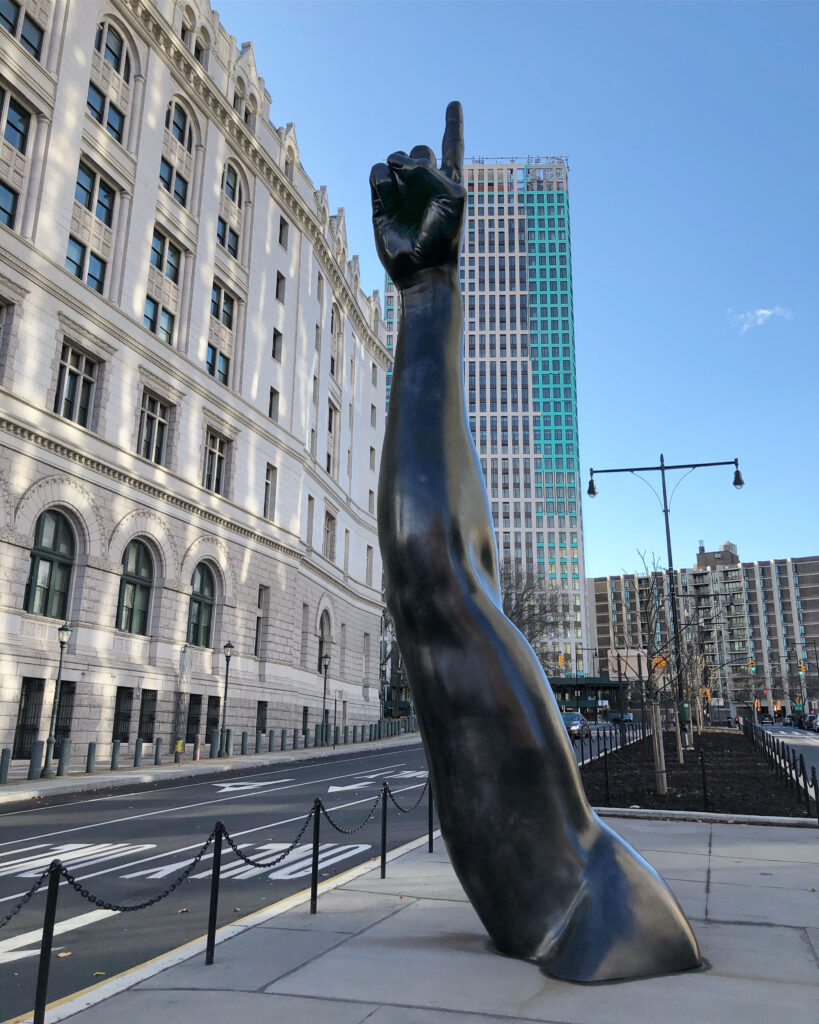
Unity, was created by Hank Willis Thomas in 2019 as part of the Department of Cultural Affairs Percent for Art Program. The 22.5 foot sculpture is a replica of NBA player Joel Embiid’s right arm.
From the artist on the work (via Downtown Brooklyn)-
“The sculpture is an homage to and celebration of the unique and multi-faceted character of the borough of Brooklyn. The spirit of Brooklyn has always been about upward mobility and connection to roots. The large-scale sculpture of a bronze arm pointing toward the sky is intended to convey to a wide audience a myriad of ideas about individual and collective identity, ambition, and perseverance”.
Thomas will be speaking with UCLA professor and author Robin D.G. Kelley today (9/18/22) at 2pm The Broad Museum about his art practice, his activism, and his piece in the museum’s current exhibition, This is Not America’s Flag.
The program will be live-streamed on The Broad’s website and their Facebook page.

Ofer Wolberger’s photo of Spencer Finch’s installation Trying to Remember the Color of the Sky on that September Morning, 2014, located at the 9/11 Memorial & Museum.
From the museum’s webpage about the work-
At the heart of the 9/11 Memorial & Museum’s mission is the promise to commemorate the 2,983 killed as a result of the 9/11 and February 26, 1993 attacks. The Memorial and the Museum fulfills this sacred responsibility in many ways—through memorialization, through education and, in some cases, through artistic expression.
One of the Museum’s most recognizable installations is a piece by artist Spencer Finch titled “Trying to Remember the Color of the Sky on That September Morning.” This work runs prominently through Memorial Hall, or the space that connects the two main exhibitions at bedrock in the Museum. This larger-than-life installation is part of the Memorial Museum’s permanent collection and was commissioned in 2014 before the Museum opened its doors to the public.
The piece is comprised of 2,983 individual watercolor squares—each representing a victim of the 2001 and 1993 attacks—and symbolizes the idea of memory. Many remember the beauty of the clear blue sky on the morning of 9/11. But, our own perception of the color blue might not be the same as that of another person. However, just like our perception of color, our memories share a common point of reference.
Within the larger art installation is the quote “No Day Shall Erase You From the Memory of Time” from Book IX of The Aeneid by Roman poet Virgil. Each letter was forged from recovered World Trade Center steel by New Mexico artist Tom Joyce. This quote suggests the transformative potential of remembrance and succinctly reinforces the 9/11 Memorial & Museum’s mission. Today, while the Memorial and the Museum are temporarily closed, these words remain as true as ever.
The image of the work shown above was included in Mint Museum’s 2021 exhibition, W|ALLS: Defend, Divide, and the Divine.

Jasper Johns’ Three Flags, 1958, is currently on view at the Whitney Museum of American Art in NYC.
Information about the work from the Whitney’s website-
In 1954, Jasper Johns began painting what would become one of his signature emblems: the American flag. As an iconic image–comparable to the targets, maps, and letters that he also has depicted–Johns realized that the flag was “seen and not looked at, not examined.” The execution and composition of Three Flags elicit close inspection by the viewer. The painting draws attention to the process of its making through Johns’s use of encaustic, a mixture of pigment suspended in warm wax that congeals as each stroke is applied; the resulting accumulation of discrete marks creates a sensuous, almost sculptural surface. The work’s structural arrangement adds to its complexity. The trio of flags—each successively diminished in scale by about twenty-five percent—projects outward, contradicting classical perspective, in which objects appear to recede from the viewer’s vantage point. By shifting the visual emphasis from the flag’s emblematic meaning to the geometric patterns and variegated texture of the picture surface and the canvas structure, Johns explores the boundary between abstraction and representation. As he remarked, this painting allowed him to “go beyond the limits of the flag, and to have different canvas space.”
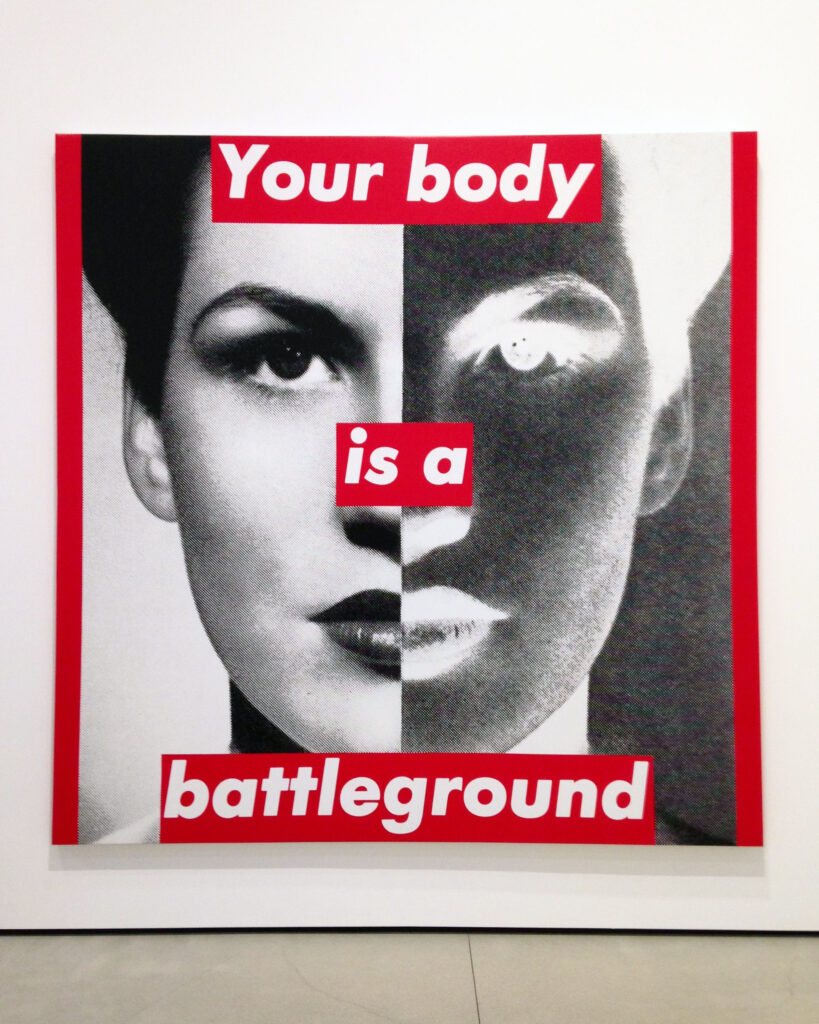
This work is currently on view at The Broad in Los Angeles.
Information from the museum’s website about this artwork-
Barbara Kruger addresses media and politics in their native tongue: tabloid, sensational, authoritative, and direct. Kruger’s words and images merge the commercial and art worlds; their critical resonance eviscerates cultural hierarchies — everyone and everything is for sale. The year 1989 was marked by numerous demonstrations protesting a new wave of antiabortion laws chipping away at the 1973 Roe v. Wade Supreme Court decision. Untitled (Your body is a battleground) was produced by Kruger for the Women’s March on Washington in support of reproductive freedom. The woman’s face, disembodied, split in positive and negative exposures, and obscured by text, marks a stark divide. This image is simultaneously art and protest. Though its origin is tied to a specific moment, the power of the work lies in the timelessness of its declaration.