Today (5/30) is the last day to see Ed Templeton’s exhibition Synthetic Suburbia at Roberts & Tilton in Culver City. His new paintings and drawings present a unique perspective on the Huntington Beach community.

Today (5/30) is the last day to see Ed Templeton’s exhibition Synthetic Suburbia at Roberts & Tilton in Culver City. His new paintings and drawings present a unique perspective on the Huntington Beach community.


Today (4/19) is the last day to see both Robert Williams’ exhibition Slang Aesthetics! and 20 Years Under the Influence of Juxtapoz, a group exhibition by guest curators Andrew Hosner of Thinkspace Gallery and Gary Pressman of Copro Gallery at the Los Angeles Municipal Art Gallery (LAMAG), in Barnsdall Park.
Robert Williams has had a long career, from working on famous 60′s comic book Zap Comix to later helping to create Juxtapoz Magazine in 1994 to provide exposure for underground artists. His paintings are highly skilled and detailed and each one has a story explaining the meanings behind the work.
The Juxtapoz exhibition has a diverse range of artists including Mark Ryden, Margaret Keane, Triston Eaton, Brett Armory, Andrew Schoulz and too many others to list here. Also drawing crowds are two of Kazuhiro Tsuji’s eerily lifelike sculptures of Dali (pictured above) and Andy Warhol.
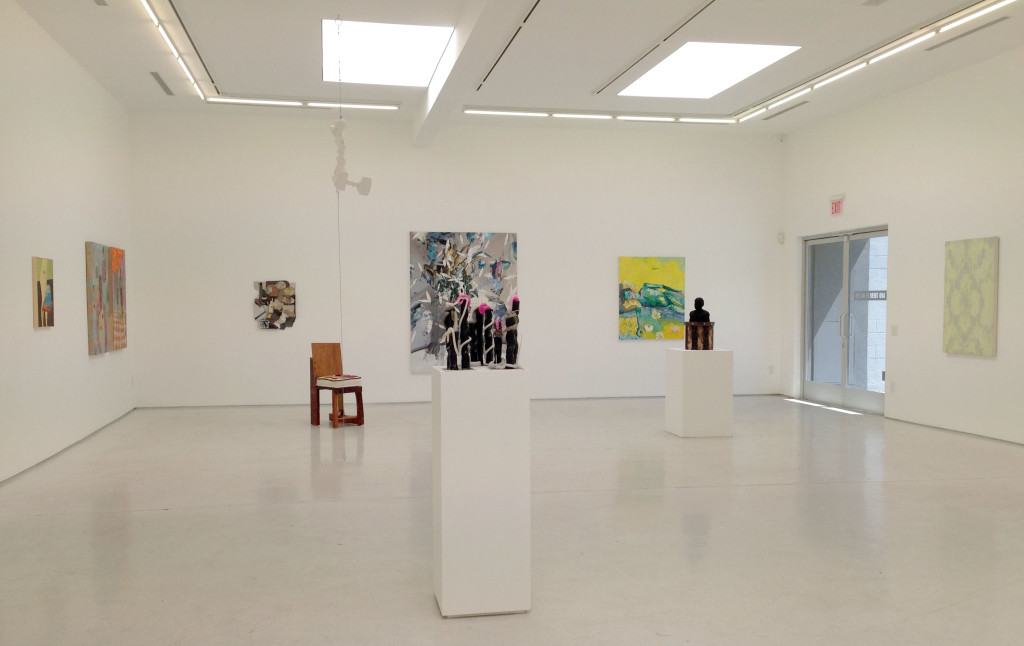
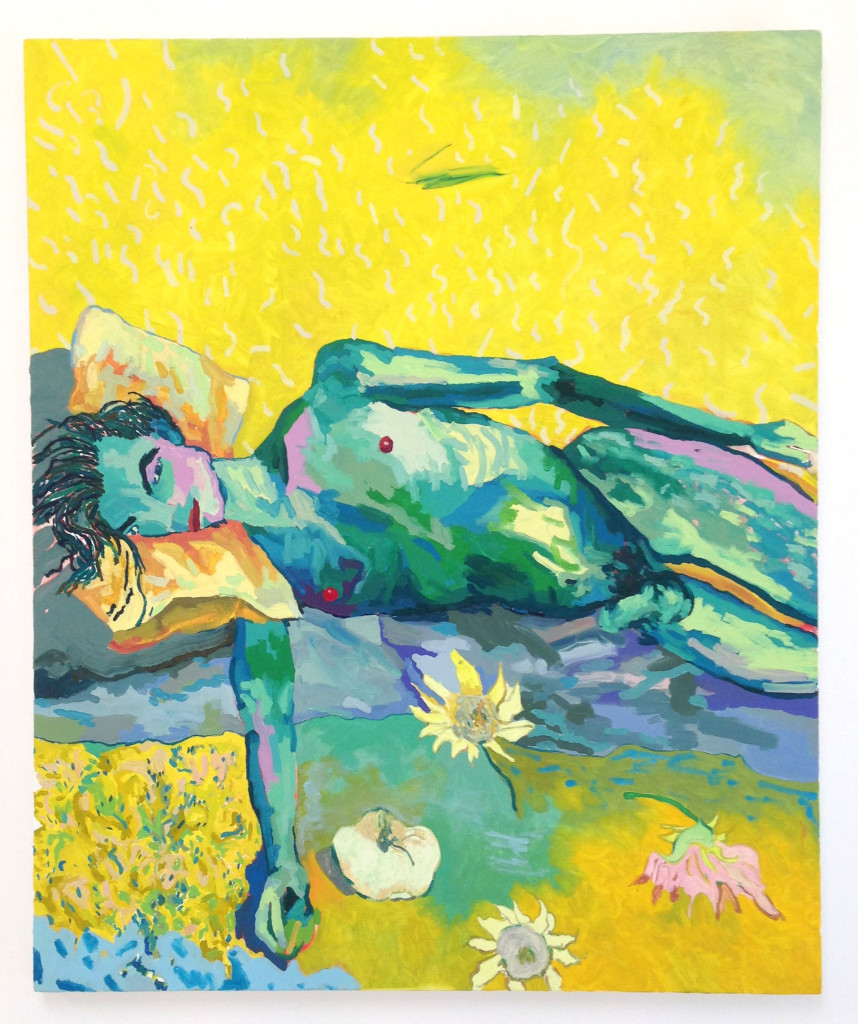
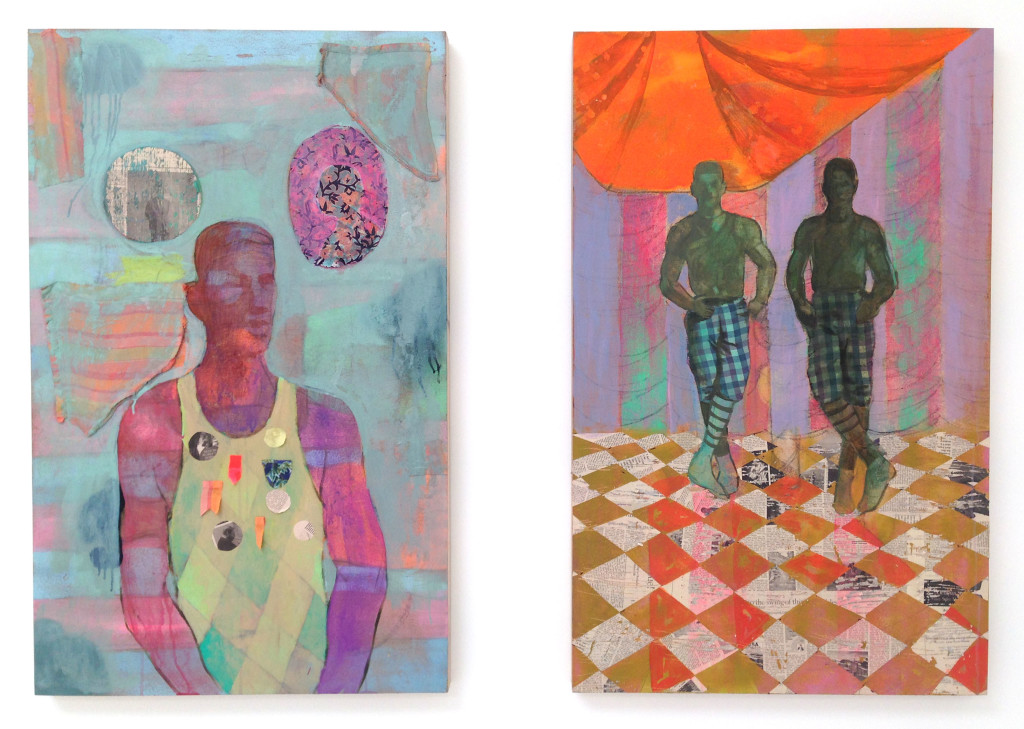
Alex Chaves
Currently at Roberts & Tilton, the exhibition And There Is An End is a wonderfully eclectic mix of painting and sculpture.
From the press release-
A search for poetic truths entails a search for art that not only has a dialogue with contemporary issues, but talks back to us. This exhibition brings together disparate voices to convene in a context spanning multiple generations and varied identities. With a range of works that acknowledges the individual via paintings and sculptural works with an unabashed display of the personal, the hand and the intuitive, implementing autonomous figuration and tactile expressions of materials that question the act of production and active image making.
This show closes 4/18/15.
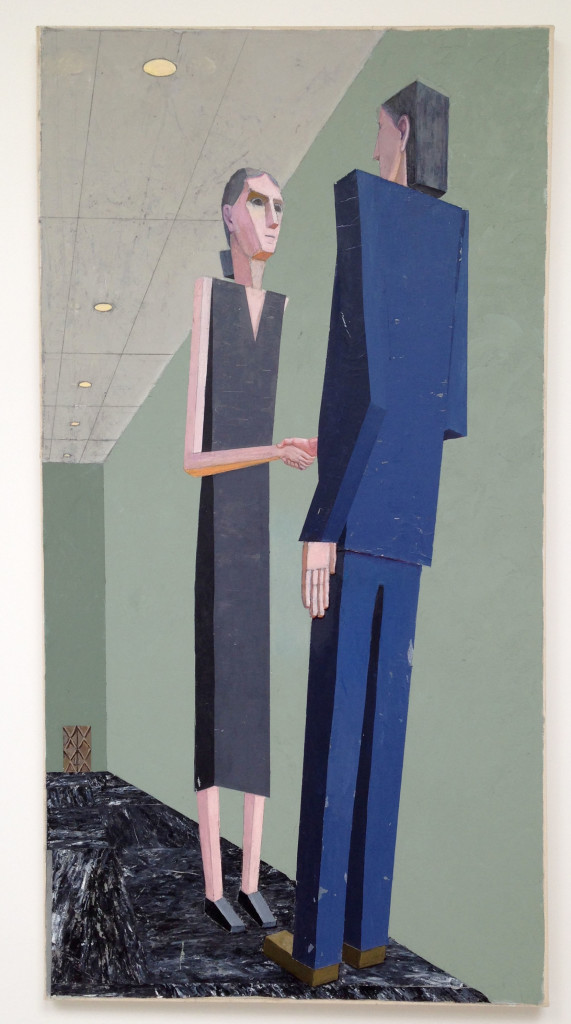
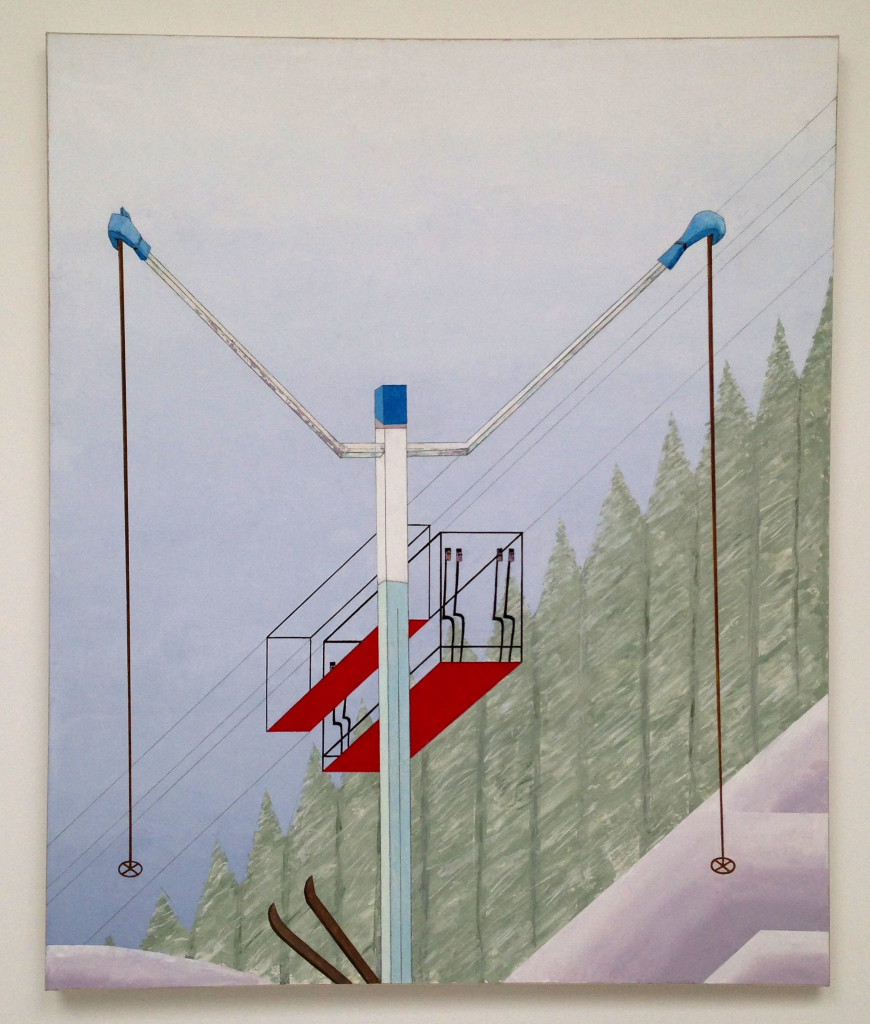
There is something pleasingly disorienting about Mernet Larsen’s paintings, currently at Various Small Fires (VSF) Gallery until 4/18. The once familiar objects take on new shapes and forms through her unique perspective.
This is the first show in Los Angeles for the artist who, though painting since the 1960′s, primarily showed in her home state of Florida, where she also taught painting at the University of South Florida.

The three person show currently at Merry Karnowsky Gallery, includes the artist collaboration of Devin Liston and Gosha Levochkin known as devNgosha (seen above), Glenn Barr, and William Wray. Barr’s collection of paintings of women on the phone have a dreamy film still quality, while Wray’s portraits of down and out superheroes will seem familiar to anyone who has seen the Hollywood Boulevard characters when they drift away from the strip. DevNgosha’s brightly colored creations address the concept of drought and thirst in the California landscape.
See it before it closes on 4/11/15.


For Los Angeles based artist Christine Frerichs’ show at Klowden Mann she has painted in two sizes, large and small. There is an incredible energy to the large paintings, with their waves of motion moving over dense layers of colorful paint. In her smaller paintings there is a more concentrated imagery, often seeming like paintings of the memories of photographs.
From the press release:
The show is Frerichs’ second with the gallery, and continues her focus on memory, relationships and the construction of personal identity, as expressed through abstract painting. The exhibition centers around a series of paired canvases layered with thick oil paint, acrylic and wax, using subtle, bold, light and dark colors, and curving textured lines which ripple across each of their surfaces. These formal qualities describe an abstracted representation of two figures, and the visceral experience of different landscapes as they relate to the physical and emotional self.
This show closes 4/11.
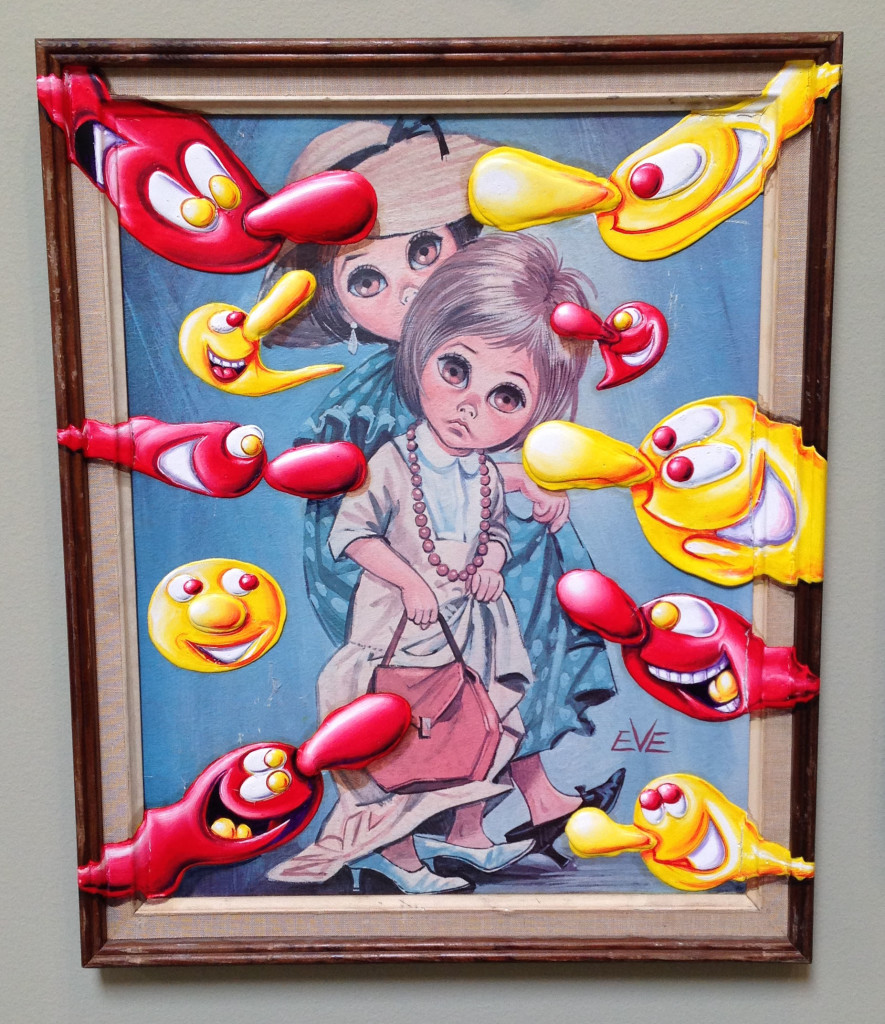
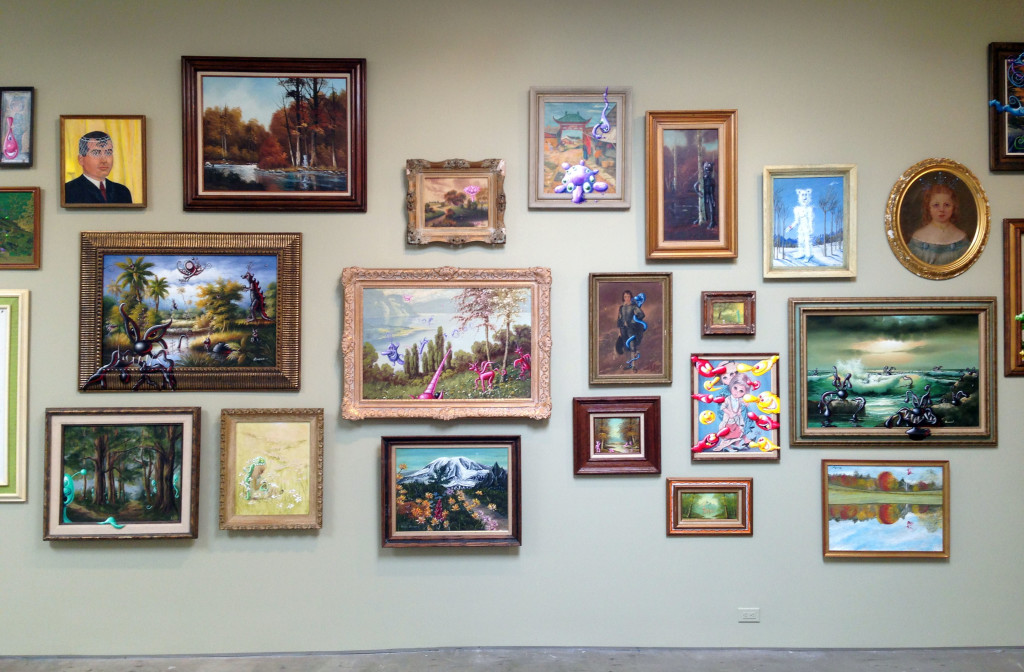
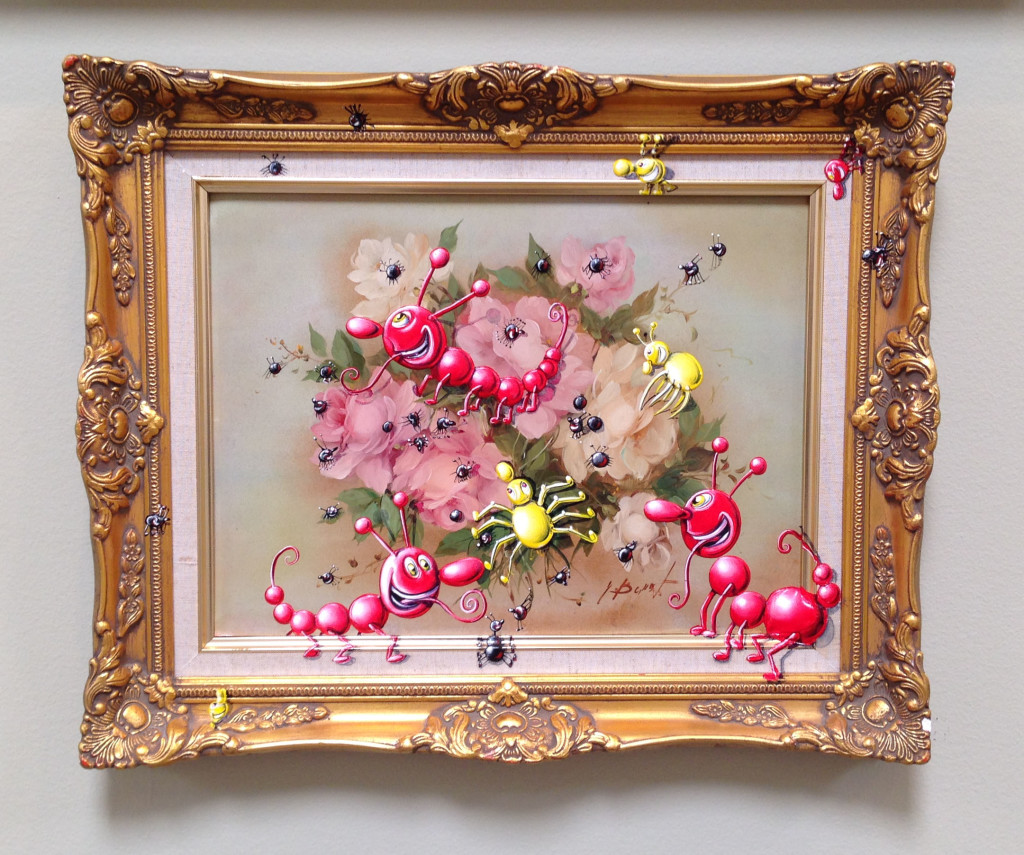
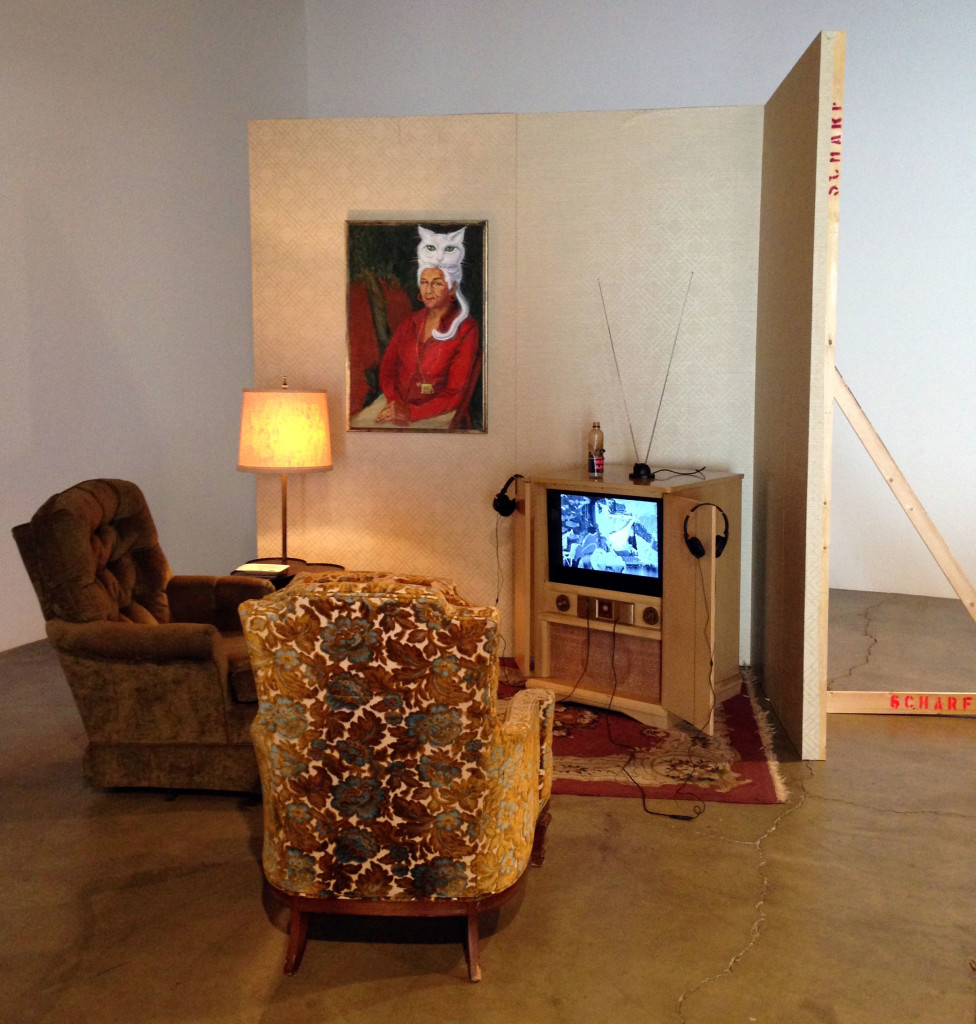
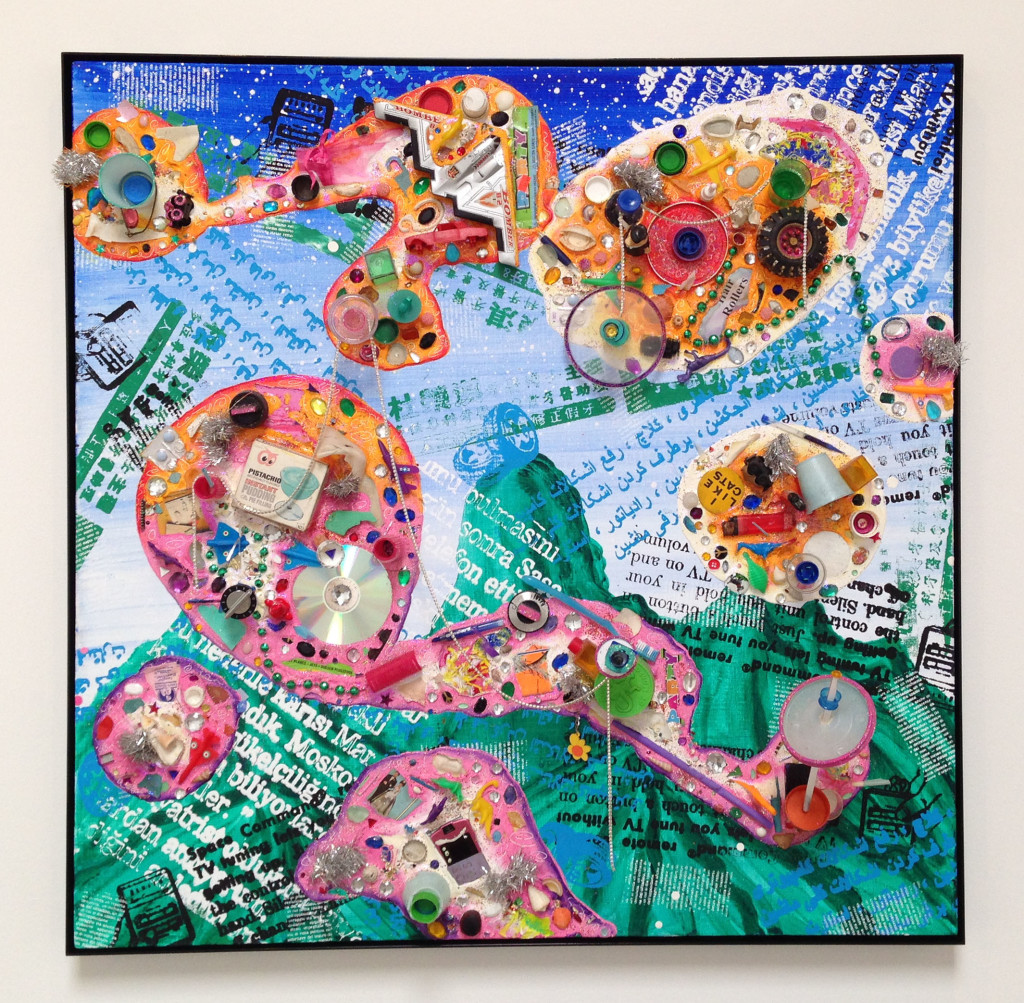
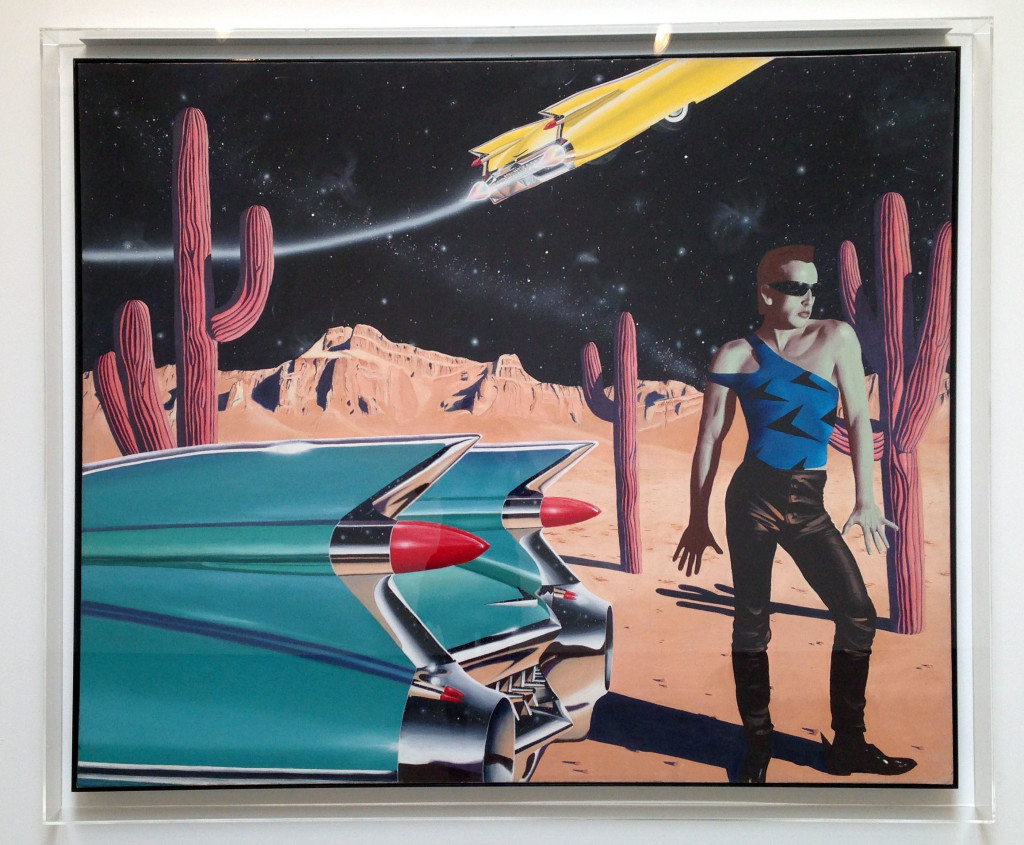
Kenny Scharf’s current show at Honor Fraser is a fun mix of collage, painting, and video, with many of the works making their debut.
From the press release:
Though Scharf is best known for his exuberant iconography, his work also contains underlying themes that reflect his ongoing commitment to social and environmental concerns. For Scharf, the embrace of fun is an act of defiance, his considered use of unconventional materials, bright color palette, and playful shapes a protest against restrictive cultural conditions. In his latest body of work, the Born Again paintings, Scharf encapsulates this notion of transforming the mundane by inserting his familiar characters and motifs into found amateur paintings. Akin to his earlier customizations of mass-produced objects like phones, washers, and televisions, here it is the discarded artwork that is repurposed.
His famous characters also make an appearance all around Davis Bros Tires on Washington and La Cienega nearby.
Today (3/23) is the last day to see Variations: Conversations in and Around Abstract Painting at LACMA.
From the press release:
In an attention-compromised age when images are instant and prevalent, abstract painting serves as a contradiction, acting as a conduit for the mark of the original, individual artist. While most of the work in the exhibition has been recently created and acquired, additional paintings culled from LACMA’s collection illustrate how artists have reanimated techniques and forms using other sources that are appropriated from popular culture, photography, and collage, essentially creating a new variation of abstract painting.
It’s also a good day to visit LACMA because they are having a full day of activities and performances to celebrate Nowruz, the Iranian New Year and the first day of spring.


From a distance the paintings in Nicolas Grenier’s One Day Mismatched Anthems Will Be Shouted in Tune, his exhibition at Luis de Jesus gallery, look like patterns and gradients. On closer inspection though, words materialize to comment on the societal structures currently controlling us.
In the first image above, Middle Ground II, anger in the darker colors moves to the “whatever” placed in gray. The center text reads “toward a bipartisan middle ground”. In the second, One Day Mismatched Anthems Will Be Shouted in Tune, the top text line fading in the pinkish gray reads “mass of folks that are left out and slowly sink to the bottom”, and further lines describe increasing ways that “folks” deal with their lot in life until the bright yellow center which reads “few folks that actually make things what they are”.
From the press release-
For Grenier, color functions as a kind of ecosystem to house the social, political, and cultural systems that serve as points of departure within the work. Gradation is used as a scalable, mutable device for organizing the paintings into large, concentric forms, as well as the interface through which we experience smaller letterforms and vectors. Thus, color plays a double agent: working to both solidify meaning (produce readability) and obscure signs as they become recognizable.
Grenier will be speaking at the gallery Saturday, December 13th at 3pm. This show closes December 20th.
(top image via Luis de Jesus gallery)


Kehinde Wiley The World Stage: Haiti at Roberts & Tilton
Today (10/25) is the last day to see Kehinde Wiley‘s The World Stage:Haiti, the latest in his series of global portraits. For this exhibition he altered his usual process for finding subjects.
From the press release:
…Kehinde Wiley found beauty in Haiti bringing it to the forefront by creating his own beauty pageants, in the long tradition of pageant culture native to the region. In previous World Stage iterations, Wiley conducted his castings on the streets. With The World Stage:Haiti, he employed a different approach specific to the culture: open calls on the radio, posters around the streets of Jacmel, Jalouise and Port-au-Prince culminating in beauty pageants. Across the Caribbean, pageants serve as mass entertainment events, allowing locals to do more than exhibit poise, talent and physical beauty; pageants are a manifestation of collective cultural values. Wiley’s pageant winners were chosen randomly rather than through a judging process. By showing the pageant contestants paintings of European masters on which the new works would be based, Wiley deepened the connection between both place and era.
For a really fascinating look at his previous work and process, I recommend watching the recent PBS documentary Kehinde Wiley: An Economy of Grace, available on their website (free).