Portuguese artist Alexandre Farto, aka Vhils, created this mural of TJ Mizell (Jam Master Jay‘s son) in 2018.
It is one of many street art projects organized by LISA Project NYC.

Portuguese artist Alexandre Farto, aka Vhils, created this mural of TJ Mizell (Jam Master Jay‘s son) in 2018.
It is one of many street art projects organized by LISA Project NYC.


This mural was created in 2019 by Tomokazu “Matzu” Matsuyama as a commission for The Houston Bowery Wall in NYC.
Matsuyama recently completed the painting Morning Sun Dance, inspired by Edward Hopper’s 1952 painting, Morning Sun. An exhibition of his paintings and works on paper centered around this new work opens at Edward Hopper House Museum in Nyack, New York, on Friday, 6/20/25.
From the museum about the exhibition-
The exhibition centers around Matsu’s new large-scale painting Morning Sun Dance. Of the work that inspired his painting, Matsu says, “While Hopper’s Morning Sun captures a moment of introspective stillness within the psychological landscape of mid-century urban life, his treatment of solitude, light, and constructed space continues to influence my own approach to thinking about isolation as well as my approach to painting.”
In Morning Sun, Hopper depicts a woman sitting on her bed in the sun, alone in an empty room, wearing a plain orange dress and a simple, contemplative expression. In Morning Sun Dance, Matsu paints a solitary woman with a similarly meditative demeanor. However, her environment is far more richly layered: the room is filled with personal artifacts—dogs, magazines, and a luxurious couch—reflecting contemporary material life. Notably, the presence of dogs, while suggesting companionship, also references historical depictions such as Toutou, le bien aimé by Rosa Bonheur (1885) and A Nurse and a Child in an Elegant Foyer by Jacob Ochtervelt (1663), in which dogs symbolized wealth and ownership. In Matsu’s work, these animals subtly underscore solitude rather than alleviate it—suggesting not connection, but the heightened self-awareness of being alone.
Her clothing fuses Western and Japanese motifs—a William Morris textile layered with traditional patterns—while a Sports Illustrated poster of Muhammad Ali nods to her alignment with diversity, strength, and modern identity. In contrast to Hopper’s figure, who gazes outward toward the cityscape, Matsu’s subject turns inward, facing her domestic space. This shift in gaze implies a broader narrative: solitude, once externalized and meditative, is now negotiated through personal space and cultural consumption.
The exhibition will also feature Matsu’s process drawings, which reveal how the artist engaged with Hopper’s use of light, figuration, and abstraction. Two additional smaller paintings by Matsu also reinterpret Hopper’s iconic figure in the orange dress—one from Hopper’s original perspective, and the other from an external vantage point, as if observing the figure from the outside.
“This exhibition offers a fascinating dialogue between two artists from different eras, both grappling with the complexities of modern life and the experience of solitude,” says Kathleen Motes Bennewitz, Executive Director of the Edward Hopper House Museum. “Matsu’s vibrant and layered response to Hopper’s work invites us to reconsider themes of isolation and introspection through a contemporary lens, highlighting the enduring relevance of Hopper’s vision while embracing new perspectives.”

This artwork, painted on a door in the East Village, was created by Australian American painter Charlie Hudson.
You can also find his work on Instagram.


Mark Rothko’s painting No.3/No.13, 1949, is currently on view at the Museum of Modern Art in NYC. The image above is a copy of it, painted on a garage door in Brooklyn.
From the museum about the work-
No. 3/No. 13 is an early example of a compositional structure that Rothko would continue to explore for more than two decades. Narrowly separated blocks of color hover against a colored ground. Their edges are soft and irregular, so that when Rothko used closely related tones the blocks sometimes seem barely to emerge from the ground. The green bar in No. 3/No. 13, on the other hand, appears to vibrate against the orange around it, creating an optical flicker. In fact, the canvas is full of gentle movement, as blocks emerge and recede and surfaces seem to breathe. Just as the edges tend to fade and blur, the colors are never completely flat, and the faint unevenness in their intensity reveals the artist’s exploration of the technique of scumbling: by planting bold colors on top of a haze of translucent layers of paint, he created ambiguity, a shifting between solidity and impalpable depth.
The sense of boundlessness in Rothko’s paintings has been related to the aesthetics of the sublime, an implicit or explicit concern of a number of his fellow painters in the New York School. The remarkable color in his paintings was for him only a means to a larger end: “I’m interested only in expressing basic human emotions—tragedy, ecstasy, doom,” he said. “If you…are moved only by…color relationships, then you miss the point.”
His page on Wikipedia quotes his “recipe for a work of art- its ingredients- how to make it- the formula” from a lecture he gave at Pratt Institute in 1958-
“I measure these ingredients very carefully when I paint a picture. It is always the form that follows these elements and the picture results from the proportions of these elements.”

This mural was created by German artist Case Maclaim for 2016’s Top to Bottom mural project- a group of murals covering a building in Long Island City organized by Arts Org NYC.


This mural is by NYC artist Chris Stain and was spotted in Bushwick, Brooklyn in 2020. It is part of Bushwick Collective’s ongoing street art project.
For Chris Stain’s most recent work, check out his Instagram.
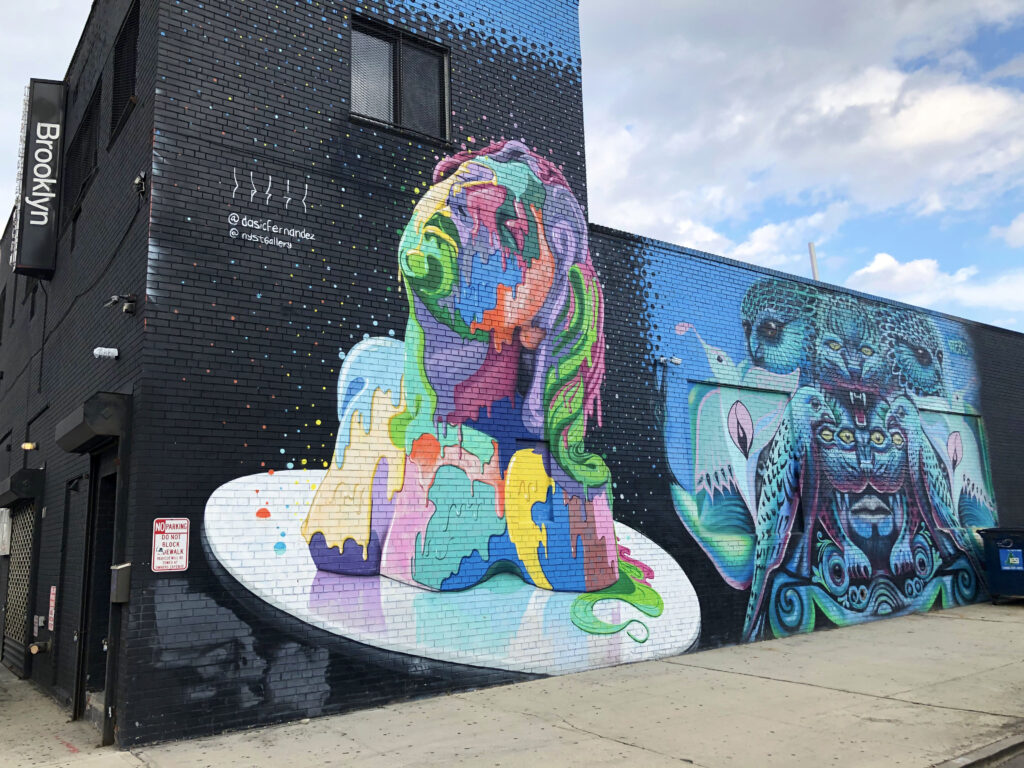
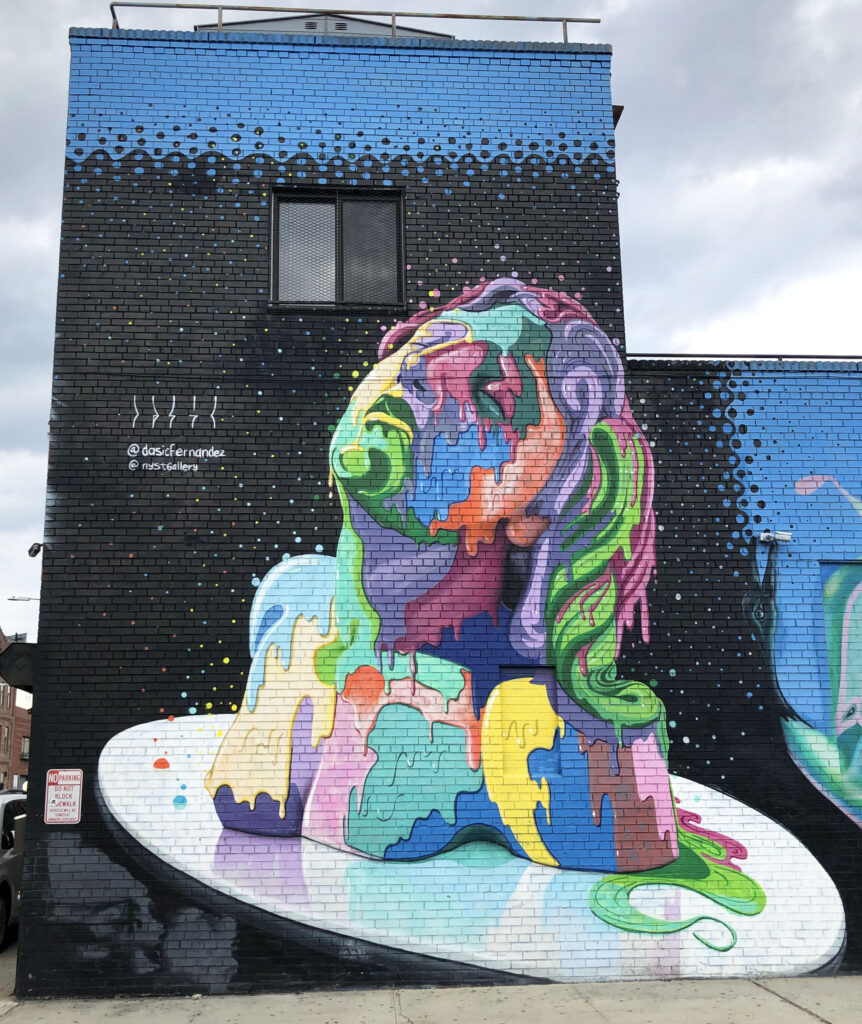
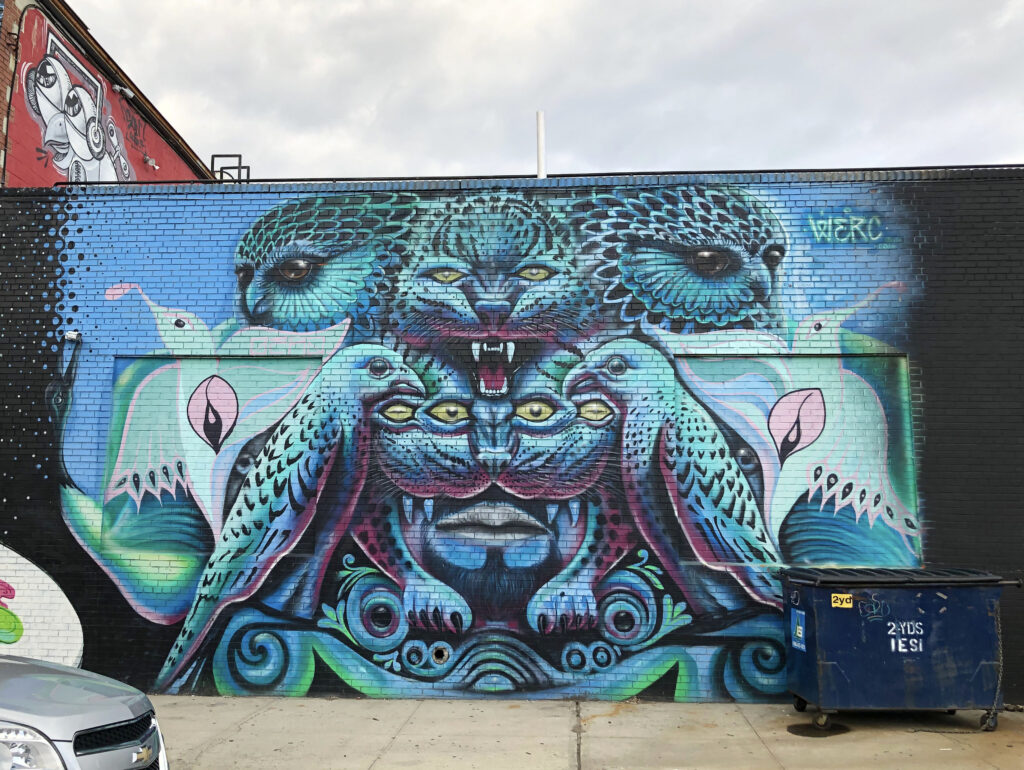
These two murals, created by artists Dasic Fernandez (left) and Werc Alvarez (right), are located in the Gowanus neighborhood in Brooklyn, New York.