Nov 272025
 

Lily van der Stokker created Thank You Darling in 2023 for the High Line in NYC.

From the High Line website about the work-

Lily van der Stokker is one of the Netherlands’ most celebrated contemporary artists. In 1983 she moved to New York, opening a small artist-run gallery space in the East Village and has since lived alternately in both New York City and Amsterdam.

For over 30 years, van der Stokker’s drawings and monumental wall paintings have subverted artistic convention and aesthetic expectations, employing an Easter candy color palette to depict clouds, flowers, swirls, and other traditionally feminine or decorative motifs. Van der Stokker annotates these compositions with handwritten text—spelling out intimate thoughts, personal musings, notes-to-self and social niceties. Her visual language is nostalgic and comforting; her playful squiggly patterns are more likely at home in the margins of a student’s notebook as they mindlessly doodle or test out their first name with the surname of a crush than they are within the white walls of a gallery. In fact, van der Stokker’s practice is in some ways defined by this incongruity. She notes, “if I make an artwork about family problems, administrative tasks, or the common flu…I’m bringing in a whole spectrum of new subject matter that is normally absent in art.” By placing on a pedestal what has traditionally been viewed as feminine or domestic, and thus superfluous and inconsequential within the realm of “serious” visual art, van der Stokker reclaims what has long been disregarded and overlooked.

In a 1990 New York Times review of van der Stokker’s debut exhibition, critic Roberta Smith remarked, “the messages conveyed in this terminally cheerful manner usually have a double edge.” Van der Stokker’s work, which she has referred to as “feminist conceptual pop art,” is undeniably joyful and positive, however, it often simultaneously speaks to weighty themes—aging, health, and, more generally, the lived experience of being a woman within patriarchal structures. Hidden in plain sight, disguised by the veneer of her compositions’ cute and charming appearances, is reality. Occasionally mundane, sometimes cheery, and at other moments, cynical or intimate—“a baby, another baby…all my no baby friends live in N.Y.,” a past mural reads. One divulges, “whoopy doo…I am…really ugly…sorry,” in cartoonish thought bubbles. “My mother will loan me €80,000 to help me buy the house,” another reveals. Van der Stokker considers the texts to be the primary component of her work, and with each work she lays bare a vulnerable inner-world for all to see—if they’re willing to look beyond the candy-coated facade.

On the High Line, van der Stokker presents Thank You Darling, a monumental, site-specific mural. Thank You Darling is painted on the side of a building, turning the architecture and shape of the edifice into the frame for the artist’s pastel and fluorescent-hued work. The light blue background is dotted with multi-colored, simple flowers in a decorative all-over pattern that appear to float across the facade—some just coming into view from the edges of the frame. Superimposed over this, read the words “THANK YOU DARLiNG,” spelled out in a juvenile, arbitrary blend of lower and upper-case lettering. Van der Stokker’s puffy bubble-letters are a classic example of playful adolescent penmanship, seemingly lifted right out of a teenager’s diary. In this location on 22nd street, Thank You Darling actively engages with its audience, expressing gratitude to all those who pass, while reclaiming, at massive scale, intimate language that is often mocked or disparaged as being feminine and unserious.

Oct 072025
 

William Wegman‘s portraits of his Weimaraner dogs were recreated in glass mosaic form by Mayer of Munich in 2018 for “Stationary Figures”, lcated in the 23rd Street subway station. The eleven murals brighten up the walls and are one of the many projects created by MTA Arts & Design.

From MTA Arts & Design about the work-

Photographed with the artist’s deadpan sense of humor, the dogs take on human attributes, from wearing street clothes like a shiny raincoat or flannel shirt, to being grouped like passengers as they gaze into space or peer down the platform as if waiting for the train.

Situated in bold blocks of color, the larger-than-life mosaic dogs are bursting into space and interacting with commuters. The mosaic fabricator, Mayer of Munich, interpreted the photographs taken for this project by meticulously transforming the facial expressions, skin textures and patterns of the dogs’ vibrant attire into glass mosaic. Wegman has lived and worked in the neighborhood for decades, and together with his dogs Flo and her brother Topper, they have created images that enliven this busy station.

Speaking about the project, Wegman said, “I wanted to create portraits of individual characters, people who you might see next to you on the platform. For these I dressed the dogs in more or less ordinary clothes, nothing too fashionable. I was very interested in the way in which photographs, even the out of focus dogs in the background of some images, could be translated into mosaic by Mayer of Munich, who skillfully turned gray stones into gray dogs.”

Below are the two series consisting of three panels each-


May 092025
 

The Creation of the Creatures of Day and Night by Rosana Paulino was recently commissioned by the High Line in New York and is on view until December 2025.

From the High Line’s website about the artist and the work-

Rosana Paulino’s practice spans drawing, painting, suture, printmaking, collage, sculpture, and installation. Her work foregrounds social, ethnic, and gender issues, taking particular care to explore the lasting legacy of slavery and the history of both racial and gender-based violence in Brazil. The artist weaves personal, scientific, and historical archives throughout her work, using these materials to demonstrate and then deconstruct violent colonial structures, particularly as they relate to Afro-Brazilian women. Taking into account the impact these archives and memories have on collective values and belief systems, Paulino examines the construction of myths—not only as an aesthetic pillar but also as a key influence on cultural consciousness.

The Creation of the Creatures of Day and Night is a continuation of the artist’s mangrove series, which depicts tree-women as a mythological archetype and symbol for the Brazilian biome. Paulino notes that mangroves, like the country’s Black and Indigenous people, have been mistreated and exploited. The artist highlights the symbolic meaning inherent in this ecosystem: It is where life begins, as a home for countless species and as a blue carbon reservoir, and where life ends, due to the decomposition of the mangrove itself. In The Creation of the Creatures of Day and Night, Paulino re-imagines this duality between life and death as day and night. From left to right, the color of the sky fades from daylight to a deeper, midnight hue. In lieu of gilded halos traditionally seen in European representations of holy figures, the tree-women’s heads are framed by halos resembling the sun and the moon. Similarly, the animals surrounding the goddesses also reference the transition from day to night. On the left side of the composition, Paulino depicts two diurnal birds native to the mangrove biome: the white egret and, in the tree-woman’s hands, the scarlet ibis. To her right, the other goddess holds an owl and is flanked by two bats, both of which are nocturnal. Together, these elements present a rich, new mythological framework for the mangrove, offering a departure from depictions shaped by colonization and exploitation.

Aug 232024
 

This mural was created by German artist Case Maclaim for 2016’s Top to Bottom mural project- a group of murals covering a building in Long Island City organized by Arts Org NYC.

Mar 012024
 

This mural is by NYC artist Chris Stain and was spotted in Bushwick, Brooklyn in 2020. It is part of Bushwick Collective’s ongoing street art project.

For Chris Stain’s most recent work, check out his Instagram.

Feb 062024
 

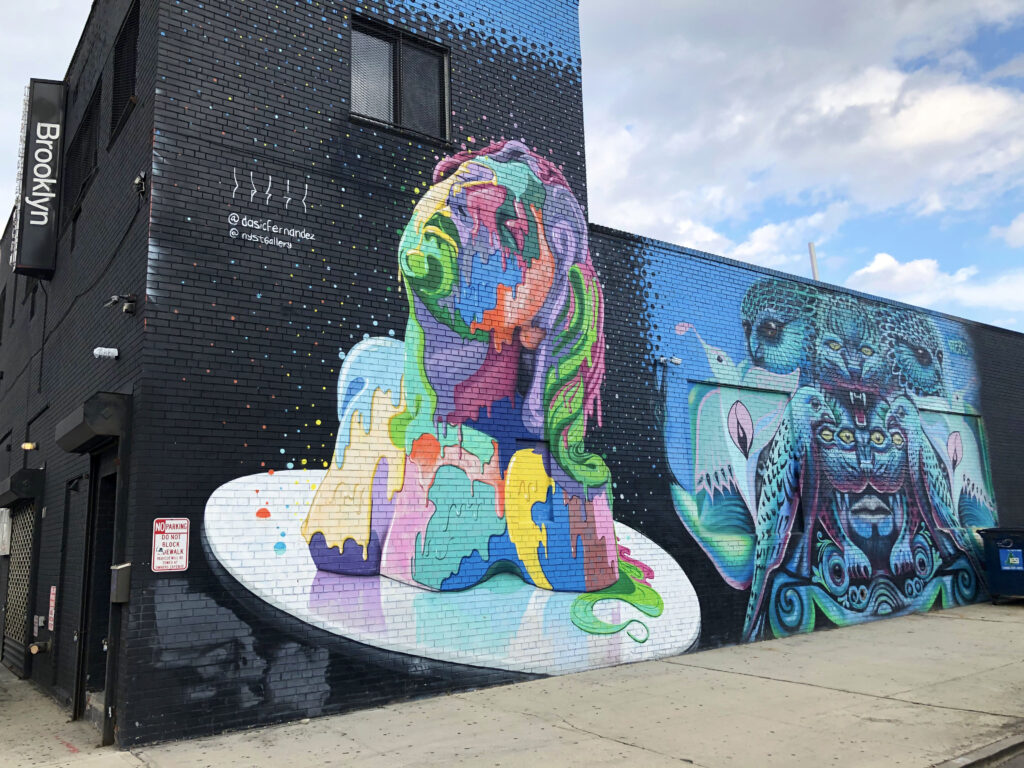
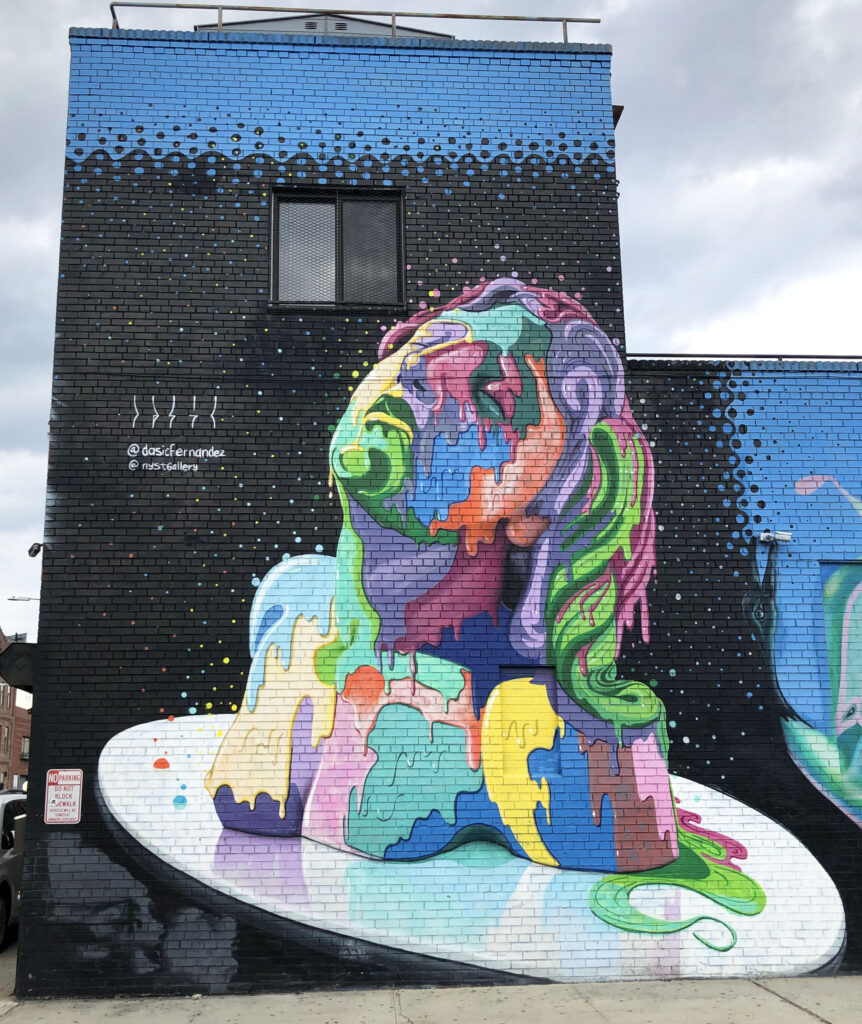
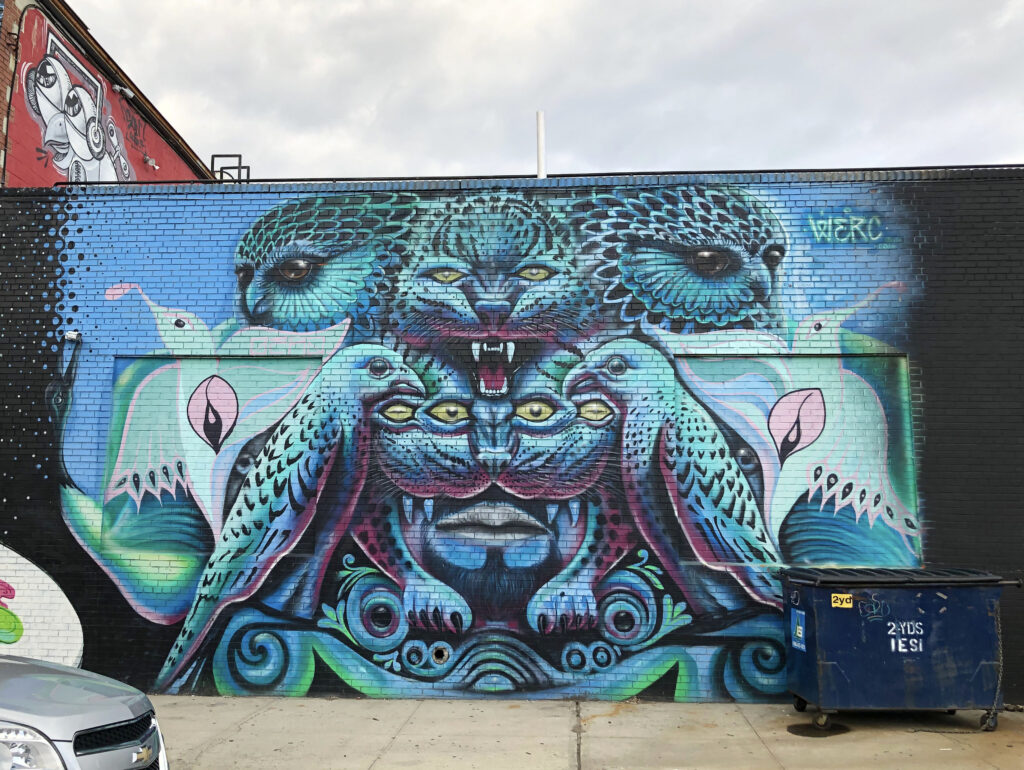
These two murals, created by artists Dasic Fernandez (left) and Werc Alvarez (right), are located in the Gowanus neighborhood in Brooklyn, New York.

Sep 222023
 

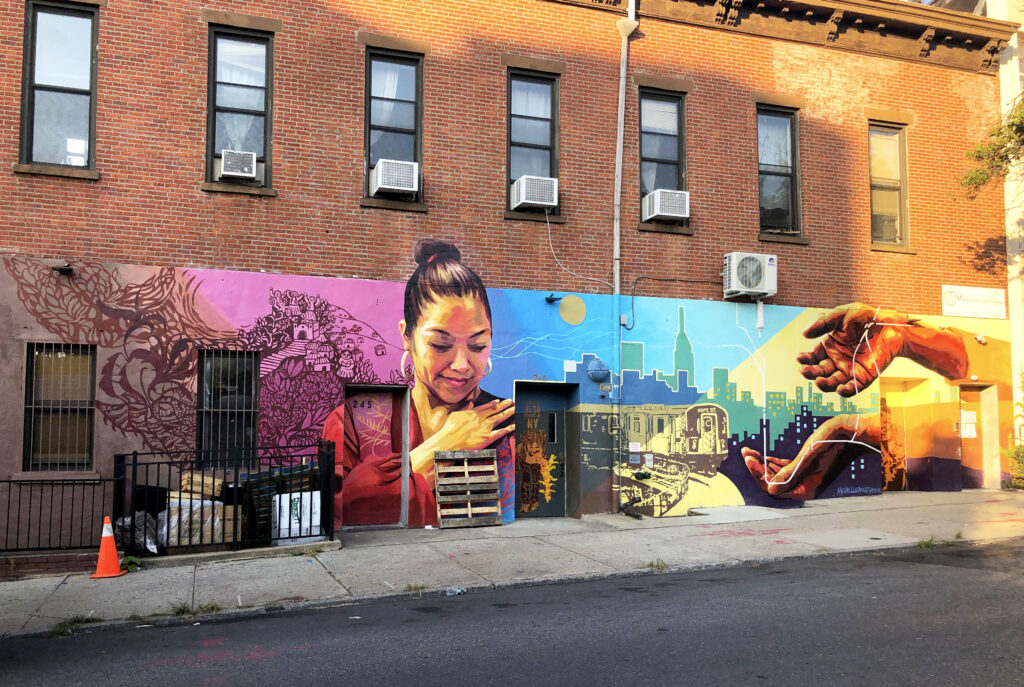
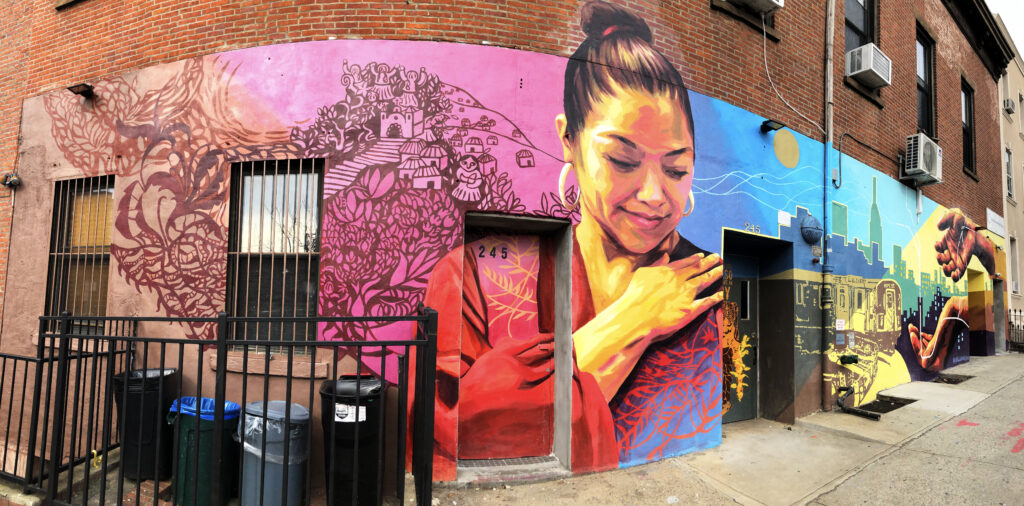
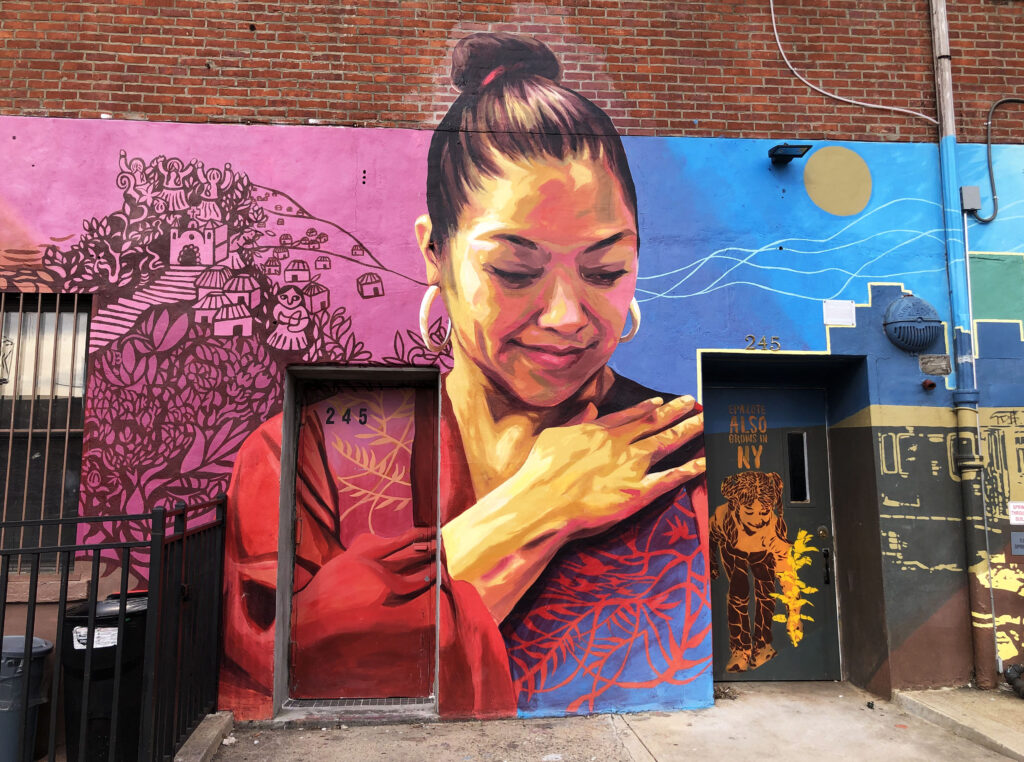
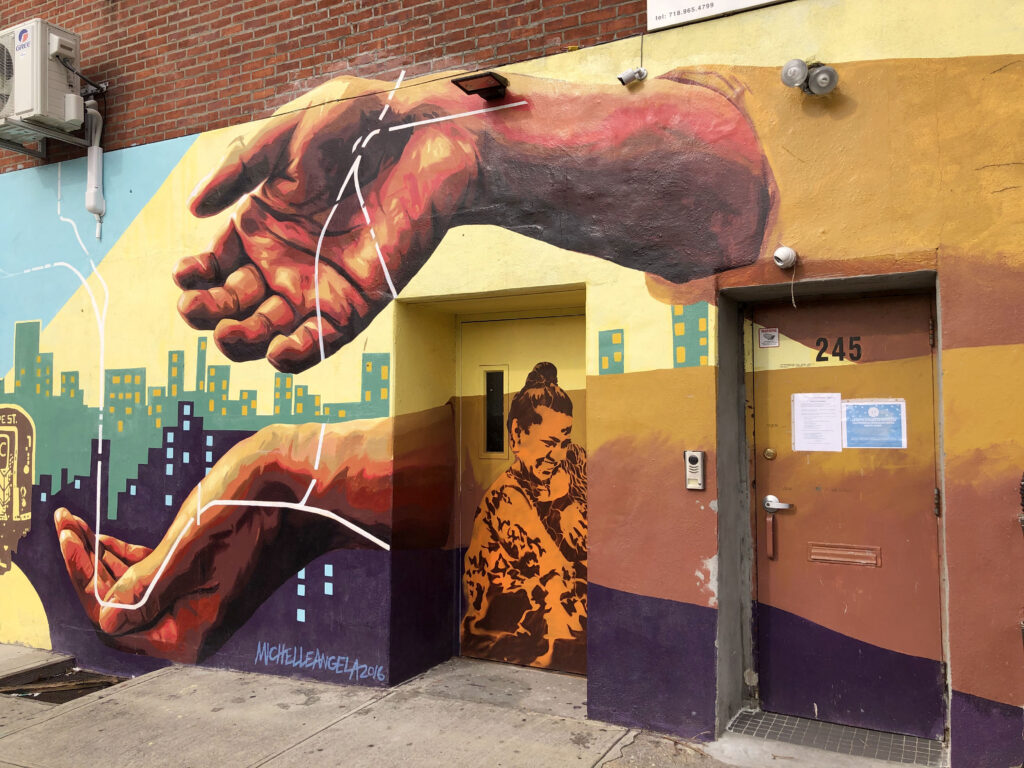
Nuestro Andar Florece by artist, muralist, arts educator and filmmaker Michelle Angela Ortiz, is located on the wall of Mixteca Organization in Brooklyn, NY. Mixteca is a community-based organization established by “a group of concerned community members to address critical needs in health, education, social and legal issues facing the burgeoning Mexican and Latin American immigrant community in Brooklyn”.

About the mural from the artist’s website-

Nuestro Andar Florece (Our Journey Blooms), celebrates the stories of Mexican immigrant women that have planted their roots in Brooklyn, New York. As part of the Barrio Roots Festival that took place in late October 2016, I led this mural project along with artist Federico Zuvire. The project was supported by Habitajes. They offered a series of creative workshops at Mixteca Organization with women that shared their immigration stories. The women are mothers, students, educators, and some survivors of domestic violence that found a new home in New York. The women decided on the messages that are conveyed in the mural. For three weeks, the artists, workshop participants, local Brooklyn artists, and neighbors participated in the creation of the mural.


Aug 012023
 

Sun and Moon, created by Jia Sung, is one of the artists chosen by The Collision Project, whose work can be seen in Industry City, Brooklyn.

About the mural-

The mural depicts two goddesses from Chinese mythology, flanking the courtyard door. The lunar deity Chang’E floats on the left with her companion rabbit, while solar goddess Xihe sits on the right with her ten sun-crow children. The paired murals reimagine protective door guardian imagery through the lens of the divine feminine.