William Wegman‘s portraits of his Weimaraner dogs were recreated in glass mosaic form by Mayer of Munich in 2018 for “Stationary Figures”, lcated in the 23rd Street subway station. The eleven murals brighten up the walls and are one of the many projects created by MTA Arts & Design.
Photographed with the artist’s deadpan sense of humor, the dogs take on human attributes, from wearing street clothes like a shiny raincoat or flannel shirt, to being grouped like passengers as they gaze into space or peer down the platform as if waiting for the train.
Situated in bold blocks of color, the larger-than-life mosaic dogs are bursting into space and interacting with commuters. The mosaic fabricator, Mayer of Munich, interpreted the photographs taken for this project by meticulously transforming the facial expressions, skin textures and patterns of the dogs’ vibrant attire into glass mosaic. Wegman has lived and worked in the neighborhood for decades, and together with his dogs Flo and her brother Topper, they have created images that enliven this busy station.
Speaking about the project, Wegman said, “I wanted to create portraits of individual characters, people who you might see next to you on the platform. For these I dressed the dogs in more or less ordinary clothes, nothing too fashionable. I was very interested in the way in which photographs, even the out of focus dogs in the background of some images, could be translated into mosaic by Mayer of Munich, who skillfully turned gray stones into gray dogs.”
Below are the two series consisting of three panels each-
For Camille Henrot’s imaginative installation for A Number of Things at Hauser & Wirth, a variety of sculptures, including several from her Abacus series, are surrounded by paintings from her Dos and Don’ts series. There’s a playfulness to both, but something a bit darker too. Walking on the soft floor among the sculptures there is a feeling of childlike wonder, while at the same time, in combination with the paintings, you are reminded of the rules and restrictions that are imposed on us, starting when we are very young, and how they become more oppressive with age.
From the gallery’s press release-
Evoking children’s developmental tools, shoes, distorted graphs and counting devices, new large-scale bronze sculptures from the artist’s ‘Abacus’ series (2024)—presented alongside recent smaller-scaled works—address the friction between a nascent sense of imagination and society’s systems of signs. The exhibition will also feature vibrant new paintings from Henrot’s ongoing ‘Dos and Don’ts’ series.
Initiated in 2021, the ‘Dos and Don’ts’ series combines printing, painting and collage techniques where etiquette books become the palimpsest for play with color, gesture, texture and trompe l’oeil. The artworks will emerge from a flooring intervention—conceived and designed with Charlap Hyman & Herrero—that transforms the gallery into a site of sensory experimentation. Henrot’s exhibition vivaciously sets the stage for the arbitrary nature of human behavior to circulate freely between rule and exception.
As viewers enter the gallery, they will be greeted by a pack of dog sculptures tied to a pole, as if left unattended by their walker. Shaped from steel wool, aluminum sheets, carved wood, wax, chain and other unexpected materials, Henrot’s creatures speak to the ever-unfolding effects of human design and domestication. As an extension of Henrot’s ongoing interest in relationships of dependency, the dogs stand in as the ultimate image of attachment.
Henrot’s latest ‘Abacus’ sculptures unite the utilitarianism of the ancient calculating tool with the arches and spirals of a children’s bead maze—a toy popularized in the 1980s as a heuristic diversion in pediatric waiting rooms and nursery schools. Through these formal associations, an instinctive sense of play collides with the learned impulse to search out patterns and impose order. With their biomorphic contours, opaline patinas and quadruped or biped anatomies, these works seem charged with a lifeforce of their own. Hovering between pure abstraction and their multivalent referents, Henrot’s bronzes invite our unfettered, sensuous engagement, even as they allude to the symbolic systems that tyrannize our imaginations.
Behavioral conditioning is a central concern of Henrot’s ‘Dos and Don’ts’ series. These richly layered paintings consider the idea of ‘etiquette’ as it relates to society at large: its codes of conduct, laws and notions of authority, civility and conformity. The works feature collaged fragments of invoices from an embryology lab; a note conjugating the German verb ‘to be;’ dental X-rays; digital error messages; children’s school homework; and to-do lists, among other things. Together, they build on Henrot’s interest in making sense of the urge to organize and categorize information—a theme that has been prevalent in her practice since her groundbreaking film ‘Grosse Fatigue’ (2013). The ‘Dos and Don’ts’ series distorts its source material to reveal the constructed, performative nature of any social identity, while acknowledging the emotional security that behavioral mimicry and groupthink can provide.
As the exhibition’s almost childlike title suggests, ‘A Number of Things’ brings together a disparate but related group of works that collectively address the enormously difficult task that is living, learning and growing in society. With tenderness for the most banal traces of our existences, Henrot offers a meditation on the competing impulses to both integrate and resist the unquestioned structures of society in our everyday lives.
‘There’s a reason why, in English, the word ‘politics,’ ‘polite’ and ‘police’ all sound the same—they are all derived from the Greek word polis or city, the Latin equivalent is civitas, which also gives us ‘civility,’ ‘civic’ and a certain modern understanding of ‘civilization.’
—David Graeber, ‘The Dawn of Everything’ (2021)
In the video walkthrough with Henrot (below) she discusses many of the inspirations for the work.
Featuring over twenty new oil paintings by Landers, this largely allegorical exhibition illustrates the complexity of artistic mortality using four protagonists: dogs—depicted in single portraits and alone in rowboats unmoored at sea; lighthouses; the ocean; and sperm whale skeletons at rest on ocean shorelines. Each subject represents the dichotomy of freedom and trepidation involved in the act of releasing art to an unknown fate. “…a bit of the artist remains in their paintings, so in that way, a painting is like an artist adrift in time and space,” says Landers in an interview with writer Johanna Fateman for the exhibition catalogue.
A cornerstone of inspiration for Adrift is Landers’ long-term interest in the work of American painter Winslow Homer (b. 1836—d. 1920) and in particular Homer’s ocean paintings. The vast and unpredictable ocean marks time and space, a preeminent symbol used throughout the years in Landers’ paintings and art history. Homer’s style is emulated by Landers in paintings throughout the exhibition including Northeaster, Summer Squall, and Yellow Dog.
Each of these subjects can be seen as a character existing within the vicissitudes of artistic practice. The dogs, at attention and alone in their boats, symbolize the vulnerability of art against an unknown future. These works also parallel Joachim Patinir’s (b. 1483—d. 1524) painting Charon crossing the Styx in which a human soul is being transported by boat into afterlife. Landers sees this as symbolic for what a painting is—a vessel for the artist into afterlife.
Two lighthouses, Portland Lighthouse, US and Sunderland Lighthouse, UK, are both welcoming and warning beacons, allegories for institutions that signal to the public what art is worth preserving. This ruling system will determine the dogs’ fate as they head into the unknown of art history. The bare whale bones, epic in their repose on the sandy shore echo the finality in the lifespan of an artwork. Such relics are epitaphs and beginnings, a sentiment imparted in We Hover, where Landers’ text painted over a fierce ocean reads: And then we hover in between existence and nonexistence in our paintings and that is both terrifying and reassuring. For Landers, Adrift is the everlasting reminder that the artist, like Patinir’s soul, is forever navigating the here and hereafter.
“The ocean represents time and space. The dog adrift in the boat is like an artwork adrift in time and space after the artist passes. The lighthouse is the institution that decides which art civilization will preserve. The whale skeleton is the fear of a life’s work gone unloved and allowed to die.”
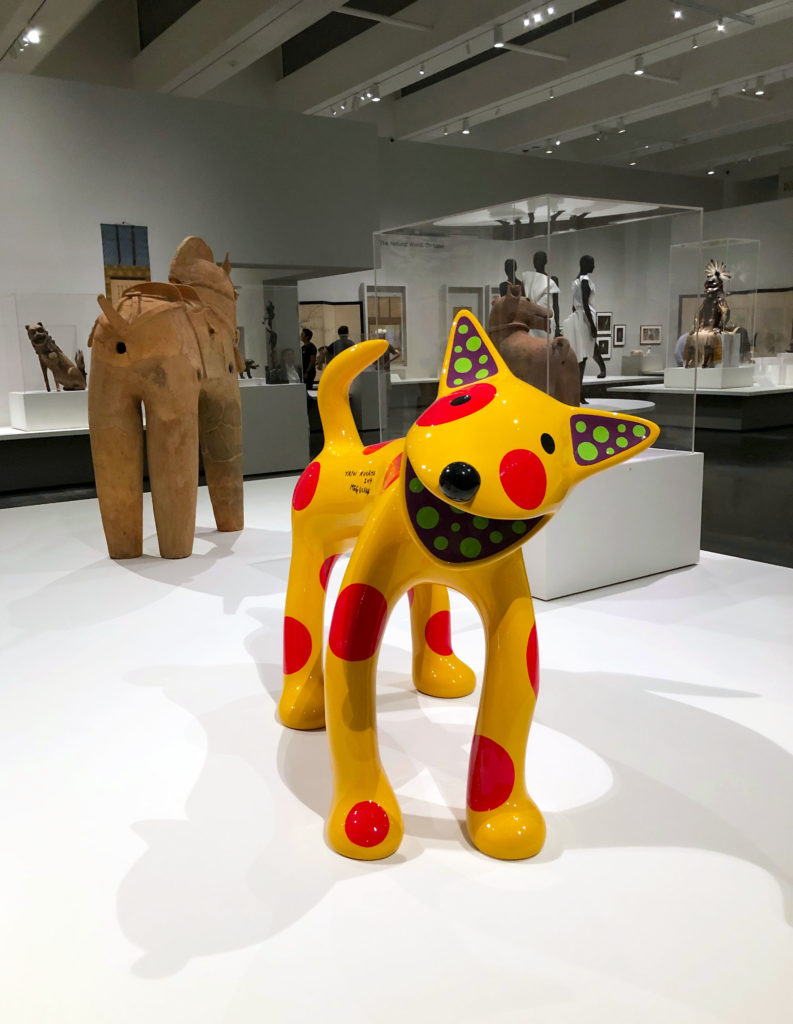
Closing 12/8/19 at LACMA is Every Living Thing: Animals in Japanese Art. It’s a really fun of exhibition with a good selection of art from different time periods, including Yayoi Kusama’s dog sculptures from Megu-chan (2014), two of which are pictured above.
From LACMA’s website-
Every Living Thing: Animals in Japanese Art celebrates one of the most distinctive and compelling aspects of Japanese art: the depiction of animals. Underpinned by Japan’s unique spiritual heritage of Shintō and Buddhism, the Japanese reverence for nature—and the place of animals within that realm—is expressed in sculpture, painting, lacquer-work, ceramics, metalwork, cloisonné, and woodblock prints.
Lions, dogs, horses, oxen, cats, fish, insects, birds, dragons, phoenixes—animals warm and cold-blooded, real and imaginary—are meticulously and beautifully rendered in myriad works from ancient 6th-century clay sculpture to contemporary art. Arranged in themes such as Zodiac Animals, Animals from Nature, Religion, Myth and Folklore, and Leisure, the exhibition draws heavily from LACMA’s permanent collection and includes masterpieces from Japanese and American public and private collections, some of which are on view for the first time.
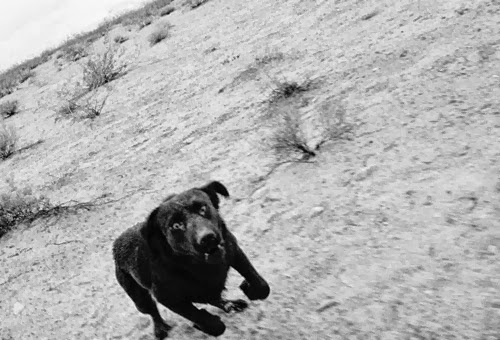
John Divola– from the series- Dogs Chasing My Car in the Desert
At the Santa Barbara Museum of Art, another part of the John Divola show, As Far As I Could Get, currently also at LACMA, is open until 1/12.
The Dogs series was shot from Divola’s car as the dogs in the desert chased him while he was photographing abandoned buildings (these images make up another section of the show). According to Divola (when he spoke at LACMA), despite their menacing appearance in the photos, many of the dogs were friendly and mostly just excited to see someone new.
A separate show of Divola’s work called EchoChamber is at Gallery Luisotti in Bergamot Station until 1/18.