Jun 212024
 

“Along the Army Corps Floodwall in Ardsley in Autumn”, 2023-4, Oil on linen

“Along the Army Corps Floodwall in Ardsley in Autumn” (closer)

“NYSC by the Saw Mill River in Winter”, 2024 Oil on linen

“Setting Sun with Entopitc Phenomena During the Canadian Wildfires in Sean’s Subaru”, 2023-4, Oil on colored linen

“LA Fitness in Ridge Hill by the Sprain Brooke in Summer”, 2023-4, Oil on linen

“LA Fitness in Ridge Hill by the Sprain Brooke in Summer” (closer)

Depicting various locations during different seasons, Dylan Vandenhoeck’s paintings for Right Under the Nose at Jack Barrett Gallery, explore the way selective vision creates and distorts our memories of moments and places.

From the press release by Jonathan Crary-

One of the important features of the Western European modern world that begins to emerge in the decades around the year 1500 is a reorganization of the human senses. Taking place over several hundred years is a relentless prioritization of vision and its isolation from the other senses. What some theorists have called “ocularcentrism” is this privileging of the eye and its alignment with rationalized forms of knowledge that distance a human observer from the physical world and estrange them from the multi-sensory immediacy of perception. Since the Renaissance, the arts have been shaped by practices and techniques that have posed the fiction that our vision is a faithful mirroring of an objective external reality. This model has been a crucial underpinning for the rationalized forms of knowledge and utilitarian, extractive priorities of Western modernity. But there have long been artists whose counter-practices have challenged this dominant framework, including, for instance, Hans Holbein and his Ambassadors, William Blake, J M W Turner, Roberto Matta and Stan Brakhage. 

Dylan Vandenhoeck is part of this lineage for the ways in which his work foregrounds the embodied, or subjective nature of our vision. One of many examples of embodied vision is the fact that our optical impressions are shaped by the actual curvature of our spherical eyeballs. Yet the most pervasive systems of visual representation, such as linear perspective, have “corrected” this phenomenon by imposing rectilinear organizations onto perceptual experience. Another feature of lived vision to which Vandenhoeck is attentive are afterimages, the response of our eyes (as part of our nervous system) to  strong stimulation of various kinds, but notably sunlight. Afterimages are vivid evidence of how our vision is a composite of sensations produced by our body and of the diverse effects of the luminous environment in which we are situated. His paintings present this hybridity as a heterogenous field of divergent events with different temporalities, but which nonetheless coalesce into the dynamic world of immediate experience. Using the terms of Deleuze and Guattari, Vandenhoeck creates a smooth space as opposed to a striated one, that is, non-metric, de-centered and open to metamorphoses. 

Around the Mound, for example, manifests some of these qualities in its disturbance of conventional spatial cues, such as altering our reading of what is near and far. It affirms an aggregate field of vision composed of perceptual fragments that don’t cohere into a unified whole. But notably, while Vandenhoeck has crafted a landscape shaped by these disjunctions, he has also interwoven into the work swirling and pulsating flows that engage the viewer kinesthetically. Part of his project is to challenge the ways in which our attentiveness has been regulated and impoverished by the digital milieus in which we are perpetually immersed. The monotonous omnipresence of electroluminescent color and powerful forms of perceptual control, such as eye tracking, have routinized and diminished our visual capacities.  Vandenhoeck conveys intimations of the sensory and libidinal gratifications of a heightened bodily response to the vibrant plurality of a living world. In this sense, there is at least a limited utopian underpinning to the images in this show. Yet if one dimension of his work poses the possibility of revivifying our perception, he makes clear that this can only occur within the broken actualities of the early twenty-first century. His revelatory images are all grounded in the prosaic periphery of New York City, marked by highways, shopping malls, and cell phone towers. Thus, one of Vandenhoeck’s remarkable achievements is the reclaiming of an expanded, transfigured vision amid the familiar terrain of the everyday. 

This exhibition closes 6/22/24.


Jun 212024
 

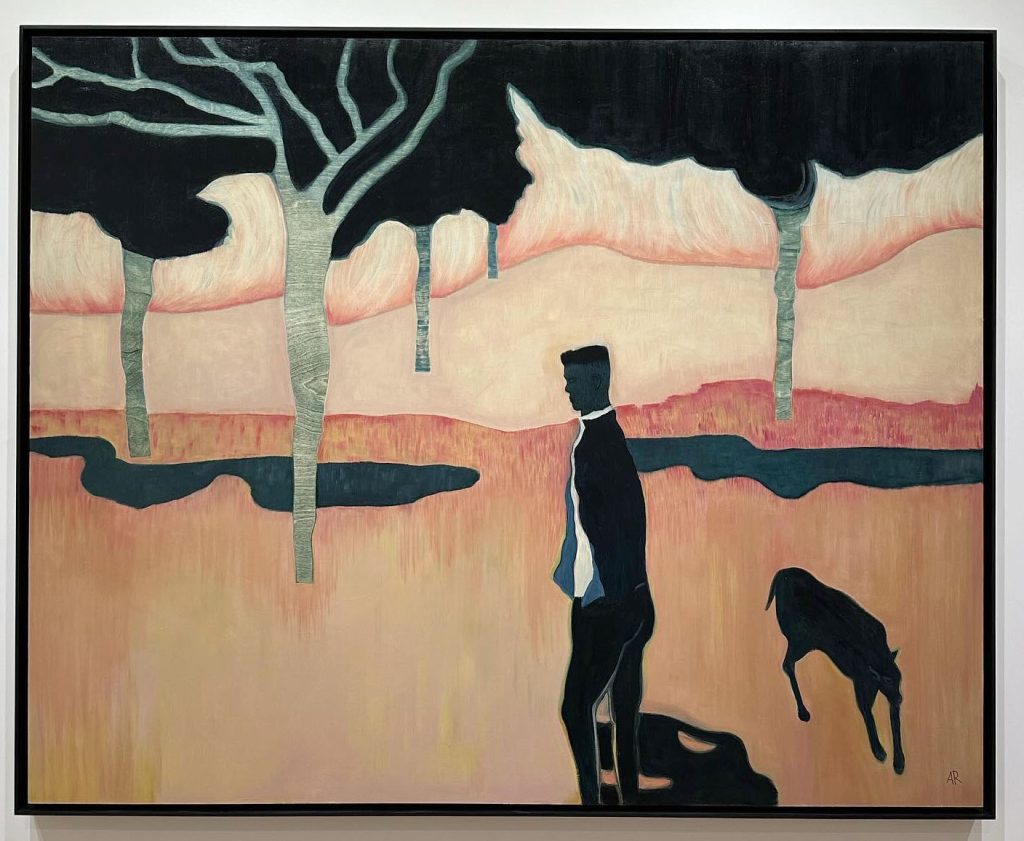
Anne Rothenstein’s beautiful and mysterious paintings are on view at Stephen Friedman Gallery until 6/22/24.

From the gallery’s press release-

Rothenstein’s dreamlike paintings depict expansive landscapes and intimate interiors drawn from memory, personal experiences, and found material from newspapers and magazines. Whether depicting androgynous figures or melancholic landscapes, Rothenstein’s works blur the lines of identity and narrative, inviting observers to immerse themselves in the ambiguity of her creations. Curator and writer Simon Grant aptly describes the experience of viewing Rothenstein’s paintings, “Looking at these paintings can feel as if we have joined a drama that has been unfolding but of which we may have missed the crucial part.”

Rothenstein’s figures are deliberately ambiguous, conjuring introspection and contemplation. While the subdued and pensive demeanor of her characters might convey solitude, they exude a presence that transcends this. In Three Figures (2023), the artist provides a glimpse into the inherent isolation experienced by human beings within a social context. Positioned on the far left, a figure is wearing a reconfigured tuxedo dress, which obscures defined gender and identity. This attire, also observed in Seated Figure and Thinking about Billy Porter (both 2024), serves as a nod to fashion as a form of political expression, drawing inspiration from actor Billy Porter’s ensemble at the 2019 Oscars ceremony. At once, these figures point to new horizons in gender politics while echoing the longstanding tradition of late nineteenth and early twentieth-century portraiture, reminiscent of artists such as Edouard Vuillard and Edvard Munch.

The power behind these works is further evident in the artist’s application of paint, and her distinctive use of color. Throughout the exhibition, burgundy red tones, pale greens, and nostalgic blues emerge and recede to reveal depth and movement. The color palette pays homage to colorists who inspire Rothenstein: Howard Hodgkin, Vilhelm Hammershøi, and Gwen John. In works like Shadow and Heat (both from 2023), the artist rendered two iterations of the same composition. The subtle variations between them evoke the notion of distorted memories resurfacing in our minds. Here, a lone figure and a dog traverse a burning landscape, reflecting concerns about climate change and devastating wildfires. This further evidences how global events influence Rothenstein’s practice: “However much I try to keep the outside world at a distance it always insists on creeping in and often steers the direction the work is taking”.

In her exploration of scale and texture for her New York debut, Rothenstein oscillates between canvas and panel for the first time, introducing a contrast to her signature wood panels. This shift enables the artist to delve deeper into her creative process and further enhance the immersive quality of her work. Through a combination of bold brushstrokes and nuanced color variations, Rothenstein achieves a striking visual harmony, where figures emerge from the surrounding space with a haunting presence. Speaking of Rothenstein’s work, art critic and curator Katy Hessel writes, “When I look at your works, their solitariness comforts me. It’s rare that you see solitude as a happy thing.”

Also on the gallery’s website are the quotes below from Rothenstein that provide additional background on her process-

Speaking of her artistic process, Rothenstein says, “My reasons, or intentions, when making a particular painting are quite mysterious to me. The spark is always lit from an existing image, a photograph or another painting, and I often don’t discover why that image leaped out at me or what it is I’m exploring until the work is finished. Sometimes I never find out. It is almost entirely intuitive. Finding a rhythm, searching for balance, alert to missteps, to what is happening, to changes of direction.

I am telling myself a story much of the time and asking questions. Who is this, where is this place, what is going on? This is what I think of as the noise of a painting. And of course, what I am trying to reach is the silence … There is a wonderful Philip Guston quote: “if you’re really painting YOU walk out.” That is what I mean by reaching the silence.”

Jun 202024
 

Holly Coulis’s latest colorful paintings for Rubber Band at Klaus con Nichtssagend have a wonderful energy to them, encouraging the eye to move along the various shifting lines.

From the press release-

Outlines serve as unreliable guides in Coulis’s new work. Here, long, colorfully painted strokes adopt a cursive quality, departing from the still life representations they have previously delineated. Squiggles and loops press against each other, moving mischievously through broader fields of layered chromatic brushstrokes. At times, these lines rush like rivulets across the canvas, while elsewhere they form an array of dynamically curving shapes within confined areas. The lines prove unpredictable, veering around hairpin curves and playfully wobbling after crafting graceful arcs. Following their trajectory leads us on detours that challenge our initial perceptions. Glimpses of familiar silhouettes—vases, bowls, fruits—vanish as swiftly as they materialize, as if the line refuses to complete the thought, instead eagerly moving on to the next loop, curl, or helix.

This exhibition is on view until 6/22/24.


Jun 132024
 

Aaron Zulpo has captured the beauty and quiet of the desert in his enchanting paintings for California Deserts at 1969 Gallery.

From the gallery-

Following his relocation to California, Zulpo’s interest in landscape painting has expanded and become a pivotal aspect of his studio practice. This change has inspired a new series of sensitively observed landscape paintings of the American West. He begins his work in plein air during exploratory hikes through rugged desert terrain. Zulpo’s connection to the land imbues his paintings with a sense of reverence.

In California Deserts, the artist presents a series of recent paintings whose subjects range from the canyons of the Santa Ana Mountains, to the peaks of Mount San Jacinto, to the boulders and century-old Yuccas of Joshua Tree National Park. Zulpo captures the changing atmospheric and lighting conditions of the desert sky, as exemplified in works such as Quail Mountain Dust Storm and Joshua Tree with a Red Sky, bathed in golden, peach, and auburn tones that evoke the allure of the desert at sunset. Other paintings, such as Looking at Maze Loop from Quail Springs, highlight the uniquely expressive quality of cloudforms, which appear, at times, to mirror the craggy rocks below.

Drawing inspiration from early twentieth-century landscape painters, such as Rockwell Kent and the Canadian Group of Seven, Zulpo presents a serious and sustained engagement with the natural world. At the same time, he brings a twenty-first century environmental consciousness to the landscape tradition, calling attention to the inherent virtue and beauty of wild spaces and the need to preserve them.

In 2017, Aaron Zulpo and Johnny DeFeo co-founded The Guild of Adventure Painters. This non-profit organization aims to keep nature at the forefront of the arts by offering residency programs, community building initiatives, exhibitions and public events. Since its inception, The Guild of Adventure Painters has been dedicated to inspiring artists to immerse themselves in the outdoors, cultivating a deeper connection with nature and playing a vital role in its preservation.

This exhibition closes 6/15/24.

Jun 132024
 

Lucas Arruda’s paintings for Assum Preto at David Zwirner capture moments in time that beckon you to look closer. On his Instagram is a photo of Agnes Varda with a quote that reads “If we opened people up, we’d find landscapes”. Standing in front of these paintings allows the viewer to contemplate Arruda’s inner landscapes as well as their own.

From the gallery-

“Assum Preto” continues Arruda’s investigations into the painted medium and its ability to serve as an evocative and transcendental conduit for the unveiling of light, memory, and emotion. The exhibition is titled after a species of blackbird native to eastern Brazil—whose mundane birdsong, according to local tradition, is said to transform into a beautiful melody if the bird’s eyesight has been shaded. As the artist explains: “It’s as if, when the bird has everything in sight, and is full of information and distractions, it can’t organize itself. Only when it’s no longer surrounded by images, can it organize everything in its head. In a certain way, I think this has to do with light.… For me, light is related to remembering.” In the works on view, light takes on a multitude of forms, surfacing in various physical, ideographical, and affective manifestations.

The exhibition is primarily composed of new paintings from Arruda’s established body of seascapes, junglescapes, and abstract monochromes; together, these works bring about a complex understanding of landscape as a product of a state of mind rather than a depiction of reality. The works on view are notable for their fogged colors—exploring subtle but intricate variations within a single hue—that range from dense reds to ethereal and almost intangible veils of white. For the monochromes, Arruda adds layer upon layer of pigment to pre-dyed raw canvas in an attempt to replicate its tinted hue in paint, methodically returning to each work for weeks or even months on end until the composition slowly builds into a hazy and ever-shifting wall of light.


The seascapes and junglescapes, on the other hand, are made on prepared surfaces using a reductive process whereby the impression of light is attained through the subtraction of pigment. Devoid of specific reference points, Arruda’s seascapes are all grounded only by their thin horizon lines. Above and below this border, charged atmospheric conditions engage further dichotomies between sky and earth, the nebulous and the solid, the psychic and the visual. The jungles, by contrast, dwell in verticality; their genesis lies in the artist’s formative memories of the verdant foliage outside his bedroom window. For Arruda, the quasi-mythical scenery of the Brazilian rainforest coaxes out tensions between reality and human imagination. Towering and impenetrable, yet containing a sense of the infinite that surpasses its physical bounds, in Arruda’s work the jungle becomes a site of power and enlightenment as much as it is a harbinger of darkness and uncertainty—a place where one can be lost to the world and find themselves again.

As curator Lilian Tone writes: “[Arruda’s] paintings suggest a tenuous, fugitive, and mediated relation to nature as that which informs an aesthetic language. As viewers, we tend to make sense of the slightest mark within an open field, to immediately perceive a horizontal line as a horizon line, to create clouds from a change in direction of brushstrokes, and to perceive ground from a thick impasto. Arruda makes paintings we experience as at once beyond abstraction and yet before representation.”


In “Assum Preto”, Arruda debuts a group of small-scale, semi-abstract paintings that are constructed from a lexicon of symbolist motifs, marking a new turn in the artist’s practice while also harking back to the planar and architectonic forms that characterize his early oeuvre. In these works, he takes visual cues from the geometries and rich colorscapes found in the Brazilian modernist paintings of José Pancetti (1902–1958), Alfredo Volpi (1896–1988), and Amadeo Luciano Lorenzato (1900–1995). Arruda handles his brush lightly but with intense control, creating clouds and thickets of markings that delicately carve through the painted surface of the canvas in a manner recalling the textures and physicality of intaglio printmaking processes. Potent and open-ended, the symbols and motifs that populate these compositions—darkly brewing storms, empty canoes, and strings of outdoor lights—visualize the themes that permeate Arruda’s body of paintings, including the artist’s own dreams, experiences, and intuitions, through the lens of the sacred and the surreal. The images shift in and out of focus, as if hovering at the precipice of memory itself.

Additionally featured is an example of Arruda’s site-specific light installations. These works comprise a pair of vertically balanced rectangles rendered directly on the gallery wall—the top one created through a light projection and the bottom one physically applied with paint—thus translating the genre of landscape into its most elemental form.

This exhibition closes 6/15/24.

Jun 122024
 

Jerome Lagarrigue has created an impressive series of paintings for Shoreline, his current exhibition at Fridman Gallery. The work allows the viewer to imagine these brief moments in the lives of his subjects.

From the gallery-

An accomplished portraitist recognized for powerful interpretations of his subjects’ interior, psychological spaces, Lagarrigue centers his new body of work on observations of coastal life in the Caribbean. This geographical restriction and the seemingly mundane activities depicted in the paintings allow the artist and his viewers to focus on incremental, subtle changes in light and color. The scenes unfold slowly – fishermen looking out onto expanses of water and sky, grocers tending to their inland shops, people going about their everyday life.

​Belying this seeming placidity is a drama of the elements. Depending on weather conditions, the coastal space undergoes extreme transformations from dawn to dusk, from sunshine to an approaching storm. Lagarrigue is keenly perceptive of the electric hues that occur naturally here, as if the subjects of his paintings are lit from behind. The sky turns fluorescent green before the hurricane. A boat is split in half – a deep mauve in the shadow of a fisherman, it turns bright pink in the sun piercing through the dark clouds.

Stark juxtapositions of colors and surfaces – unevenly lit facades, different shapes and shades of sky, water and vegetation – offer a myriad possibilities for bridging figuration and abstraction. A pink wall against a gray sky is reminiscent of Rothko’s sfumato bands of color, except that here they exist in real life, right in front of the painter’s eyes. This is a play without beginning or end, a play of light and shadow on the borderline of perception.

​Hidden in the paintings’ undertones are the unspoken stories of the citizens of these coasts, many of whom trace their heritage to the West Coast of Africa. It is the coastal population who have to adapt to new living conditions due to their direct exposure to extreme weather increasingly caused by climate change. Lagarrigue’s landscapes convey a subtle tension – the bountiful, beautiful shoreline is there, within reach, yet impossible to grasp; it’s a restricted space suggested by the paintings.

This exhibition closes 6/15/24.

Jun 122024
 

For James Isherwood’s paintings for Thaw at Seizan Gallery he has created strange and beautiful worlds with features both foreign and recognizable. According to the artist the work “examines the context of architecture, landscape, subconscious imagery, psychedelic alternate realities, time, memory and place”.

From the gallery-

Writing in Flash Art in 2020, critic Pier Luigi Sacco characterizes Isherwood as a “master of deception.” Buildings and structures are presiding features in Isherwood’s works. They become architectural protagonists through which Isherwood invents alternate realities, inviting the viewer into visual paradoxes in hyper-saturated palettes.

These structures that populate Isherwood’s paintings, alluding to David Hockney’s pools, are always presented absent of people. Sacco writes, “Despite their obvious allusion to stereotypical built forms, they are clearly not inhabited — or possibly even inhabitable.” This absence of human presence enables the viewer to inhabit the structure in a waking-dream space, transported through a cosmos of the imagination. This space has the capability to offer a duality of feeling: playful yet dangerous, otherworldly yet recognizable. Isherwood’s color palette, likewise, engages this duality, evoking everything from a drifting snowbank or a night sky to a chemical burn or a black hole.

While Isherwood begins his process by referencing visual material—often images of particular buildings—his rendering of this material lands the viewer on another astral plane entirely. His method is highly technical, while retaining an improvisational and serendipitous aspect. His technique utilizes washes and often hundreds of layers, also adding renderings that show the hand of a skilled draftsman. At the same time, his compositions allude to Magritte and other Surrealists through his playful, trickster choices.

This exhibition represents a strong passage, following a highly inventive period in the pandemic lockdown, into a newly deepened visual vernacular of Isherwood’s own invention.

This exhibition is on view until 6/15/24.

Jun 122024
 

Lubaina Himid’s solo exhibition Street Sellers at Greene Naftali is filled with gorgeous paintings, but there is so much more to the work. Through the experience of sounding out the phonetic signs and reading what’s written behind them, the viewer is given a chance to go beyond the surface for a glimpse of the inner worlds of her subjects. It’s like receiving a beautifully wrapped gift and realizing it was only a prelude to the wonders inside.

From the gallery-

Himid’s latest cycle of paintings affirms the dignity of work through depictions of vendors who ply their wares, elegantly dressed and equipped with the tools of their particular trade. The figures emerge from a rich blend of temporalities and points of reference: from the hawkers that remain street-level fixtures of urban life, to popular prints of merchants and peddlers dating back to 17th-century London as rare documents of the working class. The genre of the full-length portrait—linked to aristocrats and monarchs—is also recast with new protagonists, shown on a grand scale and fully at one with their respective métiers. Asserting the centrality of Black subjects to art historical arenas long denied them, Himid frees herself to invent what the archive lacks: “I paint it into existence.”

Each canvas is paired with a work on paper ingeniously printed to mimic a cardboard sign, embellished with painted motifs and phonetic letters that induce the viewer to read aloud—uttering the sales pitch to lend the exhibition an informal soundtrack. The prints are double-sided, with the backs revealing the sellers’ true thoughts that go unsaid. Often romantic or wistful, those inner monologues betray their attachment to the goods they carry, which Himid renders with lapidary attention to an egg’s speckled surface, the weave of chair caning, the ribbed interior of a cowrie shell. Objects here are charged like talismans—vectors of connection that are meant to change hands.

That intimacy extends to Himid’s paintings on domestic objects: from portrait heads on discarded dresser drawers to miniature vignettes on found crockery. Opening a drawer is an everyday revelation, an airing out of hidden depths, and Himid has described it as an ideal container for “lost or forgotten lives”—a compartment to hold the “memories of people whose names no one had bothered to write down.” China plates and platters are likewise tied to acts of routine encounter, which Himid overpaints with subtle disruptions to their polite decorum. One thrifted ceramic sports a tongue, another a single molar—the first pieces of a planned New York Dinner Service the artist will source locally over time, then emblazon with every part of the human body as seen from inside. Faintly troubling yet also convivial in their nods to communal space and shared endeavor, the works extend Himid’s career-long project of “interrogating narratives about the desire to belong.”

This exhibition closes 6/15/24.

Jun 072024


Kurimanzutto is currently showing two bodies of work from Argentinian artist Marta Minujín’s remarkable and varied career. The brightly colored soft sculptures are captivating but the darker pieces provide an intriguing balance.

From the press release-

“Easel painting is dead,” Marta Minujín explained in 1966, “Today man can no longer be satisfied with a static painting hanging on a wall. Life is too dynamic.” This pronouncement on painting’s demise centers a “death v. life” dialectic that propelled Minujín’s artistic experiments throughout the tumultuous 1960s. Her pursuit of a radically dynamic and temporal art that could, in her own words, “register changes that take place minute by minute” turned Minujín into a trailblazer of happenings, performances, participatory environments, and mass media art in her home country of Argentina as well as in France and the U.S.

Such a pioneering trajectory was first set into motion by two bodies of work created before 1965: Minujín’s soft sculptures, known as “Los eróticos en Technicolor [The Erotics in Technicolor]” and her chthonic paintings and assemblages in an informalist style. Together these discrete chapters of her oeuvre form a tensely intertwined conceptual dyad ruled by opposite forces, Eros and Thanatos, respectively. Their common ground—what they evoke as a site registering changes—was the body. Both series generated radically anthropomorphic artworks while implicating the body of the artist, the viewer, and the body politic, too.

For the first time since 1963, when Minujín’s informalist assemblages shared her Paris studio with “Los eróticos”, these two series of work have been brought exclusively together, allowing for their dialogue on the vulnerabilities and joys of the embodied condition to unfold. They speak of crises that go well beyond painting’s purported expiration—houselessness, chronic disease, ailing democracy, and the sexual revolution, among others—and that, though proper to the 1960s, resonate with present circumstances. Yet, by virtue of their Janus-faced nature, Minujin’s early works also suggest the possibilities of community, healing, and jubilant defiance before such upheavals and predicaments.

This exhibition closes 6/8/24.

Jun 072024
 

For Kazuyuki Takezaki’s exhibition Before Spring at 47 Canal, he presents distinctive versions of the landscape around his home in Marugame,  Japan.

The press release provides more detail-

…His current painting practice is deeply informed by the landscape around Marugame, with its plains ringed by low mountains in the distance. Often employing a grayish, chalky palette highlighted by blushes of orange shading into purple or white, he paints studies of plant life or mountain ridges as quickly rendered silhouettes that evoke miniature frescoes. In another body of work, he attaches canvas to a board and then sets out in his van to find a spot in the countryside, where he records his impressions in situ using oil stick. Comparing this practice to old men playing board games outdoors, he often spends several days on these “Board/Table” pieces, trying to keep up with the atmospheric conditions as they change hour by hour and day by day.

Both the canvases and the “Board/Table” pieces retain an element of the windowness of the earlier works in allowing for a coexistence of transparency and opacity. “At dusk, I often see the town horizontally divided into upper and lower halves by transparent and opaque color,”
Takezaki writes. Sometimes the sky looks like “solid gouache” while the town and trees are shot through with light, while at other times it’s the sky that takes on “a deeply transparent color” against the dark shadow of the town. The bands of color that occasionally bisect the small canvases at odd places, suggesting a horizon line but also arbitrary erasures, allude to this effect. They also come, Takezaki says, from a desire to work with multiple images at the same time. In a sense his works replicate the visual noise that accumulates on the surface of a window—replicate the agency of the window itself in simultaneously framing and interfering with the view.

But there is also a subtext to the works that pushes them beyond the tradition of the landscape-ranging from literati ink scrolls to amateur Sunday paintings and everything in between—into something that feels urgent and timely. According to Takezaki, the land around Marugame is dying. He can see it clearly in the sprawl being constructed in the plains, which drives away animal life, and the effects of fertilizer and other chemicals on the vegetation. The immediacy he strives for in his paintings—the way he tries to take everything all in at once, including the particles in the air and the brilliant light that illuminates the trees at dusk—is also an act of bearing witness to nature as a liminal zone between the worlds of the living and the dead. Communicating a profound yet fleeting sense of place, Takezaki’s windows onto this constantly shifting environment are also reflections on time, memory, and the porous overlaps between subject and object.

This exhibition closes 6/8/24.