Jul 022024
 

Isca Greenfield-Sanders’ beautiful paintings, currently on view at Miles McEnery Gallery were created using vintage slides she found at flea markets and estate sales.

From the gallery-

In her fourth exhibition with the gallery, Greenfield-Sanders invites viewers through blooming meadows, sprawling beaches, and grassy slopes in quiet introspection. Her palette strays from the representational, rendering her landscapes in soft pinks, hazy blues, and mossy greens. The paintings exude a sense of familiar serenity suspended in time, each bathed in a mesmerizing dance of light and emotion. “Her work wheels through time, seasons, and weather, deftly summoning the transparent hues of early morning or the diffused light of an overcast day, the brightness of a summer noon so incandescent that you might think you need to blink while regarding it,” writes Lilly Wei.

Greenfield-Sanders’ idyllically nostalgic paintings find their origin in vintage 35-millimeter slides, sourced from flea markets and estate sales, often capturing family vacations. She sorts through thousands of forgotten memories and moments, selecting the ones that resonate, then co-opting elements from each to establish her compositions. The in-depth process distills initial photographs through collage, printing, drawing, pasting, and then, once perfected, painting.

“Her interest lies in the way photographic mementos shape actual experience that time distorts,” writes Linda Yablonsky, “Memories fade. They conflate. They become a history that is less a record of fact than the stuff of dream.”

This exhibition closes 7/4/24.

Jun 272024
 

“The Day Before”, 2024, acrylic, oil, fabric collage, oil pastel, pencil on poly cotton

“In Between Dreams”, 2024, acrylic, oil, fabric collage, oil pastel, and pencil on poly cotton

Thoughts on the Table, 2024, oil, acrylic, pencil, oil pastel, paper collage on poly cotton

“Home Made by Home”, 2024, oil, acrylic, pencil, oil pastel, fabric collage on poly cotton

Areum Yang’s mixed media paintings explore the many possible meanings of “home” in Home of Being, her exhibition at Derek Eller Gallery. The use of bold colors and textured details creates images that grab your attention.  Although the works can be a bit chaotic at times, when searching for place to call home, especially while adjusting to unfamiliar cultures, that is often how it feels.

From the press release-

Yang, who was born and raised in Korea and immigrated to New York for art school in 2019, has grappled with a feeling of in-betweenness born out of that experience. Painting has been a vehicle for her to explore what home signifies. Without providing answers, her narrative is vague and ambiguous. Is home merely a roof over one’s head? A place of safety? Where loved ones reside? A repository for meaningful objects? In one painting, a crouching figure perched on a stool is accompanied by a regal dog, conveying the importance of companionship. In another, two figures lying in bed, eyes closed and hair intertwined, are feverishly imagining flocks of birds and a boat rocking on the sea, indicating that home is a place where one dreams. A different painting shows a figure seated at a table drawing, creating, surrounded by domestic objects gathered from past and present. “Home isn’t a fixed destination,” Yang explains, “it’s a dynamic, evolving experience shaped by one’s choices and connections.”

Birds and fish make frequent appearances in Yang’s paintings, depicted both as captives in cages or bowls and flying or swimming freely. They function as metaphors for her own journey of living between different cultures and trying to define her surroundings. In I’m Home, a hunched figure grips the sides of a fishbowl, face eerily pressed against the glass, while the fish has escaped and is splayed out on the tabletop, essentially reversing the dynamic between the observer and the observed. As the narrator of this story, Yang captures the interplay between these two worlds and acts as both the observer and the embodiment of diverse perspectives or characters. From this outlook, she invites viewers to step back and discover home in the richness and range of their own unique experiences.

Yang’s process of combining both wet and dry materials (charcoal, pencil, collage, pastel, acrylic, oil) lends motion to her subjects and captures an emotional state bordering on urgent anxiety. Figures coarsely rendered in pencil or charcoal inhabit vibrant backgrounds imbued with colorful, improvisational mark-making and collage. At moments, the boundaries are blurred, and the subject and atmosphere become one.

This exhibition is on view until 6/29/24.

Jun 272024
 

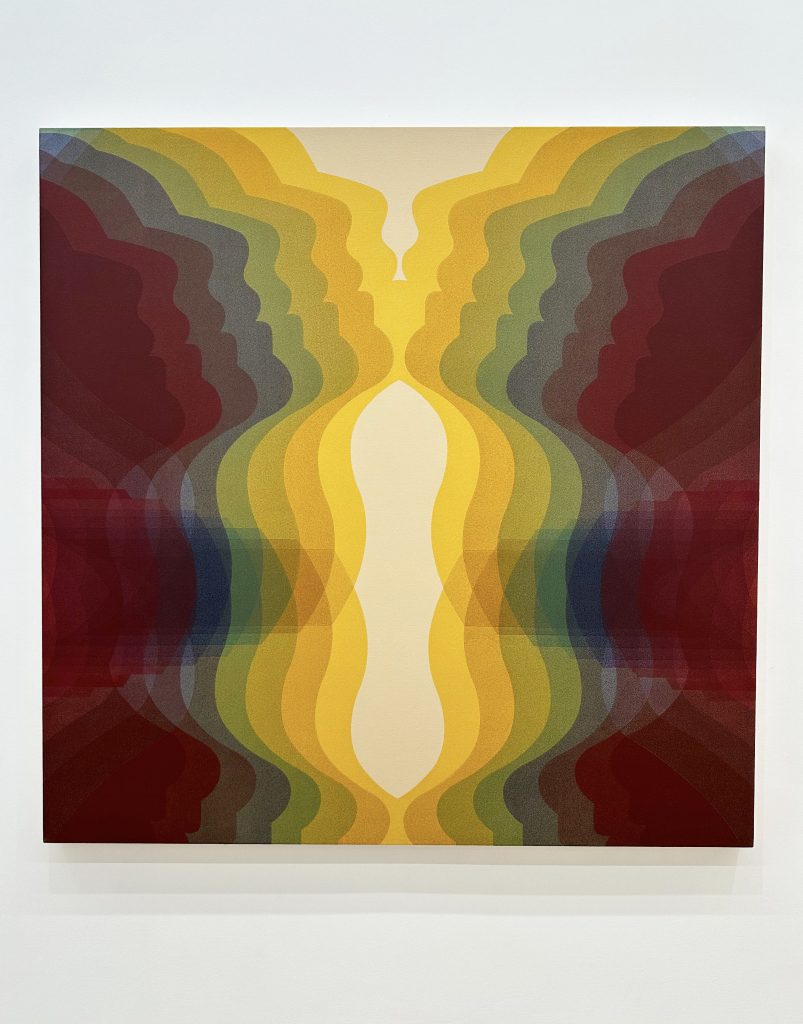
Marina Kappos uses her experience as an identical twin to explore the concept of quantum entanglement for her current exhibition Spooky Action at Shrine Gallery. Her use of color and the preciseness of the work makes the paintings both aesthetically pleasing and impressive.

From the press release-

Spooky action at a distance is an enigmatic term coined by Einstein meant to describe quantum entanglement, or the strange phenomenon when particles, or objects– potentially of any size and at any distance apart, become inexplicably linked together. These bonded entities become responsive to one another as if invisibly tethered in ways scientists do not really understand, and which can no longer be described as independent. The theory is so unusual that Einstein was essentially dismissive of the possibility even while reflecting on it, but the concept has since been documented and confirmed.

Marina Kappos identifies with this phenomena, in part because she has experienced life as an identical twin, separate yet connected. As she describes it, “I have grown up with a mirrored reflection of myself, but one that is also independent and leading a different life than me.” Both Kappos sisters can quickly affirm that being an identical twin leads to a highly unique existence that is difficult for the outside world to understand. Like quantum entanglement, or “spooky action at a distance”, identical twins are intrinsically linked from birth, almost as carbon copies, and many sets routinely claim to experience telepathy or other forms of psionic abilities with their sibling. This duality of nature and sharing an almost exact form with her sister is one of the primary sparks driving Marina Kappos in her new paintings.

Kappos has honed a precision-based process that is truly her own. The paintings generally manifest subconsciously and are obsessively tight. She applies repeating layers of acrylic paint in different hues to form ethereal images and figures that rest slightly offset from their neighboring silhouettes. Reverberating faces and skulls, a new “spooky” motif, repeat in opposing mirror-image or spin together in cycles, all while dancing together in the confined spaces of her canvases; like echoes. The buzzing frequency and optical motion in Kappos’s works reminds us that our notions of what we think of as being concrete, or as existing as separate and distinct objects (even our own bodies) might be more fluid than we realize.

This exhibition closes 6/29/24.

Jun 272024
 

Terry Winters‘ paintings for Point Cloud Pictures at Matthew Marks Gallery reference data collection methods and patterns from the natural world. The colorful and energetic works leave it up to the viewer to make their own associations.

From the gallery’s press release-

Winters’s work centers on abstraction as a catalyst for exploring the natural world. In his paintings, composition and color give new meaning to a wide range of technical references, which include advanced mathematical principles, musical notation, botany, and chemistry. In the artist’s own words: “I’m taking preexisting imagery and respecifying it through the painting process. Information is torqued with the objective of opening a fictive space or lyrical dimension.”

The title of the exhibition refers to the seven Point Cloud paintings on view, in which overlapping grids of ringed particles create complex, amorphous shapes. Borrowed from the field of three-dimensional modeling, a point cloud refers to a set of data points in space, often used to articulate objects or landscapes in digital models. “The forms can also suggest the collective behavior of animals, such as the murmuration of starlings and the schooling of fish,” Winters says. His paintings build an illusionistic sense of ever-expanding depth, as the varying size, shape, and angle of his painted data points lend a dynamism to his canvases. With the utmost attention to pigment, the paintings are built up in layers of oil, wax, and resin, further eliciting the energetic potential of their compositions.

Created through a parallel process, each painting on paper fills a large sheet from edge to edge. To make these works, Winters chose a paper size called a double elephant, which was first developed in 1826 to accommodate J.J. Audubon’s life-size depictions of birds. As Winters has described, “I’m interested in these givens, working within the parameters of that aspect ratio, and how that affects the building of the work.” Together, the works create a space that is both immediate and imaginary, what Winters has called a “vitalized geometry.”

This exhibition closes 6/29/24.

Jun 222024
 

Eva Struble has created gorgeous worlds for her exhibition Gravity of Small Things at Jane Lombard Gallery. The paintings shift from abstract to realistic and back again as bits of the natural landscapes emerge.

From the press release-

Through painting and textile, Struble explores the concept of embodiment in the landscape, relating the physical act of making to her multi-sensory and visionary experience of place. Contemplating the symbiotic relationship between humans and nature, the works collectively take into consideration our changing environment.

Struble’s paintings distill her physical experience of nature – the sharp touch of Yucca on her local hikes, the early morning smell of the Chaparral, or the disorientation of floating above seagrass in the ocean. Orchestrating a suite of visual constructs, the artist oscillates between chance and control while experimenting with pigments, media, layering, and collaging. Her work suggests a reflective yet speculative vision teeming with biodiversity and notions of cohabitation between species without interference.

The eponymous painting Gravity of Small Things effortlessly blends hazy nostalgia with honest representation and creative world-building. Sharp and soft edges intermingle in shallow focus as the viewer moves through silhouetted trees and gradient purple obstructions flecked with blue and red confetti-like marks. The landscape is at once familiar and remote, existing outside of conventional constructs of time and space. Recognizable elements break up the variegated ecosystem, playing with our perception to reveal effects similar to sunlight illuminating the changing leaves or the sparkle of reflections dancing on the surface of the water.

Snapshots of landscapes morph into organic forms as Struble reconciles her visual and corporeal memories of nature with her own body’s shapes, twists, and turns. In Malajon, layered washes of vibrant greens, blues, and pinks blend together to create a dynamic composition of varying depths, engaging our collective visual memory to suggest the ethereal entrance to an untouched cave, or perhaps a quiet adventure amidst jungle flora. As deliberate as it is exploratory, the artist’s otherworldly painterly manipulation gradually gives way to lend a semblance of reality to the abstracted composition. Drawing upon the viewer’s own experiences to evoke imaginative reflection, Struble’s works straddle the line between the human and natural worlds, simultaneously pushing and pulling to suggest alternative ways of coexisting.

This exhibition closes 6/22/24.

Jun 222024
 

Taking place at both High Noon Gallery and Chart Gallery is Jennifer Coates’s exhibition Edge Effects. The paintings are dense with imagery that requires the viewer to take a longer look.

From the press release-

Edge Effects is an ecological term that refers to the sometimes problematic changes in biodiversity where different habitats converge. These transitional zones are called ecotones: animal/vegetable environments in flux, like ditches, forest edges, marshes and grasslands. The ecotone provides a metaphorical through line for Coates’s current paintings, in which micro-climates of imagery collide. Zones of color, marks, and depicted elements aggregate and are collaged together, creating a hybrid sense of place.

Coates uses acrylic and spray paint—synthetic chemicals—to represent the landscape, emphasizing the toxicity that now runs through most organisms. Despite this pervasive chemical presence, her paintings present an ecofeminist belief in the possibility of restoring the self through hyper connection with nature.

At the edges of shapes, halos and heightened optical effects take the viewer in and out of spatial logic. She repeatedly depicts plants that flourish in poor soil, found at edges between cultivation and wildness. These ditch weeds are ubiquitous in rural Pennsylvania where Coates works in the summer. Painting them has become a way to reconcile with invasive plant species. She anchors archetypes such as Diana, Pan, Dionysus, and the Maenads to the woodlands where she has spent much of her life, incorporating local wildlife like common birds and butterflies. The butterflies, for example, pollinate as well as “puddle”—a behavior that extracts minerals from mud, carrion, blood, and sometimes tears, signaling the edge between vitality and rot. In Coates’s paintings they also feed on the remains of Classical sculpture.

Portals appear as entrances to bunkers, caves, ruins, and passage tombs. Rocks are a new pictorial element for Coates that provide a further engagement with the materiality of paint. Structures and imagery are built up and broken down through her painterly process and go in and out of presence, at the edge of sense.

This exhibition closes 6/22/24.

Jun 212024
 

“Along the Army Corps Floodwall in Ardsley in Autumn”, 2023-4, Oil on linen

“Along the Army Corps Floodwall in Ardsley in Autumn” (closer)

“NYSC by the Saw Mill River in Winter”, 2024 Oil on linen

“Setting Sun with Entopitc Phenomena During the Canadian Wildfires in Sean’s Subaru”, 2023-4, Oil on colored linen

“LA Fitness in Ridge Hill by the Sprain Brooke in Summer”, 2023-4, Oil on linen

“LA Fitness in Ridge Hill by the Sprain Brooke in Summer” (closer)

Depicting various locations during different seasons, Dylan Vandenhoeck’s paintings for Right Under the Nose at Jack Barrett Gallery, explore the way selective vision creates and distorts our memories of moments and places.

From the press release by Jonathan Crary-

One of the important features of the Western European modern world that begins to emerge in the decades around the year 1500 is a reorganization of the human senses. Taking place over several hundred years is a relentless prioritization of vision and its isolation from the other senses. What some theorists have called “ocularcentrism” is this privileging of the eye and its alignment with rationalized forms of knowledge that distance a human observer from the physical world and estrange them from the multi-sensory immediacy of perception. Since the Renaissance, the arts have been shaped by practices and techniques that have posed the fiction that our vision is a faithful mirroring of an objective external reality. This model has been a crucial underpinning for the rationalized forms of knowledge and utilitarian, extractive priorities of Western modernity. But there have long been artists whose counter-practices have challenged this dominant framework, including, for instance, Hans Holbein and his Ambassadors, William Blake, J M W Turner, Roberto Matta and Stan Brakhage

Dylan Vandenhoeck is part of this lineage for the ways in which his work foregrounds the embodied, or subjective nature of our vision. One of many examples of embodied vision is the fact that our optical impressions are shaped by the actual curvature of our spherical eyeballs. Yet the most pervasive systems of visual representation, such as linear perspective, have “corrected” this phenomenon by imposing rectilinear organizations onto perceptual experience. Another feature of lived vision to which Vandenhoeck is attentive are afterimages, the response of our eyes (as part of our nervous system) to  strong stimulation of various kinds, but notably sunlight. Afterimages are vivid evidence of how our vision is a composite of sensations produced by our body and of the diverse effects of the luminous environment in which we are situated. His paintings present this hybridity as a heterogenous field of divergent events with different temporalities, but which nonetheless coalesce into the dynamic world of immediate experience. Using the terms of Deleuze and Guattari, Vandenhoeck creates a smooth space as opposed to a striated one, that is, non-metric, de-centered and open to metamorphoses. 

Around the Mound, for example, manifests some of these qualities in its disturbance of conventional spatial cues, such as altering our reading of what is near and far. It affirms an aggregate field of vision composed of perceptual fragments that don’t cohere into a unified whole. But notably, while Vandenhoeck has crafted a landscape shaped by these disjunctions, he has also interwoven into the work swirling and pulsating flows that engage the viewer kinesthetically. Part of his project is to challenge the ways in which our attentiveness has been regulated and impoverished by the digital milieus in which we are perpetually immersed. The monotonous omnipresence of electroluminescent color and powerful forms of perceptual control, such as eye tracking, have routinized and diminished our visual capacities.  Vandenhoeck conveys intimations of the sensory and libidinal gratifications of a heightened bodily response to the vibrant plurality of a living world. In this sense, there is at least a limited utopian underpinning to the images in this show. Yet if one dimension of his work poses the possibility of revivifying our perception, he makes clear that this can only occur within the broken actualities of the early twenty-first century. His revelatory images are all grounded in the prosaic periphery of New York City, marked by highways, shopping malls, and cell phone towers. Thus, one of Vandenhoeck’s remarkable achievements is the reclaiming of an expanded, transfigured vision amid the familiar terrain of the everyday. 

This exhibition closes 6/22/24.


Jun 212024
 

Anne Rothenstein’s beautiful and mysterious paintings are on view at Stephen Friedman Gallery until 6/22/24.

From the gallery’s press release-

Rothenstein’s dreamlike paintings depict expansive landscapes and intimate interiors drawn from memory, personal experiences, and found material from newspapers and magazines. Whether depicting androgynous figures or melancholic landscapes, Rothenstein’s works blur the lines of identity and narrative, inviting observers to immerse themselves in the ambiguity of her creations. Curator and writer Simon Grant aptly describes the experience of viewing Rothenstein’s paintings, “Looking at these paintings can feel as if we have joined a drama that has been unfolding but of which we may have missed the crucial part.”

Rothenstein’s figures are deliberately ambiguous, conjuring introspection and contemplation. While the subdued and pensive demeanor of her characters might convey solitude, they exude a presence that transcends this. In Three Figures (2023), the artist provides a glimpse into the inherent isolation experienced by human beings within a social context. Positioned on the far left, a figure is wearing a reconfigured tuxedo dress, which obscures defined gender and identity. This attire, also observed in Seated Figure and Thinking about Billy Porter (both 2024), serves as a nod to fashion as a form of political expression, drawing inspiration from actor Billy Porter’s ensemble at the 2019 Oscars ceremony. At once, these figures point to new horizons in gender politics while echoing the longstanding tradition of late nineteenth and early twentieth-century portraiture, reminiscent of artists such as Edouard Vuillard and Edvard Munch.

The power behind these works is further evident in the artist’s application of paint, and her distinctive use of color. Throughout the exhibition, burgundy red tones, pale greens, and nostalgic blues emerge and recede to reveal depth and movement. The color palette pays homage to colorists who inspire Rothenstein: Howard Hodgkin, Vilhelm Hammershøi, and Gwen John. In works like Shadow and Heat (both from 2023), the artist rendered two iterations of the same composition. The subtle variations between them evoke the notion of distorted memories resurfacing in our minds. Here, a lone figure and a dog traverse a burning landscape, reflecting concerns about climate change and devastating wildfires. This further evidences how global events influence Rothenstein’s practice: “However much I try to keep the outside world at a distance it always insists on creeping in and often steers the direction the work is taking”.

In her exploration of scale and texture for her New York debut, Rothenstein oscillates between canvas and panel for the first time, introducing a contrast to her signature wood panels. This shift enables the artist to delve deeper into her creative process and further enhance the immersive quality of her work. Through a combination of bold brushstrokes and nuanced color variations, Rothenstein achieves a striking visual harmony, where figures emerge from the surrounding space with a haunting presence. Speaking of Rothenstein’s work, art critic and curator Katy Hessel writes, “When I look at your works, their solitariness comforts me. It’s rare that you see solitude as a happy thing.”

Also on the gallery’s website are the quotes below from Rothenstein that provide additional background on her process-

Speaking of her artistic process, Rothenstein says, “My reasons, or intentions, when making a particular painting are quite mysterious to me. The spark is always lit from an existing image, a photograph or another painting, and I often don’t discover why that image leaped out at me or what it is I’m exploring until the work is finished. Sometimes I never find out. It is almost entirely intuitive. Finding a rhythm, searching for balance, alert to missteps, to what is happening, to changes of direction.

I am telling myself a story much of the time and asking questions. Who is this, where is this place, what is going on? This is what I think of as the noise of a painting. And of course, what I am trying to reach is the silence … There is a wonderful Philip Guston quote: “if you’re really painting YOU walk out.” That is what I mean by reaching the silence.”

Jun 202024
 

Holly Coulis’s latest colorful paintings for Rubber Band at Klaus con Nichtssagend have a wonderful energy to them, encouraging the eye to move along the various shifting lines.

From the press release-

Outlines serve as unreliable guides in Coulis’s new work. Here, long, colorfully painted strokes adopt a cursive quality, departing from the still life representations they have previously delineated. Squiggles and loops press against each other, moving mischievously through broader fields of layered chromatic brushstrokes. At times, these lines rush like rivulets across the canvas, while elsewhere they form an array of dynamically curving shapes within confined areas. The lines prove unpredictable, veering around hairpin curves and playfully wobbling after crafting graceful arcs. Following their trajectory leads us on detours that challenge our initial perceptions. Glimpses of familiar silhouettes—vases, bowls, fruits—vanish as swiftly as they materialize, as if the line refuses to complete the thought, instead eagerly moving on to the next loop, curl, or helix.

This exhibition is on view until 6/22/24.


Jun 132024
 

Aaron Zulpo has captured the beauty and quiet of the desert in his enchanting paintings for California Deserts at 1969 Gallery.

From the gallery-

Following his relocation to California, Zulpo’s interest in landscape painting has expanded and become a pivotal aspect of his studio practice. This change has inspired a new series of sensitively observed landscape paintings of the American West. He begins his work in plein air during exploratory hikes through rugged desert terrain. Zulpo’s connection to the land imbues his paintings with a sense of reverence.

In California Deserts, the artist presents a series of recent paintings whose subjects range from the canyons of the Santa Ana Mountains, to the peaks of Mount San Jacinto, to the boulders and century-old Yuccas of Joshua Tree National Park. Zulpo captures the changing atmospheric and lighting conditions of the desert sky, as exemplified in works such as Quail Mountain Dust Storm and Joshua Tree with a Red Sky, bathed in golden, peach, and auburn tones that evoke the allure of the desert at sunset. Other paintings, such as Looking at Maze Loop from Quail Springs, highlight the uniquely expressive quality of cloudforms, which appear, at times, to mirror the craggy rocks below.

Drawing inspiration from early twentieth-century landscape painters, such as Rockwell Kent and the Canadian Group of Seven, Zulpo presents a serious and sustained engagement with the natural world. At the same time, he brings a twenty-first century environmental consciousness to the landscape tradition, calling attention to the inherent virtue and beauty of wild spaces and the need to preserve them.

In 2017, Aaron Zulpo and Johnny DeFeo co-founded The Guild of Adventure Painters. This non-profit organization aims to keep nature at the forefront of the arts by offering residency programs, community building initiatives, exhibitions and public events. Since its inception, The Guild of Adventure Painters has been dedicated to inspiring artists to immerse themselves in the outdoors, cultivating a deeper connection with nature and playing a vital role in its preservation.

This exhibition closes 6/15/24.