Dec 162025
 

“Allegory of Winter”, 1948, Goache and paper

“The Juggler (The Magician)”, 1956, Oil and inlaid mother of pearl on board

Surrealist artist Remedios Varo was born on December 16th, 1908, in Spain. Throughout her life, she was a part of avant-garde circles— first in her homeland, and later in Paris and Mexico. She and several other intellectuals and artists fled to Mexico during World War II, where they were given asylum and citizenship. It was there that she would create the majority of her best-known works.

Varo’s paintings are filled with symbolism and mystical imagery. They also often reference her own experiences creating art. While Allegory of Winter (first image) is currently in a private collection, The Juggler (The Magician) can be seen at the Museum of Modern Art.

From MoMa about the work-

This painting’s titular juggler (or magician) stands on the platform of a carnivalesque cart filled with fantastical objects and animals. He performs before seemingly identical figures robed in a single gray cloak. To produce this composition, Varo worked in the manner of early Renaissance masters: she transposed preparatory drawings onto a gesso-primed panel, which had been scratched to give the surface variation. She also deployed decalcomania, a technique favored by the Surrealists in which materials such as paper or aluminum foil are pressed onto wet paint to transfer a pattern that may then be embellished. This textured effect can be seen in the magician’s garments and in the background trees.


Oct 162025
 

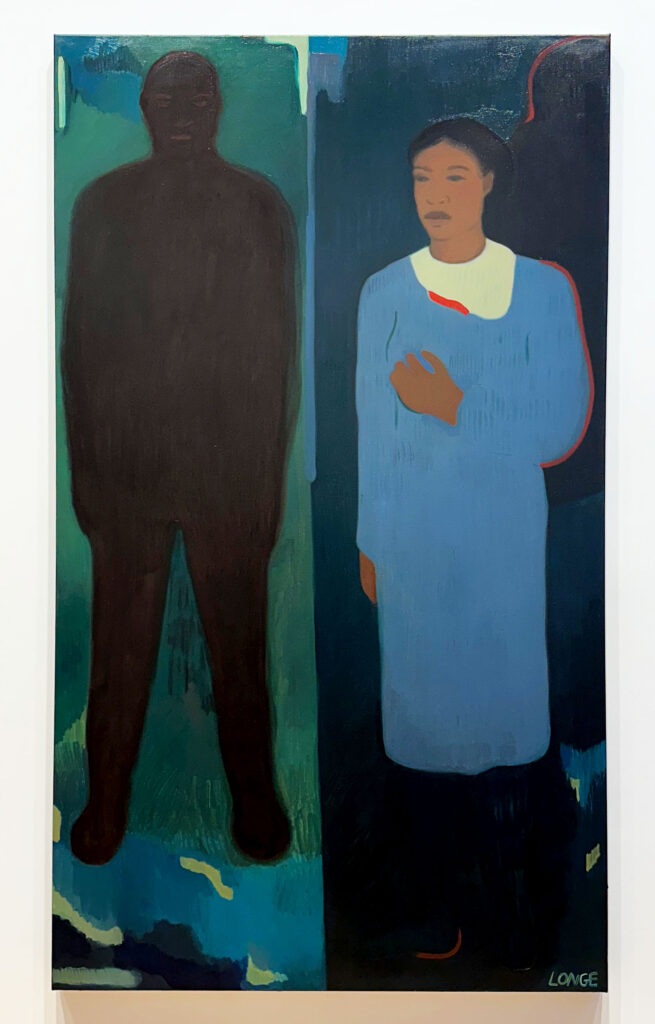
Sahara Longe “Skull”, 2024, Oil on Linen

“As We Are (after Otto Friedrich)”, 2024, Oil on Linen

“Liar”, 2024, Oil on linen

This week’s throwback is to Sahara Longe‘s paintings from her 2024 exhibition at Timothy Taylor gallery in NYC, Sugar.

From the gallery about the work-

Featuring twelve vivid and haunting canvases, Longe’s second exhibition with the gallery sees the artist reconceiving various art histories to arrive at an uncanny interplay of figures, allegories, and enigmatic landscapes. The show will be accompanied by an essay by Ferren Gipson, art historian and writer based in London.

In paintings characterised by a preternatural handling of line, colour, and figuration, Longe depicts partially abstracted subjects in atmospheric environments. Working on thick grain linen with raw pigment in a distinct palette of vermillion, lilac, raw sienna, and ochre, she renders her scenes with a fluid painterly freedom that is nevertheless quiet and precise in its effect. Across her work, she recalls aspects of the Symbolist ethos, which moved between nostalgia and rupture, seeking not to capture something directly, but rather convey the sensations it produces.

In her new paintings, Longe focuses on the nude. Articulated in spare, suggestive gestures, her subjects, largely women, are pictured huddled together, embracing a lover, or striding alone. Some set their gaze on an unknown distance, others stare down the viewer, and one confronts a fish. Each seems possessed by a disquieting tension that is emphasised by a shadowy apparition lurking in many of the works. Masculine in stature, the incubus perches over a scene or cradles another figure therein. Where Longe’s previous series reflect on social dynamics, depicting parties and crowds, these paintings are more personal; the artist explains that the new works look inward rather than outward. Expressive, brushy marks bring subtle notions of agitation, dreaminess, and intimacy to otherwise minimal passages of colour.

These paintings further explore the ideas set out in Longe’s earliest work, which emerged from her study of classical portraiture at Charles H. Cecil Studios in Florence; in her early canvases, Longe integrated and recontextualised themes and styles of old-master paintings. Here, her compositions draw from Secessionist painter Otto Friedrich’s nudes and Symbolist Ferdinand Hodler’s ominous portraits. They likewise reveal the influence of a recent trip to Oslo, where Longe was taken by Henrik Sorensen’s mural (1938–50) in Oslo City Hall (where the Nobel Peace Prize is selected), and the marginalia of illuminated manuscripts. Ushering these disparate sources and traditions into her singular aesthetic, Longe poses subtle questions about representation—who it serves, and what narratives it upholds—just as she underscores figuration’s expressive potential.

May 132024
 

“A beautiful figure without a tongue”, 2024, oil and pencil on canvas

“A beautiful figure without a tongue”, 2024, oil and pencil on canvas (detail)

“Open Season”, 2024, oil and pencil on canvas

“Open Season”, 2024, oil and pencil on canvas (detail)

“Where our love once lay, a dark and tortured jungle grew”, 2023, oil and pencil on canvas

“Where our love once lay, a dark and tortured jungle grew”, 2023, oil and pencil on canvas (detail)

A sense of foreboding looms over the paintings in Sanam Khatibi’s exhibition We Wait Until Dark at P.P.O.W gallery. In the details are smaller skeletons, ritual objects, and dead animals blood soaks the ground. Life and death are personified in both the figures and the natural surroundings. Flowers bloom or wilt, bones are scattered, a hummingbird shares a moment with a skeleton in one painting while a dead bird lies on the ground in another. Khatibi’s works have many potential meanings, like their art historical predecessors, and leave it to the viewer to come to their own conclusions.

From the press release-

…People who devote their lives to art can often cite an event that placed them on their destined path. Among the earliest memories Belgian artist Sanam Khatibi recalls is the day she discovered a book on Hieronymous Bosch left out on the table by her mother. She was five. That one might advance from consuming the rapturous reproductions of The Garden of Earthly Delights at such a young age to painting expansive, primal scenes of a troubled Paradise is one excellent example of artistic “fate.”

In Khatibi’s paintings and sculptures, the veil between desire and restraint, life and death, and the natural and spirit worlds proves thin. Again and again, the artist returns to t­he figure of a nude goddess navigating a verdant, savage land beyond the protective scrim of “civilization.” In the absence of technology, politics, bills, e-mail, and even clothing, she exhibits her most feral qualities for survival: devouring, eating, attacking, killing, and hunting. Khatibi’s subjects are perennial (desire, seduction, domination, submission), and her references to allegorical forms are extensive (17th-century Dutch still life vanitas, the motif of Death and the Maiden, antiquarian amulets, and anthropological relics), all channeled into displays of human folly and erotic obsession.

Paintings by Khatibi are full of expressions of voracity: for sex, earthly delights, experience, and transcendence, and what happens when you tempt the devil. In Where our love once lay, a dark and tortured jungle grew (2023), a fey skeleton seizes a beautiful maiden by the hair under a lightening blue sky –– a grotesque quid pro quo that recalls Lucas Cranach the Elders’ The Ill-Matched Couple (1553); or even Kawanabe Kyōsai’s Hell Courtesan (1831–1889). Decrepit and aging, his skull sprouts strawlike strands of hair, the last indication of vitality. In Open Season (2024), an Amazonian goddess places an intimate offering of amulets and animal sacrifices before a pool of water. There is a sense of reckless abandon: a human skull, a pomegranate cracked open, blood spilling over the cerulean earth––a feast for ravenous souls.

Khatibi’s Eden is repeatedly transformed into a Bosch-like tale of passionate, potentially fatal encounters (a locus amoenus turned upside down into a “locus terribilis”). In A beautiful figure without a tongue (2024), the skeletal personification of Death reappears. A maniacal grin spreads across his decaying face as he slinks away, clutching an ornate vase to his chest. Are these the spoils of Death to be hoarded in a cavernous underworld?

Throughout the exhibition, Khatibi faithfully intertwines two genres of painting (figurative landscape and still life), leaving seemingly ancillary details from one scene to reveal as sharp memento mori in another––as in Overnight Black Aphids Appeared, growing on the tips of the Sophora Sun King (2023). Here, the reappearance of skulls, amulets, and small creatures sans personnages gives the impression of a romantic sojourn set apart from the larger narrative. Each of Khatibi’s objects pulses into realism with near-scientific observation, appearing magnificent and fragile, possibly even forbidden. Placed against a velvety black ground, they fall into shadow as if pulled amorously into the afterlife. –Lola Kramer

Also included in the exhibition are several smaller works, like the one pictured below. In these darker paintings the details stand out against their black background, but the mystery of their meaning remains.


“Overnight Black Aphids Appeared, growing on the tips of the Sophora Sun King”, 2023 oil on canvas

Apr 132023
 

Closing on 4/15/23 is Sean Landers’ exhibition Adrift at Petzel Gallery in NYC.

From the gallery’s press release-

Featuring over twenty new oil paintings by Landers, this largely allegorical exhibition illustrates the complexity of artistic mortality using four protagonists: dogs—depicted in single portraits and alone in rowboats unmoored at sea; lighthouses; the ocean; and sperm whale skeletons at rest on ocean shorelines. Each subject represents the dichotomy of freedom and trepidation involved in the act of releasing art to an unknown fate. “…a bit of the artist remains in their paintings, so in that way, a painting is like an artist adrift in time and space,” says Landers in an interview with writer Johanna Fateman for the exhibition catalogue.

A cornerstone of inspiration for Adrift is Landers’ long-term interest in the work of American painter Winslow Homer (b. 1836—d. 1920) and in particular Homer’s ocean paintings. The vast and unpredictable ocean marks time and space, a preeminent symbol used throughout the years in Landers’ paintings and art history. Homer’s style is emulated by Landers in paintings throughout the exhibition including Northeaster, Summer Squall, and Yellow Dog.

Each of these subjects can be seen as a character existing within the vicissitudes of artistic practice. The dogs, at attention and alone in their boats, symbolize the vulnerability of art against an unknown future. These works also parallel Joachim Patinir’s (b. 1483—d. 1524) painting Charon crossing the Styx in which a human soul is being transported by boat into afterlife. Landers sees this as symbolic for what a painting is—a vessel for the artist into afterlife.

Two lighthouses, Portland Lighthouse, US and Sunderland Lighthouse, UK, are both welcoming and warning beacons, allegories for institutions that signal to the public what art is worth preserving. This ruling system will determine the dogs’ fate as they head into the unknown of art history. The bare whale bones, epic in their repose on the sandy shore echo the finality in the lifespan of an artwork. Such relics are epitaphs and beginnings, a sentiment imparted in We Hover, where Landers’ text painted over a fierce ocean reads: And then we hover in between existence and nonexistence in our paintings and that is both terrifying and reassuring. For Landers, Adrift is the everlasting reminder that the artist, like Patinir’s soul, is forever navigating the here and hereafter.

For added perspective on the symbolism, this is from Landers’ Instagram account

“The ocean represents time and space. The dog adrift in the boat is like an artwork adrift in time and space after the artist passes. The lighthouse is the institution that decides which art civilization will preserve. The whale skeleton is the fear of a life’s work gone unloved and allowed to die.”