Aug 092025
 

Pictured above is John Banovich‘s painting Partners, 2007, from the permanent collection of The James Museum in St. Pete, Florida.

From the museum and artist about the work-

Lions are most affectionate with their companions of the same gender. Male lions will change prides but stay with their coalition partners for their entire lives.

“There is no greater bond in the big cat world than between pride mates.”
– John Banovich


Dec 292023
 

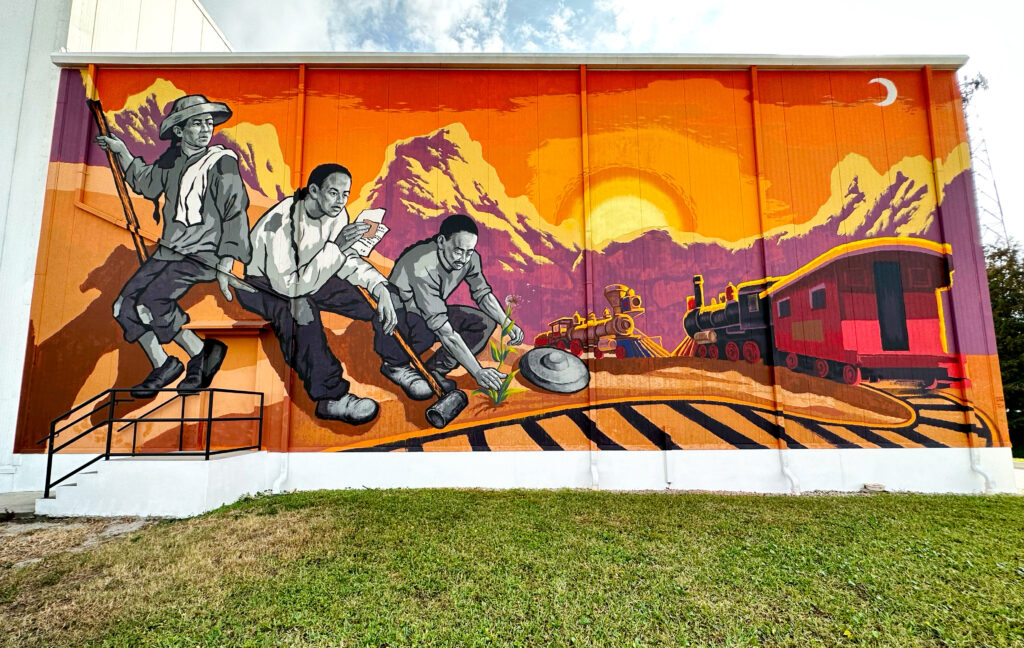
This year The James Museum partnered with SHINE Mural Festival and Chenlin Cai to create the mural seen above, The Path We Came. It was inspired by the museum’s current exhibition From Far East to West: The Chinese American Frontier.

Dec 292023
 

Hung Liu “Portrait of China Mary”, 2006, Oil on canvas

Currently at The James Museum in St. Pete, is From Far East to West: The Chinese American Frontier, an informative show that includes many beautiful paintings. There’s so much history in America that often doesn’t get taught in school. This is a great opportunity to learn about this immigration story through artwork as well as text.

From the museum about the exhibition-

While European American settlers gradually pushed the United States frontier westward throughout the 1800s, the West coast of the country was developing independently as well. Accelerated by the discovery of gold mid-century, the population boom included Chinese immigrants who crossed the Pacific Ocean to California.

Most 19th century Chinese immigrants came to their new country from the coastal Canton region (province of Guangdong today) in southeastern China. Starting over on a different continent away from familiar surroundings and culture would be challenging, but for many decades anti-Chinese hostility and exclusion laws made settling in the United States even more difficult. The achievements of Chinese immigrants paved a path for future generations and are a testament to strength and perseverance.

The foundation for the exhibition highlights narratives of Chinese America from the 1850s to the 1930s. The paintings-all created by Chinese Americans in the 21st century-reflect inspiration from this history. The painters are also fueled by their own, more recent immigration stories to the United States after China’s Cultural Revolution (1966-1976) and their rigorous art training in the government-sponsored movement of Socialist Realism. After China opened to the rest of the world in the late 1970s, many Chinese artists-like Mian Situ, Jie Wei Zhou, Benjamin Wu, Hung Liu, and Z.S. Liang, all featured here were inspired to immigrate to the United States in search of greater opportunity.

Here, these artists’ historical interpretations speak to culture, identity, community, and resilience. Related objects and ephemera from the period support these stories. From the Gold Rush to Angel Island, this exhibition reveals often overlooked but significant contributions and perspectives of Chinese immigrants that deepen our understanding of U.S. history.

Hung Liu “Dandelion with Small Bird”, 2017 Mixed media

About the above painting from the museum-

Dandelions and their fluffy seed pods can be found anywhere in the world and thrive wherever they land. Their migratory nature allows them to survive a journey across vast lands even across oceans and take root anywhere in the world. For Liu, the dandelion represents her own tenacity and ability to thrive in the face of adversity.

The dandelions, fragile in nature and tattered by the lightest breeze, mimic how images, and personal narratives, too, can be scattered by time and the winds of history —as well as by the rhythms of feast and famine …
Hung Liu

Mian Situ “Blasting a Route Through the Sierra Nevada, 1865, Central Pacific Railroad”, 2018, Oil on canvas

Mian Situ “The Gold Seekers , Chinese Camp, 1850”, 2015, Oil on canvas

Jie Wei Zhou “Dragon Parade”, 2012, Oil on Linen

This exhibition is on view until 1/28/24.

Dec 202022
 

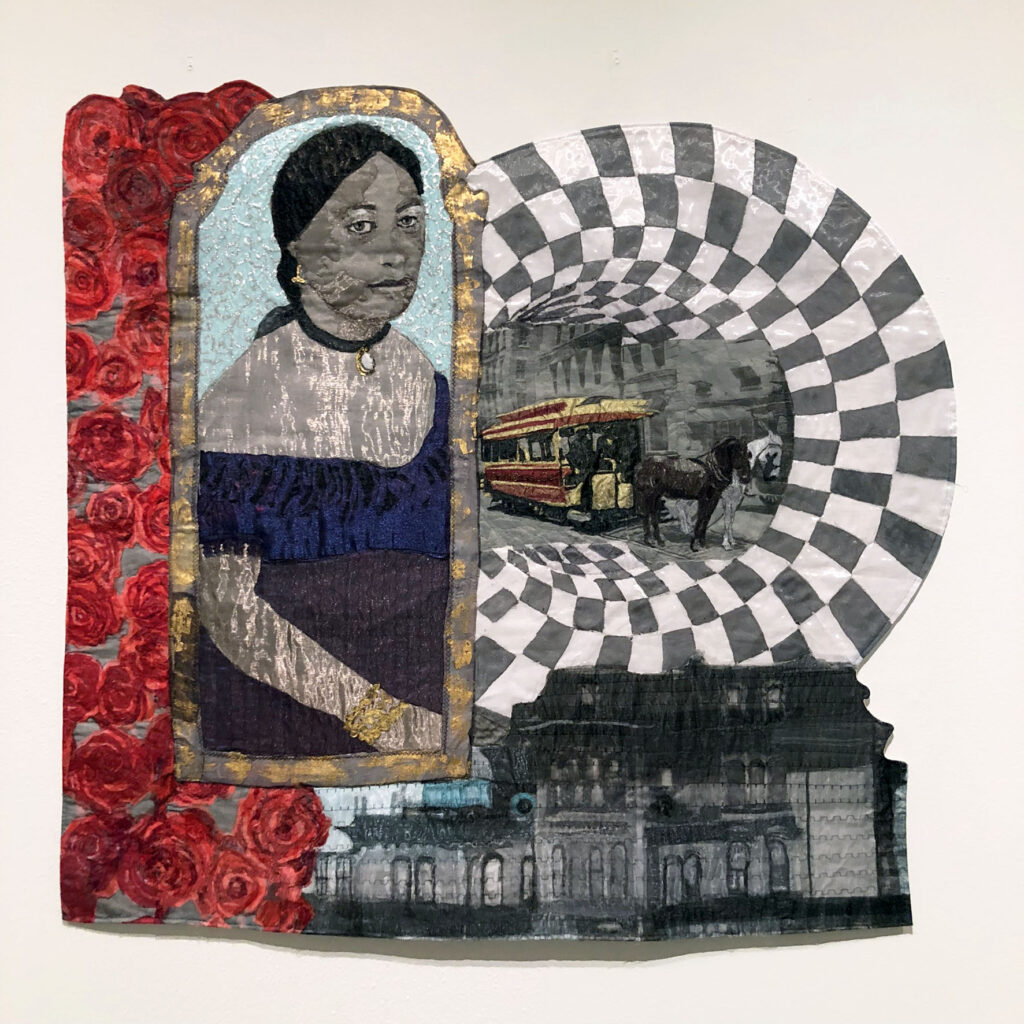
“Call Me Mrs. Mary E. Pleasant: The Midas Touch” by L’Merchie Frazier

Pictured above is a portrait of entrepreneur, civil rights activist and benefactor, Mary Ellen Pleasant who made a name and a fortune for herself in Gold Rush era San Francisco. Her timeline from 1814 to 1904 begins in racial slavery as an indentured servant girl with no formal education. She ascended to a self-made millionaire, amassing a fortune in her lifetime of over $30 million, ($900 million today).

Organized by historian, artist, and curator Dr. Carolyn Mazloomi, “Black Pioneers: Legacy in the American West” at The James Museum of Western and Wildlife Art, consists of 50 pictorial quilts created by members of Women of Color Quilters Network, a group founded by Mazloomi in 1985.

Mazloomi’s statement at the exhibition entrance-

American history is incomplete without the stories of African American men and women, from our enslaved ancestors to our societal challenges. The role of African Americans in the movement toward westward expansion has been largely overlooked. This exhibition of original pictorial quilts brings into focus the rich and diverse stories and achievements of Blacks in American western history. The timeline begins with Esteban’s 1528 arrival in the West and continues through the Civil Rights Movement.

At the end of Reconstruction in the South, discrimination and segregation caused African Americans to seek opportunities where there was less prejudice. In the 1800s, they moved by the thousands to the American West. Some went West as slaves, while free African American men joined the United States Army or became ranch hands, fur traders, cowboys, or miners.

Why quilts? Quilts and quilt making are important to American, and Black culture in particular. The art form was historically one of the few mediums accessible to marginalized groups to tell their own story, to provide warmth for their families, and to empower them with a voice through cloth. Using quilts to tell these stories accentuates the intersections of African Americans in the Western frontier while at once informing about the art form and its role in Black history. It is this often unknown and underappreciated shared reality that must be voiced if we are ever to truly value the unique contributions diverse groups make to the fabric of our nation.

Two more selections from the exhibition are below, although it was very hard to choose which quilts to highlight- there are so many great ones to choose from.

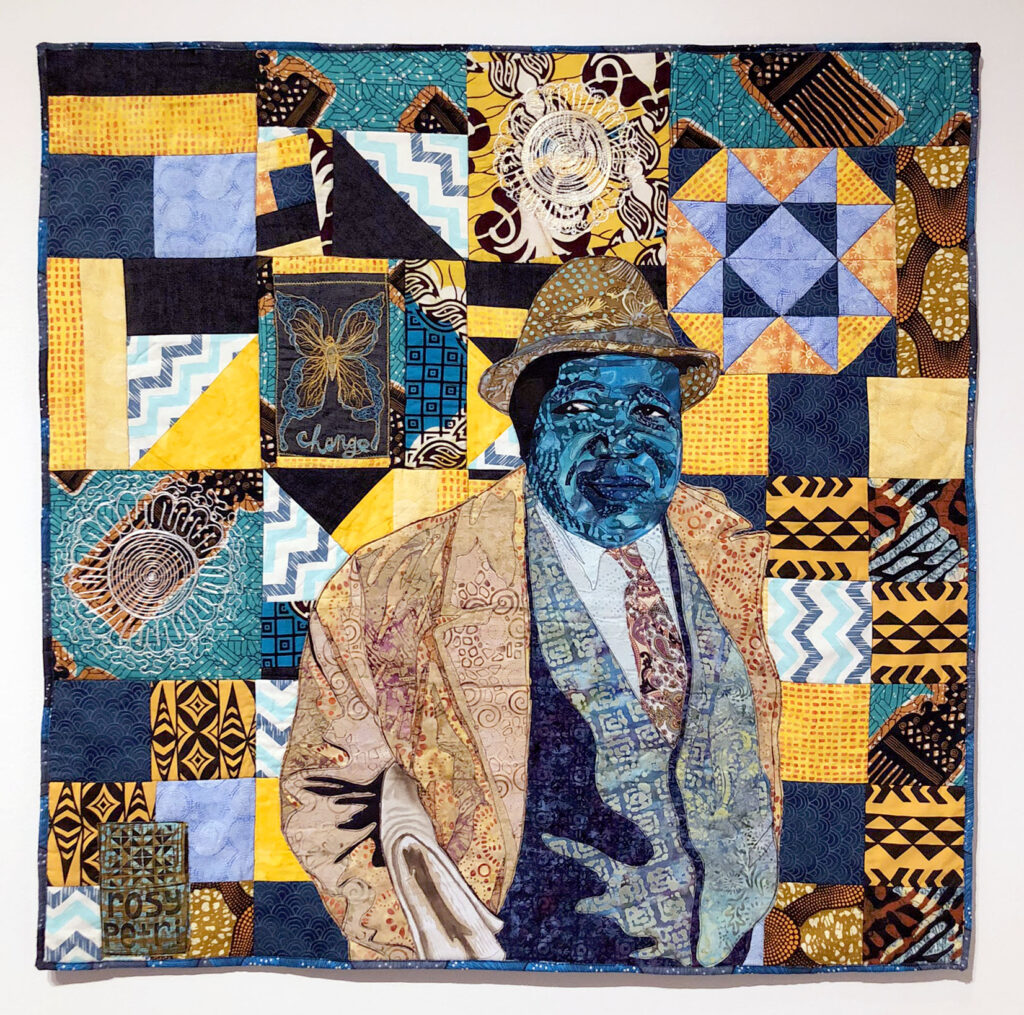
“A Good Soldier: Thomas C. Fleming, America’s Longest Serving Black Journalist” by Rosy Petri

At the time of his retirement in 1997, California journalist Thomas C. Fleming was the nation’s oldest Black journalist with the longest consecutive period of publication.

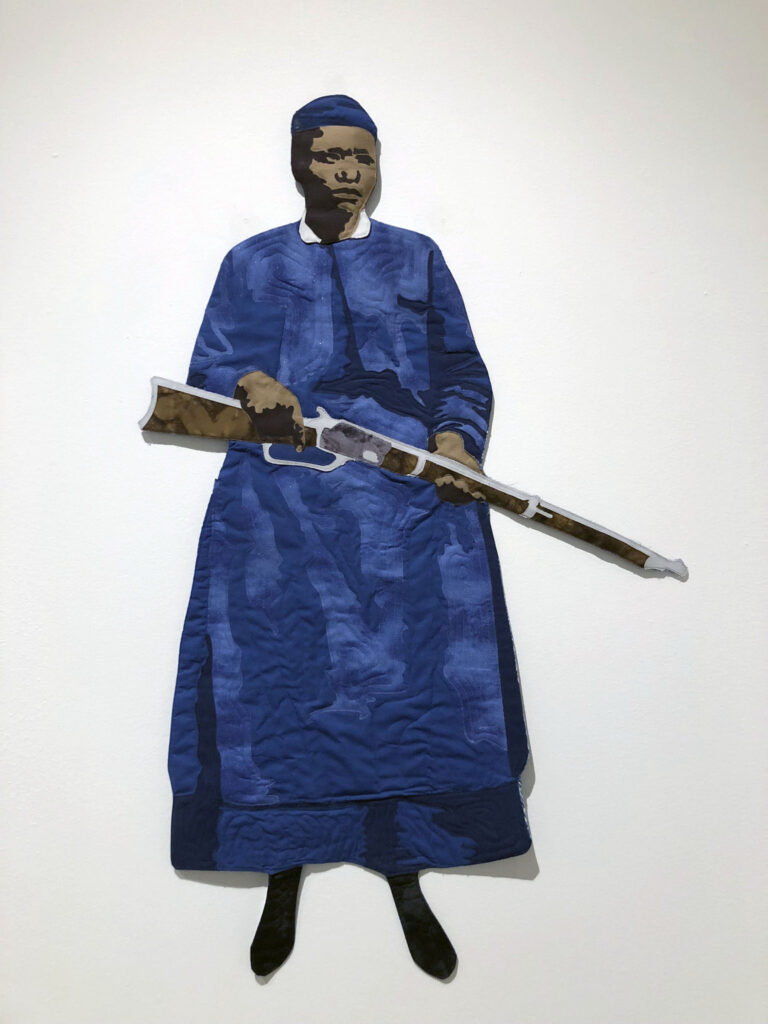
Information from the Museum’s wall plaque on Stagecoach Mary

Mary Fields- also known as Stagecoach Mary, Black Mary and White Crow-became a Wild West legend because she was the second woman and the first African American woman star route mail carrier in the United States.

Born into slavery and freed after the Civil War, she worked as a servant and laundress for families on riverboats before moving to Montana in 1885. A decade later she became a star route carrier, delivering mail using a stagecoach. She drove the 15-mile route from Cascade to Saint Peter’s Mission, Montana, from 1895 to 1903. Nicknamed Stagecoach Mary, she was known for her reliability and speed.

The six-foot-tall Fields was a quick-shooting and hard drinking mail carrier who wore men’s clothing and flaunted a revolver and a rifle. Locals praised her kindness and generosity, and schools in the town of Cascade were closed each year to celebrate her birthday.  Cascade’s mayor granted her an exemption to enter saloons after Montana passed a law forbidding women from entering these establishments.

The impressive quilts on view educate viewers with stories of individuals and events in African American history that may not have previously been familiar, and present new perspectives on those that are. It’s a wonderful way to utilize a visual medium to captivate, inform, and often inspire.

This exhibition closes on 1/8/2023.

Nov 292022
 

Taos Buffalo,1991, by John Nieto can currently be seen at The James Museum of Western and Wildlife Art, in St. Petersburg, Florida.

From the museum’s information plaque-

With vivid fields of color and strong lines, Nieto paints familiar imagery and expresses it the way he sees it. He spent most of his life in New Mexico, inspired by the light, land, and rich history of the region.

“The colors I work with are a reflection of the way I feel. Sometimes I literally see these colors up in the sky, and it is unbelievable for people who don’t live in this area (near Santa Fe). When I am painting, I feel a certain way, and I feel it in terms of a certain color. So I put it down, then that suggests another color.” -John Nieto