Sep 242026
 

Works by Catalina Escallón Rosselli at Paradigm
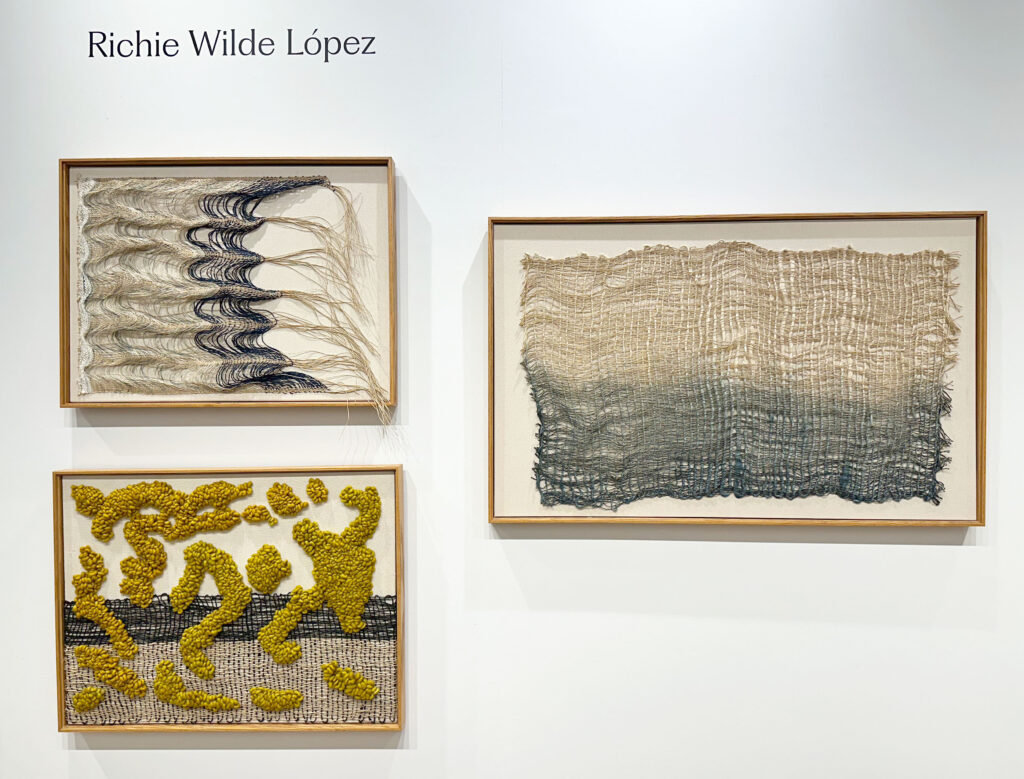
Artwork by Richie Wilde López
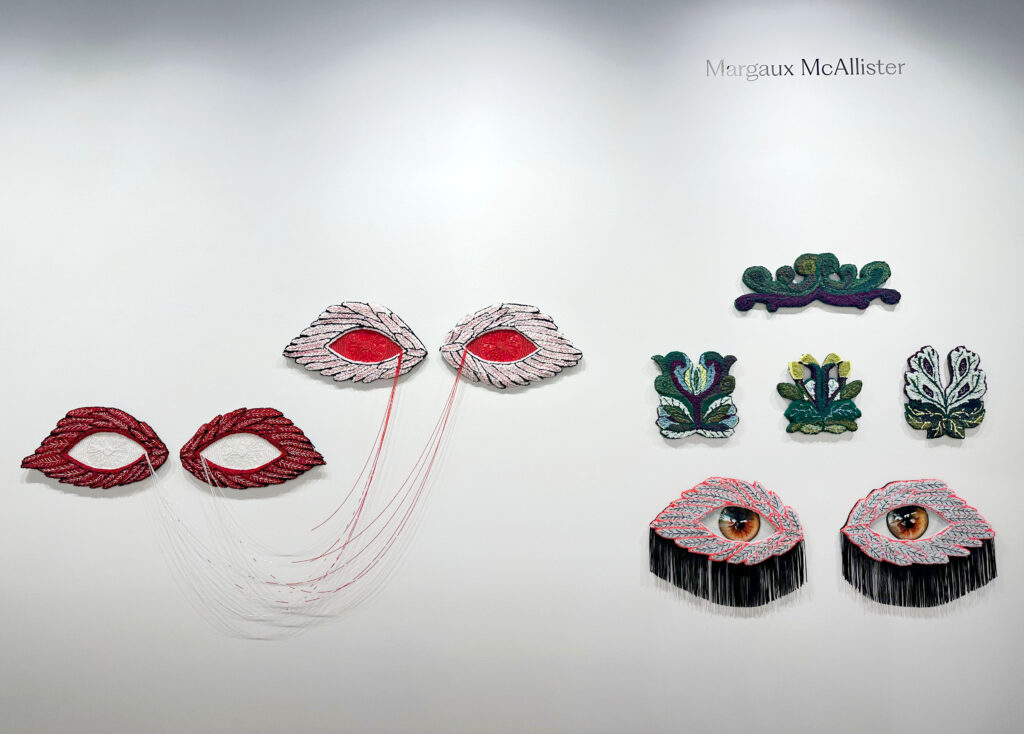
Artwork by Margaux McAllister

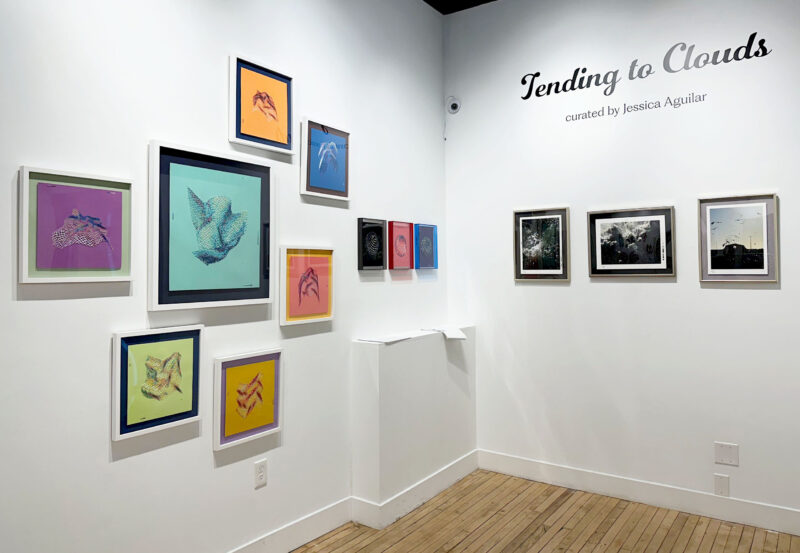
Like clouds drifting across the sky, the hands of Catalina Escallón Rosselli, Richie Wilde López, and Margaux McAllister move patiently and methodically while creating work in their chosen mediums. Several of the beautiful resulting pieces are featured in Tending to Clouds, a fiber arts exhibition curated by Jessica Aguilar, on view at Paradigm Gallery + Studio until 9/27/26.

From the gallery:

Celebrating the expansive medium of hand-crafted textiles, Aguilar brings together three artists who transform simple materials like thread, wool, and banana leaves into dreamscape compositions, grand ensembles, and embellished tapestries. Each artist engages in a personal definition of ritual while embracing repetitions in everyday tasks: tending to gardens, sustaining a home, and, of course, art-making. Each artist follows while not knowing the final results, but maintaining a strong belief in the possibilities. Embroidery artist Catalina Escallón Rosselli builds abstract colorscapes with her delicate threadwork on paper and photographs, evoking soft, beaded veils floating in space. Weaver Richie Wilde López arranges tree fibers, wool, and natural dyes to tell impactful stories in their texture and layering. Tufter Margaux McAllister adorns spiritual symbols on her ceremonial masks, veiling ethereal beings that preside over fantastical plant forms. Each of these transformations requires time and purposeful labor, a habit which these artists channel back into their art, driven by the urge to work basic material to the point of metamorphosis. Fiber is an inherently relational medium, as we all have reference points for textiles in the home: blankets, kitchen towels, upholstery; all the softer places against the hard doors and walls. In the fog of our busy lives, these artists have found meditation and convalescence through fiberwork. As they encourage the material into new form, they demonstrate the impact of slow and meaningful craft in this contemporary landscape.

Dec 192024
 

Lillian Bayley Hoover, “a planet swayed by breath”, 2024, oil on Dibond panel

Lillian Bayley Hoover, “a planet swayed by breath”, 2024, oil on Dibond panel (detail)

Marion Fink, “A mountain top full of achievements-a woman thinking of the sea.”, 2022, monotype, oil color and wax pastel on paper (left) and Lillian Bayley Hoover “here, witnessing now”, 2021, oil and pastel pencil on Dibond panel (right)

Marion Fink, “Night Sky Dreamer”, 2022, monotype, oil color and wax pastel on paper

Lillian Bayley Hoover, “the grass still sings”, 2019, acrylic and oil on Dibond panel, and “no ruined stones”, 2020, oil on Dibond panel

Teresa Shields, “Trending Threads”, 2016-17, embroidered felt and wool letter blocks, wood

Part of The Delaware Contemporary’s series of exhibitions exploring the intersection of art and design, Fissures in the Frame presents work from three artists- Marion Fink, Lillian Bayley Hoover, and Teresa Shields.

From the museum-

Although technology has increased the ease and availability of interaction, human connection has arguably become more difficult. Our daily lives have become reliant on those systems that enable, and even promote, us to interact. Modes of interchange have become more mediated; physical spaces and resources are afforded to those with access, while digital realms are accessible, but commandeer attention away to fabricated unrealities. The undercurrents of which reveal cracks; and fractured existences due to disconnect. Marion Fink, Lillian Bayley Hoover, and Teresa Shields probe these fissures, unveiling their nuance and paradox.

Marion Fink creates layered, large-scale monotype portraits that are rich with narrative elements in surrealistic settings. Raised in the early years of the digital age, Fink’s portraits allude to moments of fragmented realities; the paradox of actual, lived experiences conflated with their existence through the internet. Figures are isolated within fabricated spaces, revealing the parallels between emotion and circumstance. Fink beautifully captures these moments through competing perspectives and complex feelings.
Lillian Bayley Hoover paints landscapes that reveal features realistically while omitting others. These visual fissures that bar the viewer from accessing the remaining painting reflect the perceived separation between nature and the “human world”; one that frequently feels disconnected even though we are all of one world. Hoover investigates how nature is a witness to human life; the designed spaces that shape our world, but also those that we have inherited and how nature acts as a historical record of us.

Multimedia artist, Teresa Shields, presents an interactive installation consisting of 140 individual wooden panels that represent the maximum characters of a post on X (formerly a Tweet on Twitter) and are meant to be moved to form a message. Shields explores our relationship with language; the contradiction between the immediacy of a digital post versus that of a physically crafted message. The activity is simple but offers the opportunity to slow down, collaborate with others, and make new meanings entirely.

This exhibition closes 12/29/24.

Apr 192024
 

Meryl Engler, “Lying in Red”, 2023, Woodcut

Work by Michael Loderstedt (left), Eva Pozler (center) and Lori Kella (right)

Work by Lori Kella, Maria Uhase, and Meryl Engler (right two pieces)

Lori Kella, “Mudslide and Forsythia”, 2022, Inkjet print (left) and Corrie Slawson, “Amalgam 4”, 2022 (top) and “Amalgam 3”, 2022 (bottom), Oil and screenprint on plywood

Today (4/19/24) is the last day to see Life Out of Balance at the Emily Davis Gallery at The University of Akron. The group show show includes work by Maria Uhase, Meryl Engler, Lori Kella, Benjamin Lambert, Michael Loderstedt, Eve Polzer, Ron Shelton, Ariel Bowman, and Corrie Slawson.

From the gallery-

When a tree falls in a forest, we may see it as the death of the tree. It stops photosynthesizing, growing, feeding its mycorrhizal symbionts, flowering, developing fruit, dispersing seeds, taking in carbon dioxide, and producing oxygen. But in the ecosystem, it begins a whole new life in decay. It feeds the soil and microbes through the decomposition of its tissues; it provides a place for fungi, mosses, and lichens to grow; and it becomes a protected habitat for a myriad of insects, mammals, and birds. This same tree, therefore, can be both dying and living at the same time, depending on perspective. It can be dead if considered separate from its surroundings, or it can be alive in its continued relationship within its ecosystem.

Humans can feel more alive by being integrated with the rest of the natural world. We are not living to our full potential, or allowing nature to be its full potential, when we consider ourselves as separate from it.

If we are to have hope for solving the complex environmental issues that are facing us today, we need to work with, rather than against, the forces of nature.

Below are a few more selections.

Ron Shelton, “Yellow Mosaic”, 2021, Plastic and wire

Ariel Bowman, “Wall Trophy Series”, 2019, (Cave Bear, Antique Bison, Early Horse, Saber Cat, Dodo, Brontotherium, Parasaurolophus), Unglazed, high fired porcelain; Maria Uhase, “Splitting Headache”, 2022 Ink on paper and “Softly”, 2023, Graphite on paper

Ariel Bowman, “Wall Trophy Series”, 2019, (Cave Bear, Antique Bison, Early Horse, Saber Cat, Dodo, Brontotherium, Parasaurolophus), Unglazed, high fired porcelain

Benjamin Lambert, “A pint for a gallon”, 2020 and “I Found Your Damn Lost Shaker of Salt”, 2020, Stoneware, underglaze, glaze, epoxy

Corrie Slawson, “Stage Set Tapestry 1, for Feast: a ballet. Of Bats, Blue Footed Boobies, Penguins and other threatened fauna and flora. Pastoral landscape after Rubens”, 2020, Oil and mixed media on muslin

Corrie Slawson, “Stage Set Tapestry 1, for Feast: a ballet. Of Bats, Blue Footed Boobies, Penguins and other threatened fauna and flora. Pastoral landscape after Rubens” (detail)

Michael Loderstedt, “Snakehead”, 2023, “Thistles”, 2023, Cyanotypes on fabric, embroidery, fabric collage

Lori Kella, “Mayflies in the Grass”, and “Yellow Irises”, 2024, Framed inkjet prints

Maria Uhase, “Encircled”, 2023, Oil on linen panel, “Worm”,2023, Oil on linen and “Conglomeration in the Spiders’ Ghost Town”, 2020, Oil on canvas

Eva Polzer, “Gift from a Cat”, 2024, Ceramic, underglaze, velvet jewelry box, and “Gift from a Rat”, 2024, Ceramic, underglaze, petri dish

Meryl Engler, “Waiting”,2023, Woodcut Block


Mar 162024
 

Stephen Tornero “Don’t Tell Me” Hand dyed wool, acrylic rods

Chad Troyer “Crashing Waves” (bottom) and “Calming Shores” (top) Jacquard-woven, gradating waffle weave; Cotton, linen, rayon, silk, birch

Jen P. Harris “Oscillator” (left) and “Sphinx” (right) Hand-woven cotton, canvas, gesso, and thread on wood stretcher bars//Hand-woven cotton, canvas, thread, and acrylic paint on wood stretcher bars

Trey D. Gehring, “Stacked” Woven cotton yarn, crocheted acrylic yarn, fabric paint

Etta Sandry “Pivot: Moi-même” and “Pivot: Big Squish”, Cotton and cottolin, handwoven on Jacquard loom//Cotton and wool, handwoven on Jacquard loom

There are some incredible pieces in Waffle Weave Invitational, one of the current exhibitions at Summit Artspace. A few selections are pictured, but head to the gallery’s website to see all of the work on view.

From curator Stephen Tornero (who also has work in the show)-

This show was conceived as an idea to focus on a specific structural variable of a textile, and see how many different variations artists, artisans, and craftspeople would be able to produce. While researching the development of weaving technology, a loom with the capability to create complex structures was developed around 600 CE simultaneously in different cultures. This structure could have been produced by these looms, but also could have been designed much earlier by hand-manipulation of threads by the weaver. The waffle structure is so unique in its ability to transform a textile- seemingly a two dimensional surface- into a three dimensional object that has depth as shown by many repeated square pyramidal cells. Historically, this structure was used to create a textile that would hold water in its cells for cleaning or drying, or to help insulate the body with tiny pockets of air.  This structure can be modified by changing the color of the threads with which it is woven, the fiber content of those threads, or even by expanding the amount of threads used in a cell, expanding the scale. 

Statements from the artists about the work pictured above (from the Summit Artspace website)-

Stephen Tornero– Don’t Tell Me– “This piece is part of a continuing study of material, color, and structure in textiles. I have been mesmerized with the “waffle weave” structure and its ability to create large, three dimensional pockets of space. This pieces experiments with the combination of the flexible, fibrous wool yarns with the rigid neon acrylic rods. These two materials are combined in a large textile in order to explore the effects that this unique weaving structure will have on these materials. This use these two opposing materials in the piece creates a dialogue between the traditional usefulness of this wool weaving and its display on the wall as a work of art.”

Chad Troyer– Crashing Waves and Calming Shores– “The gradating structure allows for the weft to float acrost the surface of the weaving for varying lengths, from half an inch to nearly the whole width. The warp is allowed to float for varying lengths, but not nearly as long as the weft. After it was taken off the loom, the weaving was stretched. Parts of it were pulled, and others were left loose, allowing the floats to be accented by the folding and tautness of the cloth. The two pieces are the same piece of cloth cut apart, however they both display a different state of being: turbulent & calm.”

Jen P. Harris– Oscillator and Sphinx– “These small weaving-painting hybrids are part of an ongoing, experimental body of work in which I am developing a heterogeneous formal language that both honors and questions histories and conventions of painting and weaving.”

Trey D. Gehring– Stacked– “Stacked follows a line of investigation by the artist into a poststructuralist analysis of language as a system of symbols that lack meaning beyond context. The piece melds the namesake with the woven structure itself creating a hyper-literal interpretation of the exhibition’s theme. However, an understanding of the theoretical underpinning is unnecessary and secondary to the enjoyment of the whimsical and humorous nature of the work.”

Etta Sandry– Pivot: Moi-même and Pivot: Big Squish- “My woven work focuses on samples that explore dimensionality in woven cloth using techniques such as multi-layer weaving, pleating, and woven structures that are elastic, self-shaping, and otherwise transformative, like the pocketed cells of waffle weave. This work creates a series of translations between the flat draft and the materiality of the cloth. Weaving is a technically binary structure: a warp thread can be either raised or lowered. When drafted, woven structure is drawn as a flat grid. Woven in multiple layers, cords, and pleats, weaving maintains its inherent binary nature but takes on a new physical dimensionality. Between the flat draft and the woven cloth, there is an unknowable material transformation that reflects the nuance, radical variation, and possibility that emerges from a seemingly set and limited system. In these works, this variation is expressed through two large waffle weave samples that test the limits of the waffle structure. Each piece weaves the same design of increasingly large waffle cells. Moi-même presents a balanced the waffle weave in which warp and weft threads of a similar weight and color draw out a subtle loosening of the structure as the size of the cells increase. In The Big Squish, the waffle structure is boldly packed, extended and distorted by colorful wool wefts.”

This exhibition closes 3/16/24.

Aug 042023
 

The work above is from Regina Durante Jestrow’s current exhibition Free Form Connections at Dunedin Fine Art Center.

The artist’s statement about the exhibition-

This exhibition includes my organically shaped geometric art quilts from various series from 2020-23. I utilize improvisation, repeat patterns and shifts in scale while incorporating colors, textures, and structures representative of the diversity of the people and the natural surroundings of my current home in South Florida.

I use diversely toned second-hand, gifted, or saved fabrics and dyes from locally sourced plants and rust. Textiles are also manipulated with burning and staining with inks and acrylic paint. Other materials, such as neoprene, sequins, and faux leather, reference Miami’s pop culture.

Along with my constant interest in American Folk-Art Quilts, geometric-abstract artists from the mid to late twentieth century are my influencers, including Gees Bend quilters, Elizabeth Murray, Helen Frankenthaler, Anni Albers, and Gego. These artistic voices have driven me to create quilts of scale with strong personal symbolism and narrative.

This exhibition is on view until 8/13/23.

Dec 202022
 

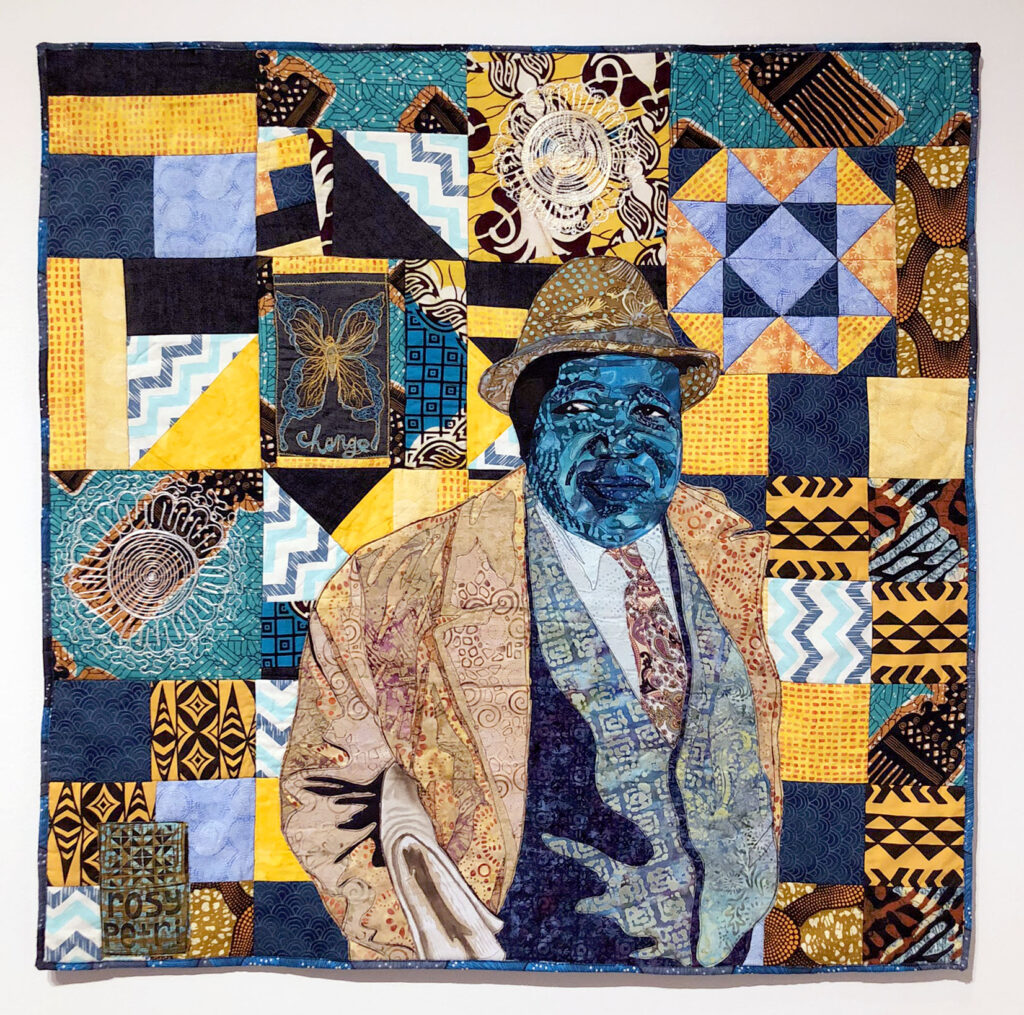
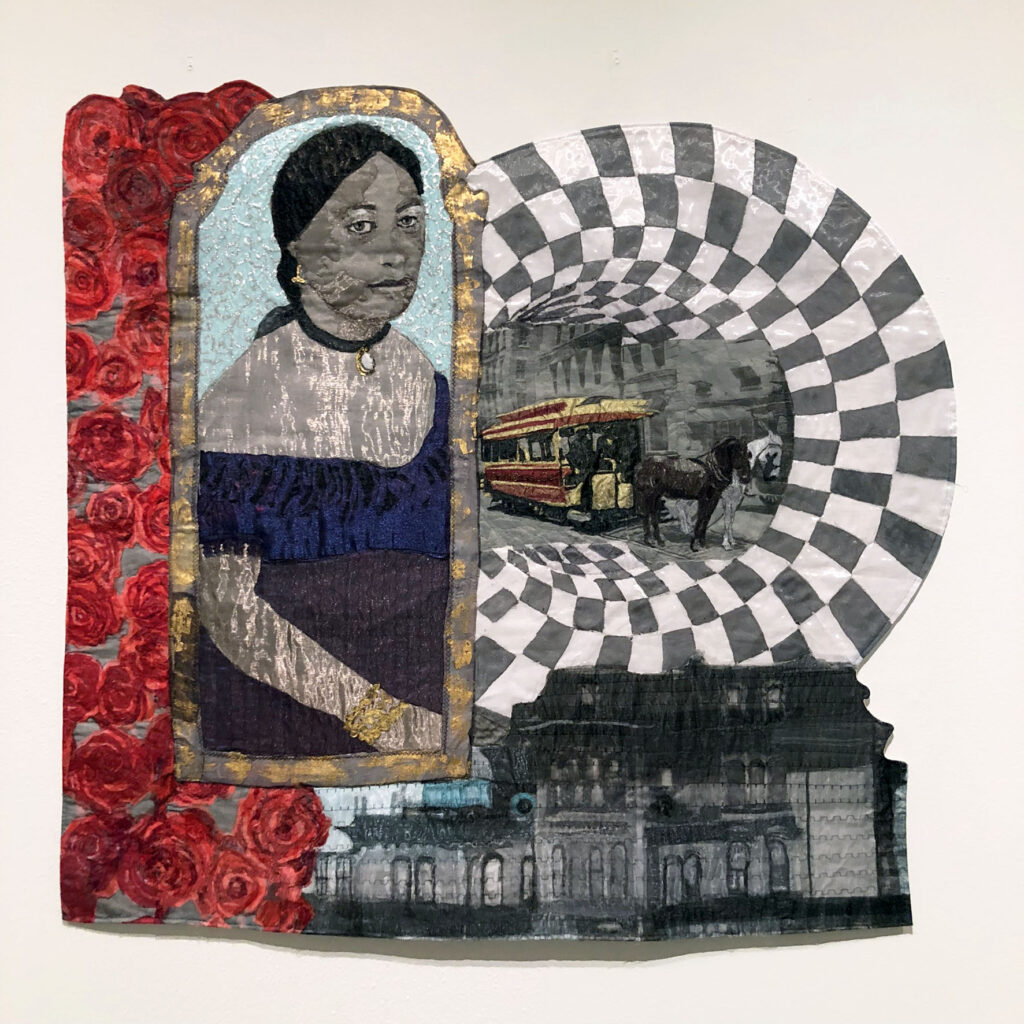
“Call Me Mrs. Mary E. Pleasant: The Midas Touch” by L’Merchie Frazier

Pictured above is a portrait of entrepreneur, civil rights activist and benefactor, Mary Ellen Pleasant who made a name and a fortune for herself in Gold Rush era San Francisco. Her timeline from 1814 to 1904 begins in racial slavery as an indentured servant girl with no formal education. She ascended to a self-made millionaire, amassing a fortune in her lifetime of over $30 million, ($900 million today).

Organized by historian, artist, and curator Dr. Carolyn Mazloomi, “Black Pioneers: Legacy in the American West” at The James Museum of Western and Wildlife Art, consists of 50 pictorial quilts created by members of Women of Color Quilters Network, a group founded by Mazloomi in 1985.

Mazloomi’s statement at the exhibition entrance-

American history is incomplete without the stories of African American men and women, from our enslaved ancestors to our societal challenges. The role of African Americans in the movement toward westward expansion has been largely overlooked. This exhibition of original pictorial quilts brings into focus the rich and diverse stories and achievements of Blacks in American western history. The timeline begins with Esteban’s 1528 arrival in the West and continues through the Civil Rights Movement.

At the end of Reconstruction in the South, discrimination and segregation caused African Americans to seek opportunities where there was less prejudice. In the 1800s, they moved by the thousands to the American West. Some went West as slaves, while free African American men joined the United States Army or became ranch hands, fur traders, cowboys, or miners.

Why quilts? Quilts and quilt making are important to American, and Black culture in particular. The art form was historically one of the few mediums accessible to marginalized groups to tell their own story, to provide warmth for their families, and to empower them with a voice through cloth. Using quilts to tell these stories accentuates the intersections of African Americans in the Western frontier while at once informing about the art form and its role in Black history. It is this often unknown and underappreciated shared reality that must be voiced if we are ever to truly value the unique contributions diverse groups make to the fabric of our nation.

Two more selections from the exhibition are below, although it was very hard to choose which quilts to highlight- there are so many great ones to choose from.

“A Good Soldier: Thomas C. Fleming, America’s Longest Serving Black Journalist” by Rosy Petri

At the time of his retirement in 1997, California journalist Thomas C. Fleming was the nation’s oldest Black journalist with the longest consecutive period of publication.

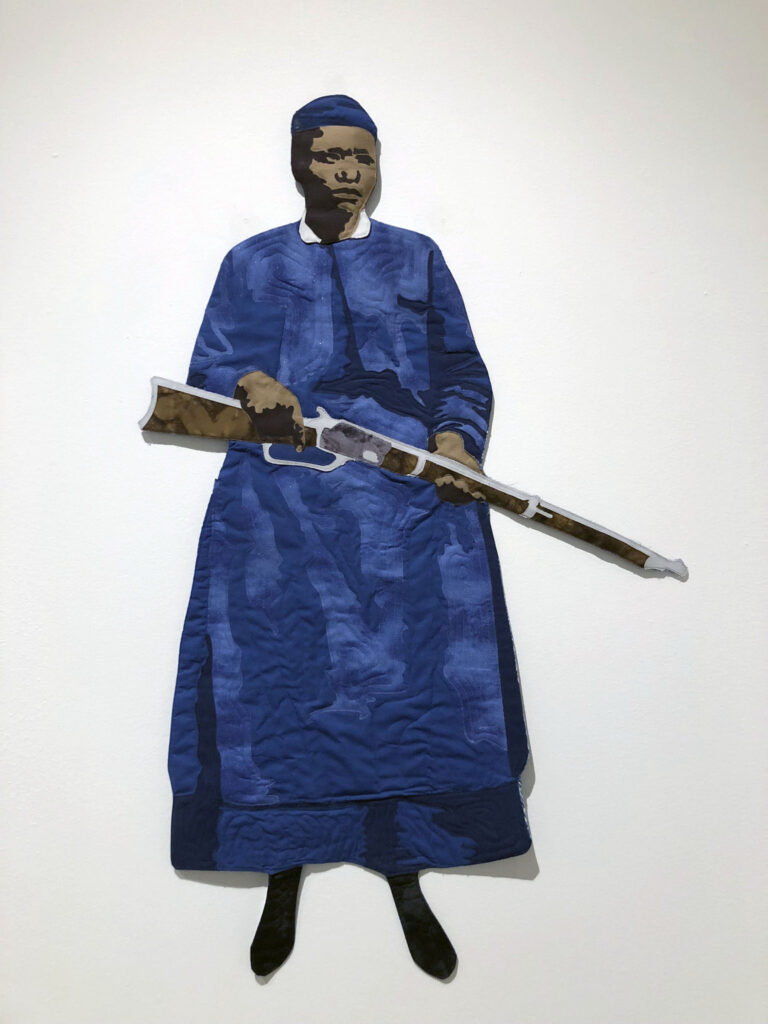
Information from the Museum’s wall plaque on Stagecoach Mary–

Mary Fields- also known as Stagecoach Mary, Black Mary and White Crow-became a Wild West legend because she was the second woman and the first African American woman star route mail carrier in the United States.

Born into slavery and freed after the Civil War, she worked as a servant and laundress for families on riverboats before moving to Montana in 1885. A decade later she became a star route carrier, delivering mail using a stagecoach. She drove the 15-mile route from Cascade to Saint Peter’s Mission, Montana, from 1895 to 1903. Nicknamed Stagecoach Mary, she was known for her reliability and speed.

The six-foot-tall Fields was a quick-shooting and hard drinking mail carrier who wore men’s clothing and flaunted a revolver and a rifle. Locals praised her kindness and generosity, and schools in the town of Cascade were closed each year to celebrate her birthday.  Cascade’s mayor granted her an exemption to enter saloons after Montana passed a law forbidding women from entering these establishments.

The impressive quilts on view educate viewers with stories of individuals and events in African American history that may not have previously been familiar, and present new perspectives on those that are. It’s a wonderful way to utilize a visual medium to captivate, inform, and often inspire.

This exhibition closes on 1/8/2023.

Dec 072022
 

For the months of November and December, Brenda McMahon Gallery is focusing on Fiber Arts, and Marlene Glickman is one of the artists included. Her fabric collages are made with hand dyed and found fabrics that she then embellishes with thread drawings.

Another one of her projects is using instant setting dyes to create silk scarves. She teaches workshops on the process and also sells kits to do it on your own. She recently gave demonstrations at the Dunedin Fine Art Center (as part of their Open House) and at Art in the Park! in Clearwater, where the scarves pictured below are from.

Glickman’s artist statement from her website–

Art, for me, is the act of expressing ideas regardless of the medium and sharing them with others. I see things and am compelled to create with them. I also love to encourage viewers to interact with my art and put their imprint on the work. Creating 3D sculptural forms and textile “paintings” using new and found materials is a passion.