
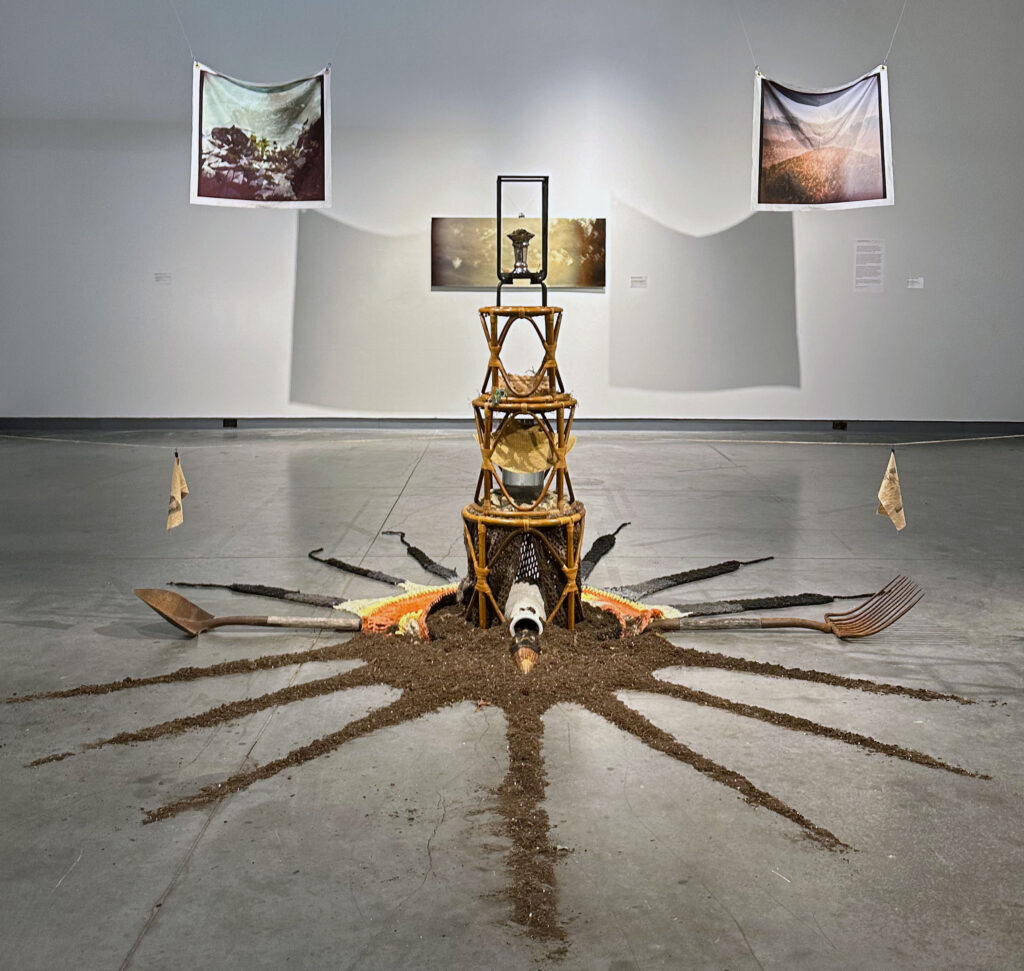
Vetiver (Vonne Napper), “without you there is no me”, 2026 (center installation) and photographs by Niama Safia Sandy
In Tree Watching at The Delaware Contemporary, four artists, Claudia “Aziza” Gibson-Hunter, Vetiver (Vonne Napper), Wanda Raimundi-Ortiz, and Niama Safia Sandy, present work inspired by the natural world. Curator Maleke Glee chose these artists based on their connections to this theme and to the work of artist Zoë Charlton.
From the museum:
Tree watching refers to the meditative practice of observing trees. Across cultures, trees have long been understood as custodians of history and portals to the spiritual realm. Here, we also acknowledge trees as watchers of our personal and collective lives—another kind of archival medium, legible only to those who revere them. Memory becomes a tool through which artists recreate real landscapes while also depicting psychological ones. In Zoë Charlton’s practice the lines between the real and imagined blur within the pictorial field and we see a sustained connection between figure and landscape. Materially, through papermaking, large-scale drawing, collage, photography, and installation, she shares her related explorations by collaborating with curators and artists.
Curated by Maleke Glee, Tree Watching responds to Charlton’s conceptual practice, in which landscape becomes a site for considering the body’s relationship to land and inheritance, bringing into conversation the practices of several accomplished artists. Though rendered differently from Charlton’s practice, these artists source inspiration from familiar lands, ancestral memory, and the expansive legacies of their diasporic communities. Tree Watching presents the work of Aziza Gibson-Hunter, Vetiver (Vonne Napper), Wanda Raimundi-Ortiz, and Niama Safia Sandy, artists united by their engagement with and reverence for the natural world. Their practices consider both natural and psychological landscapes, allowing the physical and metaphysical to meet through land stewardship, medicinal knowledge, foodways, socio-political histories, and the cultures held by the land’s inhabitants.
While trees may look different from one place to another, they grow according to a shared logic: at different paces, to different heights, bearing different fruit, yet remaining rooted as they reach upward toward the sky. Similarly, these artists draw on their cultural and aesthetic lineages to ground practices that bloom toward personal enlightenment, higher consciousness, and self-actualization.
Tree Watching blurs the lines of witness—between observer and observed, memory and presence, rootedness and transcendence. In this suspension, submission to the spiritual becomes possible. We are reminded of Indigenous ways of being and thinking with ourselves, with one another, and alongside the earth. For Charlton and Glee, authorship is not treated as a closed or solitary position. It is shaped through invitation, interpretation, collaboration, and public acknowledgment.
Below are the artists profiles from the museum and more of work from the exhibition.
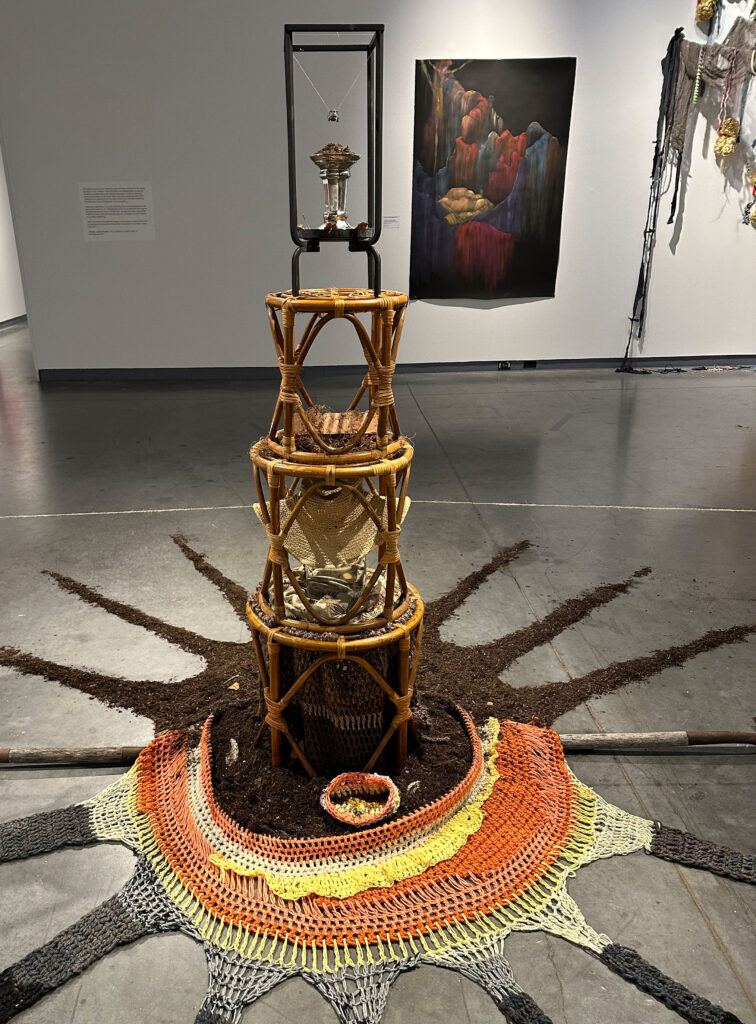
Another view of the installation by Vetiver
“without you there is no me is an assemblage sculpture that features found objects, harvested organic material from inherited land (Lacy Oasis), and a crochet textile that reimagines mycelium. The gathered pieces are representative of mediums within my practice and speak to the contraction and expansion of family legacy through spiritual, biological, and material inheritance.”
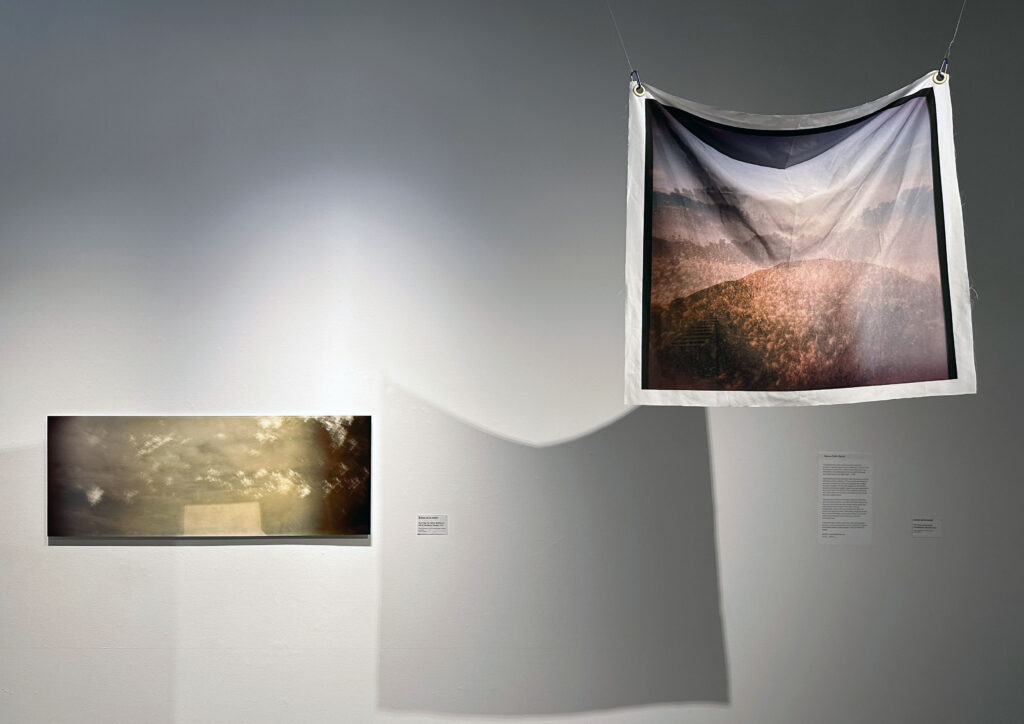
Photographs by Niama Safia Sandy
“I wandered the scenes and the sea that carried the ancestors’ essence searching for something to connect us to the things we cannot see. I want to evoke these memories embedded in the landscape so that we might find beauty and a path toward new beginnings.” – NSS
Niama Safia Sandy’s photographs mark her travels across the Americas and the Caribbean. These pursuits are shaped by personal record and by the sensory experiences recalled through a snapshot. Yet they also engage the atmospheric textures and histories carried in water particles, suspended in the air, and held in the soil that forms a platform supporting her current steps, and an archive, holding histories of those who have walked before.
These locales-Trinidad and Tobago, Baltimore, Maryland, and Teotihuacán, Mexico-are filled with natural beauty, but they also hold political records: compromised, partial, and often limited by the narrator of the story. Through photographic means, often accompanied by reflective writing and historical citation, Safia Sandy engages her own form of critical fabulation, intervening in history’s absences while recognizing elemental influence as a merited knowledge base.
Created through multiple exposures, these photographs present a sense of timelessness, as the movement, evolution, and layered stories of place appear contained within the image.
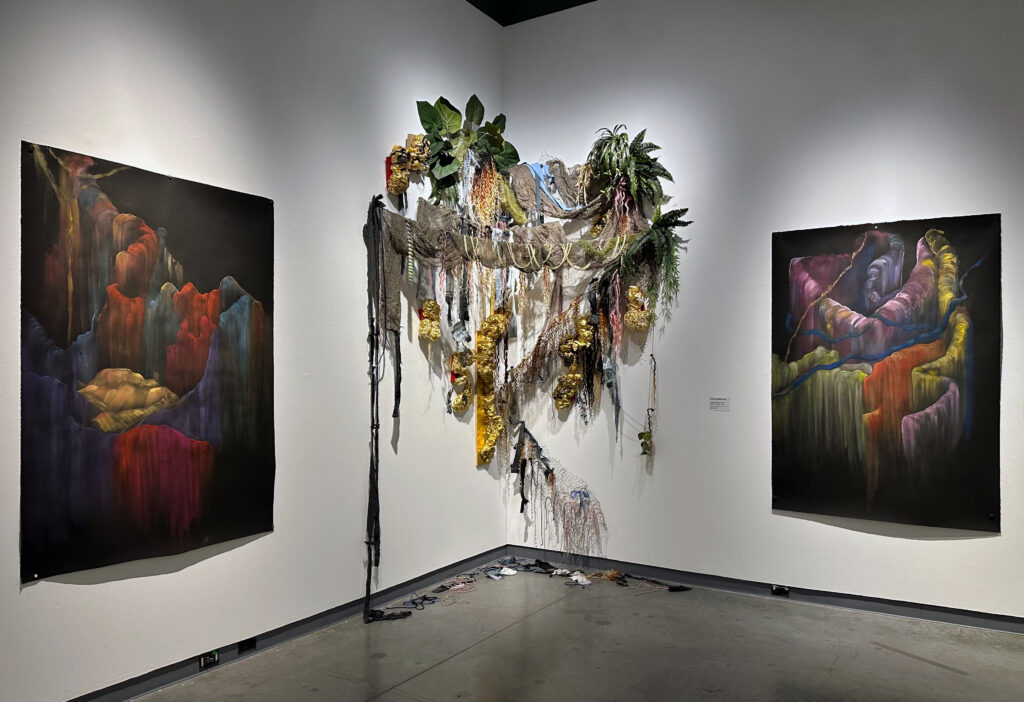
Works by Wanda Raimundi-Ortiz
Wanda Raimundi-Ortiz draws lessons from nature: from close observations of her home garden to witnessing nature consume the debris left in the wake of Hurricane Maria in Puerto Rico. She turns to the natural world as a guide, distilling what it reveals about the human condition. Like ecology, we adapt to manmade structures and atrocities, finding ways to survive, reroute, and grow around what has attempted to constrain us.
Raimundi-Ortiz’s practice ranges from portraiture, performance, and installation to more recent forays into abstraction, where she considers how environments feel rather than how they look. How does the mind remember a place? In that act of remembrance, what colors, forms, smells, textures, and other sensory fragments emerge?
Her installations and conceptual works engage the remnants of everyday life in urban and suburban environments. In them, we encounter another kind of foraging: a repurposing of commercial and found objects coded with cultural meaning, such as gold hoops, hair, and other materials sourced from beauty supply stores. These elements make her “Wig Variants,” which extend across walls and surfaces as they grow in scale and presence.
In this way, Raimundi-Ortizs practice traces the imprint of coloniality on both the body and the environment. Over time, the ever-growing modes of resistance become pronounced enough for their evidence to be seen and felt as deeply rooted, persistent, and impenetrable.
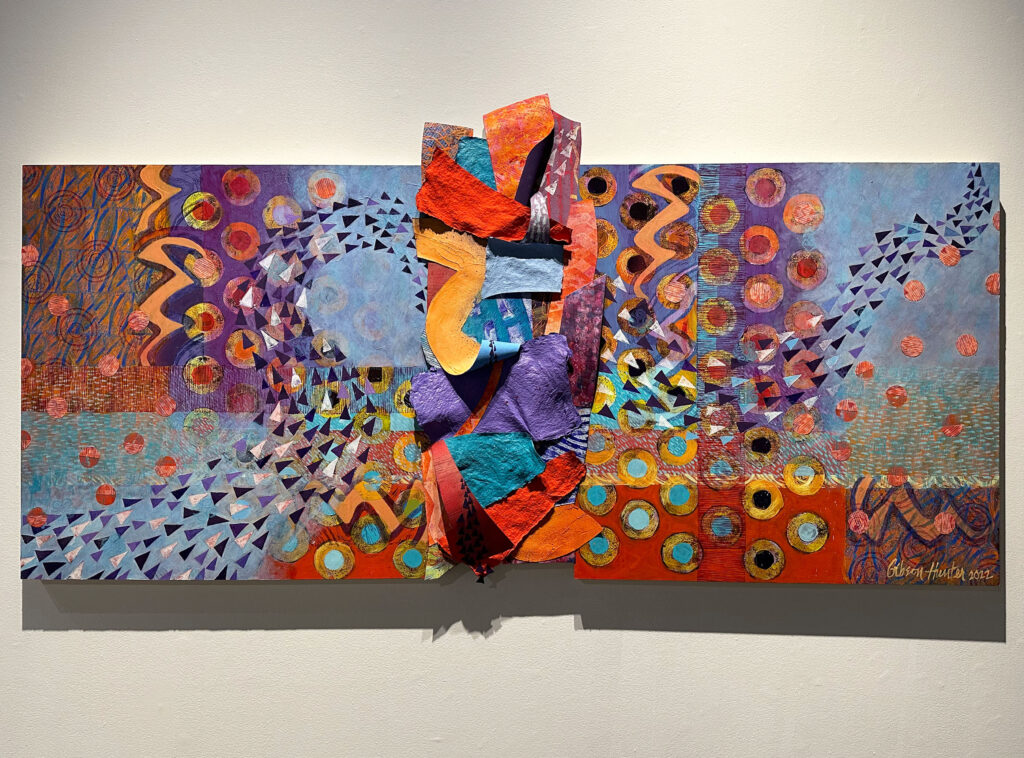
Claudia “Aziza” Gibson-Hunter, “Skyborne Deliverance”, 2022
Inspired by Toni Morrison’s Song of Solomon, this triptych reflects inherited African American knowledge systems carried through literature, oral history, and relationship to the land. In the novel, Macon “Milkman” Dead Ill travels from Michigan to Virginia on a transformative journey, where the pursuit of material wealth gives way to an encounter with ancestral land, familial memory, and spiritual inheritance. Here, the journey itself rather than the intended destination is the prize. The submission to spirit and release of ego is a primary lesson.
Claudia “Aziza” Gibson-Hunter has a deep investment in folktales, and in flight. Skyborne Deliverance, like many other of her collages, include a procession of bird-like figures in flight. Using sacred geometry, Gibson-Hunter’s collages layer meaning akin to the layering of paper.
These works together are part of her series, “flight school,” which uses abstraction to depict the vitality of African Americans. A focal inspiration is the Reconstruction Era (1860-1880) and its related scholarship produced by W.E.B. Du Bois.
“Flight School is both a lesson and offering-a study in energy, resilience, and transformation. It is where my ancestors, nature, and spirit have sent me to learn, and my art is how I return the lesson, completing the circle.” – CGH
This exhibition closes on 11/29/26.