Aug 062026
 

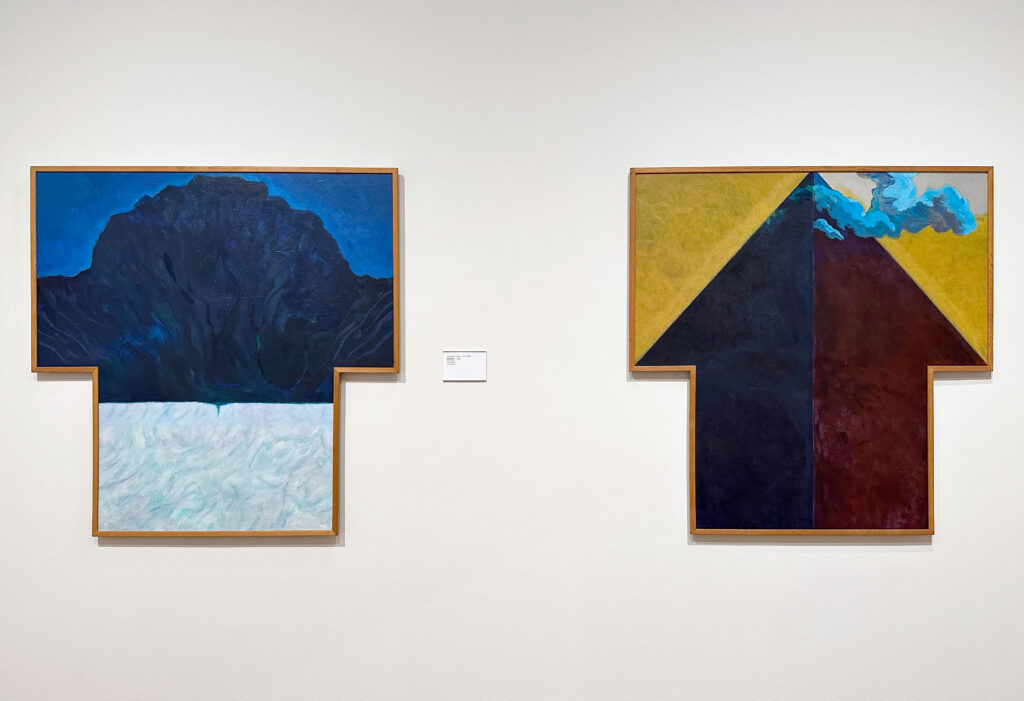
Leonard A. Harmon, “Untitled”, c.1980s, Oil on masonite

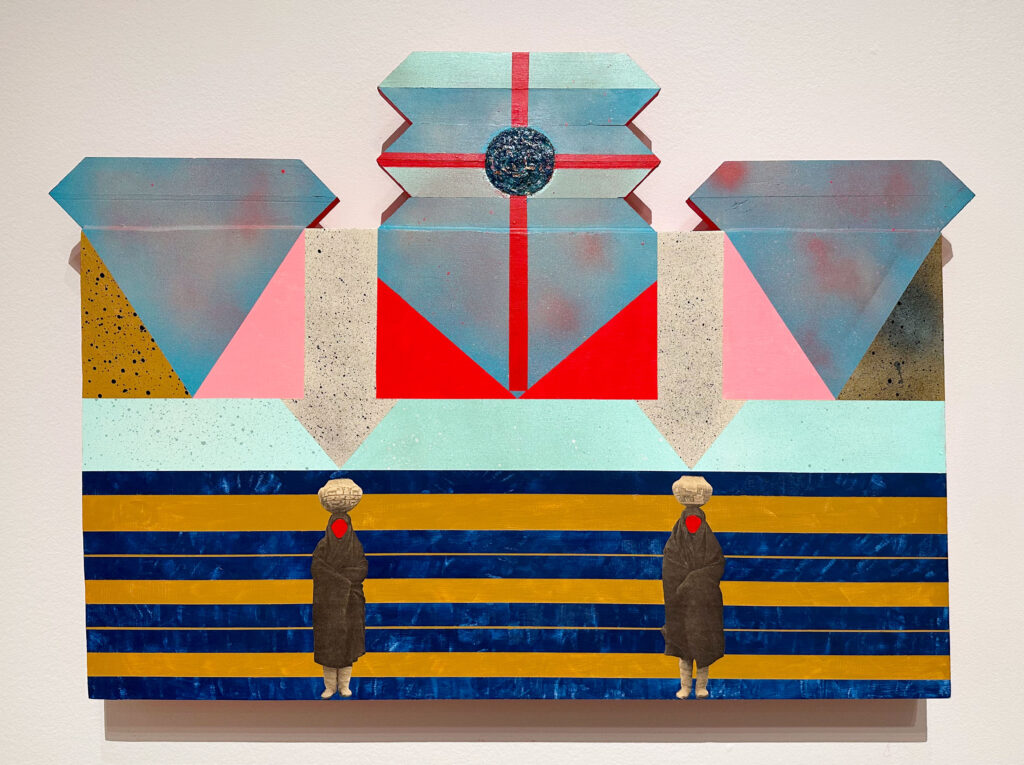
Leonard D. Harmon, “Last Copper Moon”, 2025, Acrylic, spray paint, oxidized copper shavings, paper on wood panel

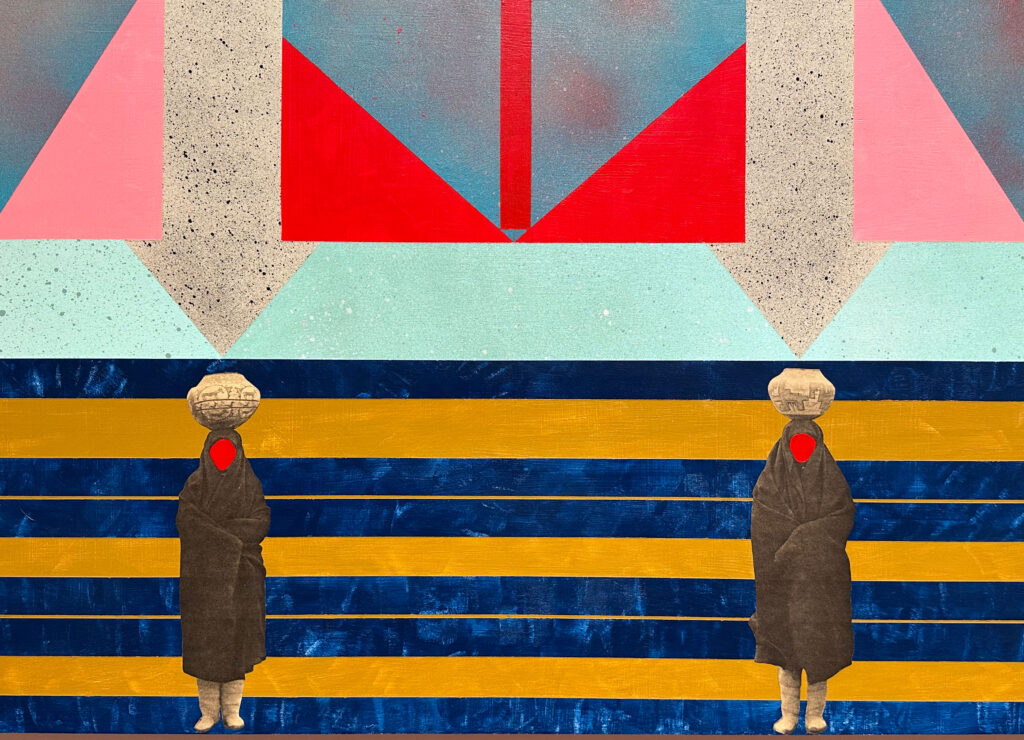
Leonard D. Harmon, “Last Copper Moon”, 2025 (detail)

Delaware Art Museum‘s Living Indigenous showcases and celebrates Indigenous communities and artists in multiple locations in the museum. The exhibition is part of the museum’s programming for the 250th anniversary of the United States.

Developed in partnership with the Nanticoke Indian Museum, one room dedicated to works created by Indigenous artists includes paintings by Leonard A. Harmon and his nephew, Leonard D. Harmon.

From the museum and artist about Last Copper Moon (pictured above):

Leonard D. Harmon notes the rich artistic legacy that precedes him. He explains, “I draw inspiration from my ancestors to infuse a modern twist into traditional arts.” This painting references the architectural forms his uncle, Leonard A. Harmon, was creating in the 1980s. A copper moon, or total lunar eclipse, is a sacred Indigenous occurrence, and the images Harmon includes refer to associated rituals.

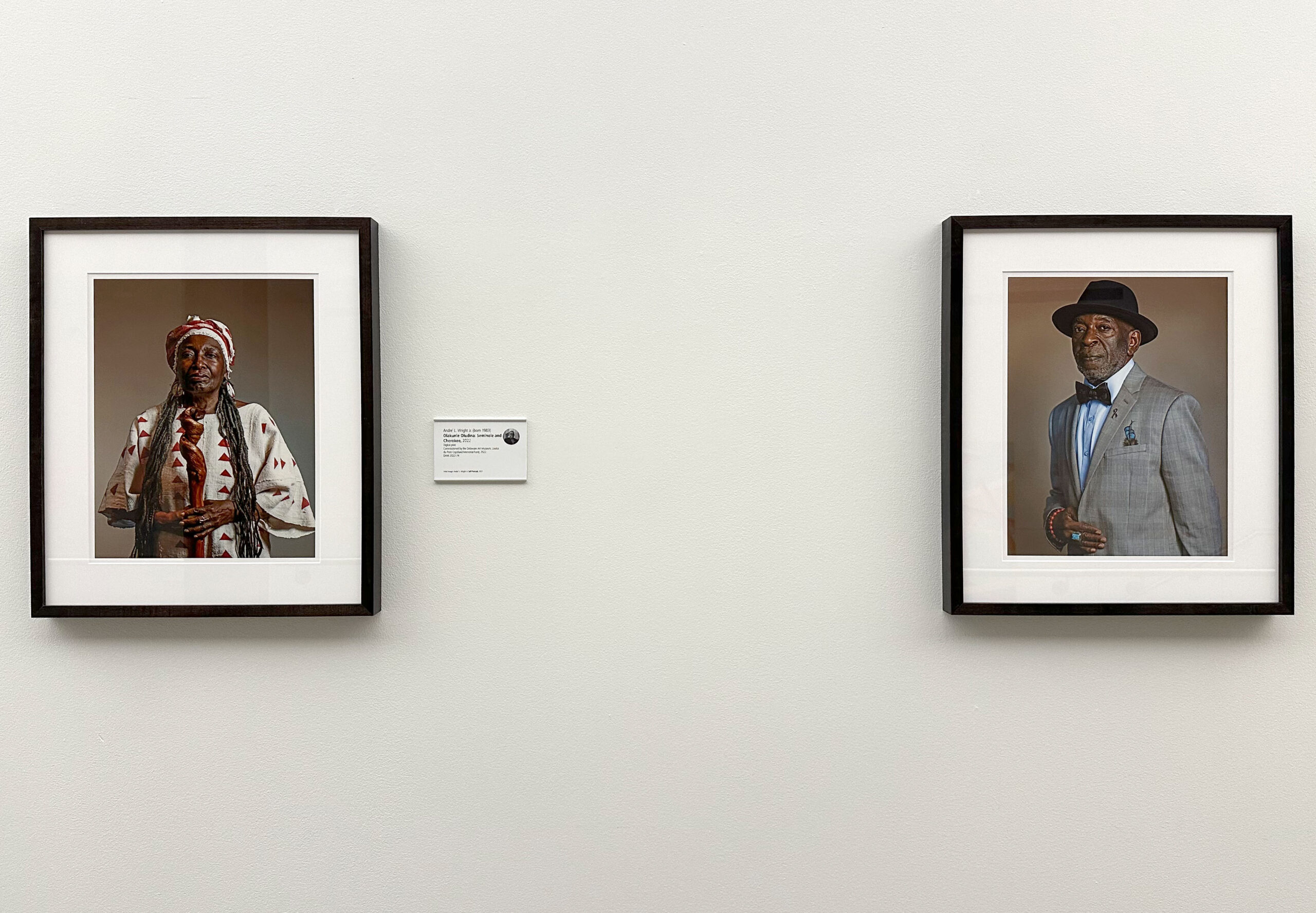
The exhibition continues upstairs with two different series of portraits of members of Delaware’s Indigenous communities– Will Wilson‘s Critical Indigenous Photographic Exchange (CIPX) and Andre’ L. Wright, Jr.’s Indigenous Faces of Wilmington. In 2022 the museum invited Wilson to continue his CIPX project in Delaware and facilitated a photoshoot of citizens of the Lenape Indian Tribe of Delaware (The Original People) and the Nanticoke Indian Tribe (The Tidewater People). That same year the museum also commissioned Andre’ L. Wright, Jr. to create a project showcasing diverse Wilmingtonians, two of which are pictured below.

Two portraits by Andre’ L. Wright, Jr. from his series “Indigenous Faces of Wilmington”

Living Indigenous is on view until 8/23/26 and the museum is free to visit every Thursday from 4-8pm.

Jul 222026
 

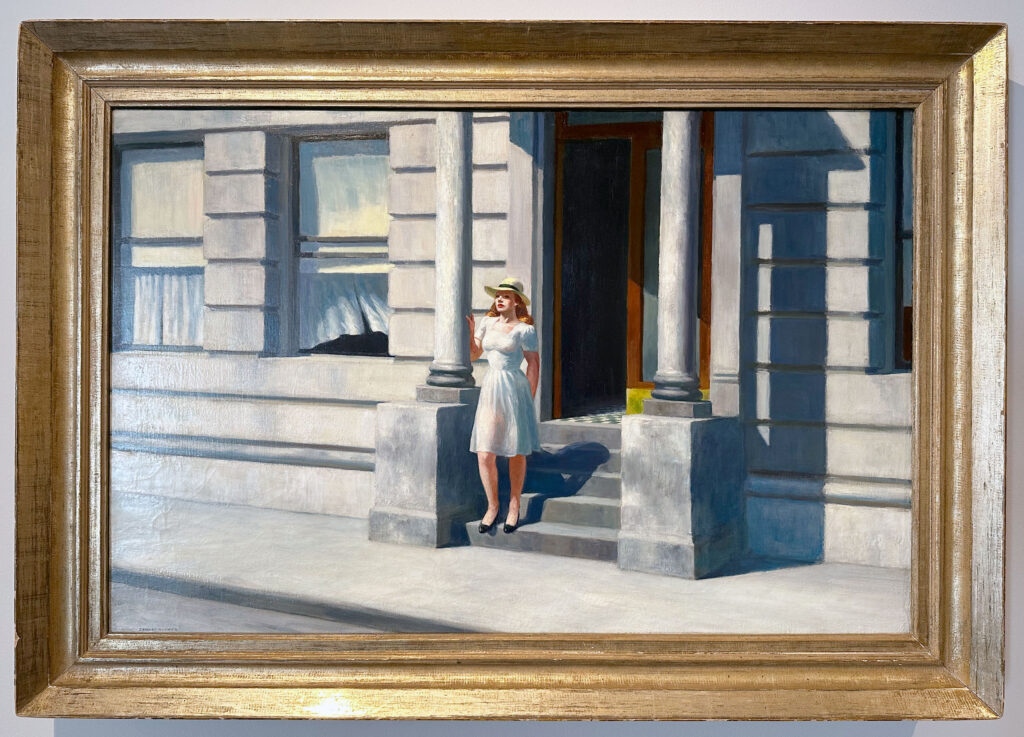
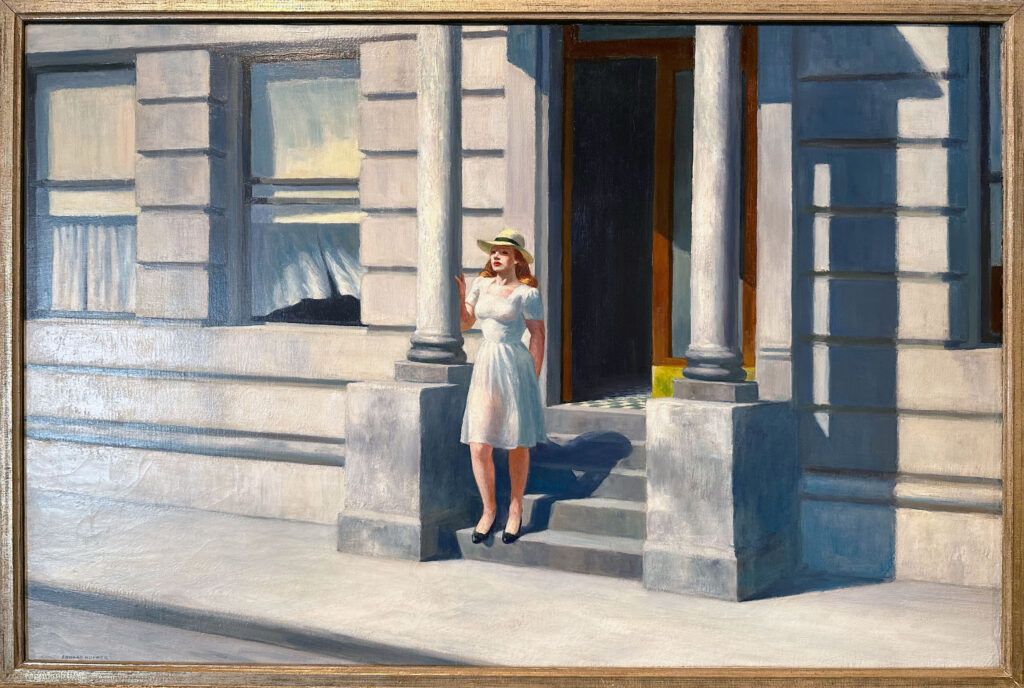
American artist Edward Hopper was born today, July 22nd, in 1882. He created numerous portraits of people in New York City, including the one pictured above, Summertime, painted in 1943.  It is currently on view at the Delaware Art Museum.

Jul 172026
 

Old televisions and clock radios are given a second life in the interactive sculptures in Emily Francisco‘s exhibition, Alchemical Signal Flow at The Delaware Contemporary. The exhibition also includes videos and documentation of some of Francisco’s other projects, and a few cyanotype prints.

From the museum:

What is a signal? We often think of cell phone reception, or a message sent through a digital app. A signal means many things in this exhibition, it references the transfer of physical data and digital data (ones and zeroes) that happens within technology. A signal can also be social, like how you dress, what brands you buy, or what you throw away. Emily Francisco combines old and new technology to help us rethink how we live with new and changing technology. To many, the mechanics of a harpsichord (a keyboard instrument) and organ are as magical as an MP3 player. Francisco embraces that magic and makes alchemy of blending old and new, low and high tech.

Francisco uses cheap everyday technology and discarded, obsolete (or no longer produced) devices. By doing so, she disrupts signal flows from user to speaker. This action challenges our expectation of call-and-respond and challenges our sense of time. Someone once owed every piece of discarded tech. One could have even been yours. She asks us to think about what these personal objects mean to us at the end of the day. What do they mean to us?

Through her work, she brings together the memory, nostalgia, and aspiration these objects hold, attempting to give them new purpose.

This exhibition closes 8/2/26.

Jul 092026
 

New Deal Posters

Willie Cole, “Rolanda”, November 5, 1978, Pastel on brown paper bag. This work was created while Cole was a CETA employee in Delaware

Photographs from the 1975 CETA-funded project “CITYSIGHTS/CITYSOUNDS” in Wilmington

Dorothea Lange, “Migrant Mother, Nipomo, CA”, 1936

Clockwise from top left: William Davidson White, “Children in the Tree”,1934; Michael J. Gallagher, “A Man’s Job”, c.1933-1934; Philip N. Yates, “Broken Nets”, 1934; Walter Willoughby, “Winter Landscape”, c. 1933-1934

Helen Farr Sloan, “W.P.A. Theater”c.1935, Oil on board. It depicts a Federal Theater production during the Depression in NYC’s Washington Square Park. These productions were often free or heavily discounted.

At a time when government arts funding and jobs programs are needed more than ever, Citizen Artist at Delaware Art Museum reminds visitors of the positive and long lasting impact of two past initiatives- The New Deal in the 1930s and 1940s, and the Comprehensive Employment and Training Act of 1973 (CETA). Featuring artwork created during these both of these time periods, the exhibition also highlights the important contributions made by artists in their communities.

From the museum about the exhibition:

Citizen Artist highlights diverse artists working for America during 1930s and 1940s Depression-era programs and federally funded initiatives of the 1970s. The New Deal and the Comprehensive Employment and Training Act were catalysts in Delaware and across the nation as economic relief programs amplified the arts, creating new possibilities for creative employment. This exhibition centers artists as historians, storytellers, and visionaries during the Semiquincentennial.

Through the Comprehensive Employment and Training Act of 1973 (CETA), the Department of Labor supported a nation’s worth of art programs on a scale not seen since the conclusion of the New Deal in 1943. Those New Deal artists that outlived the Federal Art Project never forgot the significance of their work for the public, and they took that knowledge to the classrooms and administrative offices where they carried out the rest of their careers. CETA was designed as a jobs program, not an arts program, but Title VI of the legislation funded opportunities for the cyclically unemployed —artists—in public service roles. When CETA arrived in the 1970s, artists and their allies across the nation quickly understood its potential in the context of the legacy of the New Deal.

Citizen Artist is a story about reciprocal support between artists and communities. The exhibition celebrates artists who found lasting success through their participation in fine art programs like the Public Works of Art Project and CETA-funded contemporary art spaces. We also honor the public service work undertaken by tens of thousands of New Deal and CETA-funded artists, especially the painters, puppeteers, and photographers who produced educational resources and performances for children across the nation. Citizen Artist looks back at the intertwined histories of CETA and the New Deal to elevate how artists can and do support the public. By working in graphics offices, writers’ programs, and darkrooms, New Deal and CETA artists created and transformed the physical and cultural infrastructure of the United States.

Included within Citizen Artist is Citizen Photographer, an exhibition of images created by Delaware photographers for the U.S.’s 250th anniversary.

From the museum about Citizen Photographer:

What does it mean to be a Delawarean at the nation’s 250th anniversary? The Delaware Art Museum, collaborating with Wilmington’s Teen Warehouse, the Smyrna Opera House, and the Lewes Public Library, invited residents across the state to engage in civic reflection and contribute to shaping public perceptions of identity through photography. Citizen Photographer is inspired by the federally funded initiatives of the past, such as the Farm Security Administration and the Comprehensive Employment and Training Act. These were times when documenting the nation and the many people who called it home was an earnest endeavor, the means to understand and appreciate our individuality, humanity, and common needs.

At the United States 250th anniversary in 2026, this project offers multiple ways for Delawareans to engage as learners, artists, and citizens contributing to the state’s shared story. Photographers Morris Brown II, B. Proud, and Andre’ Wright, Jr. led workshops across the state and selected the 24 photographs on view. For Wright, Jr., Citizen Photographer is “about perspective, voices, and the stories people choose to tell about where they come from.” Proud reflects how local photographers “captured the many facets of Delaware, from its cities to its farmlands, from its people to its landscapes, revealing why the state truly lives up to one of its nicknames, ‘Small Wonder.'” Morris invites us to “take the time to treasure each photograph and to experience each Delaware love story on exhibit.”

This exhibition closes 7/19/26.


Jun 182026
 

Sonya Clark, “Whitewashed”, 2017, Sherwin-Williams house paint

Walking around the rooms of the Delaware Art Museum‘s contemporary collection you could almost miss Sonya Clark‘s Whitewashed. Painted onto one of the walls, her version of the U.S. flag uses only shades of white.

From the museum about the artist and the work:

Sonya Clark possesses the ability to deftly assemble works of art both beautiful in creation and weighted with content. Whitewashed is painted directly onto the gallery wall. Visually subtle, the work engages the viewer’s recollections of the United States flag. Whitewashed is made using three Sherwin-Williams house paint colors-Incredible White, Storyteller, and Natural Choice. The shades of white replace the red, white, and blue of the American symbol.

Clark has worked with the American flag, the Confederate flag, and the Confederate Flag of Truce throughout her career. In doing so, she addresses the physical makeup of these objects and the histories, experiences, and access these symbols uncover or veil.

Jun 052026
 

Lucia Riffel‘s current installation, a red sun has water in its eye, at The Delaware Contemporary, explores elements of magical thinking, our relationship to nature, and the desire to leave some mark of ourselves in the world. In the darkened room, looped 3D animations play above small handmade sculptures, and on the floor a video is surrounded by a circle of hand prints in dirt, reminiscent of those left behind on cave walls.

About the exhibition from Riffel’s website:

I started seeing raccoons in July. They would tap on my windows at night and tap inside my walls in the morning. Watching me, sleeping in the room next to me, warmed from the waters I showered in through the thin barrier of the tub. I don’t know what they wanted or what they were trying to tell me, but they wanted to tell me something so badly. I loved them, I feared them, they consumed my thoughts for months. I am both terrified and comforted by how thin the membrane between my life and theirs is. After all, we are both just creatures trying to live.

I am interested in the marks we leave on the world and the marks the world leaves on us. Our existence feels so small, layered between an authoritative takeover and ever-growing climate devastation. But I contradict myself, because I find small things to be some of the most magical. We anthropomorphize, we think the raccoons are trying to tell us something (and maybe they are!), we see ourselves in everything, we find meaning in everything. We leave our little marks anywhere we can to signal to the others that we are here, beneath it all. Despite the horrors, we do persist. I often think about someday someone or something seeing our small, mundane, markings of life and knowing “we were here, we were here.”

I made these tiny bits of ephemera to serve as relics of time spent processing, in communion with bits of nature as it exists now, and moments tucked away at the dawn of whatever comes next.

And from The Delaware Contemporary’s website:

“My work leads one to the place between their mind and screen, space and time, thought and feeling, and into the everyday sublime. I create time loops and capsules – distilling the fleeting and immaterial through installations, animations, and horticulture. Themes of pattern and repetition coalesce both in-screen and in real life, allowing one to look through the mirror of the screen and enter a meditative headspace beyond as well as within. Processing cyclical existence, digital ephemerality, and environmental anxiety, my practice utilizes experiential stimuli to awaken interiority – leaving one in a suspended metaphysical twilight zone.​”

This exhibition is on view until 8/30/26.


May 272026
 

Works by Zoe Elwood

MFA candidates Tim Carr, Ryan Dittmar, Zoe Elwood, Rebecca Giles, Arizol Mendoza, Alyssa Rose Pirolli, and Nasir Young are currently showing their work at The Delaware Contemporary for the 2026 University of  Delaware Master of Fine Arts Thesis Exhibition. The show will be on view until 5/31/26.

The sculptures pictured above are part of  Zoe Elwood‘s installation.

Information from the museum about the artist:

Zoe Elwood (they/them) is an interdisciplinary artist from central Utah, currently based in Newark, DE, as they pursue an MFA in sculpture at the University of Delaware (UD). A self-proclaimed “sculpture convert,” the thesis exhibition for their BFA in painting & drawing (Utah Valley University, 2023) featured numerous assemblages of found objects, and one painting. The language of their practice continues to involve all things patinated, favoring the strange familiarity of those that remind of the home. Through such materials Elwood interrogates heteronormative notions of domesticity and discusses queer identity formation within intimate, intolerant spaces. Elwood is a current DELPHI Fellow at UD’s Center for Material Culture Studies and has been the recipient of several other honors, including the Dianne Komminsk Scholarship.

Below are more works from the exhibition and some information provided by the artists and the museum.

Paintings by Nasir Young

Nasir Young (B.1995, Philadelphia,Pa) received his BFA from Pennsylvania Academy of the Fine Art in 2021; and is currently a MFA candidate at the University of Delaware(2026). Young is currently represented by Gross McCleaf Gallery in Philadelphia and had his first two solo shows at the gallery. He has had a multitude of group shows along the east coast. Awards he has received range from was The Raymond D. & Estelle Rubens Travel Scholarship; two illuminate arts grants; an Elizabeth Greenshields grant; and was the second-place winner of the Philadelphia Sketch Club 158th exhibition of small oils. Young was an artist in residence at Davinci Art Alliance Resident; Delaware Contemporary and upland Vermont. Nasir’s primary source of imagery is the everyday scenes of urban inner city life influenced by the shared visual language between places.

Photo Collage work by Ryan Dittmar

Ryan Dittmar is a photographer currently collaging images onto metal forms. His work focuses on memory and what happens to it when it is lost. Dittmar first started with photography in his undergraduate studies at SUNY Oneonta. He examines the ties that photographs have to memory, examining what happens over time when memory fades but the image remains.

Through the process of photography and collage, I collect memories with the camera and re-work the memories with my exacto knife. Steel sheets become the settings for these new scenes to exist. They represent a place in my mind, an open area in which memories are allowed to be reconstructed on. At its most simplest ingredients it is steel, and photopaper. Together these forms create the liminal space that is what I call the void. The place in between presence and memory.

Paintings by Rebecca Giles

Rebecca Giles is a painter who earned her BFA from the Pennsylvania Academy of the Fine Arts. Her paintings focus on photosynthesis and plant cellular structures. She is especially interested in artificial photosynthetic systems. Giles is inspired by microscopic plant life. She has a light microscope in her art studio, and she paints pictures of what she sees through her microscope. She uses her microscope as an art tool to investigate light and color. Giles wants viewers to experience a feeling of overwhelming awe at the incredible vastness of the miniature worlds found within nature. She calls this feeling of awe the microscopic sublime.

Sculptures by Tim Carr

Tim Carr earned his BFA with a concentration in ceramics from Tyler School of Art and Architecture at Temple University in 2024. He is currently pursuing his MFA at the University of Delaware. Much of his practice centers on utilitarian ware, which he expands to engage with personal and conceptual themes, using clay as a metaphor for culture, folklore, and narrative storytelling. Throughout a decade of working with ceramics, his artistic journey began in the communal studios of the Chester County Art Association, where he first developed foundational skills in the medium. His early years at Alfred University deepened his fascination with functional tableware and refined his approach to utilitarian ceramics, with a particular focus on mastering wheel throwing.

Paintings by Alyssa Pirolli

Alyssa Pirolli is a visual artist from New Jersey and is currently an MFA Candidate at the University of Delaware. She attended private art lessons with artist Rebecca Tait at the Studio of Glenn Gables in Laurel Springs, NJ before continuing her training in Philadelphia. Pirolli received her BA from Chestnut Hill College and a Certificate from the Advanced Fine Art Program at Studio Incamminati. Her work is focused on exploring ‘the self’ and the human condition, primarily through portraiture. Community, especially the one she has come to know while pursuing her studies in Delaware, has become a driving force in her current body of work.

Sculpture by Arizol Mendoza

Arizol Mendoza (she/her/hers) is a Mexican-American sculptural ceramic artist born in New Jersey, USA. She obtained her B.A. in Art in 2018 from Rutgers University with a Minor in Psychology and is a current MFA candidate at the University of Delaware (2026). Mendoza began her ceramics career in 2015 while studying at Raritan Valley Community College (Branchburg, NJ). Originally concentrating in Graphic Design, she discovered that the plasticity and physicality of clay— combined with her existing interest in abstract forms opened a door to exploring ceramics as a medium for translating her visions into tactile, three-dimensional forms. Her earlier works explored personal narratives and storytelling through organic forms.

May 202026
 

“The Shape of What Remains”, 2026, Casein, Painted Paper, and Shopping Bag Paper

“Cocooned Reflection”, 2025, Casein, Collage, Blackout Poem,and Acrylic Mediums

“We Learn to Be Guarded”, 2026, Casein, Collaged Drawings, Found Objects and Acrylic Medium

“We Learn to Be Guarded” (detail)

For An American Son, Oscar Eduardo de Paz‘s solo exhibition at Chris White Gallery in Wilmington, he has created a series of works that capture moments from his life growing up as an American born to immigrant parents. The addition of collaged poems and objects adds textures to the paintings that draw the viewer in, while his focus on hands emphasizes the commonalities in his experiences.

From the gallery-

An American Son presents a powerful new body of work by Oscar Eduardo de Paz, tracing his journey from childhood poverty to fatherhood, community, and artistic emergence.

Through his Poetic Symbolic Representation (PSR) approach, de Paz layers figures, objects, archival fragments, and lived memory to reveal how American systems, poverty, policing, immigration, education, and care, shape a life. These paintings move between personal testimony and collective history, offering an intimate and compelling account of American experience through one son’s eyes.

The gallery is hosting a closing reception this Friday evening, 5/22/26, from 5-8pm.

May 132026
 

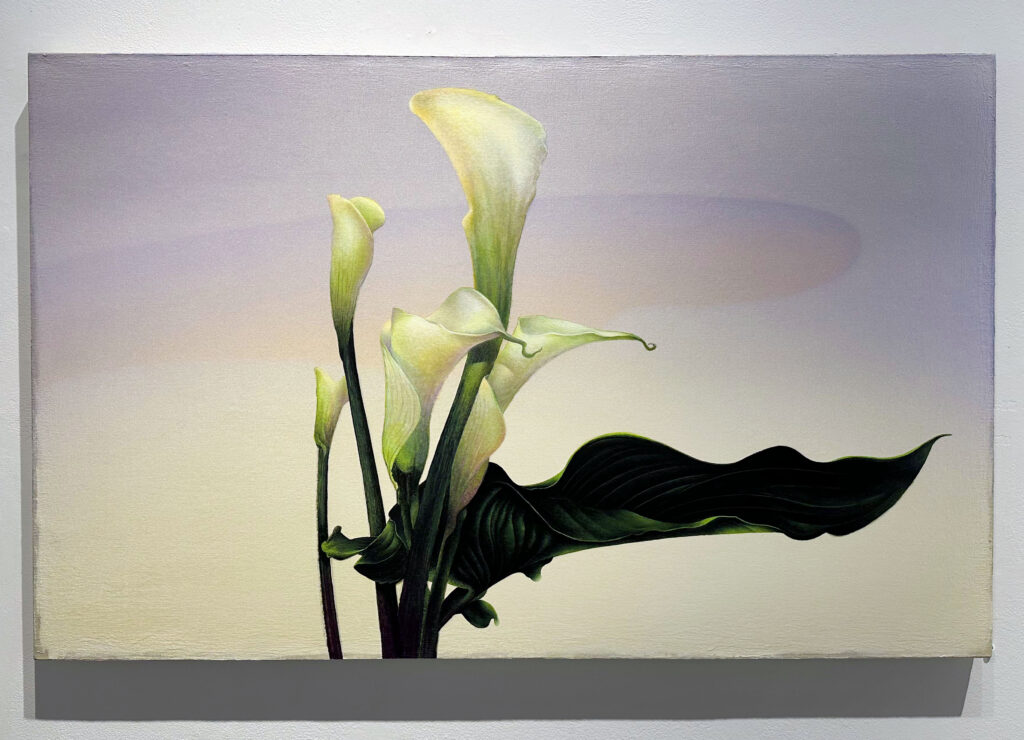
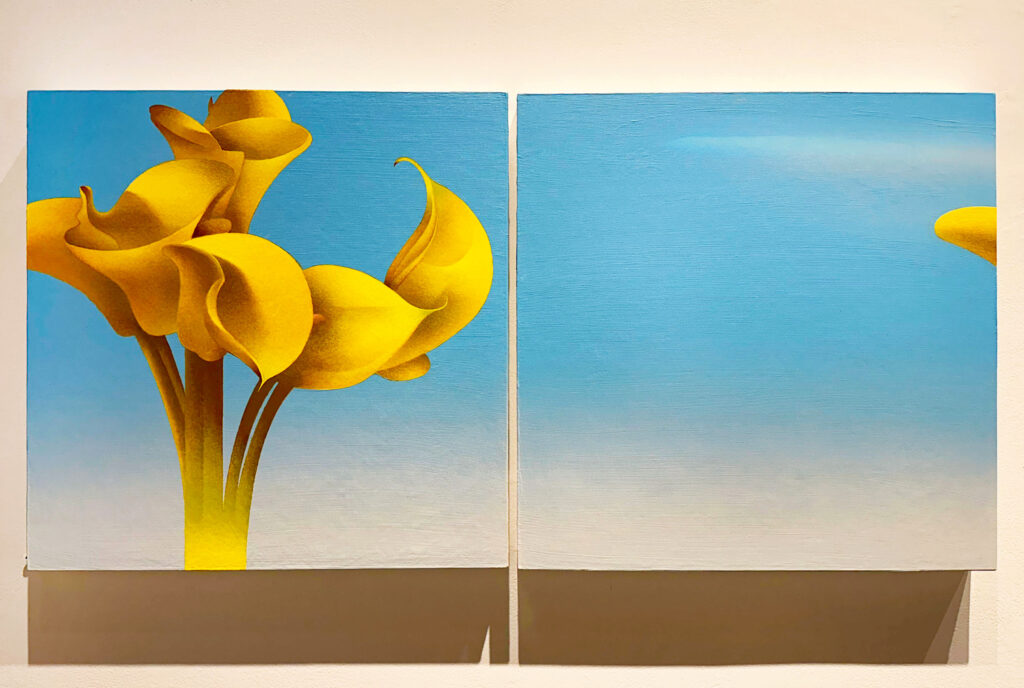
Roberta Tucci‘s beautiful layered paintings celebrating spring flowers and plants are currently on view in her solo exhibition Bloom, at The Delaware Contemporary.

Her statement about her work from her website-

I paint images that express how I perceive organic forms and the world of nature. To do this I develop personal meditative practices that enhance my awareness of nature: both particular details and living systems. I visually interpret this abstract awareness by using traditional indirect painting techniques. These techniques involve layering with varnish and glazing. This slow painting process allows me to accumulate ethereal levels of tone and color on which to create unique images. I then introduce and develop shapes, lines and patterns that represent the complexities of my natural subjects. The compositions that result invite viewers to perceive, connect and engage in a way that encourages their own with meditative contemplation.

This exhibition is on view until 5/31/26.

May 062026
 

Detail from the center work in the image above

In Stone Formations, Kira Krell‘s exhibition at the Mezzanine Gallery in Wilmington, her large multilayered paintings and smaller delicate sculptures find a cohesive balance, much like the natural formations that inspired them.

From Mezzanine Gallery and Delaware Division of the Arts-

Stone Formations is a solo exhibition by Kira Krell that guides viewers from volcanic deserts to beautiful coastlines. Through diverse geological imagery, and weathered forms, the work traces place and time, evoking memory, endurance, and the lasting presence of landscapes once called home.

Krell’s process begins by layering sand, plaster and earth pigments to create relief-like texture paintings. Adding, subtracting, and distressing these elements is necessary to achieve surfaces that appear weathered and time-worn, in pursuit of capturing geological structures: Stone Formations. Intricate details are revealed through dry brushing and mark making techniques, using acrylic and pencils. Fascinated by natural forms and their portrayal of permanence and strength, the artist offers an impression of steadiness and belonging. This acts as a counterpoint to our fast-paced, ever-changing world. Krell invites viewers to take a moment to pause, breathe and reflect on our beautiful world.

The exhibition will be on view until 5/29/26.