Dec 192025
 

While reading through the recently released list of artists selected for next year’s Whitney Biennial, I was very happy to see Kimowan Metchewais on the list. I discovered his work when it was part of USF Contemporary Art Museum‘s 2023 exhibition, Native America: In Translation.

The exhibition included a slide show of Metchewais’s polaroids that was particularly captivating. The images in this post are just a few favorites. For more on the artist, this Aperture article from 2023 is very informative.

Below are a few more selections-

Dec 112025
 

Alex Da Corte‘s Soft Power was on view from the High Line until June of last year.

His latest exhibition, Parade, is currently on view at Matthew Marks in NYC, on view until 12/20/25. The Pink Panther appears in this show as well- Da Corte depicts himself as the character painting the gallery pink.

From the High Line website about the billboard-

Known for his immersive installations, sculptures, and films, Alex Da Corte’s work explores themes of identity, consumerism, and taste, challenging societal norms and reimagining the familiar in unexpected ways. The artist draws from myriad sources, including popular and consumer culture, art history, classical literature, and modern design, seamlessly weaving together disparate elements into cohesive narratives. His adept use of vibrant color and surreal imagery lends a dreamlike quality to his work that captivates viewers and blurs the lines between fantasy and reality.

Da Corte presents a new artwork for the High Line’s 18th Street Billboard, inspired by the Pink Panther, a Friz Freleng creation designed for the animated opening sequence of a 1963 Hollywood comedy that came to embody the film and has evolved, through 60 years of spin-offs and reinventions, into cultural ubiquity. Pink’s durability across many generations has allowed it to sell countless products, from fiberglass insulation foam to artificial sweetener, yet the creature’s essence remains out of reach. With neither master nor peer—and seemingly eternally unbound by the rules of others—Pink represents a certain queer freedom. Da Corte revives Pink as an icon of resistance, supine but poised, wielding a sign of universal protest, brandishing a clear pink purpose. “There is a difference between falling down and laying down,” Da Corte explains. “I call that soft power.” This billboard is an advertisement for the value of such power.

Dec 112025
 

Sasha Gordon‘s two billboards- My Love of Upholstery (2024) and Untitled (2024), are currently on view from the High Line in NYC.

From the High Line website about the work-

Sasha Gordon creates surreal paintings and drawings that explore themes of sexuality, gender, race, and the body. Often depicting herself as subject, Gordon is keenly attuned to art historical themes of portraiture and self-portraiture, and of the politics of representation. She approaches these categories with inventiveness and humor, using the uncanny to communicate very real concerns around self-image and identity.

For the High Line – Moynihan Connector Billboard, Gordon presents two works, My Love of Upholstery (2024) and Untitled (2024). Both hail from the artist’s most recent body of work, in which she examines challenging taboos and standards of representation. Her images present a wide range of emotional states, frequently considered through the lens of her identity as a queer Asian American woman. Through endless avatars, she portrays the othering of unconventional human bodies and her own experiences of alienation. Towering over 30th Street and Dyer Avenue, the artist’s fluctuating visage appears at massive scale, marked by a distinct unnaturalness—in My Love of Upholstery, where she depicts herself with a Pinocchio-like wood-grain body, and in Untitled, in which her face and pupils are marked with five-pointed stars. These visions are simultaneously anxious and intimate, teetering somewhere between tender fantasy and nightmare. Her avatars, looming large within their frames, offer both artist and audience an outlet for exploring contradictory emotions and complex personal experiences.

Mar 092025
 

This painting, Self Portrait, Yawning created by 1783, is by French artist Joseph Ducreux and can be seen at the Getty Museum in Los Angeles.

From the museum about the work-

Joseph Ducreux experimented with the traditional limitations of the genre of self-portraiture by creating an expressive, humorous, and rather unorthodox image of himself stretching and yawning. Dressed informally in a turban and bright red jacket, Ducreux, in the midst of a huge yawn, opens his mouth wide, contorting his face with the effort and stretching his right arm toward the viewer. Holding this exaggerated pose, his back sways and his stomach pushes forward; his entire body presses up close to the surface of the picture.

Ducreux was interested in the study of physiognomy and frequently used his own features as a convenient means to observe various expressions. In fact, he executed dozens of similarly exaggerated self-portraits throughout his career. A contemporary critic admired this self-portrait for its warmth, color, and expression, but later critics complained about the repetition of the subject.


Aug 212024
 

Marilyn Moore, UAW Local 1112, Women’s Committee and Retiree Executive Board, with her General Motors company retirement gold ring on her index finger, (Youngstown Sheet & Tube Co., Lear Seating Corp., 32 years in at GM Lordstown Complex, assembly plant, van plant, metal fab, trim shop), Youngstown, OH, 2019 from “The Last Cruze” 2019

Frances Turnage, UAW Local 1112, Women’s Committee, holding her 10, 15, and 20 years of service General Motors company anniversary gold bracelets in her dining room, (34 years in at GM Lordstown Complex, paint shop) Youngstown, OH, 2019  from “The Last Cruze” 2019

LaToya Ruby Frazier: Monuments of Solidarity, currently on view at MoMA, presents several of the photographer’s bodies of work. Documenting her family, her town, and the hardworking people of several communities- she is telling the important stories of people whose lives are often overlooked.

From the museum about the exhibition-

“For this reason, it is incumbent upon me to resist—one photograph at a time, one photo essay at a time, one body of work at a time, one book at a time, one workers’ monument at a time—historical erasure and historical amnesia,” says artist-activist LaToya Ruby Frazier. Born in 1982 in the steel manufacturing town of Braddock, Pennsylvania, Frazier has used photography, text, moving images, and performance to revive and preserve forgotten stories of labor, gender, and race in the postindustrial era. LaToya Ruby Frazier: Monuments of Solidarity surveys the full range of the artist’s practice, highlighting her role as a social advocate and connector of the cultural and working classes in the 21st century.

For this exhibition, Frazier has reimagined her diverse bodies of work as a sequence of original installations that she calls “monuments for workers’ thoughts,” which address the harmful effects of industrialization and deindustrialization, the healthcare inequities facing Black working-class communities in the Rust Belt, the ongoing water crisis in Flint, Michigan, and the impact of the closure of a General Motors plant in Lordstown, Ohio. Monuments of Solidarity celebrates the expressions of creativity, mutual support, and intergenerational collaboration that persist in light of these denials of fundamental labor, human, and civil rights. As a form of Black feminist world-building, these nontraditional “monuments” demand recognition of the crucial role that women and people of color have played and continue to play in histories of labor and the working class.

“The Last Cruze” display

About The Last Cruze from the museum-

“A monument to the working-class people in this country,” as Frazier has characterized it, The Last Cruze was created in solidarity with the United Auto Workers Locals 1112 and 1714 in Lordstown, Ohio. In 2018 General Motors decided to cease North American production of the Chevrolet Cruze, leading to the “unallocation” and shuttering of the Lordstown assembly plant. Collaborating with Locals 1112 and 1714 members, Frazier made photographs that documented union-led efforts to prevent the closure.

Here more than sixty portraits of white, Black, and Latinx workers as well as images of factory labor are paired with printed excerpts from interviews Frazier conducted. These photographs and texts are displayed on a massive cadmium-red structure that resembles both an assembly line and cathedral buttressing. Framed by walls painted in two blue hues to match General Motors’ logo colors, a film featuring photographs by autoworker and photographer Kasey King follows the very last Cruze coming off the assembly line and the employees whose livelihoods depended on the plant.

“Self-Portrait with Shea and Her Daughter Zion in the Bedroom Mirror, Newton, Mississippi”, from the series “Flint Is Family, Part II”. 2017

“John Frazier, LaToya Ruby Frazier, and Andrew Carnegie”, 2010

This exhibition closes 9/7/24.

Jan 022024
 

Frank Weston Benson, “Natalie”, 1917, Oil on canvas

Childe Hassam, “Gathering Flowers in a French Garden”, 1888, Oil on canvas

Luther Emerson Van Gorder, “In the Park”, before 1894, Oil on canvas

Tampa Museum of Art’s current exhibition, Frontiers of Impressionism: Paintings from the Worcester Art Museum, features paintings by American and European impressionists and is a lovely reminder of the extraordinary works these artists created during this time period. The enduring popularity of the impressionists throughout the years makes sense when walking among these paintings. The use of color and brush work, as well as the details and beauty of the subject matter (not to mention the wealth and comfort often depicted)- make the viewer feel like they are being transported through time to the artist’s idyllic world.

From the museum-

In 2024, the term “impressionism” celebrates its 150th anniversary. Such a significant occasion inspires reflection on the profound impact that a relatively small group of artists in Paris made by positing a new mode of painting: one that favored painting outdoors over in a studio, immediacy over planning, the everyday over the grand, and the fleeting over the eternal. In doing so, the impressionists upended centuries of traditions in European art. This exhibition explores the radical impulses behind impressionism and its seemingly endless adaptability, as artists from around the world came to Paris to study and returned to their homelands, assimilating what they had absorbed and propelling the movement further.

The Worcester Art Museum pioneered new artistic horizons by embracing impressionism early in its history. The French and American impressionism collections at the Worcester Art Museum have long drawn visitors to the galleries. The first directors purchased works by Monet from his Parisian dealer, Durand-Ruel, as well as directly from American impressionists, making the Museum one of the first in the United States to collect impressionism actively as contemporary art. Over the past 125 years, this collection has grown, encapsulating the story of the movement’s roots and emergence in France and its subsequent expansion to the United States, Germany, Scandinavia, and beyond. Highlighting more than 30 artists, including Claude Monet, Pierre-Auguste Renoir, Camille Pissarro, Mary Cassatt, Childe Hassam, and Max Slevogt, this exhibition demonstrates impressionism’s international allure, captured in subjects as far-flung as Monet’s famed Giverny lily pond to the natural wonders of the Grand Canyon.

Below are a few more selections from the show.

Max Slevogt, “Selbstbildnis im Garten (A Self-Portrait in the Garden at Godgramstein), 1910, Oil on canvas

Max Slevogt, “Selbstbildnis im Garten (A Self-Portrait in the Garden at Godgramstein), 1910, Oil on canvas (detail)

Paul Signac, “Golfe Juan”, 1896, Oil on canvas

Thomas Cole, “View on the Arno, near Florence”, 1837, Oil on canvas

Lovis Corinth, “Vordem Spiegel (At the Mirror)”, 1912, Oil on canvas

John Singer Sargent, “Katherine Chase Pratt”, 1890, Oil on canvas

About the unfinished painting above (from the museum)-

A successful society portraitist, Sargent painted the elite from his international social circles. In June 1890, Sargent visited Worcester, Massachusetts, where he was inundated by requests for portraits. The sitter’s father, Frederick Pratt, a noted collector and eventual acting director of the Worcester Art Museum (1908 and 1917), became friends with the artist and invited him to return a few months later to paint his daughter, Katherine- although the idea for Katherine’s portrait originated in Sargent’s first trip to Worcester, when he had made a sketch of hydrangeas. Sargent’s vision of Katherine against a backdrop of flowers, however, proved less than satisfactory for his client and he abandoned the painting for another, more formal depiction. As an unfinished work, this painting reveals the immediacy of Sargent’s process, with careful attention to broad swaths of color and patterns in the brushwork to convey flower petals or folds of clothing.

This exhibition will be on view until 1/7/2024.

Oct 282020
 

This is the last week to see the exhibition, Luchita Hurtado. Together Forever, at Hauser & Wirth’s Chelsea, New York location. The exhibition was organized with Hurtado, who sadly passed away this year at the age of 99. There is also a video on the website of Hurtado’s son discussing the exhibition and his mother’s work that is worth watching for additional insight into the artist and her work.

From the gallery’s website-

‘Together Forever’ presents over thirty works from the 1960s through the present day in which she explored the self and the surrounding world as her primary subject. Many of these highly personal artworks – recent paintings of birth along with early works on paper that have remained largely private up to this point – will be on view to the public for the first time.

Parallel to a dynamic period of experimentation between abstraction and figuration in the early 1960s, Hurtado also focused her work inward, marking a trajectory to uncover new forms of self through portraits of herself in mirrors, looking down at her own body, and studies of her shadow. Describing this time in her practice, Hurtado explained “At a certain point, I said ‘there is no way that I can express, let’s say, except by painting myself.’ I said, ‘This is a landscape, this is the world, this is all you have, this is your home, this is where you live.’ You are what you feel, what you hear, what you know.” [1]

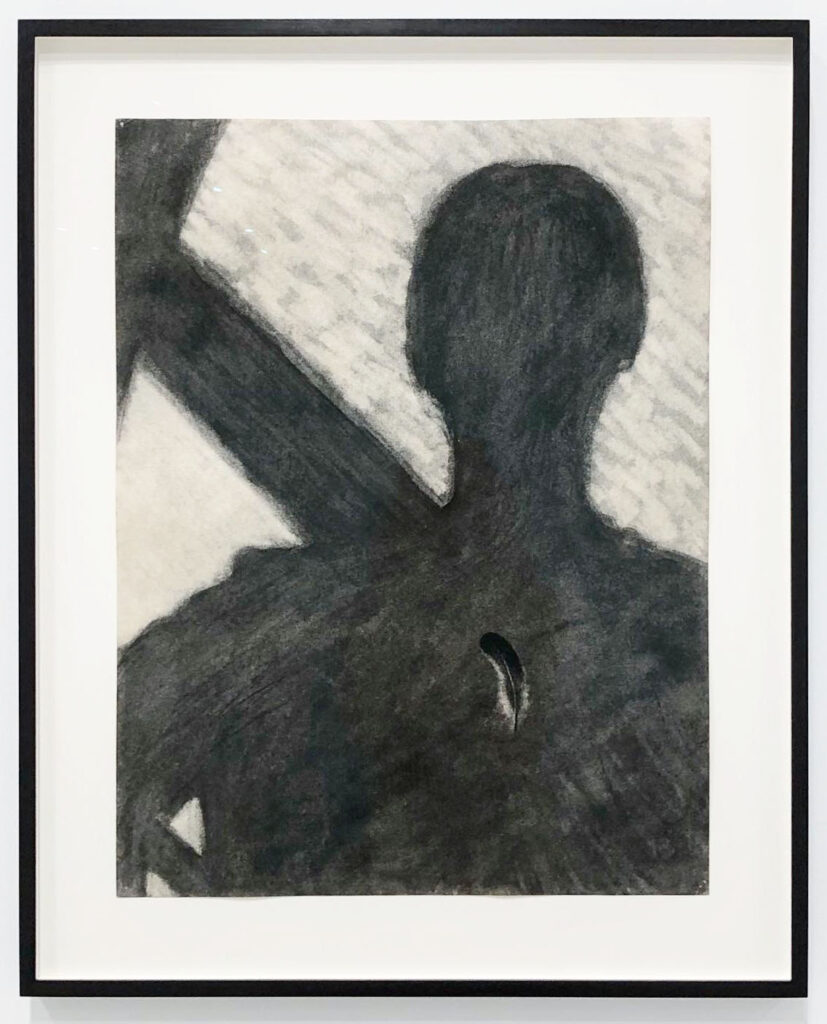
Throughout her practice up until recent years, Hurtado documented the forms of shadows in photographs and drawings, studying their size, shape, and potential. In early examples from the series included in this exhibition, the artist rendered her own body with oil, charcoal, or graphite on paper, sometimes juxtaposed with her own environment. In some works, a number of figures are depicted. However, these are multiple representations of her own shadow and the artist remains in solitude as her only subject. Another work from the series does not depict a figure at all, but only text where the artist states, ‘The only reasonable facsimile of me is in my shadow’.

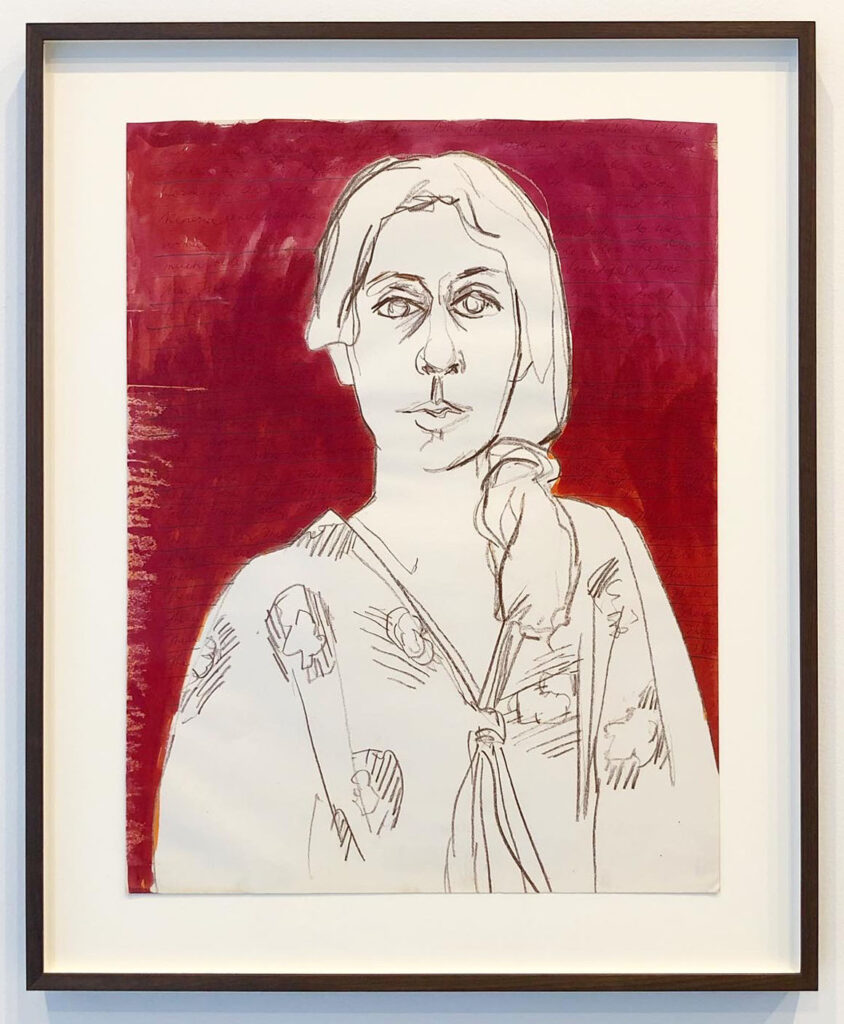
During this solitary time of artmaking, Hurtado served as her own model and prioritized her own subjective experience in the world. These works represent significant moments of introspection, seclusion, and the claiming of time for herself. In an early self-portrait in crayon and ink on paper, the artist is surrounded with the text of her own poem written about family and memories of her life in New York before motherhood. Other works, such as ‘Untitled,’ show the artist interacting with the everyday domestic objects in her home – a bookshelf, a window, a door. Another work, also ‘Untitled,’ shows Hurtado emitting a single tear as she poses amongst plants.

In the most recent paintings on view, Hurtado evolves into the landscape as she explored ways in which her own body would transform and regenerate the earth. Functioning as a symbolic proxy and an intimate meditation on the Earth as mystic progenitor, these works underscore the interconnection between corporeality and the natural world – a delicate balance that is now in jeopardy.

‘Luchita Hurtado. Together Forever’ celebrates the various forms of the artist throughout her career and life. Even in the last days of her life, Hurtado continued to experiment and push the boundaries of her own practice.

This exhibition closes 10/31/20.

Jan 242015
 

gillianwearingregenprojectsfearandloathingviasite

gillianwearinghandregenprojects

gillianwearingmeasnecklace

Today is the last day to see British artist Gillian Wearing’s exhibition everyone at Regen Projects.  The two new video works are especially affecting.

Fear and Loathing, the artist’s first work produced in the US, presents a split screen with two people wearing masks, one on each side, alternating monologues about either a fear or a loathing from their personal lives.  In the second, We are Here, residents of the West Midlands of England, tell stories of their lives as if they have returned from the dead. This piece was inspired by the American poet Edgar Lee Masters’ 1915 book Spoon River Anthology.

The artist also includes portraits of herself within the exhibition, including a portrait of herself in a mask of her younger self, a large necklace with a pendant that is a mask of her face, and a series of sculptures of her hand with different fortune teller readings written on them.

There’s a certain sadness to the exhibition as Wearing examines lives caught in circumstances that are often beyond their control. This ties in to the idea of the fortune teller, who is sought out for the feeling that life is predestined.  Yet the various fortune tellers here tell different stories for the same hand. Perhaps these are like the different stories we are presenting to the world throughout our lives, at times with our true faces masked.