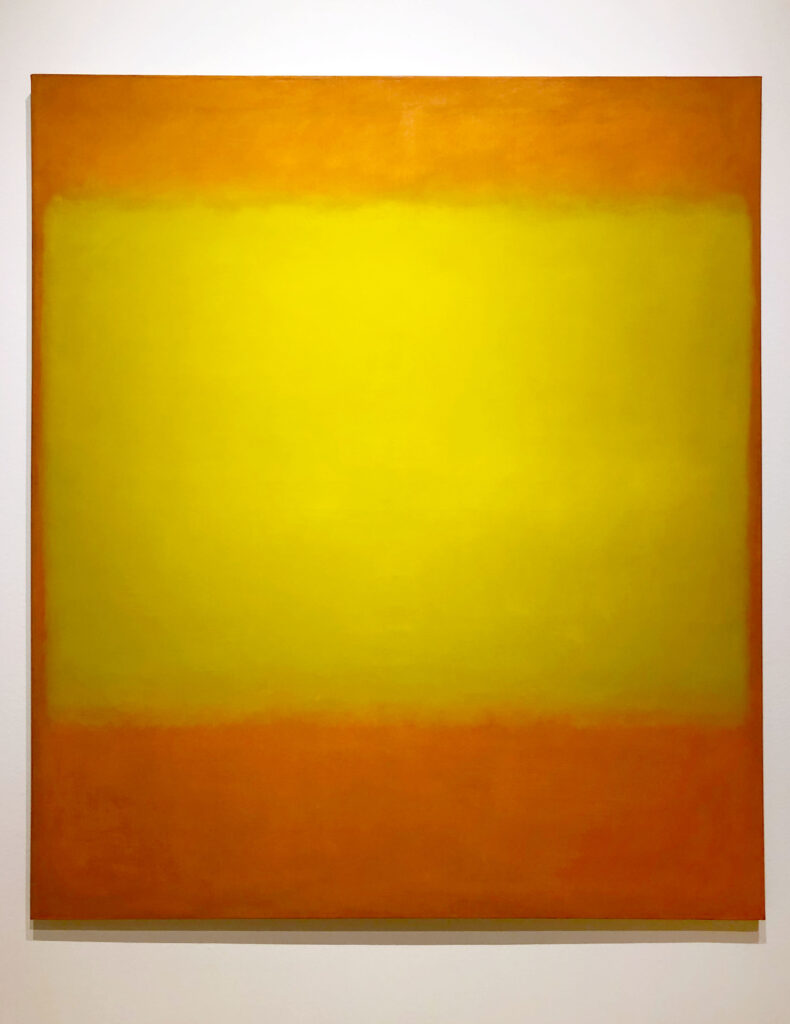
Roy Lichtenstein‘s painting Desk Calendar, 1962, part of MOCA‘s permanent collection, was on view at the museum in 2024 as part of the exhibition Reverberations.

Roy Lichtenstein‘s painting Desk Calendar, 1962, part of MOCA‘s permanent collection, was on view at the museum in 2024 as part of the exhibition Reverberations.

Cats, painted in the 1930s, is by artist and educator Dorothy Geneva Simmons Skelton. It is currently on view at Crocker Art Museum in Sacramento as part of their permanent collection.
From the museum about the artist-
Dorothy Simmons was born in Woodland, California, and grew up in Oakland. She attended the University of California, Berkeley, where she completed a B.A. and M.A. in art and education. During World War II, after marrying U.S. Army Air Corps officer John Skelton, she moved to Arlington, Virginia, and worked at the Pentagon in military intelligence. In 1948, she became a civilian member of Monuments, Fine Arts, and Archives Section Unit (aka the Monuments Men), which protected cultural monuments during the war and subsequently restituted art and other objects confiscated by Nazis.

Todd Gray, “The Song Remains (assumptions about the nature of time)”, 2024, Two UV pigment prints on Dibond, artist’s frames
In LA-based artist Todd Gray’s The Song Remains (assumptions about the nature of time), two images, one of Iggy Pop and the other of a statue in Italy, merge both visually and conceptually. It was on view as part of While Angels Gaze, his exhibition at Lehmann Maupin in NYC in 2025.
About the work from the gallery-
In The Song Remains (assumptions about the nature of time) (2024)—one of the exhibition’s smallest works, composed of just two panels—Gray depicts Iggy Pop in black and white, his image overlaid against a statue from Villa Torlonia of a figure holding a pan flute. The gesture of the statue’s outstretched arm on the left is mirrored in Iggy’s raised hand on the right, connecting the two figures across time as if by an invisible thread. The image suggests an enduring human archetype, different and yet unchanged over the course of many centuries, and invites wider questions about the essence of human nature.
Gray’s latest solo exhibition, Portals, is currently on view in Perrotin‘s new Los Angeles gallery through until 5/30/26. His commissioned piece, Octavia’s Gaze, was installed last year at LACMA in the new David Geffen Galleries, which are opening to the general public in May (they are currently open to members only).


Today’s flashback is to Noah Davis‘s Imitation of Wealth installation which was shown in MOCA’s storefront space in 2015. Sadly, Davis passed away before it opened.
Some of these works are currently on view as part of his gorgeous retrospective at the Philadelphia Museum of Art.
From MOCA’s website about the installation-
One of the unique characteristics of the contemporary art scene in Los Angeles is the proliferation of artist-run spaces, many of which are located in storefronts across the city. MOCA was founded by artists and, due to its philosophy of placing artists at the center of its mission, has long been known as “the artist’s museum.” Storefront continues this tradition by inviting two artist-run organizations to take over MOCA’s Marcia Simon Weisman Works on Paper Study Center each year.
Founded in 2012, The Underground Museum is a storefront space developed by artist Noah Davis. Located at 3508 West Washington Avenue in Los Angeles’s Arlington Heights neighborhood, The Underground Museum has a gallery space, offices that serve as editing suites and a painting studio, and an outdoor garden which hosts parties, events, and film screenings. Davis wanted to bring what he called “museum-quality art” to a traditionally African American and Latino working-class neighborhood. However, when The Underground Museum first opened, no museums were willing to lend such works. Undaunted, Davis decided to recreate iconic artworks by famous artists such as Marcel Duchamp, On Kawara, and Jeff Koons. The title for his inaugural exhibition, Imitation of Wealth, alludes to Douglas Sirk’s classic film Imitation of Life (1959), a pre-civil rights era melodrama about passing. Just as the film’s protagonist pretends to be white in order to escape the fate of the second-class citizenship offered to African Americans, the works in the exhibition masquerade as famous works of art in an attempt to break down the traditional class and ethnic barriers to high culture. Irreverent and tongue-in-cheek, Imitation of Wealth stages many of art’s time-honored questions about the nature of truth and authenticity.
The Underground Museum, where this work was first shown, was a unique and special place that held many great exhibitions and events. After Davis’s death it was run by his wife, artist Karon Davis (who co-founded the space), and his brother filmmaker Kahlil Joseph. The museum closed in 2022.
Below are some images from a visit in 2019.

Front doors of the Underground Museum
Two views of the outdoor space at the museum-


Along with the galleries, bookstore, and outdoor spaces, you could even find artwork in the bathrooms. The unique wallpaper collage seen below was created by Genevieve Gaignard.

Objects in the bathroom at the Underground Museum

Wallpaper detail

“Early Snow – Rhinecliff Hotel”, 2017, oil on canvas

“Durham, August 14, 2017”, 2017, oil on canvas
American painter Celeste Dupuy-Spencer passed away last week at the age of 46. The images above are from her 2017 exhibition Wild and Blue at Marlborough gallery in NYC. She had also been part of the Whitney Biennial earlier that same year.
The first painting is of the Rhinecliff Hotel, a bar she frequented while growing up in Rhinebeck, NY. The second, Durham, August 14, 2017, is of the metal confederate statue that protesters tore down that year. That painting was also included in her section of Made in L.A. 2018, Hammer Museum‘s biennial exhibition of artists from the Los Angeles area. Her later work was often very political, including several paintings that are dense with imagery.
In this 2018 Bomb magazine interview, Dupuy-Spencer discusses some of her past struggles and provides insights into her practice.
Her first solo exhibition in five years, Burning in the Eyes of the Maker, will open at Deitch in Los Angeles this Saturday, 4/18/26.

Nicola Vruwink‘s The Best That You Can Do, 2009-10, is currently on view as part of Palm Springs Art Museum‘s permanent collection. The artist crocheted cassette tape to create the sculpture.
The phrase “the best that you can do is fall in love” is a lyric from the 1981 song Arthur’s Theme (Best That You Can Do) by Christopher Cross for the soundtrack to the 1981 film Arthur.

“Berthe Morisot with a Muff”, c. 1871–72, Oil on canvas
Last week was Berthe Morisot‘s birthday and today it is her friend, brother-in-law, and fellow Impressionist, Édouard Manet‘s birthday. He was born on January 23rd, in 1832, and painted the portrait of her pictured above. It is part of the Cleveland Museum of Art‘s permanent collection.
From the museum about this work–
This painting depicts Impressionist painter Berthe Morisot, who met Édouard Manet at the Musée du Louvre in Paris in 1868. This portrait vibrates with vitality. Morisot wears a coat and stylish hat from which wisps of her dark hair escape. Manet’s wide brushstrokes and cross-hatchings evoke the sketchy quality of Morisot’s own paintings, likely Manet’s nod to his subject’s identity as an artist.
He made nine portraits of her in oil, watercolor, lithography, and etching during 1868–74. Initially artistic colleagues and friends, they became family in December 1874 when Morisot married Manet’s younger brother, Eugène.
The painting is currently on loan to San Francisco’s de Young museum for their current exhibition Manet & Morisot, on view until 3/1. Organized by Fine Arts Museums of San Francisco in collaboration with the Cleveland Museum of Art, the show will move to Cleveland on 3/29/26, and will run until July 5th.
About Manet & Morisot from the Cleveland Museum of Art–
Manet & Morisot is the first ever major exhibition dedicated to the artistic exchange between Édouard Manet, often referred to as the father of modern painting, and Berthe Morisot, the only woman among the founding members of the Impressionist movement. Unfolding over a period of roughly 15 years, between 1868 and 1883, theirs was perhaps the closest relationship between any two members of the Impressionist circle. As friends and colleagues—by turns collaborative and competitive—they collected one another’s work. Morisot posed for some of Manet’s most compelling portraits, several of which will be on view in the first gallery of the exhibition. When she married Manet’s younger brother, their professional connection deepened into a familial bond.
Thirty-six paintings and six drawings and prints borrowed from museums and private collections in the United States and Europe reveal the evolution of a singular friendship between two groundbreaking artists. Visitors will see beach and garden scenes made en plein air (out-of-doors) that demonstrate how Manet borrowed individual motifs and compositional ideas directly from Morisot. Portraits of fashionable Parisian women of the 1880s by the two artists show their different perspectives; Manet’s paintings were inspired by admiration and erotic interest while Morisot’s were informed by lived experience. The exhibition closes with a self-portrait by Morisot painted when she was in her mid-40s, revealing her perception of herself as a professional artist.

Jean-Michel Basquiat was born today, December 22nd, in 1960. The painting above, Untitled (1981) is currently on view at The Broad in Los Angeles.
From the museum about this work-
Many of Jean-Michel Basquiat’s paintings are in some way autobiographical, and Untitled may be considered a form of self-portraiture. The skull here exists somewhere between life and death. The eyes are listless, the face is sunken in, and the head looks lobotomized and subdued. Yet there are wild colors and spirited marks that suggest a surfeit of internal activity. Developing his own personal iconography, in this early work Basquiat both alludes to modernist appropriation of African masks and employs the mask as a means of exploring identity. Basquiat labored over this painting for months — evident in the worked surface and imagery — while most of his pieces were completed with bursts of energy over just a few days. The intensity of the painting, which was presented at his debut solo gallery exhibition in New York City, may also represent Basquiat’s anxieties surrounding the pressures of becoming a commercially successful artist.
In the video below (also from The Broad) LeVar Burton discusses the work and its possible connection to Basquiat’s childhood and family.


In addition to his numerous street art pieces, Alexandre Farto, aka Vhils, has shown his unique creations in various galleries around the world. The works above are from his 2018 exhibition Annihilation at Over the Influence gallery’s temporary location in Los Angeles.
From the gallery about the show-
Presenting a reflection on the current model of globalized development and the forces shaping and affecting local identities around the world today, Annihilation emphasizes the global impact of Los Angeles culture and the subsequent breakdown of unique global identities across continents. For his first solo exhibition in the United States since 2011, Vhils has taken the opportunity to set up a dialogue between the United States, Europe, and China to address the growing struggle for hegemonic supremacy between global powers and the ensuing social and economic impact on the world at large. Annihilation shares the stories of the citizens who breathe vitality into densely populated urban epicenters. Based on a variety of source material, from advertisements collected in cities worldwide to salvaged wooden doors, the new patchwork-like series intentionally dilutes the readability of each individual portrayed, a reflection on how identity is both formed and affected by the city’s visual discourse. This intentional juxtaposition of contrasts mirrors the interplay between elements from various cultures which we observe at work today in large urban contexts.
Vhils-Strata, which presents a selection of his work from the past twenty years, is currently on view at the Museum of Urban and Contemporary Art (MUCA) in Munich, Germany until 3/1/26.
He also recently created the site-specific installation, Doors of Cairo, located near the Pyramids in Giza in Egypt. It is part of Forever is Now 05 and is on view until 12/7/25.

Robert Therrien‘s larger than life sculpture of a table and chairs for Under The Table (1994) has been delighting visitors to The Broad in Los Angeles for years. Robert Therrien: This is a Story, recently opened at the museum is the largest exhibition of the late artist’s work to date.
From The Broad about the exhibition-
Therrien’s meditations on scale and material are a deeply influential and well-known approach within the field of contemporary sculpture, significant to The Broad’s own identity as a museum, and long admired by visitors of all ages. The installation showcases Therrien’s personal vocabulary of images and symbols—from enormous tables, chairs, and dishes, to intimate drawings of snowmen, birds, and chapels—as they become a language of continuous creation and transformation for the artist over time. Featuring more than 120 works spanning five decades, the exhibition offers unprecedented access to the artist’s exploration of scale, memory, and perception, just miles from the downtown Los Angeles home and studio space he operated out of for close to thirty years beginning in 1990. Many of the works on view, including those created just before Therrien’s untimely death in 2019, have never been featured in museum exhibitions and will offer new avenues of understanding his practice.
The exhibition is on view until 5/5/2026.