Feb 232023
 

Neil Welliver, “Big Flowage”, 1979

Neil Welliver, “Big Flowage”, 1979 (detail)
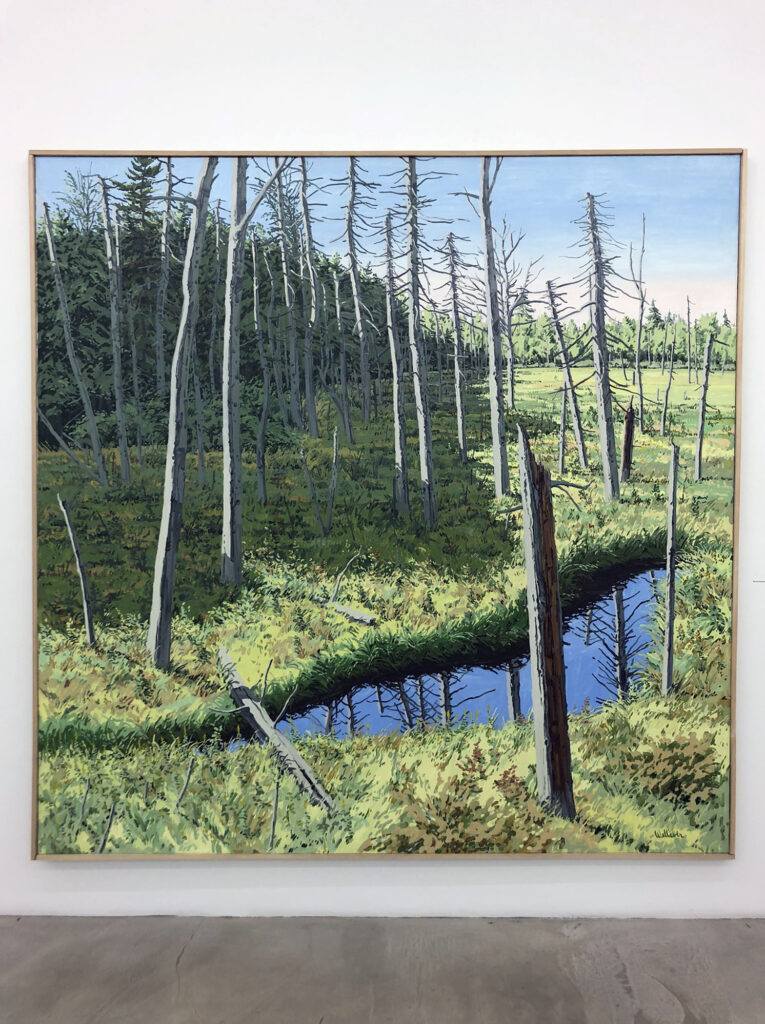
Neil Welliver, “Marsh Shadow”, 1984
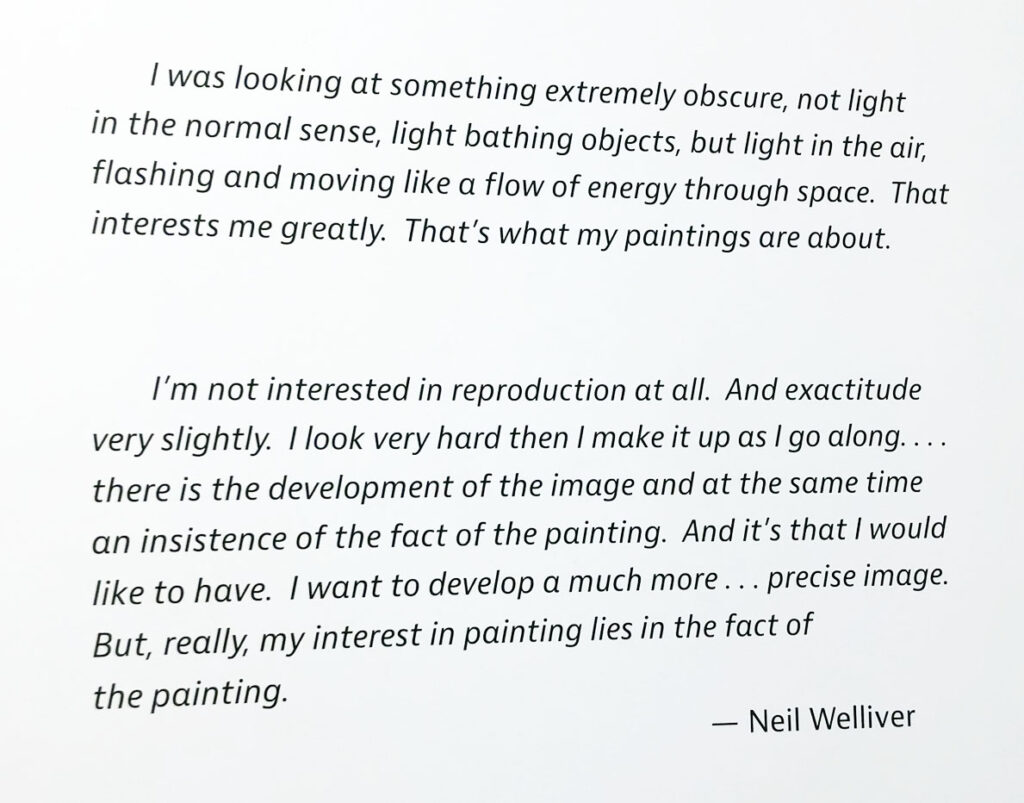
Neil Welliver quote on the gallery wall

Currently at Alexandre Gallery in NYC are Neil Welliver’s gorgeous paintings and works on paper, spanning his career from the late 1960s-2000, and including his last woodcut print, Stump.

From the gallery’s website

In his 2005 New York Times obituary, Ken Johnson wrote:

Mr. Welliver came of age as an artist in the late 1950’s and 60’s, at a time when nonrepresentational styles of painting like Abstract Expressionism and, later, Color Field and Minimalism were accorded the highest critical prestige. Along with artists like Larry Rivers, Alex Katz and Philip Pearlstein, Mr. Welliver strove to paint representational images without sacrificing the formal innovations that the Abstract Expressionists Jackson Pollock and Willem de Kooning had introduced to modern painting.

Welliver’s lifelong friend, the American poet Mark Strand, wrote of his process in 2001:

What sets Welliver’s woods apart from the woods of others is that they are, of course, his. We see them and know instantly who painted them. That stream plunging and swirling around those gray rocks is familiar, so are those clouds parading in ragged order across that sky spreading a midday blue over those hills. They are all part of Welliver’s woods. The unaffectedness, the ease with which they are simply there, without a hint of what went into their making, without an indication anywhere of the turmoil that prompted them, is what sets them apart. Of course, we can see the many brush strokes in a large Welliver and believe that they—in their tireless application—tell us what goes into a Welliver, but we would be wrong, for there is much in a Welliver that we cannot see. In the past of each one are the long hikes into the woods, which Welliver takes, loaded down with easel, canvas, brushes, oil, thinner, and tubes of color, to the spot where he will paint; then there are the hours he stands, in all kinds of weather, and paints what will be the small preparatory paintings on which he bases the large drawings that lead finally to the large paintings.

This exhibition closes 2/25/23.
Feb 132023
 

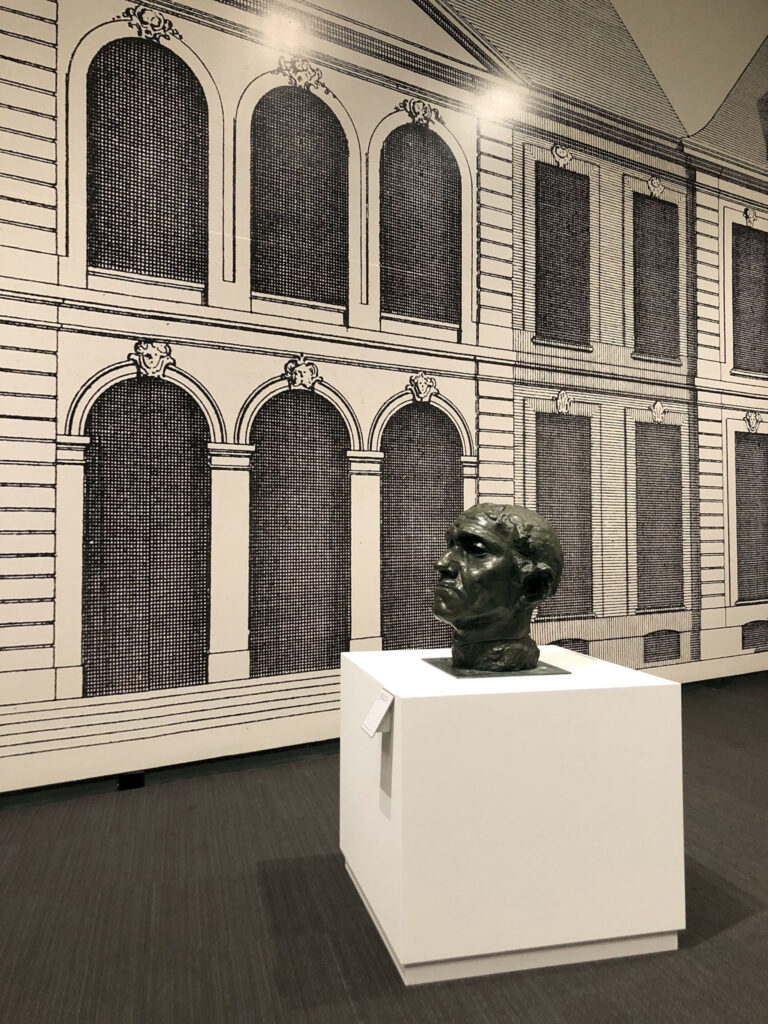
Auguste Rodin, “Monumental Head of Jean d’Aire”

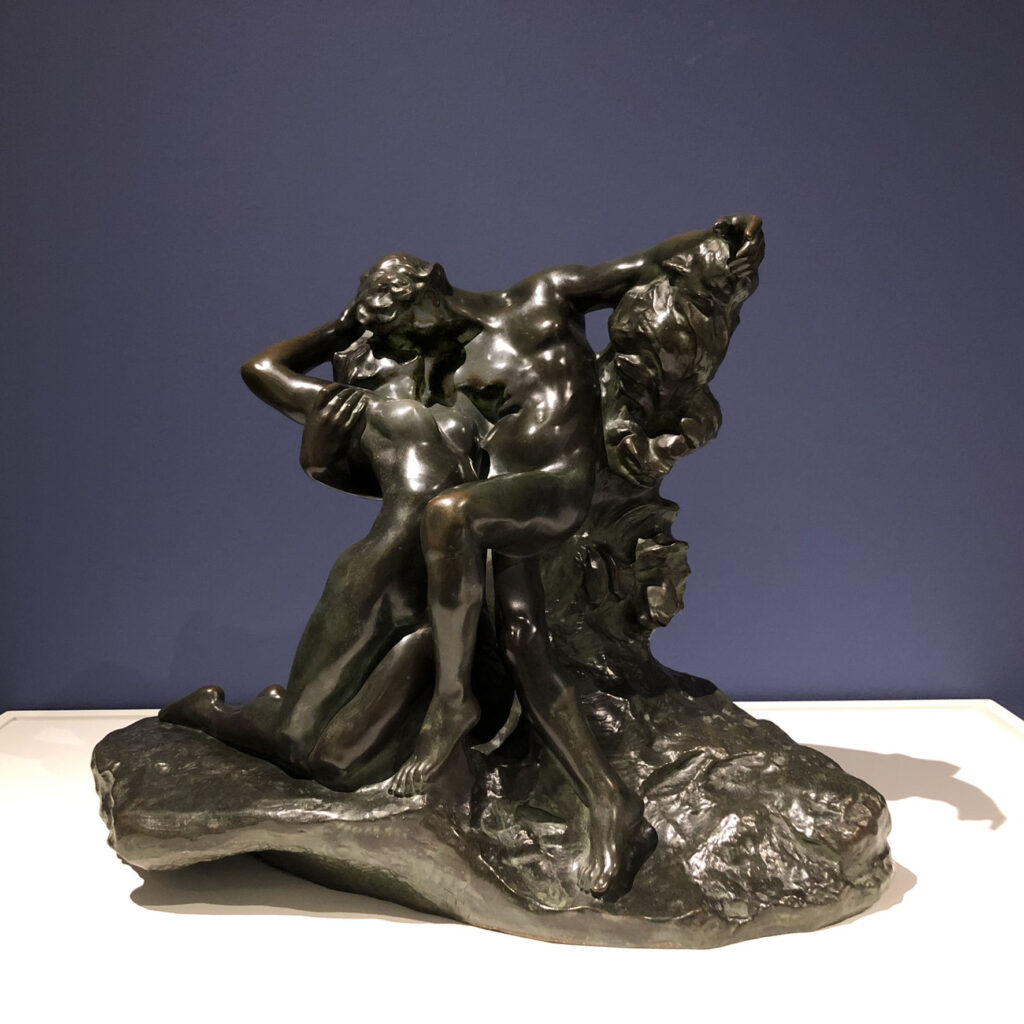
Eternal Spring

Currently at the Museum of Fine Arts St. Petersburg is True Nature: Rodin and the Age of Impressionism. The exhibition includes nearly 40 of his sculptures and presents them alongside Impressionist paintings by his contemporaries.

The curation of the show by Stanton Thomas really creates an exceptional experience for attendees. The large works, along with the paintings, are given plenty of space to be appreciated. While there is a power to seeing these larger than life works, the smaller ones, like Eternal Spring, pictured above, are also captivating.

In one room, on a single wall, is the facade of the building that would become the Musée Rodin. It is there to give both a sense of scale and to remind visitors that most of Rodin’s sculptures were intended for public spaces. Quotes by the Rodin, including one on beauty and character, along with film footage and photographs, add depth to the show as well.

This exhibition closes 3/26/23.

Feb 022023


“History is not everything, but it is a starting point. History is a clock that people use to tell their political and cultural time of day. It is a compass they use to find themselves on the map of human geography. It tells them where they are but, more importantly, what they must be.”- Dr. John Henrik Clarke

Dr. John Henrik Clarke was an American writer, historian, professor, and pioneer in the creation of Pan-African and Africana studies. He taught at both Hunter College in NYC, where he established the Department of Black and Puerto Rican studies, and Cornell University where he was the Carter G. Woodson Distinguished Visiting Professor of African History at Cornell University’s Africana Studies and Research Center.

The mural pictured above, Dr. John Henrik Clarke and the Mundari Tribe by Reginald O’Neal, was created for the 2022 edition of SHINE Mural Festival in St. Petersburg, Florida.


Aug 042022
 

“THERE IS A PERIOD WHEN IT IS CLEAR THAT YOU HAVE GONE WRONG BUT YOU CONTINUE. SOMETIMES THERE IS A LUXURIOUS AMOUNT OF TIME BEFORE ANYTHING BAD HAPPENS.”

This 1989 sculpture by Jenny Holzer is part of the permanent collection at Santa Barbara Museum of Art.

Aug 022021
 

“Life is tragic simply because the earth turns and the sun inexorably rises and sets, and one day, for each of us, the sun will go down for the last, last time. Perhaps the whole root of our trouble, the human trouble, is that we will sacrifice all the beauty of our lives, will imprison ourselves in totems, taboos, crosses, blood sacrifices, steeples, mosques, races, armies, flags, nations, in order to deny the fact of death, the only fact we have. It seems to me that one ought to rejoice in the fact of death–ought to decide, indeed, to earn one’s death by confronting with passion the conundrum of life. One is responsible for life: It is the small beacon in that terrifying darkness from which we come and to which we shall return.”

The above quote is from Baldwin’s 1963 novel, The Fire Next Time.

Happy Birthday to James Baldwin, born today, August 2nd in 1924.

The artwork above is by artist Jack Henry and is located in the River Arts District in Asheville, North Carolina. For more of his work, check out his website and Instagram.


Jan 202014
 

yousefkarshmlk

Yousuf Karsh- Martin Luther King, Jr.

“We all have the drum major instinct. We all want to be important, to surpass others, to achieve distinction, to lead the parade. … And the great issue of life is to harness the drum major instinct. It is a good instinct if you don’t distort it and pervert it. Don’t give it up. Keep feeling the need for being important. Keep feeling the need for being first. But I want you to be the first in love. I want you to be the first in moral excellence. I want you to be the first in generosity.”

– Martin Luther King, Jr. from “The Drum Major Instinct” Sermon given at Ebenezer Baptist Church in Atlanta Georgia 1968

There are so many great points made in this sermon. It’s a really good read and so much of it continues to resonate with life in the world today.