Mar 082014
 

joelkyackghebaly

joelkyackjawsghebaly

joelkyackgheballylegs

Joel KyackOld Sailors Never Die

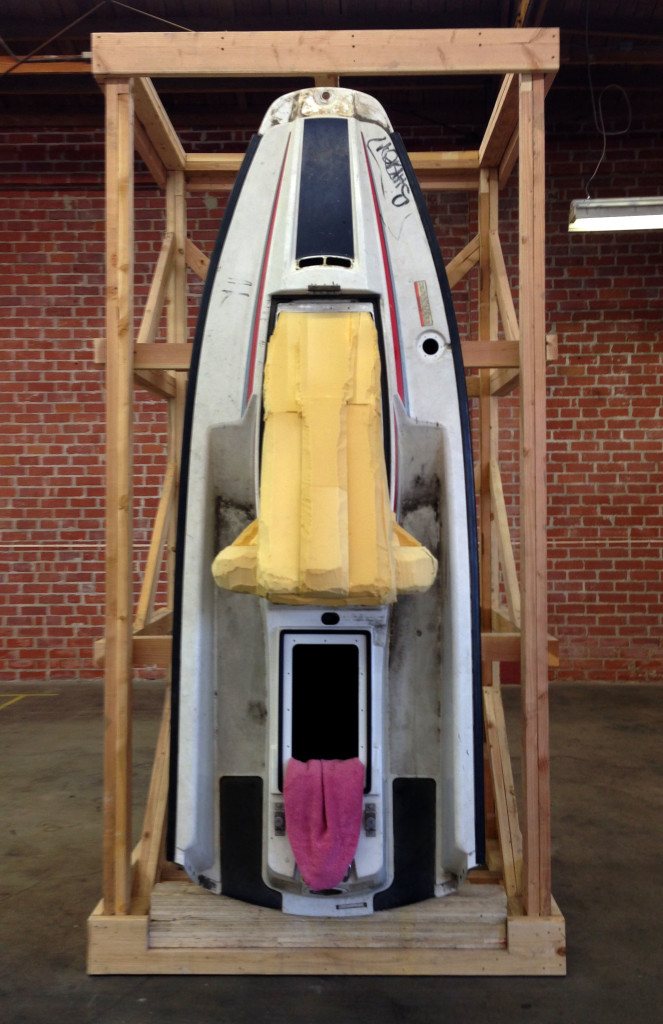
For the sculptures at Joel Kyack’s show at François Ghebaly Gallery, the press release consists of multiple choice questions on the theme of being stranded at sea like, “If you had to die at sea, on which sea would it be?” Interspersed among these are other questions, perhaps getting to more of the reasoning behind the work, like:

3. Film sets are, to varying degrees, “built to camera” – a process where only the elements of the set that will appear in the frame of the camera will be built. For what could this be a metaphor?

(a) some of life

(b) most of life

(c) all of life

and:

8. When you see a sculpture you like you respond by:

(a) wanting to remember it

(b) wanting to buy it

(c) wanting to dismiss it

The theme of being stranded or lost at sea is common in movies and television. It remains unclear whether these sculptures are aiming just to entertain or are attempting to grapple with larger issues.

Perhaps the quote at the bottom of the press release is the most telling:

“High and fine literature is wine, and mine is only water; but everybody likes water.”

― Mark Twain, Letter to William Dean Howells, 15 February 1887

If you go to see this show make sure to check out the inaugural group exhibition at Fahrenheit Gallery located in the same building.

Mar 072014
 

danieljosephmartinezrobertstilton

Martinez_ACivilWar

Daniel Joseph MartinezThe report of my death is an exaggeration; Memoirs of Becoming Narrenschiff

At Roberts & Tilton until 3/8, Martinez’s show is comprised of two parts- the first is a group of text paintings and small framed polaroids of mysterious objects surrounding a group of unearthed bonsai trees in the center of the gallery. In the second gallery is a group of photos of buildings around Los Angeles with Martinez’s text added.

Martinez’s work for this exhibition is based on Das Narrenschiff, or Ship of Fools, a satirical work created by Sebastian Brant in 1494, which focused on human folly in society. For three years Martinez traveled around Los Angeles on the bus with this in mind, observing the other passengers and his surroundings.  The result is a grim but affecting look into the perspective he gained from his travels.

(last image via Roberts & Tilton)

Mar 042014
 

josealbertomarchinudelamgalleryjosealbertomarchilamasters

Nude Female with Dark Mask II (2010) and Chalkboard in Flames (2013) by José Alberto Marchi

Currently part of a group show at Latin American Masters, artist José Alberto Marchi’s work stands out. Influenced by photography, in particular the work of Thomas Eakins, many of Marchi’s paintings like the nude shown above, are presented as both a positive and negative image. In others, the images seem to be materializing from the canvas the way a photo would from developing chemicals.

In addition to these works are some from his most recent show at the gallery, Sacrificio. The series was inspired by the final scene of Andrei Tarkovsky’s film The Sacrifice, in which the protagonist burns his house down to save the world. The late 19th and early 20th century people from his previous paintings, are now in new situations forcing them to react to a fire, the only color within the canvas. It is up to the viewer to interpret what the sacrifice, in this context, may be.

Feb 222014
 
samaragoldennightgallery

Samara Golden- Mass Murder

nightgalleryportraitsjessemockrin

Jesse Mockrin- Midnight Sun

When you walk into Night Gallery it will take your eyes awhile to adjust. When they do you will see a car parked in the center of the gallery. The next room holds Jesse Mockrin’s paintings, styled after traditional master painters, lit with one light each. The next rooms are filled with odd aluminum covered furniture, a sunset projection on one wall, stuffed animals, pianos, keyboards and more. These objects (and the car) are all part of Samara Golden’s Mass Murder. What does it all mean?

Here’s a bit of the press release:

It’s Mass murder. It’s the world and then the reversal of the world. It’s trying to find the beautiful inside of a horrible world of hypocrisy and contradiction. It’s personal. It’s optimism and pessimism in a dead lock. It’s two stories. It’s bad blood. It’s a caged thought. It’s a purple light giving a performance. It’s our living room 1975-1988. It’s an airport convention room, it’s a bank, a hospital, a hotel. The wall, a dance club, a parking lot. It’s a flight simulator that makes you believe you’re in the sky when you’re actually crashing into nothing-miles away from real life. It’s the disillusionment of the Vietnam generation, it’s my parents. It’s keyboard lessons, gymnastics, those flowers my mom loves, Vivaldi the four seasons, Pink Floyd, The Ramones. It’s a room that was both my sister’s place and my grandma’s. It’s the records, the boom box, Detroit “wheelz” radio, the two cockatiel birds, Rudy, and heavy metal. It’s the black and white TV, the alcohol, the reading, the neon knitted Afghans, the curly grey hair, the heart problems, the smoke, and the cigarettes. It’s also the matchboxes, the taste, the piano, the white carpet, the abalone box in the ladies room, the jewelry. It’s a highway underpass. It’s sleeping in the street. It’s train hopping. It’s April, it’s her amputated leg. It’s a big mess, seriously. It’s a place to think about it. It’s the fog and the mist. It’s asking why-it’s hoping for a peaceful place. It’s a broken heart for the world.

Worth checking out to draw your own conclusions. It closes 2/22.
Feb 222014
 

djhallcraigkrull

djhallcraigkrullrose

D.J. HallInto Plein Air

D.J.Hall’s larger paintings as well as her smaller gouaches and watercolors of nature taken from her small notebooks are currently being shown until 2/22 at Craig Krull Gallery at Bergamot Station. Also being shown are Los Angeles photographer John Humble’s bright color photos of Pico Boulevard.

Also closing 2/22 at Bergamot Station:

Robert von Sternberg’s vintage black and white photos at dnj Gallery

Fielder Harper’s paintings of Los Angeles in Urban Mosaic at tag Gallery offer a unique perspective of the city

Augustus Francis’s shimmery abstract paintings are at Schomburg Gallery

Feb 222014
 

eliashansenegbi2

eliashansenegbi

Elias Hansen: I’m a long way from home and I don’t really know these roads.

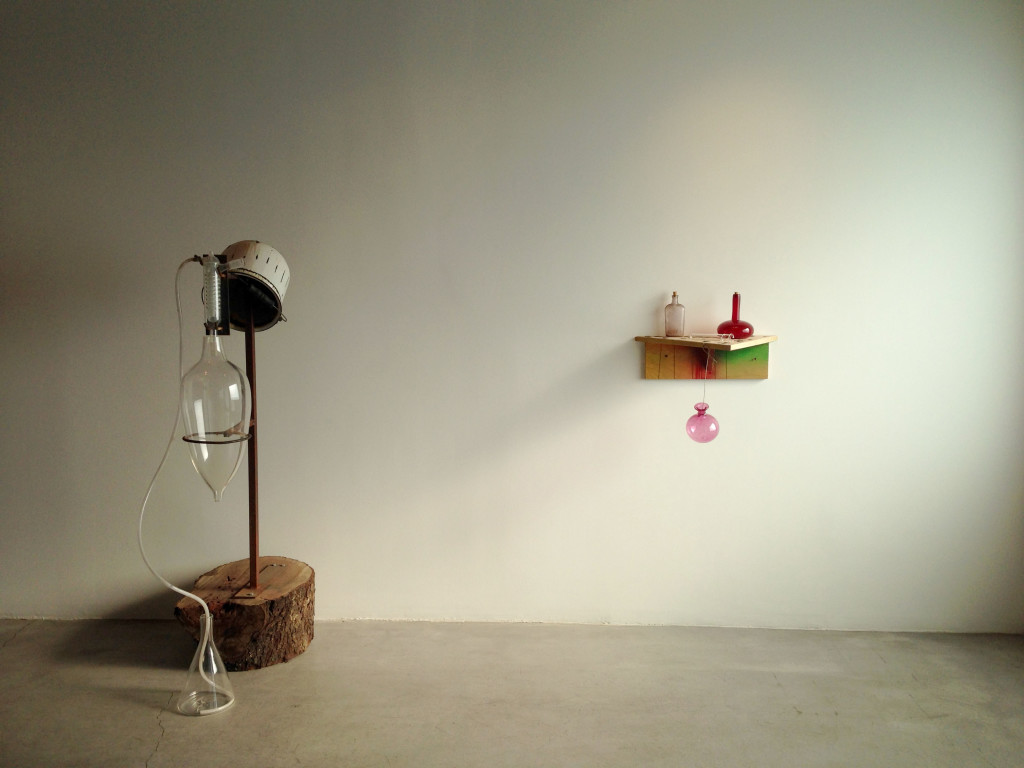
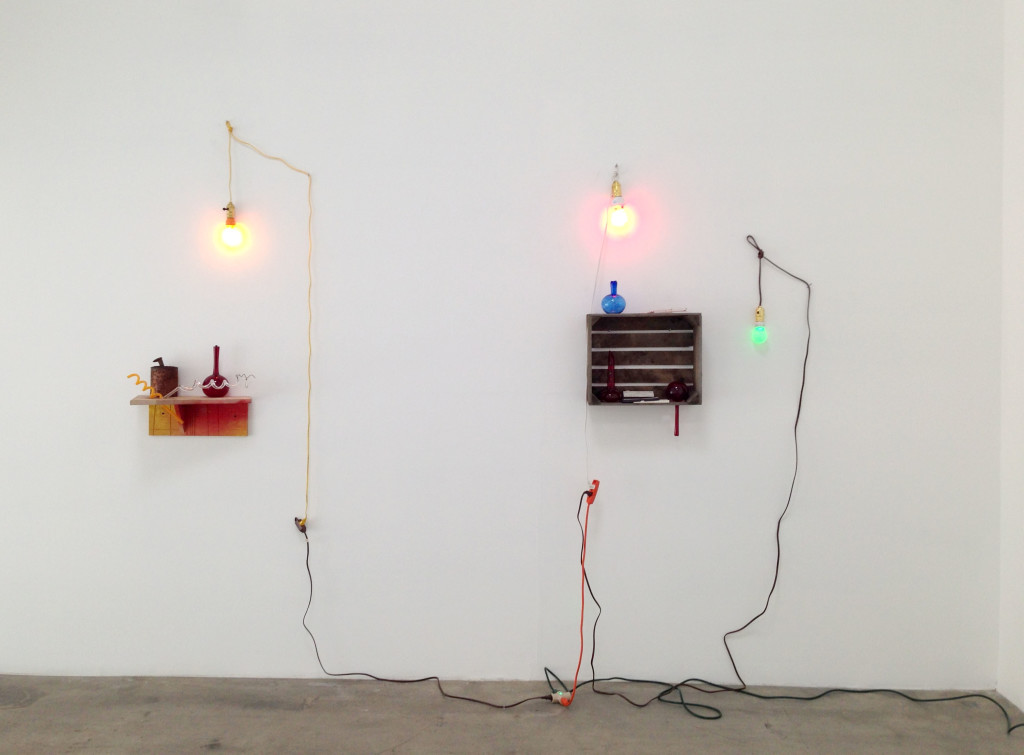
Anat Ebgi gallery is showing Elias Hansen’s new sculptures until 2/22. There are numerous beakers and other glassware combined with natural materials in setups that look, especially when lit with colored lights, like bizarre science experiments, or possibly something more suspicious.

Also in Culver City and closing 2/22:

Patrick Wilson’s geometric paintings in “Steak Night” seem to move the longer you stare at them- at Susanne Vielmetter Los Angeles Projects.

Tony de los Reyes’s show “Border Theory” at Angles Gallery paintings and lithographs are both abstract and political as the lines within them follow the natural border between the United States and Mexico created by the Rio Grande (or Rio Bravo).

Kevin Cooley and Phillip Andrew Lewis have a show called “Unexplored Territory” at Kopeikin Gallery that consists of video and photography that explores human’s desire to control natural elements like fire, and balances this concept with machines acting in ways that make them seem human. There is a video in the center room in which two fans on one power cord seem to be in a sort of dance/fight.

At LAXART, Brendan Fowler recreates photos with a commercial industrial embroidery machine creating a blend of photography and sculpture.

Feb 222014
 

yassimazandimaloney2

yassimazandimaloney

Yassi MazandiThe Sacred Wheel

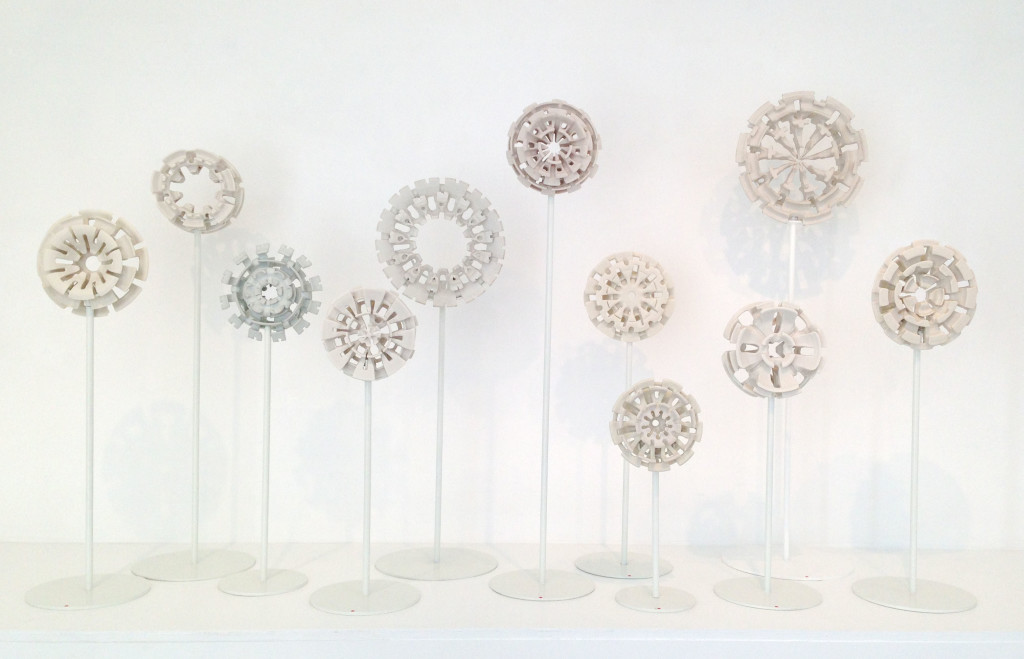
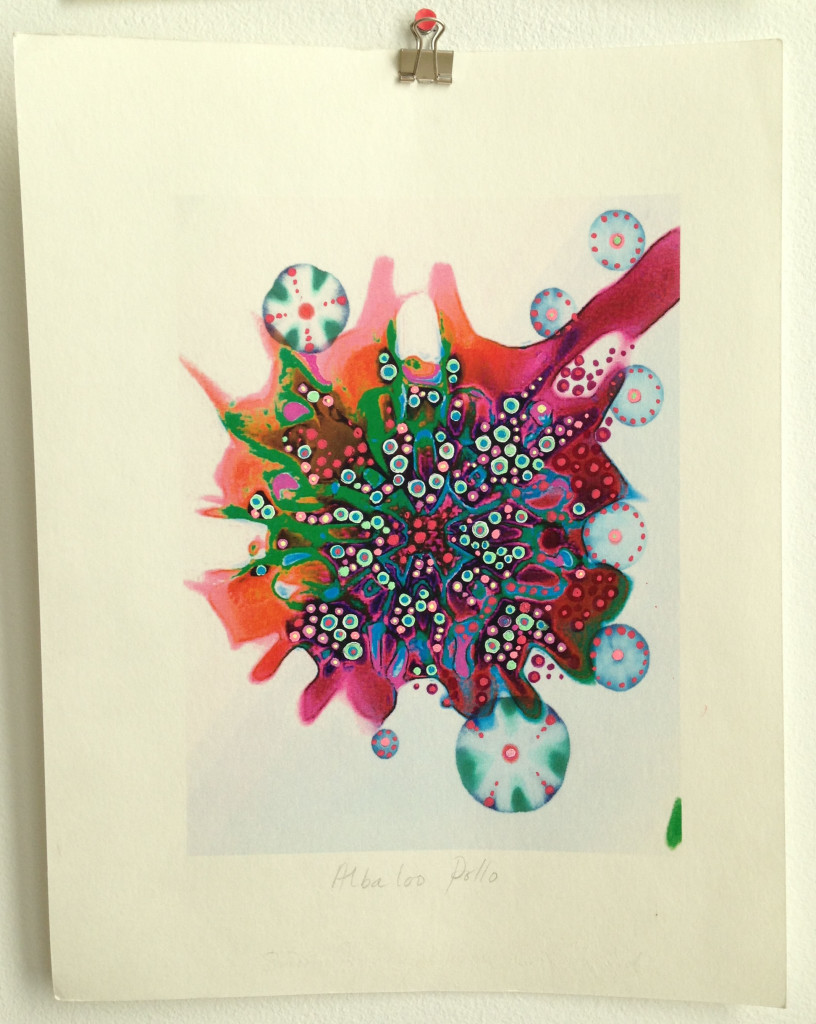
Currently at Maloney Fine Art, Yassi Mazandi has created intricate ceramic flower-like sculptures (seen above) as well as a larger impeller made of geo-polymer stone. Also on view are a series of 72 colorful watercolor paintings, (one is pictured above- Albaloo Pollo) all named after foods.

This show closes 2/22/14.

Feb 142014
 

lizlarnerregenproj

Liz Larner at Regen Projects

This is the final weekend (closes 2/15) for Liz Larner’s show at Regen Projects.

From the press release:

Regen Projects is pleased to present an exhibition of new sculptures by Los Angeles-based artist Liz Larner.The exhibition brings together her recent navigations of geological poiesis, fissures, folds, curves, and reconfigurations, and includes wall-mounted ceramic slabs, a large stainless steel X sculpture, two paper-based planchette pieces, early photographs, and a new “culture” sculpture. Larner has shown at Regen Projects since 1989, and this presentation marks her seventh solo exhibition at the gallery.

Her earlier photos, taken near the pool at the Tropicana Motel in Los Angeles are located in the side gallery and are particularly worth noting. In one a jar containing guitar strings and water sits near people sunbathing. In another, a flask with a mix of liquors hovers near the pool. It’s an interesting juxtaposition, both the objects in the photos, and this series in comparison to her newer work.

Feb 012014
 

figueroa2

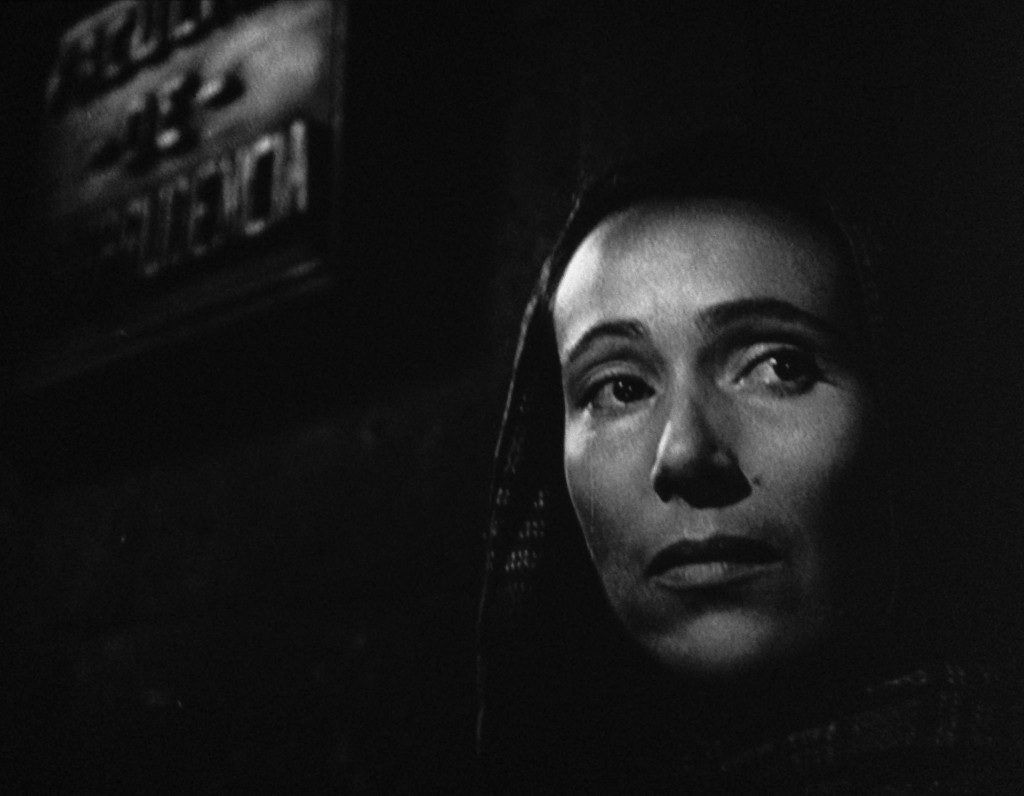
Image from Under the Mexican Sky: Gabriel Figueroa- Art and Film

From LACMA:

From the early 1930s through the early 1980s, the Mexican cinematographer Gabriel Figueroa (1907–1997) helped forge an evocative and enduring image of Mexico. Among the most important cinematographers of the so-called Golden Age of Mexican Cinema, Figueroa worked with leading directors from Mexico, the United States and Europe, traversing a wide range of genres while maintaining his distinctive and vivid visual style. In the 1930s, Figueroa was part of a vibrant community of artists in many media, including Diego Rivera, Jose Clemente Orozco, Edward Weston and Manuel Alvarez Bravo, who sought to convey the country’s transformation following the trauma of the Mexican Revolution. Later, he adapted his approach to the very different sensibilities of directors Luis Buñuel and John Huston, among others. Figueroa spoke of creating una imágen mexicana. His films are an essential part of the network of appropriations, exchanges and reinterpretations that formed Mexican visual identity and visual culture in the mid-twentieth century and beyond.

The moment you enter the exhibition, a montage of Gabriel Figueroa’s films plays on one wall to your right and it’s hard not to remain transfixed. As you move throughout the show, the history of his work begins to unfold through film clips, movie posters and stills, and artwork created at the time.

This excellently curated show includes not only large and small screen selections of Figueroa’s films, but also films shot in Mexico by Paul Strand and Sergei Eisenstein, and current artwork that was influenced by him. Of the contemporary art chosen, Rodrigo Garcia’s short film, La 7th Street y Alvarado is especially mesmerizing with its slow motion vision of Hispanic revolutionaries riding horses through present day Los Angeles.

There’s so much to see in this exhibition, yet it never feels overwhelming. That said, make sure to allocate a decent amount of time, especially if you want to see the majority of the film clips. This show closes on Sunday 2/2.