
Above is artist Larry Gray’s oil painting Anywhere Before, taken when it was on view at The Haen Gallery in Asheville, North Carolina in 2021.

Above is artist Larry Gray’s oil painting Anywhere Before, taken when it was on view at The Haen Gallery in Asheville, North Carolina in 2021.
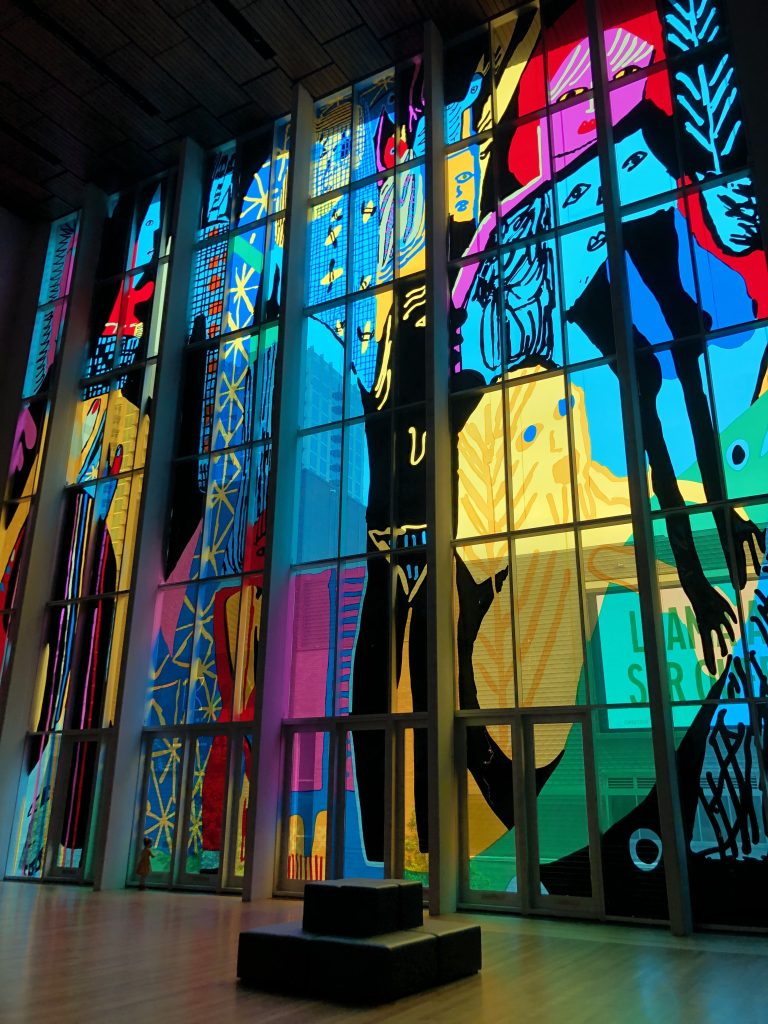

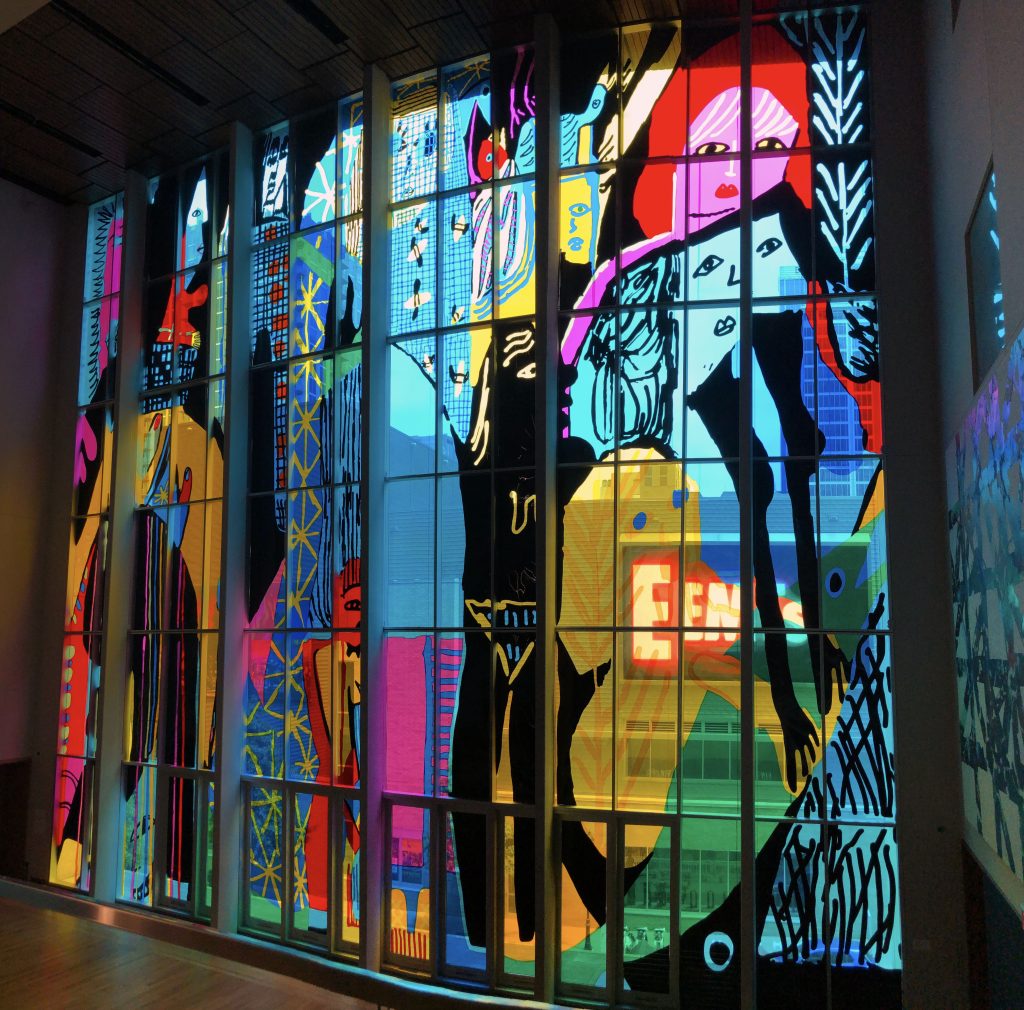
Summer Wheat created this mural, Foragers, in 2020 for the Mint Museum in Charlotte, North Carolina, where it remains on view today.
From the museum about the work-
This monumental “stained glass” installation celebrates the resilience of North Carolina’s community of makers and providers and creates a space where our present-day Charlotte community can gather for contemplation and inspiration. Collaging sheets of colored vinyl, Wheat has created a towering, prismatic composition that fills all 96 windows of the Mint atrium with female figures of varied sizes, ages, shapes, and races performing acts of labor: fisherwomen, beekeepers, hunters, mothers, caretakers, farmers, bankers.
Following the tradition of stained-glass windows found in places of worship, Wheat offers a narrative of hope and resilience that can be enjoyed in a few minutes or studied over hours. Wheat says that “Foragers presents a tradition in which women were the original hunters, technologists, and artists. This array of women connected by geometric patterns echoes the psychological space of women supporting each other. They are marching together, connecting to creatures from land and water, demonstrating their inherent link to natural elements and to the intricate depths of the unconscious.”
The women in Foragers also call attention to the underrecognized populations who have cultivated the land that we now call North Carolina, from the indigenous tribes to the colonial settlers to the enslaved Africans and all those who have followed. The region is home to myriad traditions-ceramics, basket weaving, quilting, furniture construction, textile production-and The Mint Museum specifically celebrates that legacy through its collection and exhibitions. Foragers salutes North Carolina’s history of creativity and industry, both by those whose names we know and those who remain anonymous.
Her latest exhibition, Fertile Ground, is currently on view at Nazarian/Curcio in Los Angeles, closing on 4/6/24. It includes new paintings and three stone mosaic sculptures.

Celo, 2015

Celo, 2015 (detail)

The World is Too Much With Us, 2021
The work above is from artist and retired UNC-Asheville Professor of Art Virginia Derryberry. It was part of the 2021 group exhibition FABRICated at Center for Craft. She curated the show with fellow artist Marcia Goldstein, whose work is included along with five emerging artists.
From the Center for Craft’s website-
FABRICated presents an intergenerational look at new boundaries in art and craft through works that merge fiber-based processes with other media, like painting, sculpture, and blacksmithing. Each of the seven artists explores ideas of the body, identity, and their unique, personal stories by using a medium with a rich history of craft. Stitching, in and of itself, is slow and methodical and invites the audience to slow down and look carefully at the physicality of the thread, the textures of the fabric, and the paint and the found objects that are introduced into the mix. The result is an exhibition that questions the nature of what constitutes women’s work, the relationship of fine art and craft, and how these elements can come together to form a new kind of community conversation.
And from Derryberry’s website about her work-
Virginia Derryberry’s current work includes large scale oil on canvas figure paintings along with fabric/costume constructions, that blend narrative elements from mythology and alchemy, the forerunner of modern science. The intent is to suggest multiple interpretations rather than straightforward illustration of a specific narrative. At first glance, it seems that a “real” space is being defined, but in fact, the painted images are constructed from multiple viewpoints and lighting systems. Passages of volumetric rendering set next to more abstract, painterly areas result in the creation of a virtual, shifting world where nothing is quite what it seems.