May 132019
 

ONE Gallery in West Hollywood is currently showing The Gutter Art of Stephen Varble: Genderqueer Performance Art in the 1970s photographs by Greg Day. The artist died in his late 30s and would have remained virtually unknown if not for curator David Getsy researching, collecting, and documenting everything he could find on Varble.

His performance pieces were often both audacious and humorous and the exhibition details several of them. Varble popped open blood filled condom breasts in protest at a bank (proceeding to use the blood to sign a check for “zero million dollars”), crashed the Met Gala and the premiere of Tommy, and gave “costume tours” of big name art galleries in Soho, challenging the status quo. In our current world of corporate bailouts, rampant capitalism, and celebration of the rich, its fun to imagine what kind of work Varble might have created today in response.

From the press release-

In costumes made from street trash, food waste, and stolen objects, Stephen Varble (1946–1984) took to the streets of 1970s New York City to perform his “Gutter Art.” With disruption as his aim, he led uninvited costumed tours through the galleries of SoHo, occupied Fifth Avenue gutters, and burst into banks and boutiques in his gender-confounding ensembles. Varble made the recombination of signs for gender a central theme in his increasingly outrageous costumes and performances. While maintaining he/him as his pronouns, Varble performed gender as an open question in both his life and his work, sometimes identifying as a female persona, Marie Debris, and sometimes playing up his appearance as a gay man. Only later would the term “genderqueer” emerge to describe the kind of self-made, non-binary gender options that Varble adopted throughout his life and in his disruptions of the 1970s art world.

At the pinnacle moment of Varble’s public performances, the photographer Greg Day (b. 1944) captured the inventiveness and energy of his genderqueer costume confrontations. Trained as an artist and anthropologist and with a keen eye for documenting ephemeral culture as it flourished, Day took hundreds of photographs of Varble’s trash couture, public performances, and events in 1975 and 1976. Varble understood the importance of photographers, and Day was his most important photographic collaborator. This exhibition brings together a selection of Day’s photographs of Varble performing his costume works and also includes Day’s photographs of Varble’s friends and collaborators such as Peter Hujar, Jimmy DeSana, Shibata Atsuko, Agosto Machado, and Warhol stars Jackie Curtis, Taylor Mead, and Mario Montez.

Varble sought to make a place for himself outside of art’s institutions and mainstream cultures all the while critiquing them both. The story of Varble told through Day’s photographs is both about their synergistic artistic friendship and about the queer networks and communities that made such an anti-institutional and genderqueer practice imaginable. Together, Varble and Day worked to preserve the radical potential of Gutter Art for the future.

The Gutter Art of Stephen Varble builds upon the 2018 retrospective exhibition of Stephen Varble’s work at the Leslie-Lohman Museum of Gay and Lesbian Art, New York, titled Rubbish and Dreams: The Genderqueer Performance Art of Stephen Varble, as featured in the New York Times on January 11, 2019.  The new ONE Gallery exhibition, with its focus on the collaboration of Varble with the photographer Greg Day, will explore the ways in which Varble’s disruptive guerilla performance art has lived on primarily through vibrant photographs that captured his inventive costumes, transformed trash, and public confrontations.

This exhibition closes 5/17/19.

*For an additional perspective on the artist- Stephen Varble was friends with a 14-year old girl in NYC named Fernanda Eberstadt who kept diaries detailing her time with him. She wrote an interesting piece for Granta about him, reproduced here.

May 102019
 

Hammer Museum’s current exhibition Allen Ruppersberg: Intellectual Property 1968-2018 is a fascinating and fun look at the work of the Conceptual artist. Walking through the show, the variety of the work and the artist’s sense of humor keep the exhibition engaging from start to finish.

Much of Ruppersberg’s work created in Los Angeles is specific to the city, especially how it was during the late 1960s and early 1970s.  The contrast between the urban city life and the natural surroundings of mountains, desert and beach can be seen in several of his pieces including the “Location Pieces”. For “Al’s Cafe”, he created a restaurant in downtown LA where everything from the menus, receipts, and tongue-in-cheek dishes, was a work of art. Examples of the “meals” include “Rock Varieties Smothered in Pine Needles” and the “Patti Melt”, a studio photo covered in toasted marshmallows. He later went on to create “Al’s Grand Hotel” which consisted of several rooms of various themes, run by the artist. For a little over a month of weekends, guests came to stay overnight. Like his restaurant, the hotel became a meeting place for the Los Angeles arts community.

Language and the printed word play a very important in Rupperberg’s work. He rewrote Oscar Wilde’s novel The Picture of Dorian Gray on several large canvases that take up an entire room in the show. For a series of paintings he recreated newspaper articles of strange crimes and then wrote comments on the canvas “translating” them.

Driving around Los Angeles he noticed the ubiquitous DayGlo posters made by Colby Printing and used them to print The Singing Posters: Allen Ginsberg’s Howl by Allen Ruppersberg (Parts I-III). For this work the poem is recreated phonetically in a series of these posters, along with some commercial advertising posters, and placed together to form a large mural.

Ruppersberg is still creating, collecting, and exploring the world around him. This show celebrates his unique perspective while also presenting a glimpse of what it was like to be an artist in Los Angeles at the time he was making this work.

This exhibition closes 5/12/19.


May 092019
 

Various Small Fires (VSF) is currently showing unholy ghost, Diedrick Brackens’ first solo exhibition at the gallery.

From the press release-

Employing the loom to explore intricate weaving techniques from West Africa, Kente textiles, and European tapestries, Brackens stitches together narratives of the American South, rebirth, and the changing of seasons for his new body of work. The titles and themes for this exhibition take inspiration from Essex Hemphill’s poem The Father, Son and Unholy Ghosts.

For Brackens, who identifies as a black queer person, the act of naming and birthing oneself is a radical gesture. Drawing from his personal life, ancestry, American history, and folklore, Brackens’ weavings are encoded with symbolic animals and materials that tease the knotted threads of American identity and sociopolitics. A bloodhound sniffs the ground for a subterranean figure in hiding, alluding to the terrorization of black bodies through the omnipresence of state-sanctioned violence. Catfish, on the other hand, occupy the space of spirits; swimming parallel to a levitating body, inside the heart of an aquatic being, or by hands outstretched to the sky, they are both ancestor and sustenance, the origin of human life. The silhouetted figures are born from Brackens’ projected shadow, a mirror of the self sewn with jet black yarns.

Brackens was included in Hammer Museum’s Made in L.A. 2018, their biennial exhibition of artists from the greater Los Angeles area. Below is a video made for that show that shows the artist creating and discussing his work.

Also on view are Anna Sew Hoy’s sculptures (pictured below) and a sound program by Dawn Kasper that plays in the entrance to the courtyard of the gallery space.

These exhibitions will close 5/11/19.

May 032019
 

Peer Amid (Peered Amidst), 2019

Sumday (We Gunna Rest on) Sunday, 2019

Detail of Sumday (We Gunna Rest on) Sunday, 2019

Change Comin’ Round Tha Bend (Right Round, Right Round), 2019

Regen Projects is currently showing But I Woke Jus’ Tha Same, an exhibition of paintings and drawings by artist Christina Quarles. If her work seems familiar, she was also one of the artists featured in Hammer Museum’s Made In L.A. 2018.

From the press release–

Quarles’ seductive paintings feature polymorphous figures arranged in contorted positions in space, rendered through expressive and gestural strokes that teeter on the edge of abstraction and representation. Referencing the history and techniques of painting, her work propels forward the limits of her chosen medium, and is informed by her multiply situated identity as a queer woman of mixed race. Dynamic compositions feature bold patterns and decorative motifs such as flowers, latticework, and plaid tablecloths – feminine tropes that reference domestic space. Yet the subjects in Quarles’ paintings simultaneously inhabit interior and exterior space. Perspectival planes both situate and fragment the bodies they bisect, representing the boundaries that demarcate a space from the individual, and expanding the limits and potential for representation.

Similar to her paintings, her drawings deftly combine pictorial elements using economy of line with cross hatching, and other modes of mark making, to create form and depth. Punctuating the picture plane, or outlining a figure, text additions in the form of puns or poetic wordplay often reference pop culture, situating the works in our time.

This show closes 5/9/19.


Apr 242019
 

TOTAL youth, 2019

TOTAL youth (side view), 2019

Sea Within A Sea, 2019

Sea Within A Sea, 2019 (side view)

“…We are constantly changing and rearranging our point of view. Tomorrow we will remember yesterday. The abstraction is real, more real than nature…” (punctuation mine)- text from Willie Stewart’s video Love Song (2019)

Nostalgia is something we all live with to a greater or lesser extent. The past informs our present and how we perceive things. Why do we see things the way we do? How do we frame the things we see and put them together?

For Willie Stewart’s exhibition In Between Days at Morán Morán gallery, he recreated VHS tapes, album covers, 1970s wood paneling, flowers, paintings of flowers, and more, through layers of detailed painting combined with sculpture. Their titles reference songs from bands like Depeche Mode, Germs, The Horrors, and The Cure and add additional meaning to the content of the work. Within the text of the video in the exhibition. they change their context once again.

The perception of the viewer adds yet another layer when they make their own connections based on personal associations with the objects in the work. In that way, the meaning often becomes less about the work at face value, and more about the meaning you bring to it. For some it may be no more than just an admiration of the beauty and skill of the work. Maybe it won’t resonate to some at all. But for others who remember VHS tapes more vividly or know the bands referenced, the nostalgia adds an extra appreciation.

This exhibition closes 4/27/19.

Apr 192019
 

Nuestra Señora de las Iguanas, Juchitán, Mexico, 1979

Señor de los Pájaros, Nayarit, Mexico, 1984 (image courtesy of Rose Gallery)

Currently at Rose Gallery is Graciela Iturbide: Hay Tiempo, an exhibition of beautiful photographs by the Mexican photographer.

From the press release–

Graciela Iturbide, celebrated as one of Mexico’s most prolific and distinguished photographers, observes with patience and exhibits her world with beauty, serenity and dignity. Born into a conservative family in Mexico City, Iturbide decided to create her own path, leaving a traditional domestic life to pursue the arts. During her studies in cinematography at the Universidad Nacional Autonama de Mexico, she became the achichinle (the assistant) to Manuel Alvarez Bravo, the distinguished Mexican photographer who later became a lifelong mentor to Iturbide. In their time together, Álvarez Bravo constantly reminded Iturbide to pause and observe, asserting Hay Tiempo (There is Time). This patience to allow the moment to unravel and reveal itself echoed the notion of a Mexican poetic tempo, which is present throughout Mexican art, literature and life. Iturbide came to understand and employ her mentor’s slow, observational process as she photographed many cultures and spheres.

Although Iturbide has photographed all over the world, she is widely known for the photographs she has taken in her native Mexico. While many twentieth-century photographers had documented Mexico through an outsider’s lens, shining light on poverty and politics in a neocolonial gesture, Iturbide reached beyond the document, photographing the poetic essence embedded in each moment. With Hay Tiempo in mind, she evokes a lyricism in her careful observations. In the late 1970s under an assignment for the INI (Instituto Nacional Indigenista), Iturbide photographed the Seri tribe, focusing her lens on Mexico’s indigenous population which was often overlooked and marginalized. In these portraits, the deep cultural and spiritual history of indigenous peoples exists alongside the influences of colonialism and an encroaching globalism. Then, in 1979, the celebrated Mexican artist Francisco Toledo invited Iturbide to photograph his native city Juchitan in the southern state of Oaxaca, where she encountered the strength and independence of the Zapotec women. In this indigenous, matriarchal community, the women live economically and socially independent lives in a stark contrast to the customs of westernized Mexico that Iturbide grew up within. Iturbide’s photographs, equally grounded and imaginative, portray the power and spirit of each individual. Their direct presence in the image exhibits the persevering dignity of the indigenous people in a post-colonial world. Iturbide’s photographs of Mexico show not only the diverse and rich cultural history of her nation, but also the resonance of Iturbide’s own artistic community, which invited and encouraged the photographer to explore her own nation in its multiplicities of experience.

This exhibition closes 4/20/19.

Apr 122019
 

Annie Leibovitz. The Early Years, 1970 – 1983: Archive Project No. 1 at Hauser and Wirth Los Angeles, is an engrossing look into the beginnings of a photographer who is now one of the most famous in the world. The exhibition, curated by Leibovitz herself, features more than 4,000 photographs. Despite that large number, the layout keeps it from feeling overwhelming. Photographs are put together on the walls by theme and time period. As you wander from room to room looking at the often recognizable faces, Leibovitz’s distinct style emerges.

The early sections of the show give the viewer a chance to see Annie Leibovitz as a young artist just starting out and developing her way of looking at the world through a camera. On one wall is a collage of photos creating a panorama of the Pont Neuf bridge in Paris. She took it when she realized she was standing where Henri Cartier-Bresson, one of the photographers she most admired, had once stood to photograph that same bridge. The sense of excitement she felt at that moment informs the image she would later take of Cartier-Bresson himself. That portrait is included on another wall with images of other photographers and artists she admired.

Walking from room to room, the famous faces blend together with the history of the time period. Political protests, music festivals and tours, presidential campaigns, Nixon’s resignation, Warhol’s factory- she was there documenting what was happening, often in unique ways. Her ability to observe and capture moments without intruding in her subject’s personal space remains present whether it is a rock star, politician, or a member of her own family.

As the show moves through Leibovitz’s timeline, her increased focus on the portraiture that would make her famous emerges. Her staged photographs from the 1980s of celebrities including Keith Haring, Whoopi Goldberg, and Meryl Streep appear. The transition makes logistical sense as this progression of her career is made clear by all the work that came before. Her portraits are the works that stand out the most, even at the beginning.

The exhibition captures an incredible period of time in both the artist’s work and the history of America. Make sure to leave a lot of time to see it before it closes on 4/14/19.


Apr 052019
 

Currently at Hauser & Wirth’s Los Angeles location is Piero Manzoni. Materials of His Time.

From the press release–

Piero Manzoni. Materials of His Time is the first exhibition with the gallery and the first in Los Angeles in over 20 years devoted to the seminal figure of postwar Italian Art and progenitor of Conceptualism. Curated by Rosalia Pasqualino di Marineo, director of the Piero Manzoni Foundation in Milan, this exhibition focuses on Manzoni’s revolutionary approach to unconventional materials through the exploration of what he dubbed ‘Achromes’ – paintings without color. Over 70 ‘Achromes’ will be on view, comprised of such materials as sewn cloth, cotton balls, fiberglass, synthetic and natural fur, straw, cobalt chloride, polystyrene, stones, and more. The exhibition situates Manzoni as a peer of such artists as Lucio Fontana and Yves Klein, whose experiments continue to influence contemporary art-making today. ‘Materials of His Time’ will also present, for the first time, the items on a wish list Manzoni outlined in a 1961 letter to his friend Henk Peeters: a room all in white fur, and another coated in fluorescent paint, totally immersing the visitor in white light.

The “Achromes” are simple but pleasing in their graphic simplicity. Lacking in color, they stand out against the soothing muted colors of the walls.

Heading upstairs, there’s something so delightful about stepping into the white fur room that fulfills Manzoni’s dream. The room itself has a white felt floor and fake fur lines the walls, ceiling and door. It may not be as thrilling now that installation art is more common in museums and galleries, but after reading the artist’s quote, knowing he got his wish makes it much more special. The artist died in 1963 at the young age of 29, too soon to see how much would change in the art world. Also, after seeing an exhibition that focuses on objects with so many different textures, having a chance to touch the furry walls is oddly satisfying.

This exhibition closes 4/7/19.

Apr 052019
 

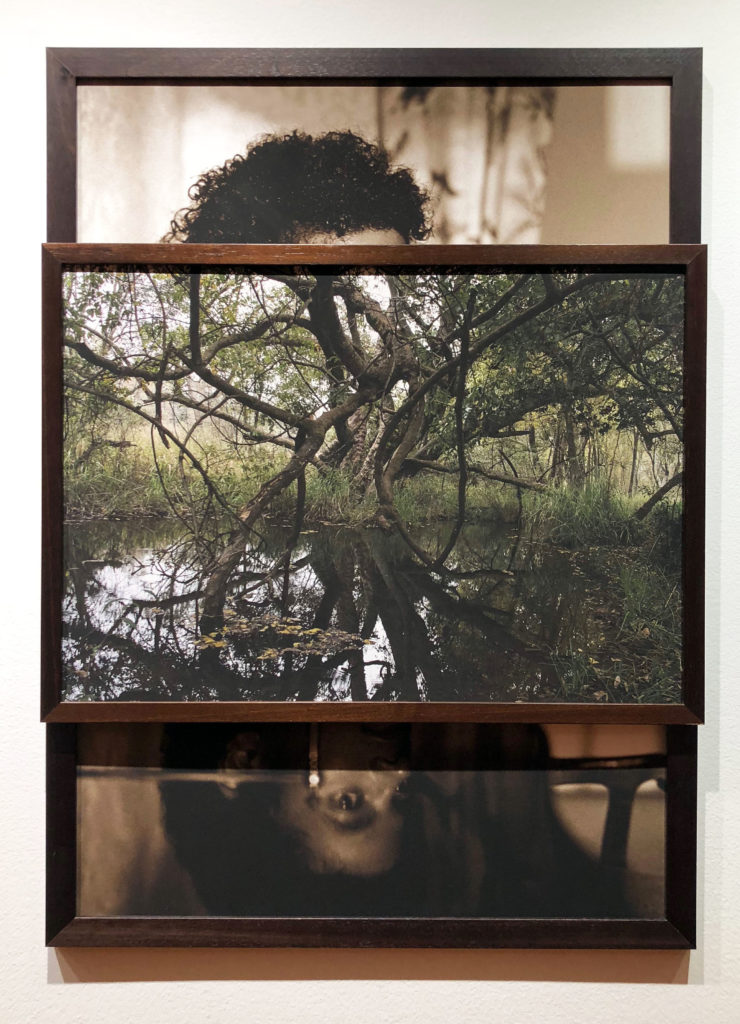
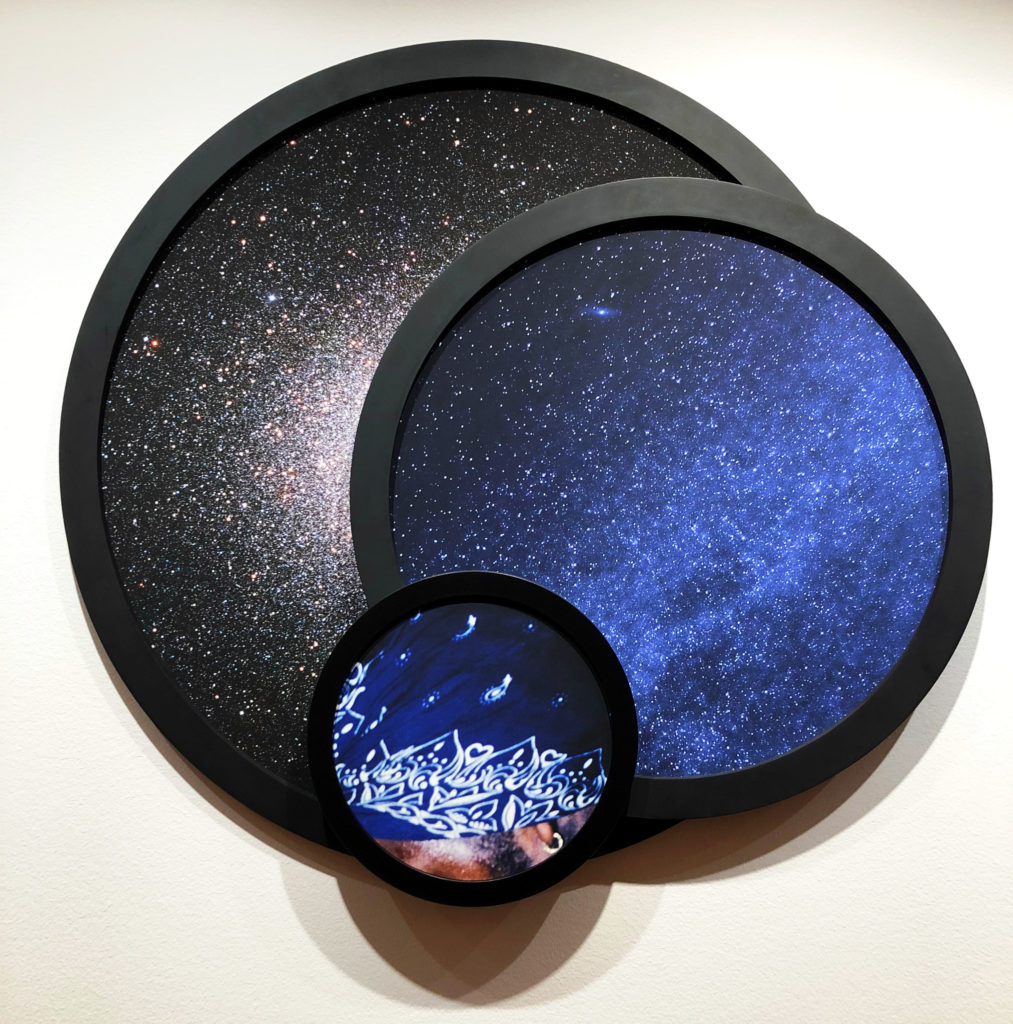
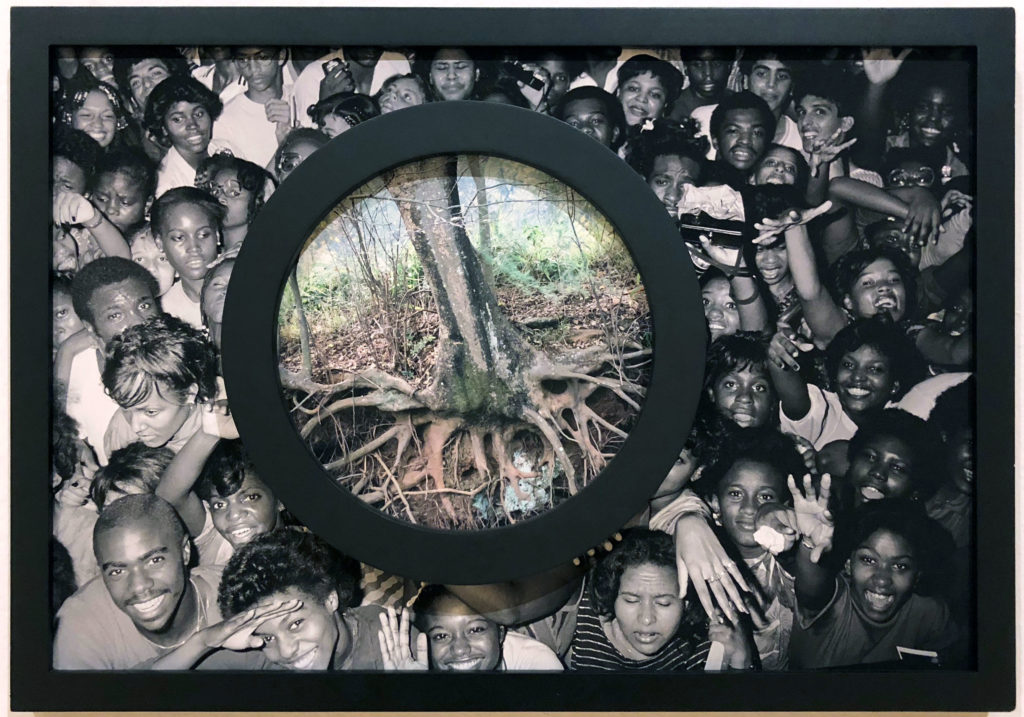
For his current exhibition at the Palm Springs Art Museum, Todd Gray:Plurality of Being, Gray combines images that could initially be seen as incongruous to add layers of meaning and complexity to issues of identity.

Using his own previous photographic explorations from different parts of the world, he then places the images together within frames he’s found or was given. Through this process the history of his own journey combines with that of those he’s photographed. In some works the roots of trees reach out between images pulling them together or imitate the stretching out of arms. The blue and white of a bandanna finds its place within the colors of the universe in another. The viewer can put together their own meanings from these juxtapositions or just enjoy the beauty of the sculptural collages.

From the press release-

Using pictures made when he was Michael Jackson’s personal photographer in the 1980s, along with those of verdant flora, local friends, and galactic imagery, Todd Gray’s wall collages portray the multiplicity of experience and memory across space and time.

Mixing archival images of Jackson on tour in the United States with lush landscapes from Italy to South Africa, Gray’s photographic sculptures reframe and reveal an intimate yet collective post-colonial, transatlantic memory. By layering images, bodies and faces become fragmented, drawing into question the role photography plays in the transmission of history and cultural identity.

This is the first U.S. presentation of work made during Gray’s 2017 residency at NIROX in Johannesburg, South Africa.

This exhibition closes 4/7/19.


Apr 042019
 

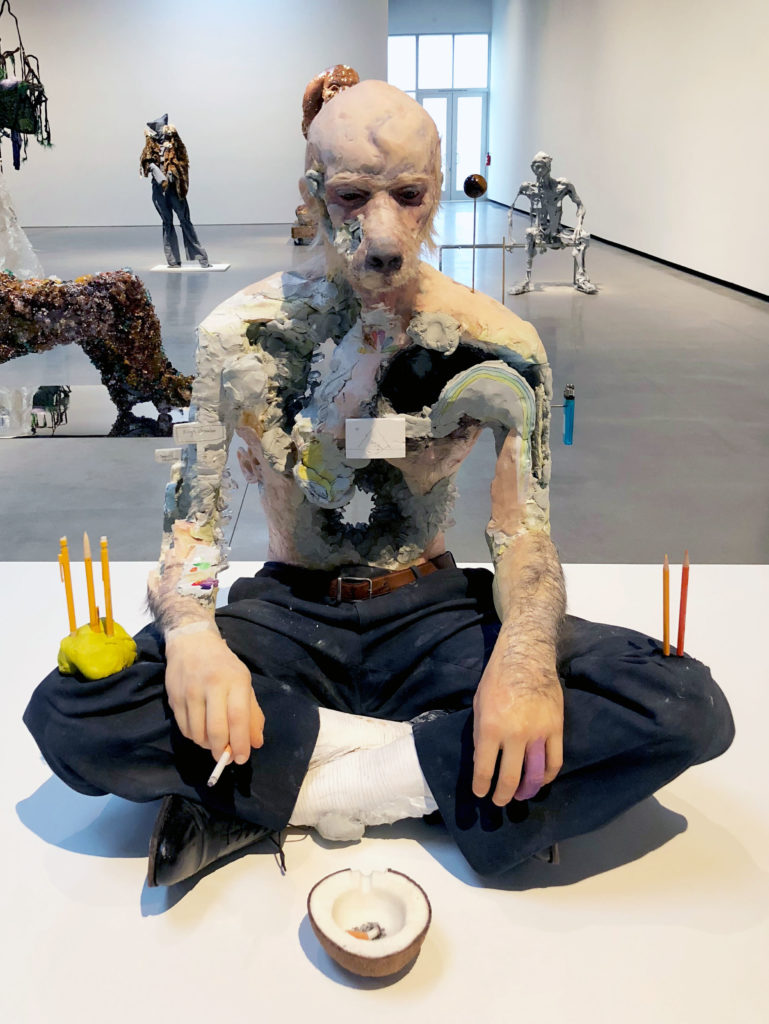
People, the current sculpture exhibition at Jeffrey Deitch’s Hollywood gallery, fills the large room with work in a variety of media but all representing human beings in some way.

From the press release-

More than fifty standing, sitting and hanging figurative sculptures will fill Jeffrey Deitch’s new Los Angeles gallery. The artists in the show span several generations from the 1980s to the present, with an emphasis on emerging talent.

All of the works in the exhibition reflect a contemporary approach to sculpture inspired by the innovations of Dada, Surrealism, Assemblage and by the influence of non- or meta- art sources like department store mannequins.

Only one work in the show is carved or modeled in the traditional way. Some are made from body casts, others are constructed with found objects and only a few use conventional sculptural materials like bronze.

The works in the exhibition reflect the diversity of the artists who created them and the diversity of the people who the sculptures represent. The styles range from hyperrealism to allegory. The subjects range from ordinary individuals to creatures of fantasy. The works explore the uncanny confrontation of the artificial and the real while simultaneously responding to the multiple approaches to human identity in the contemporary world.

One of the sculptures, Totem, by Narcissister even incorporates live women. This adds to the unsettling feeling that some of the other sculptures, like Nobody, by Karon Davis (who founded The Underground Museum with her late husband Noah Davis), might have included real people as well (they don’t).

Karon Davis, “Nobody”, 2019

One of the strongest pieces in the exhibition is David Altmejd’s Pyramid in which a human/dog hybrid figure sits smoking while its back opens to expose insides composed of quartz, a hand, and several ears protrude from its sides. The little details are fascinating. He’s even painted one of the figure’s fingers purple, perhaps a reference to Human, the Ibizan hound with one purple leg that was included in Pierre Huyghe’s exhibition at LACMA.

People was inspired by Mike Kelley’s exhibition and book project The Uncanny, from 1993, and that’s definitely an accurate description of how it feels to wander around in this particular room of sculptures.

This exhibition closes 4/6/19.