Mar 212019
 

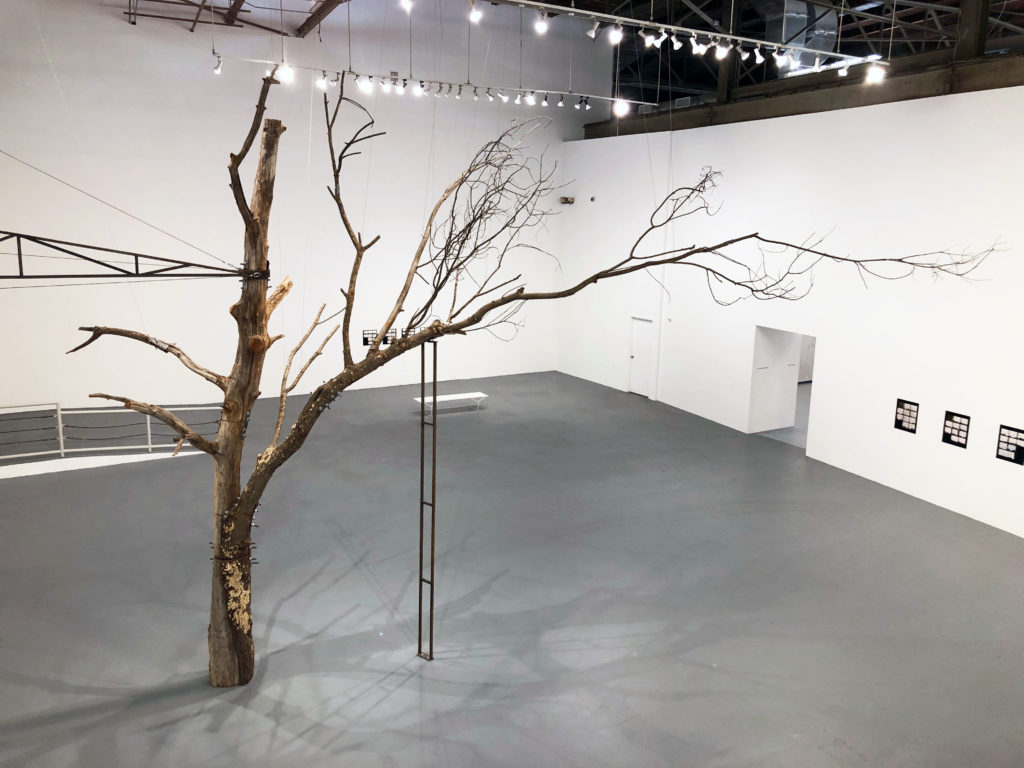
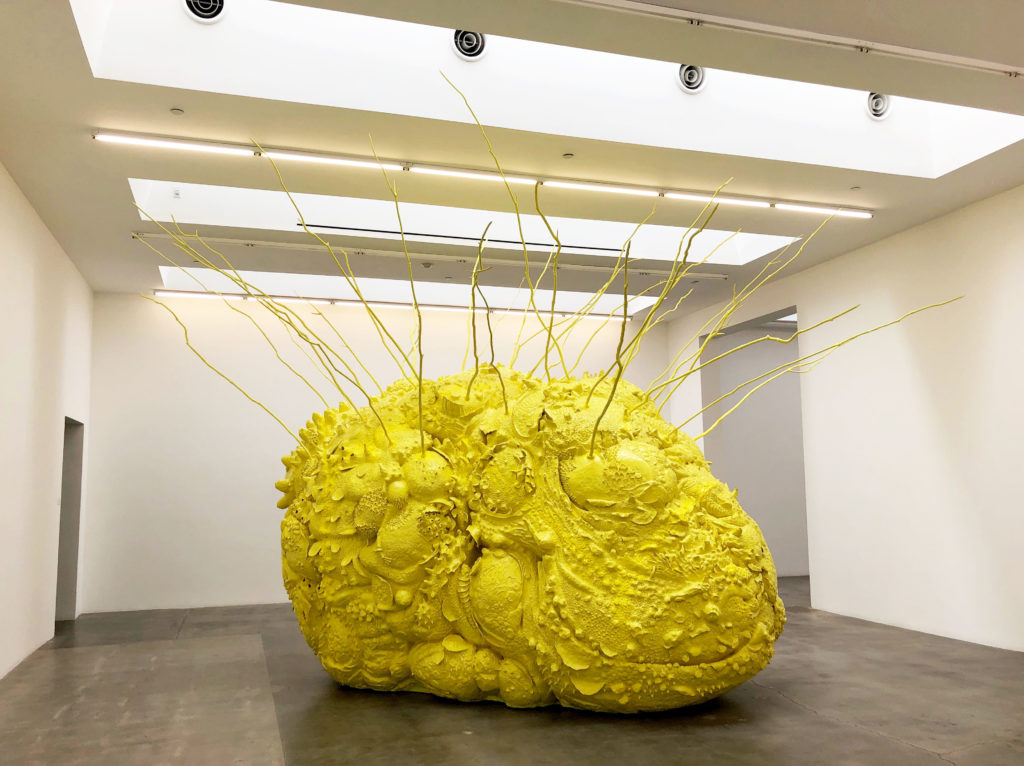
Chris Engman, “Containment” Installation, 2019
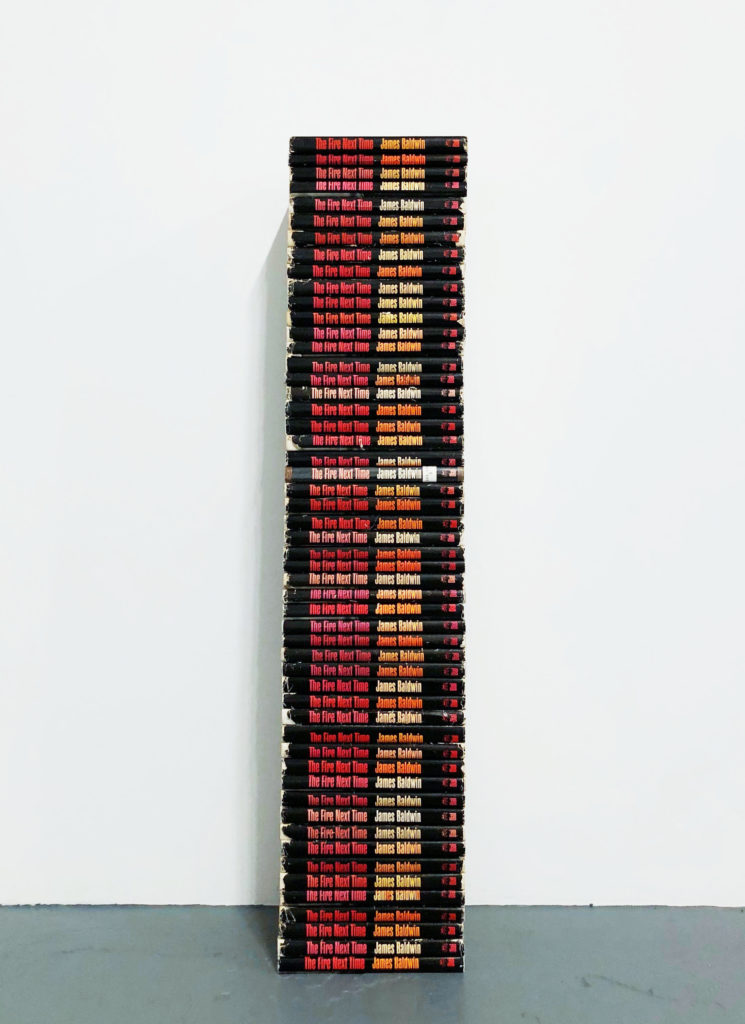
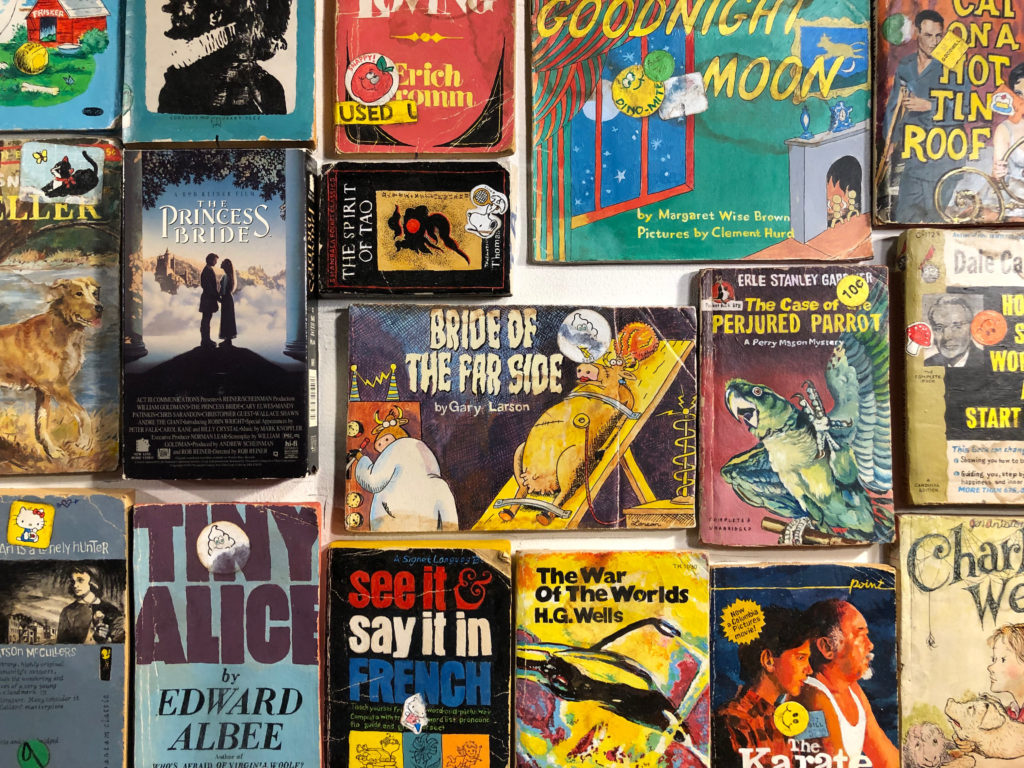
Chris Engman “Bookshelves”, 2019

Taking and viewing photos has increasingly become an important part of people’s lives, especially with the introduction of Instagram and the ability to use your phone as a camera. We are looking at more and more images than ever before. But when you are looking at a photo, how much of what you are seeing is real?

Chris Engman’s show Refraction at Luis de Jesus Gallery challenges these perceptions through his creation of photographic environments. When you enter the gallery you walk into the site-specific work Containment, which took over 300 individual prints to create. It’s an immersive piece that gives the viewer the chance to see how Engman’s final images are created.

The second room of the gallery houses several photos of different recreated natural environments, including sand dunes and a cloudy sky. On one wall there is a book shelf (pictured above) where the center is a photograph of a bookshelf and to the left and right are actual objects, furthering the challenge to question everything you are looking at. Looking at a photo of books on a shelf, next to real books on a shelf, what makes more of an impression to your eye? What is the difference between looking at a photo of the sky and a photo of a construction made of photos of the sky?

From the press release

Refraction explores the relationship between illusion and reality by exposing the deceit inherent in photographic image-making while engaging in philosophical and material play around slips in translation. Refraction refers to the change in matter or information as it passes through one medium to another. Refraction occurs when our experience of the world is mediated through photographic images. Engman states: “We see more than we would have, and there is value in that. But the thing, person, or place that is imaged is also irrevocably changed. Photographs resemble and seem somehow in proximity to places and moments we cannot access in ways we wish we could. This produces a continuous and oblique kind of yearning for what we wish could be present or more fully understood,” resulting in a mental projection through which we fill in the gaps, adding detail or meaning.

This exhibition closes 3/23/19.


Mar 212019
 

Noboru Tsubaki “Fresh Gasoline”, 1989

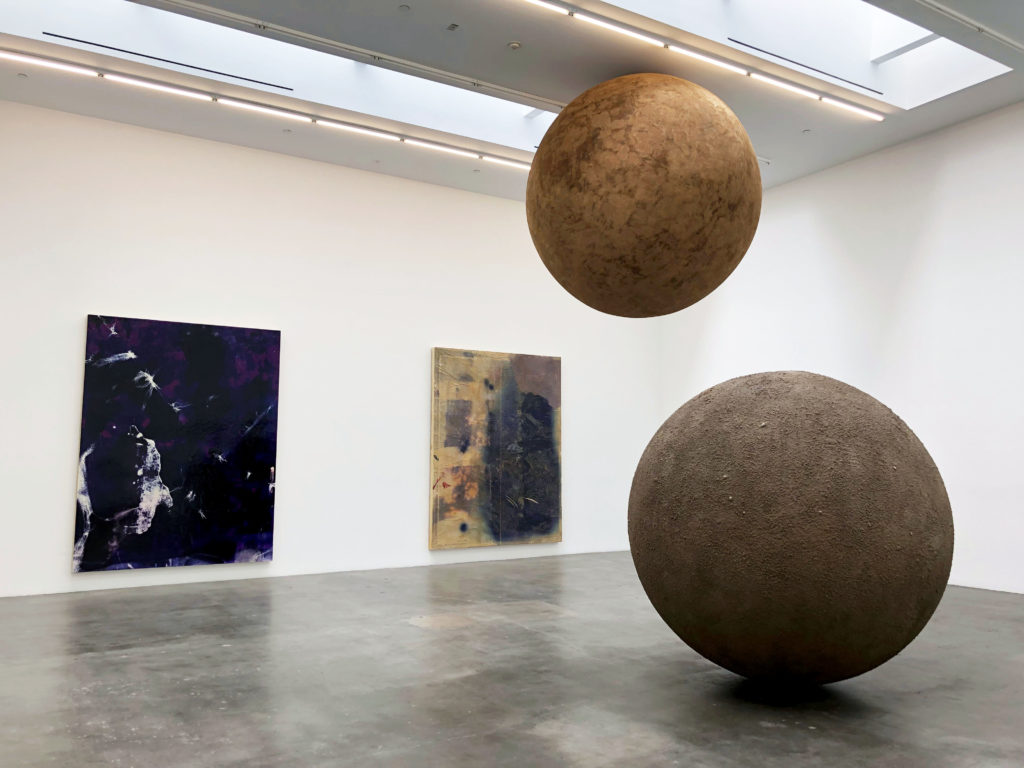
Yukinori Yanagi “Ground Transposition”, 1987/2019 (balloons) and Shinro Ohtake “Retina (Night Fever 1)”, 1990 (left on wall) and “Retina (DNA Shadow III)” (right on wall), 1990

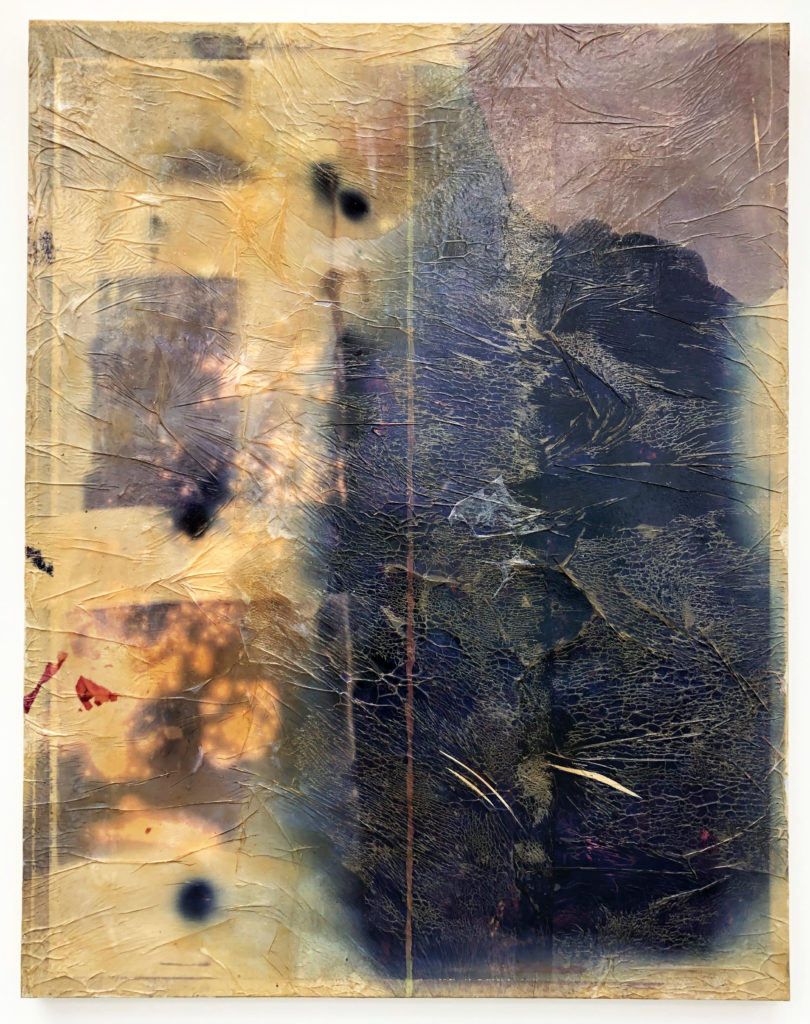
Shinro Ohtake “Retina (DNA Shadow III)”, 1990


Blum & Poe’s current exhibition Parergon: Japanese Art of the 1980s and 1990s, is a selected survey exhibition of Japanese art of the 1980s and ‘90s, curated by Mika Yoshitake. It includes the work of over twenty-five visual artists in a variety of media including painting, sculpture, video, and photography.

From the press release

The exhibition title makes reference to the gallery in Tokyo (Gallery Parergon, 1981-1987) that introduced many artists associated with the New Wave phenomenon, its name attributed to Jacques Derrida’s essay from 1978 which questioned the “framework” of art, influential to artists and critics during the period. Parergon brings together some of the most enigmatic works that were first generated during a rich two-decade period that are pivotal to the way we perceive and understand contemporary Japanese art today. In the aftermath of the conceptual reconsideration of the object and relationality spearheaded by Mono-ha in the 1970s, this era opened up new critical engagements with language and medium where artists explored expansions in installation, performance, and experimental multi-genre practices.

When the U.S. and Europe were witnessing a return to Expressionism alongside a postmodern aesthetic of simulacra and deconstruction characterized by the Pictures generation, this zeitgeist of cultural capitalism was instead manifest under Japan’s unique social and geo-political conditions resulting from the rise and burst of the bubble economy. Artists began to explore subversive artistic languages and integrate underground subcultures into their practice using a variety of media, ranging from experimentations in electro-acoustic music, geopolitical and conceptual photography, and appropriations of advertisement culture. Others addressed the internalization of historical avant-garde and modernist aesthetics that were filtered through a new poetics of form, space, and language.

In the post-1989 Hirohito era, politics of gender, nuclear crisis, and critique of nationalism are especially poignant among artists from the Kansai region. This period also witnesses the rise of art collectives in the mid-90s and their darkly humorous performances and conceptual practices that reevaluated the history of Japan’s postwar avant-garde. These events reflect on a subculture generated out of a profoundly unique “infantile capitalism,” anticipating the explosive rise of the Neo-Pop generation.

This exhibition is presented on the occasion of Blum & Poe’s 25-year anniversary. Parergon commemorates a special facet of the gallery’s history rooted in this very timeframe in Japan—with Tim Blum’s early years as an art dealer and curator spent in Tokyo in the early ‘90s—and charts a bridge between the Japanese art historical territories the gallery has long championed. Parergon pursues the creative significance of the years between the milestones of Mono-ha and the Neo-Pop generation now synonymous with Takashi Murakami and Yoshitomo Nara.

This exhibition closes 3/23/19. Part II will open 4/6/19.


Mar 062019
 

Currently at The Rendon Gallery, at a pop-up space on Palmetto Street, is Los Angeles based South African artist Ralph Ziman’s exhibition, The Casspir Project. The Casspir is a massive military vehicle that was used to terrorize the civilian population in South Africa during the apartheid-era. Sadly, they are still used by police forces in certain parts of the world, including in the United States. Ziman, with a team of artists from Zimbabwe and the Mpumalanga province of South Africa, have covered the Casspir in brightly colored beads in traditional patterns, making something beautiful out of what was once a symbol of horror.

Although the vehicle is the centerpiece, the exhibition also focuses on the arms trade and includes photos, a video, and additional beaded work. From the press release-

For this iteration of The Casspir Project, Ziman has designed the massive gallery space with a “macro and micro” experience in mind. Each room within the gallery space brings context to the next, informing the project as whole. The exhibition starts with an installation of brightly colored AK-47s leading into a room with large photographs taken in Soweto. For the photos, Ziman recreated scenes from newspapers during the apartheid, incorporating many of the elements found within the exhibition such as the beaded guns and SPOEK 1. A screening room shows a 20 minute documentary by Ziman which tells the history of the Casspir, from its design and conception to people’s personal experiences with it in the ‘70s and ‘80s. It chronicles Ziman’s reclaiming of the Casspir, detailing how he transformed and Africanized it. The exhibition culminates with the dramatic presentation of SPOEK 1, lit only by a spotlight in a dark room.

Opening a dialogue between those who remember and those too young to know, The Casspir Project is a profound attempt to reconcile history. Ziman has reclaimed the savagely violent brute—embellished and bedazzled, the Casspir has been made less threatening, its power and authority subverted.

This exhibition has been extended through 3/10/19 and this weekend Ziman will be live painting at the gallery with artist Keya Tama.


Mar 022019
 

What are the webs within our own lives? How are we connected to others? What is seen and not seen in our world? How do we function within our environment? What is created without our even noticing?

Tomás Saraceno’s current exhibition at Tanya Bonakdar Gallery in Hollywood, his first ever solo exhibition in Los Angeles, explores these ideas through the intersection of science and art. In one room, balloons drag pens to create drawings from the air and movements of those who wander through. Spider webs (displayed without the spiders) play an important part in weaving together the themes of the exhibition. Made by different species of spider and dyed with carbon ink, they are in frames against the wall. Presented in another part of the gallery, in a dark room, they are spot lit creating beautiful three dimensional sculptures. In another room, in full darkness, they are lit by a slowly moving laser which highlights in red various sections of the webs as others fade away.

In the front room of the gallery is a sculpture that continues the artist’s Cloud Cities body of work (pictured below). Cloud Cities was shown on the rooftop of the Metropolitan Museum of Art in New York in 2012.


From the press release-

… Conceived and inspired by the geometries of soap bubbles, the cluster-like artworks are composed of a number of interconnected modules, some with web-like structures set within them, which form geometric constellations inspired by the Weaire-Phelan structure. The Cloud Cities project is intimately tied to and embodied in the Aerocene Foundation, a community that proposes an epoch free from fossil fuel emissions, which challenges socio-political atmospheres by trespassing and weaving new, much needed, aerographies.

Cloud Cities are fictional urban and socioscapes in such imagined post-Anthropocenic future. These sculptural assemblages whose interplay between being tethered to the Earth whilst inviting our gaze to the sky, are devoted to reimagining life in tune and in collaboration with the atmosphere. Indeed, with 102,465 planes and about 8.3 million people traversing the atmosphere every day, swarms of particulate matter crossing borders and billions of pounds of carbon dioxide produced by fossil fuel aerial transportation, there is an entire metropolis up in the air already, coming with a huge cost and carbon print. The elemental imaginaries of Cloud Cities and Aerocene epoch call to open up the boundaries of the Earth toward a new interplanetary ecology of practice. We can reconnect with elemental sources of energy and form a new set of values that would overcome the extractive economies of the fossil fuel regime – a new stratigraphy of the future.

This exhibition closes 3/2/19.


Mar 022019
 

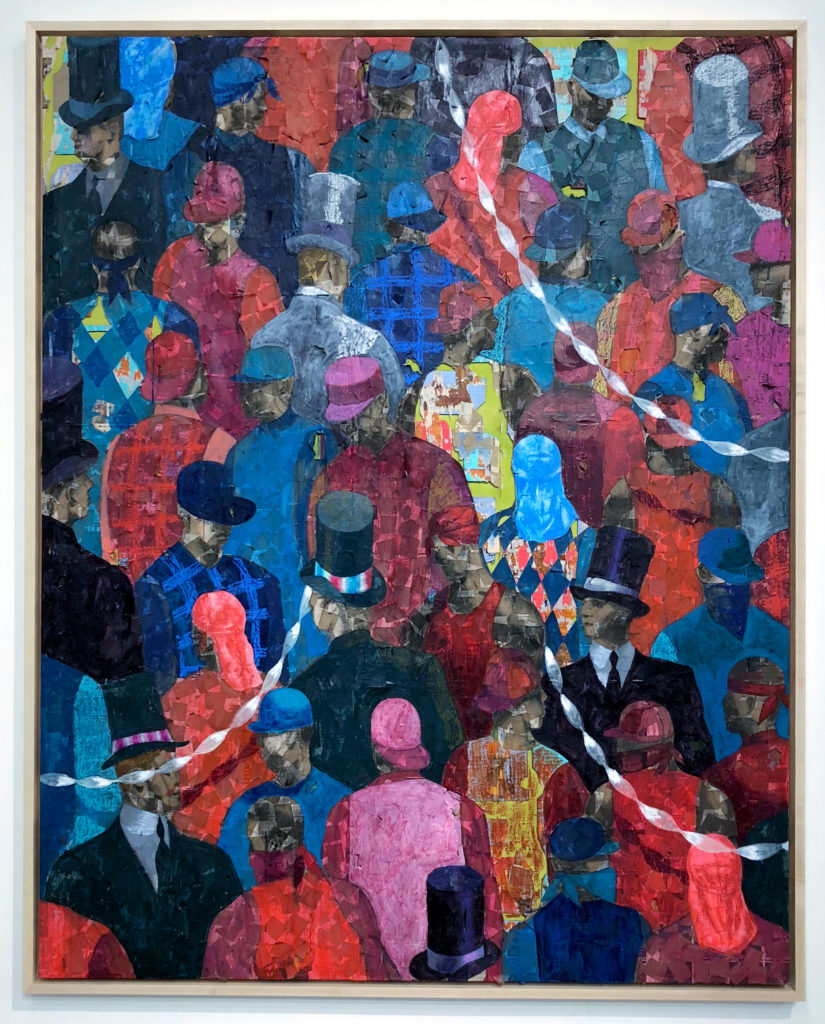
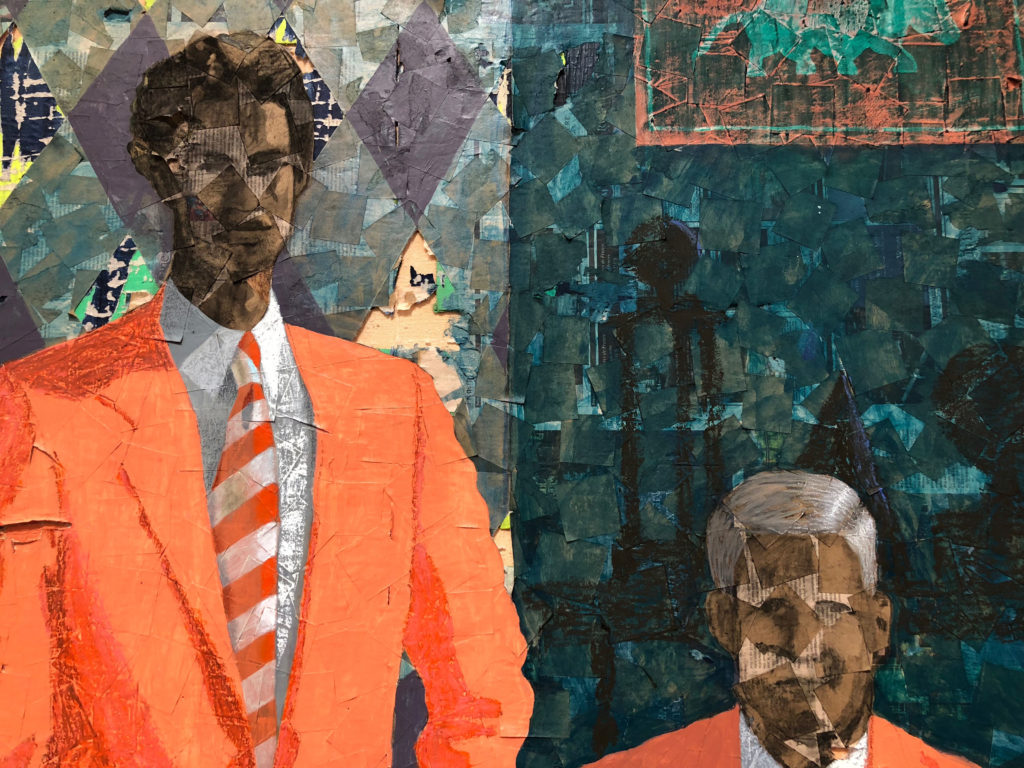
Derek Fordjour, Two Party System, 2019


JRRNNYS, Derek Fordjour’s solo exhibition at Night Gallery, includes new paintings and sculptures that “advance explorations of earlier works, returning to the subjects of crowds and athletic competitions to illustrate the entrenchment of power relations, capital flows, and racial inequality within the economic and social systems of the United States”. The paintings are made of multiple layers of painted cardboard and newspaper that are then scored and sections are removed.

This interview with the artist from artnet goes into more detail on his fascinating process and the reasons behind it.

Signing Day, 2019

Signing Day detail


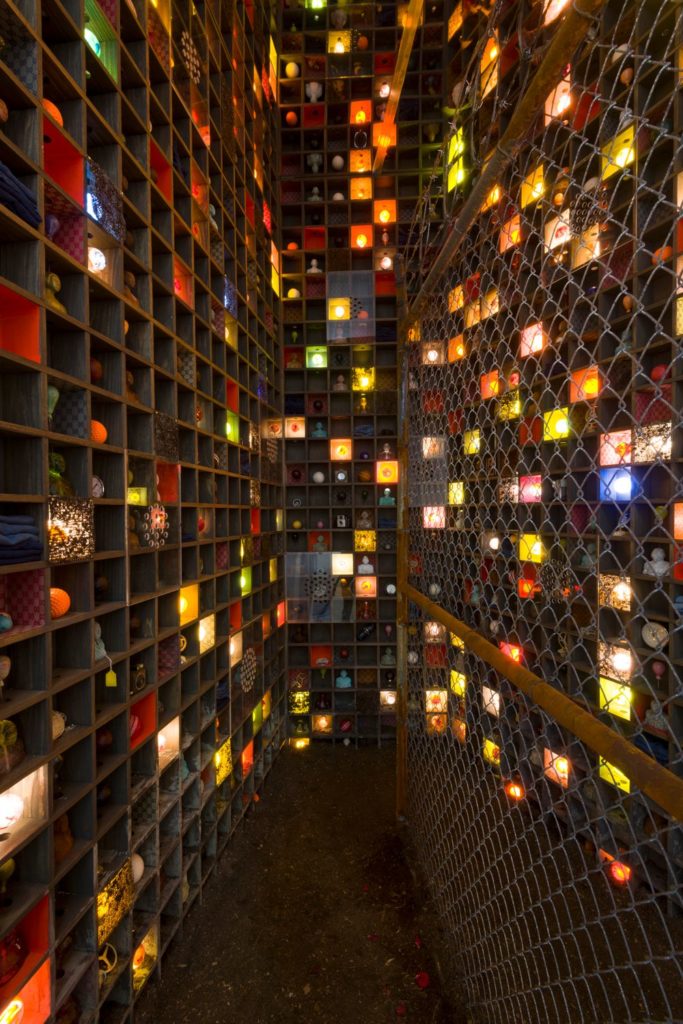
The centerpiece of the exhibition is the installation STOCKROOM Ezekiel.

From the press release

…The work takes its name from the 1884 letters of Ezekiel Archey, an 25-year-old unjustly held as a prisoner sent to labor at the Pratt Coal Mines in Birmingham. Archey’s letters, sent to the Alabama inspector of prisons, are among the most prominent primary-source documentation of the ravages of the convict leasing system, acknowledging the stark preponderance of black prisoners and the gruesome treatment of the laborers by their supervisors. Fordjour’s installation responds to Archey’s letters by creating a walled-in structure comprised of over 1,000 individually constructed compartments – cells, as the artist calls them – painstakingly organized with a variety of found and handmade objects, though by a logic that is never explicated to the viewer. Lights in individual cells blink on and off variously, while small speakers let forth bursts of music by the dictates of a rigid but similarly inscrutable pattern, luring the viewer in the eye-popping manner of the carnival game or game board. The intermittent sounds of music range from the early field recordings of 20th century ethnomusicologist Alan Lomax to 80s- and 90s-era drug dealer anthems to modern day Trap music, a largely Southern genre of hip-hop inspired by the illegal drug trade. The viewer has entered a gamelike arena whose rules remain obscure. With time, the objects that populate the shelves come into focus. Some cells contain familiar items – balls extracted from various sporting contests, the lottery and billiards, cameras, hood ornaments from luxury sports cars, decommissioned prison uniforms, and hundreds of hand blown glass balloons, among others. Others are closed off with metal grating, while still more are lined with the ubiquitous fabrics of luxury designers, invoking the aspirational quests of poverty-stricken urban communities. Finally, many cells contain small busts of the same expressionless figure, molded from resin, copper, metal, plaster, dirt, and salt – materials which stand in for the most prominent products from the era of convict leasing, including the coal mines and steel plants of of Alabama and the molasses distilleries of Florida. Taken individually, the contents of these cells suggest luxury and labor, surveillance and displacement, strategy and competition; as a whole, the work suggests the laws of chance taking place within the confines of a framework that is as unknowable as it is oppressive. From the era of Pig Laws to our current three-strikes mandatory sentencing, educational lotteries to modern day sporting empires, Fordjour’s installation points to the tragic persistence of unjust structures that define American life, employing contemporary commodities while invoking history. At once mournful and flickering with possibility, the installation conjures notions of personal loss and gain within the macro-scale context of the inscrutable systems that have determined the fates of black and brown people through the nation’s history.

Derek Fordjour, STOCKROOM Ezekiel, 2019 image via Night Gallery

This exhibition closes 3/2/19.

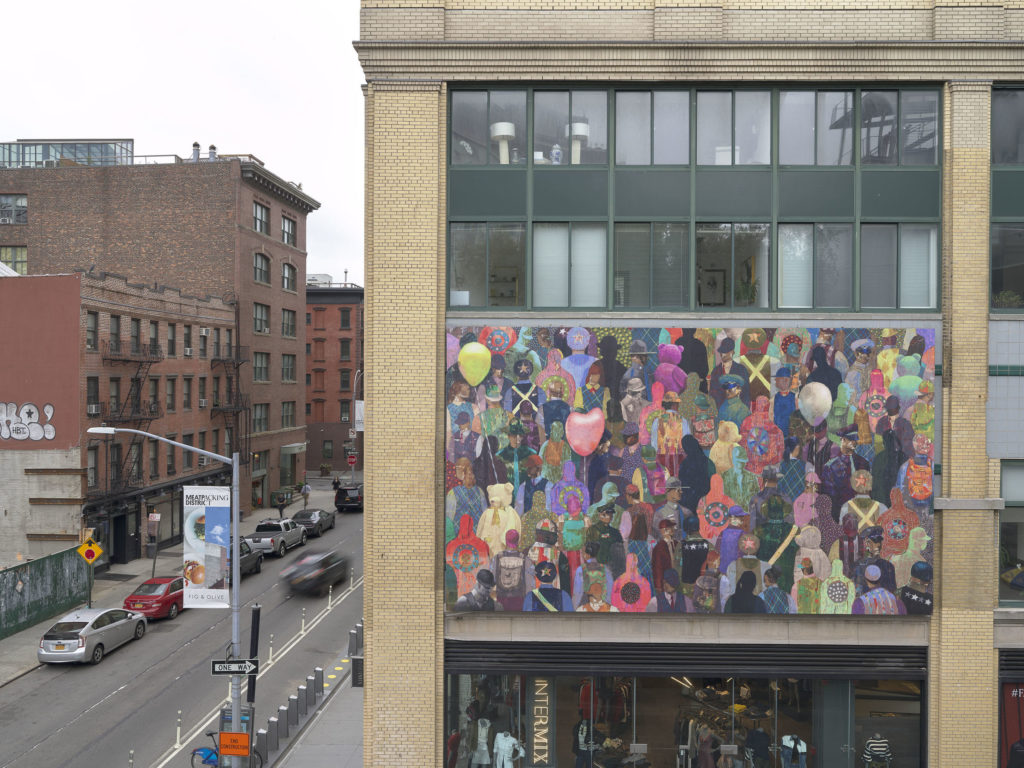
If you are in NYC you can see one of Fordjour’s new works, Half Mast, as a public art installation for the Whitney Museum. The large vinyl reproduction of his painting can be seen at the intersection of Gansevoort and Washington Streets, directly across from the Whitney and the High Line.

Derek Fordjour, Half Mast. Image via Whitney Museum

Mar 012019
 

Matvey Levenstein, LY, 2018

Currently at Kasmin Gallery are Matvey Levenstein’s paintings depicting scenes from his life in North Fork, Long Island. There’s a quiet, peaceful quality to the works, which begin with snapshots before they are turned into paintings. This exhibition closes Saturday 3/2/19.

Across the street at another of Kasmin Gallery’s Chelsea locations, and worth a visit, is an exhibition of some of Andy Warhol’s polaroid portraits.

Matvey Levenstein, Pink Moon, 2018

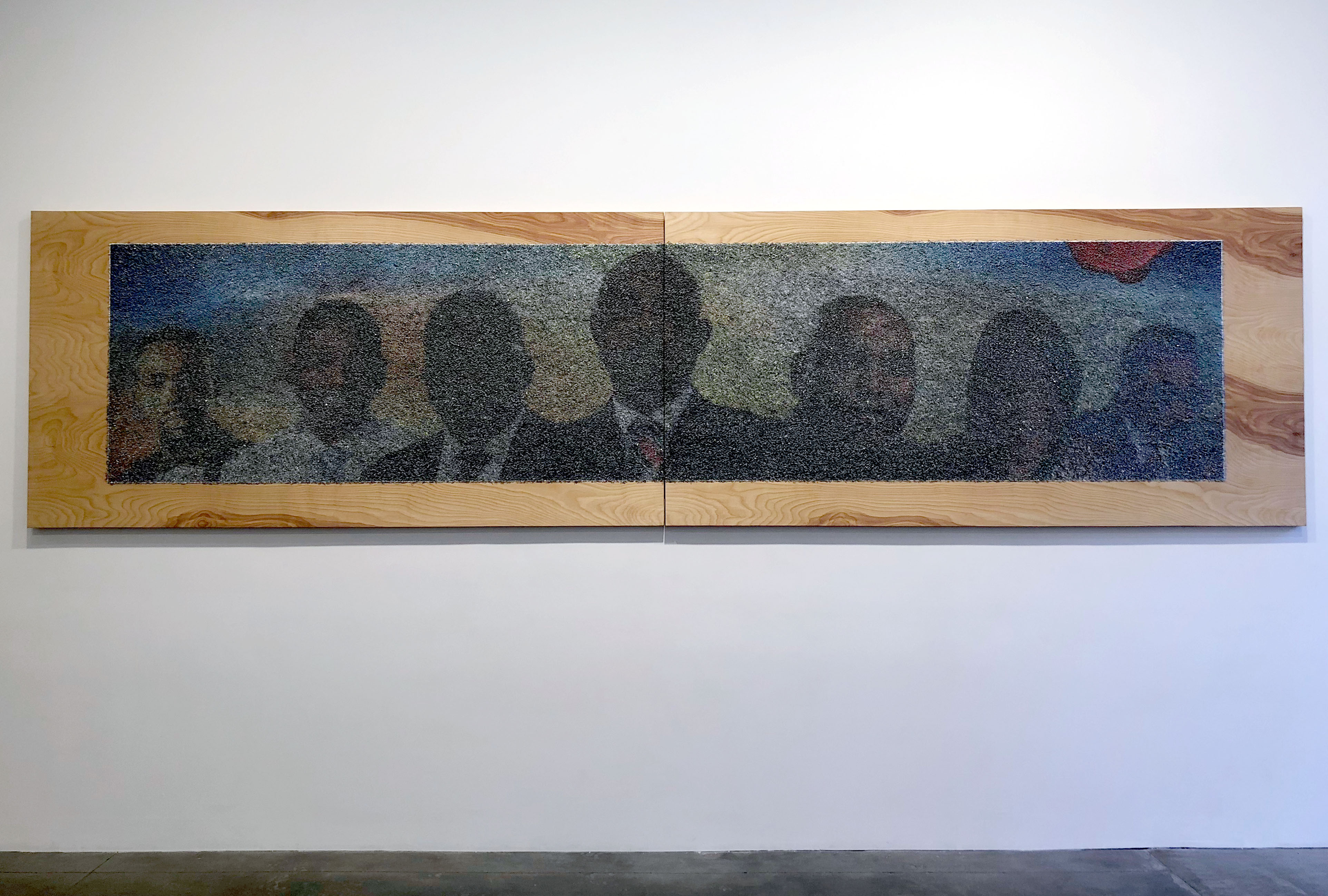
Susan Inglett Gallery is showing Slim… you don’t got the juice, an exhibition of work by Wilmer Wilson IV. His work with staples may seem familiar from its inclusion in the New Museum’s 2018 Triennial: Songs for Sabotage.

From the press release-

Slim… you don’t got the juice presents multidisciplinary departures from familiar modes of figurative representation, as they have evolved in the realm of photographic discourse. Wilmer Wilson IV has developed strategies of redaction and annotation in his work that begin to destabilize the norms of making and viewing portraiture through visual, material, and technical manipulation. An exploration into the complex renderings of individual subject-hood versus object-hood in portraiture, the artist has conceived of a stapled-surface-as-viewing-device that mediates image with material. The device is manifest in a series of staple works that almost fully shroud the photographic subjects beneath dense fields of metal fasteners. The austere, randomized application of the staples onto the surface of each portrait results in a resistance of visual penetration from many angles, complicating access to the underlying figures and deconstructing the voyeuristic inclinations of the viewer.

This exhibition closes 3/16/19.

Wilmer Wilson IV, Host, 2018


At Lehmann Maupin’s 24th Street location is McArthur Binion, Hand:Work, an exhibition of the artist’s grid paintings created with oil paint stick and paper on board. The patterns created in the work are overwhelming at first glance but then when seen up close, the personal details add a new dimension to the paintings.

From the press release

…For Binion, his personal documents represent the sum total of one’s social life: relationships, citizenship, vocation, and family life. The revealing and obscuring of these aspects of his life also addresses the larger sociopolitical reality of African-American identity—often obscured or erased from common knowledge, yet always present in tandem with major movements in American culture. In his newest Hand:Work paintings, Binion takes an introspective approach that is more closely aligned with the artist’s own self-perception—effectively, his first self-portraits. Using copies of a photo of the home where he was born, along with a photograph of his hand as the ground layer of the paintings, Binion pares down his identity to its most essential elements. These images are tiled in repeated succession, layered under his repetitious line work in oil stick. These gestures themselves relate to memories Binion has of his early childhood farm life, a disciplined approach to the cyclical, sustained effort he maintains in his work today. Through the insertion of his hand, literally in the photographs, and figuratively in his intricate, overlapping mark-making, the artist relates to his earliest introduction to artistry in his mother’s quilting, a tradition he modified and carried into his practice.

This exhibition closes 3/2/19.

McArthur Binion at Lehmann Maupin

McArthur Binion at Lehmann Maupin, detail of above painting

Robert Mann Gallery is showing the newly discovered work of photographer Ed Sievers. The exhibition of black and white photos also includes his later work from the 1970s in Venice Beach. The gallery also has an exhibition of Michael Kenna’s series of black and white female nudes made in Japan (not shown). Both shows close 3/2/19.

Ed Sievers, Untitled (woman in the shadows), c. 1960s, courtesy of the artist, image via Robert Mann Gallery

Damn! The Defiant, a group show curated by Damon Brandt and Andrew Freiser at Fredericks & Freiser Gallery, brings together “images of rebellion and dissent in contemporary portraiture” and includes a wide variety of work in different mediums from an incredible selection of artists that includes Mary Ellen Mark, Gordon Parks, Dana Schutz, Bruce Davidson, Whitfield Lovell and many more. It’s a show that’s very appropriate for a time period that is going to require more and more defiance.

From the press release-

Nothing creates projected personal territory more than the emotional push back generated from the recalcitrant expression of a defiant subject. Yet ironically, it is the very nature of this engagement that makes it difficult for the viewer to quickly detach or withdraw from what in fact amounts to an extended glare or moment of social tension. In a time of undeniable anxiety, finding both the common and contrasting ground in the portrayal of defiance speaks directly to the angst and pre-occupation for self-determination that has been and continues to be a pervasive human concern.

This exhibition closes 3/2/19.


Installation view of Damn! The Defiant, image via Fredericks & Freiser


Feb 232019
 

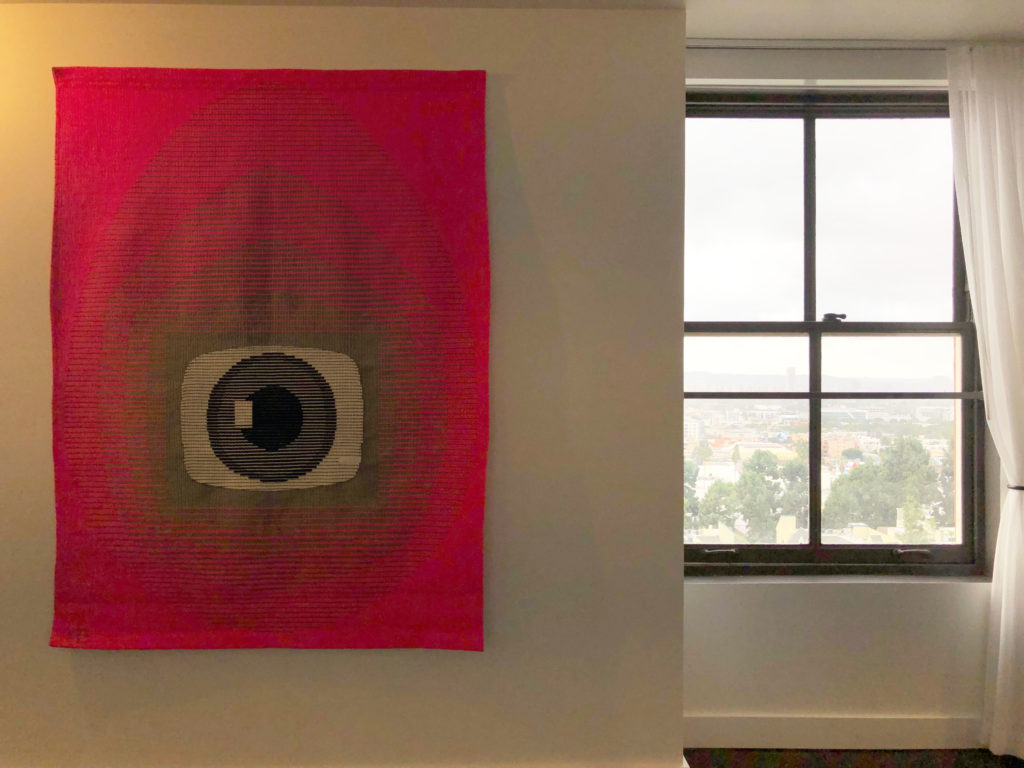
Artist Pierre Daquin’s tapestry “La Vue” courtesy of Galerie Chevalier as part of The 13th Floor project

Several art fairs took over Los Angeles last weekend, two of which used hotels to create temporary galleries and installations.

At the The Hollywood Roosevelt was the first edition of Felix, a free art fair co-founded by Dean Valentine along with brothers Al Morán and Mills Morán (of LA gallery Morán Morán). Galleries took over rooms along the pool, on the 11th floor, and the penthouse.  Starting at the penthouse was The 13th Floor (pictured above), a collection of work by French artists curated by writer Andrew Berardini and presented by The French Committee of Art Galleries and the Cultural Services of the French embassy.

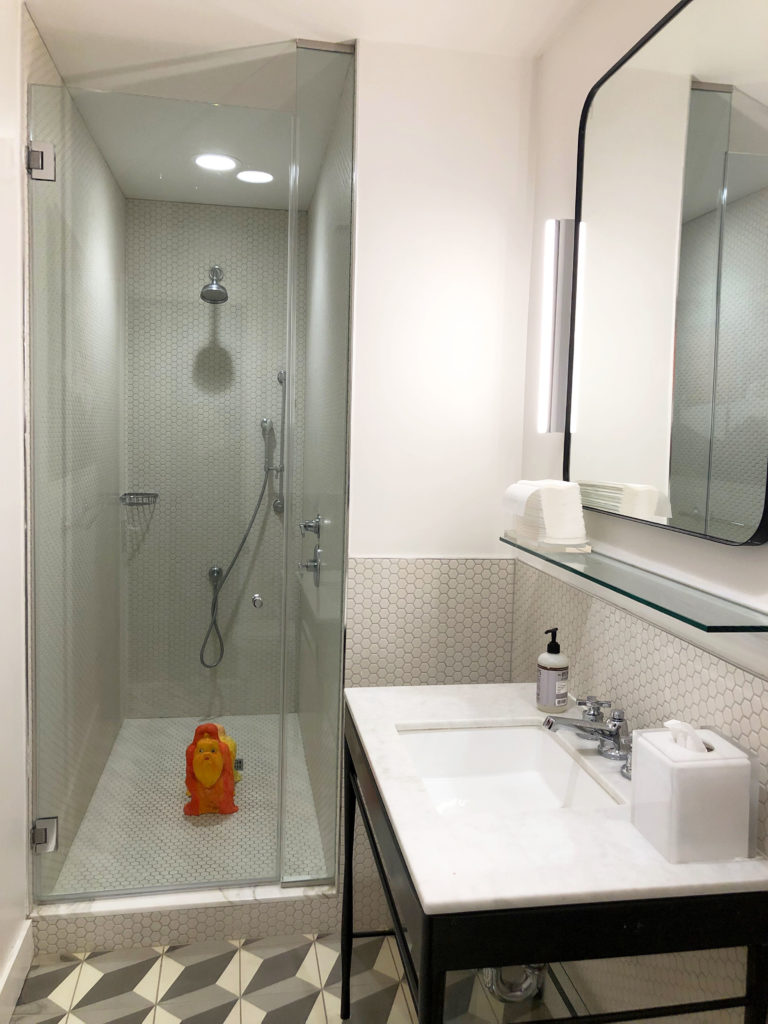
Kenny Schachter had some fun pieces in his room on the 11th Floor including Ilona Rich’s sculptures, one of which was in the bathroom shower (pictured above), and a framed collection of artist Chris Burden’s cancelled checks.

Bodega gallery, from New York’s Lower East Side, had a selection of interesting work including paintings by Alexandra Noel.

Alexandra Noel, “And then the air was filled with 10,000 things (or when a minor piece of wood becomes a missile)”

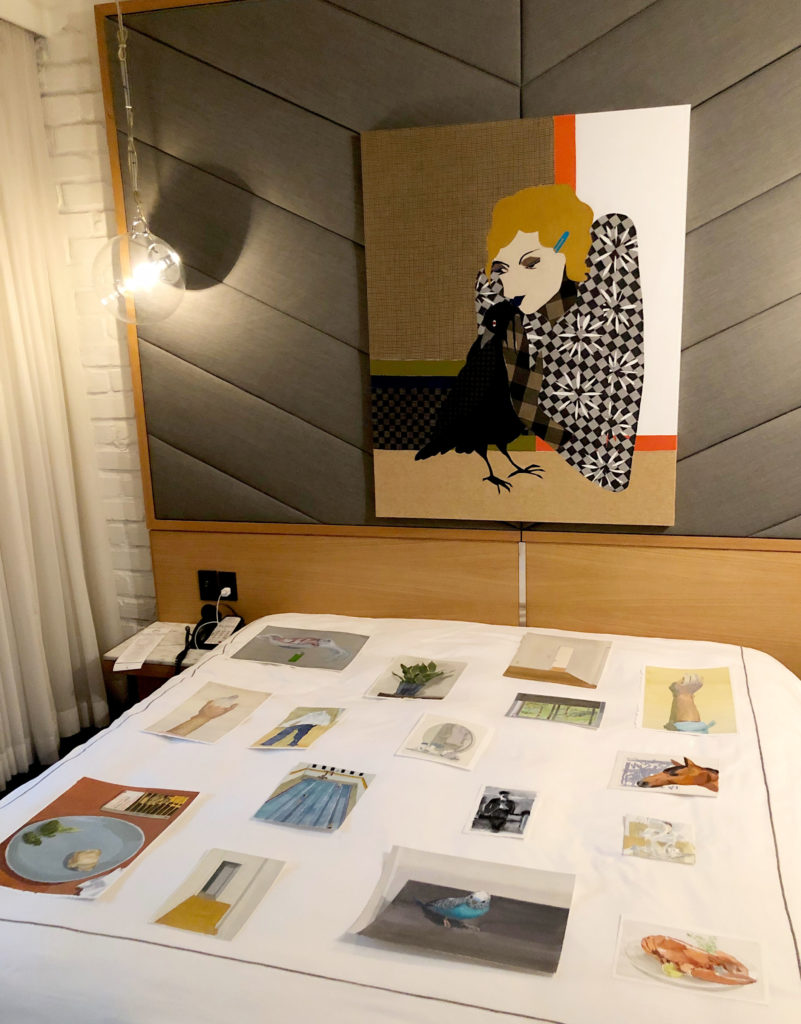
Grice Bench’s selections included a collection of lovely watercolors by Roger White and a painting placed above the bed by Lara Schnitger.

Work by Lara Schnitger and Roger White

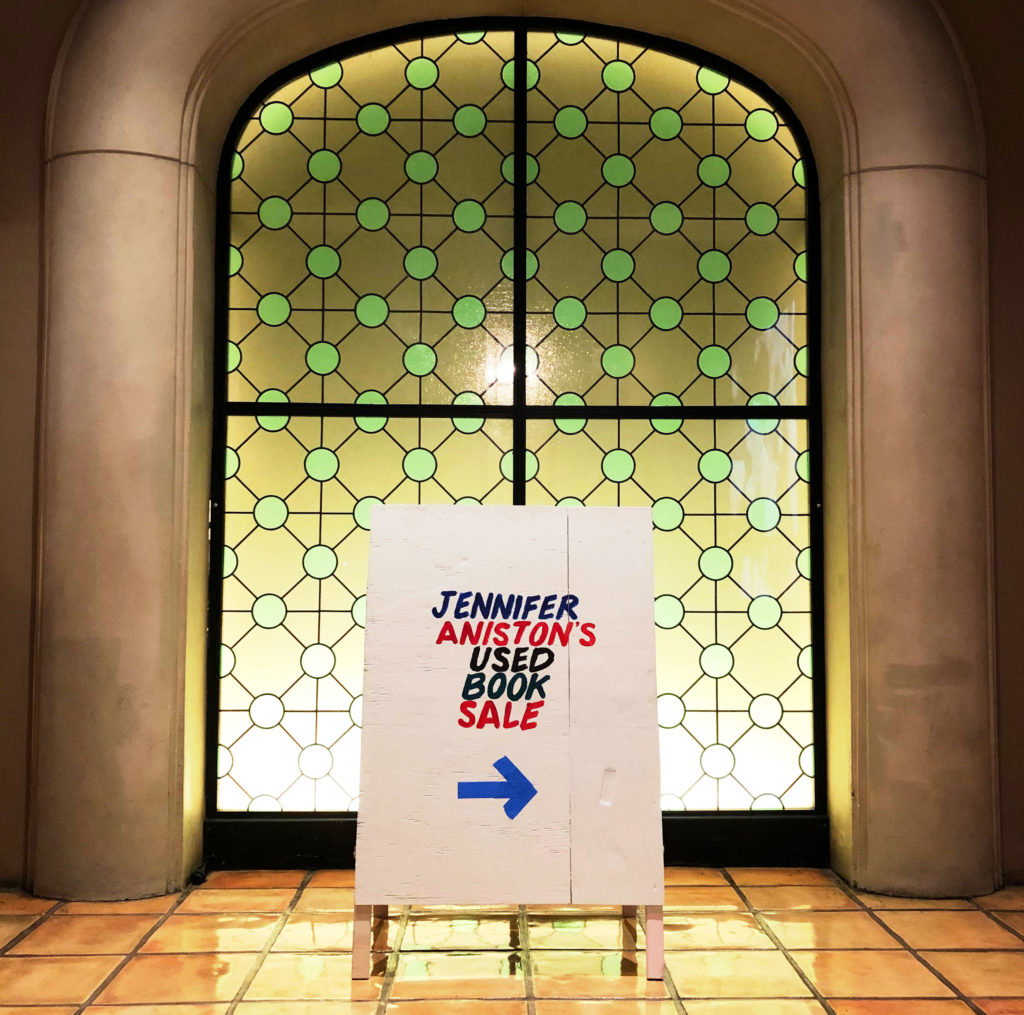
On the ground floor Marc Selwyn Fine Art presented Jennifer Aniston’s Used Book Sale, artist Kristen Morgin’s incredibly realistic ceramic replicas of books she imagines might make up the actress’ collection (the VHS tape is real).

Kristen Morgin’s ceramic books

At a hotel in a completely different part of town was the stARTup Art Fair, taking place at The Kinney in Venice. Here, instead of galleries representing the artists, it’s the artists that set up their rooms and sell their art.  It made for a great experience as the artists were all very friendly and eager to discuss their work. Below are a few highlights from the fair.

Lisa Kairos and Melissa Mohammadi’s work

“Leaf Insects Turn Into Butterflies” by Melissa Mohammadi

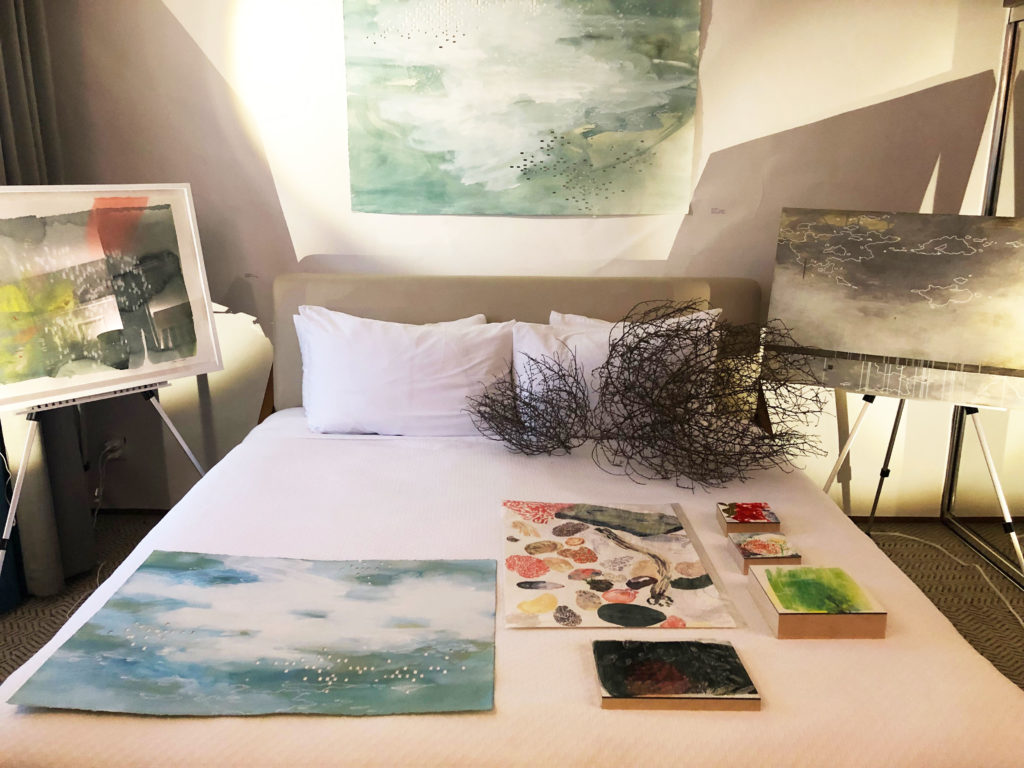
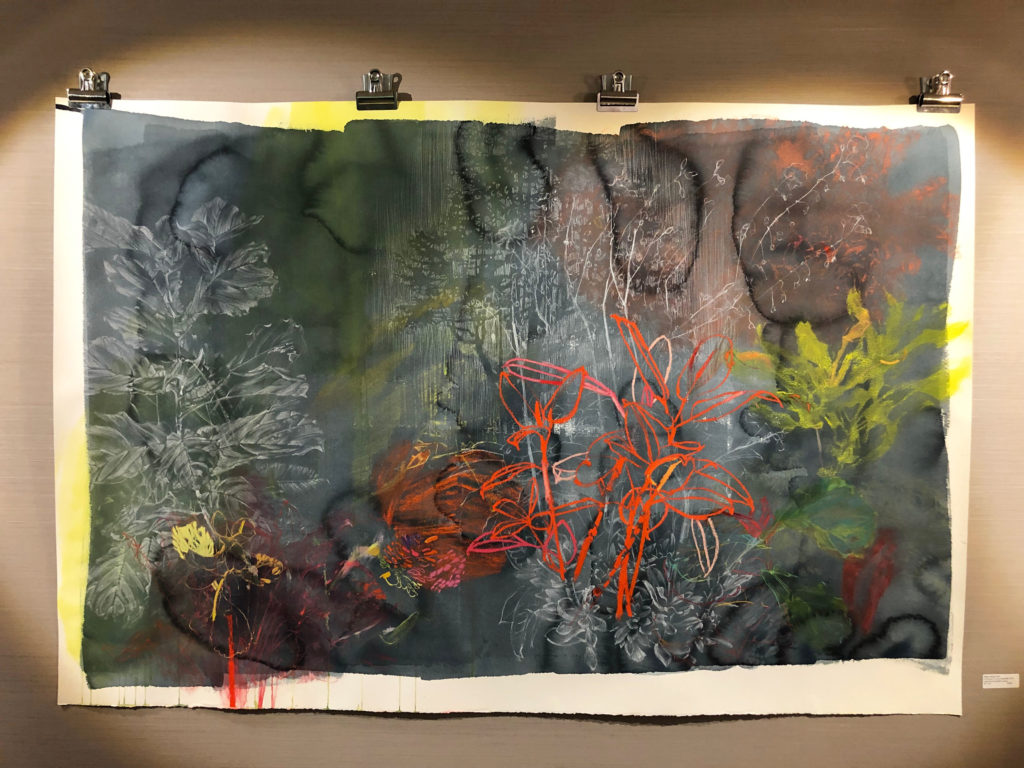
San Francisco artists Lisa Kairos and Melissa Mohammadi’s room was filled with really beautiful work. Kairos makes dreamy multilayered paintings based on natural landscapes. She then cuts patterns into the images which adds yet another dimension to the paintings. Mohammadi’s work incorporates botanical and marine life into a meditative world where bright pastels stand out among subdued watercolor backgrounds; highly detailed sections mix with the more abstract. The end result for both artists is work you want to spend time looking at.

Work by Annie Galvin of 3 Fish Studios

Work by Eric Rewitzer of 3 Fish Studios

Husband and wife artists Eric Rewitzer and Annie Galvin of 3 Fish Studios in San Francisco had lots of great, affordable prints. They also teach printmaking and collage classes in their studio.

One of Camilla Magrane’s artworks

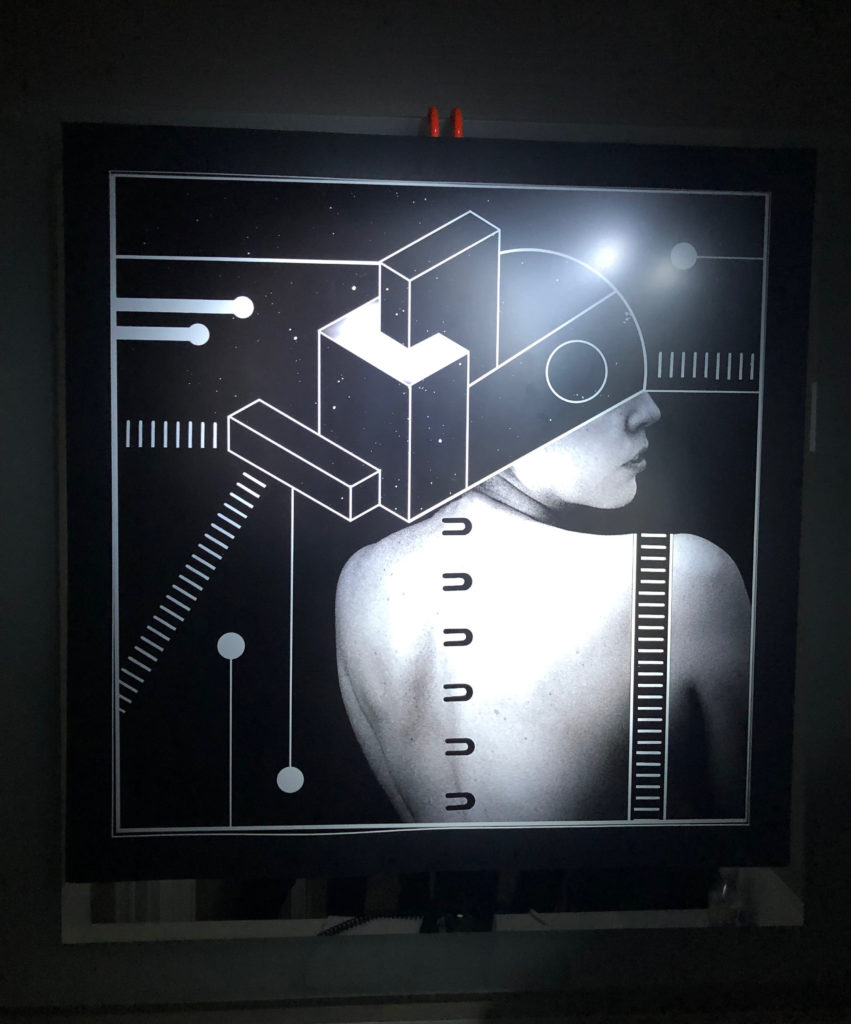
Artist Camila Magrane had several pieces in her darkened hotel room that use augmented reality technology to make the works animated and three dimensional when looked at through her Virtual Mutations app. The video above illustrates the effect.

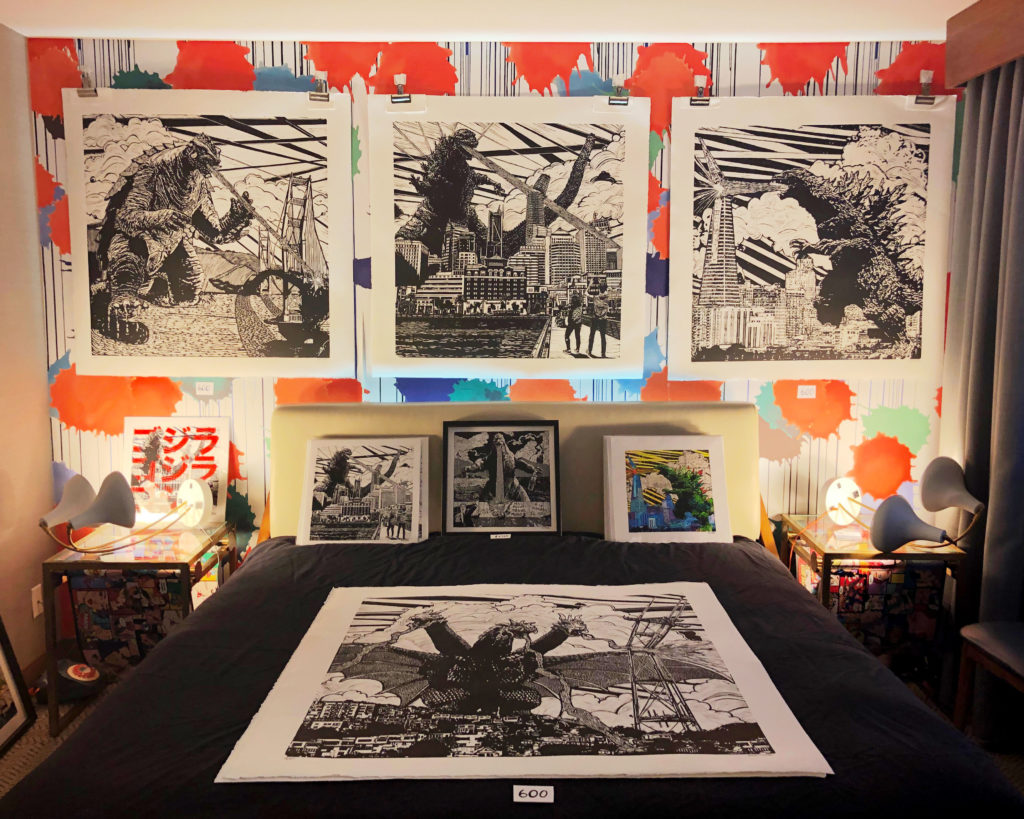
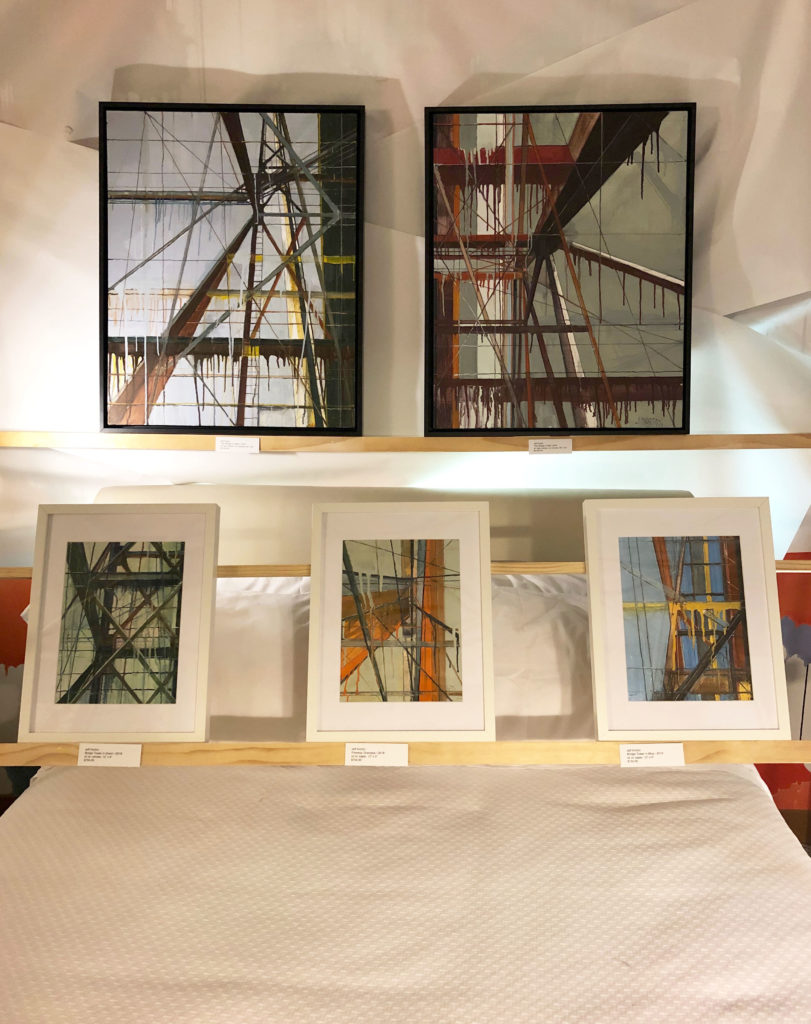
Jeff Horton uses his architecture background to create paintings of urban structures (often larger than what’s pictured above), some of which incorporate wax with oil paint for an added layer.

Other artists work not shown but worth checking out- Margaret Hyde makes ethereal still life photographs of natural objects she finds and combines with water, and Kyong Ae Kim showed a variety of impressive work including her animal skulls cut from multiple layers of drafting film and acrylic paintings combined with hand cut elements.


Feb 162019
 

Currently at Mitchell-Innes & Nash is Masses & Mainstream, an exhibition of Karl Haendel’s incredibly detailed drawings and his musings on life in current day America. The drawings can be humorous at times, including a comparison of himself to Jared Kushner through a checklist, and a record of his types of sneezes. They are balanced by others, where he expresses his anxiety when it comes to selling art, or a smaller piece that lists “wishful thinking” items that includes healthcare, education, housing, and equity for all.

From the press release-

While Karl Haendel’s newest work covers a wide range of subject matter from a stack of lawnmowers to a portrait of Barbara Walters, the common thread that links these disparate images is a dialogue between memory, both personal and collective, and national identity. Many of the works on view are drawn from overlooked sources in contemporary American life—cultural leftovers the artist combs through and resuscitates in order to represent an alternate picture of American reality. Other works, like the aforementioned stack of lawnmowers, come from the artist’s personal history and experiences—a once-submerged detail from his childhood home that has floated to the surface of recollection—that could also be read, more symbolically, as the paraphernalia of American comfort, excess and, perhaps even, of the endangered middle class.

This exhibition closes 2/16/19.

Feb 162019
 

While we are living in a time where anxiety is prevalent, it’s nice to imagine being as calm as Superchill, the title character of Hannah Epstein’s comic strip, and star of her exhibition Do You Want A Free Trip To Outer Space? at Steve Turner gallery. The show combines hooked rugs, video animation, and a video game that you can play, all creating a fun little world to inhabit for awhile.

Also in the gallery’s other rooms are Jamie Felton’s painting show Parts from an Oyster and Paige Jiyoung Moon’s paintings for Days of Our Lives.

All three exhibitions close 2/16/19.

Nearby at Regen Projects is Glenn Ligon’s exhibition of new work, Untitled (America)/Debris Field/Synecdoche/Notes for a Poem on the Third World.

From the press release

Over the years, Ligon has created neon sculptures that illuminate various phrases or words in charged and animated ways. Notes for a Poem on the Third World, Ligon’s first figurative sculpture, is comprised of a large neon based on a tracing of the artist’s hands that takes its inspiration from an unrealized film project by Pier Paolo Pasolini that was to be shot in India, Africa, the Arab countries, Latin America, and the “black ghettoes of the United States.” Pasolini claimed that it was the “discovery of the elsewhere” that drove his identification with the struggles of non-Western peoples and people on the margins of the West. Ligon’s neon, with its ambiguous gesture of greeting, protest, or surrender, is the first of a series of works inspired by Pasolini’s project.

Also featured in the exhibition is Untitled (America), 2018, a black-painted red neon in which the word “America” is displayed upside down, and Synecdoche (For Byron Kim), a neon showing the date of the next presidential election that will be lit on that day.


This exhibition closes 2/17/19.

Aug 312018
 

Lauren Halsey- The Crenshaw District Hieroglyph Project (Prototype Architecture) 2018

Lauren Halsey- The Crenshaw District Hieroglyph Project (Prototype Architecture) 2018

Currently at the Hammer Museum is Made in L.A. 2018, the museum’s fourth biennial exhibition of artists working in Los Angeles and the surrounding areas. The diverse group of artists included range in age from 29 to 97.  With so many excellent works in the exhibition, it was very hard to choose which of them to highlight. The following are just a few selections from the exhibition that stood out.

Lauren Halsey’s sculptures (pictured above), won the Mohn Award, a jury award which honors artistic excellence. You can also see another one of her sculptures at MOCA, until September 3.

Selection of works by Luchita Hurtado

The paintings above are from the oldest artist showing in the exhibition, Luchita Hurtado. At 97, she is just starting to get recognition for a lifetime of work.

The youngest artist in the show is Diedrick Brackens (shown below) who uses weaving and textile making to tell stories that reflect on cultural and personal narratives from his childhood in Mexla,Texas.

Diedrick Brackens

The most entertaining of the works in the exhibition is OURCHETYPES, created by Jade Gordon and Megan Whitmarsh. Taking up an entire room, it consists of videos, sculptures, and a publication- all dealing with issues of self discovery, adulthood, womanhood, happiness, and success from a tongue in cheek, retro New Age perspective.

Jade Gordon & Megan Whitmarsh, OURCHETYPES

Two additional video installations also worth taking time to watch-

Gelare Khoshgozaran’s Medina Wasi: Connecting Town, shot mainly in Mecca and Thermal in the Coachella Valley, includes footage from US military bases where sets were created to simulate Middle Eastern towns for troops to practice fighting in. She also includes interviews with US veterans who discuss their memories of the landscape when they were in the Middle East.

Neha Choksi’s multichannel video installation Everything sunbright, examines our relationship to the sun and includes images from nature, a dance performance, and children making drawings of the sun- all tying together themes of birth, life, and death.

This weekend Hammer Museum has programming to accompany the exhibition. On Saturday, taisha paggett will present a series of solo and duet dance performances and on Sunday, composer/performer Carolyn Pennypacker Riggs is assembling a group of mothers to explore the tropes and meanings of motherhood and Von Doog is offering empathic musical readings in the gallery prior to the performance.

This exhibition closes on Sunday 9/2.