Apr 252026
 

Cy Twombly “Fifty Days at Iliam: Shield of Achilles”, 1978

Cy Twombly “Fifty Days at Iliam”, 1978, oil, oil crayon, and graphite on canvas

“Fifty Days at Iliam: Achaeans in Battle”, 1978

“Fifty Days at Iliam: The Fire that Consumes All before It”, 1978

“Fifty Days at Iliam: Shades of Achilles, Patroclus and Hector”, 1978

“Fifty Days at Iliam: Shades of Eternal Night”, 1978

Cy Twombly was born today, April 25th, in 1928. One of his most famous works is Fifty Days at Iliam, his visual interpretation of Homer’s poem the Iliad. This “painting in ten parts” is currently on view at the Philadelphia Museum of Art and images of each of the individual works can be found on the museum’s website.

About Fifty Days at lliam from the museum-

The pinnacle of Twombly’s lifelong preoccupation with Greek and Roman mythology, Fifty Days at lliam is the artist’s rendition of the last fifty days of the Trojan War. The monumental series fuses elements of Homer’s epic poem The lliad, probably written before 700 BCE, and Alexander Pope’s translation of that poem from the 1700s.

The artist purposefully misspells the name of the besieged Trojan city as lliam, instead of the Latin llium or the Greek Ilion. The letter “a” stands as a symbol for the Greek warrior Achilles, whose rage sparked by the death of his friend Patroclus propels the end of the decade-long conflict.

Partaking in a long artistic tradition of depicting war, Twombly addresses themes of heroism and aggression, comradeship and revenge, jubilant victory and the mourning of the dead. The ten canvases can be encountered sequentially or experienced as an all-encompassing panorama that gives the sensation of witnessing the battle firsthand.

Twombly’s signature style combines the poignant gestures of abstraction with poetic allusions to classicism. Relocating from the United States to Italy in the 1950s proved decisive for Twombly’s art, which uses raw mark-making to allude to the myths of antiquity.

For a look at Twombly’s life and career, the 2018 documentary Cy Dear, is well worth a watch. The film begins with a discussion of Fifty Days at lliam, which was on view as part of a 2017 retrospective at Centre Pompidou in Paris. It also includes interviews with several of his friends and colleagues– including former assistants, his son Alessandro, art dealer Larry Gagosian, and photographer Sally Mann.

Jan 312026
 

Secret Mall Apartment Trailer

The story in the 2024 documentary Secret Mall Apartment, feels relatively straightforward at first. In 2003, a group of eight artists built an apartment in a small, unused space in the Providence Place shopping mall in Providence, Rhode Island. They continued to use it until they were discovered a few years later. But the film takes you on a journey beyond the creation of the apartment. It’s also about gentrification, urban development, and artist housing; mall culture and consumerism; the artists’ work outside the apartment; and, by the end, even the question of what makes something art.

Artist Michael Townsend was no stranger to art installations. He had previously created one inside a drainage tunnel, allowing only a select few with keys to see it. When local artist venue and living space Fort Thunder was torn down, the idea of living in the nearby new mall began. He remembered noticing an odd extra space while the mall was still being constructed. After searching and finding it with his then-wife Adriana Valdez Young, friends and fellow artists Colin Bliss, Andrew Oesch, Greta Scheing, James Mercer, Emily Ustach, and Jay Zehngebot joined them to build the apartment. Luckily for viewers, the process was also documented with a Pentax Optio (even if the footage is low-res). Furniture was added, along with a video game system, and eventually a wall.

While their new home provided a break from the outside world, it also became a place for the artists to plan their tape-art installations. These included a five-year portrait series in NYC for 9/11; a mural on the site of the Oklahoma City bombing; and creating work with kids on the walls of Hasbro Children’s Hospital in Rhode Island. Townsend continues to make tape-art projects today.

The documentary is fun to watch and at times, even inspirational. It’s currently available to watch on Netflix and other online platforms.

Sep 122025
 

Born today, 9/12, artist Robert Irwin used light and space in his work as a way to create an experience for the observer. He started out as a painter but later became well known for his site-specific installations and architectural and outdoor projects- including the central garden at the Getty Center in Los Angeles (pictured below) and his work for the Chinati Foundation in Marfa, Texas.

The works above are from his 2020 exhibition, Unlights, at Pace Gallery in New York.

About that show from Pace-

Irwin’s new works are composed from unlit six-foot fluorescent lights mounted to fixtures and installed in vertical rows directly on the wall. The glass tubes are covered in layers of opulently colored translucent gels and thin strips of electrical tape, allowing the reflective surfaces of unlit glass and anodized aluminum to interact with ambient illumination in the surrounding space and produce shifting patterns of shadow and chromatic tonality. Reflecting his recent turn toward the perceptual possibilities of unlit bulbs, Irwin’s new body of work expands the range of possibilities for how we experience sensations of rhythm, pulsation, expansion and intensity, while continuing the artist’s long-standing interest in registering the immediacy of our own presence in space.

Expanding from his breakthrough disc paintings of the late 1960s, Irwin’s new works effectively dissolve the perceived border between object and environment, focusing the viewer’s consciousness on the act of perception. Each light fixture in Irwin’s sculptures contains one or two unlit bulbs—or no bulb at all—while alternating gaps of “empty” wall are painted in subtle shades of gray, producing a sense of uncertainty about what is tactile and what is merely optical. As the shadowed, painted and reflected intervals of space reverberate in the viewer’s visual field, the wall itself enters the composition, destabilizing any sense of figure and ground. To encounter Irwin’s sculptures is thus to allow oneself to be caught in a ceaseless oscillation between flatness and volume, transparency and opacity, solidity and atmosphere.

In Irwin’s art, the object functions as a kind of score for orchestrating “the continual development and extension of humans’ potential to perceive the world.” Although unlit, the bulbs in these new sculptures are therefore never “off.” Their optically rich surfaces serve as energetic loci for heightening the sensory possibilities of the human body. In their chromatic complexity, the works convey an almost painterly quality, recalling Irwin’s origins as a second-generation Abstract Expressionist painter in the 1950s. Suggesting a rhythmic, minimal composition of repeated linear elements, the works also evoke his innovative line paintings of the early 1960s, which involve us physically and perceptually in an open-ended, immersive and transitory experience of seeing.

Widely recognized as a pivotal figure in contemporary art, Irwin is closely associated with the Light and Space movement that emerged in Los Angeles in the 1960s, and he has continued to live and work in Southern California for his entire career. He first used fluorescent lights as substrates for producing what he has called a “conditional art” in the 1970s, often in combination with architectural scrims and other spatial interventions. In the 1990s he introduced colored gels to the fluorescent tubes to alter the chromaticism of the light, and, over the past decade, began isolating the bulbs and fixtures as sculptural objects in their own right. In returning to the use of solely ambient light, Irwin’s new sculptures embody the culmination of seven decades of rigorous experimentation.

“Everything in the world is ultimately conditional,” Irwin has observed. “There is nothing that’s transcended or infinite or whatever you want to call it. Everything acts within a set of conditions.” Like all of Irwin’s works, his new sculptures respond differently to the conditions of each specific environment in which they are installed, attuning our senses to a given context and making possible an intuitive and incidental experience of seeing that resists rational or conceptual explanation. “It’s not about answers,” the artist once remarked, but rather about the act of questioning: “It’s the constant pursuit of the possibilities of what art is.”

Getty Center, Los Angeles

Below is one of his earlier paintings Untitled, 1964-6, which was on view at Palm Springs Art Museum for the 2024 exhibition Particles and Waves: Southern California Abstraction and Science, 1945-1990.

From the museum about the work-

Although this work appears to have a monochromatic white surface from afar, a matrix of thousands of painted dots becomes visible from a closer vantage point. Irwin aimed to highlight the visual effects of color interaction by juxtaposing light green and lavender, complementary colors across from each other on a color wheel. The canvas’s outwardly bowed supports and the increasing density of dots towards the painting’s center further heighten the viewer’s perceptual experience of the work.

The documentary Robert Irwin: A Desert of Pure Feeling, does an excellent job detailing his life, art, and the philosophy behind his work. It is well worth a watch and inspiring to watch him still at work in Marfa at 87. He passed away in 2023 at the age of 95.

Apr 242025
 

“I Like How the Left Side Modulates Up”, 1989, acrylic on canvas (from the “Hitchcock” series)

“Apollo, 617”, 1982, acrylic on canvas

Sundaram Tagore Gallery is currently showing the paintings of the late Robert Natkin for the exhibition A Better Place. The colorful abstract works are from the several series he produced during his lifetime.

Natkin used his artwork to explore different concepts and influences, many of which are listed in the press release below and in the information provided alongside several of the artworks.

“The Beloved (Field Mouse)”, 1969, acrylic on linen

Here, for example, is the information provided for the painting above, from his Field Mouse series-

Natkin explored motile, fragmentary shapes from 1967 onward in the “Field Mouse” series, a reference to a poem by Ezra Pound about the passage of time. These visualizations of fleeting life-experience, with which Natkin sought to form a new emotional vocabulary, often resemble microscopic views of teeming organisms. For him, they were complex emotional landscapes, reflecting a romantic turn when the Natkin family moved from New York to the quiet of rural Connecticut in 1970.

And the Days Are Not Full Enough

And the days are not full enough
And the nights are not full enough
And life slips by like a field mouse
Not shaking the grass
Ezra Pound

More from the gallery’s press release-

Robert Natkin is internationally recognized as an unsurpassed colorist and for the beauty of his large-scale abstract canvases. He was represented by blue-chip New York gallerists Elinor Poindexter in the 1960s and André Emmerich in the 1970s. Today, his work is in the collections of New York’s Metropolitan Museum of Art, Museum of Modern Art, Guggenheim Museum and Whitney Museum of American Art, among others.

Born to a poor and unhappy Russian-Jewish family in Chicago during the Great Depression, Natkin would transcend his traumatic upbringing, often finding refuge in the color and splendor of the movies, charting an industrious course through public art education and briefly co-founding a gallery, to become one of the foremost American abstract colorist painters of the 1960s, ’70s and ’80s. His paintings are life-affirming, sensual celebrations of visual delight, of glorious Hollywood Technicolor, of fascinating surface effects, enticing layers, and sunny outlooks.

Natkin’s painterly journey can be seen through its distinct and loosely phased series as he accumulated years of psychotherapy and read and looked voraciously. They reveal his drive for redemption not just through introspection, but by consistently forging new stylistic syntheses.

FEATURED SERIES

The vigorous, gestural brushwork of Natkin’s early abstractions reflects the seismic impact of the Abstract Expressionists, including Willem de Kooning, and Jackson Pollock, whose work he encountered in an article about Abstract Expressionism in Life magazine in 1949. Natkin also found inspiration in French artists Matisse and Bonnard, among others in the collections of the Art Institute of Chicago where he studied from 1948–1952.

In 1957, Natkin married the painter Judith Dolnick and together they founded the Wells Street Gallery in downtown Chicago, exhibiting cooperatively with a group of young contemporaries who similarly explored free-form abstraction, including the sculptor John Chamberlain, Ann Mattingly, Gerald van de Wiele and friend Ernest Dieringer. Wells Street Gallery made its cultural mark but was commercially unsuccessful, closing two years later, whereupon Natkin and Dolnick moved to New York.

In New York, Natkin’s vigorously abstract paintings took on more rectilinear qualities, decisively so with his Apollo series, characterized by loose vertical bands of color. The series began in the early 1960s under the inspiration of Rilke’s poem Archaic Torso of Apollo, based on a sculptural fragment in the Louvre, with its final imperative: “You have to change your life.” Named after the Greek god of the sun, the arts and healing, the Apollos established for Natkin the purpose of his art as a means of transformation for self and society.

The Apollo series was long-lived, spanning the 1960s and revived in the mid-1970s. The later instances incorporated Natkin’s distinctive technique of applying acrylic paint with a sponge covered in cloths of various textures, which he discovered in 1971. At his Dolnick’s suggestion, Natkin made a painting on a dishcloth because she had seen him make little paintings on handkerchiefs to give to friends, and then came up with the idea of effectively printing from it. The technique increased his productivity and transformed his aesthetic.

The pointillistic, gauzy effect of this technique came into its own in the more muted, diaphanous visions of the Bath series, so named for the English city where Natkin was to have an exhibition. The subtle, atmospheric nature of the Bath paintings are akin to his earlier Intimate Lighting series, which ran through much of the 1970s, and were described by British art critic Peter Fuller as possessing hints of portraiture in their central focus and inspired by Cubism in the clearly applied blocks of sponge-and-cloth-painting.

Natkin’s Straight Edge and Step paintings emerged from a period in the mid-1960s when he was preparing to teach a course on color at Pratt Institute in Brooklyn and read Josef Albers’ theories on its interaction. They also channel the modernist architecture of his native Chicago, his love of jazz singers Billie Holiday and Nina Simone, and the dynamic grid-pattern streets of New York.

He explored motile, fragmentary shapes from 1967 onward in the Field Mouse series, a reference to a poem by Ezra Pound about the passage of time. These visualizations of fleeting life-experience, by which Natkin sought to form a new emotional vocabulary, often resembled microscopic views of teeming organisms and organelles. For him, they were also complex emotional landscapes, reflecting a more romantic turn when the Natkin family moved from New York to the quiet of rural Connecticut in 1970.

In 1977, Natkin produced the Bern series, named for the Swiss capital where the Klee Foundation is located and where Natkin spent many hours among Paul Klee’s works. In this series, he uses more sharply delineated shapes against expansive fields of intense color. Perhaps the boldest colors and shapes appear in the 1980s in the Hitchcock series, an homage to the great director and the movie-theater origins of his artistic journey. Hitchcock’s interest in psychoanalytic themes where dark secrets often drive the narrative, and his charging of the carefully crafted scenery and props with menacing symbolism appealed to Natkin.

Robert Natkin died in 2010 after several years of declining health. Over the course of his career, he demonstrated a remarkable capability of spanning beauty and ugliness in his art, though he dedicated his prime to the struggle of the former over the latter, to the Apollonian ascendancy of light over darkness.

In Somewhere Over the Rainbow, a 1982 documentary by award-winning filmmaker Mike Dibb, Natkin says, “In one sense, I want to be superhuman, but in another sense, I feel I’m barely an animal. And it’s a practice that I think if I don’t always maintain, juggle both these kinds of reality, I could then very easily be done in by the very kind of reparation that I use to make myself and that I hope will help the rest of the world to become a better place. I want to become a better place! Not a person: I want to become a better place, because as a person, I’m going to be gone in—I don’t know—ten minutes or ten years, but I want to become a better place.”

This exhibition closes 4/26/25.


Jul 092024
 

“Jeff Way In His Tribeca Loft”, 2023; “Turtle Owl Death Mask”,2018 and  “Egyptian Violet Gorilla Mask”, 2017

Kimiko Fujimura “Party-3 (Party at Peter’s), 1990, and “Kimiko Fujimura in her Chinatown Loft”, 2023

For his current exhibition, Loft Law, on view at Westwood Gallery, documentary photographer and filmmaker Joshua Charow photographed artists living and working in the remaining spaces still protected by Loft Law in NYC. The well-crafted portraits offer a chance to see how the artists have made these spaces home over the years.

The gallery has also included artwork by eleven of the artists featured in the photos- Carmen Cicero, Loretta Dunkelman, Betsy Kaufman, Kimiko Fujimura, Joseph Marioni, Carolyn Oberst, Marsha Pels, Gilda Pervin, Steve Silver, Mike Sullivan, and Jeff Way.

From the gallery-

In 1982, Article 7-C of the Multiple Dwelling Law, also known as the Loft Law, was passed in New York City. The law gave protection and rent stabilization to people living illegally in manufacturing and commercially zoned lofts. Hidden behind this legislation were thousands of artists who needed a live/work environment at an affordable rent. These artists protected by the Loft Law changed the trajectory of New York’s cultural landscape.

Three years ago, Charow found a map of the remaining buildings with Loft Law protection. He rang hundreds of doorbells to find and photograph over 75 Loft Law tenants across the city to document the last of these incredible spaces and the creative individuals who made them home. Charow’s interest in the Loft Law and the vanishing history of New York stemmed from his early teenage years when he became immersed in a subculture called ‘Urban Exploring,’ the practice of illegally climbing skyscrapers, bridges, and abandoned subway stations. One of the rooftops he visited was an old factory building in South Williamsburg, where a tenant explained to Charow about the building’s remaining tenants under Loft Law protection.

The photos are a living visual document of the expansive spaces: old flophouses on the Bowery, garment factories in Tribeca and SoHo, glass factories in Greenpoint, and even a former ice cream factory in DUMBO. From the 19th to the 20th century, many buildings in NYC, including SoHo, were manufacturing centers for items from sewing machines to textiles to printing houses. The massive light-filled loft spaces with high ceilings were left empty when these businesses vacated in the mid-1900s and moved to other areas outside of New York City. The industrial-zoned lofts were not legal to live in, as they did not meet the building requirements for residential use, and oftentimes were completely raw spaces without a kitchen, shower, plumbing, or even heat. However, artists were attracted to these large spaces where they could work and create at any hour of the day. At the end of the 1970s, loft living started gaining attention in the media and the wealthy started to become attracted to this lifestyle. Soon landlords began to evict the artist tenants in favor of a wealthier clientele. A group of artists formed the Lower Manhattan Loft Tenants and spent years lobbying in Albany to gain legal protections and rent stabilization. At the time the Loft Law was first passed, there were tens of thousands of artists living in lofts across the city. Today, only a few hundred artists protected under the original 1982 Loft Law remain. This exhibition marks one of the first documentary insights into this vanishing history.

The majority of Charow’s images depict painters, sculptors, photographers, musicians, and filmmakers captured amidst their industrial loft spaces. Notable portraits include experimental music and film artists Phillip (Phill) Niblock (1933-2024) and Katherine Liberovskaya (b. 1961); Phill was instrumental in the avant-garde music and film scene from the 1960s to the present. Visuals artists include 97-year-old abstract and figurative expressionist Carmen Cicero (b. 1926), who has works in the collections of the Guggenheim Museum, Museum of Modern Art, and Whitney Museum; Kimiko Fujimura (b. 1932), who in 1965 was selected as “Japan’s Top 5 Female Painters in Contemporary Art” by Geijutsu-Shincho, a Japanese monthly art magazine; minimalist painter Loretta Dunkelman (b. 1937), a co-founder of the all-female artists cooperative A.I.R. Gallery; and Gilda Pervin (b. 1933), whose studio occupies the top floor of a 1790s Quaker building linked to the Underground Railroad and happens to be the old studio space of famed sculptor Eva Hesse, who worked there from 1965-70. Also included is Chuck DeLaney, co-founder of the Lower Manhattan Loft Tenants, an early activist group that was responsible for the lobbying and passing of the Loft Law.

This exhibition closes on 7/13/24.

May 142024
 

Kwakwaka’wakw artist and activist Chief Beau Dick’s (1955-2017) carved masks for the exhibition Walas Gwa’yam / Big, Great Whale at Andrew Kreps Gallery draw you in with their intriguing visages.

From the press release-

Our whole culture has been shattered. It’s up to the artists now to pick up the pieces and try and put them together, back where they belong. Yeah, it does become political. It becomes beyond political; it becomes very deep and emotional.” – Beau Dick speaking in the 2017 film ‘Maker of Monsters: The Extraordinary Life of Beau Dick.

Beau Dick’s works are deeply informed by the tradition of potlatch, a gift-giving ceremony practiced by Indigenous people of the coast of Pacific Northwest Canada, which focused on the redistribution of wealth as a tool for building solidarity. Outlawed by the Canadian Government for nearly seventy years as part of an ongoing history of forced assimilation, the seclusion of Dick’s birthplace on Kingcome Inlet (Gwa’yi) allowed his community to continue practicing customs relatively free from the gaze of colonial authorities. Trained in wood-carving by his father, grandfather, and other master carvers, and completing his education in Vancouver, Dick was acutely aware of inherent tensions between contemporary consumer culture and Kwakwaka’wakw teachings. Refuting his masks as static objects, his carvings reference supernatural figures, like Dzunuk’wa, the “wild woman of the woods,” and her counterpart, Bakwas, “wild man of the woods,” which are reanimated to combat what Dick saw as capitalism’s “ravenous” oppression. Frequently employing his works in dances and performances, in 2012 he took forty Atlakim (Forest) masks to his community in Alert Bay, where after one final ceremony, they were ritually burned, referencing the ongoing responsibility for rebirth, and recreation in the face of erased tradition.

Apr 262024
 

This tribute to artist Margaret Kilgallen was spotted in Los Angeles in 2014. The quote is paraphrasing what she said during an interview for the PBS program Art21. The full quote reads- “I do spend a lot of time trying to perfect my line work… when you get close up, you can always see the line waver. And I think that’s where the beauty is.” Kilgallen died of cancer in 2001, at only 33, but left behind a remarkable body of work.

You can currently see one of these works at Cantor Arts Center’s as part of the group exhibition, Day Jobs, on view until 7/21/24. The exhibition examines the impact of day jobs in the lives and work of several famous artists.

Image courtesy of Cantor Arts Center: Margaret Kilgallen, “Money to Loan (Paintings for the San Francisco Bus Shelter Posters)” [detail], 2000. Mixed media on paper and fabric, sheet 68 × 48½ inches Courtesy of the Margaret Kilgallen Estate, photo by Tony Prikryl

You can learn more about Kilgallen, her husband and fellow artist Barry McGee, and several other artists including Shepard Fairey, Mike Mills, Ed Templeton and Harmony Korine in Aaron Rose’s film Beautiful Losers.


Mar 292024
 

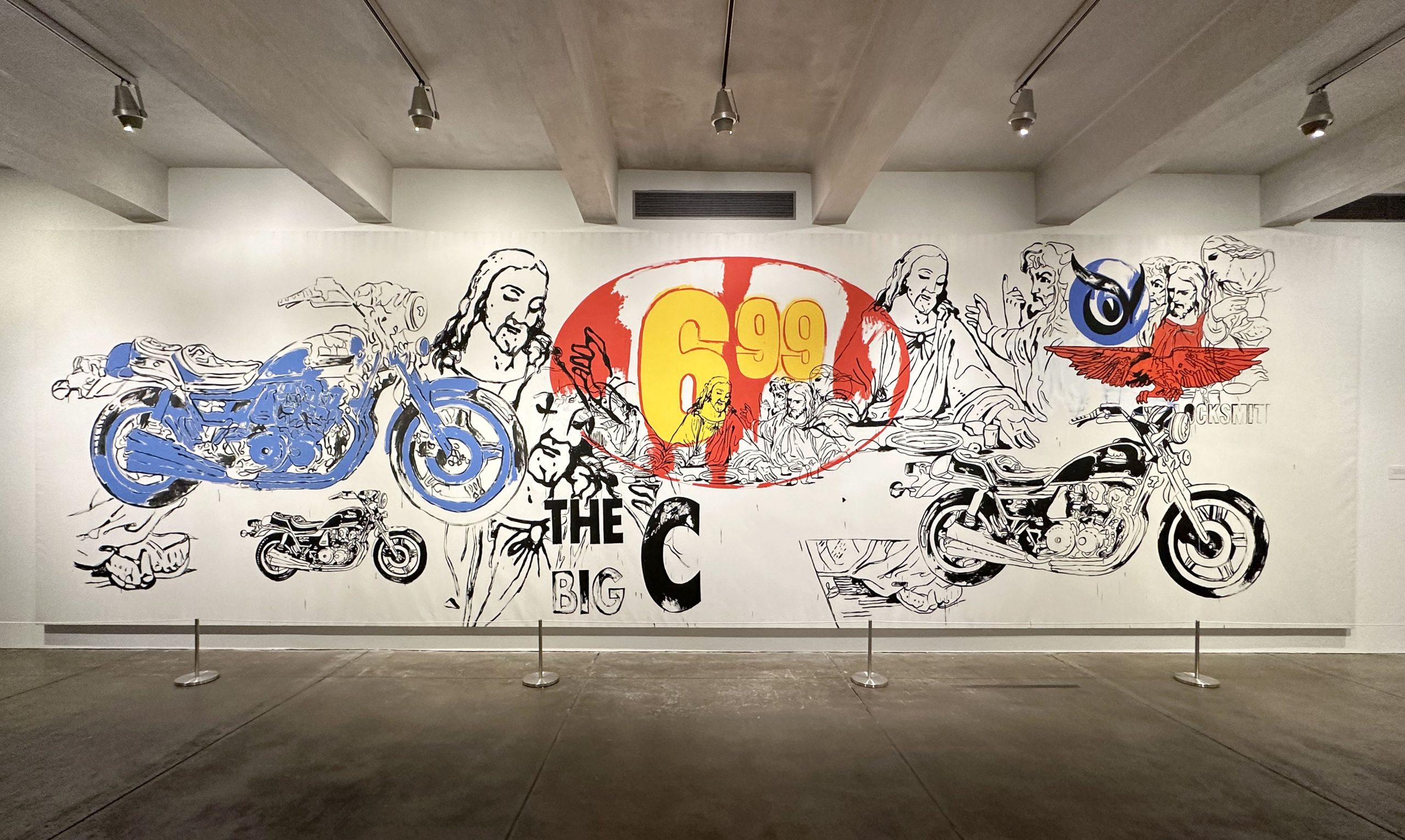
“The Last Supper”, 1986, Acrylic and silkscreen ink on linen

In the 1980s Andy Warhol created a series of paintings based around Leonardo da Vinci’s The Last Supper. The one above is currently on view at The Warhol Museum in Pittsburgh, Pennsylvania.

In 2010 it was on view as part of the Brooklyn Museum’s exhibition Andy Warhol: The Last Decade.

From their website about the work-

The Last Supper series was commissioned to inaugurate a new gallery in Milan, Italy, located across the street from the site of the Italian Renaissance artist Leonardo da Vinci’s iconic fresco (circa 1495–98) depicting Jesus’s last meal with his followers. Warhol worked obsessively for more than a year on this series, producing more than a hundred Last Supper paintings, both silkscreened and hand-painted, that were some of the largest paintings of his career.

Despite his public proclamations to the contrary, Warhol was profoundly moved by the series. Of these works, he remarked, “I painted them all by hand—I myself; so now I’ve become a Sunday painter. . . . That’s why the project took so long. But I worked with a passion.” These paintings manifest both his religious beliefs—his practice of Catholicism remained private until it was revealed at his funeral—and an irreverence toward the subject, expressed through ironic commercial logos and transgressive repetitions of Christ’s image.

Warhol created many variations using versions and pieces of da Vinci’s fresco and there is some debate as to the meanings behind them. In 2018, curator Jessica Beck wrote Warhol’s Confession: Love, Faith, and AIDs, an in-depth essay exploring possible meanings behind the work. She suggests Warhol was referencing AIDS, suffering, health, and mortality, along with his relationship to Christianity.

In this section of the essay she discusses the imagery from the painting-

The tension between Warhol’s sexuality and his religious life has its fullest expression in paintings such as The Last Supper (The Big C), in which signs and symbols create a private reference to AIDS. Hand-painted via a projection process, like paintings of 1961–62 such as Before and After, Wigs, and Dr. Scholl’s Corns, the canvas is left partly unfinished, and Warhol employs a light touch with an abstract brushstroke. On this canvas the figure of Christ recurs four times, while hands appear repeatedly. Thomas’s finger pointing to the sky, intimating that heaven knows he is free of guilt, appears prominently next to the “eye” in the Wise potato-chip logo.

…The source material for the painting, in the archives of The Andy Warhol Museum, Pittsburgh, is a collage made up of headlines from the New York Post, motorcycle ads, and clippings reading “the Big C” and “AIDS” cut from a front-page article in the Post. Warhol ultimately left out the AIDS headline while keeping the more covert “The Big C,” but given the direct references to “gay cancer” in his diaries, it becomes clear that this image of Christ was connected for him to the rapid rate at which people were dying around him. “The Big C” was synonymous with AIDS. The Last Supper (The Big C) reflects on sex and shame through appropriated images of Christ’s betrayal, the piercing owl’s eye (the Wise logo), and the numbers 699, appropriated from a price tag—$6.99—but indexing both the sexual position “69” and the “mark of the beast,” 666, in the Book of Revelations. Even the details of Christ’s feet at the far right of the canvas seem to point to the notion of punishment: for Steinberg, writing on Leonardo’s Last Supper, “as [Christ’s feet] rejoin the rest of the body, they foreshadow it glorified; and they foreshadow it crucified.”34  The image of Christ offering his flesh in the Eucharist was a symbol of salvation during a time of suffering, an unusually personal and emotional image for Warhol. In keeping with the complexities of his construction of death in the Death and Disasters, and with its repression in the diaries, the painting speaks of sex and of judgment. It is an allegorical triangulation of mourning, punishment, and fear.

For more on Warhol an his diaries, the Netflix documentary is really informative as well as entertaining. It’s a moving portrait that goes beyond what most people know about Warhol, both as an artist and as a person.

Mar 072024
 

Francesca Woodman, “Untitled (Rome), 1977-8, Gelatin silver print (image via Columbus Museum of Art)

Two of Cindy Sherman’s “Film Stills”, Gelatin silver prints from the 1970s

Four Gelatin silver prints by Diane Arbus

Francesca Woodman’s “Italy”, 1977-1978 (printed later) Gelatin silver print

Currently on view at Columbus Museum of Art is Arbus • Sherman • Woodman: American Photography from the 1960s and 1970s. Although many of these photographs by Diane Arbus, Cindy Sherman and Francesca Woodman are well known, it’s great to see the work of these three exceptional artists in person. The black and white images still captivate, even in our current image saturated world.

About the show from the museum-

This selection of monochromatic prints reflects a shared interest in capturing the world outside oneself as well as the world within. Perspective is an elemental link between each work: the images speak to how we see ourselves as individuals, how we are perceived, and how we observe others.

While Arbus was known for photographing families, children, pedestrians, performers, and celebrities, both Sherman and Woodman turned the camera on themselves. Dressing as anonymous female film characters from the 1950s and 1960s, Sherman poses in the series “Untitled Film Stills”. However, these works are not considered self-portraits, but rather carefully constructed performances of various female identities. Conversely, Woodman’s surrealist images might be called non-traditional self-portraits. By obscuring, blurring, or cropping parts of herself out of the final image, the photographs become intimate, personal snapshots that reflect a wider human fragility.

Arbus, Sherman, and Woodman are considered among the most prominent twentieth-century photographers and remain influential to contemporary artists today. By including aspects of feminism in their work and pushing the limits of the medium, these women challenged societal norms of their time while contributing to the elevation of photography as an art form.

It’s always interesting to hear artists discuss each other’s work. Included in the exhibition is this quote by Cindy Sherman about Francesca Woodman-

“She had few boundaries and made art out of nothing: empty rooms with peeling wallpaper and just her figure. No elaborate stage set-up or lights… Her process struck me more the way a painter works, making do with what’s right in front of her, rather than photographers like myself who need time to plan out what they’re going to do.”

For more on Francesca Woodman, her short life, and her artistic family, The Woodmans is an excellent documentary.

Jul 272023
 

Sinéad O’Connor- Feel So Different

Sad to hear of the passing of the brave, beautiful, and talented musician Sinéad O’Connor yesterday at 56 years old. A true artist with a phenomenal voice, she always stood firm in her convictions. The song above is from her second album, I Do Not Want What I Haven’t Got released in 1990.

To learn more about O’Connor, her memoir Rememberings was released in 2021 and there is also the 2022 documentary,  Nothing Compares.

Rest in Peace.