Oct 232024
 

Austin Lee’s uses a combination of technology and traditional artistic techniques to create work in a variety of mediums for Psychomachia, his latest exhibition at Jeffrey Deitch. The saturated colors in his paintings (and the blue of the center sculpture) make them eye catching, while his subject matter creates, at times, a feeling of unease.

From the gallery-

Austin Lee knows how to render human emotion. Through a unique process that has defined his career, Lee explores human psychology and emotions by integrating software technologies with traditional methods of artmaking to produce vibrant paintings, sculptures and video works. Psychomachia marks Lee’s first solo exhibition in Los Angeles in eight years and third exhibition with Jeffrey Deitch.

Lee’s work explores the hyperreality of social media and the internet, and, in this exhibition, he continues to explore the complexity of human connection that can be refracted through our digital age. He uses 3-D and virtual reality software to make drawings that are then painted on canvases with airbrush or fabricated in materials like resin and bronze. Lee turns inward and examines his own raw emotions through saturated hues and uncanny images.

The exhibition also draws inspiration from a transformative visit Lee made to the Giotto Chapel in Padua, Italy, where he was inspired by painted scenes from the 14th-century poem Psychomachia by Prudentius. The poem, which depicts the allegorical battle between virtues and vices for control over the human soul, served as an important source for several paintings in the exhibition. Some paintings show imagery that is directly pulled from the Chapel’s walls, while other paintings are quiet references to familiar symbols, like animals and families. Lion with Blue Eyes (2024), for example, conjures feelings of valiance and strength, whereas In Bed (2024) invites visitors to participate in a more unsettling sensation–– the feeling of being vulnerable or being under surveillance.

Central to the exhibition space is Blue Fountain (2022-2024), Lee’s fountain sculpture that was previously exhibited in his solo museum exhibition at the Lotte Museum of Art in Seoul, South Korea in September 2023.

The mezzanine features a series of new video works that continue to explore surveilled environments and the disquieting feelings in the paintings. The animated figures ogle at the viewer from the same viewpoint as reflected in In Bed. It is common for Lee to build upon previous works, placing them in a rich, multidimensional visual world through rendering them in different media.

This exhibition is on view until 10/26/24.

May 222024
 

Pictured above is Frank Stella’s 1986 work, La vecchia dell’orto, on view at Columbus Museum of Art, part of New Encounters: Reframing the Contemporary Collection of the Columbus Museum of Arta reinstallation of the museum’s contemporary galleries.

About the work from the museum-

In the 1960s Frank Stella began creating paintings with a composition of lines that closely followed the shape of the canvas. These works often resisted any sense of depth, but in the following decade, Stella would go on to create exuberant works like this, composed of brightly painted cones and other shapes that extend beyond the surface of the rectangle behind it.

The title of this work, like others in his Cones and Pillars series, is taken from an Italian folktale in which a mother’s only daughter is kept by a witch as payment for a cabbage she stole from the witch’s garden.

Stella’s practice was always evolving. In his most recent large painted sculptures, currently on view at Deitch in NYC, you can see how he expanded on the concepts he was working with here.

May 222024
 

There’s only a few days left to see Frank Stella’s recent sculptures at Deitch’s New York location. The large colorful works look drastically different depending on the angle with which they are viewed.

Stella sadly passed away at the beginning of this month. Although it is sad that we won’t be able to see what he would have come up with next, these sculptures help demonstrate how inventive he remained throughout his career.

From the gallery’s website-

Double wide flatbed trucks navigated the bridges into Manhattan to transport five monumental works by Frank Stella to Jeffrey Deitch’s SoHo gallery.

They are among the most ambitious and most radical works being made by any artist today. They extend Stella’s forms even further into three dimensions. The works are not painted sculptures or relief paintings. They completely fuse painting and sculpture in a way that has never been achieved before. The sculptures have never been shown in New York City.

Frank Stella said that one of the objectives of his recent artistic approach has been to “build a painting rather than painting a painting.” The new work is a realization of this ambition. Stella combines traditional artists’ techniques with high technology to create his new work. His monumental sculptures begin with computer models that are transformed into a series of small sculptural maquettes through 3-D printing. The artist refines these models in the studio and then sends them to fabricators in the Netherlands and Belgium where they are engineered and constructed using technology derived from shipbuilding. The sections are then shipped to Stella’s studio in the Hudson Valley where they are refined and painted with automotive paint.

The exhibition features works from two series, Scarlatti Sonata Kirkpatrick from 2014, and Atlantic Salmon Rivers from 2021-23. The Scarlatti Sonata Kirkpatrick sculptures are created with high density foam covered in fiberglass. The Grand Cascapedia, inspired by the Canadian river known for salmon fishing, is made from aluminum. As in all of Stella’s work, the forms embody their materials. The materials inspire the forms.

Stella’s work of the 1980s were characterized by its extension of two-dimensional painting into his version of baroque space. These new works extend beyond baroque space into outer space. The forms seem to float in anti-gravity. They ascend, transcending their weight. They do not have front or a back, existing in the round.

Frank Stella has expanded the art discourse for more that six decades. His new work continues to advance art into a place where it has never been before.

If you are able to see the work in person at the gallery, make sure to take the steps to the top where you will find a diorama containing the sculptural models (pictured below).

Jun 132019
 

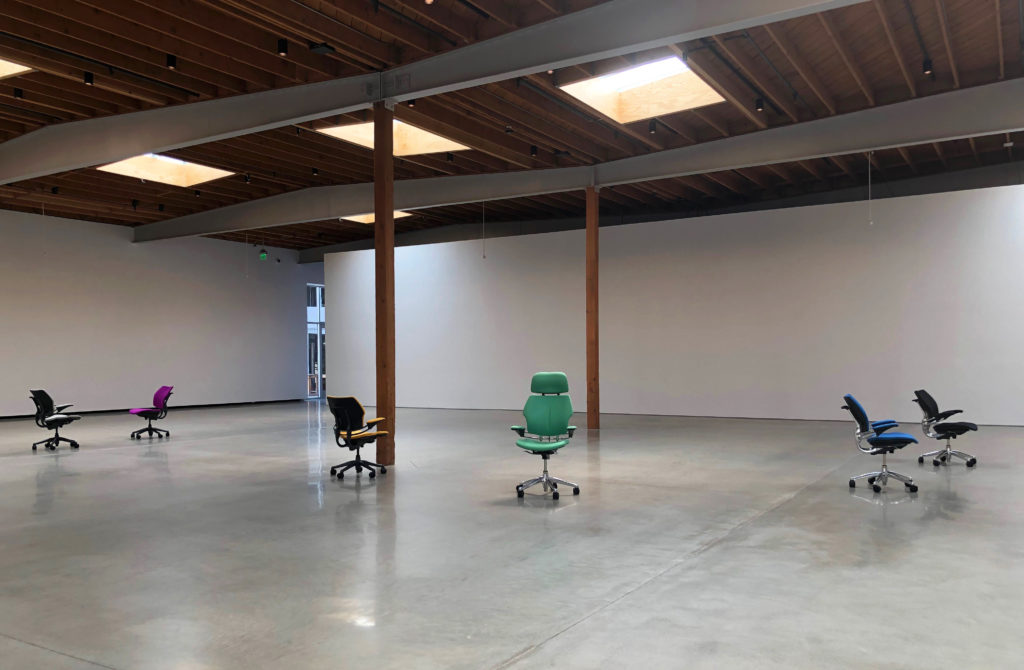
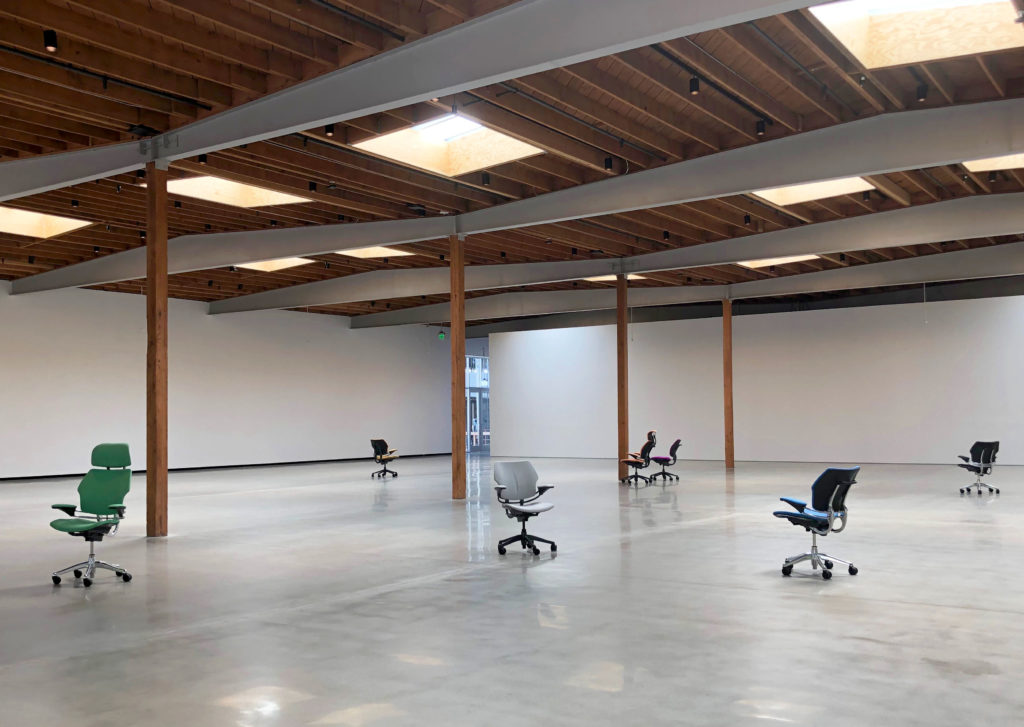
It’s not often an art show comes along where you wish there were more people in the gallery, but going to see Urs Fischer: PLAY at Jeffrey Deitch in Los Angeles was one of them. When you first walk into the large space filled only with office chairs, you notice them moving but in ways you might not expect- if you expect office chairs to be moving on their own in the first place.

The chairs are controlled by artificial intelligence that determines and learns from each encounter. Even alone in the gallery, it was delightful to watch the chairs interact with each other and then myself as I walked around. They come close to you and each other. They spin and travel together or seem to interact one by one. When others entered the gallery they change their movement again, seemingly without any set pattern. At one point I watched one of the chairs move all the way to the desk by the entrance, a space that seemed like it would be out of bounds.

Urs Fischer is quoted in the press release saying- “despite the complexity of the parts, the exhibition as a whole is pretty simple. It’s about what you, the viewer, project onto it. It’s not about chairs, it’s about humans.” This is what makes the show so fascinating, it is almost impossible not to anthropomorphize the chairs and their interactions.

PLAY, conceived of by Urs Fischer with choreography by Madeline Hollander, runs through June 15th.