Nov 132026
 

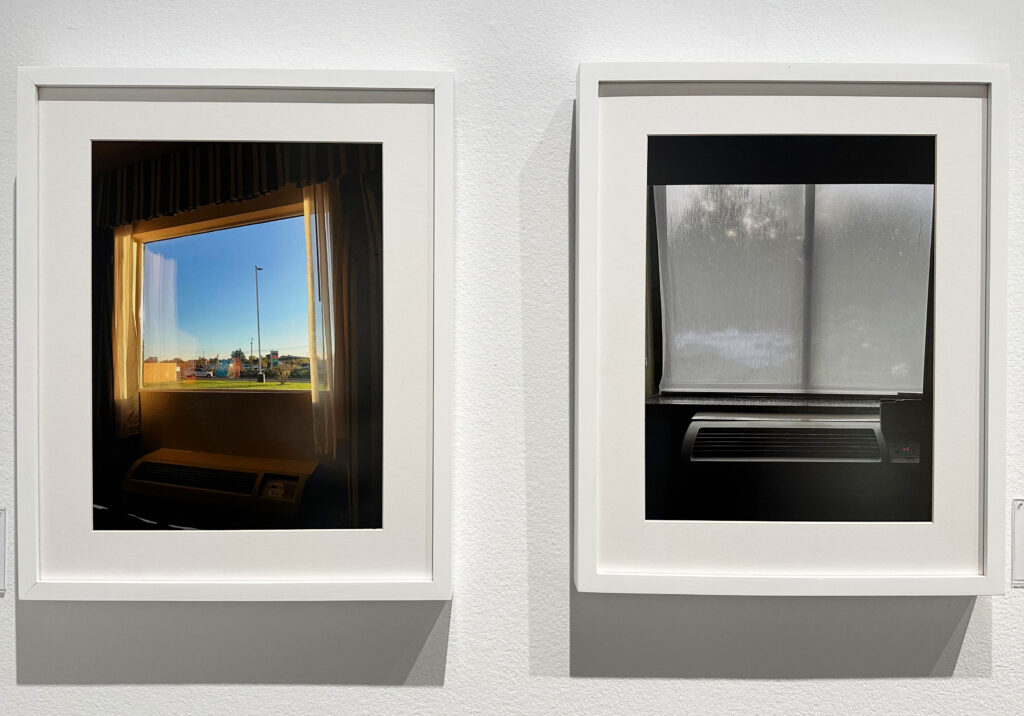
Jenee Mateer, “Best Western Plus, Bensalem PA” and “Holiday Inn Express”, Archival pigment prints

Beyond the Perspective of What You See at The Delaware Contemporary features images that move beyond the traditional associations of travel photography. The photographers included in this exhibition are Sally Canzoneri, Alexandra Duprey, Steven Edson, Prescott Moore Lassman, Jenee Mateer, Matt Mele, Melissa Sutherland Moss, JP Terlizzi, Ioannis Vastarkous, and Ava Hassinger.

From the museum and the curator, Erica Zoe Loustau about the exhibition:

Travel photography has long shaped how we imagine people, place, culture, memory, and movement. From postcards and tourism campaigns to personal archives and documentary work, the camera has acted as both witness and translator – always framing the world through perspective, longing, bias, and power.

This exhibition brings together artists who challenge traditional ideas of travel photography. Rather than romanticizing escape or reducing places to aesthetic backdrops, the work asks harder questions: What does it mean to “capture” a place? Who moves freely, and who cannot? How do tourism, migration, displacement, colonialism, climate change, labor, and globalization shape the ways people and stories travel? And what responsibilities do photographers hold toward the communities they depict?

We welcomed reflective, experimental, documentary, conceptual, intimate, poetic, or confrontational work. Artists selected for the exhibition explore personal journeys, inherited histories, diasporic identity, family migration stories, pilgrimage, borders, tourism economies, environmental change, cultural preservation, and the emotional geography of place.

And from Jenee Mateer about her images for the exhibition (pictured above):

Most people have stayed in a hotel at least once in their lives. For some it’s a regular occurrence. Special occasions, work or vacations are just some of the reasons one might need a place to stay. For my family, the reason behind our travel was baseball. My son played in high school and in the summers leading to graduation.

I do not particularly like hotels. I often find that unless you are willing to spend a lot of money, they all look very similar. The quiet insides often reflect the outside. Hotels are often in deserted areas close to freeway off ramps. The insides are very similar-2 beds, innocuous art, a mini frig and microwave, a desk for ones laptop, neutral colors, a heating and cooling unit and strange views from the windows that one is unable to open; parking lots, chain stores and chain restaurants. I associate the hotels with everything I dislike about corporate America. The air within the room is stale and slightly antiseptic. The rooms are too hot or too cold. One feels that inside, you are both somewhere and nowhere between somewhere and home. From the window the outside looks surreal while the inside is familiar and not familiar.

The stress of playing baseball and the stress of watching baseball affect the player and the parents and I started to imagine the interior of the hotel rooms as not just my interior safe space but also the space where my family retreated to relax, regroup and release tension. At the same time as they provided respite from the stress of the games, the rooms amplified my discomfort at being away from home and over time suggested patterns similar to the endless patterns of actual play that are at once the same but different.

The spaces felt like the interior psychological space of my mind, and I started to wonder how others might feel in these spaces, what their stories might reveal about themselves or about the experience of being in this waystation between home and somewhere else.

This exhibition is on view until 2/28/27.

Dec 052024
 

Chris Marker’s 1983 poetic travelogue Sans Soleil brings something new with every rewatch. The film consists of footage, some stock and some of Marker’s own work, taken around the world, with a focus primarily on Japan and Guinea-Bissau. Along with these images, a narrator (Alexandra Stewart in the English version) reads from the letters she received from the fictitious cameraman. Within these letters are his thoughts on memory, history, culture, and life itself.

On this viewing it was his mention of Sei Shonagon, a lady in waiting to Princess Sadako in Japan at the beginning of the 11th century, and her lists, that stood out for me.

He says:

“Do we ever know where history is really made? Rulers ruled and used complicated strategies to fight one another. Real power was in the hands of a family of hereditary regents; the emperor’s court had become nothing more than a place of intrigues and intellectual games. But by learning to draw a sort of melancholy comfort from the contemplation of the tiniest things this small group of idlers left a mark on Japanese sensibility much deeper than the mediocre thundering of the politicians. Shonagon had a passion for lists: the list of ‘elegant things,’ ‘distressing things,’ or even of ‘things not worth doing.’ One day she got the idea of drawing up a list of ‘things that quicken the heart.’ Not a bad criterion I realize when I’m filming…”

Finding things, however small, that “quicken the heart” is a lovely criterion for life in general and this film is certainly on the list.

After watching Sans Soleil, and researching Marker, I watched one of his earlier works, the science fiction featurette  La Jetée. Constructed using still images, it contains only one brief shot made with a movie camera.

Using voice over narration, the short film takes place after World War III and tells the story of a prisoner in a post-apocalyptic Paris forces to time travel to the past and future in the hopes of saving the present. The man has a vivid memory from his childhood before the war of a woman he had seen at the airport, just before witnessing a man’s death. Through his time travel he is able to meet and develop a relationship with her as an adult. Time and memory, themes also present in Sans Soleil, were subjects Marker retained an interest in exploring in many of his films throughout the years.

La Jetée would go on to influence many artists, musicians, and filmmakers over the years. One of the most famous examples is Terry Gilliam’s movie 12 Monkeys which uses several of the film’s concepts of time travel.

Criterion Collection has released both movies together along with Marker’s six minute film Junktopia, and other extras. For more information on his filmography, Catherine Lupton has written a very informative essay on their website.


Jun 132024
 

For the exhibition  Ming Smith: On the Road at Nicola Vassell, a variety of work from the artist’s impressive career is on display throughout the space.

From the gallery-

Nicola Vassell is pleased to present Ming Smith: On the Road, a selection of photographs from the artist’s archive that encapsulates the arc of her exploratory impulses as she sought and probed new subject matter and formal innovation from 1970 through 1993. Encompassing never-before-seen vintage and contemporary prints of images captured during her travels around the world, On the Road embodies the spirit of adventure and curiosity that advanced Smith’s singular entry into, and scrutiny of, the provinces of urban existence, nature’s quietude, family intimacy, popular culture, military life, and jazz milieus.

In the 1970s in New York, Smith’s practice was propelled by inquiry—both through her immersion in the Kamoinge Workshop and her preoccupation with the ideas of prominent twentieth-century American and European photographers. Cultivating her own radical sensibility in early experiments, she alluded to the virtuosity of Brassaï, Roy DeCarava, Diane Arbus, and Robert Frank. These artists set a tempo upon which Smith developed her own dexterity in portraiture, landscape, and street photography—highly attuned to the textures, geometries, and thrums pulsing through every spectrum of life. She recognized the haunting allure of an oil-slicked roadside and the liquid lightning of brass instruments in musicians’ animated hands.

Smith listens through her camera, sensitive to the harmony and dissonance that enliven her subjects and surroundings. At times, it is easy to forget that she works in a static medium, since each photograph transports its viewer into the energetic nucleus of the moment she captures. Through paint application, double exposure, and low shutter speed, Smith pushes photography’s form to the point of its brim and break. Like harnessing a memory, Smith underlines the evanescent—at once vivid and obscure.

This exhibition closes 6/15/24.