Jan 292026
 

Chopping Ice from the Water Trough, 1935, an oil painting by artist Dale Nichols, is part of Brandywine Museum of Art‘s permanent collection.

From the museum about the work-

Rising to popularity during the Great Depression, a style known as American Regionalism brought modern stylization to images of rural life. In his landscape painting Chopping Ice from the Water Trough, Dale Nichols engages Regionalism by bringing a clean, minimal approach to his representation of daily farm chores by highlighting the smooth contours of the snowy slopes and the sharp-edged geometry of the barn. Nichols, a native of Nebraska, trained and taught for many years at the Art Institute of Chicago but returned throughout his career to the farm subjects most familiar to him from his childhood. His work was so attuned to farm life that International Harvester Company commissioned him to depict a series of works marking the development and use of the famous McCormick Reaper in agriculture.

Jan 272026
 

A Morning Snow– Hudson River, the 1910 oil painting by George Wesley Bellows, is part of Brooklyn Museum‘s permanent collection (but not currently on view).

From the museum’s website about the work-

Assured, slashing strokes of a heavily loaded brush capture the effects of morning light reflected from freshly fallen snow. This view shows the Hudson River and New Jersey from Manhattan’s Upper West Side. George Wesley Bellows conveyed the sense of the city awakening through his depiction of the man shoveling snow, people going to work, boats plying the river, and smoke and steam interrupting the still, crisp atmosphere.

Elements of this composition move toward abstraction. The elevated vantage point reduces the illusion of depth, while horizontal and vertical components, seen particularly in the fence and tall trees, provide a subtle gridlike structure.

Jan 252026
 

“January”, 1940-41, Oil on masonite panel

Grant Wood‘s painting January is on view at Cleveland Museum of Art as part of their permanent collection. It feels like a good time to post it with both a big snowstorm happening in many parts of the U.S., and it being January.

From the museum about the work-

One of the last paintings Wood created before his untimely death from liver cancer, January has a decidedly nostalgic cast. According to the artist, the painting was “deeply rooted in the memories of my early childhood on an Iowa farm. . . . it is a land of plenty here which seems to rest, rather than suffer, under the cold.” One sign of activity, in the form of rabbit tracks, infiltrates the otherwise dormant scene. Wood’s composition teems with abstract design, most notably through the rhythmically geometric array of snow-laden corn shocks that seem to recede infinitely into the distance.

Feb 242024
 

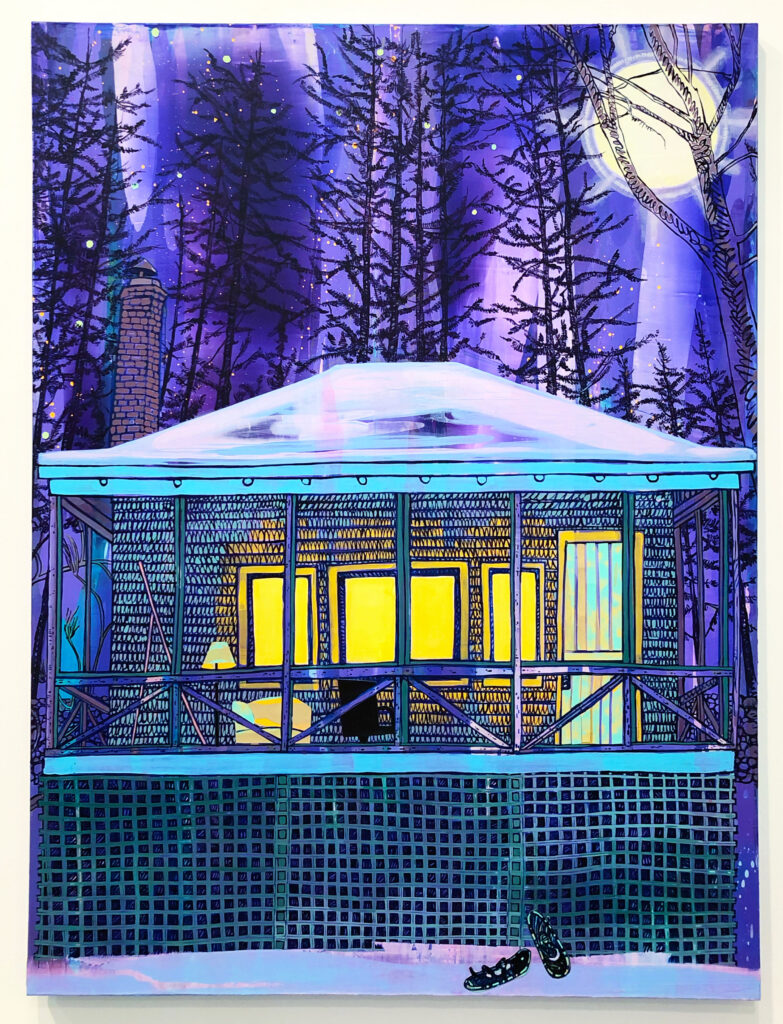
Hope Gangloff’s painting MacDowell Cheney Cabin in the Winter Super Moon, 2019, was shown at her 2019 solo exhibition at Susan Inglett Gallery in NYC.  It is one of several created during her residency at MacDowell Colony in Peterborough, New Hampshire.

Jan 192024
 

Pictured above is Drossos P. Skyllas‘ painting, Wisconsin Ice Cave, 1950, part of LACMA’s 2018 exhibition, Outliers and American Vanguard Art.

About the artist from the National Gallery of Art in Washington D.C. where the exhibition was also on view-

Drossos Skyllas achieved the exquisitely detailed, jewel-like surfaces of his paintings with tiny brushes he fashioned himself. He applied miniscule dabs of luminous oil paint in a pointillist manner, which gave his subjects a petrified yet shimmering quality. His refined technique and adherence to the academic genres of still life, landscape, portraiture, and mythological scenes demonstrate his knowledge of art history. And inspired by the old masters, he perfected the difficult depiction of reflective surfaces, including gems, mirrors, water, and ice. At the same time, his uniform clarity of detail, imposed symmetry, and sense of frozen time create a dreamlike mysteriousness reminiscent of magic realism. In addition to high art sources, Skyllas likely drew upon commercial illustration and photography. Untitled (Roses) resembles both traditional floral still lifes and midcentury advertisements for jewelry and flowers. Wisconsin Ice Cave relates as much to northern Renaissance landscape painting as to mass-produced picture postcards.

Born in Greece, Skyllas worked in his father’s tobacco business before emigrating to the US shortly after World War II. He settled in Chicago and devoted himself to becoming a professional artist, though he had no formal artistic training. Supported financially by his wife, Skyllas produced thirty-eight paintings from the late 1940s until his death in 1973. Some of these he submitted to the annual juried exhibition at the Art Institute of Chicago, Chicago and Vicinity, which featured his work in 1955, 1967, 1969, and 1973. He also sought commissions to paint portraits, but with asking prices as high as $30,000, he never found any patrons.

Skyllas’s work was discovered after his death by Chicago gallerist Phyllis Kind, who added him to her roster of self-taught artists in 1974. He was likely known to artists Jim Nutt and Gladys Nilsson before this, as they had exhibited alongside him in the 1967 Chicago and Vicinity exhibition and are enthusiastic collectors of self-taught artists (Wisconsin Ice Cave is in their collection). The meticulous finish of Skyllas’s paintings, which simultaneously evokes advertising art and Renaissance illusionism, appealed to Nutt, Nilsson, and fellow Chicago imagist Roger Brown, whose art collection also included the self-taught Greek master.