Jun 072024
 

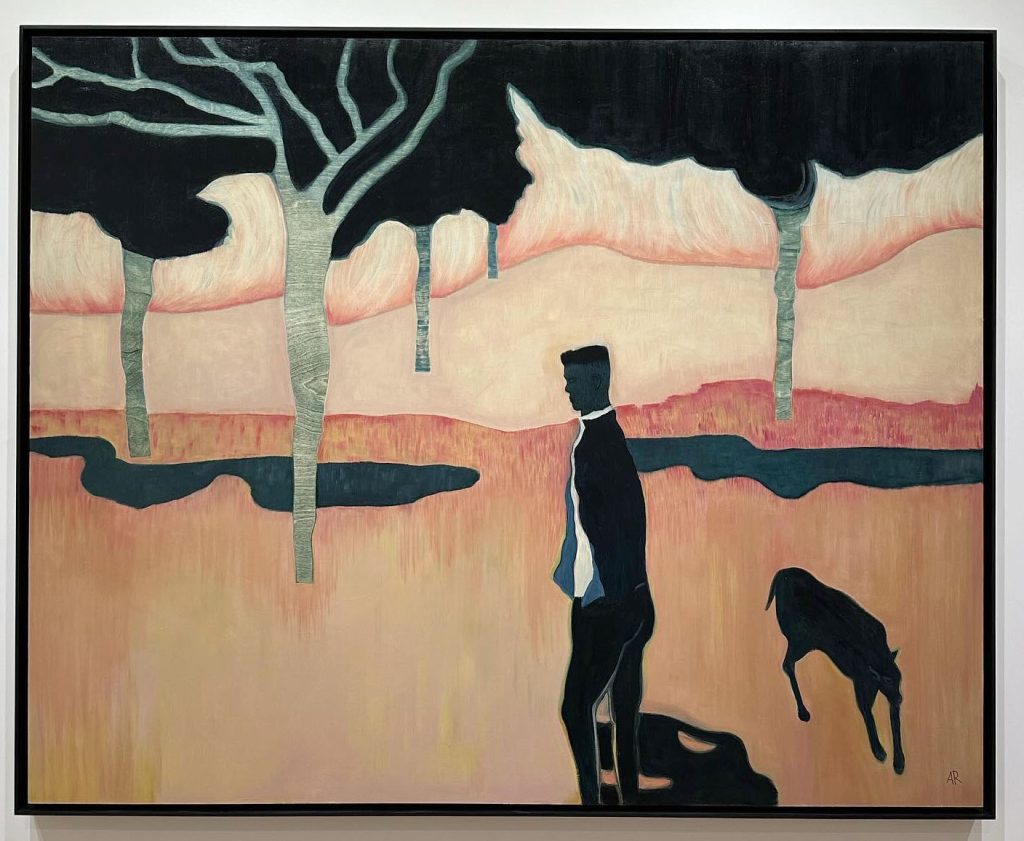
For Kazuyuki Takezaki’s exhibition Before Spring at 47 Canal, he presents distinctive versions of the landscape around his home in Marugame,  Japan.

The press release provides more detail-

…His current painting practice is deeply informed by the landscape around Marugame, with its plains ringed by low mountains in the distance. Often employing a grayish, chalky palette highlighted by blushes of orange shading into purple or white, he paints studies of plant life or mountain ridges as quickly rendered silhouettes that evoke miniature frescoes. In another body of work, he attaches canvas to a board and then sets out in his van to find a spot in the countryside, where he records his impressions in situ using oil stick. Comparing this practice to old men playing board games outdoors, he often spends several days on these “Board/Table” pieces, trying to keep up with the atmospheric conditions as they change hour by hour and day by day.

Both the canvases and the “Board/Table” pieces retain an element of the windowness of the earlier works in allowing for a coexistence of transparency and opacity. “At dusk, I often see the town horizontally divided into upper and lower halves by transparent and opaque color,”
Takezaki writes. Sometimes the sky looks like “solid gouache” while the town and trees are shot through with light, while at other times it’s the sky that takes on “a deeply transparent color” against the dark shadow of the town. The bands of color that occasionally bisect the small canvases at odd places, suggesting a horizon line but also arbitrary erasures, allude to this effect. They also come, Takezaki says, from a desire to work with multiple images at the same time. In a sense his works replicate the visual noise that accumulates on the surface of a window—replicate the agency of the window itself in simultaneously framing and interfering with the view.

But there is also a subtext to the works that pushes them beyond the tradition of the landscape-ranging from literati ink scrolls to amateur Sunday paintings and everything in between—into something that feels urgent and timely. According to Takezaki, the land around Marugame is dying. He can see it clearly in the sprawl being constructed in the plains, which drives away animal life, and the effects of fertilizer and other chemicals on the vegetation. The immediacy he strives for in his paintings—the way he tries to take everything all in at once, including the particles in the air and the brilliant light that illuminates the trees at dusk—is also an act of bearing witness to nature as a liminal zone between the worlds of the living and the dead. Communicating a profound yet fleeting sense of place, Takezaki’s windows onto this constantly shifting environment are also reflections on time, memory, and the porous overlaps between subject and object.

This exhibition closes 6/8/24.

Jun 072024
 

“1 on 1 (2 Face a Covert Bully)”, 2024, Oil, acrylic, and graphite on linen

“Larva Stage (Exposed to Linger)”, 2024, Oil, acrylic, and graphite on linen

“Larva Stage (Exposed to Linger)”, 2024, Oil, acrylic, and graphite on linen (detail)

“Routine Maintenance (Your Mouth Comes Second)”, 2024, Oil, acrylic, and graphite on linen

“Cute Ones, Abducted”, 2024, Oil, acrylic, and graphite on linen

“Cute Ones, Abducted”, 2024, Oil, acrylic, and graphite on linen (detail)

Stefanie Heinze’s paintings at Petzel for MORTAR (the cute ones shouldn’t go unnoticed) have a lot of layers- both in paint and detail. What they mean may depend on your own interpretation. The poem below by Sophie Robinson or this interview with herself may provide some clues.

From the press release-

SWEET SWEET AGENCY by Sophie Robinson

the candy here is hard & filled & there is nothing i love more
than to be treasured. if nobody’s watching i just do nothing: lie down
don’t hardly breathe, keep my face in careful stillness not to crease
its cute forgettability. the world is full of edible munchkins & it is my life’s work
to work out how to stay creamy on the inside, how not to sour myself
up with little nips of this or that or otherwise cut holes in myself thru which
to be seen. i must learn to love what i cannot know: the wide bleached anus
on a porn blog, the insane demands of toddlers, the desire for moderation or
slimness of affection, the reasons lovers leave, the trash my cat brings back,
the crack of footsteps in the woods at night, why the killer kills.
i learn it all the hard way but fwiw
i would never snap the rabbit’s neck again
i would rewind i would keep it every time

Following the artist’s relocation from Berlin to New York this past year, Heinze’s newest suite of works investigates systems of knowledge and truth, challenging received notions of representation.

Heinze considers mortar as a site of genesis, the container of beginnings, from which raw materials are processed. Mortar can be the sound of aggression, bombardment, a foil or a threat. Mortar and pestle, a receptable for grinding ingredients, a cup for holding and crushing hard, like the grinding of teeth, or the moment infatuation becomes obsession, when yearning turns from tender to brutal. The paste which binds building blocks together, holding and distributing weight, sometimes decorative, composed of cement, water and sand. Paint is mortar, the built environment is mortar, the grind is mortar, decisions are sealed in mortar, and so is the longing for something even better and bigger and harder.

Heinze starts with small-scale drawings and collages, which are translated to large-scale tracings, undergoing several transformations as her canvases take shape. Rendering her surfaces over several months, layers of line and color are suspended in scenes at once frozen and in motion. Heinze works with a sense of suspicion, disputing the power of images. Her depictions are at times plush, like her floating, 🥹-bodied cherubs, or sharp and dense, like her reckless, airborne cinder blocks. Heinze’s pictures lend expanded, fragmented associations to her subjects, both stony and swaddled, heavy and buoyant. Heinze’s works negotiate categorization, neither pure figuration nor abstraction. Language hits a limit here, reaching for the means to describe–an enzyme, a digestif–where words fail. Heinze strives for a more empirical vocabulary, generating fields of sensation.

Interested in divination practices, ranging from tarot reading to online “spiritualist” influencing, the artist creates images motivated by imagined futures, drawing on both medieval and New Age “Youtubian” utopias. Influenced by the theory of the third hand in painting, the experience of transcendence which overtakes the artist at that critical point of flow state absorption, Heinze leans into this tradition of mysticism. Heinze allows the pieces to reveal themselves over time, creating kinetic, shifting pictures that trip expectation. Heinze builds tender worlds, in which instinct and environment coalesce in new impossibilities.

This exhibition closes 6/8/24.

Jun 072024
 

Shaun Pierson

William Eric Brown

Sophia Chai

Sheida Soleimani

Gonzalo Reyes Rodriguez

Kevin Landers

Brittany Nelson

The seven artists on view at Luhring Augustine for the exhibition Tiptoeing Through the Kitchen, Recent Photography, each bring a unique vision to their practice. The artists included in this show are William Eric Brown, Sophia Chai, Kevin Landers, Brittany Nelson, Shaun Pierson, Gonzalo Reyes Rodriguez, and Sheida Soleimani. Below is more detailed information on the work from the gallery.

From the press release-

“Taking pictures is like tiptoeing into the kitchen late at night and stealing Oreo cookies.”  – Diane Arbus

Materialized in varying ways, kinship and cultural inheritance are frequent touchstones for many of these artists. William Eric Brown’s works — the source images for which were taken in Antarctica in the 1950s by the artist’s father while serving in the US Navy and stationed on an icebreaker — are instilled with new significance through his manipulation and reconceptualization, which address the current reality of climate change and its effects on the arctic. Sophia Chai explores her memory of learning the Korean alphabet as a child through her work. By drawing and painting the shapes and lines of the characters on the walls and floor of her studio, Chai reimagines them in space, thereby abstracting written communication into an embodiment of the sensation of each word being formed inside the mouth.

Sheida Soleimani stages elaborately constructed tableaux to address interwoven narratives of family, politics, and caregiving that trace both personal and public histories. Her carefully fabricated scenes demonstrate her commitment to approaching her practice with measured sensitivity; rather than divorcing her subjects from their own realities, Soleimani creates a contemplative space in which each incorporated object or image conveys an intentional message. Similarly, Shaun Pierson’s work illuminates the complex dynamics in the relationship between photographer and subject. Entwining conflicting sensations of inhibition and desire, Pierson lays bare the often simultaneously transactional and vulnerable apparatus and process of making photographs. Kevin Landers’ photographs, taken on the streets of New York and across the country, are rooted firmly in the here and now. He documents a collection of seemingly unnoticed moments, paying careful attention to unexpected details that, more often than not, most people would simply walk past — ephemera such as an abandoned shopping cart or an intricately woven spider web, expanding our notion of landscape beyond simply the pastoral.

Queer desire and a longing for another space and time are explored through the re-authoring of found or archival images in the works of Gonzalo Reyes Rodriguez and Brittany Nelson. Reyes Rodriguez pairs images from his own history with a series of photographs he purchased from a bookshop in Mexico City — dated between 1987 and 1993, the found snapshots evidence the personal experiences of a young, presumably queer, man known to us as “Technoir.” By combining the two archives, Reyes Rodriguez invites us to dwell in a space of merged memories, neither of which we can fully inhabit, and of the desire to know more. While at first glance Brittany Nelson’s use of archival materials is less overtly personal, her work considers themes of otherness, isolation, and the desire for connection. In one of the series on view, she perceived a sense of romantic devastation in the images taken by Opportunity, the Mars rover, which she amplifies by re-printing them using the 1920s analog bromoil photographic process, thereby infusing them with an added eerie, otherworldly quality.

Though varied in their approaches to photographic practice, what unifies these artists is their investigation of longing, care, and lineage — familial and otherwise — and the way in which they use the medium and the process of making the work as a means to engage with others, with themselves, and to challenge expectations. Generating a constellated conversation that draws upon photography’s history, yet turns toward something altogether new, the artists included in Tiptoeing Through the Kitchen, Recent Photography imbue the seemingly unknown with flashes of recognition.

This exhibition closes 6/8/24.

Jun 072024
 

“Nathan (Venise) III”, 2024, Oil on canvas

“Le ciel est bleu, les montagnes sont vertes”, 2024, Oil on canvas

“Ce soleil est la mer tout entière de mon enfance”, 2024, Oil on canvas

“Le Sporting”, 2024, Oil on canvas

Christine Safa’s paintings for These are the days I (have) love(d) at Bortolami’s upstairs gallery, capture the way memories often feel. The figures emerge from her canvases in a beautiful, dreamlike haze.

From the press release-

Painted from the memories of time spent in and around the Mediterranean, Safa returns to the studio, distilling these instances, rendering intimate landscapes, portraits of friends, lovers, and reminisced occasions. At certain moments, the human body sublimates into landscape—a shoulder becomes a mountain, or the horizon blends with a profile—moving in and out of one another. In Safa’s words:

“I see my paintings as tributes, fragments of memories, that which remains. That’s what I paint, what’s left. As I paint, I give birth to the silhouette, the shape of the ruins of memories which both greet and are the victims of time; which for me means my experience of these interior landscapes.”

Layered imagery adjoins distinct recollections as Safa refracts them through her body and mind in her attempt to record them as precisely as she can. Each title furthers our understanding of the artist as both painter and poet, acting as poems unto themselves, enhancing the meaning she seeks through paint and pigment.

Safa’s use of color and texture play a pivotal role in achieving the dreamy poeticism in her work and harken back to the influence of 15th century Italian painting and its relation to frescoes. She achieves her vibrant pallet by mixing pure pigment with oil, and creates plaster-like surfaces with rabbit skin glue and marble powder. This chalky, thickened substrate allows her to probe the canvas, to carve and scrape in her search for the image. The process is rightfully a slow one, as Safa forever encapsulates these fleeting moments into canvas, and her practice thus reveals itself as the poetic investigation and recollection of time passed.

This exhibition closes 6/8/24.

Jun 012024
 

Wealthy figures gaze into the distance while holding strange pets in AES+F’s exhibition of paintings Inverso Mundus: Chimeras at Sargent’s Daughters. The Russian artist collective’s creations act as a commentary on the excesses of the privileged class.

From the press release-

Inverso Mundus: Chimeras, will present a series of never before seen paintings, correlated to images and themes from Inverso Mundus, their video installation and performance work that premiered at the 56th Biennale di Venezia in 2015.  This marks the first presentation of the group’s work to feature exclusively paintings. Produced in the style of the Old Masters, these works present the groundbreaking and challenging work of AES+F in a new medium for a new audience.

AES+F works in photography, video production, sculpture, and painting with the goal of creating large-scale narratives that explore our contemporary global landscape and its culture, vices, and values.  First founded in the former Soviet Union in 1987, they have shown at major institutions across Europe, Asia, and the United States.  Their painting practice, produced collectively in the group’s Berlin studio, employs hyper-realistic oil painting techniques to mimic the digital glossiness of their video and digital work, tethering their complex renderings to the two-dimensional and the handmade.

Inverso Mundus takes as its initial reference point the sixteenth-century Carnivalesque engravings in the genre of “world upside down,” an early form of populist social critique that emerged with the advent of the Gutenberg press. This body of work presents contemporary life turned “upside down,” depicting a tragi-comic apocalypse where social conventions are inverted to highlight the unspoken premises of our social contract.  In the Chimeras series, various archetypes of contemporary life are portrayed cradling uncanny monsters on their laps like cherished pets. The series asks viewers to confront the monstrous contradictions we all hold dear in contemporary society.

In the wake of Putin’s re-election, the violence against dissidents such as Aleksei Navalny, and the recent amplified persecution of artists across Russia, AES+F’s critiques of the oligarchy, power, and military aggression are particularly pointed. Their public stance against the war in Ukraine has made them a target, and informed their decision to leave Moscow and relocate to Berlin in 2022.  This exhibition brings AES+F’s groundbreaking and urgent work to New York, adding new context to the international conversation.

This exhibition closes 6/1/24.

Jun 012024
 

“Tundra #8”, 2024, Silk and dye

“Lava Fields #23”, 2024, Silk and dye

Hildur Ásgeirsdóttir Jónsson’s current depictions of the landscape in Iceland for Lava Fields and Tundras at Tibor de Nagy are created using a three part process. She first takes photos, then projects them to create a painting on thread, and finally the thread is transferred to a loom. The results are dreamy.

From the press release-

A painter and textile artist, Jónsson uses the unique and active landscape of Iceland as the source for her works. In the current exhibition, she focuses on lava fields, made from recent volcanic eruptions on the Reykjanes Peninsula, in eyeshot of the artist’s Icelandic home in Keflavik and tundras which are arctic deserts, near Melrakkasletta, in northern Iceland, just below the arctic circle. In recent years, Jónsson has observed these evolving and tumultuous aspects of the Icelandic landscape and translated it into her painted and woven works.

Jónsson travels to her part-time home in Iceland several times a year. There she takes photographs and makes preliminary studies. Back in her studio in Ohio, she enlarges and projects the images, reworking them until she has the desired composition. She begins each work by painting the images on the loose silk threads – next these hand painted warp threads are transferred to the loom. The weaving then commences and the image is combined with the woven weft horizontal threads. Jónsson’s practice is squarely at the intersection of weaving and painting, where she deconstructs elements of both processes. The hybridized results blur the boundaries and sit comfortably between fine art and craft.

This exhibition closes 6/1/24.

Jun 012024
 

It’s easy to become a bit overwhelmed at Arthur Jafa’s exhibition BLACK POWER TOOL AND DIE TRYNIG at 52 Walker. His latest show includes a large installation, photography, sculpture, painting and a new film. Passing the reflective black surface and walking through his sculptural installation, Picture Unit II,  you’ll find portraits of bikers, a photo from the Manson murders, a subway car, and a stripper at a club next to a photo from a Rwandan genocide memorial. Next to where a video plays a collage of clips, an installation of cut out figures includes himself, Miles Davis, The Sex Pistols, and artists Cady Noland and Adrian Piper.

Death plays a large part in the show, as does personal and collective history. His best friend of forty years, cultural critic Greg Tate, recently passed away, also contributing to the heaviness of this recent work.

From the press release-

Lauded for his achievements as a filmmaker and cinematographer as well as a visual artist, Jafa has developed an incisive, chameleonic practice, through which he seeks to unravel the cultural significance and strictures ascribed in tandem upon Black existence in the Western world. In BLACK POWER TOOL AND DIE TRYNIG, Jafa invokes the body’s personal, political, and industrial guises in one fell swoop, deftly interweaving images and objects to create a forceful and maximal space that beckons toward engulfment and revelation alike.

Jafa’s exhibition at 52 Walker brings to the surface questions of form, force, and resistance— in addition to tensions that result from common slips and errors. The title of the show, BLACK POWER TOOL AND DIE TRYNIG, applies strategies of sequencing and juxtaposition, channeling various meanings in its wordplay—including political ideologies, industrial terminologies, and the specter of death—while also nodding to the complexities of the word “black” and its many inflections. Favoring intuitive arrangement over uniformity, the artist eschews traditionally monolithic modes of presentation and instead coheres multiple simultaneous events, applying a decidedly Black and non-Western viewpoint that confronts twentieth-century art historiography and museology’s indebtedness to African aesthetics.

In the video below, also on the 52 Walker website, Jafa discusses the show with screenwriter Judnick Mayard and is worth watching for additional insights.

This exhibition closes 6/1/24.

May 302024
 

Beverly Semmes’ exhibition Cut Paste, at Susan Inglett Gallery, expands on her previous work with new textures and fabrics. A red velvety robe hovers behind a sky blue painting containing a wave of blond curls and a partial eye looking out at you. Two pairs of hands on yellow mirror each other.  Duplicates appear again in the paintings adorning textured vests sewn to a gauzy orange fabric.

The materials enhance the details of their attached paintings, but they also create questions about their meaning. What is the purpose of the robe, the high heels, manicured nails, the fake (or real) white fur – do they represent luxury or the illusion of it?

From the press release-

I begin by drawing and painting on an image from a porn or fashion magazine page. I then use scissors and tape to further separate the image. from this context/environment. A new image is born from these parts, most of which belong to my longtime friend Nikie, who modeled in the early 2000s. The pair of hands, the foot in a shoe, those are all Nikie’s.

—Beverly Semmes

In Cut Paste, Semmes ups the ante in her perennial mixing of mediums, found images, scale and techniques. Early on Semmes brought her roughhewn ceramic pots literally into the folds of regal wall-to-floor sculptures, her signature works, setting them out like buoys in the pooling fabric. Now paintings enter the fray, no longer separate but equal. While several large paintings are presented conventionally, others are treated as accessories to the fabric pieces, where they appear at chest height. Smaller than a breast plate, too large to be a pendant, the odd coupling trades in the artist’s long standing engagement with Surrealism and the absurd. One of the assemblages has a companion piece–a full-size, independent version of the “worn” painting–amplifying the dialogue between historically cisgendered sewing and painting, the one grounded in the here and now, the other conjuring a world apart. The paintings are themselves hybrids resulting from a recursive process of hand painting on iterative hi-res scans of the cut, pasted and taped magazine drawings. But paint has the final word, variously altering, accentuating and concealing what lies beneath.

The group of work as a whole is set to the rhythm of repetition through doubling and Rorschaching. A pair of wall-mounted twins in orange organza, standing shoulder to shoulder like choir boys, wear matching paintings. Doubling down, the small canvases feature a mirrored composite image involving photographic and painted bare legs, red pitchers, a sofa and stripes. The image has then been further altered–abstracted–by its upended presentation as a vertical when it actually reads horizontally. The fluid positionality carries on throughout the exhibition in the way Semmes toggles between abstraction and figuration, digital or painted illusionism and IRL, pitchers and stilettos, dressed and undressed, power and vulnerability. Here Semmes levels the playing field, using her favorite models along with long-coveted fabrics, shapes, objects, and patterns as fodder for an unhinged formalism. Her restless process of cutting and pasting leads the way.

This exhibition closes 6/1/24.

May 252024
 

There are many little stories within Sascha Mallon’s lovely installation for Wolf Tales, on view at Kentler International Drawing Space. It includes sculptures and drawings, with pieces emerging from the walls. Each little section captures the imagination.

The press release below includes a poem by Erich Fried, as well as a more detailed discussion on the artist’s motivations and process.

WOLF TALES

“It is madness
says reason
It is what it is
says love
It is unhappiness
says caution
It is nothing but pain
says fear
It has no future
says insight
It is what it is
says love
It is ridiculous
says pride
It is foolish
says caution
It is impossible
says experience
It is what it is
says love.”
– Erich Fried

This installation synthesizes the artist’s engagement with drawing, glazed porcelain, and mohair silk crochet yarn, bringing all these elements into one monumental work that flows around the edges of the space. For Wolf Tales, Mallon is going back to her roots of drawing after being actively engaged with molding, firing, and glazing porcelain objects. In this exhibition she is primarily a draftsman on a quest, mirroring the main heroes of the story as they go through transformations. Going back to drawing in this more monumental format signifies for Mallon her long-cherished wish of making this method more dynamic, forgetting its static nature, and allowing drawings to flow.

The titular wolf is an ambivalent embodiment of spirit and energy that is at first at odds with a human presence of a girl and then goes through a series of spiritual and physical changes, inner and outer shifts. In his newly published autobiographical book, Japanese author Haruki Murakami devotes significant attention to how a narrative of a novel shifts when characters are presented indirectly versus being contemplated from within their own mind-frame. In her drawings for this exhibition, Sascha Mallon likewise changes the degree of her engagement with the heroes and heroines whom we see. Themes of belonging, sustainability, mistrust, loneliness, and connection are based on narrative points presented through figures of a human girl, a wolf, a raven, and others. Yet Mallon uses her subtle drawing skills to connect disparate parts of the narrative so that we can subconsciously see the connections and let the story unfold in our own time. The tale we see is one that stays with a viewer long after they leave the space. Drawing in motion is what this presentation underlines, tying all the elements together in one mandala directly drawn on the wall by this practicing Buddhist. The drawings are airy, frequently working with and playing with a negative space.

As do many artists, Mallon creates narratives based on issues she faces in her life, and as a Buddhist she thinks often about one’s perception of reality, how we create reality, how we can make a better world by changing the mind. She is fond of questioning rather than responding, leaving spaces for stillness and freedom for the viewers. Mallon’s body of work does not develop from project to project, it is one big story that keeps changing and transforming itself. To an observer, it is more of a conversation that she continues having with herself by visual means, artistic practice presented as a gestational thought process. You do not know where it starts and where it ends; it is fluid and dynamic.

As a story, Wolf Tales also develops on multiple planes and in multiple temporal frameworks. It is not a fairy tale, but rather an artistic representation of ideas and feelings, thinking through the poem by Erich Fried, which has occupied a special place in Mallon’s life for many years. Out of all of these narratives and feelings, she weaves characters and stories in the way that fairy tales do. There are no solutions. It’s about what is happening with our lives and our emotions, and it is complex. In the seminal analysis of fairy tale structure that Vladimir Propp published in 1927, the author outlines seven main characteristics important for a fairy tale (Zaubermärchen ): miraculous helper, miraculous spouse, miraculous adversary, miraculous task, miraculous object, miraculous power or gift, and other miraculous motives. In our time we need to emphasize the importance of miraculous, which could be understood to mean harmonious, compassionate, human.

Mallon is not a research-driven artist, as what we see on the walls is transmitted (or unearthed?) through sitting still and reflecting upon dharma talks and her work as a resident artist at The Creative Center at Mount Sinai Hospital. Working with people who have limited capacities affects Mallon, bringing an existential degree to her contemplation of humanity, anger, attachment, and suffering. A native of Austria, she studied art therapy, but ultimately developed her own intuitive technique of drawing and sculpting in order to perfect what she needed to say. This self-taught quality and a certain remoteness from the official and often overtly commercial art system creates a space for honesty, deep engagement, and compassion in Mallon’s works. Being informed by the understanding of larger and more painful experiences influences one’s ability to look at life. Mallon’s life informs her works and vice versa. Even with her patients she tries to find the healthy part and work with it.

Miraculous is an element of the drawings around us. Sascha Mallon offers to bring each of us home, just as a wolf and a girl who are tied in an ambiguous, but ultimately symbiotic relationship are able to do. What is the alternative if we turn away instead of looking into each other’s faces? Compassion is an essential part of Mallon’s work, a quality that we see less and less of in the polarized society of today’s United States. For the artist, an enemy that is initially perceived on the outside turns out to be an enemy on the inside. In this story, the lines get blurred, become vague and nonessential: you don’t know any more if it’s describing a girl or a wolf. Yet the hope of the artist is that through her heroes we are able to move toward peace rather than confrontation.

—Nina Chkareuli-Mdivani is a Georgian-American curator, writer, and researcher living in New York.

This exhibition closes 5/25/24.