Aug 222019
 

A Universe of One, 2018
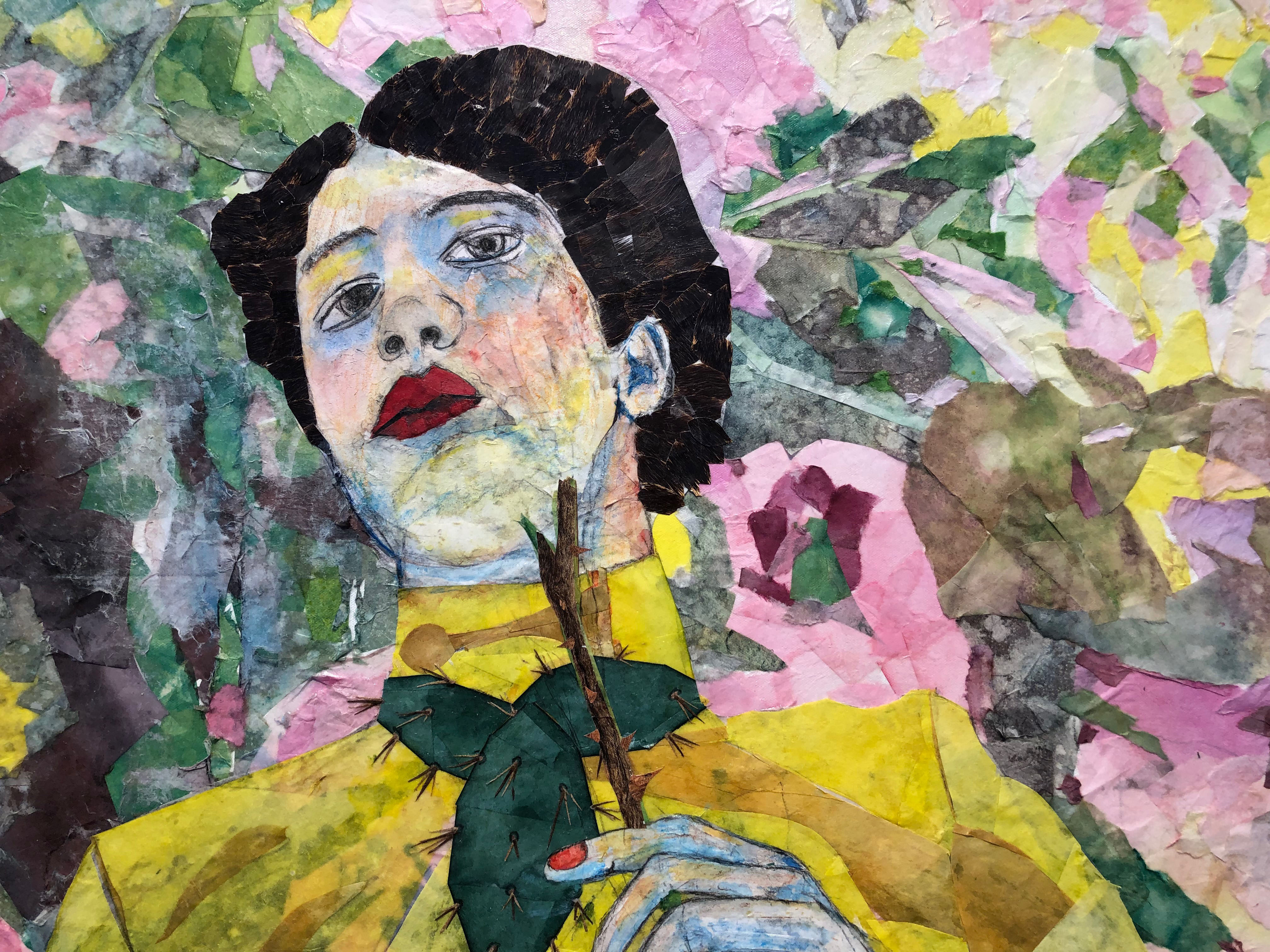
A Universe of One, 2018 (detail)

The Dream of Flight, 2019

The Dream of Flight, 2019 (detail)

Currently at Kohn Gallery is New York-based artist María Berrío’s first solo exhibition in Los Angeles.

From the press release-

Inspired by her youth in the countryside of Bogotá, Colombia, Berrío’s paintings explore the experience of immigrant identity, intercultural connectivity and the beauty that is found in the diversity of cultures and countries. Berrío depicts her figures with richly detailed and patterned backgrounds of exteriors and interiors. The large, detailed mixed media canvases employ lush, carefully crafted, multilayered Japanese papers and paint, resulting in scenes replete with pensive yet confident figures amid a scene of visual exuberance.

Berrío’s work often places female figures at the center of her intricately woven landscapes. Painted with watercolor details, her figures stare out of the composition determined to confront the viewer from their own surreal surroundings. Her work is evocative of predecessors such as Gustav Klimt and Egon Schiele, both known for their exceptional degree of emotional directness and figural distortion in the place of conventional beauty. Berrío’s works float seamlessly between historical and contemporary artistic styles as they employ a wide visual vernacular ranging from expressionism to graphic, abstract marks.

The variety of media and techniques found in María Berrío’s practice emphasizes the interwoven cultural breadth of the world in which we live, where globalization and injustice touch the lives of everyone. Each character Berrío paints is a symbol of this new reality and the strength that can issue from it. For the artist, a female soldier on the front lines is as brave and mighty as the mother who protects her children from the perils of war. These depictions of women are seen as guiding spirits who are strong, vulnerable, compassionate, courageous and in harmony with Nature and themselves. With these combinations of human traits and emotions, Berrío fortifies her belief that with womanhood every action is considered beautiful and strong, no matter how small or large.

For her current show, A Cloud’s Roots, Berrío focuses especially on place and migration. The individuals are seen in preparation for their travels, in moments of transition, and in various states of uncertainty. Berrío states, “the ambiguity is intentional; although I may have a specific idea in mind when making the work, the actual piece lacks cultural specificity to allow for all symbolic possibilities.” Berrío therefore gravitates towards symbols with global cultural significance, such as braids, birds, and flowers, with the hope that they allow diverse audiences to bring their own understanding to the work.

In her recent work, A Cloud’s Roots (2018), Berrío creates a fictional species of tree based on the dragon’s blood tree, found exclusively on an island off the coast of Yemen. The dragon’s blood tree has adapted perfectly to the island’s desert-like climate and rocky soil, inhospitable to most other plant life. It is a powerful symbol of survival and resilience, able to thrive even in the most unlikely conditions. The figures in the piece are compelled to leave their home but they carry with them the knowledge that they too have the power to put down roots wherever they go.

By reflecting on the beauty of our immigrant nation, Berrío’s new body of work aims to rewrite the narrative of American history to include the stories of people who have long been excluded. It makes space for those who were not born in this country, but come here full of hope and desire to make it their home. As the art canon expands its scope and redefines its boundaries, Berrío imagines a future in which people with diverse perspectives can walk into an institution and see themselves reflected back. Berrío states, “so many immigrants, myself included, are stuck in the inbetween, not quite from here, and no longer from there. I create work that bears witness to this liminal state of being and acknowledges it as an essential part of being American. I wish to convey that which can never be conveyed: the sheer joy of being, of creation, and the undiscoverable mystery of being alive.”

This exhibition closes 8/24/19.

Also, if you are in New York City, she recently created several glass and ceramic mosaics that can be seen in the Fort Hamilton Pkwy Station.


Jun 062019
 

Taking up an entire level of the BCAM Building at LACMA, Robert Rauschenberg: The 1/4 Mile or 2 Furlong Piece, is a wonderful testament to the artist’s work and creativity. It is also the first time it has ever been shown in its entirety.

There is so much variety in the materials, subjects, colors, and styles, that as you wander from section to section, it’s easy to notice new things the longer you look. Despite the differences among the different sections, they are bound together by a creative exuberance. LACMA recommends an hour to wander the 1/4 mile of work, but you may want to spend longer.

This exhibition will close on 6/9/19.

Mar 212019
 

Noboru Tsubaki “Fresh Gasoline”, 1989

Yukinori Yanagi “Ground Transposition”, 1987/2019 (balloons) and Shinro Ohtake “Retina (Night Fever 1)”, 1990 (left on wall) and “Retina (DNA Shadow III)” (right on wall), 1990

Shinro Ohtake “Retina (DNA Shadow III)”, 1990


Blum & Poe’s current exhibition Parergon: Japanese Art of the 1980s and 1990s, is a selected survey exhibition of Japanese art of the 1980s and ‘90s, curated by Mika Yoshitake. It includes the work of over twenty-five visual artists in a variety of media including painting, sculpture, video, and photography.

From the press release–

The exhibition title makes reference to the gallery in Tokyo (Gallery Parergon, 1981-1987) that introduced many artists associated with the New Wave phenomenon, its name attributed to Jacques Derrida’s essay from 1978 which questioned the “framework” of art, influential to artists and critics during the period. Parergon brings together some of the most enigmatic works that were first generated during a rich two-decade period that are pivotal to the way we perceive and understand contemporary Japanese art today. In the aftermath of the conceptual reconsideration of the object and relationality spearheaded by Mono-ha in the 1970s, this era opened up new critical engagements with language and medium where artists explored expansions in installation, performance, and experimental multi-genre practices.

When the U.S. and Europe were witnessing a return to Expressionism alongside a postmodern aesthetic of simulacra and deconstruction characterized by the Pictures generation, this zeitgeist of cultural capitalism was instead manifest under Japan’s unique social and geo-political conditions resulting from the rise and burst of the bubble economy. Artists began to explore subversive artistic languages and integrate underground subcultures into their practice using a variety of media, ranging from experimentations in electro-acoustic music, geopolitical and conceptual photography, and appropriations of advertisement culture. Others addressed the internalization of historical avant-garde and modernist aesthetics that were filtered through a new poetics of form, space, and language.

In the post-1989 Hirohito era, politics of gender, nuclear crisis, and critique of nationalism are especially poignant among artists from the Kansai region. This period also witnesses the rise of art collectives in the mid-90s and their darkly humorous performances and conceptual practices that reevaluated the history of Japan’s postwar avant-garde. These events reflect on a subculture generated out of a profoundly unique “infantile capitalism,” anticipating the explosive rise of the Neo-Pop generation.

This exhibition is presented on the occasion of Blum & Poe’s 25-year anniversary. Parergon commemorates a special facet of the gallery’s history rooted in this very timeframe in Japan—with Tim Blum’s early years as an art dealer and curator spent in Tokyo in the early ‘90s—and charts a bridge between the Japanese art historical territories the gallery has long championed. Parergon pursues the creative significance of the years between the milestones of Mono-ha and the Neo-Pop generation now synonymous with Takashi Murakami and Yoshitomo Nara.

This exhibition closes 3/23/19. Part II will open 4/6/19.


May 192018
 

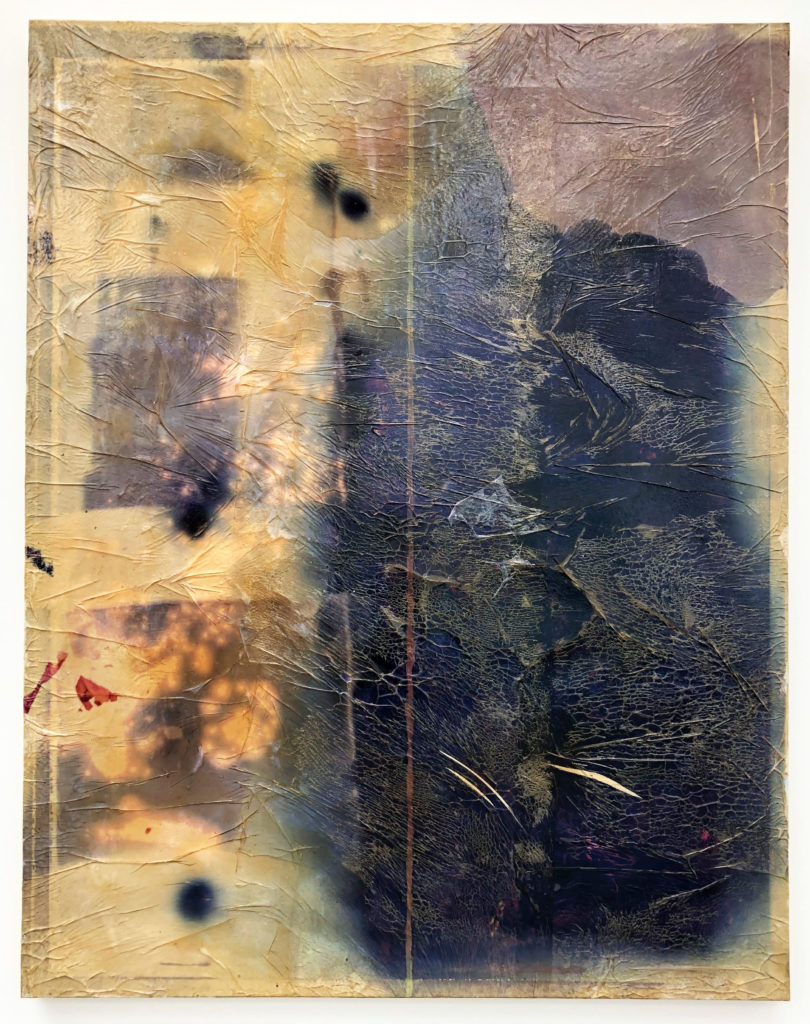
This weekend head to Hauser & Wirth to check out artist Mark Bradford‘s exhibition New Works. His first gallery exhibition in Los Angeles in over fifteen years, the paintings included continue to explore societal issues through his dramatic use of color, and his unique technique- which involves combining layers of printed paper with paint and then cutting into these layers to create intricate patterns and shapes. They are incredible to see in person.

From the press release-

Bradford employs the ‘tools of civilization’ – billboards, merchant posters, newsprint, comics, magazines, and endpapers – to conflate cultural and political forces, and create layers of social commentary in paintings that evoke deep feeling. ‘How we build and destroy ourself are the materials that I’m really interested in,’ the artist once stated, ‘and paper is one of the main ways in which information is displayed.’ Through his rigorous physical approach to the material presence of painting, Bradford has addressed powerful issues of our time, including the AIDS epidemic, the misrepresentation and fear of queer identity, and systemic racism in America. His recent work engages in a broader excavation of American history to raise questions about the preservation of the past and the transference of power.

In the new works on view at Hauser & Wirth, Bradford probes stories found in comic books to question the archetype of the antihero and the influence of the media on contemporary society, while also revisiting misconceptions of black identity and gender as seen in previous works. ‘New Works’ presents paintings that extend the artist’s examination of homophobia and racism in American society, continuing themes explored in Bradford’s multimedia installation ‘Spiderman’ (2015), which was shown at the Hammer Museum in LA in 2015.

Also at the Hauser & Wirth space are two other exhibitions worth checking out- Louise Bourgeois: The Red Sky and Romanian artist Geta Brătescu’s The Leaps of Aesop. All of these shows close 5/20/18.

If you go on 5/19, at 2pm artist Matthew Day Jackson will be discussing his work with curator Hamza Walker, Executive Director of LAXART.