

Today’s flashback is to Allison Hueman‘s 2017 mural Bloom, spotted in 2019 in downtown LA’s Arts District. The mural pays tribute to local community activist Joel Bloom, who passed away in 2007.
For more work by Hueman, also check out her Instagram.

Today’s flashback is to Allison Hueman‘s 2017 mural Bloom, spotted in 2019 in downtown LA’s Arts District. The mural pays tribute to local community activist Joel Bloom, who passed away in 2007.
For more work by Hueman, also check out her Instagram.
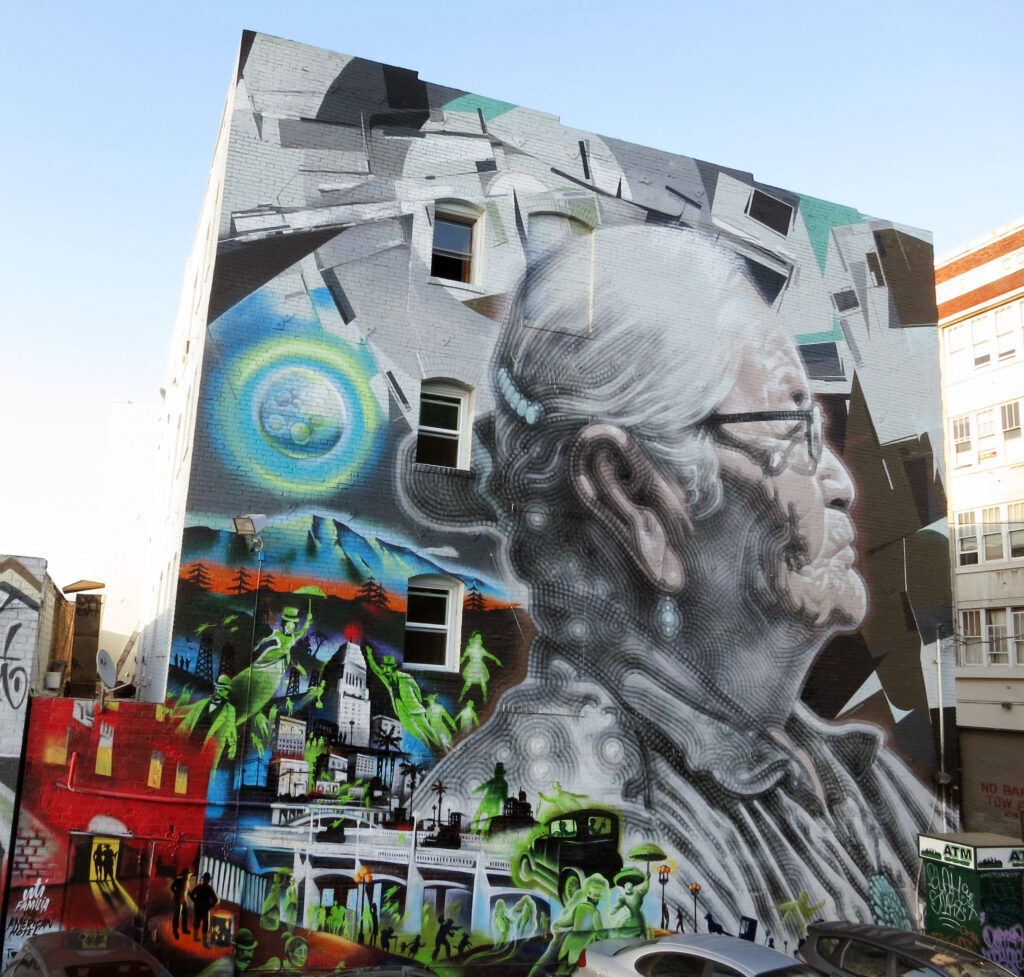
Going all the way back to 2015 today for this mural by El MAC, Augustine Kofie, and Joseph ‘Nuke’ Montalvo. La Abuelita/Má’sání, a portrait of Diné (Navajo) weaver Martha Gorman Schultz, is located on the outside of The American Hotel in Los Angeles.
From El MAC (Miles MacGregor)’s website about the mural-
“The portrait is painted entirely with aerosol and fatcaps, and is based on photos I shot a few years ago of an artist named Martha Gorman Schultz. She is a Navajo blanket weaver from northern Arizona, and part of a respected family of weavers including her granddaughter, Melissa Cody.
I felt this painting of Martha could be an empowering representation of beauty not often depicted in public art or media. Beauty that is feminine, elderly, indigenous, loving and powerful.
The building this mural was painted on was constructed in 1901, and you can imagine how much Los Angeles history it’s seen over the last hundred years or so.
This was an especially collaborative effort- Along with the work of Kofie and Nuke surrounding the figure, SKILL UTI painted the wall to the left, integrating an already existing piece by DASH 2000(Rest In Peace). SWAN provided ground support, along with CHEE, AISE, BLK, OFIER, SELEK, CALVYRUS and some other younger members of UTI crew, which has been painting these walls for the last few decades.”
Sadly, Martha Gorman Schultz passed away in February of last year at the age of 93. For more information on her life and work, check out Hyperallergic’s tribute.

“Liquid Crystal Environment” (1966)


Last year Hauser & Wirth presented several works by artist and activist Gustav Metzger for And Then Came the Environment at their downtown Los Angeles location. Metzger was an artist and an activist with strong concerns about environmental issues, ones that continue to this day. Works that address these issues are mixed with others that are explorations of science and technology including his use of liquid crystals before they became a common part of our technology, and the delightful energy of Dancing Tubes (videos of both below).
The press release provides more information on the exhibition and the artist’s history-
And Then Came the Environment presents a range of Metzger’s scientific works merging art and science from 1961 onward, highlighting his advocacy for environmental awareness and the possibilities for the transformation of society, as well as his latest experimental works, created in 2014. The exhibition title comes from Metzger’s groundbreaking 1992 essay Nature Demised wherein he proclaims an urgent need to redefine our understanding of nature in relation to the environment. Metzger explains that the politicized term ‘environment’ creates a disconnect from the natural world, manipulating public perception to obscure pollution and exploitation caused by wars and industrialization, and that it should be renamed Damaged Nature.
An early proponent of the ecology movement and an ardent activist, Gustav Metzger (1926–2017) was born in Nuremberg to Polish-Jewish parents, and fled Nazi Germany to England when he was 12 with his brother via the Kindertransport. While working as a gardener, he began his art studies in 1945 in war-embroiled Cambridge, a nexus for scientific experimentation and debate as the Atomic Age was dawning. By the late 1950s, Metzger was deeply involved in anti-nuclear protests and developed his manifestos on “auto-destructive” and “auto-creative” art. These powerful statements were aimed at “the integration of art with the advances of science and technology,” a synthesis that gained wide recognition in Europe in the 1960s through his exhibitions, lecture-demonstrations and writing.
Metzger’s quenchless curiosity about new materials and gadgets—from projectors and electronics to cholesteric liquid crystals and silicate minerals such as ‘mica’—led him to conduct experiments in and out of laboratories in collaboration with leading scientists in an effort to amplify the unpredictable beauty and uncertainty of materials in transformation: ‘the art of change, of movement, of growth.’ By the 1970s, increasingly concerned with ethical ramifications, Metzger became closely involved with the British Society for Social Responsibility in Science, raising awareness of ‘grotesque’ environmental degradation and social alienation and arguing for ‘old attitudes and new skills’ to bring science, technology, society and nature into harmony. He initiated itinerant projects to draw attention to the immense pollution caused by car emissions, a pursuit that gained momentum with his proposal for the first UN Conference on the Human Environment in Stockholm in 1972 and was later partially realized in 2007 at the Sharjah Biennial.
The artworks on view in And Then Came the Environment reveal Metzger’s lifelong interest in drawing and gesture, presenting works on paper from the mid-1950s alongside models, installations and later, Light Drawings that underpin the artist’s desire for human interaction amidst the reliance on technology that continues to this day. Following his death, The Gustav Metzger Foundation was established to further Metzger’s work and carry on his legacy.
Exhibited for the first time in Los Angeles, works here include the earliest film documentation of Metzger’s bold chemical experiments on the South Bank in London (Auto-Destructive Art: The Activities of G. Metzger, directed by H. Liversidge, 1963); his first mechanized sculpture with Liquid Crystals—Earth from Space (1966)—and the stunning, large-scale projection, Liquid Crystal Environment (1966), one of the earliest public demonstrations of the material that makes Liquid Crystal Displays (LCDs), now omnipresent in our computer, telephone and watch screens.
And Then Came the Environment also presents Dancing Tubes (1968), an early kinetic project Metzger developed in the Filtration Laboratory of the University College of Swansea; various iterations of his projects against car pollution including the model Earth Minus Environment (1992); and the Light Drawing series (2014), using a plotter machine, a technology he first used in 1970, with fiber-optic light directed by air or hand.
The exhibition will be complemented by a new short film created by artist Justin Richburg, who animated Childish Gambino’s 2018 hit Feels like Summer, which references climate change. Richburg’s piece was inspired by and responds to Metzger’s 1992 essay Damaged Nature. The film represents the first time Metzger’s ideas have been directly expressed through a new medium, thus reflecting his interests in ongoing transformation and his conviction that younger generations were the most essential, urgent audiences for his work. In 2012, five years before his death at the age of 90, Metzger wrote:
“The future of the world is what we are after. We start with the young and then when the young are twelve, fifteen, and then twenty-one, they can enter politics, and if they have got this initiation/introduction to key issues … it will make an enormous difference to the future of the world.”
Below are videos from two of the most engaging works- Dancing Tubes and Liquid Crystal Environment.
For Gustav Metzger’s Liquid Crystal Environment (1966/2024), five projectors each contain a single slide with liquid crystals that is projected through a heating and cooling system causing them to change form.
Also worth a read is Forbes’ article on the exhibition which provides additional background including Metzger’s influence on The Who’s Pete Townshend.
This exhibition was also part of The Getty’s PST ART: Art and Science Collide programming. On Saturday, 3/1, The Getty is hosting Open House at The Ebell in Los Angeles- “a free day-to-night exploration of science and art” that will include a pop-up art book fair from Printed Matter; panel discussions; a Doug Aitken multi-screen installation with a live performance by Icelandic musician Bjarki; a performance by Julianna Barwick, and more.

Work by James Jean


Work by Luke Chueh

Work by Giorgiko, moniker of husband and wife duo Darren and Trisha Inouye. These works are an homage to Darren’s family as Japanese Americans that experienced the WWII era.

Work by Mike Shinoda

Work by Yoskay Yamamoto

Work by Yoskay Yamamoto
Giant Robot Biennale 5 at the Japanese American National Museum features artwork from Sean Chao, Felicia Chiao, Luke Chueh, Giorgiko, James Jean, Taylor Lee, Mike Shinoda, Rain Szeto, and Yoskay Yamamoto.
From the museum about the exhibition and Giant Robot–
Giant Robot launched in 1994 as a hand-assembled zine in Los Angeles and grew into a staple of Asian American alternative pop culture. Since 2007, JANM has partnered with Eric Nakamura, founder of Giant Robot, to produce the biennale that is dedicated to showcasing the diverse and creative works brought together by the Giant Robot ethos.
This year marks Giant Robot’s thirtieth anniversary. While the zine and magazine are no longer published, its legacy and influence are indelible parts of our culture. The shop and gallery continue to thrive in Sawtelle’s Japantown and reflect the independent spirit of its origins. Giant Robot continues to be a highly influential brand encompassing many aspects of Asian and Asian American popular culture. These galleries contain a cross section of Giant Robot’s stalwart artists, emerging talents, and friends.
The video below from PBS Artbound is a great documentary about the Giant Robot project.
This exhibition closes Sunday, 1/5/25. On the same day the museum is free and hosting the 2025 Oshogatsu Family Festival- Year of the Snake event which will include cultural performances, crafts and other activities.

“Atabey (or change the body that destroys me)”,2024, Oil and acrylic on archival printed canvas

“Zemi (A New Spelling of My Name)”, 2024

“Zemi (A New Spelling of My Name)”, 2024 (detail)

“Ayida-Weddo (freed from all that is not marvelous)”, 2024, Oil and acrylic on archival printed canvas

“Ayida-Weddo (freed from all that is not marvelous)”, 2024, Oil and acrylic on archival printed canvas (detail)

“Mawu-Lisa (I build my language out of rocks)”, 2024, Oil and acrylic on archival printed canvas

“Mawu-Lisa (I build my language out of rocks)”, 2024, Oil and acrylic on archival printed canvas (detail)

“Huracán (beyond the triumphs of rootedness)”, 2024, Oil and acrylic on archival printed canvas
Firelei Báez has created several stunning paintings for her exhibition The fact that it amazes me does not mean I relinquish it, currently on view at Hauser & Wirth’s downtown Los Angeles location. The historical documents that serve as a background for her beautiful ciguapa figures add another dimension to the complex works.
From the gallery’s press release-
New York-based artist Firelei Báez has achieved wide acclaim over the past decade for her rigorous paintings, drawings and immersive installations that explore the influences of the Afro-Caribbean diaspora. Conjuring forgotten narratives, Báez carefully fills history’s lacunae with joyful rebellion.
This September, in her first exhibition with Hauser & Wirth since joining the gallery in 2023, Báez will present new large-scale canvases, drawings and her first-ever bronze sculpture at the gallery’s Downtown Arts District center in Los Angeles. Complex and layered, Báez’s work depicts fantastical hybrid figures and reimagined worlds. Employing beauty to reprocess the enduring effects of violence and trauma, Báez challenges traditional representations of history, nationality, gender and race. United by common cause, the paintings incorporate a wide range of subjects including art history, science fiction, anthropology, pop culture, folklore and fantasy.
‘The fact that it amazes me does not mean I relinquish it’ is a reference to the work of Martinican writer and philosopher Édouard Glissant, a key figure in shaping theories informing the Caribbean’s influence on the global stage. Drawing inspiration from Glissant’s text, ‘Poetics of Relation’ (1990)—from which the title directly quotes— Báez navigates the tensions between identity and place, using Glissant’s concept of opacity to explore modes of resistance, namely the ability to navigate the world freely within a refusal of being fully understood—both to others and to oneself.
Báez considers mythology an important tool, “a way of correcting the past and projecting a different future. Growing up in the Dominican Republic, the artist heard local folk stories about a mythic femme trickster called a ‘ciguapa’ who was known for her elusiveness. While such lore was shared to discourage unruly and wild behavior, Báez has embraced the ciguapa in her work as a figure of endless possibility. Ever-morphing and multiplying, her composite creatures are often depicted with human legs, a coat of delicate fur and backwards facing feet so that she remains traceless and ultimately unknowable. In the ciguapa, Báez explores the body as a living archive, a shape-shifting repository of meaning and history, whose continuous transformation is inherently defiant.
In the painting, Zemi (A New Spelling of My Name), (2024), a supernatural figure appears at the entrance of a cave. Rather than standing before a blank canvas, Báez begins her paintings over plans that conceal narratives of violence and exploitation. In the aforementioned painting, Báez builds her imagery atop a 19th-Century drawing of the Taíno caves in Santana, Hispaniola. At the time of its production, the illustration functioned as a factual document; however, it was only an approximation of a real location wherein Báez’s hybrid figure materializes, a triumphant manifestation of empowerment and hope in a pieced-together landscape.
This exhibition closes 1/5/24.

Sculptures by Emily Sudd


Sculptures by Kyung Boon Oh

Work by Cheyann Washington

Photography by Kate Turning


Pictured above are some selections from Plateaus: Art That Resonates, a multisensory group exhibition at Art Share L.A. exploring the dualities of life that artists bring into their work.
From the gallery-
Art Share L.A. is pleased to present Plateaus: Art that Resonates a multidisciplinary and multisensory immersive art exhibition that explores dualities: art and craft, death and life, grief and love, and activity and stillness. These contrasts exist with an interdependent bond, reminding us that bonds are intrinsic and often intertwined partners. In multiple materials, processes, and scales, monument-like creations are revealed through thoughtful burnishing of passion. The exhibition curated by Stacie B. London features seven visual artists: Amanda Maciel Antunes, Kyong Boon Oh, Hadley Holiday, Soojung Park, Emily Sudd, Kate Turning, and Cheyann Washington, along with additional contributions of ikebana by members of Sogestu Los Angeles, music by Rocco DeLuca, perfume by Lesli Wood (La Curie Eau de Parfume), and seating by Hunter Knight. Through a shared refinement of intentional experimentation with their mediums – acrylic panels, clay, glass, ink, photography, scent, sound, stone, thread, tree stumps, and wire– these artistic achievements reveal work that is brave, meditative, resilient, and vulnerable.
Our five senses inform our experiences and knowledge and assist us in ordering the world. In Plateaus: Art that Resonates the traditional forms of visual art of painting, photography, and sculpture are broadened to include aural art — via music and sound — and olfactory art. These multisensory and immersive pieces enhance the experience of viewing visual art and introduce additional dualities: sight with smell, smell with hearing, and hearing with sight. The expanded human experiences in an art gallery switch the expected experiences and invite the possibility of a familiar experience in a new way, or a breakthrough!
Breakthroughs often occur after long periods of what often seems like stagnation, or a plateau. It’s instinctual to want growth to be a continual upward trend, but instead it’s usually a series of long, flat periods (plateaus) of work with few visible results. Seemingly out of nowhere the plateau makes space for a breakthrough of creativity or growth—an intermittent moment when everything comes together. Instead of focusing on the result, it’s good to get comfortable in the plateau.
The artists and artisans of Plateaus: Art that Resonates use a broad range of approaches and techniques towards creative creations that are examples of how to grapple dualities, navigate the plateaus of life, and share breakthroughs that transmute our awareness of mortality into loving engagements with life and it’s contradictions and opposing perspectives that inspire and infuse life with meaning, immediacy, awareness, and appreciation.
Below are two of the ikebana created by members of Sogetsu Los Angeles.


This exhibition closes this Saturday (11/16) with a closing reception from 6-9pm.
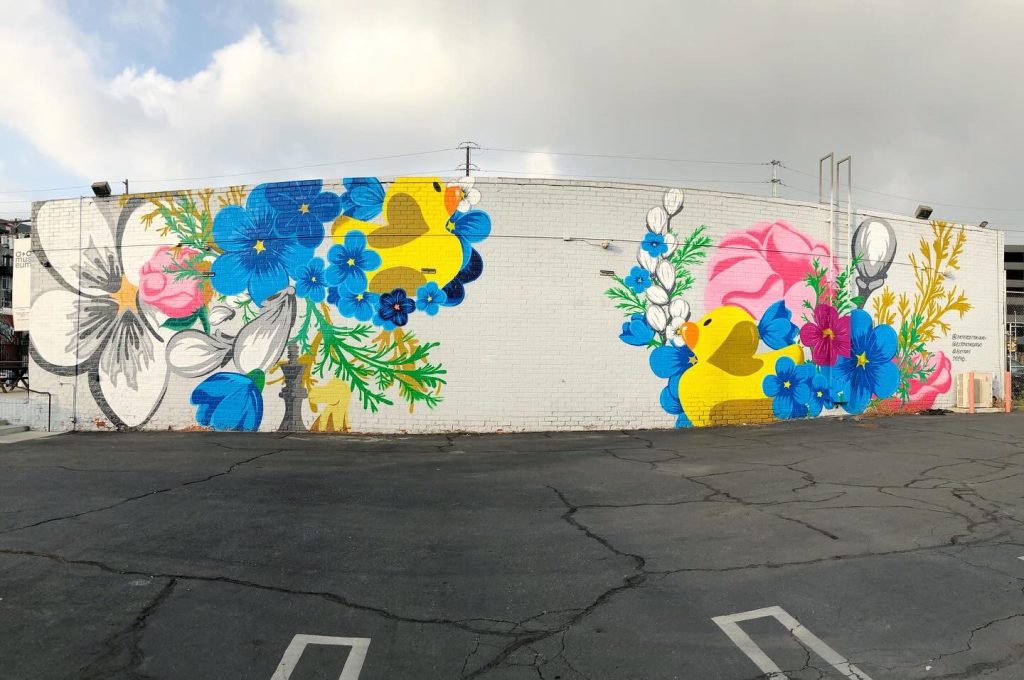

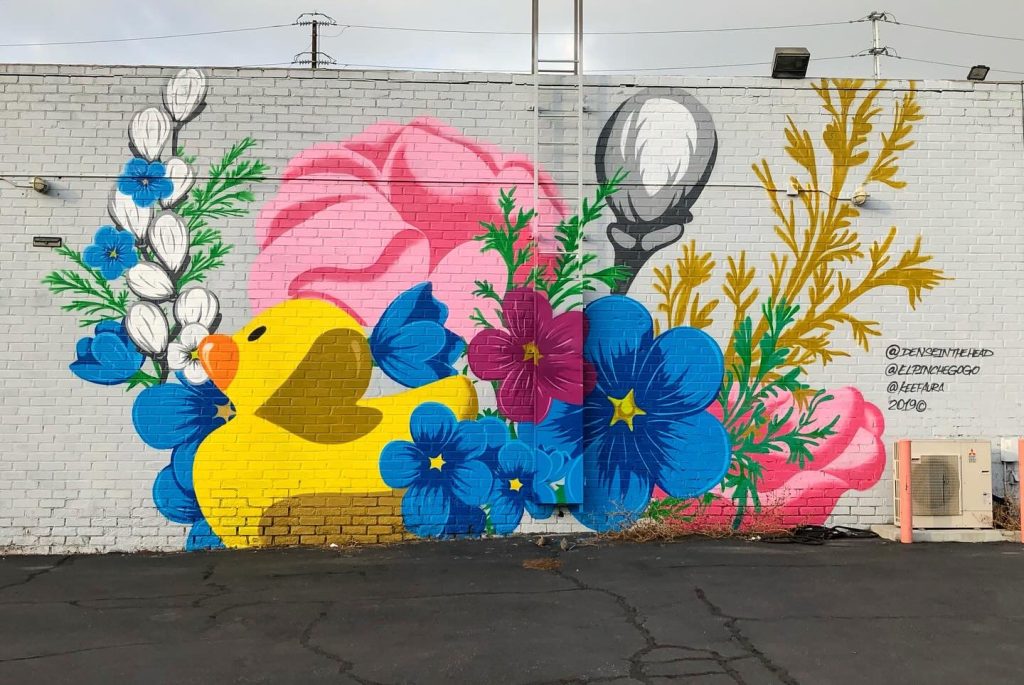
This mural, by @elpinchegogo, @denseinthehead, @keefaura, and @eder_one, was spotted in 2019 outside the A+D Museum in downtown Los Angeles.
Eder Cetina (eder_one) also runs Wilson Cetina Group, which has worked on numerous artistic projects for various organizations and museums.
Breanna Barbara- Landslide
This song is from Breanna Barbara’s upcoming new album Nothin’ But Time, out on 11/11/22.
She will be playing at The Airliner in Los Angeles on 11/12 with Big Search and Le Pain opening.

Captain Hercules Fighting Hydra, 2015, by NYCHOS, located in downtown Los Angeles.
From his other website about the work-
It shows the fight between Captain Hercules and Hydra, and is a fusion of two stories: One goes back to the greek mythology, where Hercules is given the task to kill Hydra, a nine headed snake that grows two new heads for every decapitated one. The other story refers to a comic book published by none other than Marvel, where Captain America fights the identically named terrorist organization Hydra. When merging these two plots, Nychos creates the story of Captain Hercules, who is battling a multi-headed snake and its skeleton. Covered with the translucent skin of a lion and equipped with the attributes of both heroes – Hercules’ spear and Captain America’s shield – Nychos’ character appears on multiple layers, visually as well as substantially.
More of NYCHOS’ work can also be found on his Instagram.
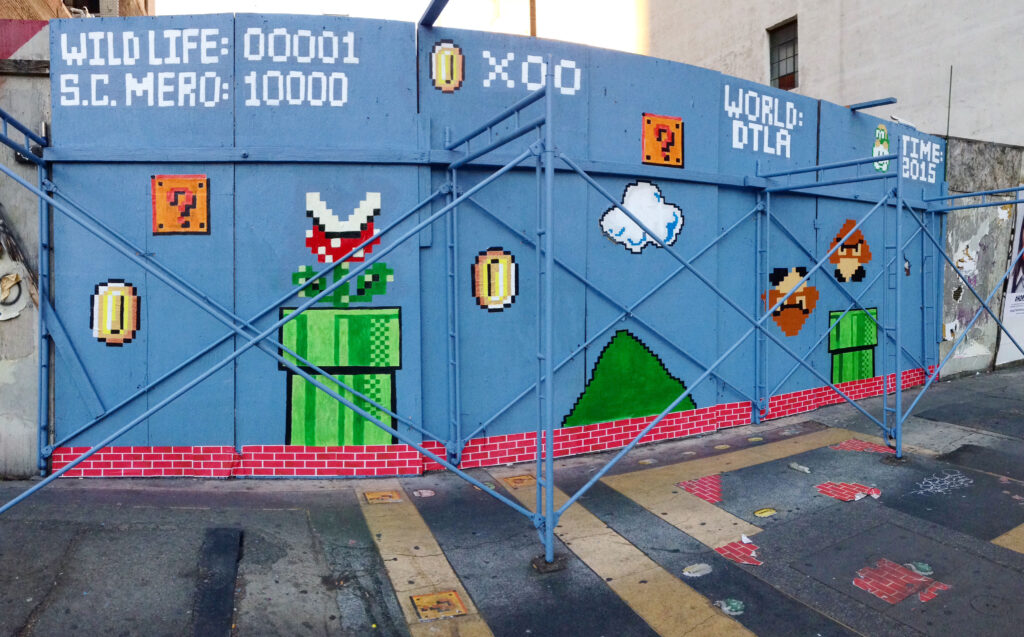
Going back to 2015 for this mural by Wildlife and S.C. Mero, who still create work in the area. Also check out Mero’s other page, where she highlights neighborhood (DTLA) events, people and art- including work by Wildlife.