Aug 272025
 

William T. Williams, “Walter’s Advice”, 1970, Oil on canvas

10-color screen prints by William T. Williams in collaboration with HKL Ltd.

A selection of books surrounded by posters created for The Pennsylvania Opera Company

Six works by painter and printmaker Gabor Peterdi

Prints by Ilya Bolotowsky

Delaware Art Museum is currently showing an impressive collection of prints from a variety of artists for Marisol to Warhol: Printmaking and Creative Collaboration.

From the museum about the exhibition-

Marisol to Warhol: Printmaking and Creative Collaboration, brings together more than a dozen portfolios and suites in DelArt’s collection. The featured prints showcase the creative collaboration of artists who experiment across media. The exhibition presents a who’s who of American artists working in the second half of the 20th century, including Marisol, William Majors, Jacob Lawrence, Andy Warhol, Audrey Flack, Robert Blackburn, Ben Sakoguchi, Lorna Simpson, Lowell Nesbitt, and Luis Jiménez. Produced by individuals and print shops, these groups of prints functioned as tools for commemoration, fundraising, and political awareness in a range of techniques, styles and intentions.

Joining the exhibition is a special loan from Art Bridges, William T. Williams’ painting Walter’s Advice from 1970. Produced the same year as a newly acquired print portfolio by Williams, Walter’s Advice employs similar forms and colors. The two are displayed together to showcase an artist’s creative exploration across media and the collaborative aspect of printmaking.

Below are a few more selections-

Pages from Dead Birds, a book which combined poetry by Christopher Erb with prints by 24 artists.

From the museum-

Dead Birds pairs poetry by Christopher Erb with prints by 24 artists, demonstrating the vibrant artistic community around the poet and his wife Elena Laza, a printer, designer, and typographer. Erb penned the poems and sent them to artists who used them as inspiration for their prints. Once the prints were produced, Laza typeset and printed the text using a turn-of-the-century press and created boxes to house the prints.

Several of the collaborating artists were affiliated with Robert Blackburn’s Printmaking Workshop and the Center for Book Arts in New York, where Erb and Laza exhibited. Others worked and studied at the Art Students League of New York and were introduced to the project through Will Barnet, a master printer and longtime instructor at the League. Dead Birds was among Erb’s most ambitious and collaborative projects.

Above are four prints from Lowell Nesbitt‘s Moon Shot print series.

From the museum-

Lowell Nesbitt produced this suite of prints, published by the Palley Gallery, following his participation in NASA’s Artist Cooperation Program. Artists working for NASA had behind-the-scenes access to witness events like launches and splashdowns up close and in person. For this series, though, Nesbitt reproduces photographs of the one place NASA can’t let him go: the Moon.

Nesbitt is often associated with Photorealism, but these prints take evocative liberties with their approach to depicting the Moon. Bolstered by quotes from astronauts, Nesbitt meditates on the visual experience of seeing the Moon up close and undistorted by the Earth’s atmosphere. The cratered surface appears in shimmering gestural whorls against the black paper-an appropriate stand-in for the unpigmented vacuum of outer space. Nesbitt’s portfolio considers space exploration alongside his printmaking process. One lithograph showing the footprint of an astronaut’s boot pressed into the lunar soil seems to reference the lithographic process itself.

Upstairs in a separate section are prints from Salvador Dalí’s playing card series, seen below.

From the museum-

In 1967 and 1969, Salvador Dali designed a set of playing cards for the renowned French printing house Draeger Freés. Several years later, the artist revisited the project and created a series of 17 designs featuring an ace, jack, queen, king, and joker in each suit. The art dealer Reese Palley later published the 250-print edition with the goal of selling individual prints at an elaborate, 50th birthday party in Paris. The sales scheme, and the chartered Pan American flights from Atlantic City to the event, were widely covered in national press in January 1972. Both the original cards and the prints that followed feature Dali’s surreal motifs and reference many of his most famous paintings.

This exhibition closes 9/7/25.

Apr 072024
 

“Moon Setting into Fog Bank over Cape Cod Bay, Morning of the Total Lunar Eclipse”, 2007, printed 2023

“1:30-4:30a.m., Moon Rising, Antelope Lake”, 2011, printed 2023

“Sun Ball, Imnamatnoon Creek, Lochsa River Valley”, 1995, printed 2023

“Fireflies”, 2005

One of the smaller prints from the “Fireflies” series

There is something so peaceful about the photographs in Barbara Bosworth: Sun Light Moon Shadow, currently on view at Cleveland Museum of Art. These beautiful moments she has captured allow the viewer to share her sense of wonder.

From the museum about the exhibition-

“My childhood home is where all my photographs come from,” says American photographer Barbara Bosworth (born 1953). Growing up in Novelty, Ohio, Bosworth adored walking with her father and looking up at the night sky, a practice that became a lifelong passion. This exhibition -timed to coincide with the total solar eclipse visible in Cleveland on April 8— features the artist’s photographs of light, from eclipses, sunrises, and sunsets to the luminescent glow of fireflies and a flashlight. Her images both explore how we endow these phenomena with personal meaning and elucidate bonds between humans and the natural world that often go unnoticed.

Photography is an art form with its roots in science, even though the two disciplines are sometimes considered opposites. The term photography was coined in 1839 by British scientist and astronomer Sir John Herschel from Greek words meaning “drawing with light.” Bosworth notes that light is an essential ingredient in both astronomy and photography. The camera and telescope, used together as Bosworth has in a number of the photographs on view, each collect light.

Time is another integral component of photography: a photograph records the light that strikes a sensitized surface-such as film or, in the case of digital photography, a sensor-during a certain length of time. In making her photographs of the heavenly bodies, Bosworth says she wants “to be reminded of the mystery closer to home: the sheer strangeness that light — millions of years old, unfathomably old – can still land on my film and be seen.”

This exhibition is on view until 6/30/24.


Mar 162023
 

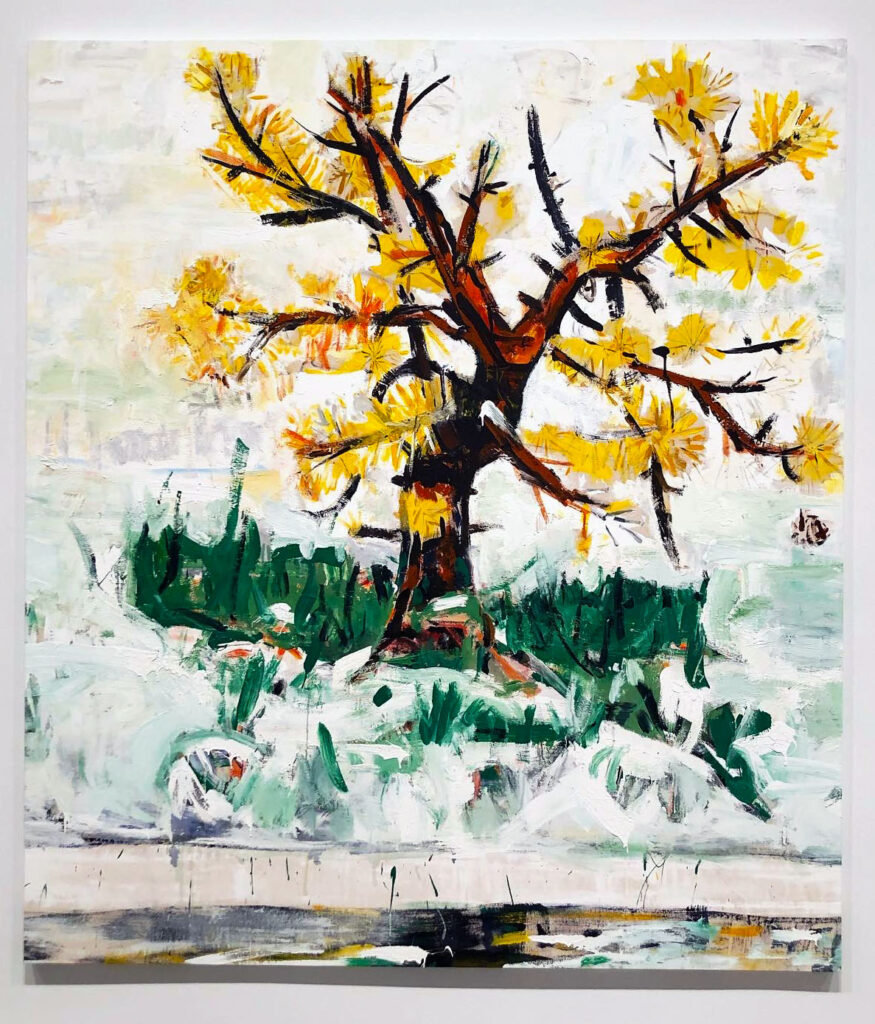
Cy Gavin, “Untitled (Yellow pine),” 2023

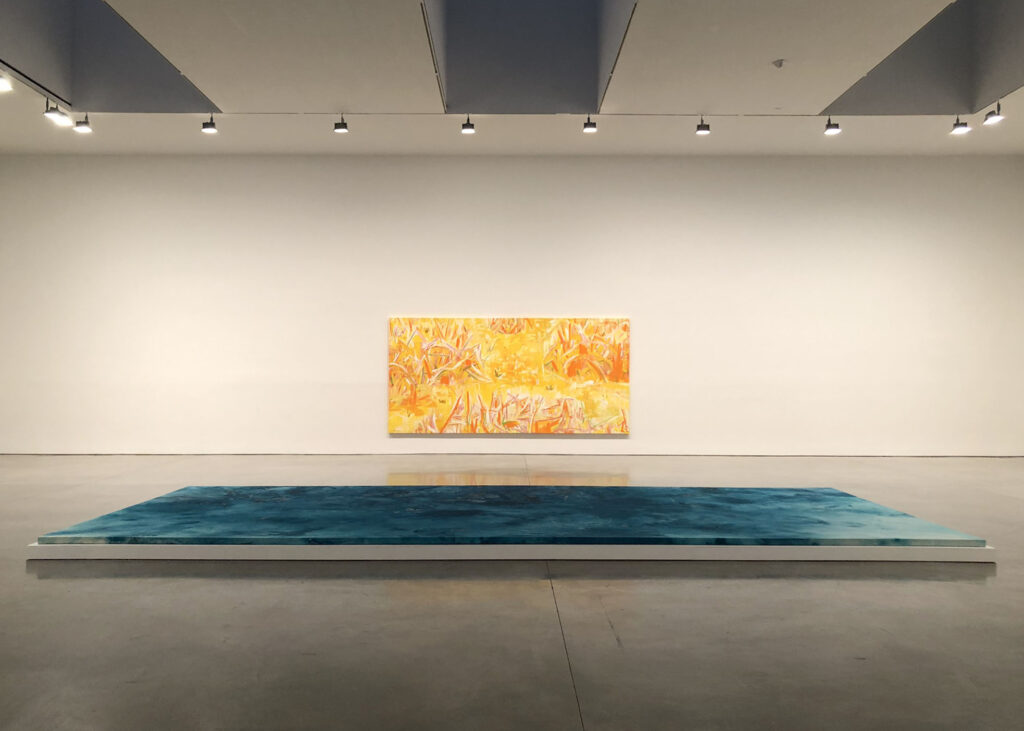
Cy Gavin, “Untitled (Crossroads/meadow), 2022

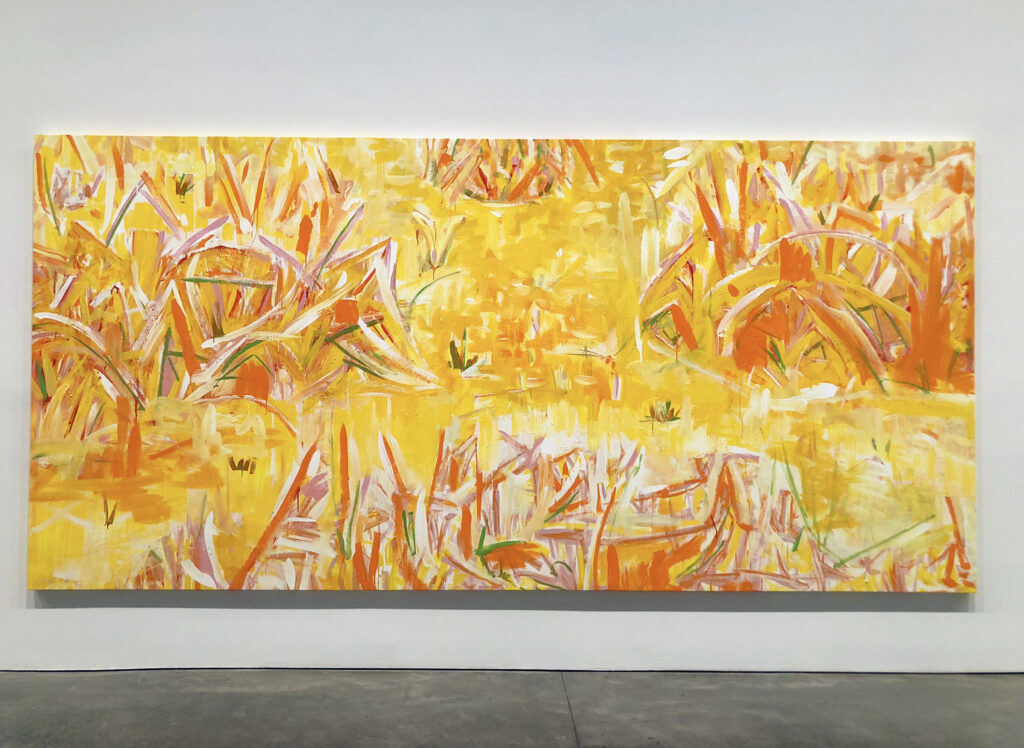
Cy Gavin, “Untitled (Crossroads/meadow), 2022

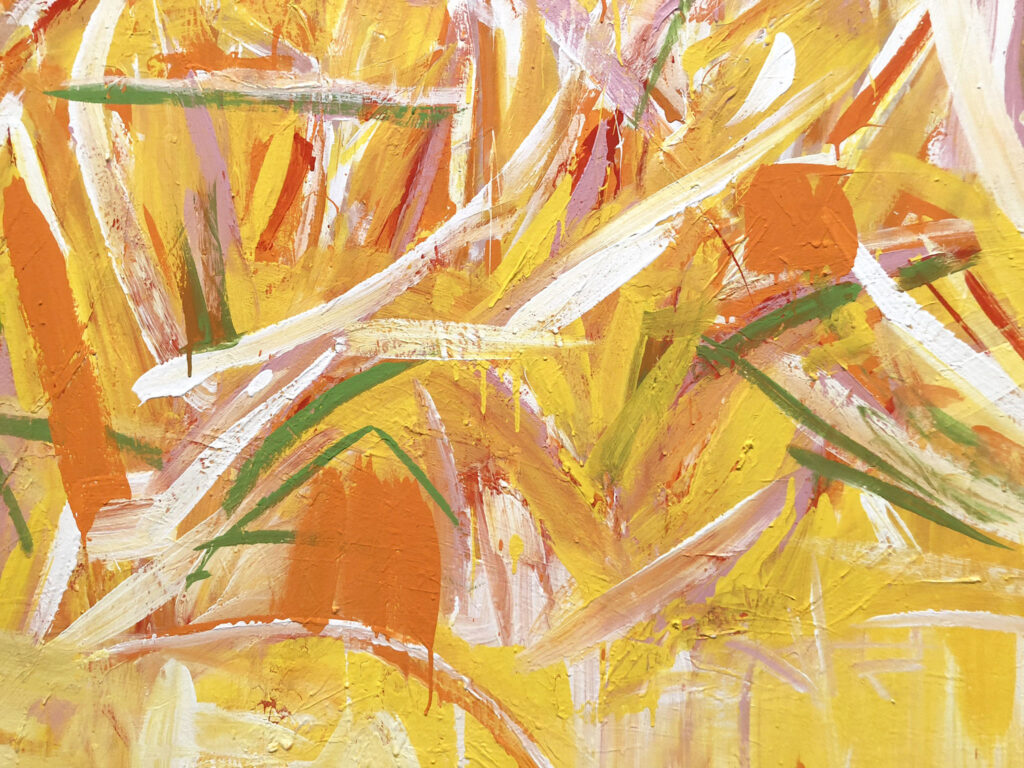
Cy Gavin, “Untitled (Crossroads/meadow), 2022 (detail)

It’s the last week to see Cy Gavin’s painting exhibition at Gagosian’s 21st location in NYC.

From the gallery’s press release-

Gavin’s landscape paintings transmute subjective responses to specific places into expansive works with striking palettes and fluid, gestural brushwork. Composed in dimensions that are in keeping with the scale of experience, these paintings interpret the sites and processes of the natural world. In this body of work, Gavin concentrates on subjects he finds in the vicinity of his studio in New York’s Hudson Valley. He proposes a conception of landscape in relation to his status as a citizen and steward of the land, developing ways to explore themes of growth, renewal, and belonging.

Gavin’s paintings respond to the land as he finds it, which he endeavors to preserve and rewild. Made following the artist’s move to his current studio in early 2020, these works are also undergirded by the tensions of our time, which are marked by periods of solitude and upheaval.

Operating both as a gestural abstraction and as a painterly interpretation of a patch of ground near his studio, Untitled (Crossroads/meadow) (2022) depicts the intersection of paths bordered by tall grass in a fiery palette dominated by yellows, oranges, and pinks, evoking the blazing heat and brightness of the late summer sun. Along with the traditional symbolism of directionality and decision-making that is inherent to crossroads, this view presents a previously manicured lawn that the artist allowed to regrow into a meadow, with mown paths allowing access through it.

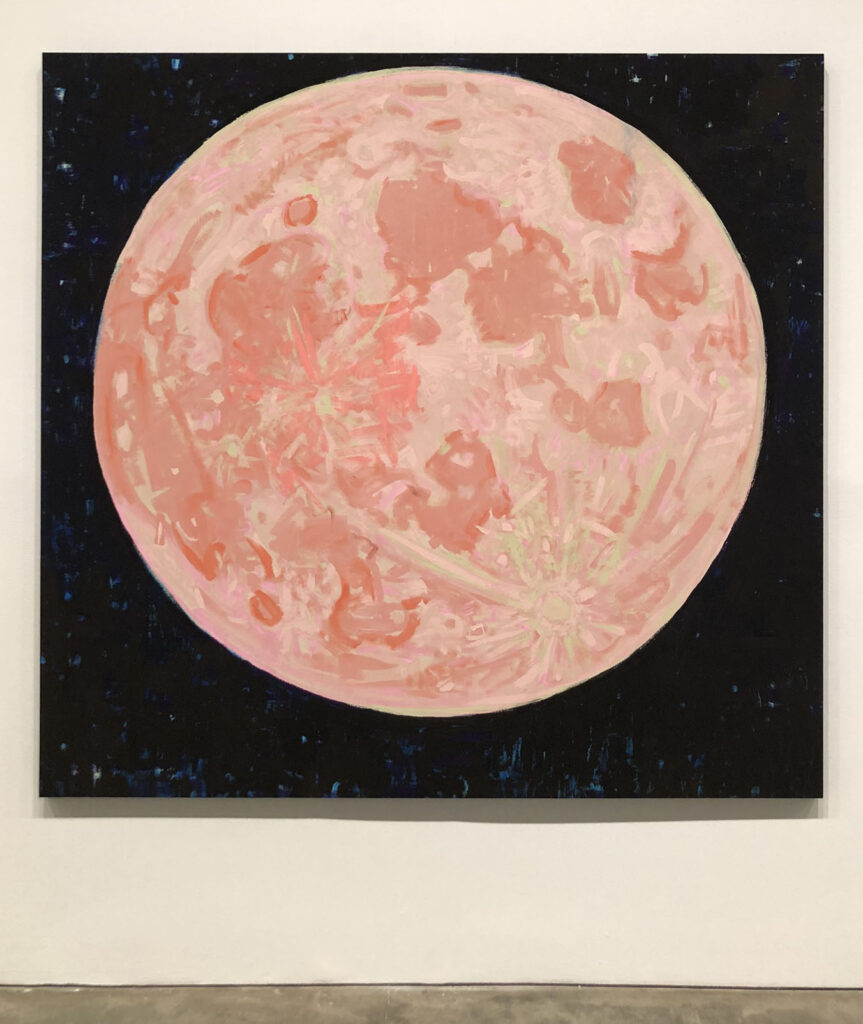
The verdant Untitled (Paths in a meadow) (2022) revisits the motif, placing the viewer low to the ground so that burgeoning grass and wildflowers divide the picture plane. Untitled (Paths, crossing—blue) (2022) is a nocturnal scene that conveys the enveloping darkness of a moonlit night. Gavin composed the painting with shades of blue that range from the diffuse washes over raw canvas in its foreground to dark, opaque passages that demarcate a tree line and open up to a star-filled sky. In a related palette of blues, Floor Painting #1 (Natural spring) (2023) is a mural-size work inspired by the dynamic waters of a spring. Displayed horizontally, the painting’s surface conveys the experience of looking down into the roiling currents, light variably revealing its depths and movements.

The themes of boundaries and borders are also prominent in Untitled (Rhododendron border) (2022), a painting in which sweeping brushstrokes describe the leaves of a woodland shrub on a dark ground, beyond which nothing can be seen. Its opacity expresses its function: the privacy achieved by a hedge the artist sited along the thoroughfare adjoining his property.

Other conceptions of time, place, and growth emerge in Untitled (Baldcypress) (2022), a painting in complementary hues that expresses the robust growth of one of the many saplings that Gavin has planted on his property. Outside its current natural range, this ancient species of tree once thrived in New York State, with this specimen now brought back to the area. Reflecting a mix of natural forces and the history of human interventions that defines the land, Untitled (Grass growing on a weir) (2022) depicts currents of water as they pass over the concrete slabs of a former dam that is now fully submerged. Simultaneously revealing and concealing visual information, the painting exists as an amalgam of past and present that defines the specificities of this place.

This exhibition closes 3/18/2023.