Aug 282026
 

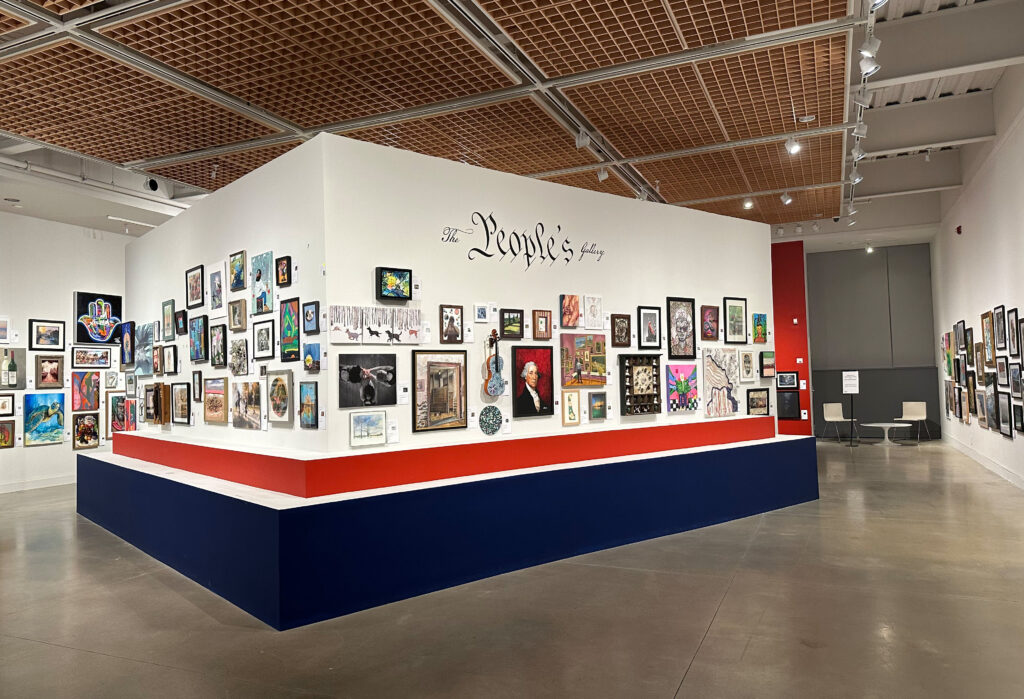
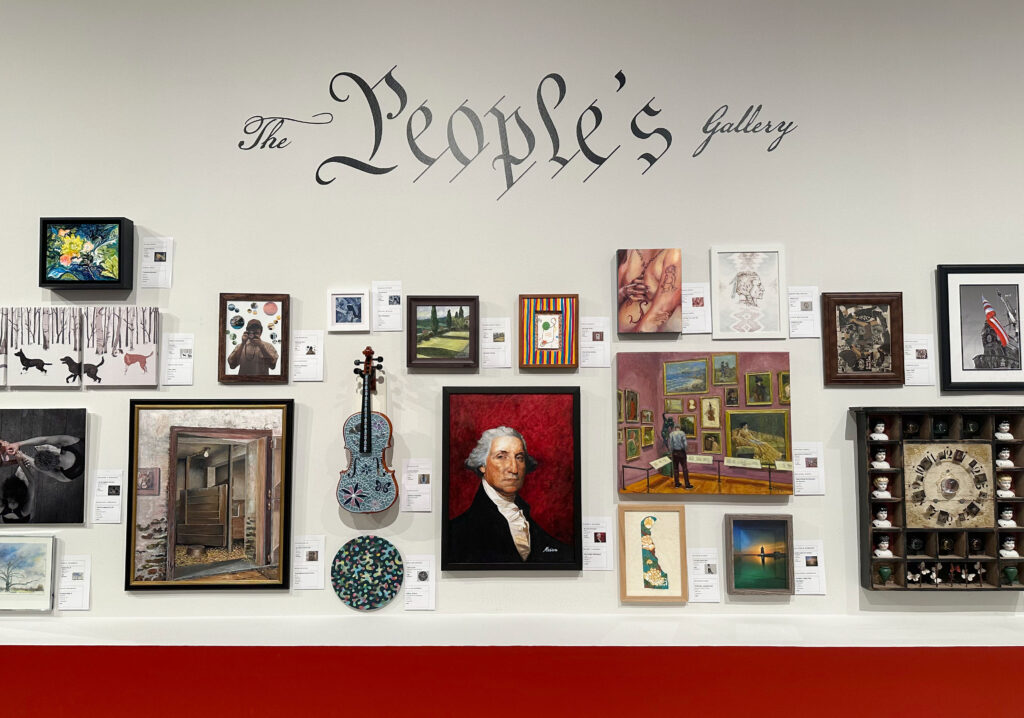
As part of their programming for the nation’s 250th birthday, Delaware Art Museum is showing the work of local artists in their current exhibition, The People’s Gallery. It is a non-juried exhibition which allowed artists at all levels to contribute work.

It’s a fantastic opportunity to see what this community of artists has created and to purchase local art. Check it out before it closes on 9/6/26.

Aug 262026
 

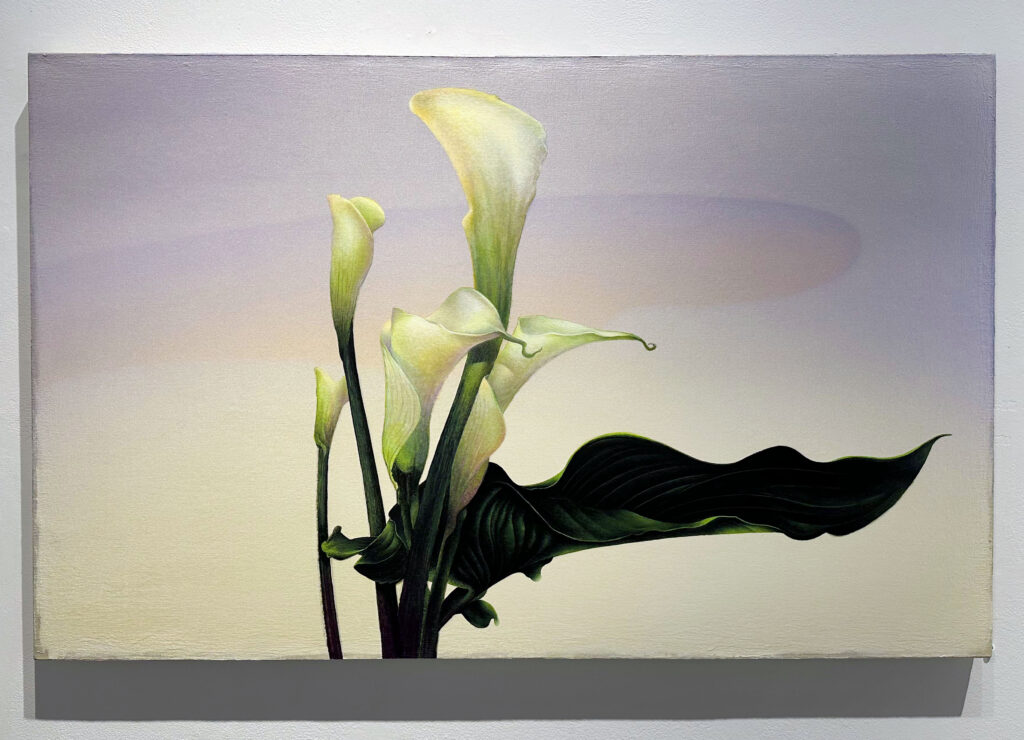
“Calla Lilly Cloud”, 2024, Acrylic and mediums on stretched linen support

In John Breakey‘s paintings for Passing Each Other, at The Delaware Contemporary, he uses flowers and skies to explore the passing of time.

His statement about the work:

Foreground flowers and background sky move at their own pace and span of life.

Together, composed for specific periods within the day, combined to express captured growth and deliberate movement.

A cloud’s soft color shifts throughout time; they can’t seem to sit still.

And what about the flower? Each blossom evolves, invisibly slow. By days, but finite.

Flowers being what they are, fall.
Clouds, how quickly they can pass.

Like the years, the more one has.
This is my current work; a series that mixes different forms of time.

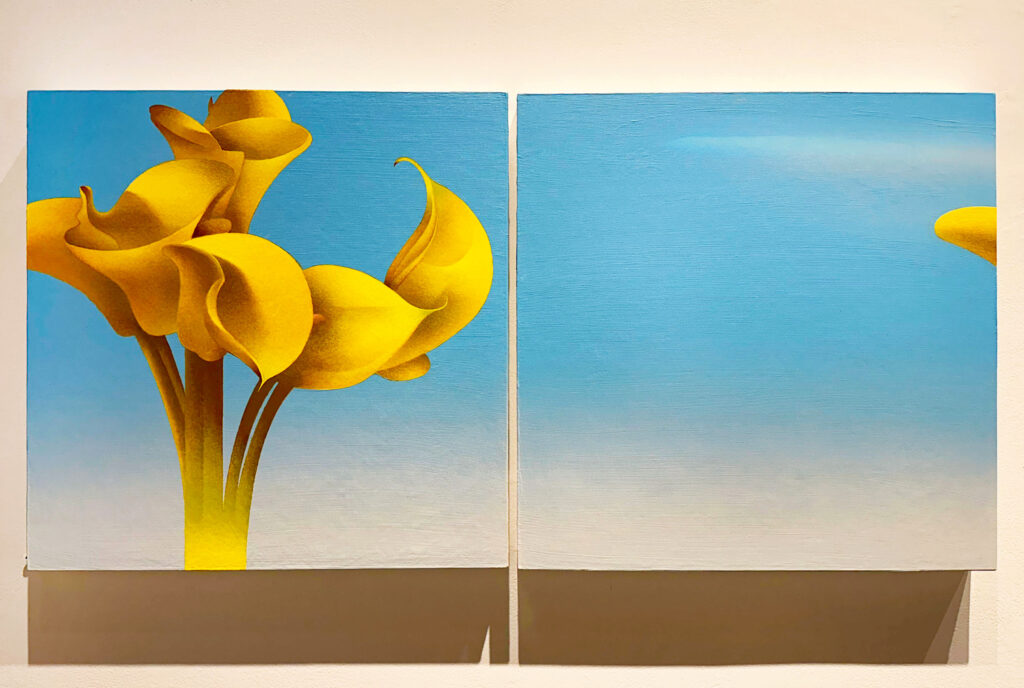
In the work above, Yellow Calla Lillies (2026) he reorders the panels to explore these ideas even further.

He says this about the painting:

I have an engraving by Aki Kuroda in the studio that speaks quietly to me: Flower X, 2004. Simplicity and grace packed into eight by ten inches. It served as a challenge to make this rendition of lillies more simple. Not graphic, not hard edged like Kuroda’s work but a new version of the work to the immediate right.

There was a deliberate choice to flip the left and right panels: these works are about time.

Two kinds.
Faster as the clouds pass.
Slower; a flower’s young green pigments before moving to dark.

Reordering the panels was my way of asking if moments are what we think they are.
Is how we account for time spent as linear as a best guess recall or something else?

This exhibition closes 8/30/26.

Aug 062026
 

Leonard A. Harmon, “Untitled”, c.1980s, Oil on masonite

Leonard D. Harmon, “Last Copper Moon”, 2025, Acrylic, spray paint, oxidized copper shavings, paper on wood panel

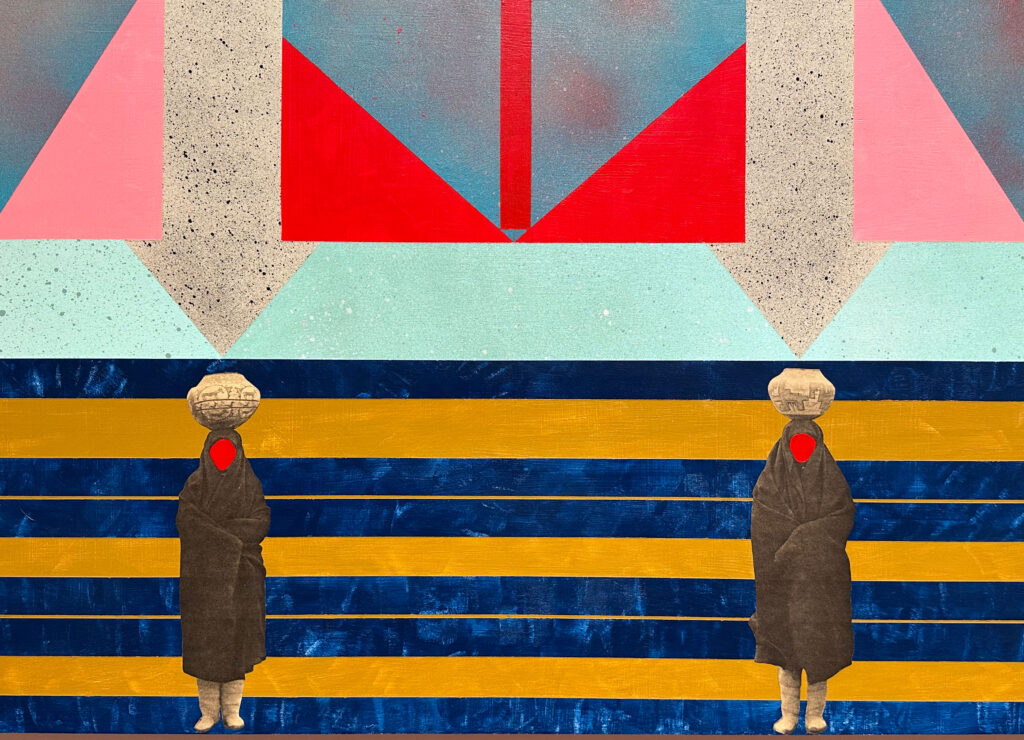
Leonard D. Harmon, “Last Copper Moon”, 2025 (detail)

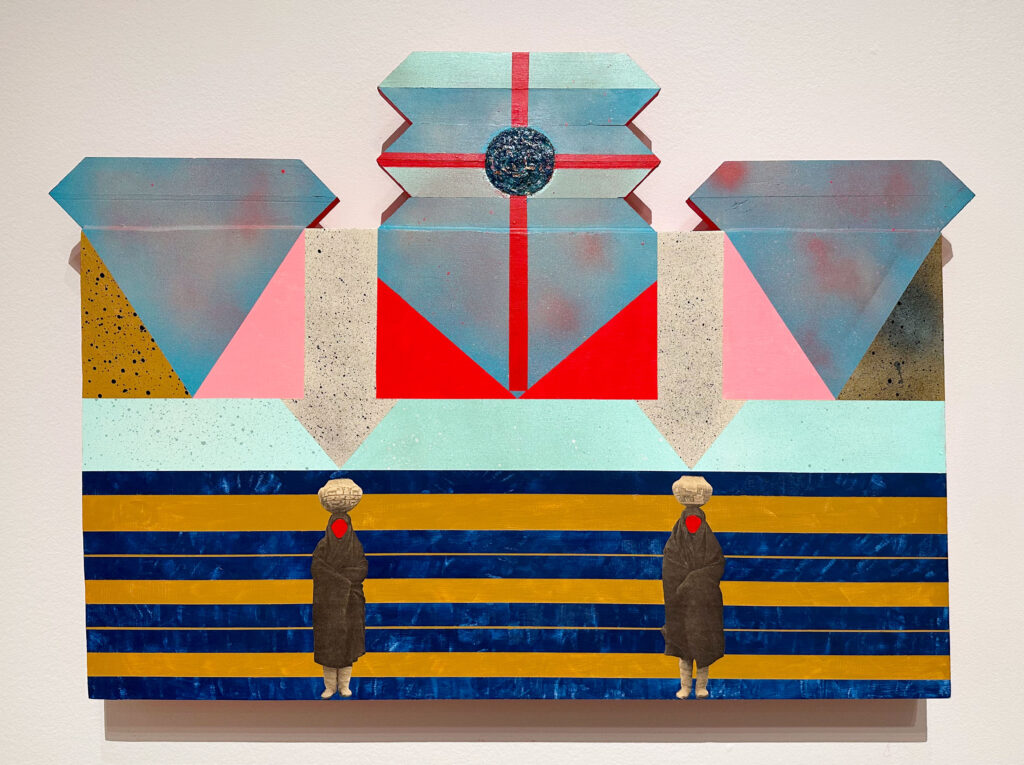
Delaware Art Museum‘s Living Indigenous showcases and celebrates Indigenous communities and artists in multiple locations in the museum. The exhibition is part of the museum’s programming for the 250th anniversary of the United States.

Developed in partnership with the Nanticoke Indian Museum, one room dedicated to works created by Indigenous artists includes paintings by Leonard A. Harmon and his nephew, Leonard D. Harmon.

From the museum and artist about Last Copper Moon (pictured above):

Leonard D. Harmon notes the rich artistic legacy that precedes him. He explains, “I draw inspiration from my ancestors to infuse a modern twist into traditional arts.” This painting references the architectural forms his uncle, Leonard A. Harmon, was creating in the 1980s. A copper moon, or total lunar eclipse, is a sacred Indigenous occurrence, and the images Harmon includes refer to associated rituals.

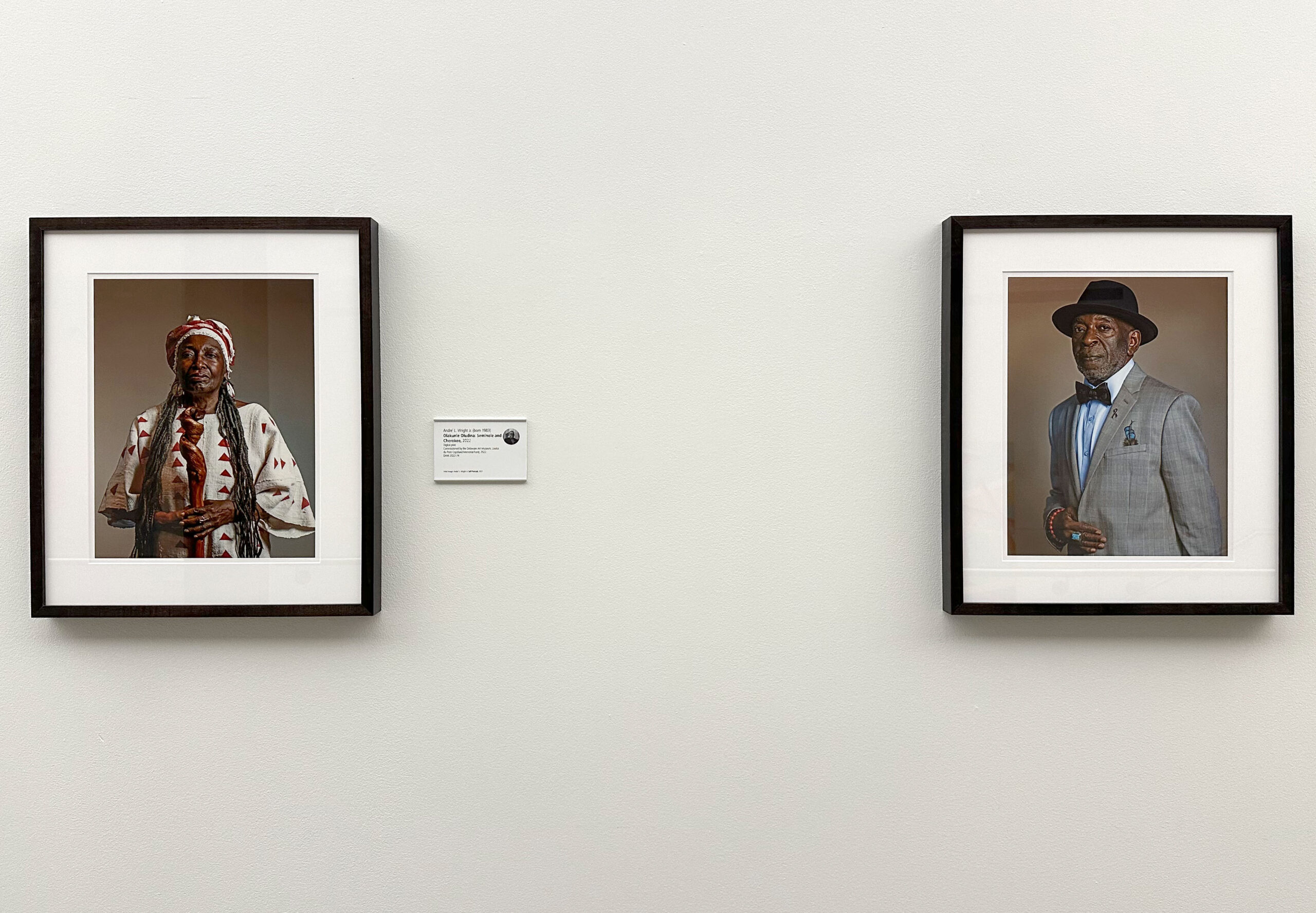
The exhibition continues upstairs with two different series of portraits of members of Delaware’s Indigenous communities– Will Wilson‘s Critical Indigenous Photographic Exchange (CIPX) and Andre’ L. Wright, Jr.’s Indigenous Faces of Wilmington. In 2022 the museum invited Wilson to continue his CIPX project in Delaware and facilitated a photoshoot of citizens of the Lenape Indian Tribe of Delaware (The Original People) and the Nanticoke Indian Tribe (The Tidewater People). That same year the museum also commissioned Andre’ L. Wright, Jr. to create a project showcasing diverse Wilmingtonians, two of which are pictured below.

Two portraits by Andre’ L. Wright, Jr. from his series “Indigenous Faces of Wilmington”

Living Indigenous is on view until 8/23/26 and the museum is free to visit every Thursday from 4-8pm.

Jul 222026
 

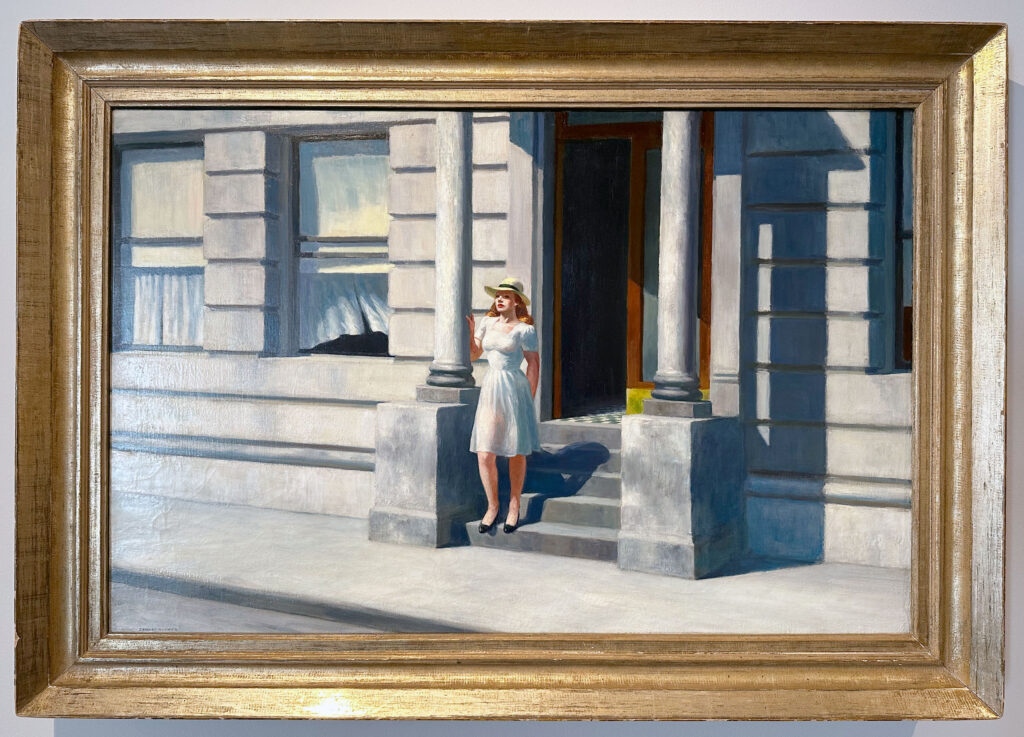
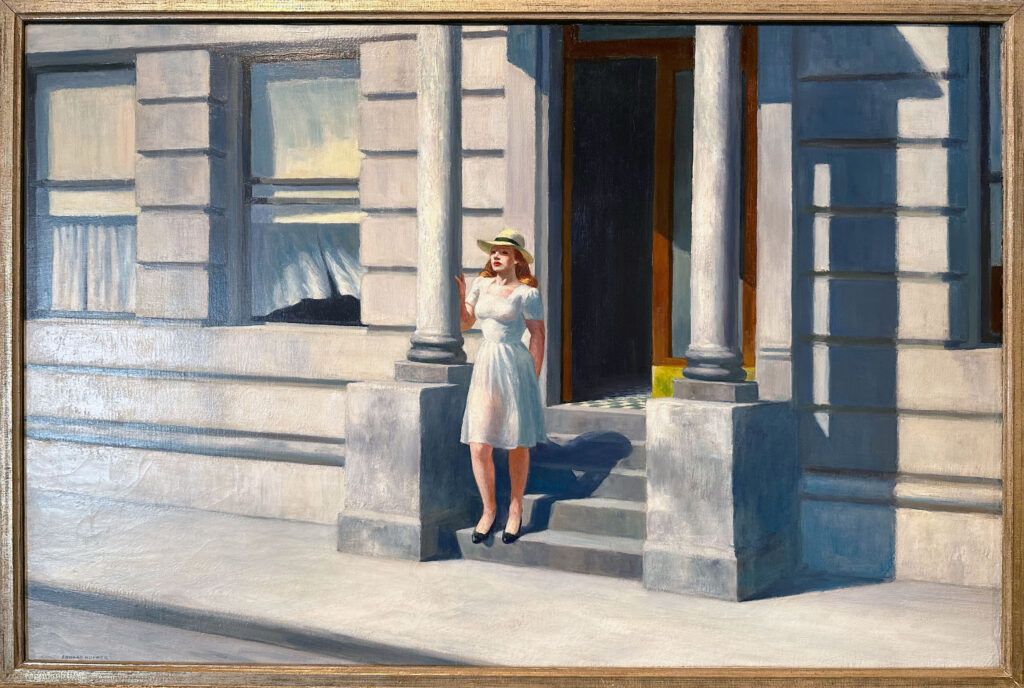
American artist Edward Hopper was born today, July 22nd, in 1882. He created numerous portraits of people in New York City, including the one pictured above, Summertime, painted in 1943.  It is currently on view at the Delaware Art Museum.

Jul 092026
 

New Deal Posters

Willie Cole, “Rolanda”, November 5, 1978, Pastel on brown paper bag. This work was created while Cole was a CETA employee in Delaware

Photographs from the 1975 CETA-funded project “CITYSIGHTS/CITYSOUNDS” in Wilmington

Dorothea Lange, “Migrant Mother, Nipomo, CA”, 1936

Clockwise from top left: William Davidson White, “Children in the Tree”,1934; Michael J. Gallagher, “A Man’s Job”, c.1933-1934; Philip N. Yates, “Broken Nets”, 1934; Walter Willoughby, “Winter Landscape”, c. 1933-1934

Helen Farr Sloan, “W.P.A. Theater”c.1935, Oil on board. It depicts a Federal Theater production during the Depression in NYC’s Washington Square Park. These productions were often free or heavily discounted.

At a time when government arts funding and jobs programs are needed more than ever, Citizen Artist at Delaware Art Museum reminds visitors of the positive and long lasting impact of two past initiatives- The New Deal in the 1930s and 1940s, and the Comprehensive Employment and Training Act of 1973 (CETA). Featuring artwork created during these both of these time periods, the exhibition also highlights the important contributions made by artists in their communities.

From the museum about the exhibition:

Citizen Artist highlights diverse artists working for America during 1930s and 1940s Depression-era programs and federally funded initiatives of the 1970s. The New Deal and the Comprehensive Employment and Training Act were catalysts in Delaware and across the nation as economic relief programs amplified the arts, creating new possibilities for creative employment. This exhibition centers artists as historians, storytellers, and visionaries during the Semiquincentennial.

Through the Comprehensive Employment and Training Act of 1973 (CETA), the Department of Labor supported a nation’s worth of art programs on a scale not seen since the conclusion of the New Deal in 1943. Those New Deal artists that outlived the Federal Art Project never forgot the significance of their work for the public, and they took that knowledge to the classrooms and administrative offices where they carried out the rest of their careers. CETA was designed as a jobs program, not an arts program, but Title VI of the legislation funded opportunities for the cyclically unemployed —artists—in public service roles. When CETA arrived in the 1970s, artists and their allies across the nation quickly understood its potential in the context of the legacy of the New Deal.

Citizen Artist is a story about reciprocal support between artists and communities. The exhibition celebrates artists who found lasting success through their participation in fine art programs like the Public Works of Art Project and CETA-funded contemporary art spaces. We also honor the public service work undertaken by tens of thousands of New Deal and CETA-funded artists, especially the painters, puppeteers, and photographers who produced educational resources and performances for children across the nation. Citizen Artist looks back at the intertwined histories of CETA and the New Deal to elevate how artists can and do support the public. By working in graphics offices, writers’ programs, and darkrooms, New Deal and CETA artists created and transformed the physical and cultural infrastructure of the United States.

Included within Citizen Artist is Citizen Photographer, an exhibition of images created by Delaware photographers for the U.S.’s 250th anniversary.

From the museum about Citizen Photographer:

What does it mean to be a Delawarean at the nation’s 250th anniversary? The Delaware Art Museum, collaborating with Wilmington’s Teen Warehouse, the Smyrna Opera House, and the Lewes Public Library, invited residents across the state to engage in civic reflection and contribute to shaping public perceptions of identity through photography. Citizen Photographer is inspired by the federally funded initiatives of the past, such as the Farm Security Administration and the Comprehensive Employment and Training Act. These were times when documenting the nation and the many people who called it home was an earnest endeavor, the means to understand and appreciate our individuality, humanity, and common needs.

At the United States 250th anniversary in 2026, this project offers multiple ways for Delawareans to engage as learners, artists, and citizens contributing to the state’s shared story. Photographers Morris Brown II, B. Proud, and Andre’ Wright, Jr. led workshops across the state and selected the 24 photographs on view. For Wright, Jr., Citizen Photographer is “about perspective, voices, and the stories people choose to tell about where they come from.” Proud reflects how local photographers “captured the many facets of Delaware, from its cities to its farmlands, from its people to its landscapes, revealing why the state truly lives up to one of its nicknames, ‘Small Wonder.'” Morris invites us to “take the time to treasure each photograph and to experience each Delaware love story on exhibit.”

This exhibition closes 7/19/26.


Jun 182026
 

Sonya Clark, “Whitewashed”, 2017, Sherwin-Williams house paint

Walking around the rooms of the Delaware Art Museum‘s contemporary collection you could almost miss Sonya Clark‘s Whitewashed. Painted onto one of the walls, her version of the U.S. flag uses only shades of white.

From the museum about the artist and the work:

Sonya Clark possesses the ability to deftly assemble works of art both beautiful in creation and weighted with content. Whitewashed is painted directly onto the gallery wall. Visually subtle, the work engages the viewer’s recollections of the United States flag. Whitewashed is made using three Sherwin-Williams house paint colors-Incredible White, Storyteller, and Natural Choice. The shades of white replace the red, white, and blue of the American symbol.

Clark has worked with the American flag, the Confederate flag, and the Confederate Flag of Truce throughout her career. In doing so, she addresses the physical makeup of these objects and the histories, experiences, and access these symbols uncover or veil.

Feb 262026
 

Kadir Nelson, “Harlem On My Mind”, 2016, Oil on canvas, Cover for The New Yorker, February 22, 2016

There’s only a few days left to see the excellent and informative exhibition Imprinted: Illustrating Race at Delaware Art Museum.

From the museum about the exhibition

The Norman Rockwell Museum assembled Imprinted: Illustrating Race with co-curator Robyn Phillips-Pendleton, a professor at the University of Delaware. The exhibition honors Rockwell’s powerful images supporting the Civil Rights Movement, displaying his work within a sweeping historical survey of American illustration that features illustrators including Romare Bearden, Emory Douglas, Howard Pyle, and Loveis Wise.

Illustration has been at the forefront of defining events in the United States, from the American Civil War and Reconstruction Era to the Harlem Renaissance and the Civil Rights Movement of the 1960s, moving forward to today. Imprinted examines widely circulated imagery, conceived and published over the course of more than three centuries, which has reflected and shaped perceptions of race across time.

Featuring over 200 artworks commissioned by publishers and advertisers, the exhibition traces harmful and prolific stereotypical representations of race that were historically sanctioned and prominently featured in newspapers, magazines, and books, on trade cards, posters, and advertisements, and on packaging and products. Imprinted also celebrates the concerted efforts of 20th and 21st century artists and editors to shift the cultural narrative through the publication—in print and across digital platforms—of positive, inclusive imagery emphasizing full agency and equity for all.

Norman Rockwell, “Murder in Mississippi”, 1965, Oil on canvas (Unpublished, intended as the final illustration for “Southern Justice” by Charles Morgan, Jr, in Look, June 29, 1965)

From the museum about the Rockwell work above-

In 1963, Rockwell turned his attention to the documentation of America’s most pressing social concerns and the subject of human rights by making works for Look magazine.

In the beginning of 1965, Rockwell began work on a piece about the murders of Michael Schwerner, James Chaney, and Andrew Goodman-three young civil rights workers who were in Mississippi to expand voter registration.

He wanted the painting to express his outrage. In a letter to Look art director Allen Hurlburt, Rockwell wrote: “I tried in a big way…to make an angry picture. If I just had a bit of Ben Shahn in me it would have helped.”

Shahn’s portraits of the three activists are also on view next Rockwell’s.

Below is Jacob Lawrence‘s painting, The Brown Angel.

Jacob Lawrence, “The Brown Angel”, 1959, Tempera on gesso panel

From the museum-

In the 1940s and 1950s, Lawrence painted a series of compelling works inspired by nightlife and its social atmosphere. In The Brown Angel, the painting’s sharp, edgy forms convey a sense of unease, perhaps pointing to the mounting racial tensions of the time.

Several of Ahmed Samuel Milai’s series of comic-style historical portraits are also on view.

Ahmed Samuel Milai, “Marie Laveau, III”, 1966, Ink, benday, and conte crayon on board    For “Facts About the Negro” by J. A. Rogers, in The Pittsburgh Courier, April 2, 1966

From the museum-

Milai was an editorial and comic strip cartoonist for the Pittsburgh Courier, an influential African American weekly newspaper published from 1907 to 1966. For 30 years, he illustrated “Your History,” a cartoon feature that became known in the 1960s as “Facts About the Negro.”

Designed to celebrate and inspire pride in the accomplishments of people of color across the fields of the arts, literature, education, and science, the series brought Black history to light at a time when such information was not widely acknowledged or shared.

You can find a few more of his illustrations here.

Thanks to the support of The Gilliam Foundation, for Black History Month the museum is offering free admission (including the exhibition), every Saturday in February. The exhibition closes 3/1/26.

Aug 272025
 

William T. Williams, “Walter’s Advice”, 1970, Oil on canvas

10-color screen prints by William T. Williams in collaboration with HKL Ltd.

A selection of books surrounded by posters created for The Pennsylvania Opera Company

Six works by painter and printmaker Gabor Peterdi

Prints by Ilya Bolotowsky

Delaware Art Museum is currently showing an impressive collection of prints from a variety of artists for Marisol to Warhol: Printmaking and Creative Collaboration.

From the museum about the exhibition-

Marisol to Warhol: Printmaking and Creative Collaboration, brings together more than a dozen portfolios and suites in DelArt’s collection. The featured prints showcase the creative collaboration of artists who experiment across media. The exhibition presents a who’s who of American artists working in the second half of the 20th century, including Marisol, William Majors, Jacob Lawrence, Andy Warhol, Audrey Flack, Robert Blackburn, Ben Sakoguchi, Lorna Simpson, Lowell Nesbitt, and Luis Jiménez. Produced by individuals and print shops, these groups of prints functioned as tools for commemoration, fundraising, and political awareness in a range of techniques, styles and intentions.

Joining the exhibition is a special loan from Art Bridges, William T. Williams’ painting Walter’s Advice from 1970. Produced the same year as a newly acquired print portfolio by Williams, Walter’s Advice employs similar forms and colors. The two are displayed together to showcase an artist’s creative exploration across media and the collaborative aspect of printmaking.

Below are a few more selections-

Pages from Dead Birds, a book which combined poetry by Christopher Erb with prints by 24 artists.

From the museum-

Dead Birds pairs poetry by Christopher Erb with prints by 24 artists, demonstrating the vibrant artistic community around the poet and his wife Elena Laza, a printer, designer, and typographer. Erb penned the poems and sent them to artists who used them as inspiration for their prints. Once the prints were produced, Laza typeset and printed the text using a turn-of-the-century press and created boxes to house the prints.

Several of the collaborating artists were affiliated with Robert Blackburn’s Printmaking Workshop and the Center for Book Arts in New York, where Erb and Laza exhibited. Others worked and studied at the Art Students League of New York and were introduced to the project through Will Barnet, a master printer and longtime instructor at the League. Dead Birds was among Erb’s most ambitious and collaborative projects.

Above are four prints from Lowell Nesbitt‘s Moon Shot print series.

From the museum-

Lowell Nesbitt produced this suite of prints, published by the Palley Gallery, following his participation in NASA’s Artist Cooperation Program. Artists working for NASA had behind-the-scenes access to witness events like launches and splashdowns up close and in person. For this series, though, Nesbitt reproduces photographs of the one place NASA can’t let him go: the Moon.

Nesbitt is often associated with Photorealism, but these prints take evocative liberties with their approach to depicting the Moon. Bolstered by quotes from astronauts, Nesbitt meditates on the visual experience of seeing the Moon up close and undistorted by the Earth’s atmosphere. The cratered surface appears in shimmering gestural whorls against the black paper-an appropriate stand-in for the unpigmented vacuum of outer space. Nesbitt’s portfolio considers space exploration alongside his printmaking process. One lithograph showing the footprint of an astronaut’s boot pressed into the lunar soil seems to reference the lithographic process itself.

Upstairs in a separate section are prints from Salvador Dalí’s playing card series, seen below.

From the museum-

In 1967 and 1969, Salvador Dali designed a set of playing cards for the renowned French printing house Draeger Freés. Several years later, the artist revisited the project and created a series of 17 designs featuring an ace, jack, queen, king, and joker in each suit. The art dealer Reese Palley later published the 250-print edition with the goal of selling individual prints at an elaborate, 50th birthday party in Paris. The sales scheme, and the chartered Pan American flights from Atlantic City to the event, were widely covered in national press in January 1972. Both the original cards and the prints that followed feature Dali’s surreal motifs and reference many of his most famous paintings.

This exhibition closes 9/7/25.

May 222025
 

Work by Adam Ledford

Painting by Sierra Montoya Barela

Painting by Sierra Montoya Barela

Installation by Debra Broz

Take A Seat, at The Delaware Contemporary, presents three artists whose work focuses on aspects of domestic life. The sculptures in Adam Ledford‘s installation, and Debra Broz’s porcelain creations both explore items found around the house and encourage viewers to take a longer look beyond the initial familiarity. Sierra Montoya Barela‘s still life paintings, with their bright colors and unique compositions, balance out the exhibition.

From the museum-

The dinner table recalls memories of cuisine, traditions, faces. Many of these memories are not clearly outlined but are rather assembled together through the periphery of our experiences. At the edge are small details such as decor or furniture, all of which complement the feeling and evoke emotion that registers our memories of the moments. The settings themselves often define the sensibility of the dinner table. Working within and beyond these domestic settings, Sierra Montoya Barela, Debra Broz, and Adam Ledford each contribute their distinct techniques to a larger place setting, inviting visitors to reminisce on tables past and present.

Sierra Montoya Barela is a painter of modern-day still life, capturing the spaces we exist in, but specifically the life that exists alongside us. Barela’s use of perspective composes a portal of access, one that feels like a peephole into the domestic items that capture our impression of a space. Each painting offers a scene that imbues surrealistic comfort. Plants that grow as we move around them, food that waits to be consumed, isolated hands or feet that are suggestively attached to a body. Barela’s spatial acuity combined with her use of color and pattern is multidimensional and lively, highlighting the surroundings that outline our lives.

Also questioning elements of space, Adam Ledford melds multiple mediums together to create installations that are dimensionally varied. The mixture of sparse line work directly applied on the wall with hand-crafted, two-dimensional ceramic vessels create a composite scene of domestic familiarity. Evocative of furniture found in our homes, the drawings support the elegant pots that rest on their implied surfaces. The nature of the entirely non-functional dioramas are deceivingly simple; their whimsical nature feeding into our sensibilities of space and depth, while subverting those perceptions into new spaces of disbelief.

Debra Broz also works within the composite. Broz alters found porcelain sculptures, seamlessly combining various pieces together to craft new creatures altogether. These small figurines are reminiscent of lovingly coveted trinkets that decorate our shelves and tables. Broz leans into our memories, appropriating the figurines’ normal representation and twisting them into something fantastical. As an actual conservator of porcelain goods, Broz’s technical skill leaves little room for error; enabling her audiences to jump into the sublime and become collectors of her newly constructed tchotchke.

This show is on view until 5/25/25.


Apr 152025
 

Artist and illustrator Joseph Christian Leyendecker created this painting in 1926 for the cover of The Saturday Evening Post. Leyendecker produced annual covers featuring timely takes on “Baby New Year” for several years.

This work was part of Delaware Art Museum’s 2024 exhibition Jazz Age Illustration, which focused on the art of popular illustration in the United States between 1919 and 1942.