May 132026
 

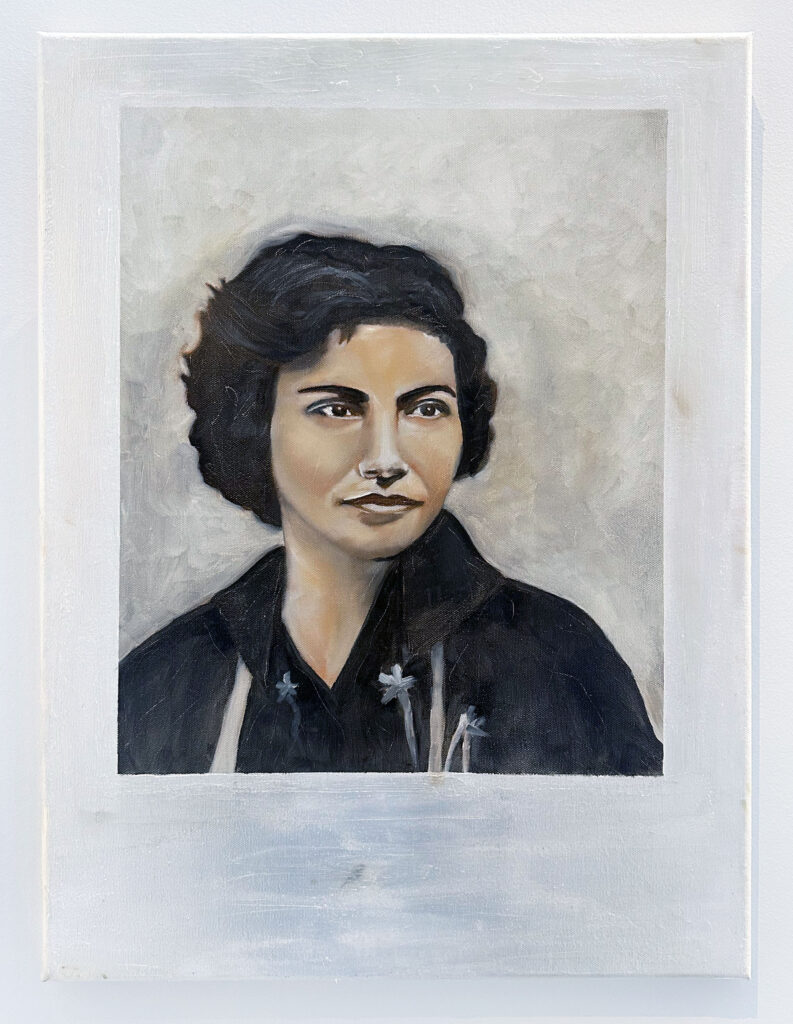
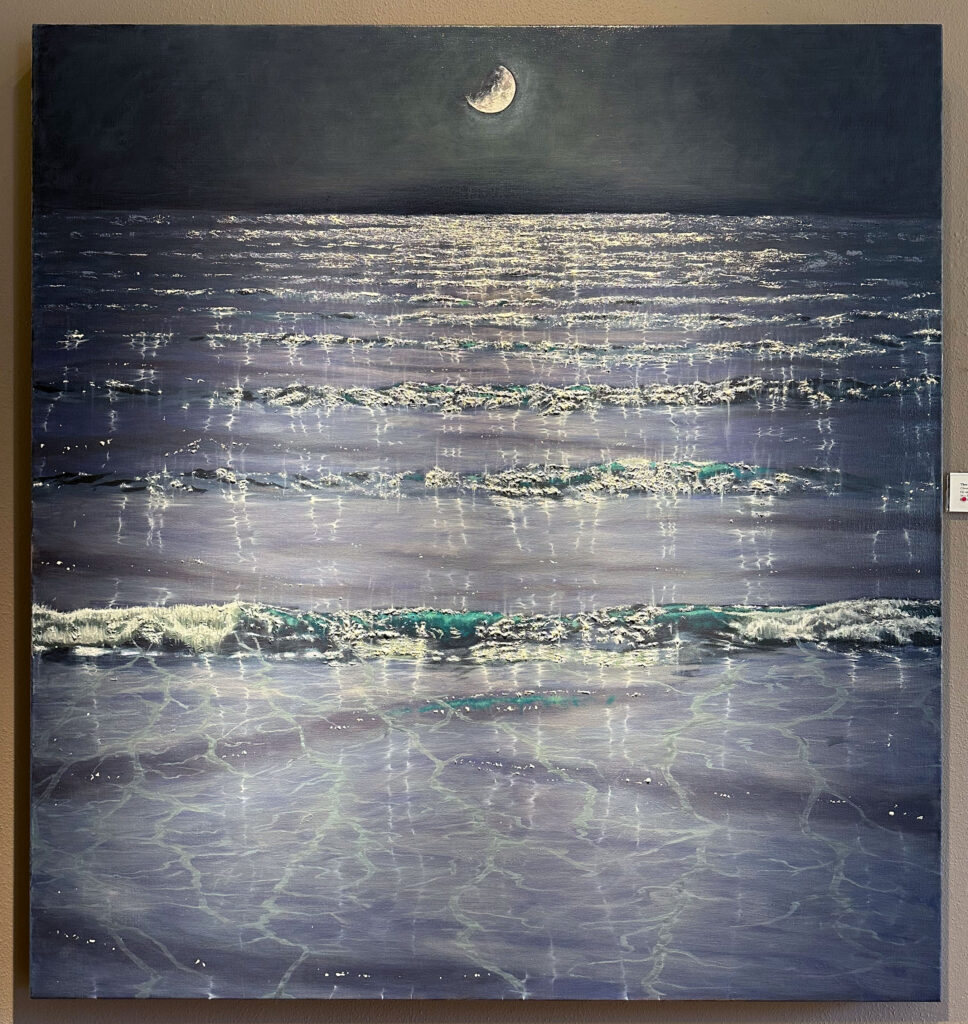
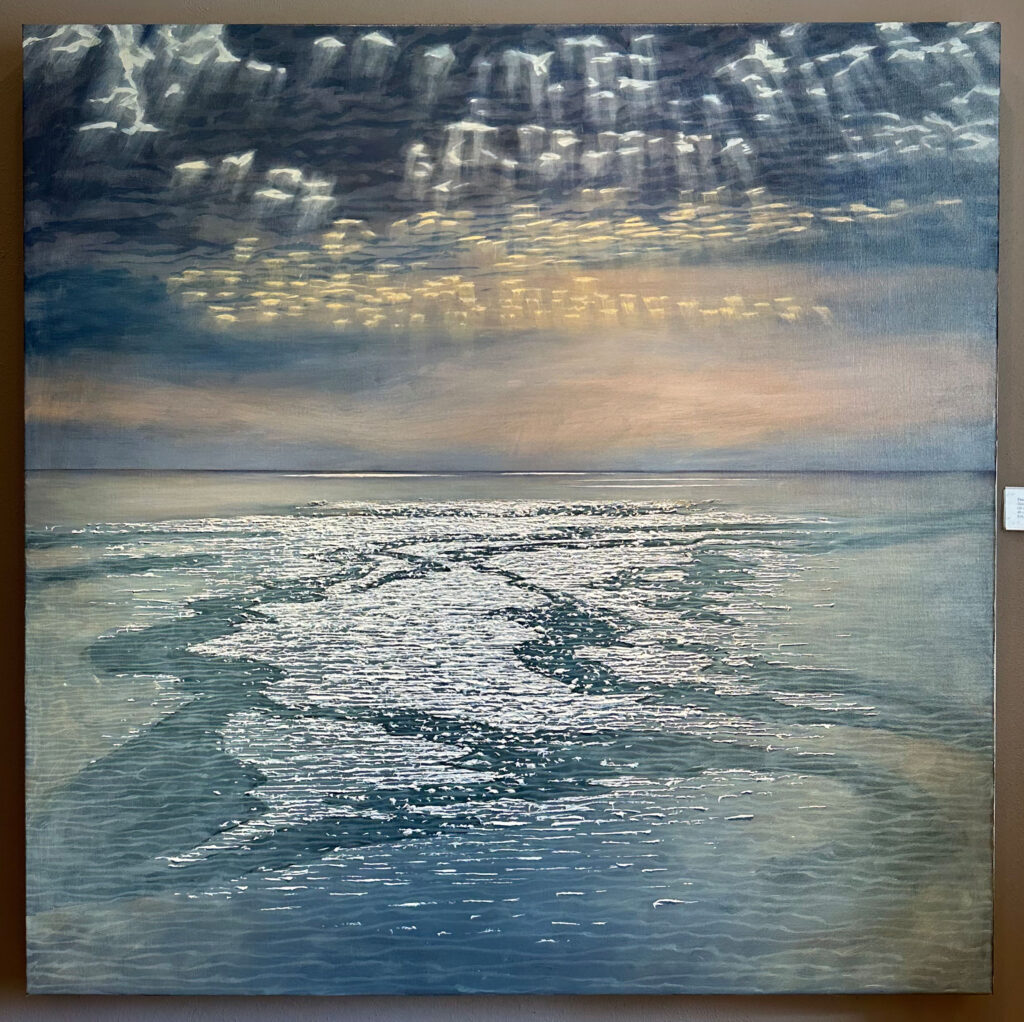
Roberta Tucci‘s beautiful layered paintings celebrating spring flowers and plants are currently on view in her solo exhibition Bloom, at The Delaware Contemporary.

Her statement about her work from her website-

I paint images that express how I perceive organic forms and the world of nature. To do this I develop personal meditative practices that enhance my awareness of nature: both particular details and living systems. I visually interpret this abstract awareness by using traditional indirect painting techniques. These techniques involve layering with varnish and glazing. This slow painting process allows me to accumulate ethereal levels of tone and color on which to create unique images. I then introduce and develop shapes, lines and patterns that represent the complexities of my natural subjects. The compositions that result invite viewers to perceive, connect and engage in a way that encourages their own with meditative contemplation.

This exhibition is on view until 5/31/26.

Dec 182025
 

Work by Mel Rosen (sculpture) and Stass Shpanin (mural, video, and paintings)

Detail from Stass Shpanin’s “Dance of Birth” animated video

Ceramic sculptures by Mel Rosen

Paintings by Stass Shpanin

The Delaware Contemporary is currently showing three exhibitions as part of its 2025 Biennial  Art + AI programming. This post covers two of them, the third is here.

Construct | Disrupt: Artificial Intelligence as Tool and Material features work by artists Mel Rosen, Stass Shpanin, Sol Kim, and Mark Burchick.

From the museum about the exhibition-

In an age when reality itself feels unstable—filtered through algorithms, fragmented by digital archives, and refracted through competing narratives—artists are increasingly turning to the tools of fiction and speculation not to obscure the truth, but to question how we construct it. Construct | Disrupt brings together the work of Mel Rosen, Sol Kim, Stass Shpanin, and Mark Burchick, four artists who use artificial intelligence, language, and archival material to explore the porous boundaries between perception, memory, and belief.

Across diverse practices—from ceramics, drawing, and painting to video, installation, and text—these artists engage with AI not as a replacement for the hand, but as a provocateur, a co-conspirator, and a mirror to the human imagination. Rather than seeking resolution or certainty, their works open up space for doubt, complexity, and contradiction.

Together, the artists in Construct | Disrupt invite us to consider how we construct meaning in a world where the archive is no longer fixed and where the image can be endlessly generated. The work of these artists does not offer answers, but rather asks: What do we trust? What do we remember? And how do we decide what is worth believing?

About the two artists pictured above, from the museum-

Stass Shpanin engages history as a space of imaginative reconstruction. Working with visual fragments from American folk traditions and immigrant archives, he uses AI to distort and reconfigure the past, generating speculative images that blend glitch, myth, and memory. His paintings and drawings present broken, layered timelines where visual language is both preserved and interrupted. Rather than restoring a singular truth, Shpanin’s work embraces the possibility of many coexisting histories—ones shaped as much by fantasy as by fact, as much by the digital as the ancestral.

Mel Rosen’s practice draws from archaeology, natural history, and personal memory to create objects and images that feel both ancient and otherworldly. Her use of AI image generation allows her to iterate quickly, mutating prompts based on her own drawings and a mental library of organic and cultural references—from Pompeian frescoes and fossils to barnacles and talismans. The resulting images feed back into her ceramics and drawings, where mythic forms and geometric distortions coexist in a suspended cosmology. Rosen’s work suggests that artifacts—whether material or digital—are always evolving, reshaped by time, environment, and interpretation.

Still from the video “Person Enough” by Sol Kim

Sol Kim (video still above) approaches language as a material form, using words to subtly disrupt social and technological systems. Her works often begin with a textual prompt—an instruction, label, or survey—that gives rise to absurd, humorous, or quietly unsettling performances. In The Cookiest Cookie, cookies are judged and destroyed by AI based on their perceived “cookie-ness,” while in Person Enough?, performers attempt to become more legibly “human” to computer vision systems. Through these gestures, Kim reveals the tensions between human nuance and machine classification, exposing the strange logic that governs our interactions with technology—and with one another.

Mark Burchick Installation

Images from Mark Burchick’s “Felt Presence”

Mark Burchick’s Felt Presence explores the intersection of faith, media, and artificial intelligence through the lens of Catholic mysticism. Drawing on archival photographs from the 1917 “Miracle of the Sun” in Fatima, Portugal, Burchick trains AI models to generate photorealistic images of miracles that were never captured on film. Presented alongside historical documentation and witness testimony, these fabricated scenes invite viewers to question the boundaries between belief, evidence, and visual truth—highlighting the unseen technological, institutional, and spiritual forces that shape our perception of reality.

In NOO Icons, Burchick expands this inquiry through an immersive video installation framed like a reliquary. A five-minute rear-projected loop, trained on over 100 images of stained glass Rose Windows, morphs into abstract color fields via AI animation. At its center is a 3D-printed altar piece generated using DreamFusion, a text-to-3D tool prompted to create a “solar monstrance.” The resulting object—gold-finished, internally lit, and housing Lithium batteries—evokes both the Communion host and a technological relic. As Kate Crawford notes in Atlas of AI, Lithium is a sacred yet finite resource driving modern AI. By encasing it in plastic and low-res form, Burchick critiques the planned obsolescence and ecological cost of our AI-powered age, reframing divine presence through the lens of material decay.

In another of the museum’s galleries is- Reimagine | Reveal: Challenging the Algorithmic Gaze featuring work by Danielle Glovin, Stephanie Dinkins, and Leah Modigliani.

About the show from the museum-

The works covering this exhibition theme approach AI not as a neutral instrument, but as a complex cultural system—one that reflects, amplifies, and at times distorts the values of its makers. Through the intersecting strategies of critique, reimagination, and bias exposure, Danielle Glovin, Stephanie Dinkins, and Leah Modigliani probe the systems—algorithmic, archival, social—that dictate what is preserved, who is recognized, and how knowledge circulates.

Together, these artists ask urgent questions: Who trains the algorithm? Whose histories are encoded, and whose are left out? What does it mean to build an intelligence—and who is it built for? In doing so, they model a critical engagement with AI, one that challenges default narratives, centers marginalized perspectives, and opens up space for new possibilities. Their practices call us to reconsider what it means to know, to remember, and to be recognized in a world increasingly shaped by invisible systems of intelligence.

Stephanie Dinkins’ interactive sculpture Not The Only One (N’TOO)

Stephanie Dinkins’ “Conversations with Bina48” (back wall) and Leah Modigliani’s AI generated letters for “Cultural Capital”

From Danielle Glovin’s series “Future Generations”

About the artists’ work pictured above-

Stephanie DinkinsNot The Only One (N’TOO) and Conversations with Bina48 extend this inquiry into the realm of relational AI, specifically that of minority groups in the tech sector. In N’TOO, an interactive sculpture gives voice to the oral histories of three generations of Black women, creating an AI entity intentionally designed, trained, and aligned with their values and lived experiences. It is a poignant reversal: instead of AI extracting meaning from biased data sets, Dinkins encodes her AI, reorienting the goals of intelligence design toward inclusivity and equal representation.

In Conversations with Bina48, Dinkins engages in an evolving dialogue with one of the world’s most advanced humanoid robots- probing the limits of kinship, consciousness, and identity. The recorded exchanges navigate tensions between human and machine, emotion and algorithm, intimacy and abstraction—underscoring the urgency of developing AI systems coded to reflect the full richness and diversity of human stories, cultures, and embodied experiences.

Leah Modigliani’s Cultural Capital offers a satirical yet incisive intervention into the circuits of artistic legitimacy. Through a fictional archive of AI-generated letters of recommendation and rejection—authored in the mimicked voices of historical critics and curators—Modigliani reveals how the rhetoric of value and genius in the art world is both constructed and recursively reinforced. The project uses generative tools to lay bare the biases embedded in cultural gatekeeping, drawing attention to the ways AI might amplify inherited hierarchies under the guise of neutrality.

Danielle Glovin’s Future Generations presents AI-generated reinterpretations of inherited family photographs, exposing the mechanics of machine vision and the flattening effects of automated classification. By transposing Midjourney text outputs onto her photographs, Glovin literalizes the collision between personal history and digital taxonomy. The result is a visual language at once familiar and estranged—where nostalgia meets simulation, and memory is rewritten through the aesthetics of machine learning.

These exhibitions will close on 12/28/25.

Dec 182025
 

Portraits by Carrie Ann Baade

Reclaim | Reframe: Datasets and Cultural Visibility, is one of three exhibitions that make up The Delaware Contemporary’s 2025 Biennial- Art + AI. The timely show features work by Carrie Ann Baade, Tyanna Buie, Blažo Kovačević, and Tara Youngborg.

From the museum

Through AI and computational technologies, artists Carrie Ann Baade, Tyanna Buie, Blažo Kovačević, and Tara Youngborg construct layered narratives that reclaim overlooked and marginalized histories. In doing so, these artists unsettle dominant cultural and media frameworks that have long erased, distorted, or commodified lived experience. Exploring themes of identity, ancestry, and displacement, they use generative tools as critical instruments to question, expose, and reconfigure the archival and institutional biases embedded in history, culture, and the environment. From ancestral reclamation and speculative futures to immersive storytelling and data-driven environmental translations, their work advances a reimagining of social justice through the lens of artificial intelligence.

Together, these artists offer a complex portrait of making in the age of AI, revealing how tools shaped by those in power can both perpetuate bias and enable resistance. Their work asks: Who shapes the cultural record? When an AI model “remembers,” whose truth is it repeating? How can we reclaim agency within these systems (built on our collective labor)?

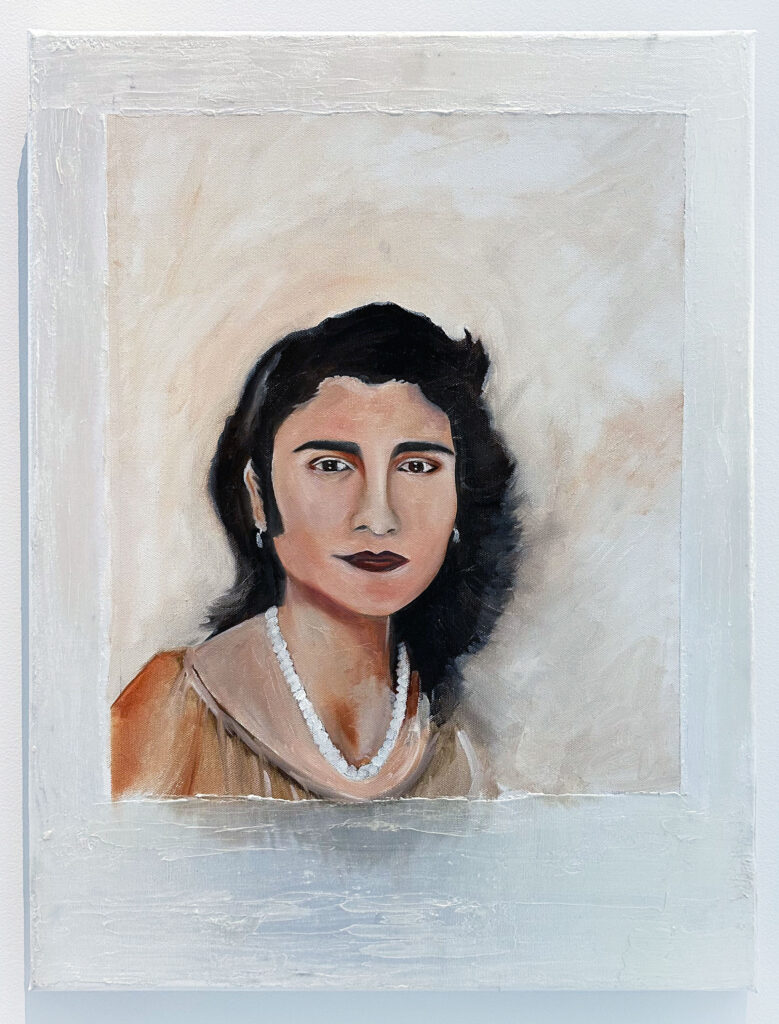
The images at the beginning of this post are from Carrie Anne Baade’s series, Birthplace. Her mixed media portraits of her ancestors, created with the help of AI, present a fascinating look at the stories of several women from early in American history.

From Baade’s statement about the work-

Birthplace is a visual exploration of personal ancestry, delving into the lives of women from colonial Louisiana between 1690 and 1750. Through oil painting, collage, and Al-generated imagery, I reconstruct the presence of these women-figures shaped by French colonial rule, Indigenous displacement, and Romani migration-whose stories have been largely absent from recorded history. Employing a methodology that blends archival research with imaginative storytelling, I create portraits that serve as visual hypotheses-acts of artistic and ancestral repair. The compositions incorporate antique lace, colonial maps, domestic fabrics, and found objects, mirroring the intertwined textures of lineage, migration, and identity. Al-generated image blending aids in synthesizing historically plausible references, speculating on the appearance and presence of women who were never visually recorded.

This project is not about one family, but a shared American inheritance. It reveals the complexity of identity in a land shaped by colonization, migration, and erasure. In rematriating these women to history, Birthplace offers viewers a visual counter-history-one rooted in survival, interconnection, and the enduring power of maternal lineage.

Pictured below are works from the other artists in the exhibition along with information provided by the museum.

Tara Youngborg examines how institutional data and machine learning shape our understanding of land and environment. Using field research, environmental archives, and US Geological Survey datasets, her datastream translates waterflow data and topographic maps into immersive video installations that highlight the limitations of digital representation. By transforming statistics into layered, shifting media, Youngborg portrays landscapes as dynamic terrains of knowledge. Glitches and ruptures in the work expose gaps between digital abstraction and lived experience, prompting questions about algorithmic authority and what is lost when place is reduced to data.

Tara Youngborg’s installation

Tara Youngborg’s installation (detail)

In AR (Argumentative Reality) and Truck for Three Illegal Passengers, Blažo Kovačević uses augmented reality, 3D modeling, and game engine software to confront invasive state surveillance and the dehumanization of migrants. Using digitally enhanced X-ray images from European Border Patrol inspections, he reconstructs a 2015 tragedy in Serbia where 54 undocumented passengers died in a van crash. His works shift between detached aerial views and intimate interior scans, altering typical media frames into ethical engagement. Kovačević warns how AI-driven technologies can perpetuate oppression through automated surveillance, data collection, and erasure, urging reflection on the politics of visibility and mediated violence.

A still from Blažo Kovačević’s video

Tyanna Buie reconstructs erased family histories and reimagines Black identity through speculative Afro-Futurist frameworks. Using ChatGPT and DeepFake technology, she remixes images, sound, and text to create narratives where absence becomes presence. In The Guardians of Nyala, Buie overlays her own likeness onto eighteenth-century Dutch dignitary portraits, then collaborates with AI to imagine a family history untouched by colonization. Rooted in personal narrative and Black popular culture, her counter-archive elevates erased lives and transforms AI from a tool of replication into one of radical self-authorship.

Two of the portraits from Tyanna Buie’s “The Guardians of Nyala”

This exhibition closes 12/28/25.

Dec 102025
 

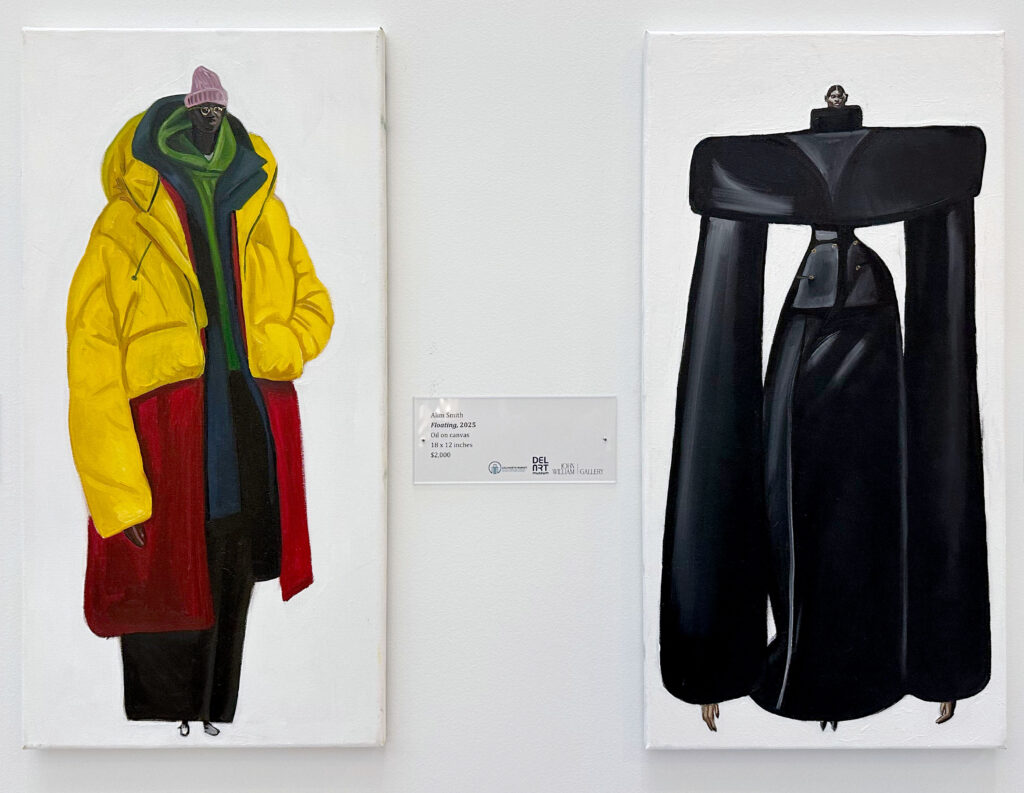
Alim Smith, “Floating” and “Thought A New Dress Would Make it Better”, 2025, Oil on canvas

Paintings by Alim Smith

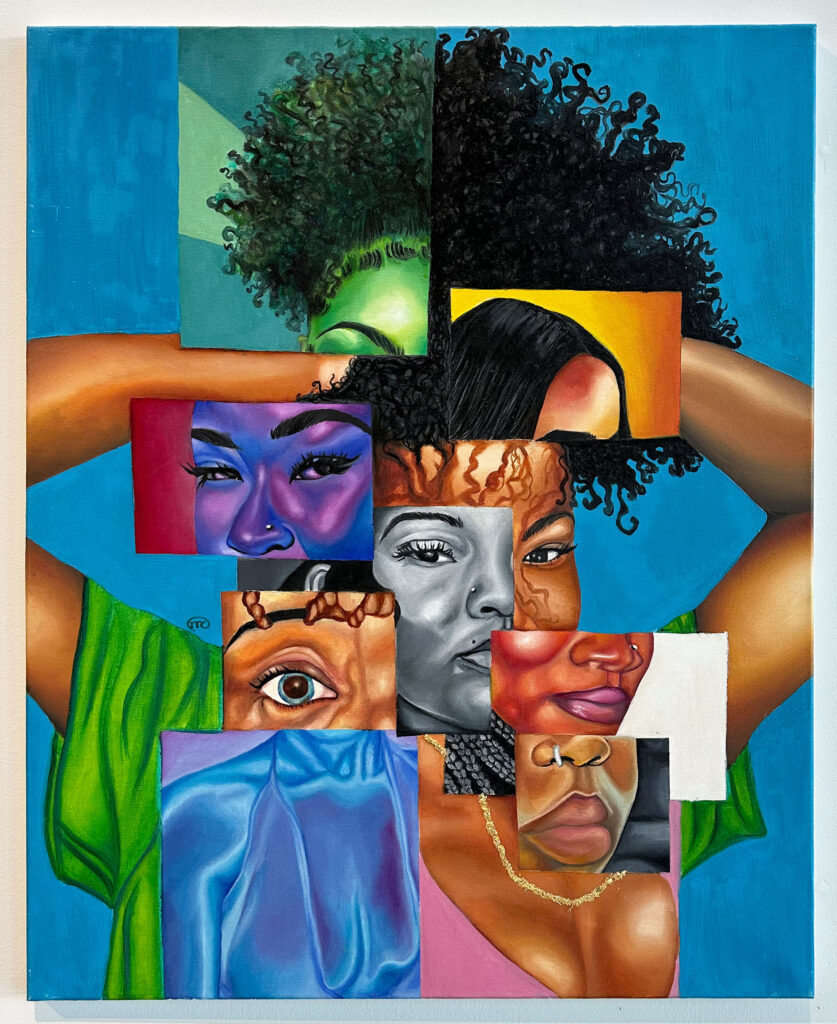
Taylor Gordon, “To Be A Black Woman”, 2023, Oil on canvas

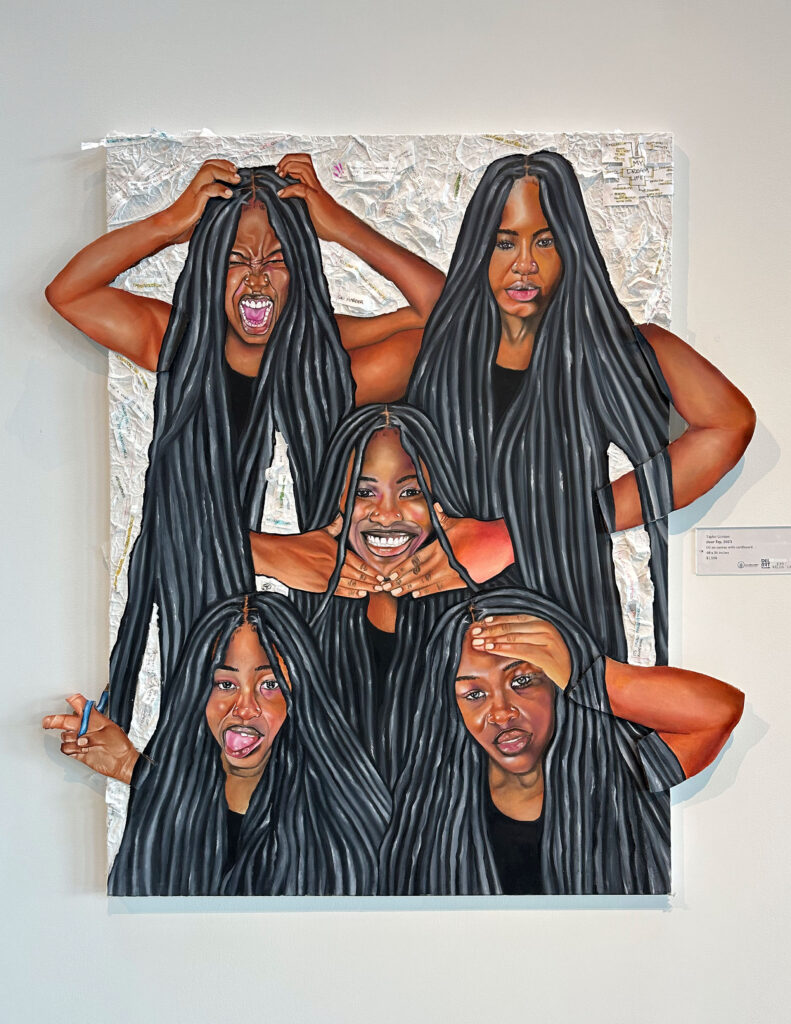
Taylor Gordon, “Dear Tay”, 2023, Oil on canvas with cardboard

Manuel Ramos, “Abuela Gorin”, 2025, Oil on canvas

Manuel Ramos, “Abuela Olga”, 2025, Oil on canvas

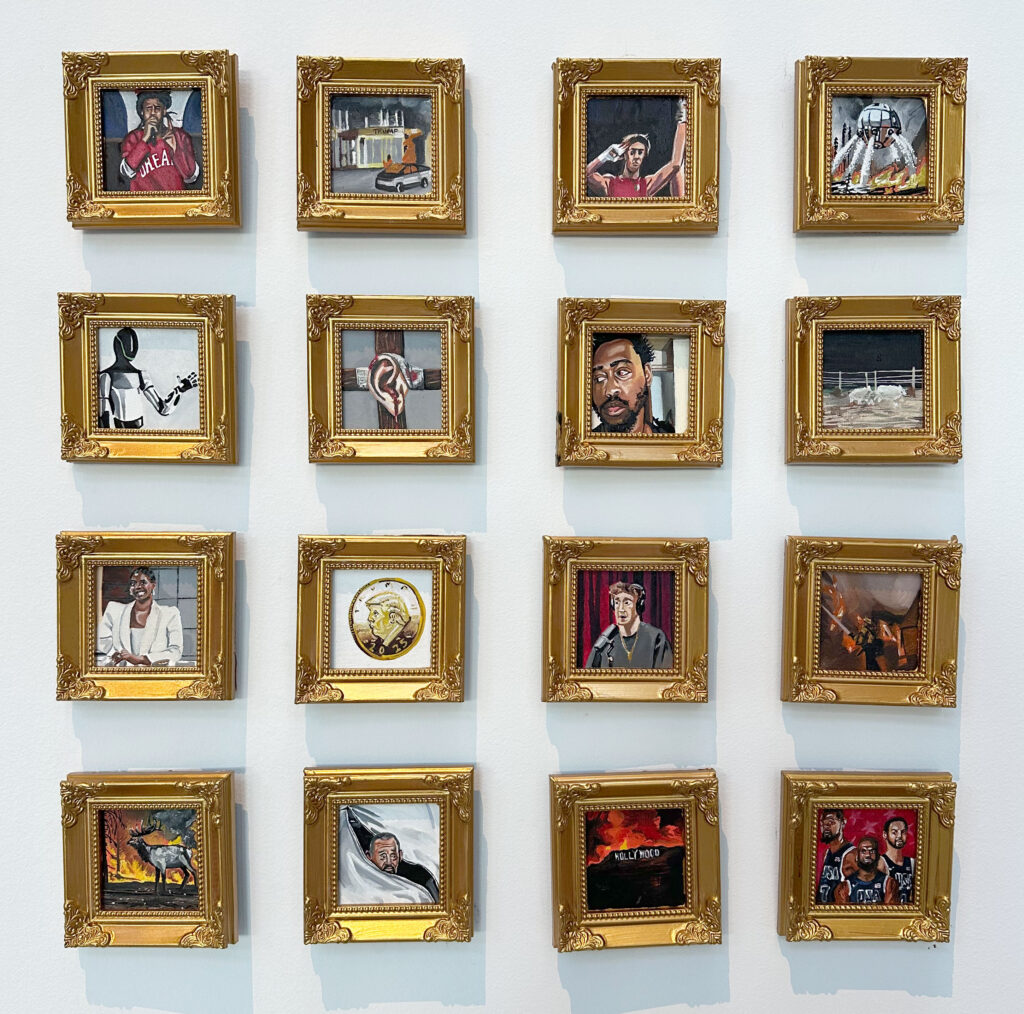
Currently on view at John William Gallery in Wilmington is Colorful Voices: Taylor Gordon, Alim Smith, Manuel Ramos, featuring unique paintings by the three Delaware artists.

From the gallery about the exhibition-

Colorful Voices: Taylor Gordon, Alim Smith, Manuel Ramos brings together three distinctive practices that articulate the richness of contemporary community life through color, portraiture, and cultural reference. The exhibition seeks to foreground the vitality of local voices while offering a space in which viewers might consider how identity, humor, and heritage are translated into visual form.

Taylor Gordon’s paintings situate themselves within the lineage of Black contemporary art, yet remain deeply personal. Her chromatic sensibility infuses each figure with layered emotional resonance, encouraging conversations around beauty, resilience, and the multiplicity of Black experience beyond reductive narratives. Manuel Ramos, or “RAmos ART,” approaches portraiture with a keen attentiveness to light and surface, imbuing his sitters with an understated dignity that resonates quietly yet powerfully. Emerging from a self-taught practice shaped during the pandemic, his canvases record moments of presence that hover between the intimate and universal. Alim Smith, or “Yesterday Nite,” works in a spontaneous visual language, fusing surrealism, popular culture, and sly humor. His rhythmic compositions and vivid palette translate music, memory, and cultural archetypes into forms at once playful and incisive.

Together these artists propose color as more than visual pleasure: it becomes a conduit for empathy, critique, and joy. Colorful Voices invites us to engage with works that are celebratory yet searching, attuned to both the textures of daily life and the broader currents shaping our communities. In gathering their practices, the exhibition hopes to affirm art’s capacity to nurture dialogue and to render visible the stories that animate shared experience.

This exhibition is on view until 12/18/25.

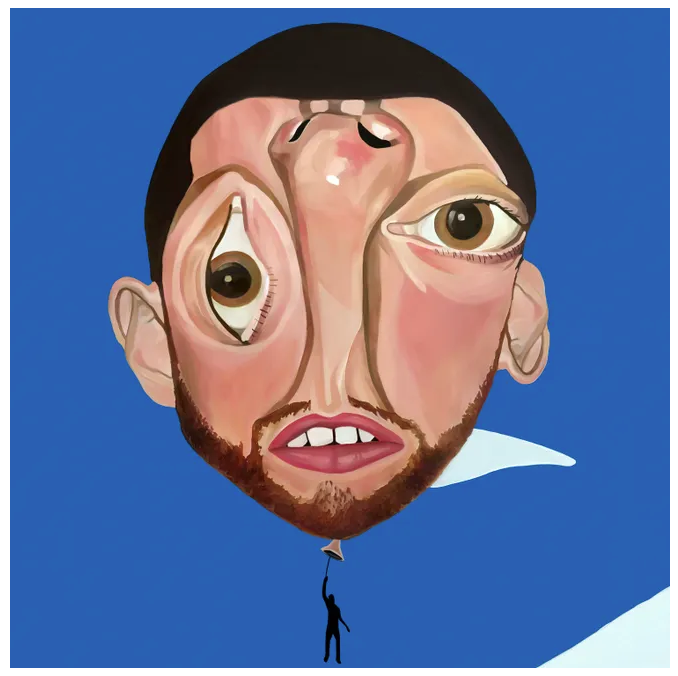
Alim Smith’s work may look familiar- he created work for the television series Atlanta and the cover art for Mac Miller‘s second posthumous album, Balloonerism, released earlier this year. Miller reached out to him in 2018, after finding his work on Instagram. Smith was recently nominated for a Grammy award for “Best Recording Package” for this album.

Mac Miller’s “Balloonerism” cover art by Alim Smith

Oct 082025
 

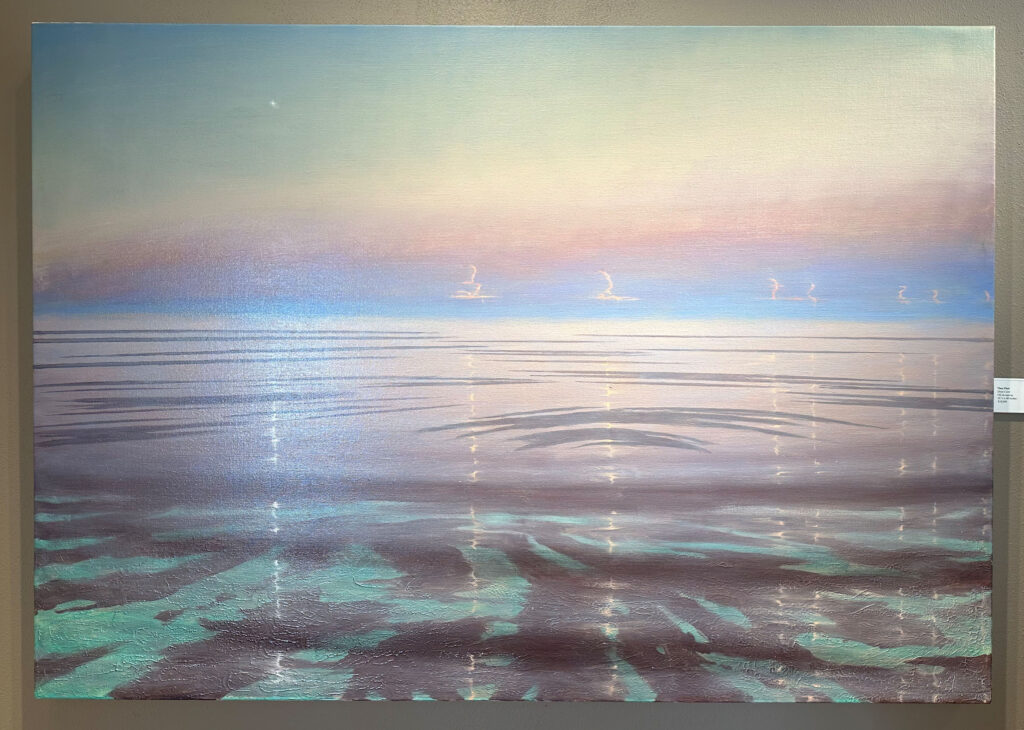
Theo Platt, “Chrome”, Oil on canvas

Theo Platt, “Sunstream”, Oil on canvas

Theo Platt, “Sunstream”, Oil on canvas (detail)

Theo Platt, “Deep Calm”, Oil on canvas

Somerville Manning Gallery is currently showing two painting exhibitions: Theo Platt‘s textured oil paintings from his Oceans series of works (pictured above) and Steven Nederveen‘s Stillness in the Shade of Green.

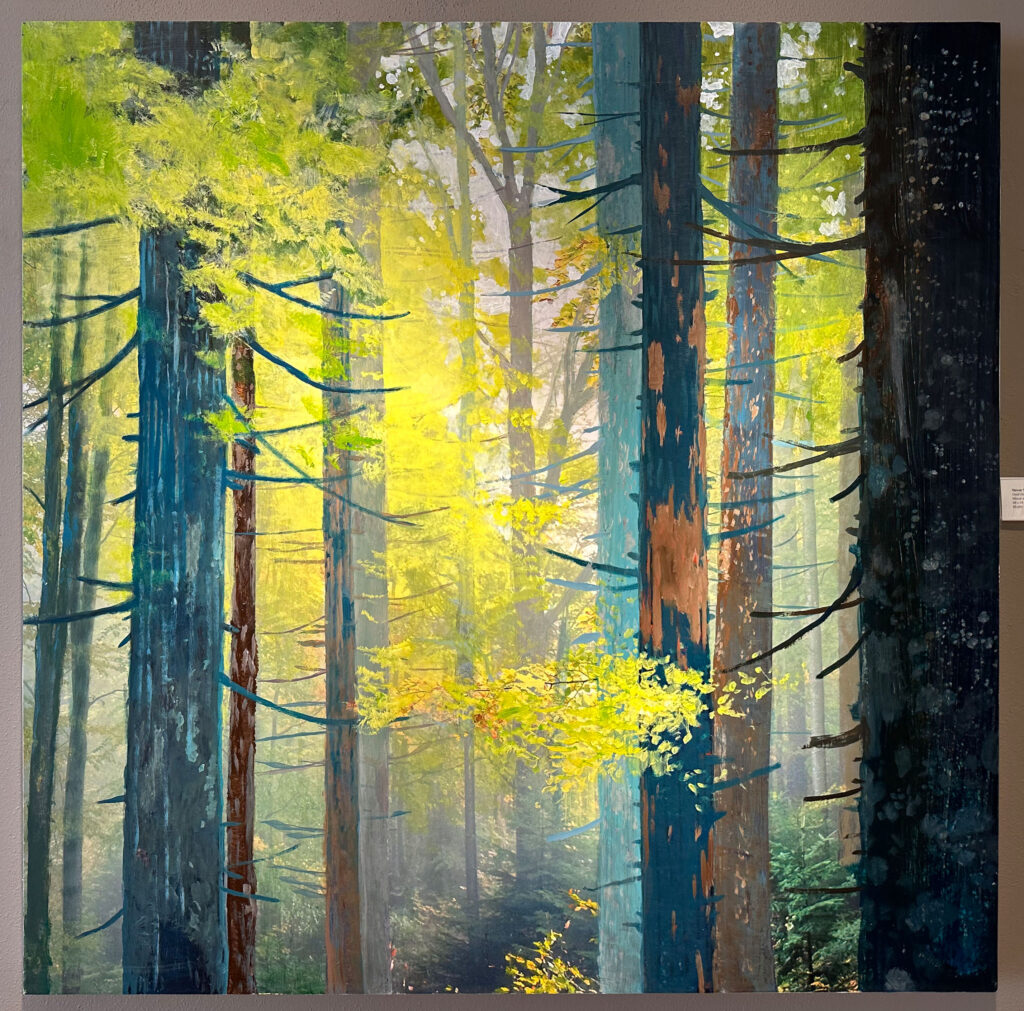
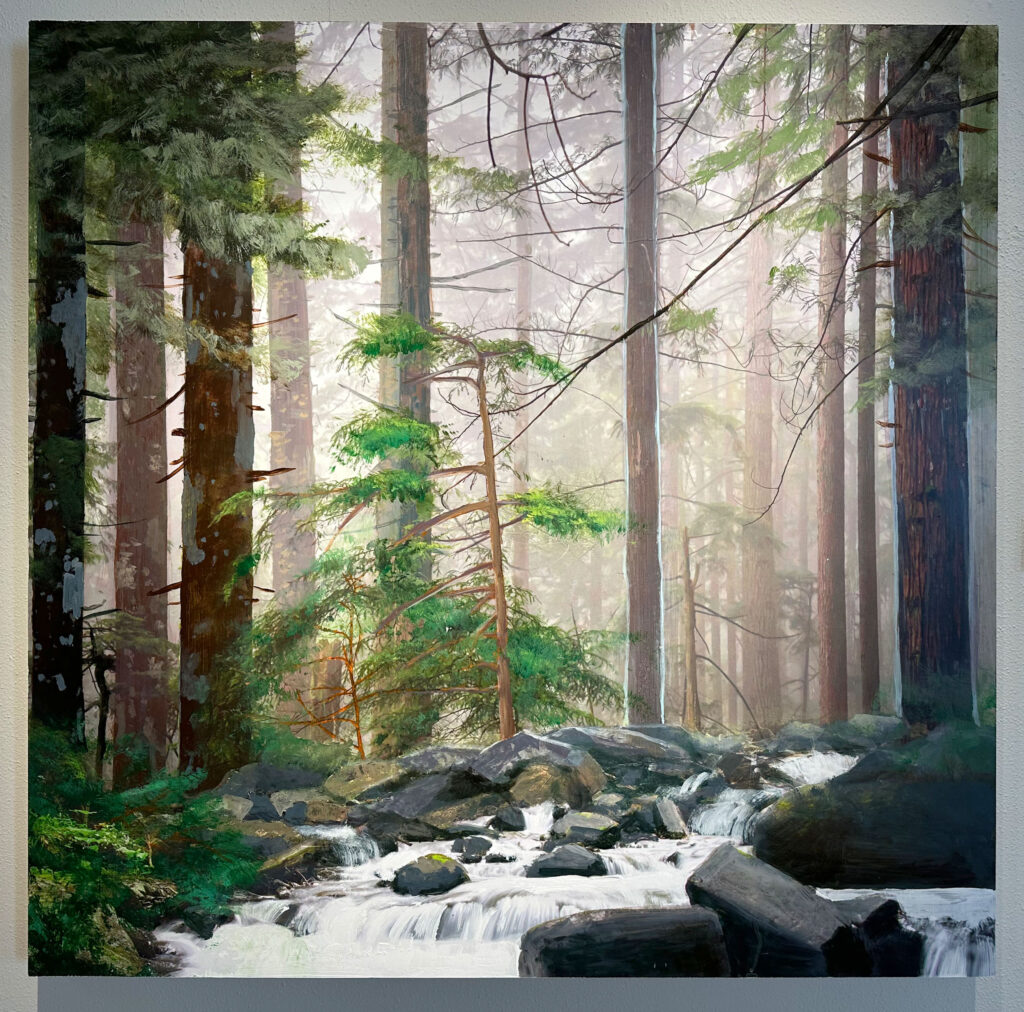
Below Nederveen describes his process for the work (pictured below)-

Using a mixed media approach to image making, I combine acrylic paint and C-print photographs. By layering these elements I can etch down into the emulsion of the photograph to reveal golden hues and also build up the surface with impasto and washes of colour. The result is an image with photo sharp detail in focal areas and painterly brush marks that obscure and create space for the imagination.

Both of these exhibitions close 10/11/25.

Steven Nederveen, “Gold Hidden Within”, Mixed Media

Steven Nederveen, “Gold Hidden Within”, Mixed Media (detail)

Steven Nederveen, “Breathe In the Forest Air”, Mixed Media


Aug 272025
 

William T. Williams, “Walter’s Advice”, 1970, Oil on canvas

10-color screen prints by William T. Williams in collaboration with HKL Ltd.

A selection of books surrounded by posters created for The Pennsylvania Opera Company

Six works by painter and printmaker Gabor Peterdi

Prints by Ilya Bolotowsky

Delaware Art Museum is currently showing an impressive collection of prints from a variety of artists for Marisol to Warhol: Printmaking and Creative Collaboration.

From the museum about the exhibition-

Marisol to Warhol: Printmaking and Creative Collaboration, brings together more than a dozen portfolios and suites in DelArt’s collection. The featured prints showcase the creative collaboration of artists who experiment across media. The exhibition presents a who’s who of American artists working in the second half of the 20th century, including Marisol, William Majors, Jacob Lawrence, Andy Warhol, Audrey Flack, Robert Blackburn, Ben Sakoguchi, Lorna Simpson, Lowell Nesbitt, and Luis Jiménez. Produced by individuals and print shops, these groups of prints functioned as tools for commemoration, fundraising, and political awareness in a range of techniques, styles and intentions.

Joining the exhibition is a special loan from Art Bridges, William T. Williams’ painting Walter’s Advice from 1970. Produced the same year as a newly acquired print portfolio by Williams, Walter’s Advice employs similar forms and colors. The two are displayed together to showcase an artist’s creative exploration across media and the collaborative aspect of printmaking.

Below are a few more selections-

Pages from Dead Birds, a book which combined poetry by Christopher Erb with prints by 24 artists.

From the museum-

Dead Birds pairs poetry by Christopher Erb with prints by 24 artists, demonstrating the vibrant artistic community around the poet and his wife Elena Laza, a printer, designer, and typographer. Erb penned the poems and sent them to artists who used them as inspiration for their prints. Once the prints were produced, Laza typeset and printed the text using a turn-of-the-century press and created boxes to house the prints.

Several of the collaborating artists were affiliated with Robert Blackburn’s Printmaking Workshop and the Center for Book Arts in New York, where Erb and Laza exhibited. Others worked and studied at the Art Students League of New York and were introduced to the project through Will Barnet, a master printer and longtime instructor at the League. Dead Birds was among Erb’s most ambitious and collaborative projects.

Above are four prints from Lowell Nesbitt‘s Moon Shot print series.

From the museum-

Lowell Nesbitt produced this suite of prints, published by the Palley Gallery, following his participation in NASA’s Artist Cooperation Program. Artists working for NASA had behind-the-scenes access to witness events like launches and splashdowns up close and in person. For this series, though, Nesbitt reproduces photographs of the one place NASA can’t let him go: the Moon.

Nesbitt is often associated with Photorealism, but these prints take evocative liberties with their approach to depicting the Moon. Bolstered by quotes from astronauts, Nesbitt meditates on the visual experience of seeing the Moon up close and undistorted by the Earth’s atmosphere. The cratered surface appears in shimmering gestural whorls against the black paper-an appropriate stand-in for the unpigmented vacuum of outer space. Nesbitt’s portfolio considers space exploration alongside his printmaking process. One lithograph showing the footprint of an astronaut’s boot pressed into the lunar soil seems to reference the lithographic process itself.

Upstairs in a separate section are prints from Salvador Dalí’s playing card series, seen below.

From the museum-

In 1967 and 1969, Salvador Dali designed a set of playing cards for the renowned French printing house Draeger Freés. Several years later, the artist revisited the project and created a series of 17 designs featuring an ace, jack, queen, king, and joker in each suit. The art dealer Reese Palley later published the 250-print edition with the goal of selling individual prints at an elaborate, 50th birthday party in Paris. The sales scheme, and the chartered Pan American flights from Atlantic City to the event, were widely covered in national press in January 1972. Both the original cards and the prints that followed feature Dali’s surreal motifs and reference many of his most famous paintings.

This exhibition closes 9/7/25.

Aug 212025
 

Painting by Kelly Irvine

Installation of sculptures by Allison Hudson

Work by Anna Guarneri

Each of the five artists in Bricolage: Artists and Accumulation, currently on view at The Delaware Contemporary, use their materials to express meaning through a layering process.

From the curators, Kasia J. Bunofsky and Leah Triplett-

“I have a very simple theory. I have always pretended that objects themselves formed a self-composition. My composition consisted of allowing them to compose themselves.” – Armand Pierre Fernandez (Arman) (November 17, 1928 – October 22, 2005)

When ‘assemblage’ first circulated as an art-historical term in the early twentieth century, it referred to the primarily formalist practice of joining tangible, often discarded or found, materials. Like a three-dimensional collage, assemblages made novel juxtapositions of individual components to create a whole artwork with its own impact. As the topography of the art world shifted mid-century, assemblage was often used to critique the post-war era’s burgeoning consumerism. Similarly, “accumulation” refers to a kind of assemblage that emphasizes materiality through the mass repetition of similar objects or forms. Accumulations lent themselves particularly well to expressing discontent with consumerism. They underscored the commodity’s necessity as a medium while maintaining the artist’s agency to reclaim meaning through the processes of recontextualization and repetition. As time persisted, assemblage continued to inspire and lend credibility to avant-garde contemporary movements. Even the new wave of ‘conceptual art’–a blatant rejection of materiality–was seen as an assemblage that forwent concrete objects to assemble ideas, language, or concepts. From installation art, to performance, to ‘relational aesthetics’, assemblage and accumulation helped pave the way for today’s contemporary art world and its many innovations.

Assemblage and accumulation emphasize the importance of each material element to the message of the completed work of art. This idea evokes a sense of collectivism; a metaphorical microcosm of material cooperation that might inspire a yearning to change our individualistic society, as art reminds us the whole cannot exist without the contributions of every one of its parts.

The artists and works featured in Bricolage: Artists and Accumulation reference the tradition of assemblage, accumulation, and their many corollaries; either through the performance held within their artistic process, their compilation of abstract concepts, or their passion to speak through material. They build, assemble, accumulate, gather, and collect. Using assemblage as both a method and technique, these artists engage assemblage as an action that is always in perpetual evolution of form. Be their medium drawing or sculpting, painting or installation-their material glass or found objects, acrylic or graphite- Anna Guarneri, Allison Hudson, Brynn Hurlstone, Kelly Irvine, and Emilio Maldonado, apply an iterative, intuitive approach to making, resulting in a bricolage.

This aesthetic- in which the whole is a sum of parts-demonstrates a depth of material knowledge. The works presented here require long looks to unfold and reveal their discrete components. Layering, stacking, blending, and amalgamating are processes and aesthetic devices that enable the viewer to experience the work in an instinctual way. Throughout these artists’ individual practices, an emphasis on transformation through collecting and comingling materials, media, and forms is paramount, with bricolage being a means for metamorphosis.

Below are additional works by the artists and information from the museum-

Allison Hudson

“My work explores the nature of cycles and the emergence of growth from decay. It’s tactile and fragile- a combination of unfired clay, wool, fabric, resin, and wax. Driven to manipulate raw materials into something new and unrecognizable, I enjoy the physicality of building, tearing apart, and mending together – striving to create work that is at once ethereal and visceral.”

Kelly Irvine

“My abstract color field paintings invite the viewer to step into a lush, translucent world of color. Drawn to the beauty of layered transparent hues from an early age, I use sheer color, overlapping forms, gestural brush work, organic forms, and repeating motifs that flow and intersect, resulting in delicious new hues and increased tonal depth. Contrast is important in my work as well; hard edges are in conversation with areas of soft gradation, while vibrant, neon hues pop against muted tints and natural, raw canvas.

I’m especially inspired by the canvas staining techniques and paintings of Helen Frankenthaler and Washington Color School artists Morris Louis and Kenneth Victor Young. I pair that inspiration with constant experimentation and manipulation of materials, developing new processes as a natural outcome.”

Anna Guarneri‘s work explores the possibilities of suggestive imagery and the devotional connotations of stained glass. She uses crude marks and associations to tap into early human experience, pulling from a range of sources – ancient art, architecture, dance history, and her own body. Colors in her work conjure poignant memories, turning drawn forms and glass structures into celebrations, memorials, or premonitions.

Guarneri’s latest body of work pulls from the visual world of postpartum life, incorporating imagery of bodily landscapes and interiors, and the various devices, accessories, and toys encountered during pregnancy, birth, and early motherhood.

Brynn Hurlstone

In Time explores the process of healing from trauma, and the permanent transformation left behind once that process begins. Layers of broken safety glass are frozen within ice and slowly melt over a steel platform. The thaw allows for the release of contained breakage onto the foundation, where it rests in a slowly evaporating pool of water. Over time the water evaporates and the shattered glass may be swept away, but the foundational steel upon which the process took place will forever carry its traces.”

Emilio Maldonado

“I create art to explore personal narratives and navigate life through the material culture of capitalist America.
My work raises questions about social constructs, structural inequalities, and the dynamics of race and class. Through a multidisciplinary approach, I repurpose discarded objects as a means to reflect on memory, identity, and social conventions.”

This exhibition is on view until 8/24/25.

Aug 132025
 

The Delaware Contemporary currently has several exhibitions on view for their summer series Radius. Guise/Trickery, a two person exhibition curated by Erica Loustau and Moriah Berrouet, features a photographic series by Ashley Suszczynski (Guise), pictured above, and hyper-realistic recreations of discarded fast food packaging created by Brian Richmond (Trickery), pictured below.

From the museum about the Suszczynski-

Ashley Suszczynski is an award-winning photographer focused on capturing ancient traditions in the modern day. The photographs on exhibit include work from her series, Ancient Tradition in the Modern Day, which is an ongoing discovery of ancient pagan roots of masked traditions throughout the villages of the Iberian Peninsula. Ashley documents costumed villagers, unearthing the various cultural traditions and winter rites of the region. The masked festivals are designed to ward away evil spirits and welcome a fresh and healthy new year. Elaborate handmade costumes allow participants to step outside their everyday identities and engage in imaginative storytelling.  Whether the suits are made from silky goat hair, fur, mirrors, or feathers, the wearing of masks and costumes fosters a sense of liberation and communal celebration. The concept of guise plays a vital role in masked folk traditions and festivals, serving as a powerful tool for transformation. Ultimately, the guise in these traditions invites reflection on the nature of identity itself and challenges participants to explore the boundaries between reality and fantasy.

Ashley’s work has been seen in National Geographic, Photo District News, All About Photo and more. Her most recent exhibition, “Ancient Tradition in the Modern Day: Iberian Folklore and Maskarades” headlined the 2022 Barcelona Foto Biennale along with the 7th Biennial of Fine Art and Documentary Photography. The exhibit took the grand prize in the worldwide Julia Margaret Cameron Award for Women Photographers.

About Brian Richmond and his work from the museum-

Brian Richmond creates hyper-realistic renditions of mass-produced packaging.  Adept in paper modelling and painting, Brian tricks the viewer into seeing “trash”.  His work addresses the pervasiveness of single-use packaging and the “highly manufactured refuse that permeates our daily lives and environments in such a powerful way that we hardly notice it anymore”. By blurring the lines between illusion and actuality, Brian exploits trickery to enrich the viewer’s experience, encouraging them to explore layers of meaning beyond the surface.  Each unique artwork deceives the eye and makes us question its reason for being in a museum context.  The trickery has drawn us in only to remind us that the trick is actually on us.  We are the ones creating the real debris that litters our cities and towns.

Brian William Richmond is a visual artist from Pennsylvania who makes three-dimensional paintings of trash. Brian graduated from the Pennsylvania College of Art and Design with a BFA in 2001. In 2008, he was awarded the Pennsylvania Council on the Arts Fellowship. In 2012, he was awarded the West Collects acquisition prize. He previously exhibited at Pulse Art Fair, Miami in 2012 as part of The West Collection’s “THIS END UP” installation. In 2013, Richmond was one of five artists who were selected by Jonathan Ferrara Gallery to participate in a group exhibition entitled “Philadelphia”, where Richmond’s mass-produced packaging series was exhibited. In 2016, he was awarded the Fleisher Wind Challenge from Fleisher Art Memorial. Brian has also been a songwriter/composer for many years now, and his current project with his long-term collaborator Nick Hardy is the Bell Harmers. Brian is currently working on his next collection of paintings, which he plans to release in the fall of 2024. Brian works and resides in Chester County, Pennsylvania.

This exhibition closes 8/24/25.
Jul 182025
 

“Arches Symbolize Growth”, 2024, Acrylic and spray paint on canvas

“Pulse: Contemporary Meets Classical”, 2023, Acrylic and spray paint on canvas

Over this past winter Delaware artist Jennifer Small had two solo exhibitions in Wilmington- Walking in the City at The Delaware Division of the Arts’ Mezzanine Gallery and Facades and Rooftops at The Delaware Contemporary.

For Walking in the City, the paintings (pictured above) capture elements from a single day in Venice, Italy. In Facades and Rooftops, works on paper and laser cut wood panels (a selection of which are pictured below) are based on homes and businesses she observed and photographed on neighborhood walks.

The works in both of these shows capture the fleeting nature of memory and observation, and the fragments that linger- juxtaposing these elements in unique ways.

Here’s what she says in her Artist Statement about the work (from her website)-

My art, initially abstract in appearance, records a journey of a day in the life—a practice that starts with documentation through the lens of a camera. I see my experiences through special goggles with the ability to transform banal spaces and objects into engaging formal elements that are pulled out of their environment and placed into my painting compositions strictly for their aesthetic significance. The process of cataloging my everyday leads to the solidification of my memories in a specific time and place and constant access to a breadth of inspiration for my paintings. New inspiration comes out of each new environment I experience whether as a resident or a visitor allowing the work to be an ever-evolving documentation of my days.

The observations I collect are combined into compositions through a process of drawing and collage where I am selecting and joining bits of each sighting to build abstract structures in imagined worlds displaying a combination of shallow and deep space. The work demonstrates loose, painterly applications juxtaposed with more rigid, hard-edge areas of the acrylic paint and spray paint that I use. While the palette is imagined, each painting is an archive of a time and place connected to a personal experience.

I want to challenge the viewer to see the work as personal yet universal. A compilation of my experiences, but also as a way to connect with abstract painting in a tangible way. I want to elevate the humble from unnoticed and small to colorful and grand by putting a spotlight on the unrecognized poetry of daily routine.

For more information, Small also recently joined fellow artist Kat Collins to discuss her process on the podcast The Artist is In.

May 232025
 

Moones Zeydabadi, “Curtain’s Tale”, 2025

The Delaware Contemporary is currently showing The 2025 University of Delaware Master of Fine Arts Thesis Exhibition. It’s an excellent chance to see what recent students have been creating.

The artists included: Abigail Dudley, Anna Freeman, Arend Neyhouse, Candy Fordjour Frimpong, Emmanuel Aboagye, Fuku Ito, Mikhail Shulga, Moones Zeydabadi, Priya Dave, Shoshi Rosenstein, Taylor Gordon, and Yoosef Mohamadi

This exhibition will be on view until 5/25/25.
Below are a selection of works from the artists and their statements about their work.
Moones Zeydabadi

Moones Zeydabadi

I make drawings and paintings depicting human and nonhuman figures in scenes of intimate encounter with each other and their environments. These narratives draw from deeply personal experiences which embody a more universal experience of being. I weave together fragments of recollection, imagined environments, and symbolic gestures to visually represent the complexity of identity and the way it shifts and fractures into new territories as one journeys through life.

My practice explores the liminal territory in which identity, memory and legacy seep through our collective subconsciousness. Through my interest in casting light on overlooked or forgotten stories, I infuse them with living qualities and complex non-linear narrative paths, I model a new, broader, and alternative space of belonging.

Foreground sculptures by Priya Dave

Detail from the interior of one sculpture by Priya Dave

Priya Dave

As an Indian, my art spectrum seeks to disrupt the cycle of disempowerment by integrating self-studied neuroscience research to explore the microbiology of the mind affected by culturally restrictive and arbitrary rules. The societal norms often resulted in mental health challenges, including depression and self-doubt, which left many struggling to trust their judgment or make decisions. Through my work, I strive to create immersive environments that map the brain’s physiological structure, fostering public engagement and raising awareness about mental health through a scientific and artistic lens.

My artistic practice encompasses various mediums, including painting, drawing, printmaking, immersive and video installations, and multi-sensorial experiences. Drawing from my Indian heritage, l often incorporate culturally and historically significant materials like kumkum, fabrics, and spices. These elements are deeply rooted in tradition and carry themes of memory, and identity. By transforming these materials into multisensory artworks, I reimagine their traditional meanings and bring them into contemporary conversations.

Through this fusion of culture and neuroscience, I create spaces that stimulate multiple senses, including sight, touch, sound, smell, and proprioception, encouraging deeper introspection. My work seeks to bridge the gap between personal experience and universal understanding, addressing the amalgamation of mental health, identity, and sensory perception. It is a reflection of my commitment to exploring how art can transcend cultural boundaries and inspire meaningful connections while fostering mental well- being and self-awareness.

Paintings by Abigail Dudley

Abigail Dudley

My paintings celebrate the singularity of perception and the way it entangles how one perceives the world. I am captivated by the slow build-up of forms and the subtle shifts in color that allow me to infuse a soft atmosphere of memory and temporal transitions into my paintings. My work is connected by my search for meaningful encounters with my surroundings through the act of painting, and a search to find surprising moments in life and painting.

My work focuses on the visual slippage between personal narrative and creating a space between harmony and contradictions of visual elements. Through this process, I tie together a space through intimate moments of perception. I aim to cultivate the idea of what it means to linger within a place and how that response can translate into a painting to act as a form of resistance to fast-looking in a culture that values a fast pace of life.

Work by Mikhail Shulga

Mikhail Shulga

My introspective nature is rooted in my identity as a Russian. Long winters and limited sunlight compel us to seek solace indoors, fostering a culture of deep spiritualism and reflection. Over generations, resilience has emerged from the hardships, shifting political regimes, and wars that define our history, further shaping this introspective tradition.

In my installations, I repurpose discarded electronics – objects imbued with nostalgia and unrealized promise. Once luxurious and cutting-edge, these items now lie abandoned on sidewalks. Many come from the ’90s and ’00s, my childhood years, when such technology symbolized hope for a better future. But that promise feels unfulfilled. While our lives have become more convenient, we are left grappling with existential questions: How does technology impact our sense of self and the meaning of human existence? Does the rapid advancement of technology amplify or diminish alienation, freedom, and authenticity? How do virtual spaces, social media, and digital communication shape our perceptions of reality, relationships, and identity? Perhaps the answers lie not in outside but in our own reflections. – “We don’t know what to do with other worlds. We don’t need other worlds. We need a mirror.” Tarkovsky, A. (Director). (1972), Solaris [Film].

Work by Emmanuel Aboagye

Emmanuel Aboagye

My work uses the language of painting to explore ideas of visibility and invisibility as it relates to issues of identity, memory and belonging in a post-colonial context. I explore the complexities of identity, be it class, race and nationality. I give agency to memory not as a tool to investigate the past but a medium for evaluation in the present. I investigate the nuances and specificity of the idea of belonging.

Having been trained as a painter, I employ modern sensibilities in engaging the materials I work with, utilizing them as a lens to examine notions of liberation. I work with materials like, acrylic paint, oil paint, brush, linen, canvas, sequence, wrappers, frost sheet, junk mail flyers, patterned plastic bags and electric iron. I consider the histories and attitude of the materials I work with. They are not merely tools but collaborators in an emancipatory process.

I lean on improvisation as a radical approach for self-liberation in my practice. This allows for spontaneity, fluidity, and the unexpected, reflecting my commitment to embracing uncertainty and possibility.

Paintings by Arend Neyhouse

Arend Neyhouse

My work weaves historical notions of art into the tapestry of our contemporary world. Specifically, while dealing with elements of myth and fable, I tell stories in the space of suburban America. As a consumer of fiction, and spending the majority of my life in suburbia, I explore the synthesis of these elements. My work exists at the crossroads of fable and familiar.

With my figurative paintings, I continue to explore realist arts position in the contemporary art world. I think that through the exploration of the mundane parts of our daily lives lies a time capsule for posterity – a captivating exploration of quietude transformed into an everlasting narrative.

My images exist in the in between. Moments before or after a great change. I am not trying to tell the whole story, but merely a single page, or even a single line; leaving whole worlds both before and after each image. A testament to the sense of sonder as the world churns around us.

Creating epic scenes through my technical approach and unwavering craftsmanship; humanity is laid bare. Through my art, I aspire to create not just paintings, but windows into the soul of our shared existence.

Head to the next page to see more of the artists from the show.