Apr 192024
 

Meryl Engler, “Lying in Red”, 2023, Woodcut

Work by Michael Loderstedt (left), Eva Pozler (center) and Lori Kella (right)

Work by Lori Kella, Maria Uhase, and Meryl Engler (right two pieces)

Lori Kella, “Mudslide and Forsythia”, 2022, Inkjet print (left) and Corrie Slawson, “Amalgam 4”, 2022 (top) and “Amalgam 3”, 2022 (bottom), Oil and screenprint on plywood

Today (4/19/24) is the last day to see Life Out of Balance at the Emily Davis Gallery at The University of Akron. The group show show includes work by Maria Uhase, Meryl Engler, Lori Kella, Benjamin Lambert, Michael Loderstedt, Eve Polzer, Ron Shelton, Ariel Bowman, and Corrie Slawson.

From the gallery-

When a tree falls in a forest, we may see it as the death of the tree. It stops photosynthesizing, growing, feeding its mycorrhizal symbionts, flowering, developing fruit, dispersing seeds, taking in carbon dioxide, and producing oxygen. But in the ecosystem, it begins a whole new life in decay. It feeds the soil and microbes through the decomposition of its tissues; it provides a place for fungi, mosses, and lichens to grow; and it becomes a protected habitat for a myriad of insects, mammals, and birds. This same tree, therefore, can be both dying and living at the same time, depending on perspective. It can be dead if considered separate from its surroundings, or it can be alive in its continued relationship within its ecosystem.

Humans can feel more alive by being integrated with the rest of the natural world. We are not living to our full potential, or allowing nature to be its full potential, when we consider ourselves as separate from it.

If we are to have hope for solving the complex environmental issues that are facing us today, we need to work with, rather than against, the forces of nature.

Below are a few more selections.

Ron Shelton, “Yellow Mosaic”, 2021, Plastic and wire

Ariel Bowman, “Wall Trophy Series”, 2019, (Cave Bear, Antique Bison, Early Horse, Saber Cat, Dodo, Brontotherium, Parasaurolophus), Unglazed, high fired porcelain; Maria Uhase, “Splitting Headache”, 2022 Ink on paper and “Softly”, 2023, Graphite on paper

Ariel Bowman, “Wall Trophy Series”, 2019, (Cave Bear, Antique Bison, Early Horse, Saber Cat, Dodo, Brontotherium, Parasaurolophus), Unglazed, high fired porcelain

Benjamin Lambert, “A pint for a gallon”, 2020 and “I Found Your Damn Lost Shaker of Salt”, 2020, Stoneware, underglaze, glaze, epoxy

Corrie Slawson, “Stage Set Tapestry 1, for Feast: a ballet. Of Bats, Blue Footed Boobies, Penguins and other threatened fauna and flora. Pastoral landscape after Rubens”, 2020, Oil and mixed media on muslin

Corrie Slawson, “Stage Set Tapestry 1, for Feast: a ballet. Of Bats, Blue Footed Boobies, Penguins and other threatened fauna and flora. Pastoral landscape after Rubens” (detail)

Michael Loderstedt, “Snakehead”, 2023, “Thistles”, 2023, Cyanotypes on fabric, embroidery, fabric collage

Lori Kella, “Mayflies in the Grass”, and “Yellow Irises”, 2024, Framed inkjet prints

Maria Uhase, “Encircled”, 2023, Oil on linen panel, “Worm”,2023, Oil on linen and “Conglomeration in the Spiders’ Ghost Town”, 2020, Oil on canvas

Eva Polzer, “Gift from a Cat”, 2024, Ceramic, underglaze, velvet jewelry box, and “Gift from a Rat”, 2024, Ceramic, underglaze, petri dish

Meryl Engler, “Waiting”,2023, Woodcut Block


Apr 072024
 

“Moon Setting into Fog Bank over Cape Cod Bay, Morning of the Total Lunar Eclipse”, 2007, printed 2023

“1:30-4:30a.m., Moon Rising, Antelope Lake”, 2011, printed 2023

“Sun Ball, Imnamatnoon Creek, Lochsa River Valley”, 1995, printed 2023

“Fireflies”, 2005

One of the smaller prints from the “Fireflies” series

There is something so peaceful about the photographs in Barbara Bosworth: Sun Light Moon Shadow, currently on view at Cleveland Museum of Art. These beautiful moments she has captured allow the viewer to share her sense of wonder.

From the museum about the exhibition-

“My childhood home is where all my photographs come from,” says American photographer Barbara Bosworth (born 1953). Growing up in Novelty, Ohio, Bosworth adored walking with her father and looking up at the night sky, a practice that became a lifelong passion. This exhibition -timed to coincide with the total solar eclipse visible in Cleveland on April 8— features the artist’s photographs of light, from eclipses, sunrises, and sunsets to the luminescent glow of fireflies and a flashlight. Her images both explore how we endow these phenomena with personal meaning and elucidate bonds between humans and the natural world that often go unnoticed.

Photography is an art form with its roots in science, even though the two disciplines are sometimes considered opposites. The term photography was coined in 1839 by British scientist and astronomer Sir John Herschel from Greek words meaning “drawing with light.” Bosworth notes that light is an essential ingredient in both astronomy and photography. The camera and telescope, used together as Bosworth has in a number of the photographs on view, each collect light.

Time is another integral component of photography: a photograph records the light that strikes a sensitized surface-such as film or, in the case of digital photography, a sensor-during a certain length of time. In making her photographs of the heavenly bodies, Bosworth says she wants “to be reminded of the mystery closer to home: the sheer strangeness that light — millions of years old, unfathomably old – can still land on my film and be seen.”

This exhibition is on view until 6/30/24.


Mar 282023
 

“Oil Bunkering #9, Niger Delta, Nigeria”, 2016

“Gold Tailings #1, Doornkop Gold Mine, Johannesburg, South Africa”, 2018,

“Salt Ponds #1, Near Fatick, Senegal”, 2019

“Salt Ponds #1, Near Fatick, Senegal”, 2019 (detail)

“Uranium Tailings #13, Husab Uranium Mine, Namibia”, 2018

Edward Burtynsky’s photographs are visually arresting and often made more so by the need to look closer to discover what exactly is being captured. Some look like paintings at first glance before you realize there are roads or other man made structures contained within them.

From the Sundaram Tagore’s press release-

Since the early 1980s, Edward Burtynsky has been photographing industrial landscapes across the globe, documenting in remarkable detail the human imprint on the planet through terraforming, extraction, urbanization and deforestation. For African Studies, premiering in New York simultaneously at Sundaram Tagore Gallery and Howard Greenberg Gallery, he focused on Sub-Saharan Africa, traveling to Kenya, Nigeria, Ethiopia, Ghana, Senegal, South Africa, Botswana, Namibia, Madagascar and Tanzania between 2015 and 2020.

Burtynsky’s interest in Africa was sparked 20 years ago while he was working on his landmark 2004 photographic project China, which explores the country’s rapid globalization and the construction of the Three Gorges Dam. The series, and subsequent award-winning documentary film by Jennifer Baichwal, Manufactured Landscapes (2006), chronicle China’s transformation into the world’s leading manufacturer and depository for its waste. Burtynsky witnessed firsthand the immense environmental—and by extension, human—cost of development, and he predicted Africa would be the next, and perhaps the last, region to undergo major industrial expansion.

Presented in large-format photographs, African Studies conveys the fragility of the natural world, bringing together images of lush, undisturbed landscapes and environments irretrievably altered by industry. The series was largely photographed from aerial perspectives, a viewpoint that distills the continent’s diverse topography into graphic patterns and gradients of sumptuous color. The resulting effect seemingly transforms the marks of human infrastructure into painterly abstract compositions. In these images, as in all his work, Burtynsky skillfully integrates critical reporting with sublime visual aesthetics creating a harmonious balance between content and form.

“With this project I hope to continue raising awareness about the cost of growing our civilization without the necessary consideration for sustainable industrial practices and the dire need for implementing globally organized governmental initiatives and binding international legislations in order to protect present and future generations from what stands to be forever lost,” Burtynsky said.

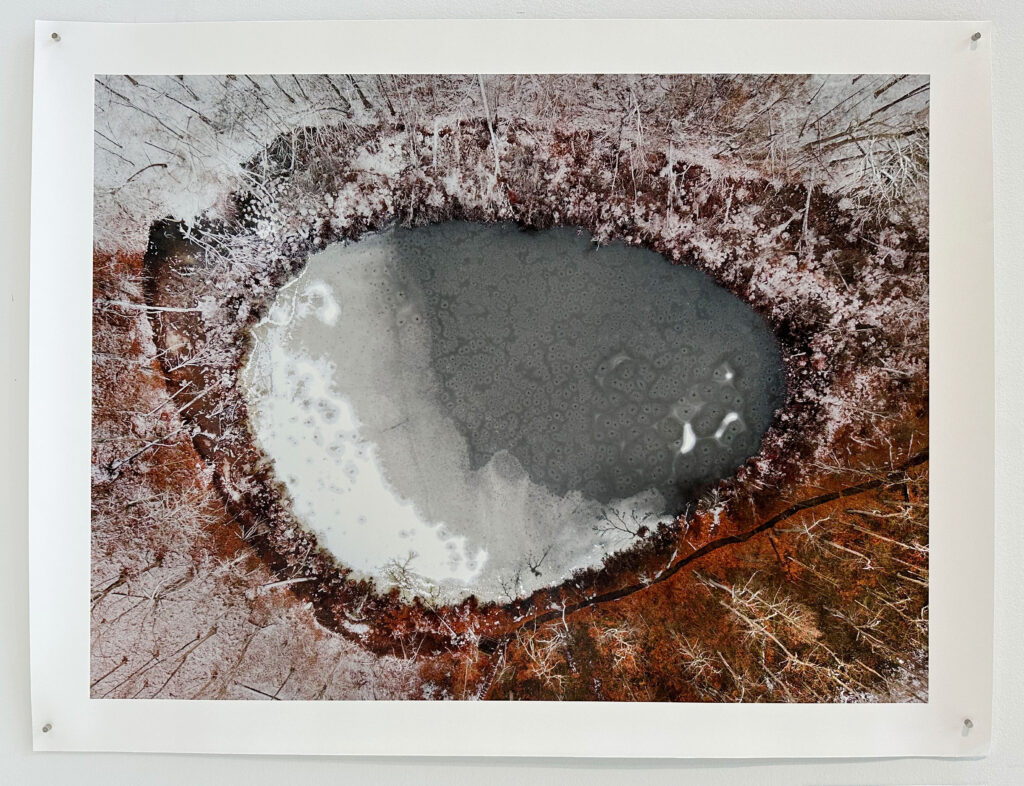
Also on view in another section of the gallery are works from his series, Natural Order. The photographs were taken in Grey County, Ontario, during the lockdown in the spring of 2020.

This quote from Burtynsky was on the wall nearby in regards to the series-

“From the frigid sleep of winter to the fecund urgency of spring, these images are an affirmation of the complexity, wonder and resilience of the natural order in all things. I find myself gazing into an infinity of apparent chaos, but through that selective contemplation, an order emerges an enduring order that remains intact regardless of our own human fate.”

This exhibition closes 4/1 at Sundaram Tagore Gallery and 4/22 at Howard Greenberg Gallery.


Apr 162016
 
egglestonfinal

© Eleanor Macnair (image courtesy Kopeikin Gallery)

large

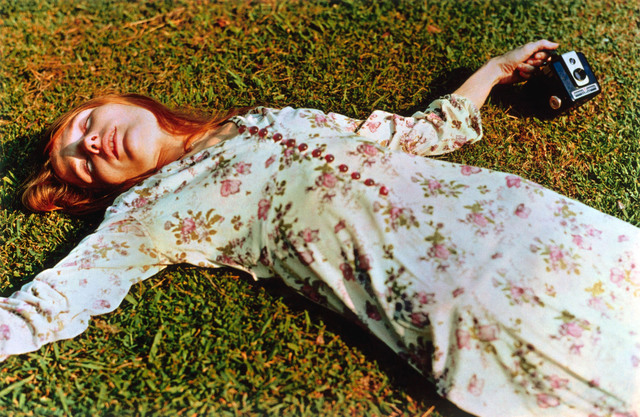
Untitled, 1975 © William Eggleston

nan32

© Eleanor Macnair (image courtesy Kopeikin Gallery)

Nan one month after being battered 1984 Nan Goldin born 1953 Purchased 1997 http://www.tate.org.uk/art/work/P78045

“Nan one month after being battered”, 1984 © Nan Goldin (image courtesy tate.org.uk)

Currently at Kopeikin Gallery are Eleanor Macnair’s delightful Play-Doh recreations of famous photographs (I’ve included the original photos for comparison, they are not in the show).  In the second part of the gallery is Michael Lange’s serene series Wald/Fluss (Forest/River).

WALD | Landscapes of Memory forest in Germany (image courtesy of Kopeikin Gallery)

This exhibition closes 4/16/16.