Oct 292026
 

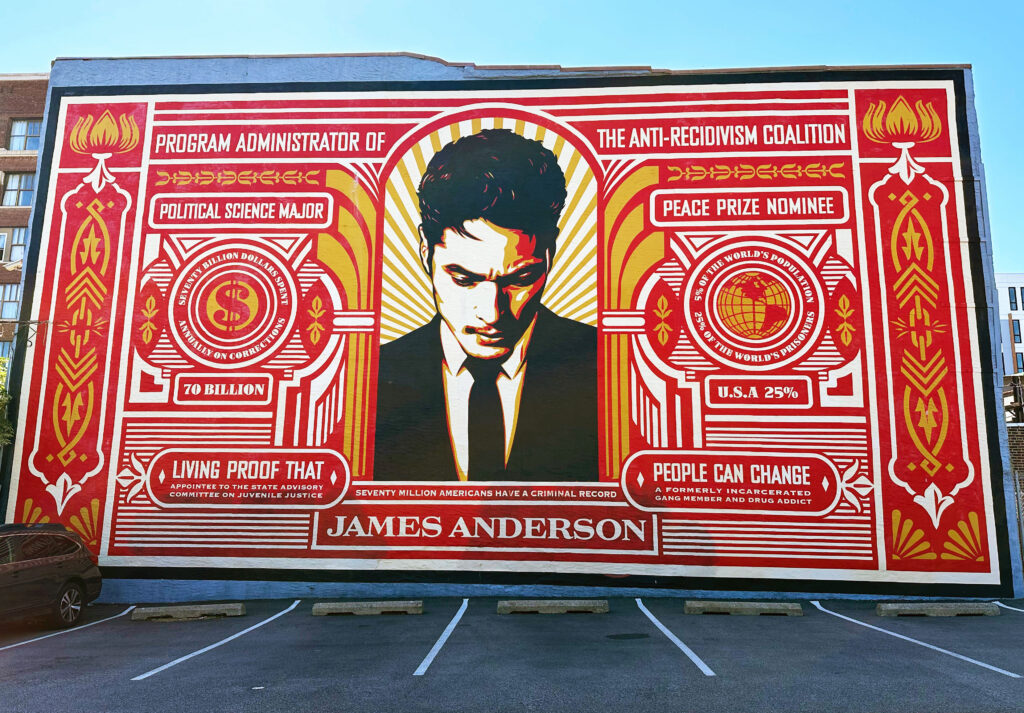
Shepard Fairey created The Stamp of Incarceration: James Anderson in 2015 for Mural Arts Philadelphia.

From Mural Arts about the work:

Shepard Fairey came to Philadelphia to meet with inmates at Graterford SCI, members of the Guild (Mural Arts’ re-entry program for formerly incarcerated people), and others involved in Mural Arts’ Restorative Justice program. Based on this dialogue, he developed a series of images that kicked off a massive campaign designed to raise awareness about criminal justice. Going back to the origins of his Andre the Giant sticker, Shepard distributed stickers to the public for mass distribution, engaging in a participatory form of art. He has created several murals in Philadelphia.

This project was part of Open Source, a citywide exhibition that brought 14 extraordinary artists from around the world to Philadelphia. They worked with Mural Arts Philadelphia and guest curator Pedro Alonzo to create a new series of public artworks that explore and illuminate Philadelphia’s diverse urban identity.

This Saturday (10/31/26) is Mural Arts Fest, taking place from 12-5pm in Philadelphia’s LOVE Park. The free event includes live performances, mask decorating, pumpkin painting, an artist vendor market, and more.

Oct 282026
 

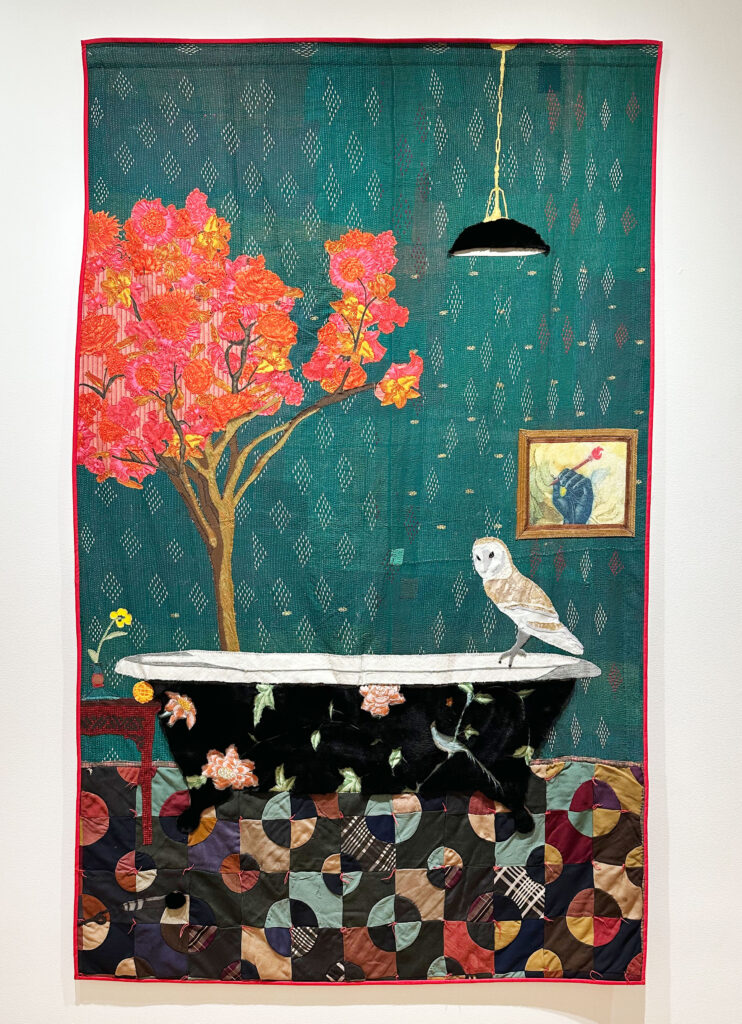
Jesse Krimes, “Riverside”, 2026, Antique quilts, used clothing collected from incarcerated people, assorted textiles
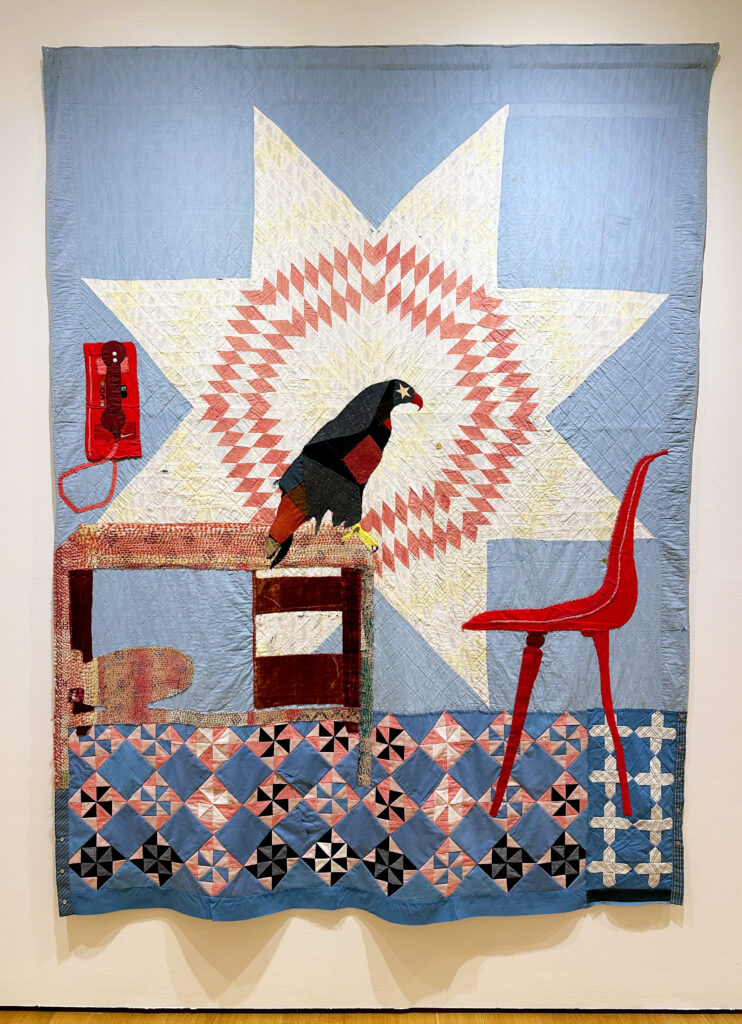
“Red Eagle”, 2020, Antique quilt, used clothing collected from incarcerated people, assorted textiles
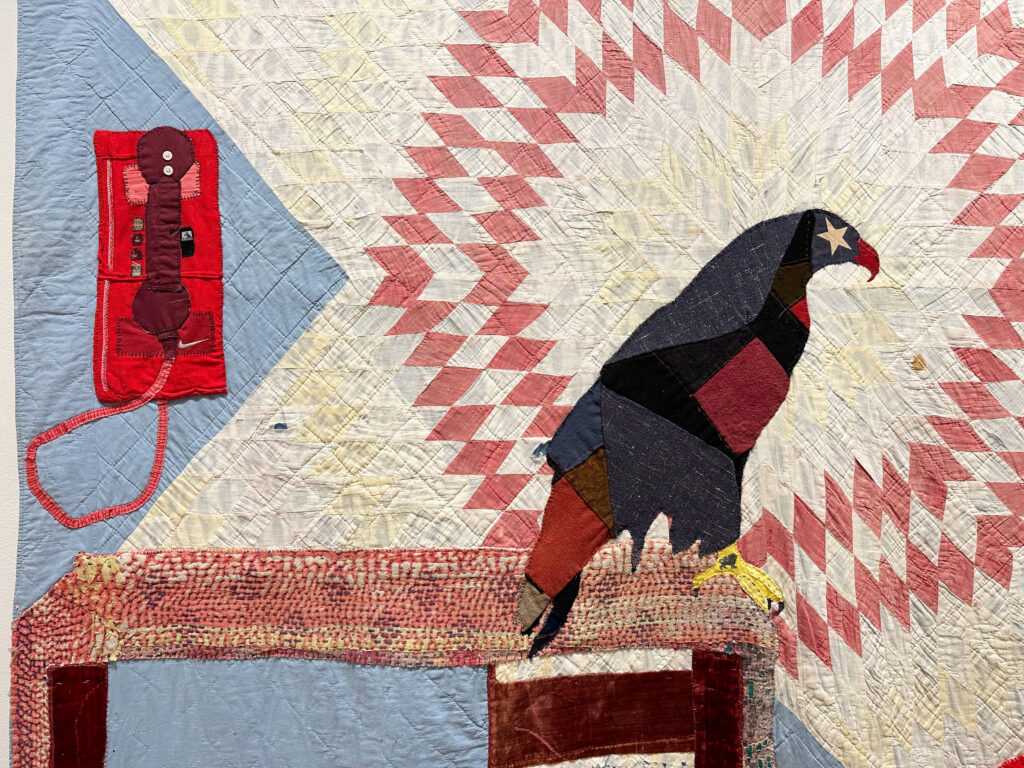
“Red Eagle”, detail

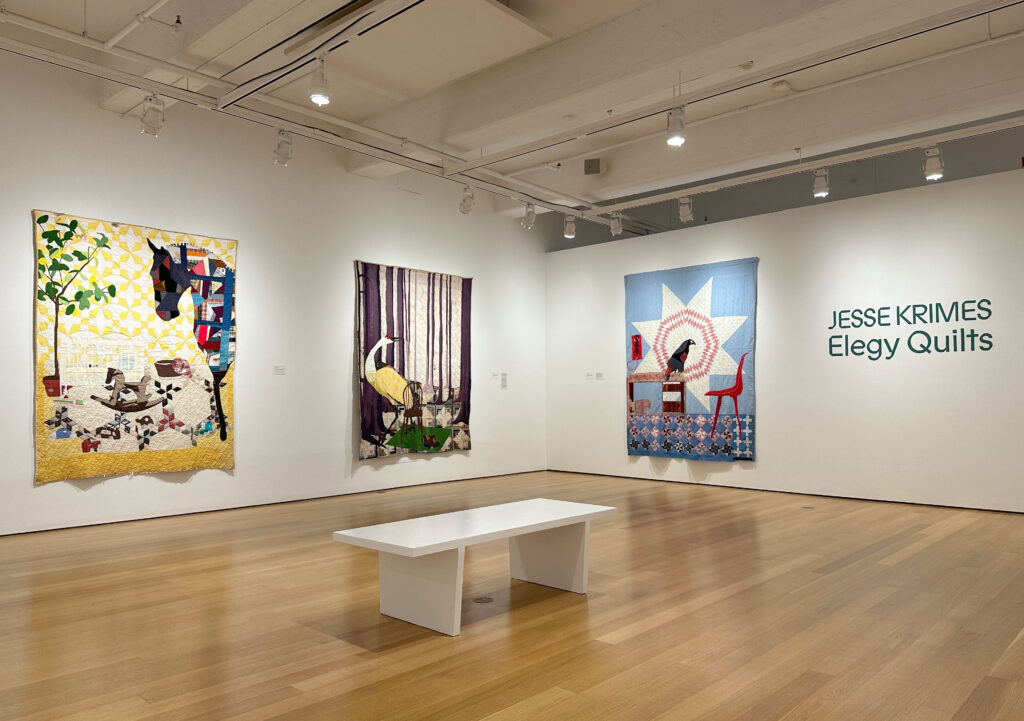
While the quilts in Jesse Krimes‘s exhibition Elegy Quilts at The Fabric Workshop and Museum are beautifully crafted works, it is how he builds on the ideas and personal items of the incarcerated people he worked with that make them so poignant.

The exhibition also includes the recent quilt Riverside, (pictured at the top of this post), a newly commissioned work inspired by Krimes’s workshops with young adults from Mural Arts Philadelphia’s Restorative Justice program. A mural of the piece was also created, located at 990 Spring Garden Street, Philadelphia.

From the museum about the exhibition:

Presented in partnership with Mural Arts Philadelphia, this exhibition features selections from Jesse Krimes’s Elegy Quilt series (2020–present), a body of work that renders the personal effects of the U.S. carceral system through portraits of domestic spaces. Drawing on his own experience with incarceration, Krimes gathers donated clothing and textile fragments from currently and formerly incarcerated individuals and reconstitutes them into intricately patterned quilts that meditate on memory, loss, alienation, and comfort. Continuing in the spirit of American quilting traditions, the works situate these narratives within broader histories of communal making and resilience.

To produce the works on view, Krimes invited incarcerated collaborators to describe a memory of home. He then prompted them to choose a representative animal figure as a symbolic stand in for the incarcerated person. The quilts, titled after U.S. prisons and jails, become tactile archives grappling with estrangement, yearning, and the complexities of release and reintegration. Through this process, Krimes reframes everyday materials into narratives of dignity and connection, prompting critical reflection on the psychological and material costs of incarceration.

Marion, pictured below, also has an affecting story behind it.
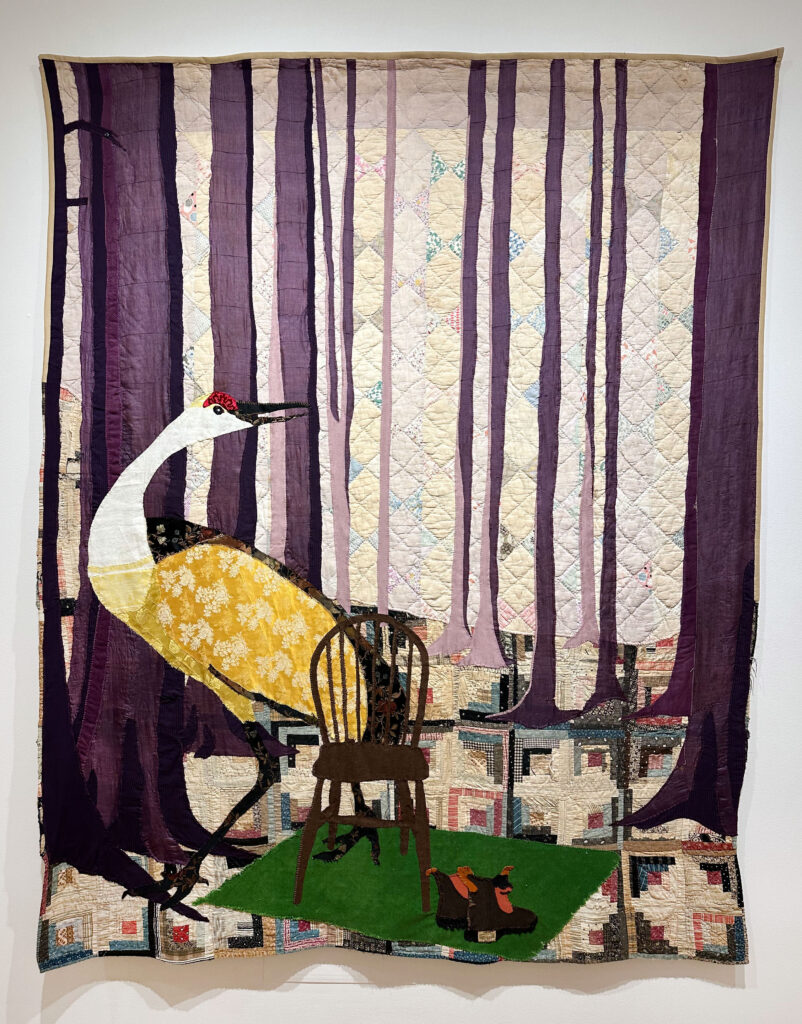
“Marion”, 2022, Antique quilt, used clothing collected from incarcerated people, assorted textiles

From the museum:

Krimes utilizes the names of American penitentiaries-here the Federal Correctional Institution in Marion, Illinois-as titles for his quilts to convey the immense scale of mass incarceration in the United States. The quilts themselves, however, depict personal relationships to home, memory, and safety.

When Krimes asked his collaborator for Marion, who is currently incarcerated, where he last felt most comfortable, the individual described the woods behind his house where he would meditate. The resulting quilt is a portrait in absentia: rather than depicting the figure in contemplative repose, Krimes presents an empty chair and discarded boots as the material traces of the “sitter.” A brightly patterned crane curves around the chair like a guardian figure suggestive of freedom and flight.

The crane’s vivid yellow coloring and the rich purple of the towering trees create a distinction between the peaceful natural setting and this animal avatar. As with the other works in the Elegy Quilt series, Marion offers a vision of individual longing, softness, and vulnerability in resistance to the severe discomfort and violent anonymity produced by the carceral system.

This exhibition is on view until 11/1/26.

Oct 152026
 

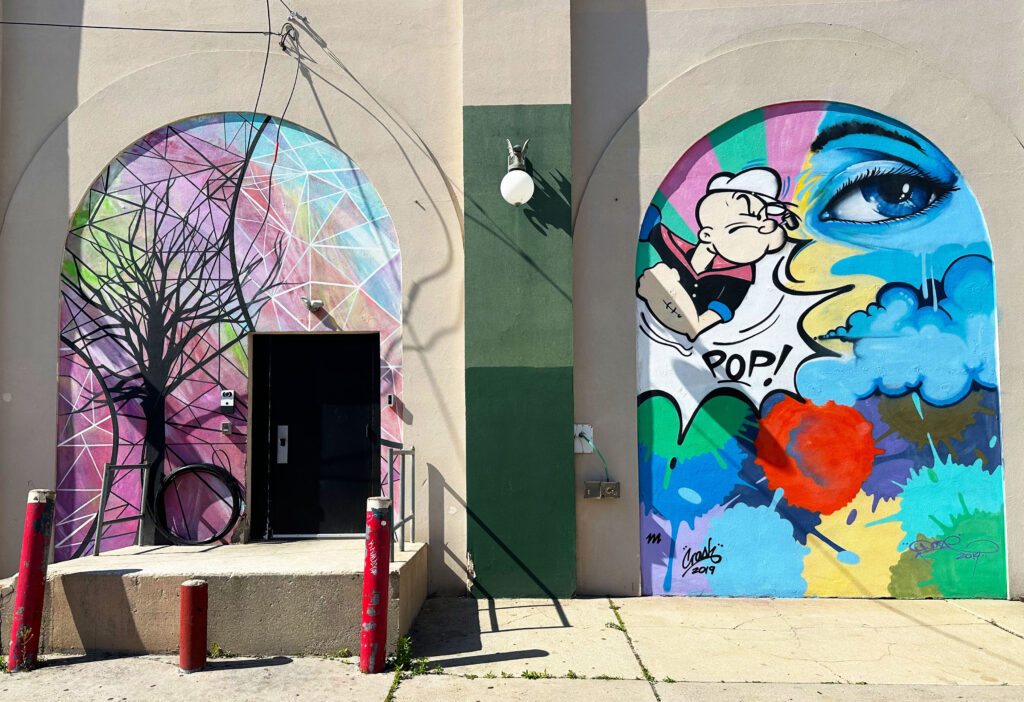
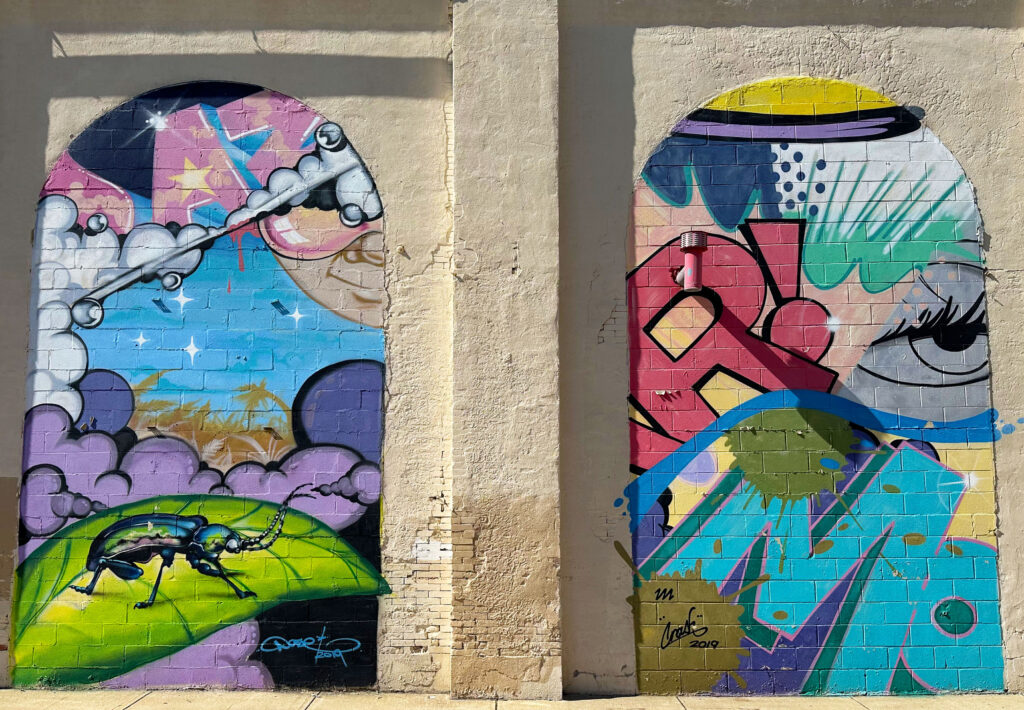
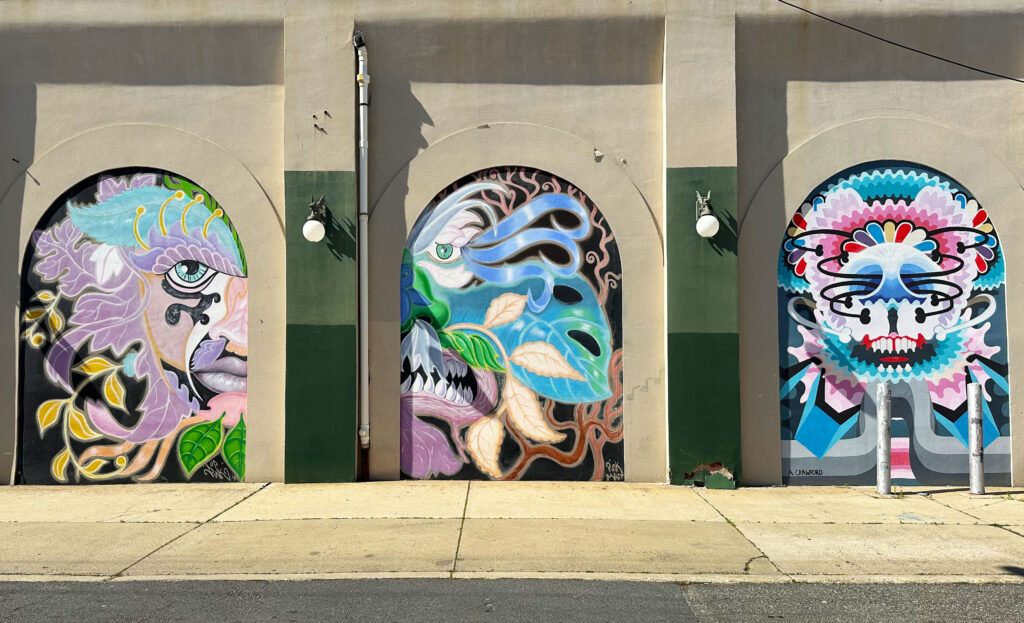
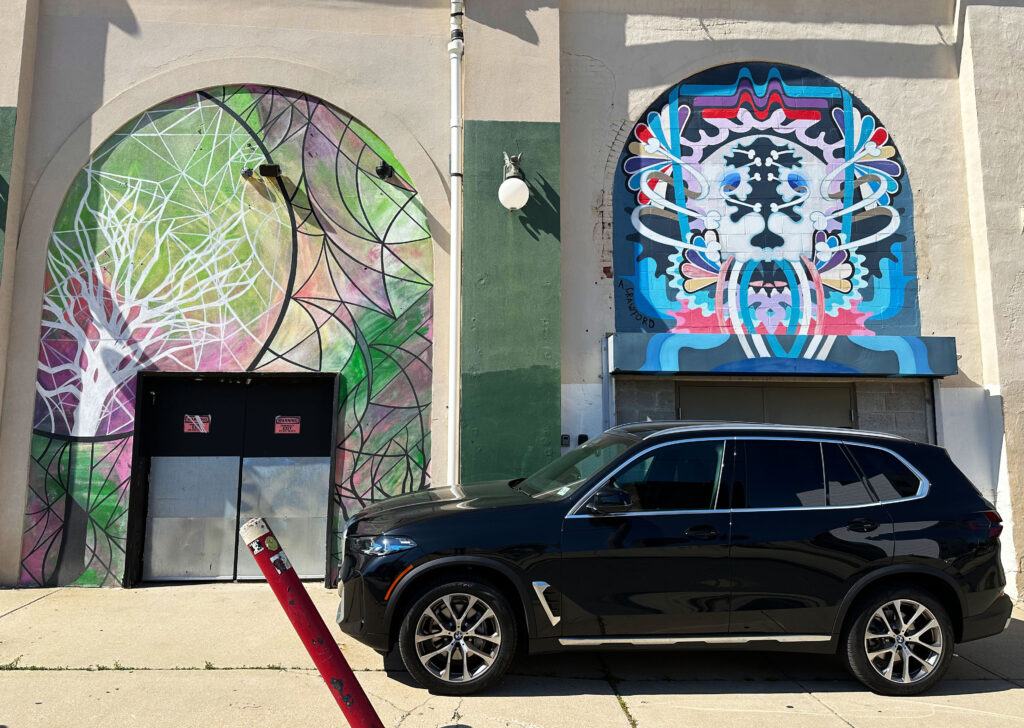
These murals were created in 2020 on the Union Transfer building in Philadelphia by NYC artists John “Crash” Matos, Chris “Daze” Ellis and Lady Pink and Philly-based artists and muralists Adam Crawford and Andréa Grasso.

More details on the project can be found on the Mural Arts website.

Aug 112026
 

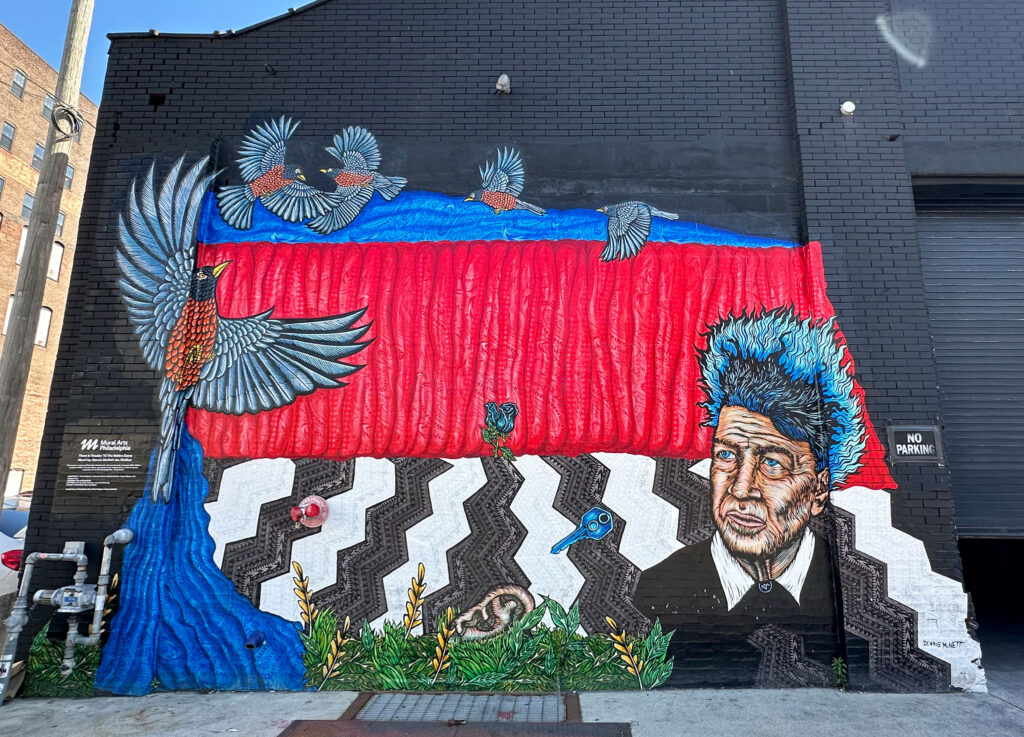
There Is Trouble ‘Til The Robins Come was created by artist Dennis McNett (aka Wolfbat) for Mural Arts Philadelphia in 2025. It incorporates layers of printed woodcut patterns along with painted elements.

The mural is a tribute to David Lynch, who passed away in January of that year.  Lynch lived in Philadelphia’s Callowhill neighborhood, where the mural is located, when he attended Pennsylvania Academy of Fine Arts (PAFA) in the late 1960s.

From McNett’s artist statement on the Mural Arts website:

“The loss of David Lynch leaves a huge void to those he effected with his work and wisdom. As a young artist, I saw Eraserhead, Blue Velvet and Twin Peaks in 1991 when I was 18 and it changed my perspective on what art could be. It made it ok to be weird and feel out of place. It was one of my first introductions to art outside of an art history book and contributed to my development of becoming an artist. I still revisit his work almost yearly. When I was talking about doing a small mural with [Mural Arts Philadelphia], David Lynch had just passed and I was rewatching his films and a documentary. I really wanted to do a mural dedicated to him.

Philadelphia was his biggest influence. 1965-70. The character played by Jack Nance, Eraserhead, had a very memorable head of hair that stood straight up like he had been electrocuted. I put this head of hair on David Lynch’s portrait. Eraserhead was David Lynch’s first film released in 1977.

In Blue Velvet (1986 film) the character played by Lauren Dern, Sandy, describes a dream of robins. In her dream the world is dark and all there was [was] darkness because there was no love. Suddenly thousands of robins flew in and created this blinding light and the light was love. At the end of the movie when all the turmoil is resolved, there is a robin on the windowsill. The robins in the mural are from Sandy’s dream. There is also a drape of blue velvet in the bottom part of the mural. The ear is also from Blue Velvet and is the ear the Jeffrey finds.

The iconic zigzag patterned floor and deep red curtains are from Lynch’s 1990-91 Twin Peaks and later in 1992 Fire Walk With Me. They are the setting of the Black Lodge. The symbolic blue key is from the 2001 movie Mulholland Drive and is tied to Camilla’s reality. The edges or the mural are not cut straight but intentionally extend past the edges like Lynch’s unbound imagination and subconscious mind.”

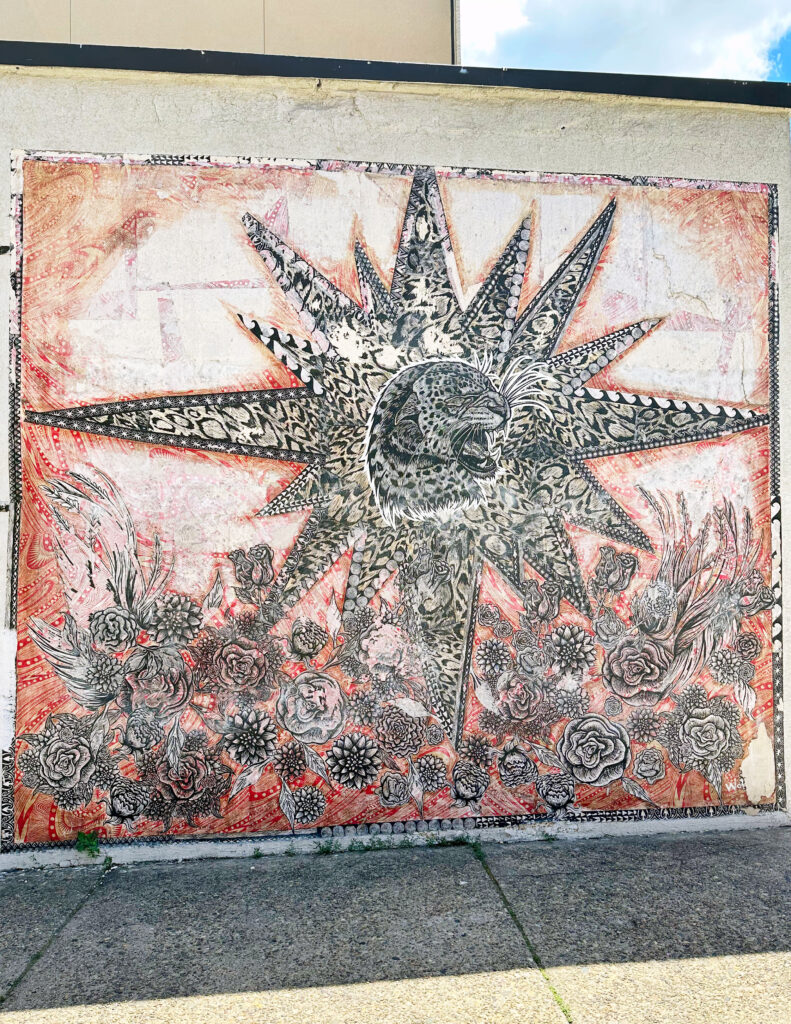
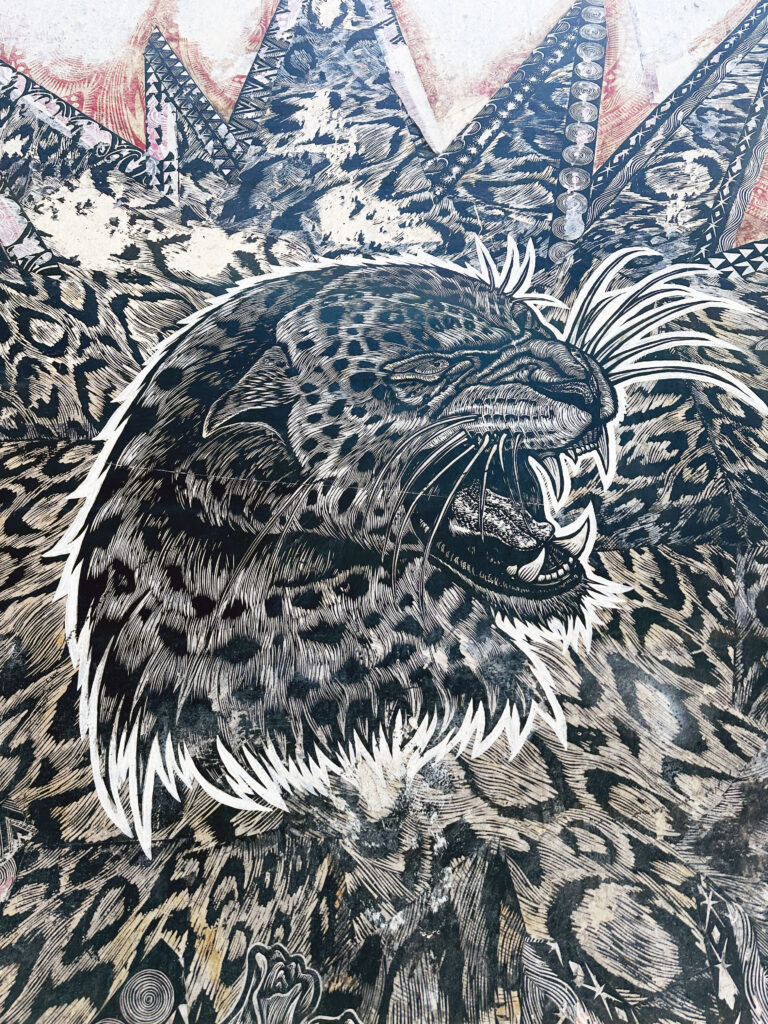
McNett has a few other murals around town, including the one below, created in 2014, located on the side of what once was Philly Home Brew.

Jul 032026
 

Artist Meg Saligman created this mural, Our Flag Unfurled, in 2001, for Mural Arts Philadelphia.

From the Mural Arts website:

In the wake of the 9/11 attacks, artist Meg Saligman volunteered to paint this now iconic mural, Our Flag Unfurled on the massive south facing wall of Philadelphia Warehousing and Cold Storage building. The design was intended to appear slightly sad, as if unfurling down the side of the building.

Painted just north of center city, between I-95 and the Benjamin Franklin Bridge, the size and location of the mural make it a gateway to the city for thousands of daily commuters.

Originally intended as a temporary display of resilience, the 6,000 square foot image of the flag has remained one of Mural Arts’ most visible and iconic works since the fall of 2001. Although Sherwin Williams donated their highest quality paint for the original project, 15 years is a long time for any work of public art. In 2016, the mural received a refresh in time for the Wawa Welcome America July 4th ceremonies, and the Democratic National Convention later that month.

Jul 022026
 

The Talented Mr. Trotter: You Can Be Anything, located on the wall of The Clay Studio building, was created by Philadelphia artist Roberto Lugo in 2022.  It is a portrait of Philadelphia musician Tariq Trotter, aka Black Thought, of The Roots.

From Mural Arts Philadelphia about the mural:

The Talented Mr. Trotter: You Can Be Anything by artist Roberto Lugo is located in the Olde Kensington neighborhood of Philadelphia, Pennsylvania. Lugo has taken inspiration from musical artist Tariq Trotter of The Roots, particularly his story of growing up in Philly as a renaissance man. The mural design explores Trotter’s personal and artistic influences, while materially representing his myriad elements of inspiration and support through combining textile and ceramic patterning from across the world. Trotter’s central portrait is elevated in being formally honored on a highly decorative vase, flanked by his grandmother, who raised him, on the left and Afrika Bombaataa on the right. Traditional floral patterns are spread across the background but are filled with primarily non-Western and street culture patterns. Visual references range from African and South American textile prints, to the graffiti-esque fonts of sneaker culture.

A Kensington-born potter, social activist, spoken word poet, and educator, Roberto Lugo sees his pottery as a process of transforming the ground we walk on into something we eat from. His studio practice communicates with diverse audiences that, in some cases, are not so invested in using art to understand the world. Over the past two years, Lugo has led ceramic workshops at Tyler School of Art and several virtual design challenges with youth in Mural Arts’ Education program. These workshops have tapped into everyday patterns and ceramic traditions from all over the world. Lugo has created a large mural inspired by Roots leading member and proud Philadelphian, Tariq Trotter. Trotter’s multi-talented and visionary approach to his creative practice and humble dedication to his home city are core aspects of Lugo’s mural homage.

A longtime advocate for The Clay Studio and its community programs, Lugo’s mural is installed on The Clay Studio’s building in Olde Kensington at 1425 N American Street that opened in spring 2022.

Jun 242026
 

Magic Hour, by artist and educator Brad Carney and poet Ursula Rucker, was created in 2021 for Mural Arts Philadelphia.

From Mural Arts about the work:

Magic Hour by artist Brad Carney and poet Ursula Rucker was created to reflect personal moments and shared feelings from community experiences during magic hour. Magic hour is a transitional moment each day at sunrise and sunset where the light embraces us and gives us pause to view the awe of the light. The design represents a scene of transition. The sun is just about to set, people are coming and going, embracing the moment of illuminating light.

The mural, placed across the street from the Berks SEPTA station, is also reflective of a location of transition for many commuters going to work, school, and home. The mural aims to provide a moment of pause to those in their daily commute and passers-by, just as magic hour does — reflect in a moment, shed light on our lives, and embrace the day.

Each figurative element represents an expression of joy or wonder as the viewer connects within themselves or with others. The landscape draws from nature, historical buildings, and local contemporary settings reflecting the past, but also looking ahead at the collective bright future. The words and images in the mural are meant to stand alone. They can be formed into one’s own narrative, or be something that the viewer thinks about and interprets as they walk away from the mural.

Jun 172026
 

Isaac Tin Wei Lin created Start From Here in 2015 for Mural Arts Philadelphia.

From the Mural Arts website about the work:

Start From Here is a deconstruction and distillation of Isaac Tin Wei Lin’s previous abstract work which used calligraphic brush marks in single colors. In this piece similar marks were layered in different colors creating a chaotic tapestry. The layered marks are then presented individually like Lego pieces laid out before assembly, allowing them to be seen as parts of a whole.

Start From Here is a reference to operational and instructional manuals for building something. The colors of the marks were chosen based on color theory, what looked good to the artist and national flags. The title plays into the idea of newness and beginnings, while the use of colors of national flags speaks to the idea that (unless you are Native American) we all come from somewhere else as immigrants or refugees, and as the artist’s parents did, are here to start a new life.

You can also find his work on Instagram.

Jun 022026
 

Overlooking the Sartain Street Community Garden, David Guinn‘s mural Garden of Delight was created in 2010 for Philadelphia’s Mural Arts Program.

About the mural from Mural Arts Philadelphia’s website:

On the left side of the mural, rendered in line drawings, are three vignettes from the immediate neighborhood. Two trees in the center lean into each other, symbolic of an embrace. The garden spills out from the space between them. This is to symbolize the spirit of community gardens and the people who work together to nurture these gardens. Guinn created the mural with transparent colors, to simulate the feel of a watercolor painting. The bottom extends the actual garden’s space up onto the wall and vice versa.

You can also find Guinn’s work on his Instagram.

May 052026
 

Artist Meg Saligman has created several murals for the City of Philadelphia Mural Arts Program including Philadelphia Muses, pictured above, which was painted in 1999.

From the Mural Arts website about this mural-

Intended as a contemporary interpretation of the classical muses, Saligman has created an arts landscape filled with figures and elements symbolizing today’s art and creativity.

In the center of the composition is an arts machine spinning out spheres, symbols of the perfect art form. Each of the nine muses in the composition is associated with a sphere, and there are circular references throughout the composition, such as the compass.

Through portraits of local performing artists and references to works of art by local artists, Saligman honors the following forms of creative expression.

The entire mural was created by the artist in her studio using large squares of a polyester fabric called non-woven media (or parachute cloth). These were then adhered to the wall with an acrylic gel, much like a giant decoupage. Saligman’s style is very painterly yet also very realistic and makes frequent allusions to classical themes and figures like the muses in this composition.