Aug 202026
 

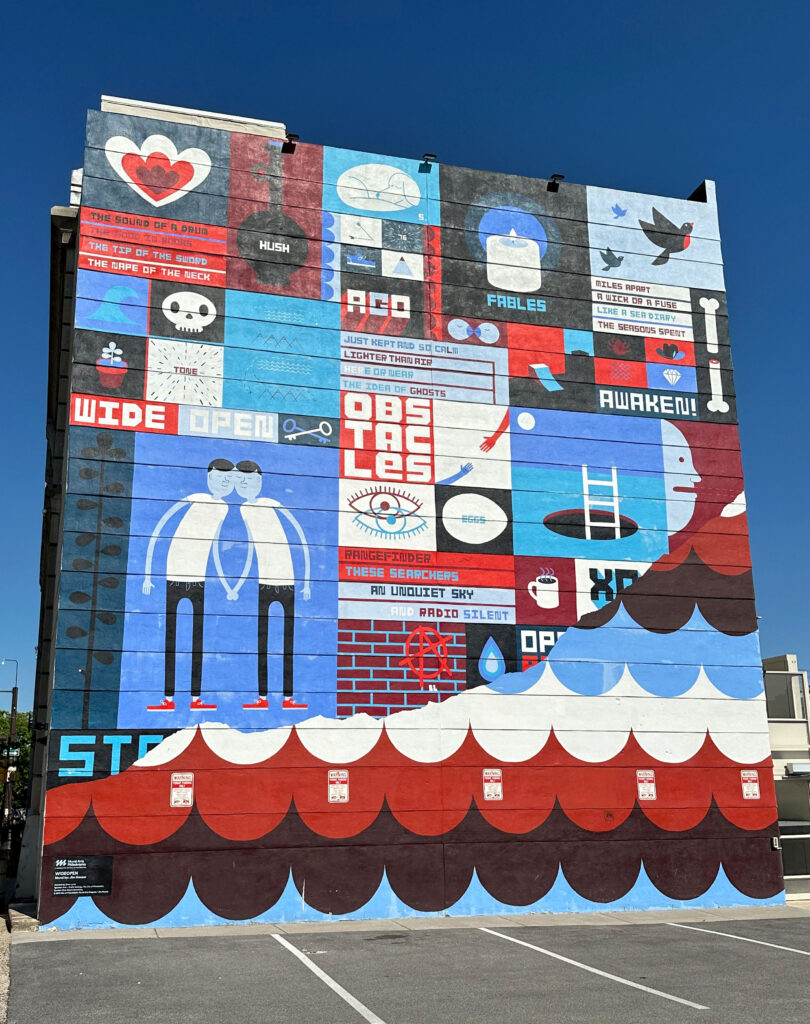
Philadelphia artist Jim Houser created this mural, Wide Open, in 2019 for Mural Arts Philadelphia.

From Mural Arts:

Wide Open by artist Jim Houser features a design that speaks directly to the artist’s view of Philadelphia. Located in the Northern Liberties neighborhood, the mural’s themes include the concept of brotherly love, family and friends, a love of skateboarding and music, and the complex interaction of danger and beauty. The struggle of loss, hope and pride in where one lives intertwine in this striking mural.

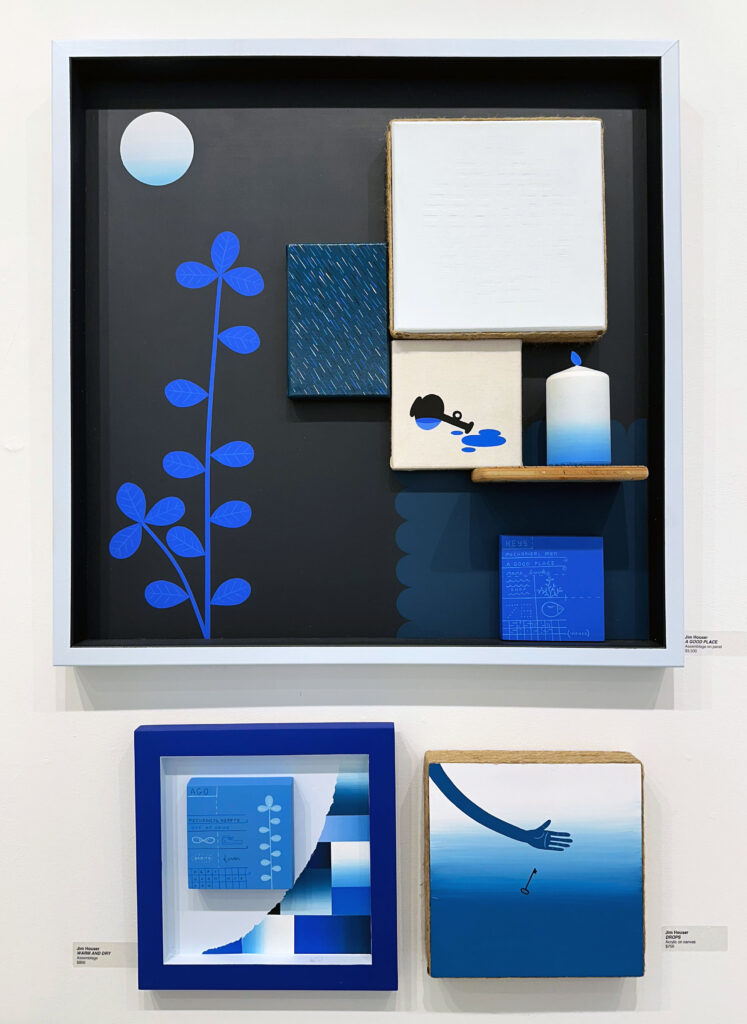
His mixed media paintings, seen below, were also recently on view at Philadelphia’s Paradigm Gallery.

Work by Jim Houser at Paradigm Gallery in May of this year

You can find his most recent work on Instagram.

Aug 042026
 

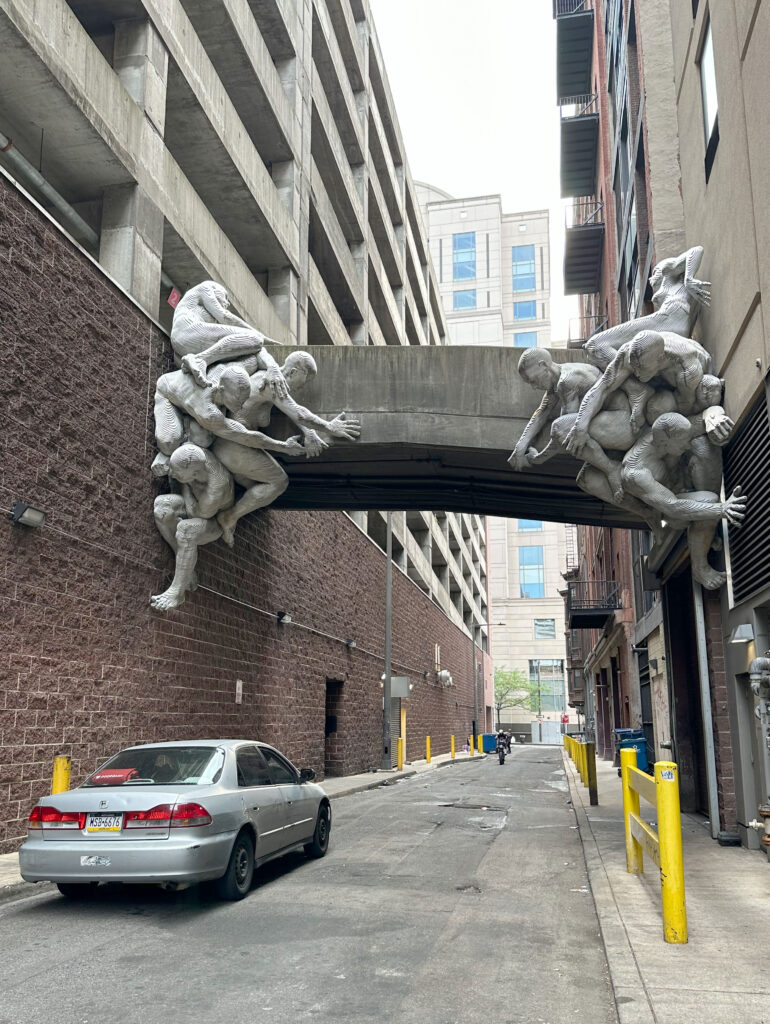
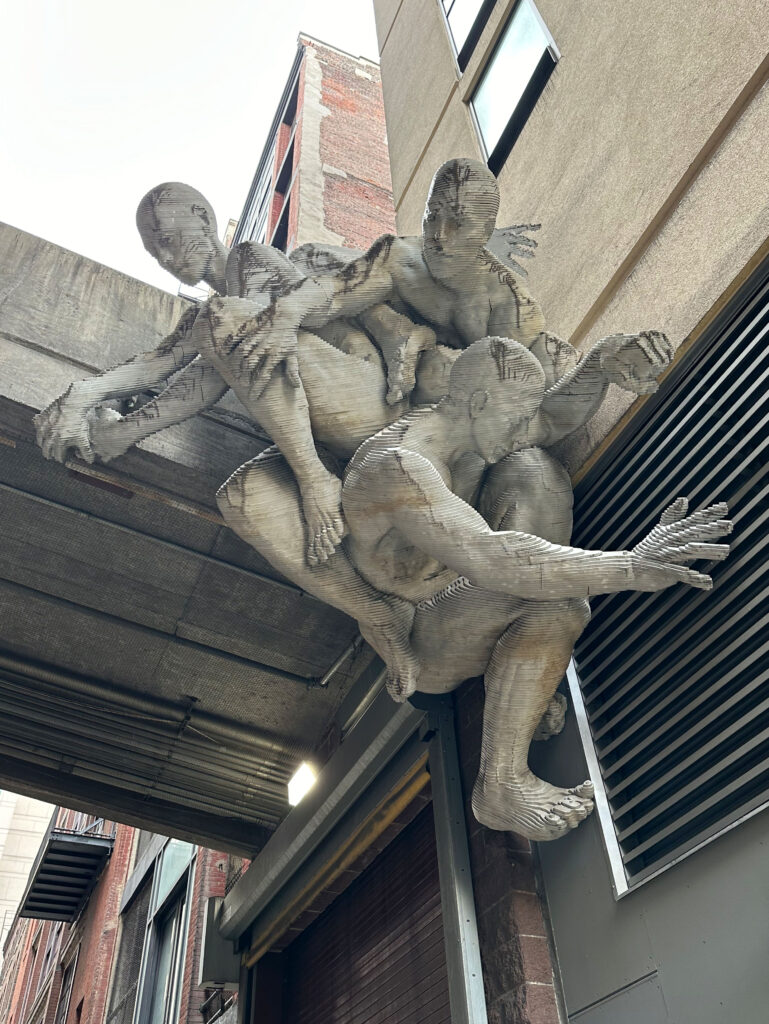
In Miguel Horn‘s 2021 artwork ContraFuerte, his figures, made from aluminum plates, appear to be holding up a bridge between two buildings. Located on Cuthbert Street, an alley off of 18th Street in downtown Philadelphia, it was created as part of the city’s Percent for Art program.

For additional information on the work, check out this article from WHYY.


Jul 022026
 

“Alberto Ayala”, acrylic on wood; Portrait of Roberto Lugo’s grandfather; and “Potpourri Boat”, Ceramic sculpture

Art history, American history, and personal history mix in Roberto Lugo‘s exhibition, American Crib: What’s Happening?, currently on view at The Clay Studio. Wandering around the installation you’ll find portraits of Nikki Giovanni and Lugo’s grandfather, Billie Holiday and The Roots on ceramic sculptures, and plenty of places to sit and take it all in – including a graffitied train car.

From The Clay Studio’s website:

Roberto Lugo welcomes visitors into an imagined living space celebrating his Philadelphia roots and cultural heritage. This deeply personal reflection on America’s socio-political landscape celebrates the power of art to communicate. Lugo mixes historical pottery traditions with pop culture, humor, and critical clarity to address complex issues, including cultural identity, mental health, social justice, and the resilience of underrepresented communities.

This exhibition is a part of Radical Americana. A larger multi-location project that brings together art and culture institutions around Philadelphia. Learn more about Radical Americana here.

More than just a retrospective of Lugo’s career so far, “American Crib: What’s Happening?” will be a deeply personal and poignant reflection on America’s socio-economic and political landscape.

And the Lugo’s statement about his work:

My work is intended to be a biographical narrative that tells the many stories of my life. The objects I create speak of personal subjects – my experiences with obesity, racism, and class division. I use the associations with ceramic material and forms of pottery, such as elite fine china and porcelain, to discuss these issues with humor and irony. My strongest concepts are influenced from the juxtaposition of cultural elements in the form of mass media and current events. Using historical ideology within pottery as a vehicle to introduce a modern theme is of great importance because it allows me to add more dimensions to my artwork.

In the video below, also from The Clay Studio’s website, Lugo discusses the work, some of his inspirations, and the installation.

This exhibition closes 7/9/26.

Jun 262026
 

Protesting injustice is a powerful way for individuals to come together to create change. In the exhibition How We Stay Free at Tilt Institute for the Contemporary Image, photos by Mike Arrison, Harvey Finkle, Joe Piette, and Sunny Singh vividly capture past protests that have taken place in Philadelphia over the years, reminding visitors of the power of community.

From the gallery about the exhibition:

Following the widely publicized murders of George Floyd and other Black citizens by police, an unprecedented wave of public outcry swept the nation. Despite the pervasive uncertainty and restrictions imposed by the global COVID-19 pandemic, Philadelphians organized and sustained mass protests, taking to the streets to emphatically demand racial justice, police accountability, and structural reform. Later that same year, the tragic shooting death of Walter Wallace Jr. by police officers in the West Philadelphia neighborhood of Cobbs Creek further underscored these systemic issues. His family had called 911 seeking assistance for a mental health crisis, only for the encounter to escalate fatally, tragically illustrating the severe gaps in the community’s support and emergency response systems.

Inspired by the energy generated from these events, West Philadelphia residents Fajr Muhammad and Christopher Rogers published How We Stay Free: Notes On A Black Uprising. This project is not merely a book but a dynamic, living archive of community resistance, featuring powerful, multi-modal contributions from a diverse coalition of artists, writers, poets, and scholars who were active participants in the struggle. This exhibition, which shares the same title, serves as an essential visual and experiential archive. It documents the work initiated by the authors, alongside the tireless efforts of local organizations, grassroots collectives, and community-based activists. Philadelphia’s legacy of civil disobedience is both deep and enduring, stretching from the national Black Lives Matter protests to localized calls for Palestinian liberation and the No Arena fight against a proposed sports complex in the historic Chinatown neighborhood.

The visceral imagery and compelling narratives presented on the gallery walls emphasize a crucial point, a collective and sustained response is necessary to ensure meaningful and lasting progress is achieved. This philosophical approach—that change requires unity and shared purpose—serves as the foundational connective tissue binding both the publication and the exhibition. Spanning several decades of resistance and activism, the collection functions as a series of time capsules. These suspended moments deliberately position the artist not as detached photojournalists, but as participant-observers—marching alongside a broad and diverse coalition of revolutionaries united by the inalienable right of all people to be truly free.

This show closes 6/27/26.

Jun 022026
 

Overlooking the Sartain Street Community Garden, David Guinn‘s mural Garden of Delight was created in 2010 for Philadelphia’s Mural Arts Program.

About the mural from Mural Arts Philadelphia’s website:

On the left side of the mural, rendered in line drawings, are three vignettes from the immediate neighborhood. Two trees in the center lean into each other, symbolic of an embrace. The garden spills out from the space between them. This is to symbolize the spirit of community gardens and the people who work together to nurture these gardens. Guinn created the mural with transparent colors, to simulate the feel of a watercolor painting. The bottom extends the actual garden’s space up onto the wall and vice versa.

You can also find Guinn’s work on his Instagram.

May 302026
 

The paintings pictured above are from Philly-based artist Macy West‘s exhibition 4:5, currently on view at Pink Noise Projects in Philadelphia until 5/31/26.

Her statement about the work from the gallery:

4:5 is a new collection of paintings considering the shorthand, diagramming, and notation that accompanies notetaking and sorting of information. I’m fascinated with perception, how we move through the world with physical bodies, how our bodies mediate our experience, and how we develop additional mediators, symbols, and signals to communicate with each other. Developed within the aesthetic parameters of the notebook, each painting relies on the repetition of form and mark. The grid, the crop, and the mask are recurring compositional strategies which reference ideation, speculation, and learning. The paintings are only 10 x 12.5 inches each, maintaining my preferred 4:5 ratio at the scale of the page.

These works respond to my own need to work through information in my studio, to prepare again and again, to edit, revise, measure, scale up, scale down, transpose, translate, cut, paste, and rotate as I try to make sense of experience: perpetual motion, the passage of time, the constant stream of images, the torrent of news, and the influx of sensory information more generally. For 4:5, many of the paintings begin with a screenprint which, like a notebook, contains and sequences the content, the image on the canvas. The structure is a primary assumption accepted to receive the meaning, which excludes as much as it organizes. My perpetual impulse toward change prevents me from flattening ideas into a single image.

The paintings reference the need for a key or an interpreter when engaging with the generated abstractions.Their meaning exists in their impenetrability, their sense of organization without understanding. They are fragmented in a way that reminds us of breakdown in communication, and the limits of human knowledge. What does it mean to know part of something? How much knowledge is required for understanding? When does position fail to provide context, but instead dilute meaning?

Mar 052026
 

Nonstop (2107) by Arden Bendler Browning was commissioned by Philadelphia’s Percent for Art Program and is on view at Philadelphia International Airport.

From Art at PHL about the work-

Philadelphia artist Arden Bendler Browning is known for creating large-scale, highly energized, gestural paintings inspired by her urban surroundings. Browning’s paintings are mostly abstract, yet include hints of realism with the suggestion of architectural structures, roadways, telephone poles, and green spaces. Browning’s paintings envelop the viewer with their scale, intensity, and sense of movement. Her imagery is derived from photos taken while traversing the city. The photos enable her to see the city from various vantage points and, as she has described, “jump through time and space.”

Browning’s paintings visually capture that sense of timelessness as she often conveys a disorienting landscape where colors and shapes collide and overlap, where only glimpses of reality come into focus. She speaks of the urban environment as “a vast sea of fluctuating boundaries arguing claim to the demarcation of space.” This statement also describes Browning’s work as she depicts the urban landscape using an amalgam of colors, shapes, and painterly marks adrift and influx.

Browning has said, “Nonstop is multifaceted and dense, full of action, and vibrancy in unexpected places with pockets of space and clusters of commotion. It is just like Philadelphia.”

Browning is currently part of the group exhibition, The Landscape: Lost and Found at Ellen Miller Gallery in Boston, on view until 3/28/26.