Apr 162026
 

Noah Davis, “The Conductor”, 2014, Oil on canvas

A collection of photographs, notes, documents, and a video (not pictured) are located on a wall at the beginning of the exhibition

Currently at the Philadelphia Museum of Art, the retrospective Noah Davis presents a collection of works from the artist’s short but impressive career.

From the museum about the show-

Noah Davis (born in 1983) drew inspiration from every corner of life: photographs dug out of bins in flea markets, books on Egyptian mythology, daytime television, history paintings, early internet blogs. He used these sources to populate his work with a cast of anonymous figures who rest and play and dance and read and swim in scenes that tug between the fictional and the imaginary, the ordinary and the fantastical.

Even as a high school student, Davis had a painting studio, a space near his family home in Seattle that his parents had rented in the hope that he would kindly stop ruining the carpets. He studied film and conceptual art at Cooper Union in New York City before assembling his own motley education among fellow artists in Los Angeles. He slid fluidly between painting styles to present a breadth of Black life, feeling keenly a responsibility to represent the people around him. In 2012, Davis and his wife Karon cofounded the Underground Museum, in the historically Black and Latinx Los Angeles neighborhood of Arlington Heights. There they transformed three storefronts into a cultural center that was free and open to all.

This exhibition, the first museum retrospective of Davis’s work, highlights his relentless creativity from 2007 until his untimely death in 2015, and his devotion to all aspects of a person’s encounter with art. As he put it simply: “Painting does something to your soul that nothing else can. It is visceral and immediate.”

Below are a few selections-

“Isis”, 2009, Oil and acrylic on linen

Artist Karon Davis, Noah’s wife, discussed Isis on the audio tour provided for Hammer Museum’s version of the exhibition.

Below is an excerpt from the transcript-

…Isis is based on a photo Noah took the day I unfurled two large fans, each with cheesy images of an Egyptian king and queen printed on their surface, and painted them yellow with house paint. I threw on my sister’s Naja’s old gold dance leotard from the 80s with sequins lining the hems and tassels that hung off my butt and sparkled like tinsel.

Noah said, “Stand there. You are Isis.” Using the fans as wings, I raised my arms and opened them. He snapped the pic and quickly retreated to paint. Egypt has always held a special place in my heart. When Noah and I met, I was studying ancient myths and history. I had just left my production job in Hollywood and was exploring film projects. Black Wall Street, Black Cowboys, Stepin Fetchit, The Frogs, Egyptian mythology, and so on.

Noah joined me on these journeys through history, and our home became a portal where imaginations could run wild. We exchanged stories, dreams, and techniques of making art. He painted and we lost ourselves in the magical time.

You can see both of us in this painting. Noah’s reflection is behind me in the window of our home. This painting holds so much for me. It is our past, and it is my present, and future in both painting and in life. I am Isis, and Noah is Osiris.

In ancient Egyptian mythology, Isis assembles all the scattered parts of Osiris in order to cast a spell to make him whole again, so he can live forever as a god. Noah is my Osiris. He will live forever through his work. My assignment is gathering these parts of my love and protecting them..

“Pueblo del Rio: Arabesque”, 2014, Oil on canvas

From the museum about the paintings above-

These works were inspired by Pueblo del Rio, a housing project designed in part by Paul Williams in 1941 for Black defense workers in Los Angeles. The projects were built along the concept of a “garden city,” with shared lawns and outdoor spaces designed to promote community, but they quickly degenerated into one of the most impoverished and dangerous areas in the city. In quiet resistance to this reality, Davis reimagined Pueblo del Rio as a place of harmony and accord, where ballet dancers arabesque and a trumpeter plays.

The exhibition also includes Davis’s Imitation of Wealth, pictured below, where he recreated famous works of art.

“Imitation of Wealth” -Davis’s versions of sculptures by Dan Flavin and Marcel Duchamp along with a real On Kawara painting

From the museum-

Davis’s father left him a small inheritance, specifically for fostering community and joy. Davis and Karon rented three storefronts in the Arlington Heights section of Los Angeles, and started devoting themselves to what would become known as the Underground Museum (UM) – an art space, free and open to all — made possible by his father’s legacy. Davis’s paintings of this time reveal a man deeply invested in the question of what he felt had been missing all these years: spaces for “the people around me” to feel recognized and to congregate. The exhibition The Missing Link opened at Roberts & Tilton Gallery in Los Angeles in February 2013.

Davis persuaded his gallery to throw the opening dinner at the UM, which became the museum’s unofficial opening. He served frogs’ legs and champagne, and guests were able to enjoy new sculptures by Karon, as well as their first jointly curated show: Imitation of Wealth. When no museums would lend, Davis decided he would simply make do himself: “What if we just use what we have — like these ugly-ass lights.” The building’s LED strip lights were turned into an imitation Dan Flavin sculpture, while a $70 vacuum cleaner from Craigslist became a knockoff Jeff Koons. The exhibition became a kind of elegy to the bootleg, the title alluding to Douglas Sirk’s 1959 melodrama Imitation of Life, in which the young Black protagonist passes as white.

The museum included one work from their own collection, On Kawara‘s 3. JUNI 2001, in this recreation, with an interesting coincidence-

When he started bootlegging his own artworks, he made a fake On Kawara painting with the date of Oct. 7, 1957, to mark his father, Keven Davis’s, birthday. To honor his original spirit and ambition, we are lending this authentic On Kawara from our collection to join his “imitations” — it’s a special coincidence that the date is Noah Davis’s own birthday. The year 2001 was when he moved to New York to become an artist; a moment that led to everything else in this exhibition.

This exhibition closes 4/26/26.

Mar 312026
 

“Neighbors”, acrylic on canvas, 2025

“Neighbors” (detail)

“Neighbors” (detail)

“Bird and Fish”, acrylic on canvas, 2025

The paintings in Aitor Lajarin-Encina‘s exhibition Flora, Fauna, and Furniture at Pentimenti gallery in Philadelphia contain tiny elements that tell bigger stories. The longer you look, the more your interpretation may change.

From the gallery-

Aitor Lajarin-Encina’s paintings engage in dialogue with global histories of painting and popular image-making traditions, drawing from sources as varied as Baroque art, Constructivism, satirical cartoons, and video games. They function as visual poems, inviting viewers into moments of existential suspense that spark philosophical reflections on life and relationships between people, objects, and the environment.

At first glance, Aitor’s playful, cartoony, oneiric acrylic-on-canvas paintings appear figurative and tightly composed, relying heavily on narrative tension and visual appeal. They unfold as dreamlike tableaux populated by recurring iconographic elements: human figures, horses, celestial bodies, domestic furniture and objects, clothing, parks, cityscapes, plants, and everyday items. Beneath this apparently flat appearance, the surface opens into multiple layers rich with texture—drips, splatters, bumps, and accidents—carefully constructed and physically present in his work.

Lajarin-Encina approaches art as an immediate and intuitive experience, emphasizing its poetic intensity and emotional resonance rather than hidden or symbolic meanings. At the same time, the work offers a critique of a world designed by humans to be “user-friendly,” while simultaneously estranging people from the natural mysteries and wonders of the world.

This exhibition closes 4/4/26.

Mar 262026
 

Ava Blitz created this glass mosaic, Pink, in 2012 for Philadelphia International Airport. It is part of Philadelphia’s Percent for Art Program.

From Art at PHL-

Philadelphia artist Ava Blitz works in various artistic disciplines including sculpture and photography. In either medium, Blitz is inspired by nature and natural forms. In her sculptural work, she is known to mass similar objects together to suggest continual growth and to emulate the abundance of repetitive forms found in nature. Her sculpture is often large-scale and abstract with minimal detail to capture nature’s basic essence and to encourage the viewer’s imagination. Blitz also photographs nature, usually imagery that she has taken while on walks near her home. The photographs, typically of trees, feature variations of dense, lush foliage. Using digital photography, Blitz is able to heighten the color and alter the imagery to emphasize the beauty and mystery that inspires her artwork.

In Pink, Blitz has incorporated her photography and her interest in nature, abstraction, and repetition to create a glass tile mosaic. She describes the artwork as “playing with the edge between realism and abstraction to create a magical forest or garden – a virtual reality that viewers can enter, explore, and experience on multiple levels.” Seen from a distance, the branches and pink blossoms are recognizable. Yet up close, the tree dissolves into an abstraction of tactile, colorful, iridescent glass tiles.

Mar 262026
 

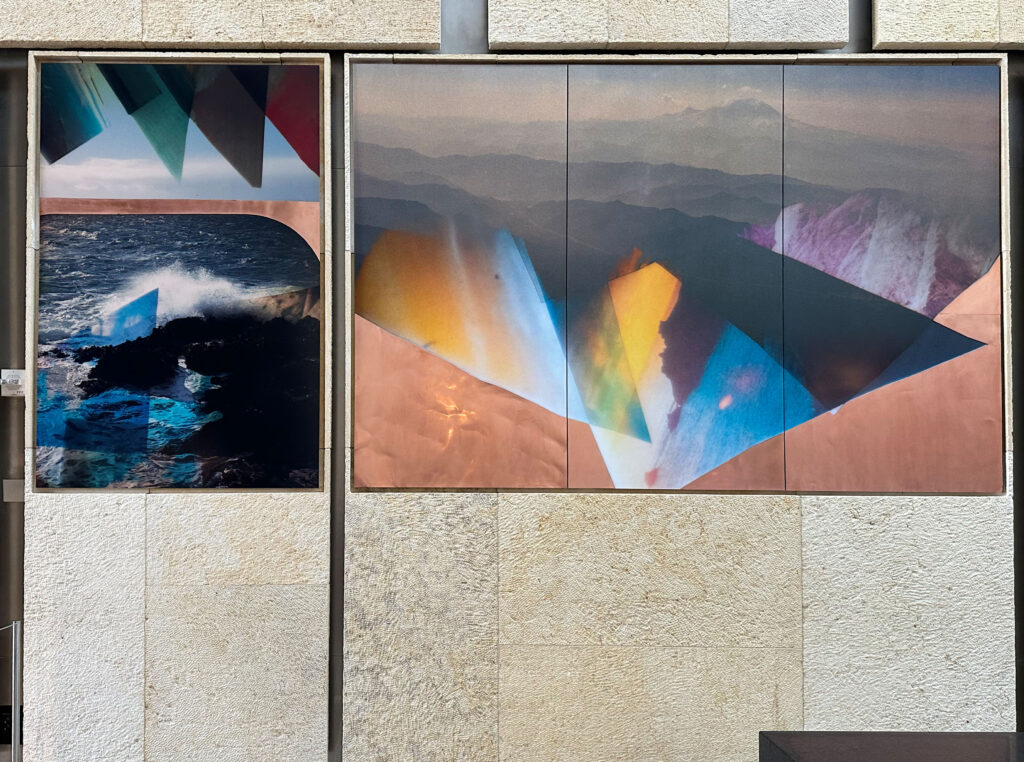
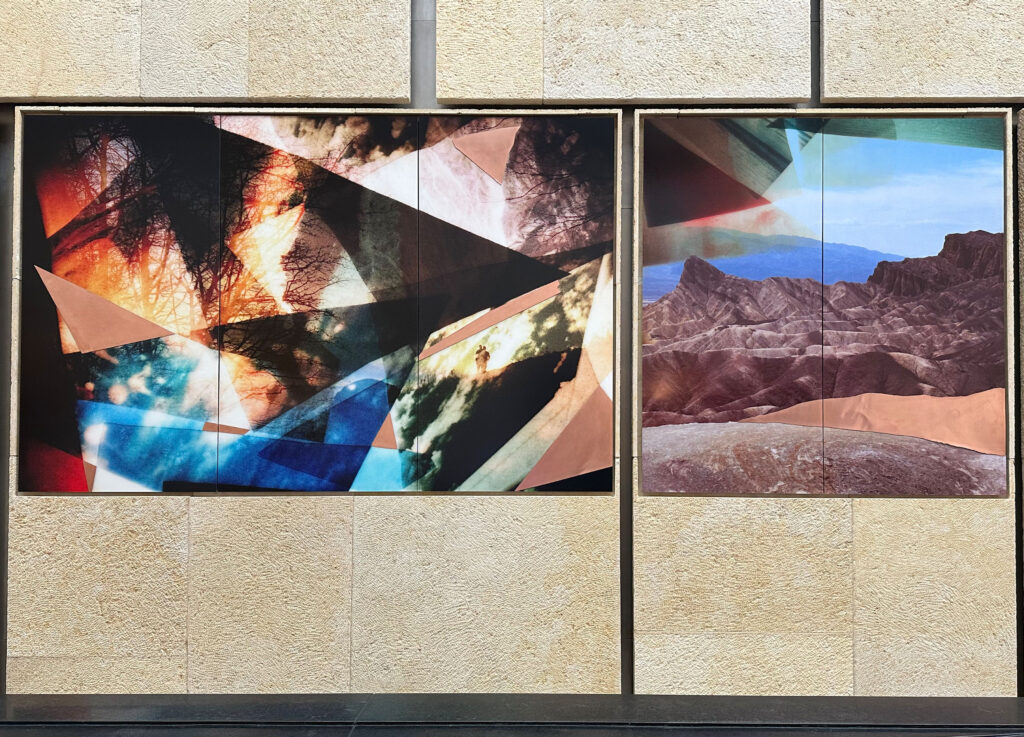
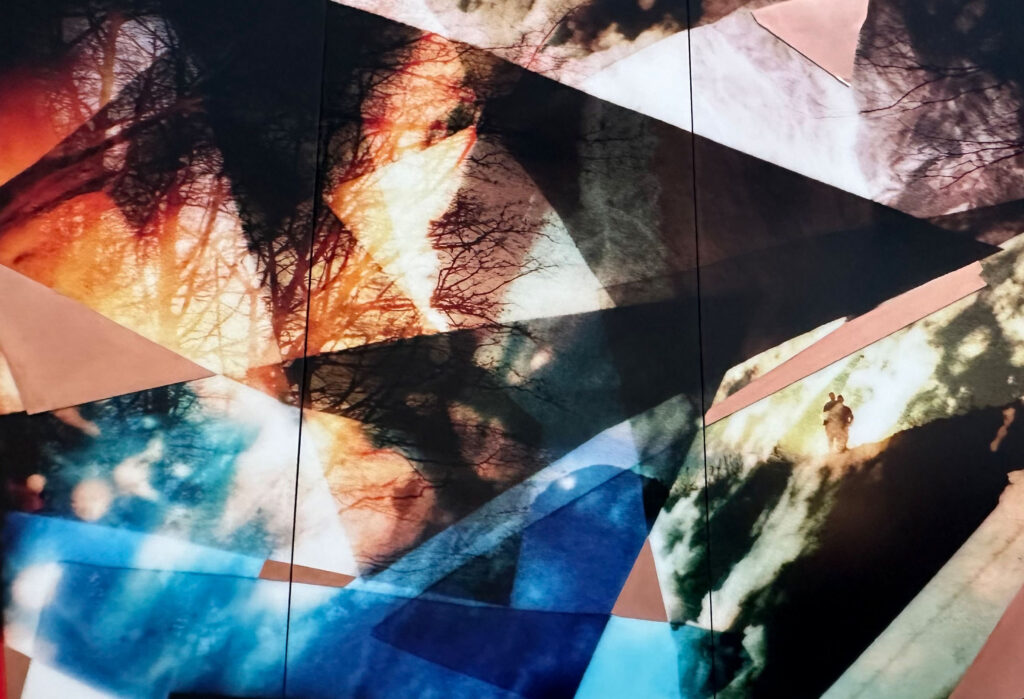
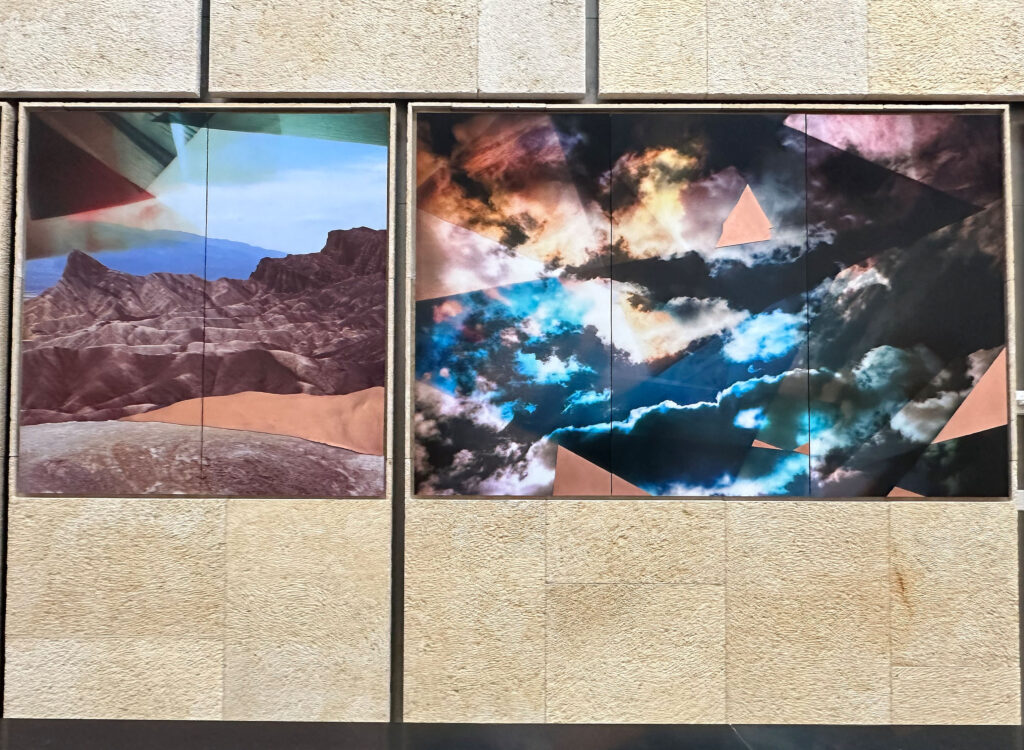
Sarah Zwerling‘s digital collage Hamilton Street, Philadelphia, is on view at the Philadelphia International Airport as part of their exhibition programming.

From Art at PHL’s website

Philadelphia artist Sarah Zwerling was invited to create a site-specific artwork installed directly on two interior glass enclosures located in Terminal A-East. Zwerling, whose work often features nature and architectural structures, has combined these influences as she has re-imagined her neighborhood street — an area in West Philadelphia characterized by its abundance of twin homes. Using digital photography, Zwerling focused on the rooflines of the Hamilton Street homes in combination with various trees found throughout nearby Fairmount Park. The imagery lines both sides of the concourse similar to the experience of walking along a narrow residential street like Hamilton. Zwerling has emphasized and altered aspects of the homes and the trees, even adding stylized blossoms and birds to animate the landscape and enhance the overall beauty and sense of wonderment.

Feb 192026
 

“Woman Walking in an Exotic Forest”, c. 1910, Oil on canvas

“The Sleeping Gypsy”, 1897, Oil on canvas

Henri Rousseau: A Painter’s Secrets at the Barnes Foundation in Philadelphia provides a fascinating look at the self-taught painter’s career. Rousseau’s variety of subjects, from portraits and flowers, to the jungles he never experienced in person, were in part a response to what was popular and might sell. But the unique, and sometimes mysterious, paintings also show an artist unafraid to paint the world in his own distinct style.

From the foundation about the exhibition-

Born in 1844, Henri Rousseau became an artist in his forties, while he was working as a customs officer at the toll gates of Paris. From 1886 his paintings were regularly shown at the annual Salon des Indépendants, where anyone who paid the entrance fee could exhibit. He kept clippings of his reviews, good or bad. What mattered to him was being noticed, and though his paintings were mocked by many, by the end of the 19th century he had become a celebrity. Notoriety, however, did not lift his always meager standard of living.

Rousseau taught himself to paint and was celebrated as a “naif,” which at the time meant uneducated, simple, and honest. In reality, he had received a good basic education and was aware of art history and the art of his time. His acquaintances included Paul Gauguin and Pablo Picasso, and he knew successful “academic” artists too. Moreover, he was not always trustworthy; he joined the army in 1863 to avoid going to prison for embezzlement, and in 1908 he was found guilty of passing false checks.

This exhibition sets out to show how strategic Rousseau was in pursuing earnings and recognition as an artist, as well as the intensity with which he committed himself to painting. It also seeks to reveal the surprising complexity of his painting technique. His self-belief overrode his failures, and the impact of his work ensured art market success, but only after his death in 1910. By the mid-1920s, Dr. Albert C. Barnes was buying Rousseau’s paintings for prices comparable to those of Matisse and Picasso.

Below are a few more selections-

“Carnival Evening”, 1886, Oil on canvas

“Carnival Evening”, 1886, Oil on canvas (detail)

“The Snake Charmer”, 1907, Oil on canvas

“Jungle Landscape with Setting Sun”, c.1910, Oil on canvas

“Jungle Landscape with Setting Sun”, c.1910, Oil on canvas (detail)

This exhibition closes 2/22/26.


Feb 182026
 

This mural by Justine Kelley is one of several located in Philadelphia International Airport as part of their rotating exhibition programming.

From Art at PHL curator Helen Cahng and the artist-

Justine Kelley is a Filipino-American, Philadelphia-based printmaker, illustrator, and designer. She is inspired by vibrant colors, emotions, and the accidents that happen during the art-making process. Most of Kelley’s work is hand-drawn, infusing it with an honest, intimate quality. Her illustrations aim to explore the social barriers that exist between people to create new structures of meaning and connectivity. Kelley likens her art-making process to cooking—she uses the resources she has to feed the people she loves. Her goal is to synthesize emotion as a raw material and use it to create a magic funhouse mirror which reflects the world back at itself.

For her exhibition at Philadelphia International Airport, Kelley presents the Bella Vista neighborhood with an emphasis on the Italian Market, the nation’s oldest open-air market which spans 20 city blocks in South Philly. Bella Vista means “Beautiful Sight” in Italian. For many generations, this neighborhood has been home to a variety of immigrant communities, from Irish, Italian, and African descendants in the 1800s to Vietnamese, Korean, Cambodian, and Mexican communities settling in the 1900s. Having recently moved to South Philly, Kelley says, “I wanted to celebrate the abundance of food and fresh produce, colorful signage and typography, and bustling community that exist in the Italian Market and Bella Vista area, with much thanks to the shopkeepers who run their businesses and the neighbors who live here… If the path to one’s heart is through the stomach, then this place is an artery pumping vitality to the city, feeding us with nutritious foods and delicious sights. It’s a feast for all the senses. If I were to rename Bella Vista, it would be the Italian words for “Beautiful Sights, Sounds, Tastes, Smells, and Feelings”.

Feb 182026
 

King Saladeen created these murals for the Philadelphia International Airport’s Exhibitions Program.

From Art at PHL about this exhibition

Philadelphia artist King Saladeen has created his largest painting installation to date currently on view at Philadelphia International Airport. Saladeen’s art is motivational and energetic. His paintings are filled with vibrant colors, shapes, patterns, markings, and text, along with representational imagery that includes his trademark JP the Money Bear and Philadelphia’s skyline. The work represents his passion to inspire as he says, “Dream Big, Love What You Do!” A message evident in this epic four-part painting.

Saladeen created this artwork partially in his studio as four paintings scaled to the proportions of the four gallery walls. The original paintings were scanned, printed on vinyl, and adhered on site. Over two nights, Saladeen painted atop the vinyl to complete his vision. It was an amazing performance to watch as he intuitively added more colors, shapes, and details until it was deemed complete.


Feb 132026
 

Currently on view at Philadelphia International Airport, It’s A Wrap 2, brightens a section of the airport with art work and installations by several local artists.

Included in this post are works by Nicole Nicolich (pictured above), Tim Eads of Tuft the World, Olivia Chiaravalli, and on the ceiling tiles- work by Miriam Singer and Eurhi Jones.

From the airport about the exhibition

This exhibition features work by Philadelphia area artists who were invited to create unique architectural interventions within the Airport terminal. Using yarn, fabric, felt, found objects, tape, paint, wheat paste, and wood, the artists applied their work to the ceiling tiles, columns, rockers, walls, walkway, and windows. They have visually transformed this location into an immersive and experiential art-filled passageway.

The artists responded to the existing architectural elements to create an unexpected visual experience and an engaging space for people to pass through. It is a form of urban interventionism where art activates the built environment with the intention to see a public space in a new and creative way.

Work by Tim Eads of Tuft the World

Olivia Chiaravalli, “Brick by Brick”

Miriam Singer, “Dreamliner”

Eurhi Jones, “Tinicum”

Feb 132026
 

Anuj Chandra Shrestha, “Sumud”

If you have a layover or arrive early to Philadelphia International Airport, make sure to take some time to check out some of the art on display.  Works like the murals in this post, are part of the airport’s Exhibitions Program.

About Art at PHL:

The Airport’s Exhibitions Program is a nationally-recognized, award-winning visual arts initiative.

In 1998, Philadelphia International Airport established an Exhibitions Program – a visual arts initiative to humanize the Airport environment, provide visibility for Philadelphia’s unique cultural life, and to enrich the experience of the traveling public.

The Exhibitions Program is responsible for organizing and presenting rotating exhibitions that are located throughout the Airport. The exhibits change throughout the year to provide a variety of educational and cultural programs. This forum for presenting visual arts attests to the Airport’s commitment to supporting arts and culture.

The Exhibitions Program provides millions of visitors from around the world access to a wide variety of art forms by artists and arts institutions from the Philadelphia area.

The artists in this post- Anuj Chandra Shrestha, Lale Westvind, Steve Teare, Olivia Fredricks, and Amze Emmons are all part of the exhibition, Jawn 8. Jawn, a slang term local to Philadelphia, is defined as- “a placeholder word that may refer to a thing, place, person, or event, substituting for a specific word/name”. For even more on the word jawn, check out this article on Atlas Obscura.

Lale Westvind, “They Grew The Garden”

Steve Teare, “The Art Museum Games”

Olivia Fredricks, “The City is Our Playground”

Amze Emmons, “Philly Birdsong Onomatopoeia”


Feb 062026
 

Giorgio de Chirico, “Portrait of Guillaume Apollinaire”,1914, Oil and charcoal on canvas

René Magritte, “The Secret Double”, 1927, Oil on Canvas

Dreamworld: Surrealism at 100 at the Philadelphia Museum of Art presents a large collection of works, in a variety of mediums, from the artistic movement. The show takes you through Surrealism’s history and is filled with many inventive and imaginative pieces- including several from lesser-known artists.

From the museum about the exhibition-

Surrealism burst onto the scene in Paris in 1924. French writer André Breton announced the aims of this revolutionary literary and artistic movement in his Manifesto of Surrealism. It started with a question: How, ideally, should we live? Breton observed that, at about twenty years of age, we make the error of trading our childlike imaginations for adult good sense and logic. Yet it’s the imagination that allows access to the innate state of freedom that we all possess. And maintaining freedom, Breton proposed, should always be the highest human aspiration.

Surrealism’s ambitions were broad and bold: its adherents wanted nothing less than a revolution in consciousness. To that end, they explored a method of experimental poetry called automatic writing, comparable to spoken free association, done spontaneously and, as far as possible, without conscious intent. Sigmund Freud’s theories about the role of the unconscious and the interpretation of dreams were an important inspiration. The Surrealists looked to access the unconscious mind to break free from the constraining rationality of the modern world.

Visual artists were part of the Surrealist movement from the start. They took up surprising and often challenging subject matter, imagery, and techniques across many mediums: painting, sculpture, drawing, printmaking, photography, book illustration and design, and film. In Dreamworld: Surrealism at 100, we explore how, from the movement’s 1920s beginnings through the 1950s, these trailblazing artists made good on Surrealism’s revolution in consciousness.

The exhibition is split into six categories- Waking Dream which features Surrealism’s beginnings in the 1920s, Natural History, focused on the influence of nature, Desire, Premonition of War, Exiles, and Magic Art, which focuses on the new type of esotericism that emerged within Surrealism in the aftermath of World War II.

Lee Miller’s photographs of natural rock formations

Salvador Dalí, “Aphrodisiac Telephone” 1938, Plastic, metal

From the museum about Aphrodisiac Telephone, one of the artworks in the Desire section

Salvador Dalí likened the Surrealist object, which uses found items, as a symbolic creation with improbable juxtapositions, comparable to poetry and sexual perversion. He applied this idea in Aphrodisiac Telephone. Its basis is the substitution of a lobster— a real lobster in the sculpture’s first iteration for display in 1938, a factitious lobster in white plastic for the editioned version —for a similarly shaped telephone handset. The title alludes to the lobster’s reputation as an aphrodisiac when eaten.

Max Ernst, “The Fireside Angel (The Triumph of Surrealism)”, 1937, Oil on canvas

From the museum about the Max Ernst painting above, from the Premonition of War section-

Ernst painted The Fireside Angel (The Triumph of Surrealism) to protest the atrocities of the Spanish Civil War as well as the defeat of the Republican side. But this depiction of a rampaging bird-headed beast also served as an allegorical reflection on the nature of evil. Ernst exhibited this painting as The Triumph of Surrealism — a despairingly ironic title given the situation in Europe — at the 1938 International Surrealist Exhibition in Paris.

During World War II many European artists escaped to New York City and Mexico. The Exiles section features works by these artists, as well as Mexican (like Roberto Montenegro pictured below) and American artists whose work could also be seen as part of the Surrealist movement.

Roberto Montenegro, “The Double”, 1938, Oil on panel

The last section of the exhibition Magic Art, focuses on the increase in post-war interest in supernatural themes. There was also a room devoted to the work of artist friends Leonora Carrington and Remedios Varo, who had moved to Mexico during the war.

Leonora Carrington, “And Then We Saw the Daughter of the Minotaur”, 1953, Oil on canvas

Remedios Varo, “Creation of the Birds”, 1957, Oil on Masonite

This exhibition is on view until 2/16/25.