Mar 292023
 

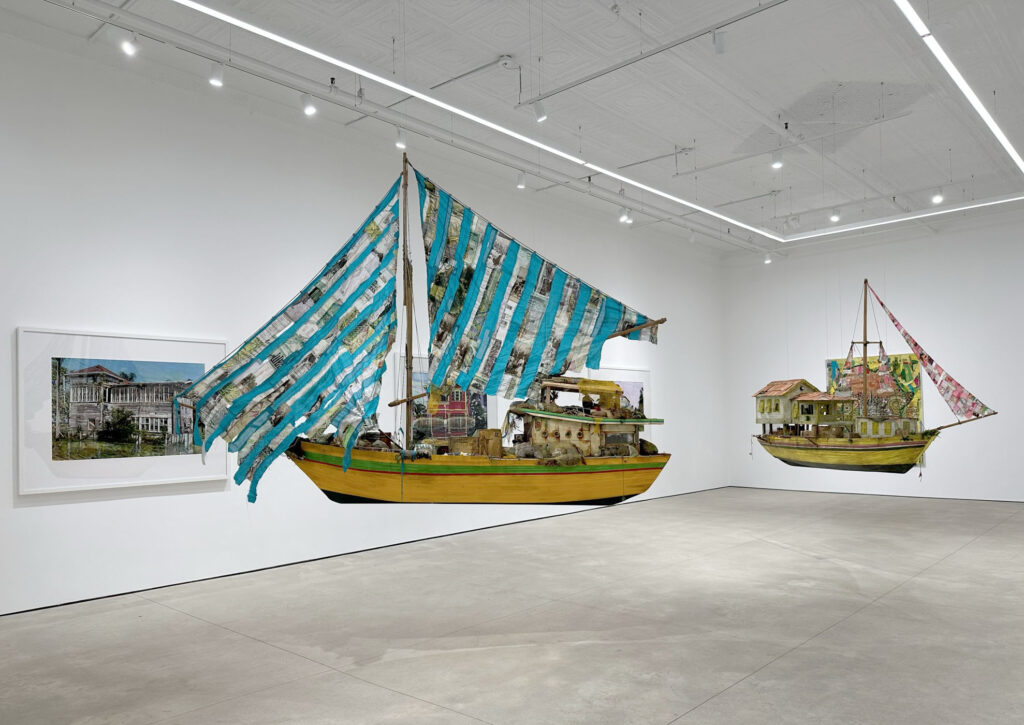
Hew Locke, “Listening to the Land” room view

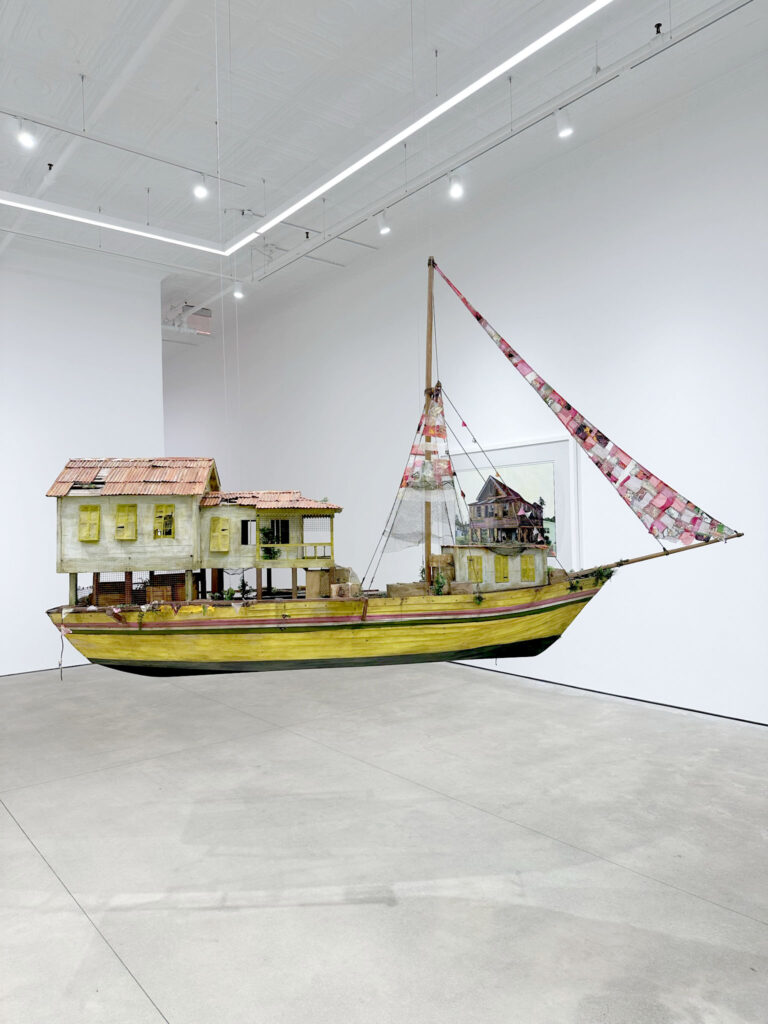
“The Relic”, 2022

“The Relic” 2022 (another side)

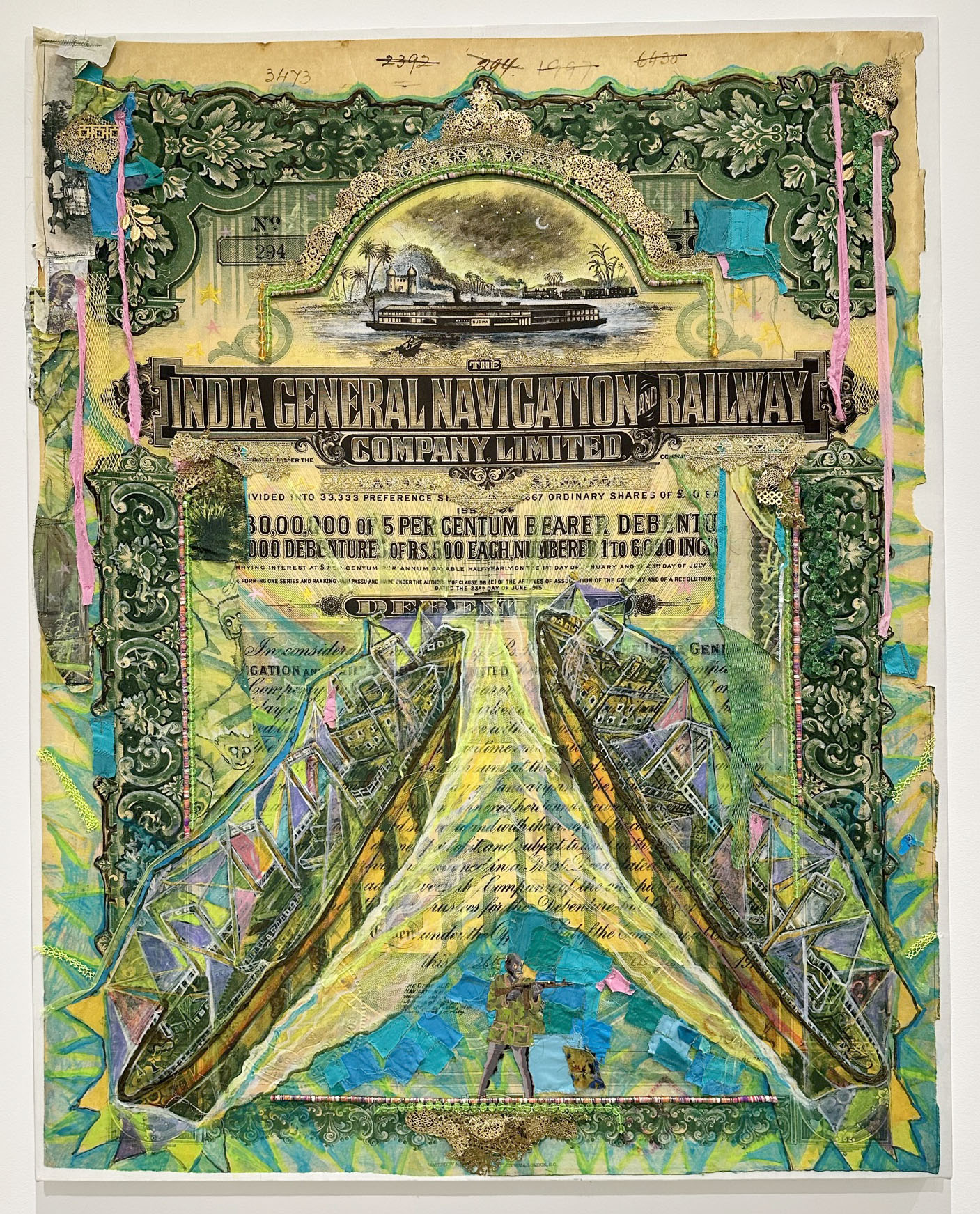
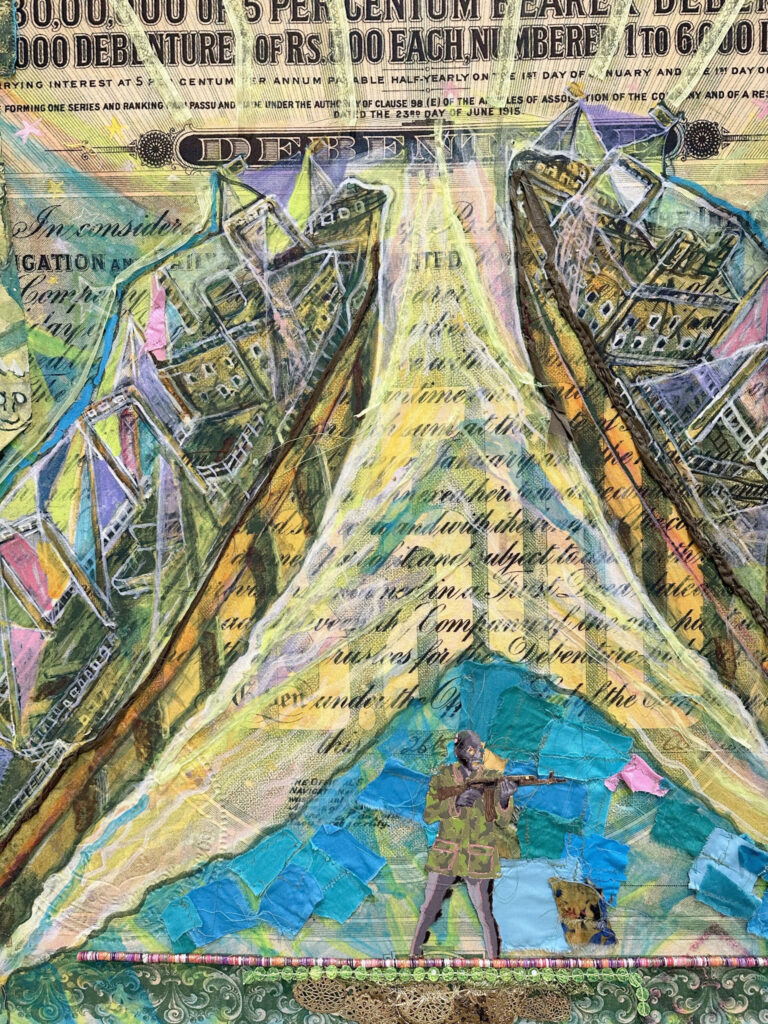
“Raw Materials 3”, 2022

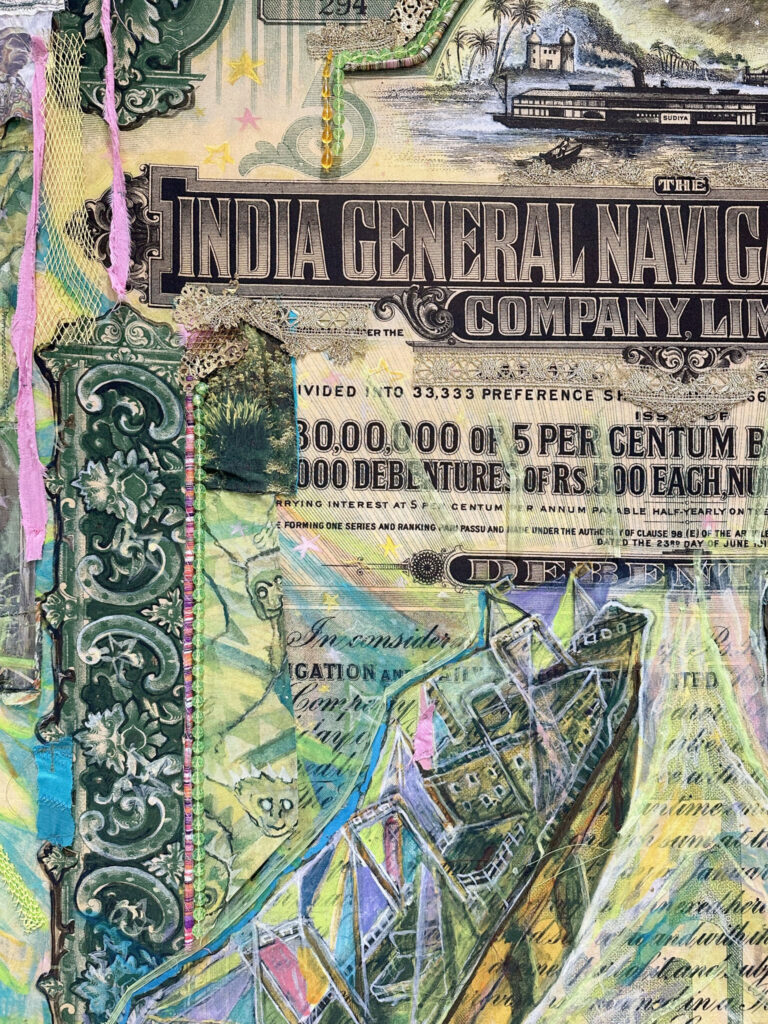
“Raw Materials 3”, 2022 (detail)

“Raw Materials 3”, 2022 (detail)

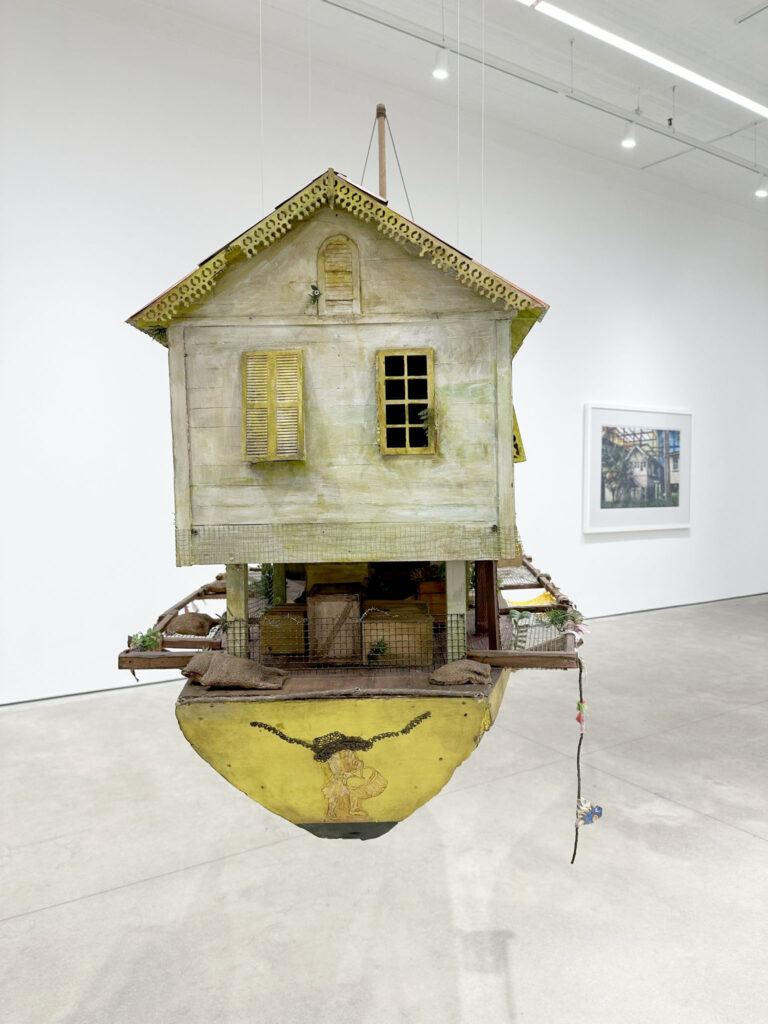
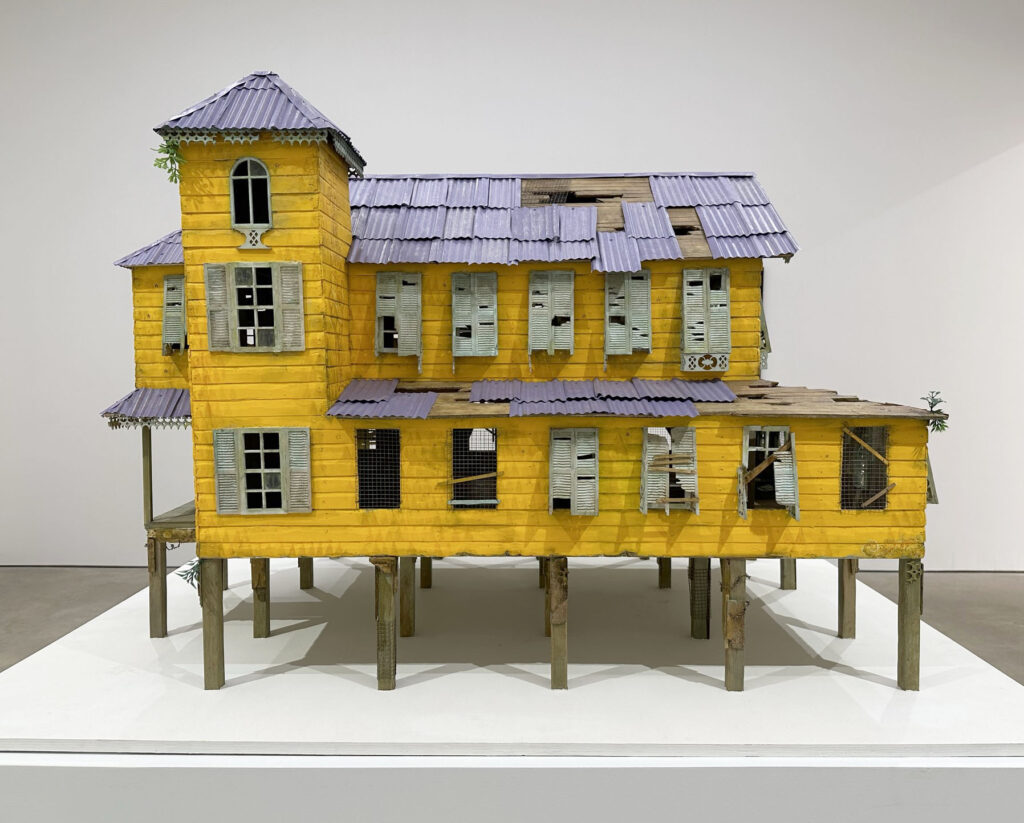
“Jumbie House 2”, 2022

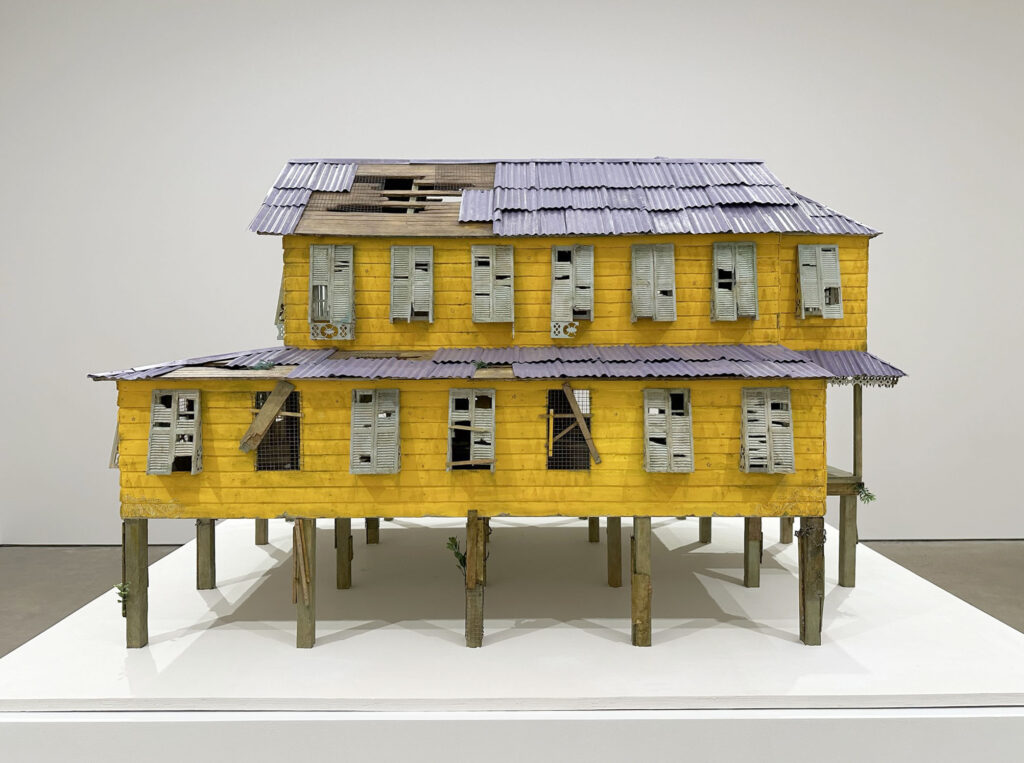
“Jumbie House 2”, 2022

For Hew Locke’s exhibition, Listening to the Land, at P.P.O.W. he has created intricate sculptures and paintings that are fascinating in person.

From the press release-

Locke is known for exploring the languages of colonial and post-colonial power, and the symbols through which different cultures assume and assert identity. Furthering the themes explored in his celebrated commission The Procession at Tate Britain, and his concurrent installation Gilt on the façade of The Metropolitan Museum of Art, this exhibit engages with contemporary and historical inequities while reflecting on the landscape and history of the Caribbean. The exhibition draws its title from a poem by Guyanese political activist and poet Martin Carter which situates itself between two opposing forces of the landscape – sea and forest. Locke’s show features new sculptures and wall works with recurring motifs of stilt-houses, boats, memento mori, and share certificates referencing tensions between the land, the sea, and economic power. Reflecting on these links, Locke notes, “The land was created to generate money for colonial power, now the sea wants it back.”

Translating to ‘land of many waters,’ Guyana and its physical, economic, and political landscape serve as one of the primary sources for Locke’s work. Having spent his childhood in this newly independent nation, the artist witnessed first-hand an era of radical transformation. Now, the country teeters on the precipice of an oil boom and is one of the world’s fastest growing economies. Juxtaposing personal meditations on the climate crisis with political commentary on the history of a globalized world, Locke contemplates the ways in which colonies were exploited to accumulate capital, and observes how Guyana’s economic future lies in the exploitation of its waters. Locke’s new boat sculptures The Relic and The Survivor embody this broad worldview as the two battered wrecks drift through time and history. Evoking the fragmented and diverse legacies of the global diaspora, the boats’ patchwork sails are interspersed with photo transfers of 19th Century cane cutters and banana boat loaders, while their decks are loaded with cargo that could allude to colonial plunder, trade goods or personal belongings.

Based on an abandoned plantation house, Locke’s newest sculpture Jumbie House 2 features layered images that unveil the spirits that haunt this colonial vestige. Presented alongside are a series of painted photographs of dilapidated vernacular architecture across Georgetown and rural Guyana. Constantly under threat of being washed away by storms or rising sea levels, these crumbling structures echo anxieties surrounding climate change and historical erasure. A new series of mixed media wall works, Raw Materials, is derived from antique share certificates and bonds. Locke richly decorates the appliques with acrylic, beads, and patchwork to draw attention to the complex ways in which the past shapes the present. The image of an 1898 Chinese Imperial Gold Loan behind painted Congolese figures connects the global economy at the height of Empire to current Sino-African trade networks. In another work, a painted representation of a Nigerian Ife mask, alongside an image of David Livingstone, is layered on a French-African Mortgage Bond from 1923, connecting exploration and exploitation of African land, to current conversations surrounding the repatriation of artifacts. Taken together, the works in Locke’s Listening to the Land echo William Faulkner’s adage “The past is never dead. It’s not even past.”

This exhibition closes 4/1/23.

The Procession, mentioned above, can now be seen at Baltic Centre for Contemporary Art, in Gateshead, England until June 11th, 2023.

Gilt, also mentioned above, is on view at The Metropolitan Museum of Art until May 30th, 2023.


Mar 282023
 

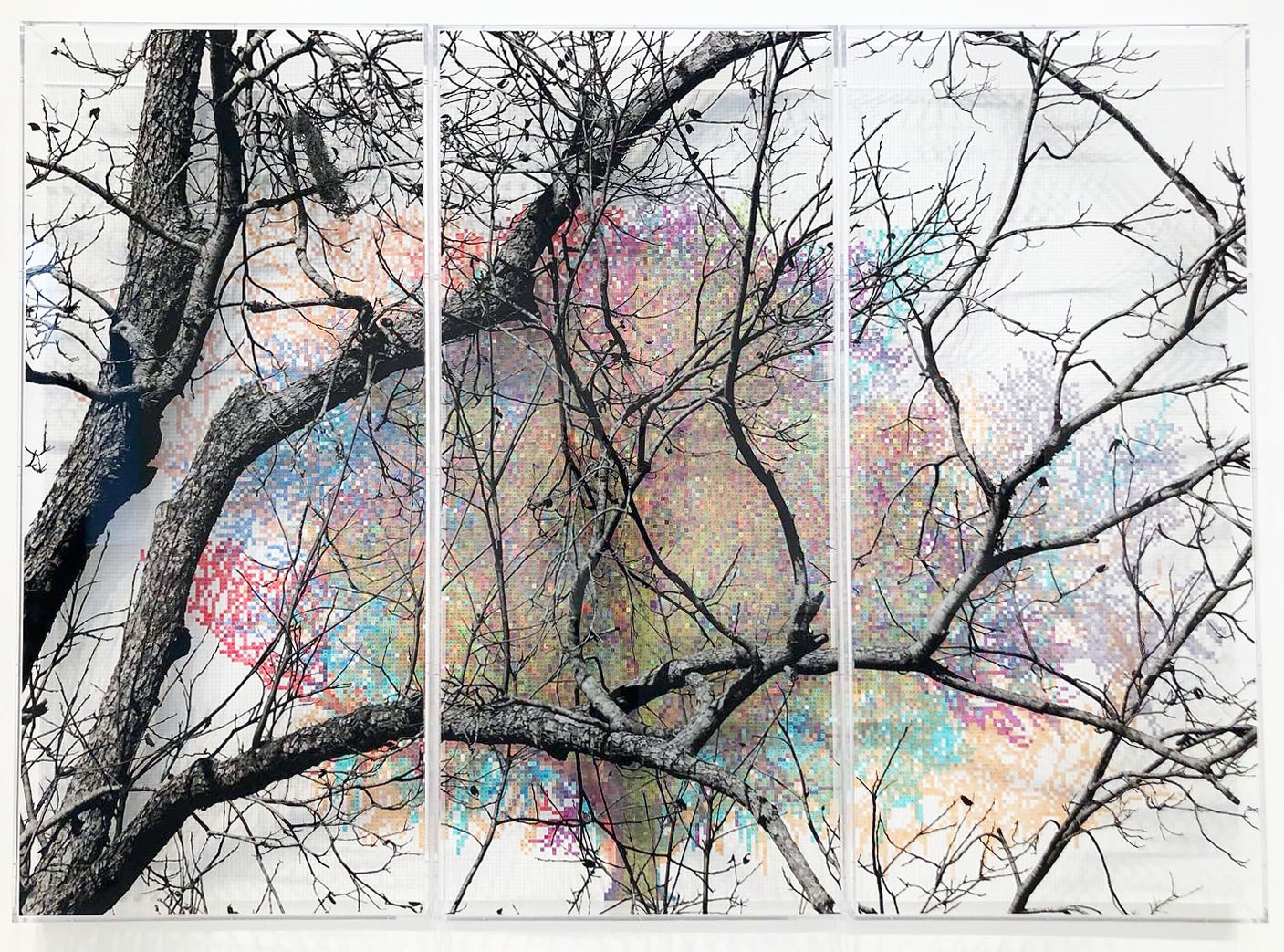
Charles Gaines’ work never fails to impress and his recent exhibition, Southern Trees, at Hauser and Wirth in NYC, is no exception.

From the press release-

One of the most important conceptual artists working today, the show explores the evolution of Gaines’s complex practice, demonstrating how he has continued to forge new paths within the innovative framework of two of his most acclaimed series, Numbers and Trees and Walnut Tree Orchard. The exhibition’s title, ‘Southern Trees,’ alludes directly to the 150-year-old pecan trees pictured in the new works, and symbolically to the opening lyrics of ‘Strange Fruit,’ Billie Holiday’s haunting protest anthem from the 1930s.

The image of the tree has been central to Gaines’s practice since he first began the Walnut Tree Orchard series in the 1970s. In ‘Southern Trees,’ Gaines advances the series using pecan trees photographed on a visit to Boone Hall Plantation in Charleston County, South Carolina––not far from where the artist was born and lived until he was five years old. Presented alongside a key early example from the walnut tree series, eight new triptych works on paper revisit and expand upon this significant original body of work.

‘Walnut Tree Orchard: Set M’ (1977), on loan from the Whitney Museum of American Art, New York, pairs a black and white photograph of a walnut tree with two drawings derived from it––an ink outline of the same tree and a grayscale grid that plots all of the trees included in the series up until that point. The newest series, titled Pecan Trees (2022), begins similarly, with a stark black and white photograph of a tree; yet in the drawings that accompany it, Gaines has filled in the outline of the tree with solid ink and used vibrant watercolors to plot all the previous trees in the final drawing. These successive modifications to scale, color and background demonstrate Gaines’s theory that while ‘the system has never changed, the outcome is always different.’

This extends to Gaines’s new Numbers and Trees Plexiglas series, which begin with the artist assigning each tree a distinctive color and numbered grid––breaking down the composition into individual cells that reflect the full form of the tree depicted in the photograph on the surface. However, Gaines reverses his signature process in this new series by overlaying the forms of the trees one at a time and in progression on the back panel of the work rather than on the front. He then brings the photograph to the surface by printing an enlarged detail of the most recently added tree on the work’s Plexiglas surface. This approach brings the tree’s shadowy branches to the foreground, highlighting its textural details and contrasting tones while obscuring the colorful numbered grids painted underneath it. This reversal produces a dramatically different effect, igniting a more somber, yet stirring, reaction to the work as the austere branches, dripping with moss, dominate the picture.

Created through carefully considered systems rather than through the artist’s own imagination or intuition, these new works remove the artist’s subjectivity by following a set of self-determined rules and procedures. The works call into question both the objective nature of the trees and the subjective natural and material human actions that surround them. The fastidious layering process allows Gaines to reveal the differences between the trees’ shapes where the forms do not align. These differences, highlighted by the artist’s systems, suggest the arbitrary nature of other manufactured systems in our society––such as politics, gender, race and class.

This exhibition closes 4/1/23.

Mar 262023
 

Kirsty Wither “Tumbling Crowd”

Yelena Lezhen “Clockwork Bird Song”

Esther Rosa “Goes around, comes around III”

This weekend is the Affordable Art Fair in NYC. It’s a chance to check out and buy art at reasonable prices.The fair goes to Hampstead, London next, and will return to New York in September of 2023.

For more on the artists pictured above and their galleries-

Kirsty Wither runs the London gallery Cameron Contemporary with her husband, Robin Cameron.

Yelena Lezhen’s work was shown by Barcelona gallery Manifest Destiny Art. Check out her Instagram for current work.

Esther Rosa’s sculpture was part of InSight Artspace’s booth. Her Instagram is also a good place to see her work.


Mar 222023
 

Rajan Krishnan, “House and a Little Cashew Tree”, 2010

Rajan Krishnan, “Language of Woods”, 2009

Rajan Krishnan, “Language of Woods”, 2009 (detail)

Rajan Krishnan “Bird from the Grove by the River”, 2011

Beautiful paintings by the late Rajan Krishnan from his exhibition Ecologue at Aicon Contemporary.

From the press release-

A play on the word eclogue, a genre of short poems about pastoral life, the suffix ‘logue’ denotes discourse of a specific type, ‘Ecologue’ then is an ecological discourse. This specific conversation about the ecological happens through contact between coarse canvas and the paint on the bristles of Rajan Krishnan’s brush, it is a document : a letter, a journal, a portrait, a story, a manual.

Krishnan’s paintings have been described by his wife and journalist Renu Ramnath as “documents of change.” The careful renderings of Kerala’s agrarian landscape (trees, birds, forests, rivers) are engrossed in larger themes of societal transition and movement – progress and decay, each individual painting freezing a moment in time. In this series of paintings, Krishnan visualizes a vibrant world so full of detail, yet isolated, in an aura of nothingness, compressed, with no backgrounds or foregrounds. His paintings bring the viewer in to meditate on existence. A boat, a fish, a tree, a house, a monkey just as they are.

The artist’s commitment to his home state of Kerala is admirable, as a topography to be both admired and critiqued as a landscape full of possibility. Andrew Shea recalls, for “those who knew him and those who admired his spirit and work, the palpable absence of the artist himself wanes slightly amidst the remarkable body of work he has left behind and his legacy as a pioneer of the uniquely collaborative and welcoming community of artists he nurtured within Kochi and further afield.”

Art historian Kathleen Wyma writes “Krishnan’s paintings seize on sites of crystallized memory as critical interventions into the present. Re-calling and re-recollecting the flow and ebb of time (both real and imagined). His images simultaneously evoke the will to remember and the desire to heed the accretions of localized time.” In our current moment, as questions of climate worsen and the illusion of development as progress remains, every intentional stroke of Krishnan’s brush acts as a tool for contemplation. Scenes of dried up rivers, singular fish, and labyrinth-like groves invite us to reflect on the past, present, and future.

Mar 222023
 

Erika Ranee, “Nacre”, 2023

Erika Ranee, “Nacre”, 2023 (detail)

Erika Ranee, “You Go First”, 2023

Erika Ranee, “You Go First”, 2023 (detail)

Erika Ranee, “You Go First”, 2023 (detail)

The paintings by Erika Ranee, part of her exhibition, All Natural at Klaus von Nichtssagend Gallery, are densely constructed and require a closer look to truly appreciate the work it took to create the intense final products.

From the press release-

Ranee takes inspiration from the world all around her; a crosstown bus ride might reveal pops of color in a passenger’s bright blue IKEA bag seen against municipal orange plastic seats. A bucket of “Purple Dark” acrylic, discontinued by Guerra Paints but gifted to the artist, might bring to mind dahlias and peonies, her favorite flowers. All Natural refers to Ranee’s time spent between NYC and rural Western Massachusetts, and an ongoing fascination with both the fertile, natural world of the countryside and a – no-less fecund  – urbanized terrain shaped by its human inhabitants. The title also obliquely refers to drawings Ranee made of her niece’s braided hair extensions, some of which have been collaged into her paintings’ surfaces, fomenting another set of layered meaning to the works.

Ranee employs a wide variety of painting techniques to create her abstractions. Image and surface are developed through wide-ranging and multitudinous applications and removals of material in dense layers. Wide swaths of color are poured, allowing multi-directional deltas that show the influence of gravity and entropy. Lustrous, glossy paints sit under or beside bubbling and crackled powdery pigments on the canvas. Elements are collaged from sources including blacklight posters, coloring book pages, found children’s drawings and spray-stenciled botanical matter. In places, cut scraps of other paintings are glued onto her raucous surfaces then painted over, cut up, torn out and painted again. Some layers include ink drawings on newsprint shellacked or encased in gel mediums, then incised and peeled to reveal hidden forms underneath. Patterns resembling electric Lichtenberg formations are made through spray paint expelled directly into wet shellac. The result is a body of work that invites us to look closely, examine details, and wonder at its making, all while reveling in the lush colors and forms that ebb and flow before us.

This exhibition closes 3/25/23.

Mar 172023
 

Sheila Isham, “Chung Fu II– Wind with Lake”, 1972

Hollis Taggart in NYC is currently showing Beyond the Brush: Sheila Isham 1969-1978, which showcases the artist’s dreamy spray gun paintings.

From the press release-

Isham led an extraordinary life traveling around the world with her diplomat husband, carefully absorbing and transforming the myriad cultures and traditions she encountered into her own distinct abstract style. Beyond the Brush explores Isham’s enduring interest in philosophy, nature, and spirituality through the lens of a specific technique and decade in the artist’s illustrious career: her spray gun works from 1968 through 1978. Although Isham’s work is held in some of the country’s most esteemed museum collections – including the Museum of Modern Art, New York; Hirshhorn Museum; Washington, D.C.; and Minneapolis Institute of Art; to name just a few – it has not been the focus of a major solo exhibition in the United States for over a decade. Spanning both floors of Hollis Taggart’s recently expanded flagship at 521 West 26th Street, Beyond the Brush intends to reintroduce audiences to Isham’s ethereal works and celebrate her remarkable ability to translate the metaphysical into the visual.

Born in New York City in 1927, Sheila Isham married Hayward Isham, a U.S. Foreign Service officer, after she graduated from Byrn Mawr College. Her husband’s career caused the couple to frequently relocate internationally, while Isham’s inquisitiveness led her to fully immerse herself in each culture, diligently studying local beliefs and traditions. In Germany, she became the first American to be accepted at the Berlin Academy of Fine Arts, where she studied from 1950 to 1954 under German Expressionists. In 1955, Isham accompanied her husband to Moscow, where she immersed herself in Russian avant-garde art, and in 1962, to Hong Kong, where she began a rigorous study of classical Chinese calligraphy as well as Eastern philosophies. During her time in Hong Kong, Isham was especially influenced by her studies with the master Feng Kanghou, who oversaw her calligraphic efforts. After a brief return to the United States, the Ishams moved to Haiti in 1974, where the artist became especially preoccupied by the natural world and studying the effects of light.

While in Hong Kong and upon her return to the United States in the early 1970s, Isham became interested in merging Eastern and Western artistic traditions and philosophies. This spiritual inquiry led her into the atmospheric color abstractions that are the focus of Beyond the Brush. Aiming to achieve an impressionistic light effect and to imbue her abstraction with spirituality, Isham embraced the spray gun – an instrument that releases pigment under pressure – which she had been experimenting with since the mid-1960s. This technique, along with her delicate palette, allowed her to create cloud-like forms that capture the sensation of ethereality. As Patricia Lewy notes in her catalogue essay, “Isham followed an internal drive to affirm a higher consciousness through color and form,” leading her to develop of a singular, meditative visual language. Beyond specific cultural influences, it is Isham’s commitment to spirituality and interest in the sublime that provides the strongest thread between the works in Beyond the Brush.

“We are thrilled to devote both floors of the gallery to this incredibly rich decade of Sheila Isham’s career,” said Hollis Taggart. “Though Isham – now in the ninety-fifth year of her life – contributed greatly to the art of the twentieth century, her fascinating life and oeuvre has not been studied or exhibited extensively, especially in the past decade. With Beyond the Brush, we hope to not only begin to give Isham’s work the scholarship it deserves – starting with Patricia Lewy’s scholarly catalogue essay – but also to share the sheer beauty of her canvases with wider audiences.”

This exhibition closes 3/18/23.

Mar 172023
 

Currently at Derek Eller Gallery in NYC is Alyson Shotz: Alloys of Moonlight. The exhibition highlights her unique work which becomes more intriguing the more time you spend looking at it.

From the press release-

Featuring a monumental polychromatic steel sculpture and luminescent three-dimensional aluminum wall works, Alloys of Moonlight delves further into questions that Shotz has been exploring throughout her nearly 30-year career: how do we grasp the mysterious forces that shape the universe, and how do we reconcile observable reality with the noumenal reality of environmental phenomena? This new body of work explores the dialectic between these axes, as Shotz refines a sculptural language to visualize the unseen and the sublime forces that frame the natural world. The works in Alloys of Moonlight act as instruments by which to measure and reflect the ineffable forces of nature.

In the center of the gallery is Aphelion, a looped steel sculpture that turns and twists in ways that seem to defy nature, leading the eye in an endless serpentine path around its undulating curves. The sculpture transforms as the viewer moves around the piece, its colors shifting from gold to green to blue. Changes in light and time of day are registered by the changing colors of Aphelion’s surface, a phantom quality mirrored in the spatial nature of the work. Made of the least amount of material to hold its shape, Aphelion constitutes a delicate synthesis between positive and negative space. It is as much composed of a mesh-like steel as the air that flows through it. The form, which is born of the artist’s longstanding interest in knots and non-orientable surfaces like the Mobius Strip, is similarly fugitive and beguiling. Comparable entangled structures serve a fundamental role in the quantum-mechanical foundations of nature itself, and knot-like forms likewise have appeared as cultural signifiers throughout art history in Roman, Byzantine, Chinese, African and Islamic art.

The walls of the gallery feature a series of crumpled aluminum sheets, painted in a hazy spectrum of light-reflective mineral colors. Rather than the two-dimensional geometry of a flat plane, these pieces are spatial objects that delineate the magnitude of a prior impact. Named Alloys of Moonlight after the title of the show, each piece has a particular form, a shape that quantifies the exact nature of an individual collision. Conversely, the folding also embeds the aluminum sheets with a degree of potential energy and the suggestion of an incomplete natural process: the unfurling of a leaf or the folding of a wing. As representations or diagrams, these works define form through a negative logic—rather than creating sculptural volume through physical material, thin walls of aluminum outline the shape of an interior void. Alloys of Moonlight subverts the expectation of concrete immutability, instead using space as a sculptural medium. This language of spatial ambiguity is paralleled by the striking luminescent surfaces of the works, which are similarly variable. Like the orbits of moons around planets, each piece is in constant flux, registering changes in sunlight as well as the shifting position of the viewer. The sculptures in this exhibition exemplify the interplay between what is visible, concrete, measurable, and a more ethereal subtext that structures the natural world. Alloys of Moonlight renews and deepens Shotz’s exploration of the delicate and sublime space between these realities.

This exhibition closes 3/18/23.

Mar 162023
 

Eric “ESH” Hornsby, “Living Daylights 1″and “Living Daylights 2”

Adam Christopher Reed, “The Judge”

Nikita Rosalind, “Peace in the Wild Waves”

The Werk Gallery is an exciting new space in St. Pete that hosts monthly exhibitions in one half and the owners’ curated mix of vintage and modern items in the other. The photos above are from Shiny & New, the first gallery’s first show.

Artists from this exhibition pictured above- Adam Christopher Reed, Nikita Rosalind, and Eric “ESH” Hornsby

Currently the gallery is showing Rite of Spring, featuring artists Kenny Jensen, Nathan Beard, Samson Huang, Laura Spencer (Miss Crit), John Gascot, and Leafmore Studios (Becca McCoy and Justin Groom).

The gallery is open Thursday- Sunday from 12-5 pm.